REVIEW 3 major objections 6 minor
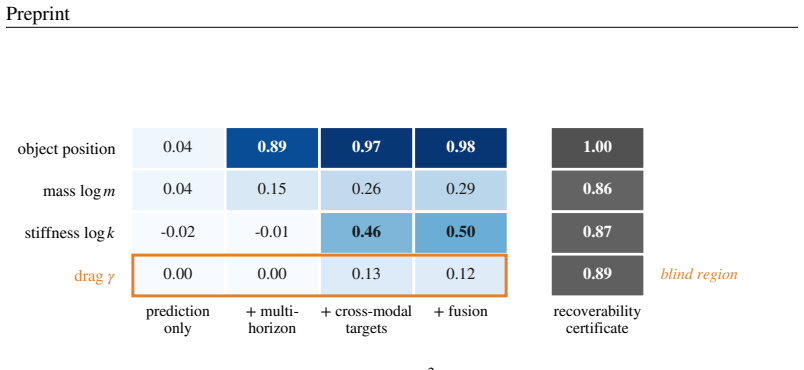
Prediction objectives decide which physics a latent world model keeps: fusion without forecasting is discarded, and some recoverable parameters stay blind no matter the data.
Reviewed by Pith at T0; open to challenge. T0 means a machine referee read the full paper against a public rubric. the ladder, T0–T4 →
T0 review · grok-4.5
2026-07-30 13:42 UTC pith:ODULFHST
load-bearing objection Clean causal map of what JEPA-style latents actually keep: targets retain physics that fusion alone discards, and scale does not fix a missing objective—scoped frontier on drag is honest, not oversold. the 3 major comments →
What Can Latent World Models Know? Physical Parameter Identifiability in Multimodal Predictive Representations
The pith
A machine-rendered reading of the paper's core claim, the machinery that carries it, and where it could break.
Core claim
Objective structure determines which physical parameters a trained latent acquires, and extra data improves only parameters the objective already pressures it to keep. Inputs bound what can be known; prediction targets decide what is retained. Stiffness enters only when touch is a forecast target, not when the same signal is fused as input, and slow ratio-type parameters such as drag remain largely unacquired under deterministic point-prediction objectives even when recoverability certificates are high.
What carries the argument
The certificate-gated identifiability protocol: first certify each physical parameter as recoverable from raw observations with a strong probe, then measure whether it is decodable from the frozen latent under controlled input×target×horizon interventions, so a null result can be blamed on the objective rather than the environment or the instrument.
Load-bearing premise
That failures under the tested deterministic point-prediction setups reflect a general property of that objective class, not just limited model capacity, short history, or the particular sensors and environments used.
What would settle it
Train an otherwise matched model whose optimum is not a conditional mean—episode-level latent variables or explicit belief states—and check whether drag (or another slow ratio-type parameter) rises from the ~0.13 plateau toward its recoverability certificate while prediction quality stays intact.
If this is right
- Every modality that should shape the latent must be a prediction target; un-forecast fusion is discarded.
- Vision-only single-step latent world models can ignore even perfectly visible state unless multi-horizon or cross-modal pressure breaks the lazy equilibrium.
- Scaling data alone will not buy back physics the objective never asks for; factorial arms missing information or targets stay flat.
- Contact-rich parameters whose readout is slow and ratio-type under current sensors (drag, viscosity, smooth friction) need new objective or coordinate designs.
- Sensing must match the physics bandwidth: frame-averaged touch destroys stiffness evidence that sub-step peaks carry.
Where Pith is reading between the lines
- If conditional-mean collapse is the mechanism, generative or variational world models with episode-level uncertainty should systematically outperform pure point-prediction JEPAs on friction and viscosity.
- Robot foundation-model recipes that fuse force without forecasting it may be silently throwing away contact physics even when the hardware is present.
- A practical diagnostic for any multimodal world model is the certificate-gated factorial itself: certify recoverability, then ablate target vs input before claiming physical understanding.
- Changing observation coordinates so that a blind parameter’s trace becomes linear (as with log-speed for drag) may be as important as changing the loss.
Editorial analysis
A structured set of objections, weighed in public.
Referee Report
Summary. The paper asks which physical parameters a prediction-trained latent world model actually contains, and what decides acquisition. In POKEWORLD, visually identical objects hide mass, drag, and contact stiffness; a certificate-gated protocol first establishes recoverability from raw observations, then probes frozen X-JEPA latents under a factorial of inputs, prediction targets, and horizons. The central empirical map is that inputs bound what can be known while prediction targets decide what is retained (stiffness enters only when touch is forecast; vision-only single-step models discard even visible object state), with a frontier at slow, ratio-type parameters such as drag (certificate ~0.89, model plateau ~0.13 under deterministic point prediction). Attribute-matrix interventions, supervised and reconstruction controls on the same trunk, functional glide tests, and closed-loop MPC support the account. On RH20T (two robots, up to 4,258 episodes), an input×target factorial over scaling curves reproduces the mechanisms: arms missing information or prediction pressure stay flat in scale, and only the full multimodal objective forecasts force beyond persistence with held-out gains that grow with data.
Significance. The question is load-bearing for latent world models and contact-rich robotics: prediction is widely assumed to force internalization of physics, yet which quantities are acquired has lacked controlled, parameter-level answers. The certificate-gated protocol is a reusable methodological contribution that cleanly separates environment, instrument, and objective failures. The input-versus-target dissection, lazy-equilibrium escapes, λ dose–response, and four-arm scaling curves with passthrough bounds and held-out tasks are carefully designed and mutually reinforcing. Explicit strengths include dual probe families, functional prediction tests, same-trunk supervised and reconstruction controls, closed-loop control tracking state content, and a falsifiable coordinate-level prediction (log-speed linearization) for the blind-region hypothesis. If the scoped claims hold, the design rules—every modality a target, multi-horizon direct heads, structure before scale—are immediately actionable for multimodal JEPA-style training.
major comments (3)
- [§4.5, Table 1, Abstract, §8] §4.5 and Table 1 (and the parallel App. C controls): the frontier claim attributes the drag null (model ~0.13 vs certificate 0.89) to deterministic point-prediction / conditional-mean collapse. The supervised system-ID head on the same trunk reaches only 0.45, so roughly half the certificate gap is still trunk/history, not objective. The manuscript notes this (§4.5, §7) but the abstract and §8 still read as if the full certificate–model gap is objective structure. Please separate, in the main claims and Table 1 discussion, (i) what the objective fails to request (supervised lift 0.13→0.45 with prediction quality unchanged) from (ii) what the current trunk and 16-step windows leave unrecovered even under direct supervision (0.45 vs 0.89). Without that split, the blind-region hypothesis over-attributes nulls to the objective class.
- [§4.5, §7] §4.5 mechanism paragraph and §7: conditional-mean collapse is offered as the mechanism unifying the attribute matrix, with Gaussian-NLL as the main discriminating control (γ unchanged). That control correctly leaves the mean optimum fixed, but it is a weak probe of the broader claim that “objectives whose optimum is not a conditional mean” would unblind slow×ratio parameters. Given that the frontier is one of the paper’s four organizing results, either (a) add one belief-state / episode-level latent or stochastic-latent control on the same trunk, or (b) demote the mechanism from explanatory claim to explicitly untested hypothesis in the main text (not only in Limitations), and state what single experiment would falsify it. Option (b) is acceptable if (a) is out of scope; the current wording sits between the two.
- [Abstract, §5, Contributions, §7] §5 and Fig. 5: the real-robot section correctly validates mechanisms on observables rather than ground-truth physical parameters, and §7 states this. The abstract’s closing sentence (“Objective structure determines which physical parameters a latent acquires…”) and the contribution list still present RH20T as confirming the parameter-identifiability map. Please align abstract/contributions language with §5/§7: RH20T transfers lazy equilibrium, target pressure, fusion, and scale-flat degeneracy on force/pose/anticipation—not mass/stiffness/drag identifiability. A one-sentence scope qualifier in the abstract would suffice.
minor comments (6)
- [Figure 1] Figure 1 caption and column headers: the cumulative enrichment path (prediction only → multi-horizon → cross-modal targets → fusion) is central; state explicitly which variant each column corresponds to (V, multi-horizon V, VXt/VX, VFX) so the map is readable without cross-referencing Fig. 2.
- [Table 2, §4.2] Table 2 position column: the main text notes this is the single-horizon operating point where the lazy equilibrium is visible, but the table itself does not. A footnote would prevent misreading VF/VFX position as pure learned content rather than partly passthrough under fusion.
- [§3, App. A] §3 certificates: the oracle thresholds (0.4/0.4/0.25 for m/γ/k) and the dual instruments for drag (physics-informed 0.89 vs recurrent 0.70) are important; a short sentence on why the gate uses the higher drag certificate would help readers who only skim App. A.
- [§2] Related work: the distinction from static multimodal encoders (Kepler, HPT, Sparsh) is clear; a brief pointer to classical system-identification excitation design (beyond the Ljung citation) would better situate the behavior-policy mixture.
- [Abstract, title block] Typos/formatting: “WhatCanLatentWorldModelsKnow?” title spacing in the preprint header; “identifiability maphas” missing space in the abstract; occasional en-dash/minus inconsistencies in R² values (−0.02 vs -0.02).
- [Figure 4, App. C.5] App. C.5 onset base rates differ sharply across configs (2.75% vs 0.64%); the main text already cautions within-config AUC comparison—consider repeating that caution in the Fig. 4 caption where both embodiments appear together.
Circularity Check
No significant circularity: empirical input×target interventions with independent recoverability certificates, not a derivation that redefines its outputs as its inputs.
full rationale
The paper’s load-bearing claims are interventional comparisons (which modalities are inputs vs prediction targets; multi-horizon heads; SIGReg λ; supervised vs reconstruction objectives on a fixed trunk; RH20T four-arm scaling), not first-principles derivations. Recoverability certificates are lower bounds from raw-observation estimators (recurrent probes, physics-informed glide estimators) built before and independently of the trained latent; model content is then read by separate linear/nonlinear probes and functional glide/control tests. A null on the latent is therefore not forced by how the certificate is defined. Probe R² values are standard post-hoc readouts of frozen states, not parameters fitted on a subset and re-labeled as predictions of a closely related target. Adoption of the LeJEPA/LeWM substrate and SIGReg is methodological scaffolding, not a self-cited uniqueness theorem that forbids alternatives or smuggles the result. The blind-region / conditional-mean-collapse account is scoped as an empirical hypothesis about deterministic point-prediction objectives under the tested coordinates, with explicit controls (supervised head lifts γ; pixel reconstruction stays blind; Gaussian-NLL leaves the mean optimum unchanged; log-speed linearizes the trace). No step reduces Eq./claim Y to input X by construction. Honest non-finding.
Axiom & Free-Parameter Ledger
free parameters (5)
- SIGReg weight λ =
main results at λ=0.02; sweep 0.005–0.3
- Prediction horizons Δ ∈ {1,4,16} =
1, 4, 16 steps
- Contact-frame touch loss weight and glide reweighting factors =
default touch weight 4; glide relative weights {1,4,16,64}
- Probe and certificate architecture choices =
GRU width 96, 16-step windows; ridge primary model probes
- Model capacity and latent dimension =
~5M params, latent dim 128
axioms (6)
- domain assumption Linear and nonlinear probes on frozen predictor states, plus functional prediction tests, are valid operational measures of whether a physical parameter is contained or used by the latent.
- domain assumption A recoverability certificate from raw-observation estimators licenses attributing model nulls to the objective rather than the environment or instrument.
- domain assumption Deterministic squared-error (or Gaussian-NLL mean) multi-horizon prediction on JEPA-style trunks is representative enough to map what current latent world-model objectives acquire.
- ad hoc to paper POKEWORLD's hidden-parameter spectrum (γ chiefly visual, m cross-modal, k almost purely tactile) and behavior mixture adequately excite the relevant dynamics for identifiability claims.
- domain assumption LeJEPA/SIGReg training dynamics (isotropic-Gaussian anti-collapse without EMA/stop-grad heuristics) are a stable neutral substrate for content measurements.
- domain assumption On RH20T, observation-space metrics (force readout/forecast, rollout error, contact-onset AUC) on held-out tasks are valid proxies for transfer of the map's mechanisms when ground-truth object parameters are unavailable.
invented entities (5)
-
POKEWORLD environment
no independent evidence
-
Certificate-gated identifiability protocol
independent evidence
-
X-JEPA variant family (V/VF/VXp/VXt/VX/VFX)
independent evidence
-
Lazy equilibrium
independent evidence
-
Blind-region hypothesis (slow × ratio-type parameters under sensed coordinates)
independent evidence
read the original abstract
A central premise of latent world models is that predicting the future forces a representation to internalize the physics of its environment. Which physical quantities does a trained latent actually contain, and what decides this? We answer with controlled interventions in POKEWORLD, an interactive environment whose visually identical objects hide mass, drag, and contact stiffness. A certificate-gated protocol first certifies each parameter as recoverable from raw observations, then measures whether it enters the latent, so a null result can be attributed to the objective rather than to the environment. The resulting identifiability map has two organizing mechanisms and one frontier. Inputs limit what can be known, while prediction targets decide what is retained. Stiffness enters the latent only when touch is forecast ($R^2=0.50$, compared with $-0.02$ when the same signal is merely fused into the input), and under single-step prediction a vision-only latent discards even perfectly visible object state. Drag marks the frontier. It carries a recoverability certificate of 0.89 yet plateaus near 0.13 under every deterministic prediction objective we test, while a supervised head on the same trunk reaches 0.45. Parameters whose readout is slow and ratio-type under the sensed coordinates fall outside what these objectives acquire. On RH20T, an input-target factorial across scaling curves reproduces both mechanisms across two robots and 4,258 episodes. Every arm missing information or prediction pressure stays flat over a fivefold data range, and only the full multimodal objective forecasts force beyond a persistence baseline, with held-out gains that grow with scale. Objective structure determines which physical parameters a latent acquires, and additional data improves only the parameters it already acquires.
Figures


discussion (0)
Sign in with ORCID, Apple, or X to comment. Anyone can read and Pith papers without signing in.