Generalized Extended Codes with Applications in Entanglement-Assisted Qubit and Qutrit Codes
Pith reviewed 2026-07-03 05:03 UTC · model grok-4.3
The pith
Generalized extended codes C(u,a) let researchers independently tune Hermitian hull dimension and dual distance to build better entanglement-assisted quantum codes.
A machine-rendered reading of the paper's core claim, the machinery that carries it, and where it could break.
Core claim
Any generalized extended code is monomially equivalent to the Hermitian dual of a code closely related to a second kind of extended code of C perp H. Every [n+1,k+1] linear code D over F_{q^2} with d(D perp H)>1 is monomially equivalent to C(u,a) for fixed a in F_{q^2}^* and suitable u. The Hermitian hull dimension and Hermitian dual distance of C(u,a) are characterized by the position of u relative to C + C perp H and its interaction with minimum-weight codewords of C perp H. Several conditions allow simultaneous increase of both the hull dimension and the dual distance.
What carries the argument
The generalized extended code C(u,a) of an [n,k] linear code C, formed by adjoining a scalar a and vector u; the construction supplies explicit levers on Hermitian hull dimension and Hermitian dual distance.
If this is right
- The Hermitian construction for EAQECCs can now be applied to families of C(u,a) whose hull and dual-distance parameters are chosen independently.
- 267 new entanglement-assisted qubit codes appear for lengths up to 40.
- 14 new entanglement-assisted qutrit codes appear for lengths up to 25.
- Improvements over existing tables are confirmed for 236 qubit codes and 8 qutrit codes.
Where Pith is reading between the lines
- The same position-based control on hull dimension may extend to other dual-distance measures or to non-Hermitian settings.
- Tables of best-known EA codes can be updated systematically by enumerating admissible u vectors for each base code C.
- The ability to raise hull dimension while preserving or increasing dual distance may reduce the entanglement consumption needed for a target error-correcting capability.
Load-bearing premise
The stated monomial equivalences and the characterizations of hull dimension and dual distance for C(u,a) are correct, so the listed new EA codes can actually be built and verified as improvements.
What would settle it
A concrete linear code D of length n+1 whose Hermitian dual distance exceeds 1 but cannot be expressed as any C(u,a) for an [n,k] code C, fixed a, and vector u, or a case where the predicted hull dimension from u's position does not match the actual hull.
Figures
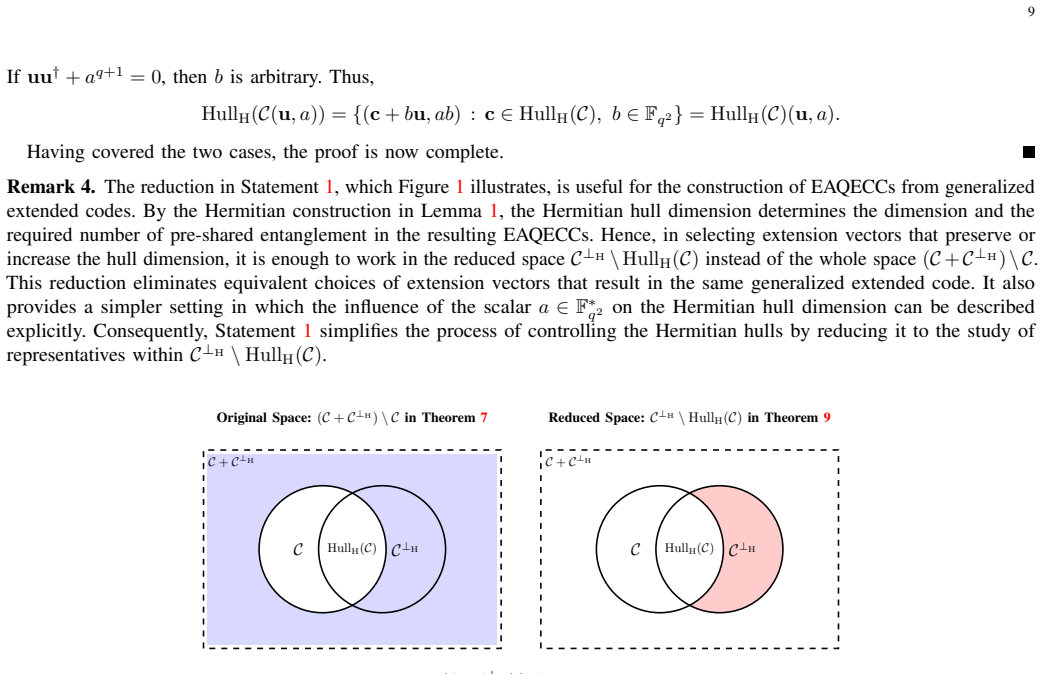
read the original abstract
We prove that any generalized extended code is monomially equivalent to the Hermitian dual of a code which is closely related to a second kind of extended code of $\C^{\perp_{\rm H}}$. Every $[n+1,k+1]_{q^2}$ linear code $\D$ with $d(\D^{\perp_{\rm H}})>1$ is monomially equivalent to the generalized extended code $\C({\bf u},a)$ of an $[n,k]_{q^2}$ linear code $\C$ for a fixed $a\in\F_{q^2}^{*}$ and some ${\bf u}\in\F_{q^2}^{n}$. We then characterize the Hermitian hull and Hermitian dual distance of $\C({\bf u},a)$ in terms of the position of ${\bf u}$ relative to $\C+\C^{\perp_{\rm H}}$ and the interaction between ${\bf u}$ and the minimum weight codewords of $\C^{\perp_{\rm H}}$, respectively. We obtain explicit criteria to independently control the expected Hermitian hull dimension and Hermitian dual distance of $\C({\bf u},a)$. In particular, several conditions for simultaneously increasing the Hermitian hull dimension and the Hermitian dual distance of $\C({\bf u},a)$ are derived. Applying these results to the Hermitian construction for EAQECCs gives us $267$ new EA qubit codes of lengths $n \leq 40$ and $14$ new EA qutrit codes of lengths $n \leq 25$ compared to the best-known codes in Grassl's code tables and the imporvements recorded in very recent works in the literature. Among the new parameter sets, we confirm improvements for $236$ qubit and $8$ qutrit codes.
Editorial analysis
A structured set of objections, weighed in public.
Referee Report
Summary. The paper proves that generalized extended codes are monomially equivalent to Hermitian duals of related extended codes, shows that every suitable [n+1,k+1]_{q^2} code is monomially equivalent to some C(u,a), characterizes the Hermitian hull dimension of C(u,a) via the position of u relative to C + C^⊥_H and the Hermitian dual distance via interaction of u with minimum-weight words of C^⊥_H, derives explicit criteria to control these quantities (including conditions for simultaneously increasing both), and applies the results via the Hermitian EA construction to report 267 new EA qubit codes (n≤40) and 14 new EA qutrit codes (n≤25), confirming improvements for 236 qubit and 8 qutrit parameter sets over Grassl tables and recent literature.
Significance. If the characterizations hold, the work supplies a constructive method for tuning hull dimension and dual distance in the Hermitian EA framework, directly yielding new code parameters that enlarge the known tables; this is a concrete contribution to the catalog of entanglement-assisted quantum codes.
major comments (2)
- [Abstract (and the section stating the characterizations)] The central claim of 267/14 new EA codes (and the 236/8 confirmed improvements) rests entirely on the correctness of the hull-dimension characterization (position of u relative to C + C^⊥_H) and dual-distance characterization (interaction of u with min-weight words of C^⊥_H) together with the derived simultaneous-increase criteria; any off-by-one or missed case in these statements would mean the constructed C(u,a) fails to achieve the claimed parameters, rendering the listed improvements invalid.
- [The equivalence theorems] The monomial-equivalence statements (any generalized extended code ≡ Hermitian dual of a related extended code; every suitable D ≡ C(u,a) for fixed a and some u) are load-bearing for the reduction to the Hermitian EA construction; the manuscript must make explicit whether these equivalences preserve the Hermitian inner product and the relevant distances.
minor comments (2)
- [Abstract] Abstract contains the typo "imporvements" (should be "improvements").
- [Introduction / definitions] Notation for the generalized extended code C(u,a) and the fixed scalar a should be introduced with a short definition or reference to the precise construction before the equivalence and characterization statements.
Simulated Author's Rebuttal
We thank the referee for the careful reading of the manuscript and for the positive assessment of its significance. We address each major comment below.
read point-by-point responses
-
Referee: [Abstract (and the section stating the characterizations)] The central claim of 267/14 new EA codes (and the 236/8 confirmed improvements) rests entirely on the correctness of the hull-dimension characterization (position of u relative to C + C^⊥_H) and dual-distance characterization (interaction of u with min-weight words of C^⊥_H) together with the derived simultaneous-increase criteria; any off-by-one or missed case in these statements would mean the constructed C(u,a) fails to achieve the claimed parameters, rendering the listed improvements invalid.
Authors: The hull-dimension and dual-distance characterizations, together with the simultaneous-increase criteria, are established by direct case analysis on the position of u relative to C + C^⊥_H and on the Hermitian inner products of u with the minimum-weight vectors of C^⊥_H; the proofs appear in Theorems 3.1–3.3 and Corollary 3.4. These arguments enumerate all possible configurations of the relevant inner products and therefore contain no omitted cases. The 267/14 new EA codes are obtained by applying the criteria to explicit base codes whose parameters are independently verified. To increase transparency we will insert, in the revised manuscript, a short additional paragraph that restates the exhaustive case division and supplies two further low-length numerical checks. revision: partial
-
Referee: [The equivalence theorems] The monomial-equivalence statements (any generalized extended code ≡ Hermitian dual of a related extended code; every suitable D ≡ C(u,a) for fixed a and some u) are load-bearing for the reduction to the Hermitian EA construction; the manuscript must make explicit whether these equivalences preserve the Hermitian inner product and the relevant distances.
Authors: The monomial maps in Theorems 2.1 and 2.2 are constructed explicitly: a coordinate permutation together with component-wise multiplication by nonzero field elements whose conjugates are chosen so that the Hermitian inner product is preserved (i.e., the image of the dual is the dual of the image). Because monomial equivalence preserves Hamming weights, the minimum distances are likewise preserved. We will add, immediately after the statements of Theorems 2.1 and 2.2, a single sentence that records these preservation properties and refers the reader to the explicit form of the monomials given in the proofs. revision: yes
Circularity Check
No circularity: algebraic derivations are independent of outputs
full rationale
The paper derives monomial equivalence statements and explicit criteria for Hermitian hull dimension and dual distance of C(u,a) directly from linear-algebraic properties over finite fields (position of u relative to C + C^⊥_H and interaction with minimum-weight words). These are then applied to the Hermitian EA construction to enumerate new parameter sets, which are checked for improvement against external tables (Grassl and recent literature). No step reduces a claimed result to a fitted parameter, self-definition, or load-bearing self-citation; the characterizations are presented as proved statements whose validity is required for the new codes but are not presupposed by the construction itself. This is a standard non-circular proof-and-application structure.
Axiom & Free-Parameter Ledger
axioms (2)
- standard math Standard properties of linear codes over finite fields F_{q^2} and their Hermitian duals
- standard math Monomial equivalence preserves the relevant code parameters
Reference graph
Works this paper leans on
-
[1]
Every equidistant linear code is a sequence of dual Hamming codes,
A. Bonisoli, “Every equidistant linear code is a sequence of dual Hamming codes,”Ars Combin., vol. 18, pp. 181–186, 1984
work page 1984
-
[2]
Blocking sets in finite projective planes,
A. A. Bruen, “Blocking sets in finite projective planes,”SIAM J. Appl. Math., vol. 21, no. 3, pp. 380–392, 1971
work page 1971
-
[3]
Correcting quantum errors with entanglement,
T. A. Brun, I. Devetak, and M.-H. Hsieh, “Correcting quantum errors with entanglement,”Science, vol. 314, no. 5798, pp. 436–439, Oct. 2006
work page 2006
-
[4]
Good quantum error-correcting codes exist,
A. R. Calderbank and P. W. Shor, “Good quantum error-correcting codes exist,”Phys. Rev. A, vol. 54, no. 2, pp. 1098–1105, Aug. 1996
work page 1996
-
[5]
M. Cao, “MDS codes with Galois hulls of arbitrary dimensions and the related entanglement-assisted quantum error correction,”IEEE Trans. Inf. Theory, vol. 67, no. 12, pp. 7964–7984, Dec. 2021
work page 2021
-
[6]
Classical codes and quantum codes involving the σ inner product,
M. Cao, Y . Li, and S. Zhu, “Classical codes and quantum codes involving the σ inner product,”IEEE Trans. Inf. Theory, vol. 71, no. 10, pp. 7649–7669, Oct. 2025
work page 2025
-
[7]
New MDS entanglement-assisted quantum codes from MDS Hermitian self-orthogonal codes,
H. Chen, “New MDS entanglement-assisted quantum codes from MDS Hermitian self-orthogonal codes,”Des. Codes Cryptogr., vol. 91, no. 8, pp. 2665–2676, 2023
work page 2023
-
[8]
Large Hermitian hull GRS codes of any given length,
H. Chen, “Large Hermitian hull GRS codes of any given length,”Des. Codes Cryptogr., vol. 92, no. 7, pp. 1845–1853, 2024
work page 2024
-
[9]
Blocking sets in projective spaces,
G. L. Ebert, “Blocking sets in projective spaces,”Canad. J. Math., vol. 30, no. 4, pp. 856–862, 1978
work page 1978
-
[10]
Entanglement-assisted concatenated quantum codes: Parameters and asymptotic performance,
J. Fan, W. Cheng, G. Luo, Z. Li, and M. Cao, “Entanglement-assisted concatenated quantum codes: Parameters and asymptotic performance,” arXiv:2501.04921, 2025. [Online]. Available: https://arxiv.org/pdf/2501.04921
-
[11]
Euclidean and Hermitian hulls of MDS codes and their applications to EAQECCs,
W. Fang, F.-W. Fu, L. Li, and S. Zhu, “Euclidean and Hermitian hulls of MDS codes and their applications to EAQECCs,”IEEE Trans. Inf. Theory, vol. 66, no. 6, pp. 3527–3537, Jun. 2020
work page 2020
-
[12]
Entanglement-assisted quantum error-correcting codes over arbitrary finite fields,
C. Galindo, F. Hernando, R. Matsumoto, and D. Ruano, “Entanglement-assisted quantum error-correcting codes over arbitrary finite fields,”Quantum Inf. Process., vol. 18, no. 4, Art. no. 116, 2019
work page 2019
-
[13]
Entanglement-assisted quantum communication beating the quantum Singleton bound,
M. Grassl, “Entanglement-assisted quantum communication beating the quantum Singleton bound,”Phys. Rev. A, vol. 103, no. 2, Art. no. L020601, Feb. 2021
work page 2021
-
[14]
Bounds on the minimum distance of entanglement-assisted qubit quantum codes,
M. Grassl, “Bounds on the minimum distance of entanglement-assisted qubit quantum codes,” [Online]. Available: https://eaqecc.codetables.de/qubit.php. Accessed: June. 15, 2026
work page 2026
-
[15]
Bounds on the minimum distance of entanglement-assisted qutrit quantum codes,
M. Grassl, “Bounds on the minimum distance of entanglement-assisted qutrit quantum codes,” [Online]. Available: https://eaqecc.codetables.de/qutrit.php. Accessed: June. 15, 2026
work page 2026
-
[16]
Bounds on the minimum distance of linear codes,
M. Grassl, “Bounds on the minimum distance of linear codes,” [Online]. Available at http://www.codetables.de. Accessed: June 15, 2026
work page 2026
-
[17]
W. C. Huffman and V . Pless,Fundamentals of Error-Correcting Codes. Cambridge, U.K.: Cambridge Univ. Press, 2003
work page 2003
-
[18]
Nonbinary stabilizer codes over finite fields,
A. Ketkar, A. Klappenecker, S. Kumar, and P. K. Sarvepalli, “Nonbinary stabilizer codes over finite fields,”IEEE Trans. Inf. Theory, vol. 52, no. 11, pp. 4892–4914, Nov. 2006
work page 2006
-
[19]
Binary optimal linear codes with various hull dimensions and entanglement-assisted QECCs,
J. L. Kim, “Binary optimal linear codes with various hull dimensions and entanglement-assisted QECCs,”Comput. Appl. Math., vol. 42, no. 3, Art. no. 114, Mar. 2023
work page 2023
-
[20]
Optimal quaternary linear codes with one-dimensional Hermitian hull and related EAQECCs,
S. Li, M. Shi, and H. Liu, “Optimal quaternary linear codes with one-dimensional Hermitian hull and related EAQECCs,”Quantum Inf. Process., vol. 22, no. 10, Art. no. 388, Oct. 2023
work page 2023
-
[21]
Supplementary information: EAQECCs from generalized extended codes
Y . Li, “Supplementary information: EAQECCs from generalized extended codes.” [Online]. Available at https://github.com/yanglimath/ SI-EAQECCs-from-GECs/tree/main, 2026
work page 2026
-
[22]
On symplectic hulls of linear codes and related applications,
Y . Li and S. Zhu, “On symplectic hulls of linear codes and related applications,”J. Appl. Math. Comput., vol. 70, no. 3, pp. 2603–2622, Apr. 2024
work page 2024
-
[23]
Y . Li and S. Zhu, “Linear codes of larger lengths with Galois hulls of arbitrary dimensions and related entanglement-assisted quantum error-correcting codes,”Discrete Math., vol. 347, no. 2, Art. no. 113 760, Feb. 2024
work page 2024
-
[24]
The hull of two classical propagation rules and their applications,
Y . Li, S. Zhu, and E. Mart ´ınez-Moro, “The hull of two classical propagation rules and their applications,”IEEE Trans. Inf. Theory, vol. 69, no. 10, pp. 6500–6511, Oct. 2023
work page 2023
-
[25]
On the construction of Hermitian self-orthogonal codes over F9 and their application,
Z. Li, R. Li, C. Guan, and H. Song, “On the construction of Hermitian self-orthogonal codes over F9 and their application,”Int. J. Theor. Phys., vol. 63, no. 9, Art. no. 221, 2024
work page 2024
-
[26]
Construction of linear codes with various Hermitian hull dimensions and related EAQECCs,
R. Liu, S. Li, and M. Shi, “Construction of linear codes with various Hermitian hull dimensions and related EAQECCs,”Adv. Math. Commun., vol. 19, no. 2, pp. 588–603, 2025
work page 2025
-
[27]
Constructing quantum error-correcting codes that require a variable amount of entanglement,
G. Luo, M. F. Ezerman, M. Grassl, and S. Ling, “Constructing quantum error-correcting codes that require a variable amount of entanglement,”Quantum Inf. Process., vol. 23, no. 1, Art. no. 4, 2023
work page 2023
-
[28]
On propagation rules for entanglement-assisted quantum codes,
G. Luo, L. Sok, M. F. Ezerman, and S. Ling, “On propagation rules for entanglement-assisted quantum codes,” inProc. 12th Int. Symp. Topics Coding (ISTC), Brest, France, Sep. 4–8, 2023, pp. 1–5
work page 2023
-
[29]
On linear codes whose Hermitian hulls are MDS,
G. Luo, L. Sok, M. F. Ezerman, and S. Ling, “On linear codes whose Hermitian hulls are MDS,”IEEE Trans. Inf. Theory, vol. 70, no. 7, pp. 4889–4904, Jul. 2024
work page 2024
-
[30]
BCH codes with larger dimensional hull,
B. Pang, S. Zhu, T. Yang, and J. Gao, “BCH codes with larger dimensional hull,”Des. Codes Cryptogr., vol. 91, pp. 3933–3951, Dec. 2023
work page 2023
-
[31]
Scheme for reducing decoherence in quantum computer memory,
P. W. Shor, “Scheme for reducing decoherence in quantum computer memory,”Phys. Rev. A, vol. 52, no. 4, pp. R2493–R2496, Oct. 1995
work page 1995
-
[32]
Error correcting codes in quantum theory,
A. M. Steane, “Error correcting codes in quantum theory,”Phys. Rev. Lett., vol. 77, no. 5, pp. 793–797, Jul. 1996
work page 1996
-
[33]
The extended codes of some linear codes,
Z. Sun, C. Ding, and T. Chen, “The extended codes of some linear codes,”Finite Fields Appl., vol. 96, Art. no. 102 401, 2024
work page 2024
-
[34]
The extended codes of projective two-weight codes,
Z. Sun, C. Ding, and T. Chen, “The extended codes of projective two-weight codes,”Discrete Math., vol. 347, no. 9, Art. no. 114 080, 2024
work page 2024
-
[36]
[Online]. Available at https://arxiv.org/pdf/2606.02137
work page internal anchor Pith review Pith/arXiv arXiv
discussion (0)
Sign in with ORCID, Apple, or X to comment. Anyone can read and Pith papers without signing in.