A Resource Comparison of Logical T-State Preparation
Pith reviewed 2026-06-29 17:42 UTC · model grok-4.3
The pith
Distillation reaches the lowest T-state output errors while code switching records the lowest single-attempt costs and smallest footprints.
A machine-rendered reading of the paper's core claim, the machinery that carries it, and where it could break.
Core claim
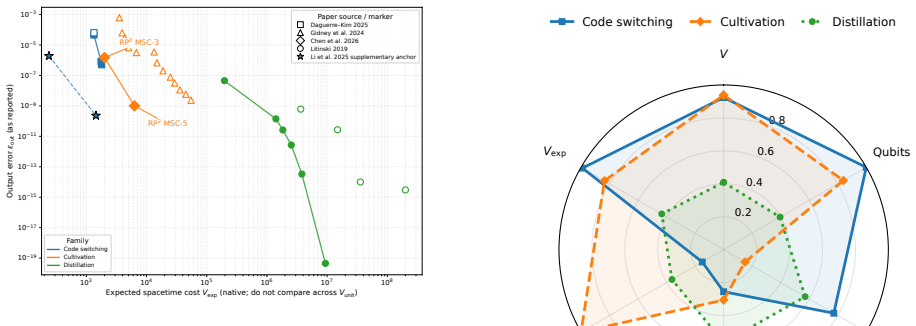
Within the current dataset, distillation reaches the lowest output error regime; code switching achieves the lowest reported single attempt cost and the smallest explicit footprint among the compatible rows; and recent RP2 cultivation results add low cost cultivation points with output errors between 1e-6 and 1e-9. As a simple algorithm level case study, we also examine the reported preparation routes under an error budget motivated by Shor factoring algorithm, in order to relate single state preparation costs to full workload requirements. The resulting comparison clarifies the trade offs currently supported across the literature, while remaining bounded by the conventions and coverage of t
What carries the argument
A multi-metric comparison table that records output error, single attempt cost, expected cost per accepted output, footprint, latency, and reporting completeness for each protocol configuration while preserving native units.
If this is right
- Distillation protocols are the route that reaches the lowest output error regime.
- Code switching protocols achieve the lowest reported single attempt cost and the smallest explicit footprint among the compared entries.
- Recent cultivation results supply low-cost options at output errors between 1e-6 and 1e-9.
- Under an error budget motivated by Shor's factoring algorithm, single-state preparation costs translate directly into full workload requirements.
- All reported trade-offs remain bounded by the code families, noise models, and cost conventions of the source papers.
Where Pith is reading between the lines
- Future protocols could be added to the same native-unit table to test whether they improve on the current lowest-error or lowest-cost points.
- Hardware designs constrained by physical footprint or latency may favor code switching even when distillation offers lower error.
- The comparison dataset could serve as a baseline for checking whether new noise models alter the relative ordering of the three routes.
- Extending the same native-unit approach to other non-Clifford gates might reveal analogous trade-off patterns.
Load-bearing premise
Results reported under different code families, noise models, postselection rules, and cost conventions can be meaningfully compared by retaining native units without selection bias or incompatibility in the underlying assumptions.
What would settle it
A re-evaluation of the same protocols under identical noise models, code families, and postselection rules that reverses the observed ordering of output errors or single-attempt costs.
Figures

read the original abstract
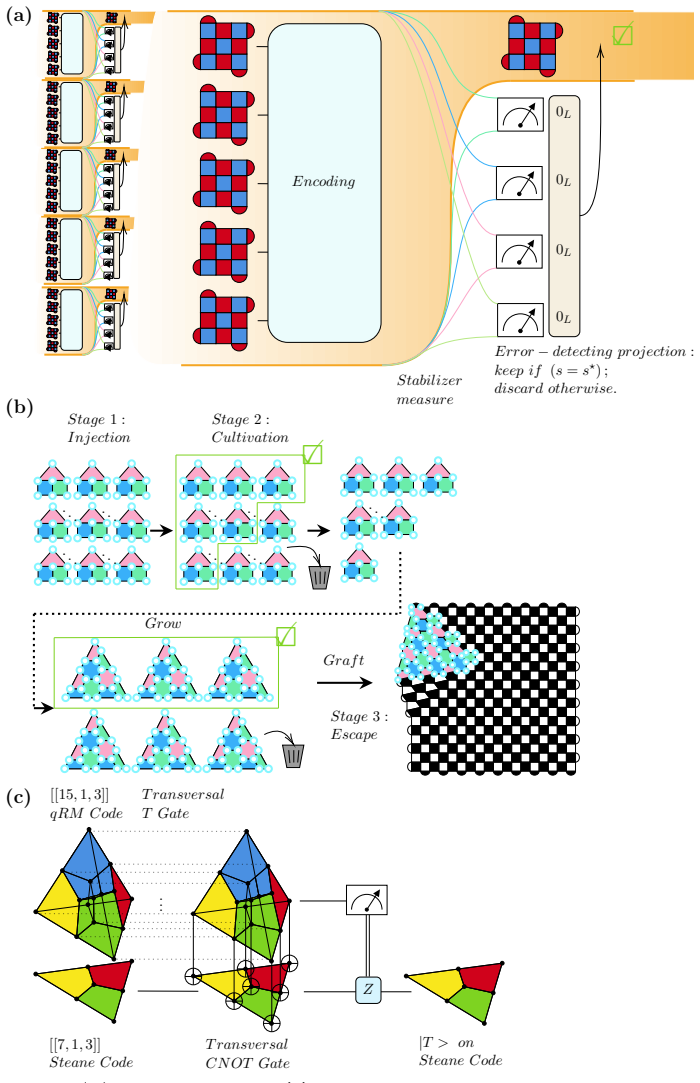
Logical T state preparation is a major overhead source in fault tolerant architectures built from stabilizer operations. Existing protocols, however, are reported under different code families, noise models, postselection rules, and cost conventions, making direct comparison difficult. We compare three representative preparation routes: magic state distillation, magic state cultivation, and code switching, using currently available results. Rather than reducing heterogeneous data to a single cost metric, we retain source native cost units and record output error, single attempt cost, expected cost per accepted output, footprint, latency, and reporting completeness for each configuration. Within the current dataset, distillation reaches the lowest output error regime; code switching achieves the lowest reported single attempt cost and the smallest explicit footprint among the compatible rows; and recent RP2 cultivation results add low cost cultivation points with output errors between 1e-6 and 1e-9. As a simple algorithm level case study, we also examine the reported preparation routes under an error budget motivated by Shor factoring algorithm, in order to relate single state preparation costs to full workload requirements. The resulting comparison clarifies the trade offs currently supported across the literature, while remaining bounded by the conventions and coverage of the underlying papers.
Editorial analysis
A structured set of objections, weighed in public.
Referee Report
Summary. The manuscript compares three routes for logical T-state preparation—magic state distillation, magic state cultivation, and code switching—by collecting results from the existing literature. Rather than unifying the heterogeneous data into a single metric, the authors retain the native cost units and report output error, single attempt cost, expected cost per accepted output, footprint, latency, and reporting completeness. Within the dataset, they conclude that distillation reaches the lowest output error regime, code switching the lowest single attempt cost and smallest explicit footprint among compatible rows, and recent RP2 cultivation results provide low-cost points with output errors between 1e-6 and 1e-9. A case study relates these to an error budget for Shor's factoring algorithm.
Significance. This work provides a useful snapshot of the current state of T-state preparation protocols in fault-tolerant quantum computing. The decision to retain native units is a positive feature that avoids introducing additional assumptions or unification biases that could distort the comparisons. If the dataset-level orderings hold under the acknowledged heterogeneity, the paper clarifies practical trade-offs for resource estimation in quantum algorithms. The inclusion of the Shor factoring case study helps connect single-state costs to full workload requirements.
major comments (1)
- Abstract: The statements that 'distillation reaches the lowest output error regime' and 'code switching achieves the lowest reported single attempt cost and the smallest explicit footprint among the compatible rows' are load-bearing for the paper's contribution. These rankings assume that the retained native error probabilities and costs are directly comparable across different code families, noise models, postselection rules, and cost conventions. While the abstract notes that these differences make direct comparison difficult, the manuscript does not provide additional justification or sensitivity analysis showing that the orderings remain meaningful despite potential incommensurability in logical observables or acceptance criteria.
minor comments (2)
- The definition and criteria used for 'compatible rows' in the dataset comparisons should be stated explicitly, as this directly affects which entries contribute to the reported minima.
- The case study relating preparation costs to the Shor factoring error budget would benefit from a brief statement of the assumed total error budget allocation and how the per-state costs scale to the full algorithm.
Simulated Author's Rebuttal
We thank the referee for the positive assessment of the manuscript as a useful snapshot of T-state preparation protocols and for endorsing the decision to retain native cost units. We address the single major comment below.
read point-by-point responses
-
Referee: The statements that 'distillation reaches the lowest output error regime' and 'code switching achieves the lowest reported single attempt cost and the smallest explicit footprint among the compatible rows' are load-bearing for the paper's contribution. These rankings assume that the retained native error probabilities and costs are directly comparable across different code families, noise models, postselection rules, and cost conventions. While the abstract notes that these differences make direct comparison difficult, the manuscript does not provide additional justification or sensitivity analysis showing that the orderings remain meaningful despite potential incommensurability in logical observables or acceptance criteria.
Authors: We thank the referee for this observation. The abstract and introduction already qualify the claims explicitly with the phrases 'within the current dataset' and 'among the compatible rows' to signal that the reported orderings are descriptive observations drawn from the collected literature under each protocol's native conventions, rather than assertions of direct cross-protocol equivalence. The manuscript's stated methodology is to compile existing results without imposing a unifying metric precisely to avoid the biases that would arise from reconciling incommensurable noise models, acceptance criteria, or logical observables. Consequently, no sensitivity analysis is performed, as any such analysis would require introducing additional modeling assumptions (e.g., cross-code error equivalences or cost normalizations) that the paper deliberately refrains from making. Readers are referred to the source references for the specific details of each protocol's noise model and postselection rules. We maintain that the current wording and approach already bound the claims appropriately for a literature survey and do not require further justification or revision. revision: no
Circularity Check
No circularity; literature comparison of external results
full rationale
The paper collects and tabulates existing results on T-state preparation from the literature under three routes (distillation, cultivation, code switching). It derives no new quantities, equations, or predictions from its own inputs or fitted parameters. Native units are retained explicitly to avoid fabricating a common metric, and the abstract states the comparison is bounded by source conventions. No self-definitional steps, fitted-input predictions, or load-bearing self-citation chains appear. The dataset-level rankings are descriptive statements about the collected rows rather than derivations that reduce to the paper's own construction.
Axiom & Free-Parameter Ledger
axioms (1)
- domain assumption Results from papers using different code families, noise models, postselection rules, and cost conventions can be directly compared by retaining native cost units
Reference graph
Works this paper leans on
-
[1]
Simulating physics with computers
Richard P. Feynman. “Simulating physics with computers”. International Journal of xiii Theoretical Physics21, 467–488 (1982)
1982
-
[2]
Algorithms for quantum computation: discrete logarithms and factor- ing
Peter W. Shor. “Algorithms for quantum computation: discrete logarithms and factor- ing”. In Proceedings 35th Annual Sympo- sium on Foundations of Computer Science. Pages 124–134. IEEE (1994)
1994
-
[3]
Quantum computing in the NISQ era and beyond
John Preskill. “Quantum computing in the NISQ era and beyond”. Quantum 2, 79 (2018)
2018
-
[4]
Fault-tolerant quantum computation
Peter W. Shor. “Fault-tolerant quantum computation”. In Proceedings of the 37th Annual Symposium on Foundations of Com- puter Science. Pages 56–65. IEEE (1996). arXiv:quant-ph/9605011
work page internal anchor Pith review Pith/arXiv arXiv 1996
-
[5]
Fault- tolerant quantum computation with con- stant error rate
Dorit Aharonov and Michael Ben-Or. “Fault- tolerant quantum computation with con- stant error rate”. SIAM Journal on Com- puting 38, 1207–1282 (2008). arXiv:quant- ph/9906129
-
[6]
An Introduction to Quantum Error Correction and Fault-Tolerant Quantum Computation
Daniel Gottesman. “An introduction to quantum error correction and fault- tolerant quantum computation” (2010). arXiv:0904.2557
work page internal anchor Pith review Pith/arXiv arXiv 2010
-
[7]
Quantum teleportation is a universal com- putational primitive
Daniel Gottesman and Isaac L. Chuang. “Quantum teleportation is a universal com- putational primitive”. Nature 402, 390– 393 (1999)
1999
-
[8]
Univer- sal quantum computation with ideal Clifford gates and noisy ancillas
Sergey Bravyi and Alexei Kitaev. “Univer- sal quantum computation with ideal Clifford gates and noisy ancillas”. Physical Review A 71, 022316 (2005)
2005
-
[9]
Roads towards fault- tolerant universal quantum computation
Earl T. Campbell, Barbara M. Terhal, and Christophe Vuillot. “Roads towards fault- tolerant universal quantum computation”. Nature549, 172–179 (2017)
2017
-
[10]
Surface codes: Towards practical large-scale quantum computation
Austin G. Fowler, Matteo Mariantoni, John M. Martinis, and Andrew N. Cleland. “Surface codes: Towards practical large-scale quantum computation”. Physical Review A 86, 032324 (2012)
2012
-
[11]
A game of surface codes: Large-scale quantum computing with lattice surgery
Daniel Litinski. “A game of surface codes: Large-scale quantum computing with lattice surgery”. Quantum3, 128 (2019)
2019
-
[12]
Quantum computation with realistic magic- state factories
Joe O’Gorman and Earl T. Campbell. “Quantum computation with realistic magic- state factories”. Physical Review A 95, 032338 (2017)
2017
-
[13]
Magic state distillation: Not as costly as you think
Daniel Litinski. “Magic state distillation: Not as costly as you think”. Quantum3, 205 (2019)
2019
-
[14]
How to factor 2048 bit RSA integers in 8 hours us- ing 20 million noisy qubits
Craig Gidney and Martin Ekerå. “How to factor 2048 bit RSA integers in 8 hours us- ing 20 million noisy qubits”. Quantum5, 433 (2021)
2048
-
[15]
Magic- state distillation with low overhead
Sergey Bravyi and Jeongwan Haah. “Magic- state distillation with low overhead”. Physi- cal Review A86, 052329 (2012)
2012
-
[16]
Magic state dis- tillation with low space overhead and opti- mal asymptotic input count
Jeongwan Haah, Matthew B. Hastings, D. Poulin, and D. Wecker. “Magic state dis- tillation with low space overhead and opti- mal asymptotic input count”. Quantum1, 31 (2017)
2017
-
[17]
Multilevel distillation of magic states for quantum computing
Cody Jones. “Multilevel distillation of magic states for quantum computing”. Physical Re- view A87, 042305 (2013)
2013
-
[18]
Distillation with sublogarithmic overhead
Matthew B. Hastings and Jeongwan Haah. “Distillation with sublogarithmic overhead”. Physical Review Letters120, 050504 (2018)
2018
-
[19]
Fault-tolerant conversion between the Steane and Reed- Muller quantum codes
Jonas T. Anderson, Guillaume Duclos- Cianci, and David Poulin. “Fault-tolerant conversion between the Steane and Reed- Muller quantum codes”. Physical Review Letters113, 080501 (2014)
2014
-
[20]
Gauge color codes: optimal transversal gates and gauge fixing in topolog- ical stabilizer codes
Héctor Bombín. “Gauge color codes: optimal transversal gates and gauge fixing in topolog- ical stabilizer codes”. New Journal of Physics 17, 083002 (2015)
2015
-
[21]
The cost of uni- versality: A comparative study of the over- head of state distillation and code switch- ing with color codes
Michael E. Beverland, Aleksander Kubica, and Krysta M. Svore. “The cost of uni- versality: A comparative study of the over- head of state distillation and code switch- ing with color codes”. PRX Quantum 2, 020341 (2021)
2021
-
[22]
Code switching revisited: Low-overhead magic state preparation using color codes
Lucas Daguerre and Isaac H. Kim. “Code switching revisited: Low-overhead magic state preparation using color codes”. Phys- ical Review Research7, 023080 (2025)
2025
-
[23]
Magic state cultivation: growing T states as cheap as CNOT gates
Craig Gidney, Noah Shutty, and Cody Jones. “Magic state cultivation: growing T states as cheap as CNOT gates” (2024). arXiv:2409.17595
work page internal anchor Pith review Pith/arXiv arXiv 2024
-
[24]
Efficient magic state cultivation on rp2
Zi-Han Chen, Ming-Cheng Chen, Chao- Yang Lu, and Jian-Wei Pan. “Efficient magic state cultivation on rp2”. PRX Quantum7, 010315 (2026)
2026
-
[25]
Efficientmagic state cultivation on the surface code
Yotam Vaknin, Shoham Jacoby, Arne Grimsmo, andAlexRetzker. “Efficientmagic state cultivation on the surface code” (2025). arXiv:2502.01743
-
[26]
CultivatingTstates on the surface code with only two-qubit gates
Jahan Claes. “CultivatingTstates on the surface code with only two-qubit gates” (2025). arXiv:2509.05232. xiv
-
[27]
Methodology for quantum logic gate construction
Xinlan Zhou, Debbie W. Leung, and Isaac L. Chuang. “Methodology for quantum logic gate construction”. Physical Review A62, 052316 (2000)
2000
-
[28]
Re- strictions on transversal encoded quantum gate sets
Bryan Eastin and Emanuel Knill. “Re- strictions on transversal encoded quantum gate sets”. Physical Review Letters 102, 110502 (2009)
2009
-
[29]
Classi- fication of topologically protected gates for local stabilizer codes
Sergey Bravyi and Robert König. “Classi- fication of topologically protected gates for local stabilizer codes”. Physical Review Let- ters110, 170503 (2013)
2013
-
[30]
Quantum universality from magic states distillation applied to CSS codes
Ben W. Reichardt. “Quantum universality from magic states distillation applied to CSS codes”. Quantum Information Processing4, 251–264 (2005)
2005
-
[31]
Magic-state distillation with the four-qubit code
Adam M. Meier, Bryan Eastin, and EmanuelKnill. “Magic-statedistillationwith the four-qubit code”. Quantum Informa- tion & Computation 13, 195–209 (2013). arXiv:1204.4221
work page internal anchor Pith review Pith/arXiv arXiv 2013
-
[32]
Surfacecodeimplementationofblock code state distillation
AustinG.Fowler, SimonJ.Devitt, andCody Jones. “Surfacecodeimplementationofblock code state distillation”. Scientific Reports3, 1939 (2013)
1939
-
[33]
Measurement sequences for magic state dis- tillation
Jeongwan Haah and Matthew B. Hastings. “Measurement sequences for magic state dis- tillation”. Quantum5, 383 (2021)
2021
-
[34]
Fault-tolerant postselection for low-overhead magic state preparation
Héctor Bombín, Mihir Pant, Sam Roberts, and Karthik I. Seetharam. “Fault-tolerant postselection for low-overhead magic state preparation”. PRX Quantum 5, 010302 (2024)
2024
-
[35]
Topological quantum distillation
Héctor Bombín and Miguel A. Martin- Delgado. “Topological quantum distillation”. Physical Review Letters97, 180501 (2006)
2006
-
[36]
Unfolding the color code
Aleksander Kubica, Beni Yoshida, and Fer- nando Pastawski. “Unfolding the color code”. New Journal of Physics17, 083026 (2015)
2015
-
[37]
Fault- tolerant code-switching protocols for near- term quantum processors
Friederike Butt, Sascha Heußen, Manuel Rispler, and Markus Müller. “Fault- tolerant code-switching protocols for near- term quantum processors”. PRX Quantum 5, 020345 (2024)
2024
-
[38]
Using concatenated quantum codes for universal fault-tolerant quantum gates
Tomas Jochym-O’Connor and Raymond Laflamme. “Using concatenated quantum codes for universal fault-tolerant quantum gates”. Physical Review Letters 112, 010505 (2014)
2014
-
[39]
Stacked codes: Universal fault- tolerant quantum computation in a two- dimensional layout
Tomas Jochym-O’Connor and Stephen D. Bartlett. “Stacked codes: Universal fault- tolerant quantum computation in a two- dimensional layout”. Physical Review A93, 022323 (2016)
2016
-
[40]
Universal fault-tolerant gates on concatenated stabilizer codes
Theodore J. Yoder, Ryuji Takagi, and Isaac L. Chuang. “Universal fault-tolerant gates on concatenated stabilizer codes”. Physical Review X6, 031039 (2016)
2016
-
[41]
Fault-tolerant quantum computing with color codes
Andrew J. Landahl, Jonas T. Anderson, and Patrick R. Rice. “Fault-tolerant quan- tum computing with color codes” (2011). arXiv:1108.5738
work page internal anchor Pith review Pith/arXiv arXiv 2011
-
[42]
Decoding color codes by projection onto surface codes
Nicolas Delfosse. “Decoding color codes by projection onto surface codes”. Physical Re- view A89, 012317 (2014)
2014
-
[43]
Universal fault-tolerant quantum computa- tion with only transversal gates and error correction
Adam Paetznick and Ben W. Reichardt. “Universal fault-tolerant quantum computa- tion with only transversal gates and error correction”. Physical Review Letters 111, 090505 (2013)
2013
-
[44]
Transversal dimension jump for product qldpc codes
Christine Li, John Preskill, and Qian Xu. “Transversal dimension jump for product qldpc codes” (2025). arXiv:2510.07269
-
[45]
QuantumcircuitsofT-depth one
PeterSelinger. “QuantumcircuitsofT-depth one”. Physical Review A87, 042302 (2013)
2013
-
[46]
Low-overhead constructions for the fault-tolerant Toffoli gate
Cody Jones. “Low-overhead constructions for the fault-tolerant Toffoli gate”. Physical Review A87, 022328 (2013)
2013
-
[47]
Halving the cost of quantum addition
Craig Gidney. “Halving the cost of quantum addition”. Quantum2, 74 (2018). xv
2018
discussion (0)
Sign in with ORCID, Apple, or X to comment. Anyone can read and Pith papers without signing in.