REVIEW 2 major objections 6 minor 25 references
MaestroCut claims that online feedback from device drift can contract stitched variance, meet latency and reliability targets, and encrypt fragments at about 1% overhead.
Reviewed by Pith at T0; open to challenge. T0 means a machine referee read the full paper against a public rubric. the ladder, T0–T4 →
A closed-loop circuit-cutting framework that adapts partitioning, shot allocation, and estimator choice to live noise drift reports variance contraction and about 1% confidentiality overhead in simulation and emulation.
T0 review reviewed 2026-08-05 challenge →
load-bearing objection Closed-loop cutting framework is a real systems contribution, but the IND-CFA security bound does not follow from the phase-only mask actually used; deserves peer review with a mandatory security fix. the 2 major comments →
MAESTROCUT: Dynamic, Noise-Adaptive, and Secure Quantum Circuit Cutting on Near-Term Hardware
The pith
A machine-rendered reading of the paper's core claim, the machinery that carries it, and where it could break.
The reading
Core claim
On its own terms, the paper's central claim is that the four problems blocking practical circuit cutting—sampling overhead, time-varying noise, topology-blind allocation, and fragment exposure—can be solved together rather than separately. The system tracks a per-fragment variance proxy with a Kalman filter, uses a Gaussian-process prior over the heavy-hex device graph to correlate fragments that are close to one another, and allocates shots by solving a spectral relaxation of a stitched-variance bound. The resulting allocation is water-filling: fragment i receives S u_i^(2/3) / sum_j u_j^(2/3) shots, where u_i is the tracked uncertainty. A CUSUM trigger repartitions the circuit when drift a
What carries the argument
The load-bearing object is a closed-form water-filling shot allocation. The paper upper-bounds stitched variance by lambda_max(Sigma-tilde) sum_i u_i^2 / s_i^2, where s_i are per-fragment shots, u_i = sigma-hat_i sqrt(log(N/rho)) is a tracked standard deviation times a ShotQC confidence tail factor, and Sigma-tilde is the Matérn-1/2 covariance over fragment anchors, shrunk by Kalman filter uncertainty. Minimizing that upper bound under a fixed total shot budget gives the KKT-optimal rule s_i^* = S u_i^(2/3) / sum_j u_j^(2/3). This rule converts live drift observations into a concrete, cheap-to-recompute allocation: every B shots the Kalman updates change u_i, the water-filling recomputes, an
Load-bearing premise
All the contraction and reallocation results rest on the assumption that fragment variances drift as a Gaussian random walk and correlate across fragments through an exponentially decaying spatial kernel; if real hardware drift has heavy tails, sudden breaks, or non-spatial correlations, the Kalman tracker, water-filling allocation, and CUSUM triggers may not transfer.
What would settle it
Run the full loop on a real multi-tenant quantum cloud device for several days, recording per-fragment variance observations. Then fit two models to those observations: the paper's Gaussian-drift plus exponentially decaying spatial prior, and a heavy-tailed or breakpoint alternative. If the alternative fits substantially better and water-filling on the observed variances does not reduce stitched variance against uniform or proportional allocation, the central claim fails.
If this is right
- With an online variance tracker, a circuit cut once and left unchanged no longer has to be trusted: when drift crosses a threshold, the partition can be refined and shots redistributed, so accuracy degrades gracefully instead of silently.
- The water-filling rule tells an operator exactly how to redistribute a fixed shot budget across fragments: more shots go to fragments whose tracked uncertainty is high, and the resulting stitched-variance contraction is provable under the model.
- The entropy-gated cascade gives a per-fragment choice between cheap classical shadows and expensive maximum-likelihood reconstruction, so the same pipeline can handle low- and high-entropy fragments without overspending.
- Confidentiality through Pauli padding and AEAD can be added to a cutting pipeline at about 1% runtime cost, making it feasible to run sensitive workloads on semi-honest cloud providers.
- Budget enforcement with abort and audit means a user can state a variance or leakage cap and get an immutable record if the system cannot meet it.
Where Pith is reading between the lines
- The water-filling step is not tied to quantum circuits: any distributed estimation task with per-worker variances that drift could use the same Kalman-plus-water-filling allocation to contract total error under a fixed sampling budget. The paper does not explore this transfer.
- The stated security guarantee is conditional on the semi-honest provider model and on AEAD and QOTP being instantiated correctly; a malicious provider who can coherently tamper with fragments before decoy checks would need verification beyond decoys, which the paper leaves to future work.
- The empirical alpha and beta fits in the estimator cascade are workload-dependent; on unfamiliar circuit families the cascade boundary could be miscalibrated unless the fits are re-estimated online.
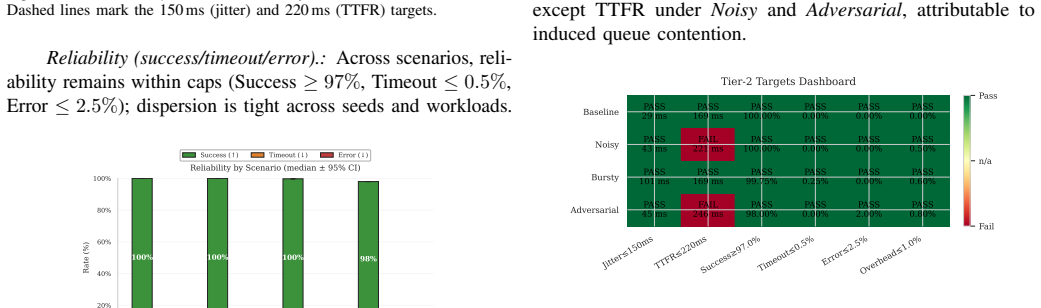
- The Tier-2 time-to-first-result misses under noisy and adversarial queueing point to the scheduler, not the estimation stack; an age-aware or size-aware dispatch policy is a natural next step that the paper itself flags.
Editorial analysis
A structured set of objections, weighed in public.
Referee Report
Summary. The paper presents MaestroCut, a closed-loop framework for quantum circuit cutting that adapts partitioning, shot allocation, and estimator selection to runtime drift, and adds a confidentiality layer called PhasePad-OTP. The system comprises an incremental multilevel-FM partitioner with CUSUM-triggered refinement, a Kalman-filtered topology-aware shot allocator (Topo-GP) with a closed-form water-filling solution, an entropy-gated estimator cascade, and a Pauli-padding security layer. The evaluation includes Tier-1 simulation across five workloads and Tier-2 emulation with calibrated noise and queueing dynamics. The central claims are variance contraction versus uniform allocation, stable SLOs under drift, approximately 1% security overhead, and IND-CFA fragment confidentiality with a 2^{-λ} advantage bound.
Significance. If the security claim were supportable, the paper would make a useful systems contribution: it is the first framework I am aware of that co-optimizes partitioning, allocation, estimation, and confidentiality in a closed loop. The allocation mathematics (Prop. 1) is correct, the Tier-2 emulation methodology with calibrated noise and queueing is a strength, and the open-source artifact is commendable. However, the IND-CFA security bound is not established for the scheme as described, and this is a headline advertised feature. The rest of the system—drift tracking, topology-aware allocation, and the empirical evaluation—is defensible and well executed, but the paper’s overall claim of a 'cryptographically secure' cutting framework currently rests on an unsupported security result.
major comments (2)
- [§IV.E, Algorithm 4, Proposition 4] The claimed IND-CFA bound (≤ 2^{-λ} + ε_AEAD(q)) does not follow from the described scheme. Algorithm 4 uses a per-fragment key K_i ∈ {0,1}^a with a = ⌈λ/2⌉ and applies only a phase mask Z^{K_i}. This is not a quantum one-time pad: the paper's own §II states QOTP requires 2n key bits for an n-qubit fragment. Averaging over K_i dephases the state in the computational basis, so an adversary can distinguish fragments whose Z-basis populations differ (e.g., |0⟩ vs |1⟩) with advantage 1. The proof sketch's hybrid step 'replace phase masks by uniform one-time pads' substitutes a different encryption than the one specified. Moreover, even if the phase mask were a full QOTP, a key of length a=λ/2 yields at best a guessing advantage of 2^{-λ/2}, not 2^{-λ}. Proposition 4 therefore does not support the fragment-confidentiality pillar of the central claim.
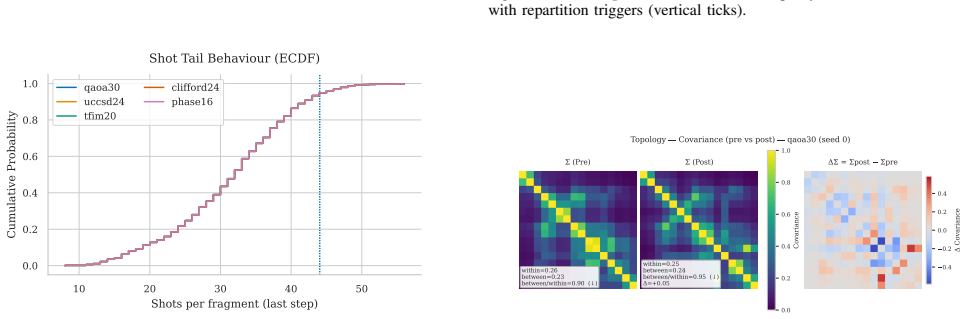
- [§V.C, Fig. 3; §VI.c] The variance-contraction validation is partly circular. The 'Theory ε(d,Q)' curve in Fig. 3 is computed from the same uncertainty proxy u_i that is used to allocate shots via Eq. (8), so the agreement between theory and empirical is to a significant degree by construction. In addition, the Tier-1 noise processes are generated from the same Matérn-1/2 kernel with Wiener drift that the Kalman/Topo-GP model assumes (Eqs. 4–5); as the paper concedes in §VI.c, 'different noise processes may affect constants.' The reported contraction ratios (Fig. 4) are therefore not yet evidence that the method transfers to hardware with heavy-tailed drift, structural breaks, or non-spatial correlations. Please add robustness experiments with misspecified priors, or temper the 'drift-resilient' claim accordingly.
minor comments (6)
- [§II vs §IV.E] The paper states in §II that QOTP requires 2n uniformly random key bits, but §IV.E uses a=⌈λ/2⌉ and a phase-only mask. This inconsistency should be resolved; the PhasePad-OTP scheme should not be described as inheriting QOTP guarantees.
- [§V.C, Fig. 3] The 'Theory ε(d,Q)' curve is not defined; no equation or algorithm is provided for ε(d,Q). Please define this quantity explicitly, including how it is computed from the model parameters.
- [§V.C, RQ3, Fig. 10] The cascade optimality evaluation appears to use the same fitted parameters (α, β, Bias_MLE) both to derive the decision boundary and to generate the empirical choices. Please describe the train/test split or cross-validation procedure that prevents circularity in the RQ3 result.
- [§IV.C, Eq. (6)] The bound uses λ_max(Σ̃), but the paper does not state how λ_max is estimated or upper-bounded in practice. Adding this detail would make the bound auditable.
- [Algorithm 2, line 7] The expression s^⋆_i ← max{s_min, S w_i/Z} can violate the total budget Σ s_i = S when the floor binds; the integer projection in lines 8–15 corrects it, but the formula is misleading. Suggest presenting the capped version only after projection is applied.
- [§IV.F] The claim 'guaranteeing ∥T_full − T_12-term∥_1 ≤ 0.03' lacks a proof or reference. Please provide a derivation or a citation for this bound.
Circularity Check
Variance contraction and cascade optimality are validated against the same equations that define the allocator/selector; the PhasePad security proof substitutes a full QOTP for the implemented phase-only mask.
specific steps
-
fitted input called prediction
[Section IV.C, Eq. (6)-(8) and Prop. 1; Section V.C Fig. 3]
"Relaxing (6) by Lemma 1 yields the convex program min_{s_i≥s_min} Σ_i u_i^2/s_i^2 s.t. Σ_i s_i = S. ... Proposition 1 (KKT water-filling). The unique optimum ... is s⋆_i = S u_i^{2/3}/Σ_j u_j^{2/3}. ... Fig. 3: 'Variance contraction and theoretical bound. ... solid curve shows ε(d,Q) when available.'"
The allocation is chosen to minimize the spectral-relaxed proxy Σ_i u_i^2/s_i^2, and the KKT formula is the minimizer of that proxy. Therefore the contraction of this proxy relative to uniform is a mathematical consequence of the optimizer for any positive u_i; it is not an empirical discovery about hardware noise. The 'Theory' curve is plotted against the same u_i used to allocate shots, so it reports the optimizer's own objective gap rather than independently validating that the proxy tracks true stitched variance.
-
self definitional
[Section IV.D, Eq. (9)-(10), Algorithm 3; Section V.C Fig. 10]
"Empirical fits from Tier-1 calibration yield MSE_shad(s_i) ≈ α/s_i, MSE_MLE(s_i,H_i) ≈ β/s_i^2 + Bias_MLE(H_i)^2 ... Risk-minimising decision rule: Choose the estimator that minimises predicted MSE: E⋆_i = arg min{α/s_i, β/s_i^2 + Bias_MLE(H_i)^2}. ... Fig. 10: 'The cascade aligns with the model boundary MSE_MLE(H,s)=MSE_Shadows(s).'"
Algorithm 3 implements exactly Eq. (10), using the same fitted α, β, and Bias_MLE from Eq. (9). Thus the RQ3 test compares the cascade's decisions to the decision rule that defines the cascade itself. Agreement between the plotted boundary and the decisions is built into the algorithm unless numerical or estimation noise corrupts the implementation; it does not provide independent evidence that the fitted MSE models are accurate.
-
other
[Section IV.E, Algorithm 4 and Proposition 4 proof sketch]
"Algorithm 4: 'a ← ⌈λ/2⌉; ... sample K_i ∈ {0,1}^a; apply phase mask Z^{K_i} (Pauli-frame compatible)'. Proposition 4 proof sketch: 'replace headers by pseudorandom strings (AEAD) and phase masks by uniform one-time pads that commute with Pauli frames; indistinguishability reduces to key guessing.'"
The implemented encryption is only a phase mask Z^{K_i} with |K_i|=⌈λ/2⌉, which is not a quantum one-time pad. The paper itself states in Section II that hiding an n-qubit fragment requires 2n uniformly random key bits. The proof's hybrid step replaces the phase mask with a uniform one-time pad over the full Pauli group, i.e., with a stronger primitive than the scheme actually uses. Consequently the claimed 2^{-λ}+ε_AEAD(q) bound is derived from a different algorithm than the one specified, so the IND-CFA security claim does not follow for Algorithm 4.
full rationale
The paper's core allocation is a valid minimizer of its stated proxy, so it is not circular in the sense of a false algebraic derivation. However, the paper presents variance contraction as evidence for the method while the 'theory' curve is the optimizer's own objective ratio: the KKT water-filling formula is the minimizer of Σ u_i^2/s_i^2, so contraction of that proxy is by construction. The estimator-cascade optimality evaluation is a direct tautology: the cascade and the 'predicted H–s boundary' are the same fitted decision rule. The PhasePad security bound is a load-bearing substitution gap rather than a self-citation: the proof replaces the implemented phase-only mask with a full QOTP, which the scheme does not use. This affects the headline confidentiality claim but is not exactly a circular derivation, so I record it under 'other'. Self-citations are not the source of the problem; the issues are internal to the paper's definitions and proof choices. Overall, two central empirical validations reduce by construction and the security proof relies on an un-implemented stronger primitive, warranting a score of 6.
Axiom & Free-Parameter Ledger
free parameters (7)
- Cascade MSE coefficients alpha, beta =
workload-dependent, fitted from Tier-1 calibration
- Bias_MLE(H_i) model =
measured from 1% pilot entropy
- Matérn kernel parameters sigma_k^2, ell =
not reported
- Kalman process and observation noise q_i, r_i =
q_i calibrated from historical deltas; r_i unspecified
- CUSUM slack kappa and threshold h =
chosen for target ARL0; values not reported
- Partition policy weights alpha, beta, gamma =
hand-chosen, sum to 1
- Decoy fraction eta and verifier threshold eps_ver =
eta = 0.02; eps_ver not stated
axioms (9)
- standard math Rayleigh quotient bound: y^T Sigma y <= lambda_max(Sigma) ||y||^2 for positive semidefinite Sigma
- standard math KKT stationarity and strict convexity give the unique water-filling optimum s_i proportional to u_i^{2/3}
- domain assumption Per-fragment variance follows a random walk: sigma^2_t = sigma^2_{t-1} plus Gaussian noise
- domain assumption Cross-fragment variance correlation is Matérn-1/2 in heavy-hex graph distance
- ad hoc to paper Estimator MSE has power-law forms MSE_shad approx alpha/s and MSE_MLE approx beta/s^2 + Bias^2
- domain assumption ShotQC tail factor sqrt(log(N/rho)) is a valid per-fragment variance proxy u_i
- domain assumption AES-GCM-SIV is standard-secure and its AEAD distinguishing advantage bounds the hybrid argument
- domain assumption Semi-honest provider for confidentiality, trusted client and post-processor, no collusion
- ad hoc to paper A phase mask with a = ceil(lambda/2) bits yields 2^{-lambda} indistinguishability
Cite this review
Pith. "Pith review of MAESTROCUT: Dynamic, Noise-Adaptive, and Secure Quantum Circuit Cutting on Near-Term Hardware." pith.science (2026). https://pith.science/paper/OFIOS6VM
@misc{pith2026250900811,
  author       = {Pith},
  title        = {Pith review of: MAESTROCUT: Dynamic, Noise-Adaptive, and Secure Quantum Circuit Cutting on Near-Term Hardware},
  year         = {2026},
  howpublished = {\url{https://pith.science/paper/OFIOS6VM}},
  note         = {Machine review of arXiv:2509.00811}
}
read the original abstract
We present MaestroCut, a closed-loop framework for quantum circuit cutting that adapts partitioning and shot allocation to device drift and workload variation. MaestroCut tracks a variance proxy in real time, triggers re-cutting when accuracy degrades, and routes shots using topology-aware priors. An online estimator cascade (MLE, Bayesian, GP-assisted) selects the lowest-error reconstruction within a fixed budget. Tier-1 simulations show consistent variance contraction and reduced mean-squared error versus uniform and proportional baselines. Tier-2 emulation with realistic queueing and noise demonstrates stable latency targets, high reliability, and ~1% software overhead under stress scenarios. These results indicate that adaptive circuit cutting can provide accuracy and efficiency improvements with minimal operational cost on near-term hardware.
Figures







Reference graph
Works this paper leans on
-
[1]
Fast quantum circuit cutting with randomized measurements,
A. Lowe et al. , “Fast quantum circuit cutting with randomized measurements,” Quantum, vol. 7, p. 934, Mar. 2023, ISSN : 2521-327X. DOI: 10.22331/q-2023- 03-02-934. [Online]. Available: http://dx.doi.org/10. 22331/q-2023-03-02-934
doi:10.22331/q-2023- 2023
-
[2]
D. Chen, B. Baheri, V . Chaudhary, Q. Guan, N. Xie, and S. Xu, Approximate quantum circuit cutting , 2022. arXiv: 2212.01270 [quant-ph]. [Online]. Available: https://arxiv.org/abs/2212.01270
work page internal anchor Pith review Pith/arXiv arXiv 2022
-
[3]
Optimal joint cutting of two-qubit rotation gates,
C. Ufrecht et al. , “Optimal joint cutting of two-qubit rotation gates,” Physical Review A, vol. 109, no. 5, 2024, ISSN : 2469-9934. DOI: 10.1103/physreva.109.052440. [Online]. Available: http://dx.doi.org/10.1103/PhysRevA. 109.052440
-
[4]
Ancilla-driven blind quantum computation for clients with different quantum capabilities,
Q. Dai, J. Quan, X. Lou, and Q. Li, “Ancilla-driven blind quantum computation for clients with different quantum capabilities,” 2023
work page 2023
- [5]
-
[6]
Fragqc: An efficient quantum error reduction technique using quantum circuit fragmentation,
S. Basu, A. Das, A. Saha, A. Chakrabarti, and S. Sur- Kolay, “Fragqc: An efficient quantum error reduction technique using quantum circuit fragmentation,” Journal of Systems and Software , vol. 214, p. 112 085, Aug. 2024, ISSN : 0164-1212. DOI: 10.1016/j.jss.2024.112085. [Online]. Available: http://dx.doi.org/10.1016/j.jss.2024. 112085
arXiv 2024
-
[7]
Private quantum computation: An introduction to blind quantum computing and related protocols,
J. F. Fitzsimons, “Private quantum computation: An introduction to blind quantum computing and related protocols,” npj Quantum Information, vol. 3, no. 1, p. 23,
-
[8]
C. Lu, R. Telang, A. Aysu, and K. Basu, Quantum leak: Timing side-channel attacks on cloud-based quantum services, 2024. arXiv: 2401.01521 [quant-ph]
Pith/arXiv arXiv 2024
-
[9]
Simulat- ing large quantum circuits on a small quantum computer,
T. Peng, A. W. Harrow, M. Ozols, and X. Wu, “Simulat- ing large quantum circuits on a small quantum computer,” Physical Review Letters , vol. 125, no. 15, Oct. 2020, ISSN : 1079-7114. DOI: 10.1103/physrevlett.125.150504. [Online]. Available: http : / / dx . doi . org / 10 . 1103 / PhysRevLett.125.150504
-
[10]
Cutqc: Using small quantum computers for large quantum circuit evaluations,
W. Tang, T. Tomesh, M. Suchara, J. Larson, and M. Martonosi, “Cutqc: Using small quantum computers for large quantum circuit evaluations,” in Proceedings of the 26th ACM International Conference on Architectural Support for Programming Languages and Operating Sys- tems, ser. ASPLOS ’21, ACM, Apr. 2021, pp. 473–486. DOI: 10.1145/3445814.3446758. [Online]. ...
arXiv 2021
-
[11]
M. Bechtold, J. Barzen, F. Leymann, and A. Mandl, Circuit cutting with non-maximally entangled states ,
-
[12]
A. Pawar et al., Qrcc: Evaluating large quantum circuits on small quantum computers through integrated qubit reuse and circuit cutting , 2025. DOI: https : / / doi . org / 10 . 1145 / 3622781 . 3674179. arXiv: 2312 . 10298 [quant-ph]. [Online]. Available: https://arxiv.org/ abs/2312.10298
work page internal anchor Pith review Pith/arXiv arXiv 2025
-
[13]
Efficient quantum circuit cutting by neglecting basis elements,
D. T. Chen et al., “Efficient quantum circuit cutting by neglecting basis elements,” 2023
work page 2023
-
[14]
Quantum circuit cutting for classical shadows,
D. T. S. Chen, Z. H. Saleem, and M. A. Perlin, “Quantum circuit cutting for classical shadows,” ACM Transactions on Quantum Computing , vol. 5, no. 2, pp. 1–21, Jun. 2024, ISSN : 2643-6817. DOI: 10.1145/3665335. [Online]. Available: http://dx.doi.org/10.1145/3665335
doi:10.1145/3665335 2024
-
[15]
Z. Li, M. Guo, M. Barad, W. Tang, E. Z. Zhang, and Y . Huang, A case for quantum circuit cutting for nisq applications: Impact of topology, determinism, and sparsity, 2024. arXiv: 2412.17929 [quant-ph]. [Online]. Available: https://arxiv.org/abs/2412.17929
work page internal anchor Pith review Pith/arXiv arXiv 2024
-
[16]
A. Ambainis, M. Mosca, A. Tapp, and R. de Wolf, Private quantum channels and the cost of randomizing quantum information, 2000
work page 2000
-
[17]
Universal blind quantum computation,
A. Broadbent, J. Fitzsimons, and E. Kashefi, “Universal blind quantum computation,” in FOCS, 2009
work page 2009
-
[18]
Quantum circuit cutting with maximum-likelihood tomography,
M. A. Perlin, Z. H. Saleem, M. Suchara, and J. C. Os- born, “Quantum circuit cutting with maximum-likelihood tomography,” npj Quantum Information , vol. 7, no. 1, 2021, ISSN : 2056-6387. DOI: 10 . 1038 / s41534 - 021 - 00390-6. [Online]. Available: http://dx.doi.org/10.1038/ s41534-021-00390-6
work page 2021
-
[19]
F. Burt, K. -C. Chen, and K. K. Leung, A multilevel framework for partitioning quantum circuits , 2025. arXiv: 2503.19082 [quant-ph]. [Online]. Available: https://arxiv.org/abs/2503.19082
arXiv 2025
-
[20]
Adap- tive mitigation of time-varying quantum noise,
S. Dasgupta, T. S. Humble, and A. Danageozian, “Adap- tive mitigation of time-varying quantum noise,” in 2023 IEEE International Conference on Quantum Computing and Engineering (QCE), vol. 01, 2023, pp. 99–110. DOI: 10.1109/QCE57702.2023.00020
arXiv 2023
-
[21]
X. Fang et al., Caliscalpel: In-situ and fine-grained qubit calibration integrated with surface code quantum error correction, 2024. arXiv: 2412 . 02036 [quant-ph]. [Online]. Available: https://arxiv.org/abs/2412.02036
work page internal anchor Pith review Pith/arXiv arXiv 2024
-
[22]
C. Piveteau and D. Sutter, Circuit knitting with classical communication , 2022. arXiv: 2205 . 00016 [quant-ph]
work page 2022
-
[23]
Predicting many properties of a quantum system from very few measurements,
H.-Y . Huang, R. Kueng, and J. Preskill, “Predicting many properties of a quantum system from very few measurements,” Nature Physics, 2020
work page 2020
-
[2017]
1038 / s41534 - 017 - 0025 - 3
DOI: 10 . 1038 / s41534 - 017 - 0025 - 3. [Online]. Available: https://doi.org/10.1038/s41534-017-0025-3
-
[2023]
Circuit Cutting with Non-Maximally Entangled States
arXiv: 2306 . 12084 [quant-ph]. [Online]. Available: https://arxiv.org/abs/2306.12084
work page internal anchor Pith review Pith/arXiv arXiv
This paper was first reviewed by deepseek-v4-flash on August 5, 2026.
discussion (0)
Sign in with ORCID, Apple, or X to comment. Anyone can read and Pith papers without signing in.