REVIEW 2 major objections 4 minor 65 references
Toward a reliable description of ${(p,pN)}$ reactions in the distorted-wave impulse approximation
T0 review · 2 major / 4 minor · reviewed 2026-08-14 · deepseek-v4-flash
Pith's one-line read The paper reanalyzes all 18 published inverse-kinematics (p,pN) knockout cases with the distorted-wave impulse approximation and finds that the extracted reduction factor has nearly no proton-neutron asymmetry dependence, while the…
desk verdict Solid partial-wave DWIA reanalysis of GSI (p,pN) data; the weak ΔS slope is the weakest link because the acknowledged missing higher-order effects may flatten it. read the letter →
The pith
A machine-rendered reading of the paper's core claim, the machinery that carries it, and where it could break.
The reading
What carries the argument
The load-bearing object is the factorized DWIA transition amplitude $\langle \chi_1^{(-)}\chi_2^{(-)} | t_{pN} | \chi_0^{(+)}\phi_{nljm}\rangle$; the factorization separates the three-body scattering wave function into two two-body distorted waves, which is the premise that makes the calculation tractable. Around that amplitude the paper stacks four correction terms: the Perey factor for the nonlocality of the bound single-particle wave function, the Darwin factor for relativistic corrections to the Dirac scattering waves, the Møller factor $\eta$ that converts the $pN$ cross section between the two-nucleon frame and the three-body frame, and energy-dependent Dirac optical potentials for the distorted waves. The ratio $R_s = \sigma_{\rm exp}/\sigma_{\rm th}$ extracted from these ingredients is the quantity whose asymmetry dependence the paper claims is weak.
What would settle it
Run a full three-body Faddeev/AGS calculation for $^{12}$C(p,2p)$^{11}$B that includes multistep scattering together with the nonlocality, Møller-factor, and energy-dependent optical-potential corrections used here: if the 150–300 MeV/c undershoot of the transverse momentum distribution disappears, the DWIA factorization is the culprit; if it persists, the discrepancy comes from input physics rather than the factorization. A simpler check is a same-channel measurement at quasifree kinematics, where DWIA should already agree.
Extended reading notes
Core claim
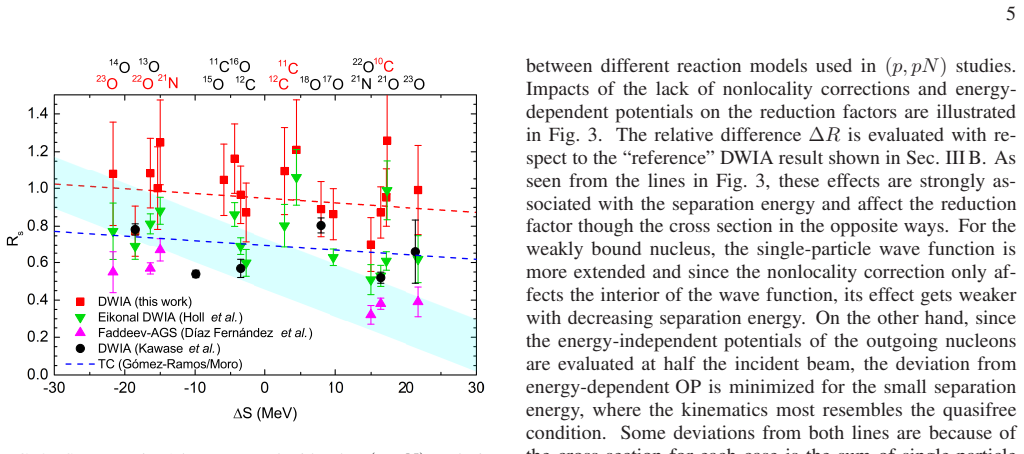
On the paper's own terms, the discovery is that a full partial-wave DWIA calculation, with the Perey factor for the bound-state wave function, the Darwin factor for the Dirac scattering waves, the Møller factor, and energy-dependent optical potentials, reproduces the trend of all 18 published (p,pN) cross sections well enough to extract reduction factors clustered near 0.9–1.0. A linear fit gives $R_s = 0.947(36) - 2.6(27)\times 10^{-3}\,\Delta S$ with reduced $\chi^2/N = 0.74$, where $\Delta S$ is the proton-neutron separation-energy asymmetry. The near-flat slope is consistent with coupled-cluster and self-consistent Green's function reduced spectroscopic factors and with transfer-to-continuum and earlier DWIA analyses, and it stands in contrast to the steep asymmetry reported for nucleon-removal reactions. The same calculation underestimates the high-recoil part (150–300 MeV/c) of the $^{12}$C($p$,2$p$)$^{11}$B transverse momentum distribution, which the authors interpret as a genuine missing piece—likely multistep scattering or channel coupling—rather than a defect of the data or of the optical-potential choice.
Load-bearing premise
The extraction starts from a factorized transition amplitude in which the three-body scattering wave function is written as a product of two two-body distorted waves; if multistep scattering or channel coupling contributes significantly, every computed cross section and reduction factor shifts.
Editorial extensions
If this is right
- Reduction factors extracted from intermediate-energy (p,pN) data should not be read as evidence for a strong proton-neutron asymmetry dependence of spectroscopic quenching; the fitted slope is consistent with zero within uncertainties.
- Absolute values of $R_s$ from this DWIA lie above the $(e,e'p)$ benchmark for $^{12}$C and $^{16}$O, so if electron knockout is the reference, the integrated data contain extra strength that the present model cannot generate.
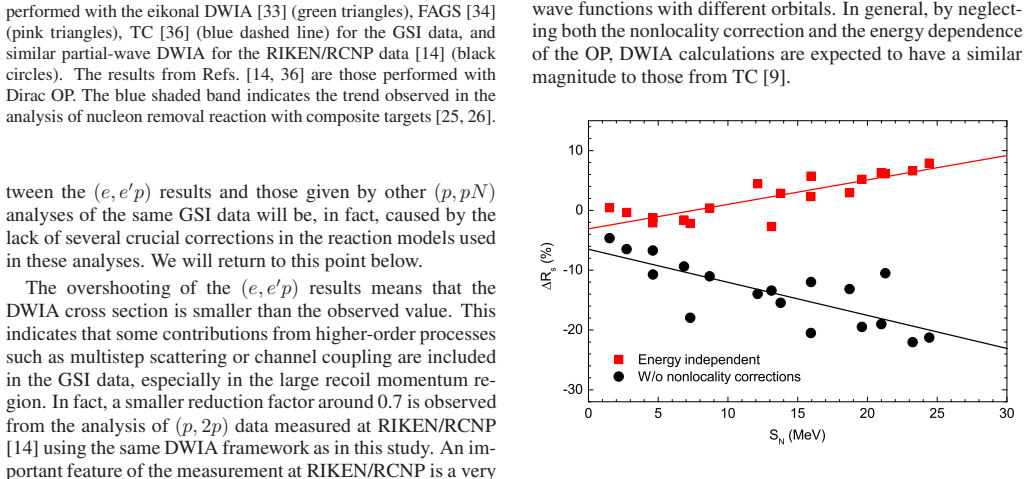
- Neglecting the nonlocality corrections and the Møller factor shifts $R_s$ by up to roughly 18–26%, and these effects partly cancel the missing higher-order strength; future model comparisons must include them.
- Momentum distributions, not just integrated cross sections, are needed to expose missing reaction mechanisms; the 150–300 MeV/c undershoot is the diagnostic signature.
- Measurements with kinematics tightly restricted to the quasifree condition give smaller $R_s$ values, so restricting acceptance reduces the influence of the higher-order effects the paper identifies.
Reading between the lines
- The authors' own diagnosis implies a concrete prediction: if higher-order processes are the cause, the discrepancy between DWIA and data should grow monotonically with recoil momentum, vanish at the quasifree point, and be largely independent of the target isotope once the single-particle wave function is fixed.
- Because the Møller factor is a known function of beam energy, a scan of the same knockout channel across 300–450 MeV/u could isolate its contribution and sharpen the extracted $R_s$ without changing nuclear-structure inputs.
- The near-unity $R_s$ values, combined with the missing high-momentum strength, suggest that semi-inclusive inverse-kinematics knockout may systematically overestimate spectroscopic factors unless the acceptance is restricted; this could reconcile the (p,pN) results with the smaller $(e,e'p)$ quenching factors.
- Extending the same correction set to a nonlocal dispersive optical model, which the authors note is underway, would test whether the Perey/Darwin treatment captures all nonlocality or whether part of the high-momentum discrepancy is a wave-function effect rather than a reaction effect.
Signed reviews
Editorial analysis
A structured set of objections, weighed in public.
Referee Report
Summary. The paper presents a partial-wave distorted-wave impulse approximation (DWIA) analysis of all eighteen published R3B/LAND (p,2p) and (p,pn) cross sections on carbon, nitrogen, and oxygen isotopes at 300–450 MeV/u. The authors compute single-particle cross sections using Dirac optical potentials (EDAD2), Woods-Saxon bound states with radii matched to Hartree-Fock and depths fixed by separation energies, Franey-Love t-matrix amplitudes, and shell-model spectroscopic factors. They include nonlocality corrections (Perey and Darwin factors), the Møller factor, and energy-dependent final-state optical potentials, and they estimate uncertainties from alternative inputs. The central result is that the extracted reduction factors Rs = σexp/σth show a very weak dependence on proton-neutron asymmetry ΔS, fitted as Rs = 0.947(36) − 2.6(27)×10⁻³ ΔS with reduced χ²/N = 0.74. The transverse momentum distribution of ¹²C(p,2p)¹¹B is also analyzed and is found to undershoot the data in the 150–300 MeV/c region, which the authors attribute to missing higher-order effects such as multistep scattering or channel coupling.
Significance. If the weak asymmetry dependence of Rs holds, it would strengthen the case that (p,pN) reactions at intermediate energies probe the same spectroscopic strength as transfer and ab initio methods, in contrast to the steeper asymmetry reported from composite-target knockout. The paper is valuable for its systematic quantification of input choices: nonlocality, Møller factor, energy-dependent optical potentials, and NN interaction prescription. The calculations are based on standard, documented ingredients, and no parameter of the reaction model is fitted to the GSI cross sections, which is a clear strength. The comparison with other reaction models and with (e,e′p) results is informative and properly highlights the role of higher-order effects. However, the paper's own admission that important higher-order contributions are missing from the model means that the absolute values of Rs, and potentially their ΔS dependence, are not yet reliably established.
major comments (2)
- [Sec. III B, Table I, Fig. 5] The central claim of a very weak ΔS dependence of Rs rests on the unquantified assumption that the missing higher-order effects, which the authors explicitly identify in Sec. IV and Fig. 5, do not vary systematically with ΔS. The data in Table I show a concrete pattern consistent with such a variation: for 21N, Rs = 0.70(14) in (p,2p) versus 1.25(23) in (p,pn); for 22O, 0.87(14) versus 1.08(19); and for 23O, 0.99(24) versus 1.08(28). Since Fig. 5 shows that the missing strength appears at recoil momenta of 150–300 MeV/c, and since the fraction of the semi-inclusive cross section in that region grows with the separation energy of the knocked-out nucleon, proton removal from neutron-rich nuclei (deeply bound protons) should be underestimated more than neutron removal (weakly bound neutrons). This is exactly the pattern needed to produce a negative fitted slope. The authors do not estimate the magnitude or ΔS dependence of the missing higher-order contributions, so the fitted slope Rs = 0.947(36) − 2.6(27)×10⁻³ ΔS cannot currently be interpreted as a property of spectroscopic strength rather than a reaction-model artifact. I request a quantitative sensitivity estimate, for example by comparing results under restricted quasi-free kinematics, by using a reaction model that includes multistep contributions, or by artificially removing the high-recoil region and refitting the slope.
- [Sec. III C and Sec. IV] The paper states that the close-to-unity reduction factors 'indicate a fundamental problem in current reaction models' and that higher-order effects are missing, yet it also compares the DWIA Rs values with ab initio SCGF and CC results in Fig. 1 and concludes consistency of the weak trend. These statements are in tension: if the missing higher-order strength affects the integrated cross sections, then the absolute values of Rs are systematically too high, and the comparison in Fig. 1 is not a clean test of the structure calculations. The authors should explicitly separate conclusions that are robust under the admitted missing effects (e.g., the relative behavior of different input choices) from those that are not (e.g., the absolute magnitude and the slope of Rs versus ΔS).
minor comments (4)
- [Sec. III A] The adopted 10% uncertainty for the single-particle wave functions is stated without a detailed derivation; the text says it is based on Refs. [25,36] and a comparison with (e,e′p) analyses, but a short explanation of how this number was obtained would improve transparency.
- [Table I] The σth column is given without uncertainties, while the text quotes total relative uncertainties of 15–25% for Rs. It would be clearer to show the theoretical uncertainty on σth or to state explicitly that the quoted uncertainties on Rs already include it.
- [Abstract and Sec. IV] The sentence 'some higher-order effects, which is essential for an accurate cross-section description at large recoil momentum, is missing' has a subject–verb agreement error: 'effects' is plural, so 'are missing' (or rephrase as 'an effect ... is missing').
- [Fig. 5] The caption mentions the blue dotted line as the nonlocality-corrected result scaled by 0.655, but the body text says the scaling factor is 0.66. The numbers should be made consistent.
Circularity Check
No significant circularity: Rs values are ratios of external GSI cross sections to DWIA predictions built from independent optical potentials, HF radii, shell-model spectroscopic factors, and literature NN amplitudes; the linear slope is an output summary, not an input.
full rationale
The derivation chain is self-contained with respect to circularity. The transition amplitude (Eq. 1), momentum distribution (Eq. 2), Møller factor (Eqs. 4-5), and Perey/Darwin factors (Eqs. 8-9) are fixed prescriptions using inputs from independent published sources: EDAD Dirac optical potentials [45], Hartree-Fock radii with Skyrme SkX [47], WBT shell-model spectroscopic factors [53], and Franey-Love NN amplitudes [37]. No parameter of the reaction calculation is fitted to the GSI cross sections. The reduction factor is defined as Rs = σexp/σth (Table I), i.e., a ratio of external experimental data to a priori DWIA predictions. The linear fit Rs = 0.947(36) − 2.6(27)×10−3 ΔS is a summary statistic of these extracted ratios, not a fitted input that is then called a prediction. The TMD comparison in Fig. 5 uses the already-extracted Rs only to normalize the calculated shape; the shape comparison, and the observed 150–300 MeV/c undershoot, is an independent check. Citations to the authors' prior work (e.g., Refs. [4,9]) supply the standard DWIA factorization, but they are not used as a uniqueness theorem or as evidence for the weak-asymmetry claim; that claim is supported by the calculation against external data and by agreement with independent TC, FAGS, eikonal-DWIA, CC, and SCGF analyses. The skeptical concern that missing higher-order effects may bias the ΔS slope is a physics-accuracy critique, not a circularity: it does not identify any input that is equivalent to the output by construction.
Assumptions & free parameters
free parameters (6)
- Woods-Saxon central depth for each single-particle state =
Adjusted to reproduce experimental separation energy
- Woods-Saxon radius parameter =
Set by <r^2> = [A/(A-1)]<r^2>_HF with Skyrme SkX
- Woods-Saxon spin-orbit depth Vso =
6 MeV
- Woods-Saxon diffuseness a =
0.7 fm
- Nonlocality range beta =
0.85 fm
- Linear-fit intercept and slope of Rs versus ΔS =
intercept = 0.947(36); slope = -2.6(27)x10^-3
assumptions (8)
- domain assumption Three-body wave function separates into two two-body distorted waves (Eq. 1)
- domain assumption Kinematic coupling term in the exit channel Hamiltonian may be approximated
- domain assumption Perey factor replaces the nonlocal bound-state wave function with a local-equivalent form
- domain assumption Darwin factor accounts for the relativistic velocity dependence of Dirac optical waves
- standard math Møller factor transforms the pN cross section between the two-nucleon center-of-mass frame and the three-body frame
- domain assumption Franey-Love t-matrix with final-energy prescription gives the half-off-shell pN amplitude
- domain assumption Shell-model spectroscopic factors with WBT interaction and center-of-mass correction are the correct single-particle-strength fragmentation inputs
- domain assumption The measured semi-inclusive cross sections are sums over all bound states of the residual nucleus, with no continuum contribution
Cite this review
Pith. "Pith review of Toward a reliable description of ${(p,pN)}$ reactions in the distorted-wave impulse approximation." pith.science (2026). https://pith.science/paper/OFOSBYO4
@misc{pith2026190800667,
  author       = {Pith},
  title        = {Pith review of: Toward a reliable description of $(p,pN)$ reactions in the distorted-wave impulse approximation},
  year         = {2026},
  howpublished = {\url{https://pith.science/paper/OFOSBYO4}},
  note         = {Machine review of arXiv:1908.00667}
}
abstract
Background: Proton-induced nucleon knockout $(p,pN)$ reactions have been successfully used to study the single-particle nature of stable nuclei in normal kinematics with the distorted-wave impulse approximation (DWIA) framework. Recently, these reactions have been applied to rare-isotope beams at intermediate energies in inverse kinematics to study the quenching of spectroscopic factors. Purpose: Our goal is to investigate the effects of various corrections and uncertainties within the standard DWIA formalism on the $(p,pN)$ cross sections. The consistency of the extracted reduction factors between DWIA and other methods is also evaluated. Method: We analyze the $(p,2p)$ and $(p,pn)$ reactions data measured at the R$^3$B/LAND setup at GSI for carbon, nitrogen, and oxygen isotopes in the incident energy range of 300--450 MeV/u. Cross sections and reduction factors are calculated by using the DWIA method. The transverse momentum distribution of the $^{12}$C($p$,$2p$)$^{11}$B reaction is also investigated. Results: We have found that including the nonlocality corrections and the M\o ller factor affects the cross sections considerably. The proton-neutron asymmetry dependence of reduction factors extracted by the DWIA calculation is very weak and consistent with those given by other reaction methods and \textit{ab initio} structure calculations. Conclusions: The results found in this work provide a detailed investigation of the DWIA method for $(p,pN)$ reactions at intermediate energies. They also suggest that some higher-order effects, which is essential for an accurate cross-section description at large recoil momentum, is missing in the current DWIA and other reaction models.
Figures

Figures from the paper (2 more)


Reference graph
Works this paper leans on
-
[14]
using the same DWIA framework as in this study. An im- portant feature of the measurement at RIKEN/RCNP is a very constrained kinematics corresponding to the quasifree con di- tion. This supports the conclusion that the lack of higher-order effects will be the main reason for the underestimation of th e GSI data with the current DWIA calculation. The disc...
- [1]
- [2]
-
[3]
P . Kitching, W. J. McDonald, Th. A. J. Maris, and C. A. Z. V asconcellos, Adv. Nucl. Phys.15, 43 (1985)
work page 1985
-
[4]
Wakasa, K
T. Wakasa, K. Ogata, and T. Noro, Prog. Part. Nucl. Phys. 96, 32 (2017)
2017
-
[5]
6(27) × 10−3∆ S with a reduced χ 2/N of 0.74
947(36) − 2. 6(27) × 10−3∆ S with a reduced χ 2/N of 0.74. As discussed in Sec. III C, the close-to-unity reduction fac tor does not necessarily mean that the quenching effect observe d in (p, pN ) reactions is weak but rather indicates a fundamen- tal problem in current reaction models. The reduction factors from DWIA are compared with the reduced SFs, w...
-
[6]
N. S. Chant and P . G. Roos, Phys. Rev. C 27, 1060 (1983)
work page 1983
-
[7]
Aumann, C
T. Aumann, C. A. Bertulani, and J. Ryckebusch, Phys. Rev. C 88, 064610 (2013)
2013
Show all 65 references
-
[8]
Ogata, K
K. Ogata, K. Y oshida and K. Minomo, Phys. Rev. C 92, 034616 (2015)
2015
-
[9]
Y oshida, M
K. Y oshida, M. Gómez-Ramos, K. Ogata, and A. M. Moro, Phys. Rev. C 97, 024608 (2018)
2018
-
[10]
Olivier, S
L. Olivier, S. Franchoo, M. Niikura, Z. V ajta, D. Sohler , P . Doornenbal, A. Obertelli, Y . Tsunoda, T. Otsuka, G. Authele t et al., Phys. Rev. Lett. 119, 192501 (2017)
2017
-
[11]
Elekes, Á
Z. Elekes, Á. Kripkó, D. Sohler, K. Sieja, K. Ogata, K. Y oshida, P . Doornenbal, A. Obertelli, G. Authelet, H. Baba et al., Phys. Rev. C 99, 014312 (2019)
2019
-
[12]
N. S. Chant and P . G. Roos, Phys. Rev. C 15, 57 (1977)
1977
-
[13]
S. Chen, J. Lee, P . Doornenbal, A. Obertelli, C. Barbier i, Y . Chazono, P . Navrátil, K. Ogata, T. Otsuka, F. Raimondi et al. , Phys. Rev. Lett. 123, 142501 (2019)
2019
-
[15]
Crespo, A
R. Crespo, A. Deltuva, E. Cravo, M. Rodríguez-Gallardo , and A. C. Fonseca, Phys. Rev. C 77, 024601 (2008)
2008
-
[16]
Crespo, E
R. Crespo, E. Cravo, and A. Deltuva, Phys. Rev. C 99, 054622 (2019)
2019
-
[17]
A. M. Moro, Phys. Rev. C 92, 044605 (2015)
2015
-
[18]
Lapikás, Nucl
L. Lapikás, Nucl. Phys. A 553, 297c (1993)
1993
-
[19]
Taniuchi, C
R. Taniuchi, C. Santamaria, P . Doornenbal, A. Obertell i, K. Y oneda, G. Authelet, H. Baba, D. Calvet, F. Château, A. Corsi et al., Nature 569, 53 (2019)
2019
-
[20]
Dickhoff and C
W. Dickhoff and C. Barbieri, Prog. Part. Nucl. Phys. 52, 377 (2004)
2004
-
[21]
Kawase, T
S. Kawase, T. Uesaka, T. L. Tang, D. Beaumel, M. Dozono, T . Fukunaga, T. Fujii, N. Fukuda, A. Galindo-Uribarri, S. Hwan g et al., Prog. Theor. Exp. Phys. 2018, 021D01 (2018)
2018
-
[22]
Barbieri, Phys
C. Barbieri, Phys. Rev. Lett. 103, 202502 (2009)
2009
-
[23]
Jensen, G
Ø. Jensen, G. Hagen, M. Hjorth-Jensen, B. A. Brown, and A . Gade, Phys. Rev. Lett. 107, 032501 (2011)
2011
-
[24]
democratic
calculations. V ery recently, a series of(p, pN ) measurements for carbon- , nitrogen-, and oxygen-isotope beam with incident energy range of 300–450 MeV/u in inverse kinematics was performed at the R 3B/LAND setup at GSI Helmholtzzentrum für Schw- erionenforschung in Darmstad...
-
[25]
A. Gade, P . Adrich, D. Bazin, M. D. Bowen, B. A. Brown, C. M. Campbell, J. M. Cook, T. Glasmacher, P . G. Hansen, K. Hosier et al., Phys. Rev. C 77, 044306 (2008)
2008
-
[26]
V . R. Pandharipande, I. Sick, and P . K. A. d. Huberts, Rev. Mod. Phys. 69, 981 (1997)
1997
-
[27]
J. Lee, J. A. Tostevin, B. A. Brown, F. Delaunay, W. G. Lyn ch, M. J. Saelim, and M. B. Tsang, Phys. Rev. C 73, 044608 (2006)
2006
-
[28]
Sick, Prog
I. Sick, Prog. Part. Nucl. Phys. 59, 447 (2007)
2007
-
[29]
Flavigny, N
F. Flavigny, N. Keeley, A. Gillibert, and A. Obertelli, Phys. Rev. C 97, 034601 (2018)
2018
-
[30]
B. P . Kay, J. P . Schiffer, and S. J. Freeman, Phys. Rev. Lett. 111, 042502 (2013)
2013
-
[31]
Cipollone, C
A. Cipollone, C. Barbieri, and P . Navrátil, Phys. Rev. C 92, 014306 (2015)
2015
-
[32]
Panin, J
V . Panin, J. T. Taylor, S. Paschalis, F. Wamers, Y . Aksyu tina, H. Alvarez-Pol, T. Aumann, C. A. Bertulani, K. Boretzky, C. Caesar et al., Phys. Lett. B 753, 204 (2016)
2016
-
[33]
The reduction factor Rs = σexp/σ th is given in the last column
and 21N,22,23O [34]. The reduction factor Rs = σexp/σ th is given in the last column. The reduction factors as a function of the proton-neutron asymmetry ∆ S is shown in Fig. 1. The value calculated from the present DWIA analysis is indicated by red squares with error bars pro...
-
[34]
J. A. Tostevin and A. Gade, Phys. Rev. C 90, 057602 (2014)
2014
-
[35]
Flavigny, A
F. Flavigny, A. Gillibert, L. Nalpas, A. Obertelli, N. K eeley, C. Barbieri, D. Beaumel, S. Boissinot, G. Burgunder, A. Cipollone et al., Phys. Rev. Lett. 110, 122503 (2013)
2013
-
[36]
Gómez-Ramos and A
M. Gómez-Ramos and A. M. Moro, Phys. Lett. B 785, 511 (2018)
2018
-
[37]
Different choices of the on-shell approximat ion such as initial-energy and average-energy prescriptions g ive an uncertainty of 2% for (p, 2p) and 8% for (p, pn ) processes
with a final-energy prescription, which has been sug- gested to be the best approximation for the half-off-shell a m- plitude [49]. Different choices of the on-shell approximat ion such as initial-energy and average-energy prescriptions g ive an uncertainty of 2% for (p, 2p) an...
-
[38]
Y . P . Xu, D. Y . Pang, X. Y . Y un, C. Wen, C. X. Y uan, and J. L. Lou, Phys. Lett. B 790, 308 (2019)
2019
-
[39]
A. K. Kerman, H. McManus, and R. M. Thaler, Ann. Phys. (NY) 8, 551 (1959)
1959
-
[40]
L. Atar, S. Paschalis, C. Barbieri, C. A. Bertulani, P . D íaz Fer- nández, M. Holl, M. A. Najafi, V . Panin, H. Alvarez-Pol, T. Aumann et al., Phys. Rev. Lett. 120, 052501 (2018)
2018
-
[41]
Díaz Fernández, H
P . Díaz Fernández, H. Alvarez-Pol, R. Crespo, E. Cravo, L. Atar, A. Deltuva, T. Aumann, V . Avdeichikov, S. Beceiro-Novo, D. Bemmerer et al., Phys. Rev. C 97, 024311 (2018)
2018
-
[42]
M. Holl, V . Panin, H. Alvarez-Pol, L. Atar, T. Aumann, S. Beceiro-Novo, J. Benlliure, C.A. Bertulani, J.M. Boillos, K. Boretzky et al., Phys. Lett. B 795, 682 (2019)
2019
-
[43]
S. Hama, B. C. Clark, E. D. Cooper, H. S. Sherif, and R. L. Mercer, Phys. Rev. C 41, 2737 (1990)
1990
-
[44]
M. A. Franey and W. G. Love, Phys. Rev. C 31, 488 (1985)
1985
-
[45]
Møller, Kgl
C. Møller, Kgl. Danske Videnskab. Selsbak, Mat-fys. Medd. 23, 1 (1945)
1945
-
[46]
E. D. Cooper, S. Hama, and B. C. Clark, Phys. Rev. C 80, 034605 (2009)
2009
-
[47]
F. G. Perey, Direct Interactions and Nuclear Reaction Mech- anism (Gordon and Breach Science Publishers, New Y ork, 1963), p. 125
1963
-
[48]
Perey and B
F. Perey and B. Buck, Nucl. Phys. 32, 353 (1962)
1962
-
[49]
L. G. Arnold, B. C. Clark, R. L. Mercer, and P . Schwandt, Phys. 8 Rev. C 23, 1949 (1965)
1965
-
[50]
V . G. J. Stoks, R. A. M. Klomp, C. P . F. Terheggen, and J. J. de Swart, Phys. Rev. C 49, 2950 (1994)
1994
-
[51]
J. M. Udías, P . Sarriguren, E. Moya de Guerra, E. Garrido , and J. A. Caballero, Phys. Rev. C 51, 3246 (1995)
1995
-
[52]
E. D. Cooper, S. Hama, B. C. Clark, and R. L. Mercer, Phys. Rev. C 47, 297 (1993)
1993
-
[53]
correction [54]
and includes the c.m. correction [54]. Since many of the considered nuclei are weakly bound, the use of SF calcu- lated from the SM, compared with the IPM limit, provides a more proper description of single-particle-strength frag men- tation near the Fermi level. B. Reduction ...
-
[54]
Brown, Phys
B.A. Brown, Phys. Rev. C 58, 220 (1998)
1998
-
[55]
G. J. Kramer, H. P . Blok, and L. Lapikás, Nucl. Phys. A 679, 267 (2001)
2001
-
[56]
We compare also with the result of the more recent SCGF calculation in Ref
with Λ 3N = 400 MeV . We compare also with the result of the more recent SCGF calculation in Ref. [33] based on the NNLO-sat [57] for the NN interaction, which is more opti- mized for the mass region in that study. The present DWIA calculation shows a reasonable agreement with...
-
[57]
E. F. Redish, G. J. Stephenson, Jr., and G. M. Lerner, Phy s. Rev. C 2, 1665 (1970)
1970
-
[58]
Machleidt, Phys
R. Machleidt, Phys. Rev. C 63, 024001 (2001)
2001
-
[59]
R. A. Arndt, I. I. Strakovsky, and R. L. Workman, Int. J. M od. Phys. A 18, 449 (2003)
2003
-
[60]
E. K. Warburton and B. A. Brown, Phys. Rev. C 46, 923 (1992)
1992
-
[61]
A. E. L. Dieperink and T. de Forest, Jr., Phys. Rev. C 10, 543 (1974)
1974
-
[62]
D. R. Entem and R. Machleidt, Phys. Rev. C 68, 041001 (R) (2003)
2003
-
[63]
R. Roth, S. Binder, K. V obig, A. Calci, J. Langhammer, an d P . Navrátil, Phys. Rev. Lett. 109, 052501 (2012)
2012
-
[64]
Ekström, G
A. Ekström, G. R. Jansen, K. A. Wendt, G. Hagen, T. Pa- penbrock, B. D. Carlsson, C. Forssén, M. Hjorth-Jensen, P . Navrátil, and W. Nazarewicz, Phys. Rev. C 91, 051301 (2015)
2015
-
[65]
M. C. Atkinson, H. P . Blok, L. Lapikás, R. J. Charity, and W. H. Dickhoff, Phys. Rev. C 98, 044627 (2018)
2018
Reviewed August 14, 2026 · model on record in the stance chip above.
Discussion (0). Continue with ORCID to comment.