REVIEW 4 major objections 4 minor 3 cited by
Altermagnetism-driven FFLO superconductivity in finite-filling 2D lattices
T0 review · 4 major / 4 minor · reviewed 2026-08-03 · deepseek-v4-flash
Pith's one-line read Which altermagnet symmetry wins at making FFLO superconductivity depends on filling, and d_xy wins broadly at low filling while d_x2-y2 only works narrowly at high filling.
desk verdict Solid mean-field map of d_xy vs d_x2-y2 altermagnetic FFLO at finite filling; the qualitative contrast is likely right, but the boundaries rest on a single-plane-wave FF ansatz and the VHS suppression is correlational. read the letter →
The pith
A machine-rendered reading of the paper's core claim, the machinery that carries it, and where it could break.
The reading
What carries the argument
The central object is the spin-dependent single-particle dispersion ξ_k ± J_k, where the altermagnetic order enters as a d-wave spin-splitting term: J_k = −λ sin k_x sin k_y for d_xy-wave, and J_k = −(t_am/2)(cos k_x − cos k_y) for d_x2−y2-wave. Two complementary tools carry the argument: the non-self-consistent T-matrix ladder sum, whose inverse vertex function Γ^{-1}(q, ω=0) is maximized at a nonzero pairing momentum q (Thouless criterion), and the mean-field thermodynamic potential Ω(Δ, q) minimized over the pairing amplitude Δ and the FFLO momentum q. The direction of the optimal q is dictated by the altermagnet symmetry—along the axes for d_xy, along the diagonals for d_x2−y2—and the co
What would settle it
A direct check would be to minimize the full mean-field thermodynamic potential over an arbitrary spatial profile of Δ(x), or over a superposition of q and −q (LO state), at the parameters where the paper predicts a BCS–FFLO transition (e.g., ν = 1.0, U = −3t, λ above about 0.87t). If an LO or multi-q state has lower energy there, the claimed phase diagram would not describe the true ground state.
Extended reading notes
Core claim
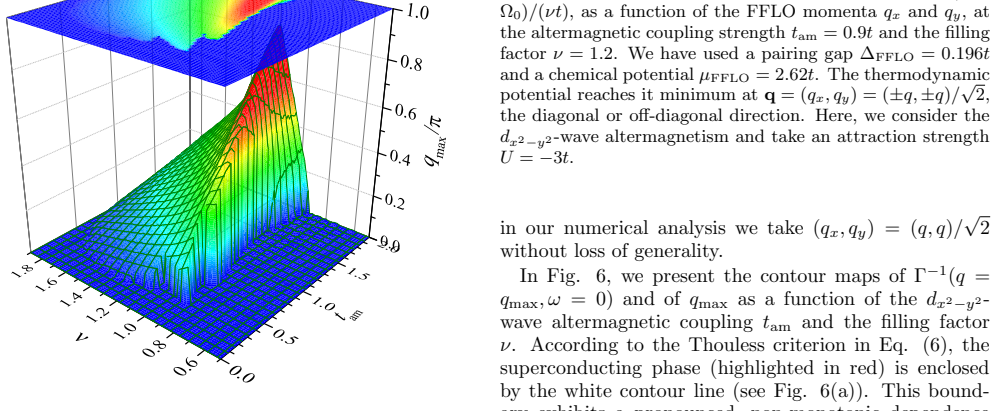
The central claim is that the symmetry of the altermagnetic spin-splitting term dictates whether finite-momentum pairing survives away from the dilute limit. In a single-band square-lattice Hubbard model with on-site s-wave attraction and next-nearest-neighbor hopping, the authors show through mean-field Bogoliubov–de Gennes calculations and a non-self-consistent T-matrix Thouless criterion that d_xy-wave altermagnetism produces a stable FFLO phase over a wide range of low fillings, with a quantum Lifshitz point where BCS, FFLO, and normal phases meet. In contrast, d_x2-y2-wave altermagnetism yields finite-momentum pairing only for filling factors above roughly one electron per site (ν > ~1)
Load-bearing premise
The calculation assumes the superconducting order parameter is a single plane wave, Δ(x) = Δ e^{iq·x}, with q chosen along the direction set by the normal-state T-matrix maximum, and never lets an LO (cos q·x) or multi-q texture compete for the ground state, so the phase boundaries are trusted only if that FF ansatz is the true energy minimum.
Editorial extensions
If this is right
- The symmetry of the altermagnetic order becomes a practical selection rule: d_xy-wave altermagnets are promising for zero-field FFLO superconductivity, while d_x2−y2-wave altermagnets are largely ineffective away from high filling.
- The Van Hove singularity, rather than enhancing superconductivity, narrows or suppresses the FFLO regime; materials with flat bands near the Fermi level may be less, not more, favorable for finite-momentum pairing.
- The existence of a quantum Lifshitz point, where BCS, FFLO, and normal states meet, gives a precise experimental target: tuning filling and altermagnetic coupling near this point should show sharp signatures of finite-momentum pairing.
- To emulate real candidate materials, the next-nearest-neighbor hopping term breaks particle-hole symmetry and shifts the Van Hove singularity; the predicted phase diagrams change substantially with this hopping.
- At low fillings the two altermagnet types are equivalent under a π/4 rotation, so dilute-limit experiments cannot distinguish them; distinguishing evidence must come from finite-filling measurements.
Reading between the lines
- If the suppression near the Van Hove singularity is general, it suggests that engineering the Fermi surface away from saddle points—for example by strain or doping—could widen the FFLO window more effectively than simply increasing the altermagnetic coupling.
- The authors restrict the superconducting order to a single plane-wave FF form, Δ e^{iq·x}; a full competition with LO or multi-q textures might shift the BCS–FFLO boundaries, but the qualitative contrast between d_xy and d_x2−y2 could persist because it originates in the normal-state susceptibility maximum location.
- The temperature dependence shown for d_xy-wave altermagnetism (a Lifshitz point at T_c ≈ 0.56 T_c^0) suggests finite-momentum pairing is a low-temperature phenomenon; experiments should look for the FFLO phase only well below the zero-field superconducting T_c.
- For d_x2−y2-wave altermagnets, the prediction of FFLO only at high filling (ν ≳ 1) with moderate coupling could be tested by angle-resolved photoemission or thermodynamic probes on candidate materials, if the single-band model captures their essential band structure.
Editorial analysis
A structured set of objections, weighed in public.
Referee Report
Summary. The paper investigates finite-momentum FFLO superconductivity in a square-lattice Hubbard model with on-site attraction and two types of d-wave altermagnetism, dxy and dx2-y2, including next-nearest-neighbor hopping. The authors use a non-self-consistent T-matrix Thouless criterion in the normal state and Bogoliubov mean-field theory in the superconducting state, assuming a single-plane-wave FF order parameter. They report that dxy altermagnetism stabilizes FFLO over a broad parameter range at low fillings, while dx2-y2 altermagnetism only gives a narrow FFLO region at high fillings, and they attribute a suppression of superconductivity near ν≈0.6–0.8 to the Van Hove singularity. Appendix B explicitly shows the low-filling equivalence of the two altermagnetic forms via a momentum-space rotation.
Significance. If the symmetry/filling dichotomy is robust, the result gives useful guidance for searching for altermagnetism-induced FFLO in lattice materials and extends earlier continuum and two-band analyses. The combination of a normal-state instability criterion and a superconducting-state mean-field calculation is methodologically appropriate, and the explicit dilute-limit rotation in Appendix B is a valuable check. The central claims rest, however, on quantitative phase boundaries that are computed within a restricted single-plane-wave ansatz and on a Van Hove argument that is currently correlational; the paper would be strengthened substantially by tests of the LO/multi-q competition and by more direct numerical evidence for the VHS mechanism.
major comments (4)
- [Sec. III B, Eq. (10); Figs. 5 and 8] The superconducting order parameter is restricted to a single plane wave, Δ(x)=Δ e^{iq·x}, and Ω is minimized only over Δ and q. Since the minima appear at ±q (Fig. 3), the Larkin-Ovchinnikov state Δ cos(q·x), which includes both q and -q, is not considered. In single-band lattice models the FF vs. LO competition is known to be parameter-dependent, and Ref. [33] is a two-band Ginzburg-Landau analysis, not a justification for the present single-band effective model. Because Figs. 5 and 8 are the quantitative basis for the main claim, please compare the thermodynamic potential of an LO or multi-q texture, or at least investigate the stability of the FF state against q↔-q mixing.
- [Eq. (8)] Equation (8) writes the inverse vertex function with ξ_{q/2+k''↑} in both Fermi functions and in the denominator. For a spin-singlet pair with momenta k+q/2 (↑) and -k+q/2 (↓), the second single-particle energy should be ξ_{q/2-k''↓}=ξ_{q/2-k''}-J_{q/2-k''}. Since both d-wave forms of J_k used here are even under k→-k, this is not a relabeling effect. Please verify whether the code used the expression as printed or the spin-down form; if the printed formula was used literally, the T-matrix instability results in Figs. 2, 6, and 9 could be affected.
- [Secs. IV A, IV B and Sec. V] The abstract claims that a Van Hove singularity 'tends to suppress' FFLO superconductivity, but the evidence in the text is correlational: Sec. IV A says the narrowing 'might be associated' with the VHS and Sec. IV B says it 'might be related.' No density of states is shown, and the position ν_VH≈0.66 is taken from the cited dispersion without a direct computation. A controlled check, e.g., varying t' to move the VHS or overlaying the DOS on the phase diagrams, would make this claim load-bearing. Otherwise the abstract should be softened.
- [Sec. IV (numerical details)] The study is purely numerical, but no k-grid size, convergence tolerance for the identity Im Γ^{-1}=0 [Eq. (9)], or error estimates are reported. The phase boundaries in Figs. 5 and 8 are inferred from contour plots, and η=0.02t is fixed without a check of its effect. As written, the quantitative boundaries cannot be reproduced or independently verified. Please provide the numerical parameters, convergence tests, and ideally make the data/code available.
minor comments (4)
- [Sec. II heading] The heading reads 'MODEL HAMIL TONIAN'; 'HAMILTONIAN' should be one word.
- [Sec. II, Eq. (1)] The symbol s(σ) is not explicitly defined; please state s(↑)=+1 and s(↓)=-1.
- [Eq. (10)] Describing Δ as a 'real order parameter' while writing Δ(x)=Δ e^{iq·x} may confuse readers; clarify that the amplitude is real but the order parameter is spatially phase-modulated.
- [Throughout] The spacing in 'd xy-wave' and 'd x2−y2-wave' is inconsistent; use uniform notation such as d_{xy}-wave and d_{x^2-y^2}-wave.
Circularity Check
No circular derivation: phase diagrams are computed by explicit minimization of the thermodynamic potential; the FF ansatz is a stated assumption, not a disguised input.
full rationale
I walked the paper's derivation chain. The model Hamiltonian (Eqs. 1-2) defines the spin-split dispersion and on-site attraction. The normal-state pairing instability is determined by the Thouless criterion applied to the ladder vertex function (Eqs. 6-8), and the superconducting phase is obtained by minimizing the mean-field thermodynamic potential Ω(Δ, q) with respect to both the pairing amplitude and the finite momentum q (Eqs. 17-20), with μ adjusted by the number equation (Eq. 21). The reported BCS-FFLO-normal phase boundaries in Figs. 5 and 8 are outputs of this minimization, not inputs; no parameter is fitted to the target result. The dilute-limit equivalence between d_xy and d_{x^2-y^2} altermagnetism is shown by an explicit π/4 rotation of the low-k dispersion (Appendix B, Eqs. B1-B3), not by assuming the answer. The paper does cite the authors' own prior work ([21,34,36,42]) for the standard mean-field framework, the FF ansatz, and the Lifshitz-point terminology, but these citations are not load-bearing in a circular sense: all central numerical results are generated within the present manuscript. The single-plane-wave FF ansatz, Δ(x)=Δ e^{iq·x}, is an explicit modeling assumption (Sec. III B), not a hidden reduction of the result to its input, because q is a variational parameter and the emergence of nonzero q is the computed outcome. The failure to consider LO or multi-q textures is a physical modeling limitation that could affect the ground-state identification, but it is not circularity under the definitions used here. Therefore no circular step is present; the paper is self-contained in its derivation, and the modest score reflects only the presence of non-load-bearing self-citations.
Assumptions & free parameters
free parameters (4)
- t' (next-nearest-neighbor hopping) =
-0.35t
- U (on-site attraction) =
-3t
- T (temperature in most calculations) =
0.01t
- η (imaginary broadening) =
≈0.02t
assumptions (7)
- standard math BCS mean-field decoupling of the on-site attractive interaction
- standard math Bogoliubov transformation and thermodynamic potential expression
- standard math Ladder (T-matrix) summation and Thouless criterion
- domain assumption Single-band effective model with d-wave altermagnetic splitting J_k of the given forms
- ad hoc to paper The superconducting order is a single-plane-wave FF state Δ e^{iq·x}
- domain assumption Non-self-consistent T-matrix and mean-field are quantitatively reliable at U=-3t
- domain assumption t'=-0.35t is representative and the VHS location follows from [38]
Cite this review
Pith. "Pith review of Altermagnetism-driven FFLO superconductivity in finite-filling 2D lattices." pith.science (2026). https://pith.science/paper/OFWJ4Z6T
@misc{pith2026260106735,
  author       = {Pith},
  title        = {Pith review of: Altermagnetism-driven FFLO superconductivity in finite-filling 2D lattices},
  year         = {2026},
  howpublished = {\url{https://pith.science/paper/OFWJ4Z6T}},
  note         = {Machine review of arXiv:2601.06735}
}
abstract
We systematically investigate the emergence of finite-momentum Fulde-Ferrell-Larkin-Ovchinnikov (FFLO) superconductivity in a square lattice Hubbard model with finite filling, driven by either $d_{xy}$-wave or $d_{x^{2}-y^{2}}$-wave altermagnetic order in the presence of on-site $s$-wave attractive interactions. Our study combines mean-field calculation in the superconducting phase with pairing instability analysis of the normal state, incorporating the next-nearest-neighbor hopping in the single-particle dispersion relation. We demonstrate that the two types of altermagnetism have markedly different impacts on the stabilization of FFLO states. Specifically, $d_{xy}$-wave altermagnetism supports FFLO superconductivity over a broad parameter regime at low fillings, whereas $d_{x^{2}-y^{2}}$-wave altermagnetism only induces FFLO pairing in a narrow range at high fillings. Furthermore, we find that the presence of a Van Hove singularity in the density of states tends to suppress FFLO superconductivity. These findings may provide guidance for experimental exploration of altermagnetism-induced FFLO states in real materials with more complex electronic structures.
Figures


Figures from the paper (8 more)




Forward citations
Cited by 3 Pith papers
-
First-Order Topological FFLO Transition and Superconducting Diode Sign Reversal in Altermagnetic Nanowires
Altermagnetic coupling in a 1D SOC nanowire is predicted to drive a first-order transition between conventional (Z2=+1) and topological (Z2=-1) FFLO superconductivity, marked by a sign-reversing superconducting diode ...
-
Superconducting States and Intertwined Orders in Metallic Altermagnets
In C4T-symmetric d-wave altermagnets, equal-spin p-wave pairing condenses in two non-degenerate two-component gap sets, producing two transition temperatures, with nematic and spin-current-loop fluctuations respective...
-
Finite-momentum superconductivity with singlet-triplet mixing in an altermagnetic metal: A pairing instability analysis
In an altermagnetic square-lattice metal, the leading pairing instability is a finite-momentum FFLO state with a multi-component singlet-triplet order parameter.
Reference graph
Works this paper leans on
-
[33]
Liu and H Hu, Inhomogeneous Fulde-Ferrell super- fluidity in spin-orbit-coupled atomic Fermi gases, Phys
X.-J. Liu and H Hu, Inhomogeneous Fulde-Ferrell super- fluidity in spin-orbit-coupled atomic Fermi gases, Phys. Rev. A87, 051608(R) (2013)
2013
-
[1]
Ethics approval and consent to participate Not Applicable
-
[2]
Consequently, /s45/s48/s46/s53 /s48/s46/s48 /s48/s46/s53 /s45/s48/s46/s48/s48/s49/s48 /s45/s48/s46/s48/s48/s48/s53 /s48/s46/s48/s48/s48/s48 /s48/s46/s48/s48/s48/s53 /s48/s46/s48/s48/s49/s48 /s45/s48/s46/s53 /s48/s46/s48 /s48/s46/s53 /s48 /s113 /s121 /s113 /s120 /s45/s48/s46/s48/s48/s50 /s48 /s48/s46/s48/s48/s50 FIG. 7. The landscape of the thermodynamic p...
-
[3]
Consent for publication Not Applicable
-
[4]
Availability of data and materials The data generated during the current study are avail- able from the contributing author upon reasonable re- quest
-
[5]
Competing interests The authors have no competing interests to declare that are relevant to the content of this article
-
[6]
8 DP240100248 (X.-J.L.) and DP240101590 (H.H.)
Funding This research was supported by the Australian Re- search Council’s (ARC) Discovery Program, Grants Nos. 8 DP240100248 (X.-J.L.) and DP240101590 (H.H.)
-
[7]
All the authors read and approved the final manuscript
Authors’ contributions All the authors equally contributed to all aspects of the manuscript. All the authors read and approved the final manuscript
Show all 51 references
-
[8]
Acknowledgements See funding support
-
[9]
Figures 9(a) and 9(b) display contour plots of Γ −1(q=q max, ω= 0) and ofq max, respectively, as functions of the altermagnetic coupling strengthλand temperatureT
Authors’ information Xia-Ji Liu, Centre for Quantum Technology Theory, Swinburne University of Technology, Melbourne 3122, Australia, Email: xiajiliu@swin.edu.au Hui Hu, Centre for Quantum Technology Theory, Swinburne University of Technology, Melbourne 3122, Australia, Email:...
-
[10]
ˇSmejkal, J
L. ˇSmejkal, J. Sinova, and T. Jungwirth, Emerging Re- search Landscape of Altermagnetism, Phys. Rev. X12, 040501 (2022)
2022
-
[11]
Jungwirth, R
T. Jungwirth, R. M. Fernandes, E. Fradkin, A. H. Mac- Donald, J. Sinova, and L. ˇSmejkal, Altermagnetism: an unconventional spin-ordered phase of matter,Newton1, 100162 (2025)
2025
-
[12]
Z. Liu, H. Hu, and X.-J. Liu, Altermagnetism and super- conductivity: A short historical review, arXiv:2510.09170 (2025)
2025 arXiv
-
[13]
Y. Noda, K. Ohno, and S. Nakamura, Momentum- dependent band spin splitting in semiconducting MnO 2: a density functional calculation, Phys. Chem. Chem. Phys.18, 13294 (2016)
2016
-
[14]
M. Naka, S. Hayami, H. Kusunose, Y. Yanagi, Y. Mo- tome, and H. Seo, Spin current generation in organic an- tiferromagnets, Nat. Commun.10, 4305 (2019)
2019
-
[15]
Hayami, Y
S. Hayami, Y. Yanagi, and H. Kusunose, Momentum- Dependent Spin Splitting by Collinear Antiferromagnetic Ordering, J. Phys. Soc. Jpn.88, 123702 (2019)
2019
-
[16]
K.-H. Ahn, A. Hariki, K.-W. Lee, and J. Kuneˇ s, Antifer- romagnetism in RuO 2 asd-wave Pomeranchuk instabil- ity, Phys. Rev. B99, 184432 (2019)
2019
-
[17]
Hayami, Y
S. Hayami, Y. Yanagi, and H. Kusunose, Spontaneous antisymmetric spin splitting in noncollinear antiferro- magnets without spin-orbit coupling, Phys. Rev. B101, 220403(R) (2020)
2020
-
[18]
Hayami, Y
S. Hayami, Y. Yanagi, and H. Kusunose, Bottom-up de- sign of spin-split and reshaped electronic band structures in antiferromagnets without spin-orbit coupling: Proce- dure on the basis of augmented multipoles, Phys. Rev. B 102, 144441 (2020)
2020
-
[19]
ˇSmejkal, R
L. ˇSmejkal, R. Gonz´ alez-Hern´ andez, T. Jungwirth, and J. Sinova, Crystal time-reversal symmetry breaking and spontaneous Hall effect in collinear antiferromagnets, Sci. Adv.6, eaaz8809 (2020)
2020
-
[20]
I. I. Mazin, Altermagnetism in MnTe: Origin, predicted manifestations, and routes to detwinning, Phys. Rev. B 107, L100418 (2023)
2023
-
[21]
O. J. Amin, A. Dal Din, E. Golias, Y. Niu, A. Zakharov, S. C. Fromage, C. J. B. Fields, S. L. Heywood, R. B. Cousins, F. Maccherozzi, J. Krempask´ y, J. H. Dil, D. Kriegner, B. Kiraly, R. P. Campion, A. W. Rushforth, K. W. Edmonds, S. S. Dhesi, L. ˇSmejkal, T. Jungwirth, 10 /s...
2024
-
[22]
V. S. de Carvalho and H. Freire, Unconventional super- conductivity in altermagnets with spin-orbit coupling, Phys. Rev. B110, L220503 (2024)
2024
-
[23]
I. I. Mazin, Notes on altermagnetism and superconduc- tivity, AAPPS Bull.35, 8 (2025)
2025
-
[24]
Fukaya, B
Y. Fukaya, B. Lu, K. Yada, Y. Tanaka, and J. Cayao, Superconducting phenomena in systems with unconven- tional magnets, J. Phys.: Condens. Matter37, 313003 (2025)
2025
-
[25]
Zhang, L.-H
S.-B. Zhang, L.-H. Hu, and T. Neupert, Finite- momentum Cooper pairing in proximitized altermagnets, Nat. Commun.15, 1801 (2024)
2024
-
[26]
Fulde and R
P. Fulde and R. A. Ferrell, Superconductivity in a Strong Spin-Exchange Field, Phys. Rev.135, A550 (1964)
1964
-
[27]
A. I. Larkin and Yu. N. Ovchinnikov, Nonuniform state of superconductors, Zh. Eksp. Teor. Fiz.47, 1136 (1964) [Sov. Phys. JETP20, 762 (1965)]
1964
-
[28]
Casalbuoni and G
R. Casalbuoni and G. Nardulli, Inhomogeneous super- conductivity in condensed matter and QCD, Rev. Mod. Phys.76, 263 (2004)
2004
-
[29]
S. Uji, T. Terashima, M. Nishimura, Y. Takahide, T. Konoike, K. Enomoto, H. Cui, H. Kobayashi, A. Kobayashi, H. Tanaka, M. Tokumoto, E. S. Choi, T. Tokumoto, D. Graf, and J. S. Brooks, Vortex Dynam- ics and the Fulde-Ferrell-Larkin-Ovchinnikov State in a Magnetic-Field-Induced...
2006
-
[30]
Hu and X.-J
H. Hu and X.-J. Liu, Mean-field phase diagrams of im- balanced Fermi gases near a Feshbach resonance, Phys. Rev. A73, 051603(R) (2006)
2006
-
[31]
Hu, X.-J
H. Hu, X.-J. Liu, and P. D. Drummond, Phase Diagram of a Strongly Interacting Polarized Fermi Gas in One Dimension, Phys. Rev. Lett.98, 070403 (2007)
2007
-
[32]
Kenzelmann, Th
M. Kenzelmann, Th. Str¨ assle, C. Niedermayer, M. Sigrist, B. Padmanabhan, M. Zolliker, A. D. Bianchi, R. Movshovich, E. D. Bauer, J. L. Sarrao, and J. D. Thompson, Coupled superconducting and magnetic or- der in CeCoIn 5, Science321, 1652 (2008)
2008
-
[34]
P. Wan, O. Zheliuk, N. F. Q. Yuan, X. Peng, L. Zhang, M. Liang, U. Zeitler, S. Wiedmann, N. E. Hussey, T. T. M. Palstra, and J. Ye, Orbital Fulde–Ferrell–Larkin– Ovchinnikov state in an Ising superconductor, Nature 619, 46 (2023)
2023
-
[35]
D. Zhao, L. Debbeler, M. K¨ uhne, S. Fecher, N. Gross, and J. Smet, Evidence of finite-momentum pairing in a centrosymmetric bilayer, Nature Phys.19, 1599 (2023)
2023
-
[36]
Kawamura and Y
T. Kawamura and Y. Ohashi, Non-equilibrium BCS- BEC crossover and unconventional FFLO superfluid in a strongly interacting driven-dissipative Fermi gas, AAPPS Bull.34, 31 (2024)
2024
-
[37]
Sumita, M
S. Sumita, M. Naka, and H. Seo, Fulde-Ferrell-Larkin- Ovchinnikov state induced by antiferromagnetic order in κ-type organic conductors, Phys. Rev. Res.5, 043171 (2023)
2023
-
[38]
Chakraborty and A
D. Chakraborty and A. M. Black-Schaffer, Zero-field finite-momentum and field-induced superconductivity in altermagnets, Phys. Rev. B110, L060508 (2024)
2024
-
[39]
S. Hong, M. J. Park, and K.-M. Kim, Unconventional p-wave and finite-momentum superconductivity induced by altermagnetism through the formation of Bogoliubov Fermi surface, Phys. Rev. B111, 054501 (2025)
2025
-
[40]
I. V. Iorsh, Electron pairing by dispersive phonons in altermagnets: Reentrant superconductivity and continu- ous transition to finite momentum superconducting state, Phys. Rev. B111, L220503 (2025)
2025
-
[41]
Sim and J
G. Sim and J. Knolle, Pair Density Waves and Supercur- rent Diode Effect in Altermagnets, Phys. Rev. B112, L020502 (2025)
2025
-
[42]
Sumita, M
S. Sumita, M. Naka, and H. Seo, Phase-modulated su- perconductivity via altermagnetism, Phys. Rev. B112, 144510 (2025). 11
2025
-
[43]
H. Hu, Z. Liu, and X.-J. Liu, Unconventional supercon- ductivity of an altermagnetic metal: Polarized BCS and inhomogeneous FFLO states, Phys. Rev. B112, 184501 (2025)
2025
-
[44]
Mukasa and Y
K. Mukasa and Y. Masaki, Finite-momentum Super- conductivity in Two-dimensional Altermagnets with a Rashba-type Spin–Orbit Coupling, J. Phys. Soc. Jpn.94, 064705 (2025)
2025
-
[45]
Z. Liu, H. Hu, and X.-J. Liu, Fulde-Ferrell-Larkin- Ovchinnikov states and topological Bogoliubov Fermi surfaces in altermagnets: an analytical study, arXiv:2508.07813 (2025)
2025
-
[46]
Soto-Garrido and E
R. Soto-Garrido and E. Fradkin, Pair-density-wave su- perconducting states and electronic liquid-crystal phases, Phys. Rev. B89, 165126 (2014)
2014
-
[47]
A. T. Rømer, A. Kreisel, I. Eremin, M. A. Malakhov, T. A. Maier, P. J. Hirschfeld, and B. M. Andersen, Pairing symmetry of the one-band Hubbard model in the para- magnetic weak-coupling limit: A numerical RPA study, Phys. Rev. B92, 104505 (2015)
2015
-
[48]
D. J. Thouless, Perturbation theory in statistical me- chanics and the theory of superconductivity, Ann. Phys. (N. Y.)10, 553 (1960)
1960
-
[49]
Liu and H
X.-J. Liu and H. Hu, BCS-BEC crossover in an asym- metric two-component Fermi gas, Europhys. Lett.75, 364 (2006)
2006
-
[50]
R. D. Pisarski, V. V. Skokov, and A. M. Tsvelik, A ped- agogical introduction to the Lifshitz regime, Universe5, 48 (2019)
2019
-
[51]
Hu and X.-J
H. Hu and X.-J. Liu, Quantum Lifshitz points in an al- termagnetic superconductor, AAPPS Bull.35, 35 (2025)
2025
Reviewed August 3, 2026 · model on record in the stance chip above.
Discussion (0). Sign in to comment.