REVIEW 2 major objections 2 minor 10 references
Blockchain-stored policy lets hospitals of unequal compute power run federated medical imaging via capacity-matched models and weighted ensembles.
Reviewed by Pith at T0; open to challenge. T0 means a machine referee read the full paper against a public rubric. the ladder, T0–T4 →
T0 review · grok-4.3
2026-06-30 14:17 UTC pith:OFY64G4D
load-bearing objection Blockchain coordination cuts communication sharply but the capacity-aware model assignment is proposed without direct tests on heterogeneous hardware. the 2 major comments →
ChainLearn: A Blockchain-Based Capacity-Aware Framework for Federated Ensemble Learning
The pith
A machine-rendered reading of the paper's core claim, the machinery that carries it, and where it could break.
Core claim
Capacity-aware coordination separates on-chain policy from off-chain learning: throughput measurements determine which of MobileNetV3-Small, EfficientNet-B0, or ResNet-50 each hospital trains, blockchain records the resulting weights, and a weighted ensemble produces the final prediction. This allows weak and strong hospitals to contribute without forcing uniform architectures or exchanging model parameters.
What carries the argument
The blockchain contract that stores hospital registration, benchmark hashes, metrics, and ensemble weights to coordinate capacity-appropriate model assignment and off-chain weighted inference.
Load-bearing premise
Measuring each hospital's throughput and assigning different model sizes will let the weighted ensemble maintain accuracy without the performance loss that uniform-architecture federated methods assume.
What would settle it
An experiment that runs the same hospitals on a new medical imaging task and finds the capacity-assigned ensemble produces higher calibration error or lower accuracy than a single uniform model trained under FedAvg.
If this is right
- Hospitals with low compute can still contribute without being excluded or forced to run oversized models.
- Only 224 bytes travel per round instead of full model parameters, cutting communication by more than 912000 times versus FedAvg.
- Calibration error stays the same or lower than an equal-weight ensemble across three non-IID levels.
- Accuracy remains competitive with FedAvg, FedProx, and FedMD on both PneumoniaMNIST and DermaMNIST.
Where Pith is reading between the lines
- The same throughput-to-architecture mapping could be applied to any device-heterogeneous setting such as edge cameras or mobile phones.
- Storing only hashes and scalars on-chain makes the coordination layer scale to hundreds of hospitals without blockchain bloat.
- If throughput benchmarks prove stable over time, the contract could be updated less often, further lowering overhead.
Editorial analysis
A structured set of objections, weighed in public.
Referee Report
Summary. The paper introduces ChainLearn, a blockchain-based framework for capacity-aware federated ensemble learning in medical imaging. Hospitals' throughput is measured to assign capacity-appropriate architectures (MobileNetV3-Small, EfficientNet-B0, ResNet-50); a Solidity contract handles registration, benchmark hashes, metrics and weights on-chain while training and weighted ensemble inference occur off-chain. Experiments on PneumoniaMNIST and DermaMNIST (5 seeds, 3 non-IID partitions) report competitive accuracy versus FedAvg/FedProx/FedMD, lower or equal calibration error versus equal-weight ensembles, and communication of only 224 bytes per round (912,000x reduction vs. FedAvg).
Significance. If the capacity-aware assignment and weighted ensemble are shown to function as described, the work would enable resource-heterogeneous hospitals to participate in privacy-preserving medical FL without forcing uniform models or high communication, while using blockchain only for lightweight coordination. The reported communication reduction is a concrete practical advantage.
major comments (2)
- [Experiments] Experiments section: the reported results on PneumoniaMNIST and DermaMNIST compare calibration error and accuracy but contain no evaluation, simulation, or measurement of hospital throughput, benchmark hashes, or dynamic assignment of architectures based on capacity. The central claim that capacity-aware coordination enables heterogeneous participation without standard FL degradation therefore rests on an untested assumption rather than demonstrated evidence.
- [Abstract / Framework description] Abstract and § on framework: the weighting procedure for the ensemble (how throughput metrics translate into ensemble weights) is not specified with sufficient detail to reproduce or verify the reported calibration-error advantage over equal-weight ensembles.
minor comments (2)
- [Abstract] The exact definition of the 224-byte communication figure and the 912,000x reduction calculation should be stated explicitly (e.g., which FedAvg payload size is used for the ratio).
- [Experiments] Error bars, exact non-IID partition generation method, and baseline hyper-parameters are referenced but not fully detailed in the provided text, limiting assessment of the accuracy and calibration claims.
Simulated Author's Rebuttal
We thank the referee for the detailed and constructive feedback. We address each major comment below. Where the comments identify gaps in the current manuscript, we will revise accordingly to strengthen the presentation of the capacity-aware mechanism and its empirical support.
read point-by-point responses
-
Referee: [Experiments] Experiments section: the reported results on PneumoniaMNIST and DermaMNIST compare calibration error and accuracy but contain no evaluation, simulation, or measurement of hospital throughput, benchmark hashes, or dynamic assignment of architectures based on capacity. The central claim that capacity-aware coordination enables heterogeneous participation without standard FL degradation therefore rests on an untested assumption rather than demonstrated evidence.
Authors: We agree that the current experiments section validates the ensemble accuracy and calibration results but does not include direct measurements, simulations, or evaluations of hospital throughput, benchmark hash computation, or the dynamic architecture assignment process. The framework description outlines these steps, yet the empirical demonstration of the capacity-aware coordination itself is absent from the reported results. In the revised manuscript we will add a dedicated simulation subsection that measures synthetic hospital throughput values, computes benchmark hashes, performs dynamic assignment of the three architectures, and verifies that the resulting heterogeneous ensemble maintains the reported performance levels without degradation relative to homogeneous baselines. revision: yes
-
Referee: [Abstract / Framework description] Abstract and § on framework: the weighting procedure for the ensemble (how throughput metrics translate into ensemble weights) is not specified with sufficient detail to reproduce or verify the reported calibration-error advantage over equal-weight ensembles.
Authors: We acknowledge that the current description of the weighting procedure is insufficiently detailed. The manuscript states that predictions are combined via a weighted ensemble derived from throughput metrics, yet it does not provide the explicit mapping, formula, or normalization steps that convert measured throughput into per-model weights. In the revised version we will expand the framework section with the precise weighting function, including how throughput values are normalized across hospitals and how the resulting weights are applied during off-chain inference, thereby enabling reproduction of the calibration-error comparison. revision: yes
Circularity Check
No circularity; derivation is self-contained empirical proposal
full rationale
The manuscript describes a framework (throughput measurement, capacity-based model assignment, weighted ensemble, on-chain Solidity policy) and reports empirical results on PneumoniaMNIST/DermaMNIST. No equations, fitted parameters presented as predictions, self-citations used as load-bearing uniqueness theorems, or ansatzes smuggled via prior work appear in the text. Claims reduce to experimental comparisons rather than any definitional equivalence or self-referential reduction. This is the normal non-circular case.
Axiom & Free-Parameter Ledger
axioms (1)
- domain assumption Hospitals can be assigned different model architectures based on measured throughput without loss of overall system performance.
read the original abstract
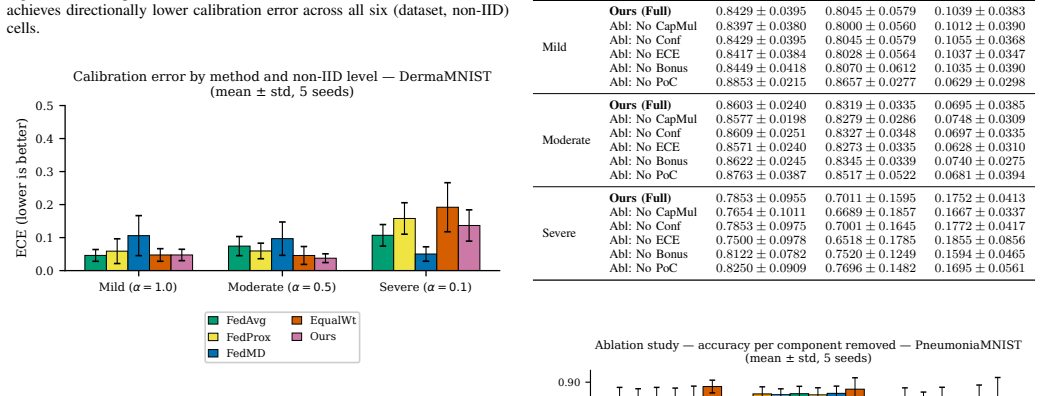
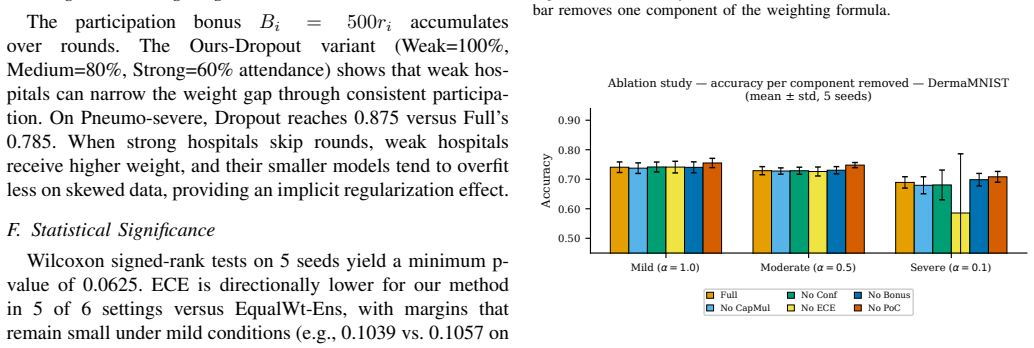
Federated learning is used in medical imaging where privacy prohibits centralizing data. Standard federated algorithms assume homogeneous hardware, identical architectures, and centralized aggregation, which fails when hospitals have unequal compute resources. We propose capacity-aware coordination: measure each hospital's throughput, assign capacity-appropriate architectures (MobileNetV3-Small, EfficientNet-B0, ResNet-50), and combine predictions via weighted ensemble. Weak and strong hospitals can participate without forcing uniform architectures. We separate on-chain policy from off-chain learning. A Solidity contract stores hospital registration, benchmark hashes, metrics, and weights. Hospitals train locally and submit only hashes and scalars (not parameters). Weighted ensemble inference is computed off-chain. Experiments on PneumoniaMNIST and DermaMNIST (5 seeds, 3 non-IID levels) show our method achieves lower or equal calibration error versus equal-weight ensemble and competitive accuracy versus FedAvg, FedProx, and FedMD. Communication overhead is 224 bytes per round, a reduction of over 912,000x compared to FedAvg.
Figures




Reference graph
Works this paper leans on
-
[1]
11em plus .33em minus .07em 4000 4000 100 4000 4000 500 `\.=1000 = #1 \@IEEEnotcompsoconly \@IEEEcompsoconly #1 * [1] 0pt [0pt][0pt] #1 * [1] 0pt [0pt][0pt] #1 * \| ** #1 \@IEEEauthorblockNstyle \@IEEEcompsocnotconfonly \@IEEEauthorblockAstyle \@IEEEcompsocnotconfonly \@IEEEcompsocconfonly \@IEEEauthordefaulttextstyle \@IEEEcompsocnotconfonly \@IEEEauthor...
work page 1982
-
[2]
H. B. McMahan et al., ``Communication-Efficient Learning of Deep Networks from Decentralized Data,'' 2017
work page 2017
-
[3]
Li et al., ``Federated Optimization in Heterogeneous Networks,'' MLSys, 2020
T. Li et al., ``Federated Optimization in Heterogeneous Networks,'' MLSys, 2020
work page 2020
- [4]
-
[5]
J. Yang et al., ``MedMNIST v2 -- A Large-Scale Lightweight Benchmark for 2D and 3D Biomedical Image Classification,'' Scientific Data, 2023
work page 2023
-
[6]
Guo et al., ``On Calibration of Modern Neural Networks,'' ICML, 2017
C. Guo et al., ``On Calibration of Modern Neural Networks,'' ICML, 2017
work page 2017
-
[7]
Wood, ``Ethereum: A Secure Decentralized Generalized Transaction Ledger,'' 2014
G. Wood, ``Ethereum: A Secure Decentralized Generalized Transaction Ledger,'' 2014
work page 2014
-
[8]
Solidity Documentation, Ethereum Foundation
-
[9]
Kim et al., ``Blockchain-Based Federated Learning for Medical Systems,'' 2021
M. Kim et al., ``Blockchain-Based Federated Learning for Medical Systems,'' 2021
work page 2021
-
[10]
Rieke et al., ``The Future of Digital Health with Federated Learning,'' NPJ Digital Medicine, 2020
work page 2020
discussion (0)
Sign in with ORCID, Apple, or X to comment. Anyone can read and Pith papers without signing in.