Vortex-enhanced photovoltaic current in disordered topological materials
Pith reviewed 2026-06-30 01:09 UTC · model grok-4.3
The pith
The interband Berry phase forms vortices in momentum space that enhance skew scattering from impurities, producing a ballistic photovoltaic current in topological materials.
A machine-rendered reading of the paper's core claim, the machinery that carries it, and where it could break.
Core claim
In disordered topological materials, the interband Berry phase has a vortex structure in momentum space, or equivalently the phase of the optical dipole matrix element winds around points in the Brillouin zone. This optical vorticity, required by nontrivial Chern numbers, enhances electron-impurity skew scattering and thereby produces a ballistic photovoltaic current. The current is sensitive to the topological material class, the symmetry class of the crystalline defects, and the light polarization. Sensitivity appears through frequency exponents in the current for topological semimetals and through constraints on the bulk photovoltaic tensor that arise from emergent magnetic symmetries in
What carries the argument
The vortex structure of the interband Berry phase (optical vorticity) in momentum space, which amplifies skew scattering off defects.
If this is right
- Topological semimetals exhibit photovoltaic current scaling as a power of light frequency whose exponent depends on the material class, defect symmetry, and polarization.
- The bulk photovoltaic tensor in time-reversal-invariant topological materials obeys additional constraints traceable to emergent magnetic symmetries.
- Frequency-dependent photoconductivity can distinguish topological classes when combined with defect characterization.
- Defect engineering that alters symmetry class can tune the magnitude and direction of the photocurrent.
Where Pith is reading between the lines
- The same vorticity mechanism may allow optical readout of topological invariants in samples that are too disordered for conventional transport probes.
- Polarization-dependent measurements on multilayer graphene or transition-metal dichalcogenides could test the predicted tensor constraints.
- If the enhancement survives, disorder itself becomes a controllable knob for generating photocurrents in topological devices rather than a source of decoherence.
Load-bearing premise
The optical vorticity produces a net enhancement of skew scattering that is not canceled by other disorder or band-structure effects.
What would settle it
Measurement of the photovoltaic current versus light frequency in a specific topological semimetal that fails to show the predicted exponent set by its Chern number, defect symmetry, and polarization.
Figures
read the original abstract
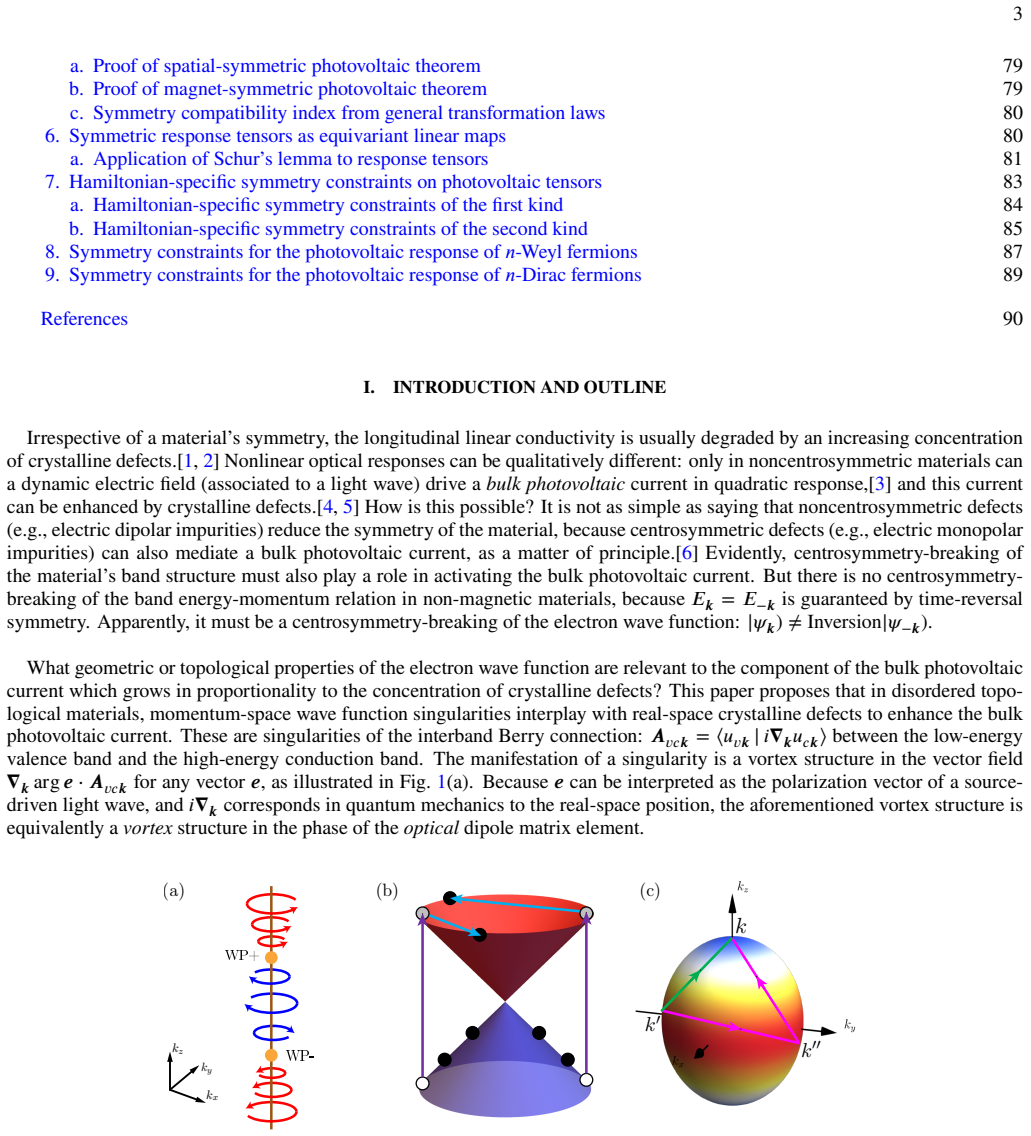
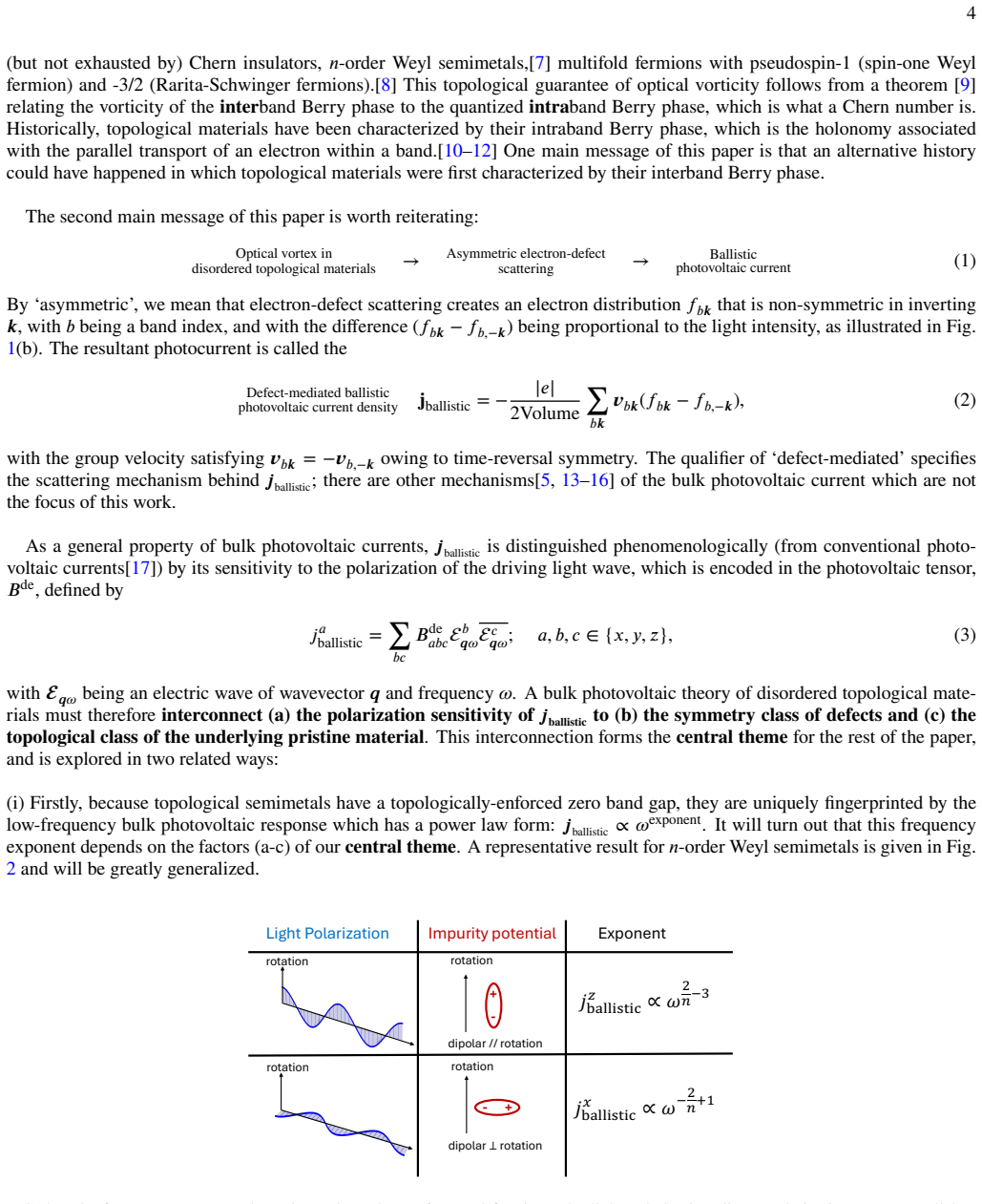
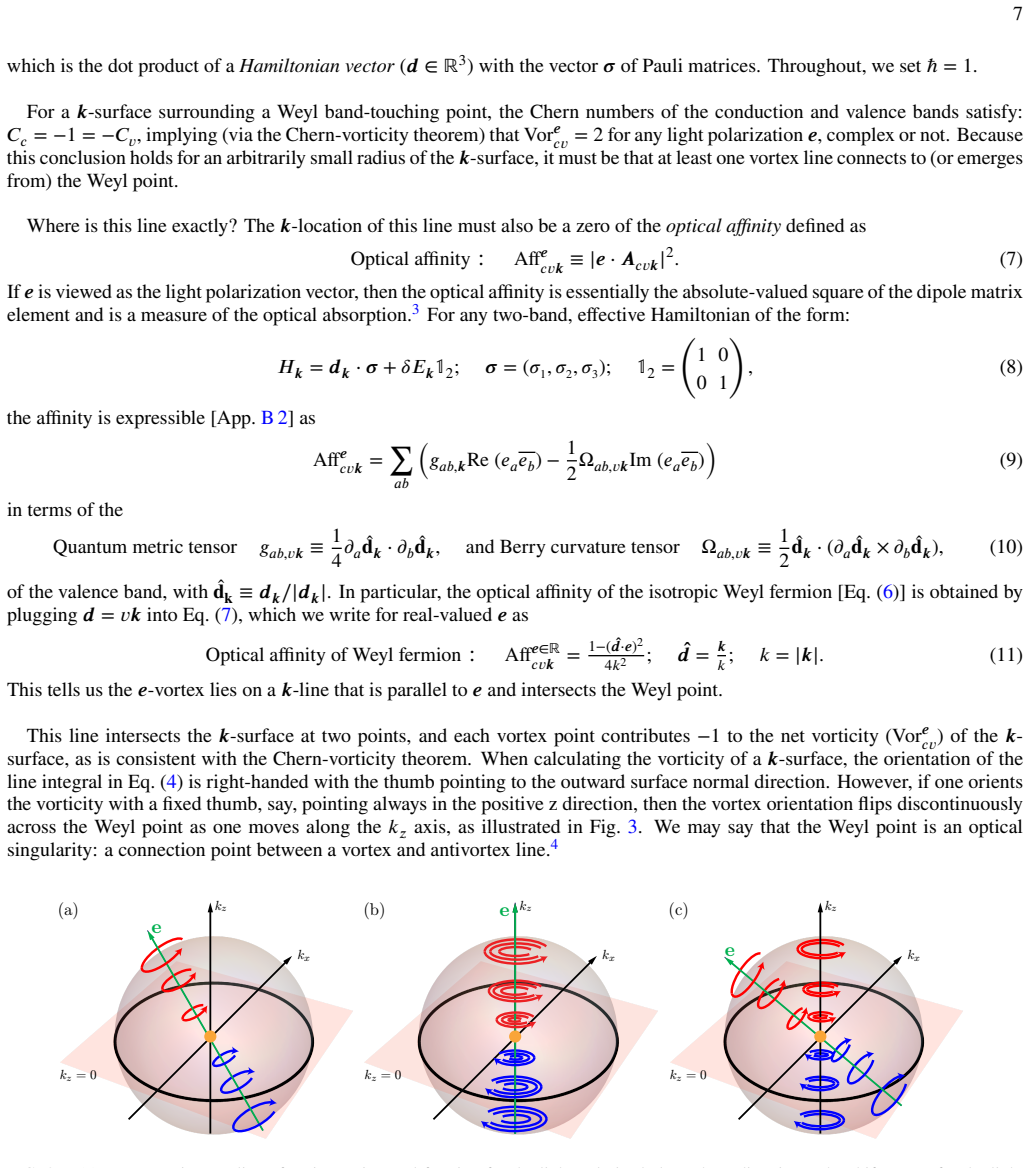
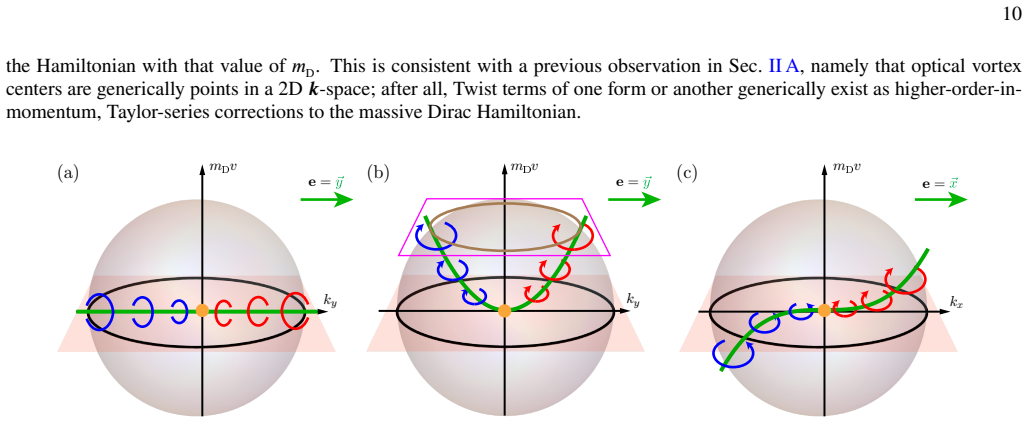
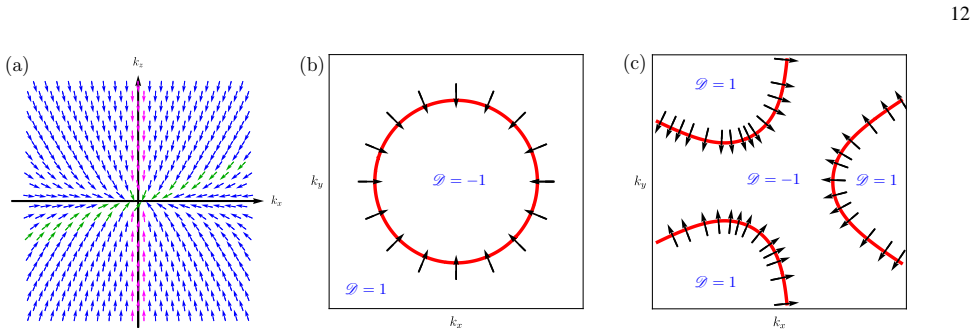
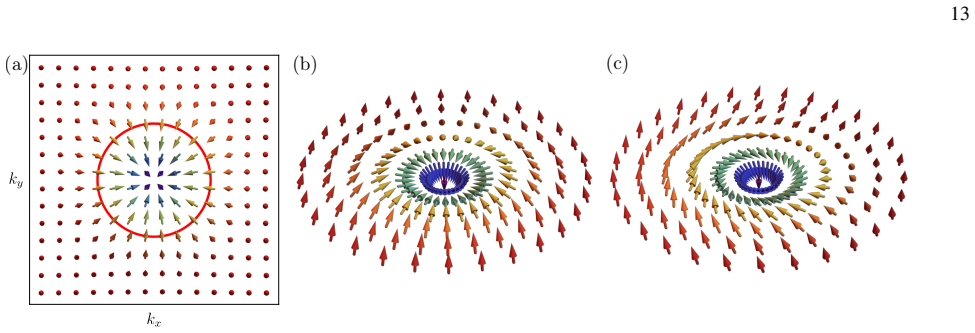
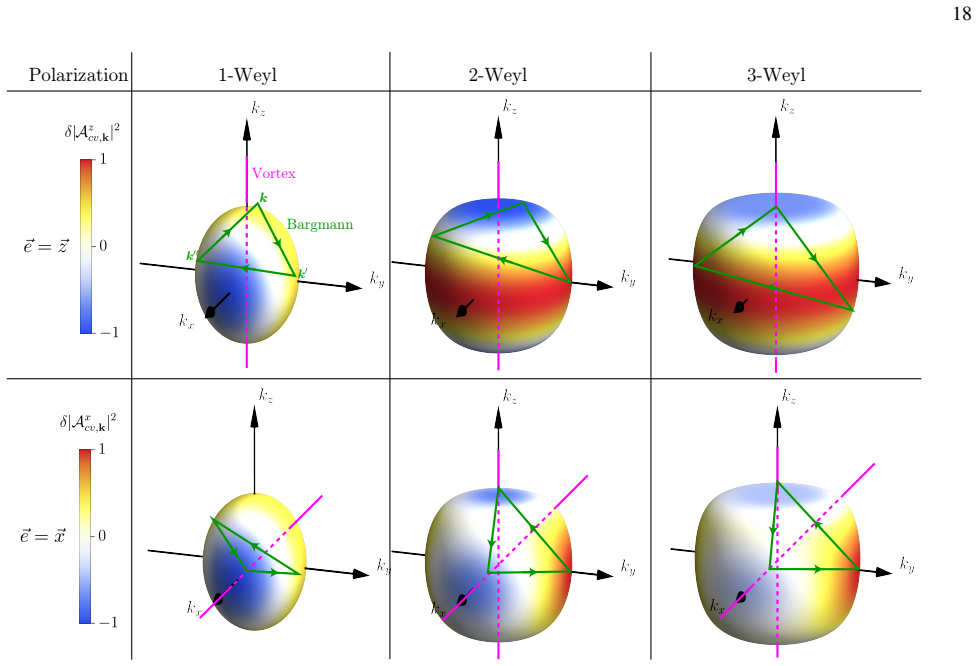
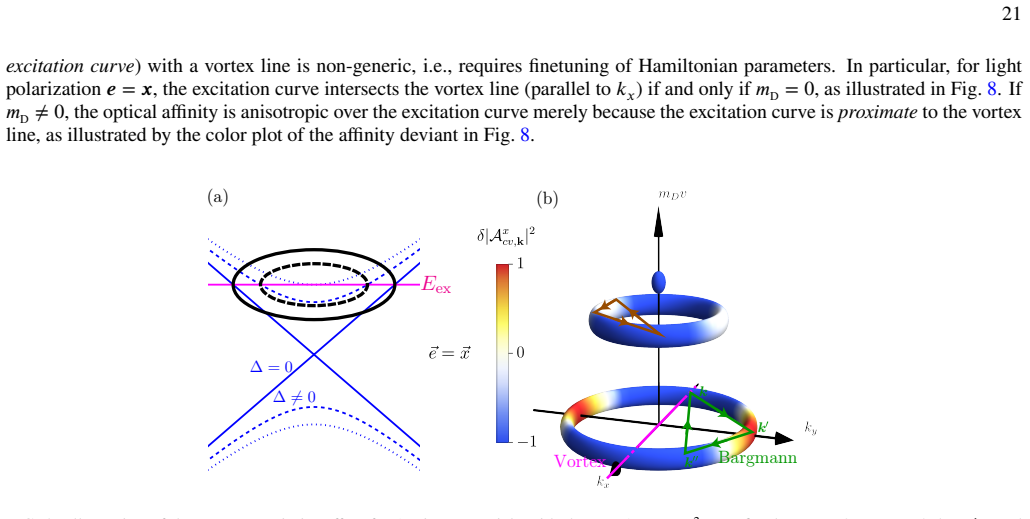
In disordered topological materials, real-space crystalline defects interplay with momentum-space wave function singularities to \textit{enhance} the bulk photovoltaic current. What's singular is the interband Berry phase, or equivalently the phase of the \textit{optical} dipole matrix element, which has a \textit{vortex} structure in momentum space. Such \textit{optical vorticity} is guaranteed to exist in all topological materials associated with nontrivial Chern numbers. These vortices enhance electron-impurity skew scattering, which manifests as a ballistic photovoltaic current that is sensitive to (a) the topological material class, (b) the symmetry class of crystalline defects, and (c) the light polarization. This sensitivity manifests in two ways: firstly, by (a-c)-dependent frequency exponents for the photovoltaic current $\propto \omega^{\text{exponent}}$ in topological semimetals, with $\omega$ the frequency of the light source. Secondly, by (a-c)-dependent constraints of the bulk photovoltaic tensor, which are explainable only by emergent, \textit{magnetic} symmetries of \textit{time-reversal-invariant} topological materials. These ideas are concretized by case studies on multifold fermions, 3D $m$-order Weyl semimetals and 2D $n$-order Dirac systems, which include $n$-layer rhombohedral graphene, transition metal dichalcogenides, and topological surface states. Theoretical guidance is provided for a tri-pronged experimental program that combines frequency-tuned photoconductivity measurements, defect characterization and defect engineering.
Editorial analysis
A structured set of objections, weighed in public.
Referee Report
Summary. The manuscript claims that the vortex structure of the interband Berry phase (equivalently, the phase of the optical dipole matrix element) in topological materials with nontrivial Chern numbers enhances electron-impurity skew scattering in the presence of crystalline defects. This produces a ballistic bulk photovoltaic (BPV) current whose magnitude and tensor structure are sensitive to the topological material class, the symmetry class of defects, and light polarization. The sensitivity appears as (a-c)-dependent frequency exponents in the photocurrent for topological semimetals and as constraints on the BPV tensor that are attributed to emergent magnetic symmetries of time-reversal-invariant systems. These ideas are illustrated through case studies on multifold fermions, 3D m-order Weyl semimetals, and 2D n-order Dirac systems (including n-layer rhombohedral graphene, TMDs, and topological surface states), with guidance for frequency-tuned photoconductivity, defect characterization, and defect-engineering experiments.
Significance. If the central mechanism is shown to produce a parametrically dominant contribution, the work would link momentum-space Berry-phase vorticity directly to disorder-enabled nonlinear transport, providing a new diagnostic for topological invariants via photocurrent measurements and suggesting routes to engineer BPV responses through controlled defects. The absence of free parameters in the proposed symmetry constraints and the emphasis on falsifiable frequency exponents are positive features.
major comments (3)
- [Theory section (derivation of skew-scattering rate) and case studies] The central claim that optical vorticity yields a net skew-scattering enhancement requires a demonstration that the vortex contribution is not canceled or overwhelmed by ordinary (non-vortex) impurity scattering, intervalley processes, or higher-order band-structure corrections. No such parametric comparison or explicit summation over all scattering channels is provided in the derivation of the skew-scattering rate or in the case-study calculations.
- [Section on BPV tensor constraints and emergent symmetries] The attribution of BPV-tensor constraints to emergent magnetic symmetries of time-reversal-invariant topological materials is load-bearing for the symmetry-class sensitivity claim, yet the manuscript does not show how these symmetries arise from the combination of Berry-phase vorticity and defect scattering or why they survive when all disorder channels are retained.
- [Case studies on multifold fermions and m-order Weyl semimetals] In the frequency-exponent analysis for topological semimetals, the reported ω^exponent scalings are presented as diagnostic of the vortex mechanism, but without an explicit comparison showing that competing scattering channels produce different exponents or are sub-dominant, the diagnostic power of the exponents remains unestablished.
minor comments (2)
- [Introduction and theory] Notation for the optical dipole phase and its vortex winding number should be defined explicitly before use in the case studies.
- [Case studies] The manuscript would benefit from a table summarizing the predicted frequency exponents and tensor constraints for each material class and defect symmetry.
Simulated Author's Rebuttal
We thank the referee for the careful reading and constructive major comments. We address each point below. The revisions add explicit parametric comparisons, symmetry derivations, and exponent tables to strengthen the claims without altering the core results.
read point-by-point responses
-
Referee: [Theory section (derivation of skew-scattering rate) and case studies] The central claim that optical vorticity yields a net skew-scattering enhancement requires a demonstration that the vortex contribution is not canceled or overwhelmed by ordinary (non-vortex) impurity scattering, intervalley processes, or higher-order band-structure corrections. No such parametric comparison or explicit summation over all scattering channels is provided in the derivation of the skew-scattering rate or in the case-study calculations.
Authors: The skew-scattering rate is extracted from the antisymmetric component of the T-matrix, which receives a nonzero contribution only from the phase winding of the optical dipole matrix element (the vorticity). Symmetric contributions from non-vortex scattering and intervalley processes cancel exactly in this antisymmetric channel by construction. Higher-order band corrections enter at sub-leading order in the impurity potential and do not modify the leading frequency scaling. To make the separation explicit we have added a new paragraph in the Theory section together with an appendix that performs the explicit summation over channels and shows the vortex term remains parametrically dominant for weak disorder. revision: yes
-
Referee: [Section on BPV tensor constraints and emergent symmetries] The attribution of BPV-tensor constraints to emergent magnetic symmetries of time-reversal-invariant topological materials is load-bearing for the symmetry-class sensitivity claim, yet the manuscript does not show how these symmetries arise from the combination of Berry-phase vorticity and defect scattering or why they survive when all disorder channels are retained.
Authors: The vorticity imprints an effective orbital angular momentum on the scattering amplitude. When combined with time-reversal invariance this generates an emergent magnetic point-group symmetry that constrains the BPV tensor. Because the symmetry is enforced by the phase structure rather than by any particular scattering channel, it is preserved under inclusion of all disorder processes that respect the underlying crystalline symmetry class. We have expanded the relevant section with an explicit symmetry derivation and a short proof that the constraints remain intact when additional channels are retained. revision: yes
-
Referee: [Case studies on multifold fermions and m-order Weyl semimetals] In the frequency-exponent analysis for topological semimetals, the reported ω^exponent scalings are presented as diagnostic of the vortex mechanism, but without an explicit comparison showing that competing scattering channels produce different exponents or are sub-dominant, the diagnostic power of the exponents remains unestablished.
Authors: The distinct exponents arise because the vorticity supplies an extra momentum-dependent phase factor in the matrix element that is absent in conventional (non-vortex) scattering. We have added a comparison table in the case-studies section that lists the leading exponents for the vortex-enhanced channel versus direct intervalley and higher-order processes; the latter yield different powers. This establishes the diagnostic utility of the reported scalings. revision: yes
Circularity Check
No circularity: derivation self-contained from Berry phase and scattering theory
full rationale
The abstract frames the enhancement of skew scattering as a direct consequence of the vortex structure of the interband Berry phase (guaranteed by nontrivial Chern numbers) acting on electron-impurity scattering. No load-bearing step reduces a claimed prediction to a fitted parameter, a self-citation chain, or a definitional renaming. The frequency exponents and tensor constraints are presented as outputs of the topological and symmetry analysis rather than inputs. Case studies apply the framework to concrete systems without evidence that the central result is presupposed by construction. This is the normal, non-circular outcome for a first-principles scattering argument.
Axiom & Free-Parameter Ledger
axioms (1)
- domain assumption Nontrivial Chern numbers guarantee the existence of optical vorticity (vortex structure in the phase of the optical dipole matrix element) in all associated topological materials.
Reference graph
Works this paper leans on
-
[1]
The Hamiltonian of 𝑛-Dirac semimetals is similar to that of𝑛-Weyl semimetals, see Eq
Appendix to ‘Vortex-proximity effect in𝑛-Dirac semimetals’ As in the case of𝑛-Weyl semimetals, we focus on the case of untilted and unwarped𝑛-Dirac fermions. The Hamiltonian of 𝑛-Dirac semimetals is similar to that of𝑛-Weyl semimetals, see Eq. (13), albeit with𝑣𝑘𝑧 →Δ, whereΔis a gap. Let us present the necessary nontrivial ingredients in the ballistic pho...
-
[2]
–Let us first derive the conductivity shown in Eq
Appendix to ‘Tilt-activated𝒋ballistic for symmetry-unpinned Weyl fermions’ Isotropic Weyl fermion with tilting. –Let us first derive the conductivity shown in Eq. (79). The tilting term breaks the SO(3) but does not change the wavefunction and thus the optical affinity. Using Eq. (9), the optical affinity of the tilted Weyl can be explicitly calculated as...
-
[3]
Appendix to ‘Warp-activated𝒋ballistic for massive𝑛-Dirac fermions’ In this appendix, we consider the details of the calculations for the warped𝑛-Dirac Hamiltonian relevant for𝑛 >1-layer rhombohedral graphene [18], 𝐻𝑛 =𝒅⋅𝝈= ( Δ𝑓 𝑛(𝑘−)𝑛 𝑓𝑛(𝑘+)𝑛 −Δ ) +𝐻 6′,𝑛 𝒌 ,(C35) 𝑘± =𝑘 𝑥 ±𝑖𝑘 𝑦,Δ =𝑚 𝐷𝑣2,(C36) see also Eq. (A21). The trigonal warping here originates from t...
-
[4]
The devil can move the rulers and fix the crystal (intervention I), or move the crystal and fix the rulers (intervention II)
What it means for a response tensor to be symmetric While experimenting on a crystal, if a mischievous devil were to momentarily cover your eyes and to displace/rotate/reflect your spacetime rulers relative to the crystal, you wouldn’t be able to tell the difference when your eyes are open. The devil can move the rulers and fix the crystal (intervention I...
-
[5]
Theproductofthisperturbationtheoryisanalgorithm whose final output is𝑅
Response tensors as algorithms Allresponsetensorsarecalculatedbysometypeofperturbationtheory. Theproductofthisperturbationtheoryisanalgorithm whose final output is𝑅. We use the same letter to denote the algorithm: 𝑅=𝑅(𝑓 0, 𝐻, 𝐼);𝐼=𝐼(𝑓 0, 𝐻).(D13) The inputs to the algorithm are: (a) The one-electron distribution function𝑓0 𝐵 in the zeroth order of the per...
-
[6]
The practical value of the compatibility index is that Ind𝑔 𝑅 = { 1, 𝑅is(𝐻 𝑒 =𝐻 𝑔)-compatible, i.e., can be nonzero if𝐻𝑒 =𝐻 𝑔
Symmetry compatibility index of response tensors Forsymmetriesthatsquaretoidentity:𝑔 2 =𝑒(includingsymmetrieswhichareprojectivelyrepresented:̂ 𝑔2 = −̂ 𝑒),wedefine 𝑔-compatibility index of response Ind𝑔 𝑅 = ±1;𝑅(𝐻 𝑔, 𝐼(𝐻 𝑔)) =Ind 𝑔 𝑅 ⋅𝑅(𝐻 𝑒, 𝐼(𝐻 𝑒)).(D52) If𝑅(𝐻 𝑒, 𝐼(𝐻 𝑒))is not proportional to𝑅(𝐻𝑔, 𝐼(𝐻 𝑔)), then it can be decomposed into two terms with wel...
-
[7]
General constraints on photovoltaic tensors from Hamiltonian symmetries A point-group-symmetric [Eq. (A5)] Hamiltonian has the following implications for the photovoltaic tensor: Spatial-symmetric photovoltaic theorem∶𝐻 𝑔𝑠 =𝐻 𝑒 ⇒𝚺 𝑎𝑏𝑐 =𝑔 𝑠 𝑎𝑑𝑔𝑠 𝑏𝑒𝑔𝑠 𝑐𝑓 𝚺𝑑𝑒𝑓 ;(D65) Magnet-symmetric photovoltaic theorem∶𝐻 𝑇 𝑔𝑠 =𝐻 𝑒 ⇒𝚺 𝑎𝑏𝑐 =Ind 𝑇 Σ 𝑔𝑠 𝑎𝑑𝑔𝑠 𝑏𝑒𝑔𝑠 𝑐𝑓 𝚺𝑑𝑒𝑓 .(D66...
-
[8]
Symmetric response tensors as equivariant linear maps In applying the spatial-symmetric photovoltaic theorem [Eq. (D65)] to concretely determine the symmetry-allowed photo- voltaic response tensor elements, it is useful to view a𝐺-symmetric response tensor as a𝐺-equivariant linear map and apply Schur’s lemma. Let us first develop this viewpoint of respons...
-
[9]
(D65)-(D66) apply to all photovoltaic tensors independent of specific details of the Hamiltonian, beyondtheassumptionthattheHamiltonianissymmetric:𝐻 𝑔 =𝐻 𝑒
Hamiltonian-specific symmetry constraints on photovoltaic tensors The two theorems in Eqs. (D65)-(D66) apply to all photovoltaic tensors independent of specific details of the Hamiltonian, beyondtheassumptionthattheHamiltonianissymmetric:𝐻 𝑔 =𝐻 𝑒. Incontrast,weintroduceinthissubappendixthenotionof 𝐻-specificsymmetryconstraints(shortforHamiltonian-specific...
-
[10]
XXII and derived in the remainder of this section
Symmetry constraints for the photovoltaic response of𝑛-Weyl fermions Our main result is summarized in Tab. XXII and derived in the remainder of this section. Fermion Impurity Group Shift𝑙/Ballistic𝑙 Shift𝑐/Ballistic𝑐 Σim,𝑙 ballistic 𝐻 𝑤,𝑛 𝑉 𝑚 𝐷∞ ×ℤ 𝑇 2 Σ𝑙 𝑥𝑦𝑧 = −Σ 𝑙 𝑦𝑧𝑥 0 Σ𝑙 𝑥𝑦𝑧 = 0 𝑉 𝑑∥𝑧 𝑆𝑂(2) ×ℤ 𝑇 2 Σ𝑙 𝑧𝑧𝑧; Σ 𝑙 𝑧𝑥𝑥 = Σ 𝑙 𝑧𝑦𝑦; Σ 𝑙 𝑥𝑥𝑧 = Σ 𝑙 𝑦𝑦𝑧; Σ 𝑙 𝑥𝑦𝑧 ...
-
[11]
Time-reversal symmetry ensures that the circular tensor vanishes: 𝐻 𝑇 =𝐻 𝑒 ⇒Σ 𝑐 = 0,(D130) according to Eq. (D113) with𝑔=𝑇 , 𝑔𝑠 𝑎𝑏 =𝛿 𝑎𝑏 and(𝑠 𝑐)𝑇 = −1.This conclusion holds not just for𝑛-Weyl fermions but also for massless𝑛-Dirac fermions (which are𝑇-symmetric), and not just for monopole impurities but also for dipole impurities (also 𝑇-symmetric). This ...
-
[12]
Let us define𝑁𝑎𝑏𝑐;𝑥 (resp.𝑁 𝑎𝑏𝑐;𝑦) as the number of ‘abc’ which are x indices (resp
Symmetry constraints for the photovoltaic response of𝑛-Dirac fermions In a ‘2D system’, we restrict current and electric fields to lie in the xy-plane, so the indices inΣ𝑎𝑏𝑐 can only be x or y indices. Let us define𝑁𝑎𝑏𝑐;𝑥 (resp.𝑁 𝑎𝑏𝑐;𝑦) as the number of ‘abc’ which are x indices (resp. y indices); because𝑁𝑎𝑏𝑐;𝑥 +𝑁 𝑎𝑏𝑐;𝑦 = 3, 𝑁𝑎𝑏𝑐;𝑥 is odd if and only if𝑁𝑎...
-
[13]
Drude, Zur elektronentheorie der metalle, Annalen der Physik306, 566 (1900)
P. Drude, Zur elektronentheorie der metalle, Annalen der Physik306, 566 (1900)
1900
-
[14]
N. W. Ashcroft and N. D. Mermin,Solid state physics (Thomson Learning, 20 Channel Center Street, Boston, MA 02210, USA, 1976)
1976
-
[15]
Kraut and R
W. Kraut and R. von Baltz, Anomalous bulk photovoltaic effect in ferroelectrics: A quadratic response theory, Phys. Rev. B19, 1548 (1979)
1979
-
[16]
Belinicher, E
V. Belinicher, E. Ivchenko, and B. Sturman, Kinetic theory of the displacement photovoltaic effect in piezoelectric, Soviet Physics JETP 56, 359 (1982)
1982
-
[17]
V.I.BelinicherandB.I.Sturman,Thephotogalvaniceffectinmedialackingacenterofsymmetry,SovietPhysicsUspekhi23,199(1980)
1980
-
[18]
H. Isobe, S.-Y. Xu, and L. Fu, High-frequency rectification via chiral bloch electrons, Science Advances6, eaay2497 (2020), https://www.science.org/doi/pdf/10.1126/sciadv.aay2497
-
[19]
C. Fang, M. J. Gilbert, X. Dai, and B. A. Bernevig, Multi-weyl topological semimetals stabilized by point group symmetry, Phys. Rev. Lett.108, 266802 (2012)
2012
-
[20]
B.Bradlyn,J.Cano,Z.Wang,M.G.Vergniory,C.Felser,R.J.Cava,andB.A.Bernevig,Beyonddiracandweylfermions: Unconventional quasiparticles in conventional crystals, Science353, 10.1126/science.aaf5037 (2016)
-
[21]
Zhu and A
P. Zhu and A. Alexandradinata, Anomalous shift and optical vorticity in the steady photovoltaic current, Physical Review B110, 115108 (2024)
2024
-
[22]
D. J. Thouless, M. Kohmoto, M. P. Nightingale, and M. den Nijs, Quantized hall conductance in a two-dimensional periodic potential, Phys. Rev. Lett.49, 405 (1982)
1982
-
[23]
parity anomaly
F. D. M. Haldane, Model for a quantum Hall effect without Landau levels: Condensed-matter realization of the “parity anomaly”, Phys. Rev. Lett.61, 2015 (1988)
2015
-
[24]
X. Wan, A. Turner, A. Vishwanath, and S. Y. Savrasov, Topological semimetal and fermi-arc surface states in the electronic structure of pyrochlore iridates, Phys. Rev. B83, 205101 (2011)
2011
-
[25]
V. I. Belinicher and B. I. Sturman, Phonon mechanisms of the photogalvanic effect in piezoelectrics, Soviet Physics – Solid State20, 476 (1978), [Fiz. Tverd. Tela20, 821 (1978)]
1978
-
[26]
Z. Dai, A. M. Schankler, L. Gao, L. Z. Tan, and A. M. Rappe, Phonon-assisted ballistic current from first-principles calculations, Phys. Rev. Lett.126, 177403 (2021)
2021
-
[27]
Dai and A
Z. Dai and A. M. Rappe, First-principles calculation of ballistic current from electron-hole interaction, Phys. Rev. B104, 235203 (2021)
2021
- [28]
-
[29]
Würfel and U
P. Würfel and U. Würfel,Physics of Solar Cells: From Basic Principles to Advanced Concepts, 2nd ed. (Wiley-VCH, Weinheim, 2009)
2009
-
[30]
Trigonal warping and Berry's phase N pi in ABC-stacked multilayer graphene
M. Koshino and E. McCann, Trigonal warping and Berry’s phase N pi in ABC-stacked multilayer graphene, Phys. Rev. B80, 165409 (2009), arXiv:0906.4634 [cond-mat]
work page internal anchor Pith review Pith/arXiv arXiv 2009
-
[31]
Nielsen and M
H. Nielsen and M. Ninomiya, Absence of neutrinos on a lattice: (i). proof by homotopy theory, Nuclear Physics B185, 20 (1981)
1981
- [32]
-
[33]
Semimetal with both Rarita-Schwinger-Weyl and Weyl excitations
L. Liang and Y. Yu, Semimetal with both Rarita-Schwinger-Weyl and Weyl excitations, Physical Review B93, 045113 (2016), arXiv:1512.07460
work page internal anchor Pith review Pith/arXiv arXiv 2016
-
[34]
N. B. M. Schröter, S. Stolz, K. Manna, F. De Juan, M. G. Vergniory, J. A. Krieger, D. Pei, T. Schmitt, P. Dudin, T. K. Kim, C. Cacho, B. Bradlyn, H. Borrmann, M. Schmidt, R. Widmer, V. N. Strocov, and C. Felser, Observation and control of maximal Chern numbers in a chiral topological semimetal, Science369, 179 (2020), arXiv:1907.08723 [cond-mat.mes-hall]
-
[35]
I. Boettcher, Interplay of Topology and Electron-Electron Interactions in Rarita-Schwinger-Weyl semimetals, Physical Review Letters 124, 127602 (2020), arXiv:1907.05354v2
- [36]
-
[37]
X.L. Qi, Y.S. Wu, and S.C. Zhang, Topological quantization of the spin Hall effect in two-dimensional paramagnetic semiconductors, Phys. Rev. B74, 085308 (2006)
2006
-
[38]
H.Rostami,A.G.Moghaddam,andR.Asgari,EffectivelatticeHamiltonianformonolayerMoS$_2$: Tailoringelectronicstructurewith perpendicular electric and magnetic fields, Physical Review B88, 085440 (2013), arXiv:1302.5901 [cond-mat.mes-hall]
work page internal anchor Pith review Pith/arXiv arXiv 2013
-
[39]
Fu, Hexagonal Warping Effects in the Surface States of the Topological Insulator Bi2Te3, Phys
L. Fu, Hexagonal Warping Effects in the Surface States of the Topological Insulator Bi2Te3, Phys. Rev. Lett.103, 266801 (2009). 91
2009
-
[40]
B. A. B. with Taylor L. Hughes,Topological Insulators and Topological Superconductors (Princeton University Press, 2013)
2013
-
[41]
Alexandradinata, Quantization of intraband and interband Berry phases in the shift current, Physical Review B110, 075159 (2024)
A. Alexandradinata, Quantization of intraband and interband Berry phases in the shift current, Physical Review B110, 075159 (2024)
2024
-
[42]
B. I. Sturman and V. M. Fridkin,The Photovoltaic and Photorefractive Effects in Noncentrosymmetric Materials (Gordon and Breach Science Publishers, 1992)
1992
- [43]
-
[44]
Bargmann, Note on Wigner’s Theorem on Symmetry Operations, Journal of Mathematical Physics5, 862 (2004), https://pubs.aip.org/aip/jmp/article-pdf/5/7/862/8174248/862_1_online.pdf
V. Bargmann, Note on Wigner’s Theorem on Symmetry Operations, Journal of Mathematical Physics5, 862 (2004), https://pubs.aip.org/aip/jmp/article-pdf/5/7/862/8174248/862_1_online.pdf
2004
-
[45]
J. P. Provost and G. Vallee, Riemannian structure on manifolds of quantum states, Communications in Mathematical Physics76, 289 (1980)
1980
-
[46]
M. V. Berry, Quantal phase factors accompanying adiabatic changes, Proc. R. Soc. Lond A392, 45 (1984)
1984
-
[47]
J.Ahn,G.-Y.Guo,N.Nagaosa,andA.Vishwanath,Riemanniangeometryofresonantopticalresponses,NaturePhysics10.1038/s41567- 021-01465-z (2021)
2021
-
[48]
T. Morimoto and N. Nagaosa, Topological nature of nonlinear optical effects in solids, Science Advances2, 10.1126/sciadv.1501524 (2016)
-
[49]
Ahn, G.-Y
J. Ahn, G.-Y. Guo, and N. Nagaosa, Low-frequency divergence and quantum geometry of the bulk photovoltaic effect in topological semimetals, Phys. Rev. X10, 041041 (2020)
2020
-
[50]
K. W. Kim, T. Morimoto, and N. Nagaosa, Shift charge and spin photocurrents in dirac surface states of topological insulator, Phys. Rev. B95, 035134 (2017)
2017
- [51]
-
[52]
M. Z. Hasan and C. L. Kane, Colloquium: Topological insulators, Reviews of Modern Physics82, 3045 (2010), arXiv:1002.3895
work page internal anchor Pith review Pith/arXiv arXiv 2010
-
[53]
Colloquium: Topological Band Theory
A. Bansil, H. Lin, and T. Das, Colloquium: Topological band theory, Reviews of Modern Physics88, 021004 (2016), arXiv:1603.03576
work page internal anchor Pith review Pith/arXiv arXiv 2016
-
[54]
The electronic properties of bilayer graphene
E. McCann and M. Koshino, The electronic properties of bilayer graphene, Rep. Prog. Phys.76, 056503 (2013), arXiv:1205.6953
work page internal anchor Pith review Pith/arXiv arXiv 2013
-
[55]
Alexandradinata, X
A. Alexandradinata, X. Dai, and B. A. Bernevig, Wilson-loop characterization of inversion-symmetric topological insulators, Phys. Rev. B89, 155114 (2014)
2014
-
[56]
Alexandradinata, J
A. Alexandradinata, J. Höller, C. Wang, H. Cheng, and L. Lu, Crystallographic splitting theorem for band representations and fragile topological photonic crystals, Phys. Rev. B102, 115117 (2020)
2020
-
[57]
De Nittis and K
G. De Nittis and K. Gomi, Classification of “Real” Bloch-bundles: Topological quantum systems of type AI, J. Geom. Phys.86, 303 (2014)
2014
-
[58]
Hasan, X
C.-L.Zhang,F.Schindler,H.Liu,T.-R.Chang,S.-Y.Xu,G.Chang,W.Hua,H.Jiang,Z.Yuan,J.Sun,H.-T.Jeng,H.-Z.Lu,H.Lin,M.Z. Hasan, X. C.Xie, T. Neupert,and S. Jia,Ultraquantum magnetoresistancein thekramers-weyl semimetal candidate𝛽−ag2Se, Phys.Rev. B96, 165148 (2017)
2017
-
[59]
S. Kim, R. C. McKay, N. Bielinski, J. Park, C. Zhao, M.-K. Lin, J. A. Hlevyack, X. Guo, S.-K. Mo, P. Abbamonte,et al., Signatures of kramers-weyl fermions in the charge density wave material (tase4) 2i, Communications Materials6, 227 (2025)
2025
-
[60]
Chang, B
G. Chang, B. J. Wieder, F. Schindler, D. S. Sanchez, I. Belopolski, S.-M. Huang, B. Singh, D. Wu, T.-R. Chang, T. Neupert,et al., Topological quantum properties of chiral crystals, Nature materials17, 978 (2018)
2018
-
[61]
Li, W.-W
Z. Li, W.-W. Yang, J.-J. Feng, B.-B. Ruan, Y.-Z. Zhou, T. Sun, H.-W. Shi, L. Ju, S.-F. Wang, T. Han, J.-P. Song, X.-R. Hu, Z.-K. Zhou, M.-S. Long, X.-Y. Hou, Q.-N. Xu, Z.-A. Ren, Q.-G. Mu, and L. Shan, Type-i superconductivity in the weyl semimetaltage2 with chiral structure, Phys. Rev. B110, 174506 (2024)
2024
-
[62]
L. Yang, Z. Liu, Y. Sun, H. Peng, H. Yang, T. Zhang, B. Zhou, Y. Zhang, Y. Guo, M. Rahn,et al., Weyl semimetal phase in the non- centrosymmetric compound taas, Nature physics11, 728 (2015)
2015
-
[63]
S.-Y.Xu,I.Belopolski,N.Alidoust,M.Neupane,G.Bian,C.Zhang,R.Sankar,G.Chang,Z.Yuan,C.-C.Lee, etal.,Discoveryofaweyl fermion semimetal and topological fermi arcs, Science349, 613 (2015)
2015
-
[64]
B. Lv, H. Weng, B. Fu, X. P. Wang, H. Miao, J. Ma, P. Richard, X. Huang, L. Zhao, G. Chen,et al., Experimental discovery of weyl semimetal taas, Physical Review X5, 031013 (2015)
2015
-
[65]
B.Lv,N.Xu,H.Weng,J.Ma,P.Richard,X.Huang,L.Zhao,G.Chen,C.Matt,F.Bisti, etal.,Observationofweylnodesintaas,Nature Physics11, 724 (2015)
2015
-
[66]
C. Wang, Y. Zhang, J. Huang, S. Nie, G. Liu, A. Liang, Y. Zhang, B. Shen, J. Liu, C. Hu, Y. Ding, D. Liu, Y. Hu, S. He, L. Zhao, L. Yu, J. Hu, J. Wei, Z. Mao, Y. Shi, X. Jia, F. Zhang, S. Zhang, F. Yang, Z. Wang, Q. Peng, H. Weng, X. Dai, Z. Fang, Z. Xu, C. Chen, and X. J. Zhou, Observation of fermi arc and its connection with bulk states in the candidate...
2016
-
[67]
Y. Wu, D. Mou, N. H. Jo, K. Sun, L. Huang, S. L. Bud’ko, P. C. Canfield, and A. Kaminski, Observation of fermi arcs in the type-ii weyl semimetal candidatewte2, Phys. Rev. B94, 121113(R) (2016)
2016
-
[68]
Chiral Decomposition in the Electronic Structure of Graphene Multilayers
H. Min and A. H. MacDonald, Chiral decomposition in the electronic structure of graphene multilayers, Physical Review B77, 155416 (2008), arXiv:0711.4333 [cond-mat.mes-hall]
work page internal anchor Pith review Pith/arXiv arXiv 2008
-
[69]
L. Zhang, Y. Zhang, J. Camacho, M. Khodas, and I. Zaliznyak, The experimental observation of quantum Hall effect of l=3 chiral quasi- particles in trilayer graphene, Nature Physics7, 953 (2011), arXiv:1103.6023 [cond-mat.str-el]
work page internal anchor Pith review Pith/arXiv arXiv 2011
-
[70]
C. H. Lui, Z. Li, K. F. Mak, E. Cappelluti, and T. F. Heinz, Observation of an electrically tunable band gap in trilayer graphene, Nature Physics7, 944 (2011), arXiv:1105.4658 [cond-mat.mes-hall]
work page internal anchor Pith review Pith/arXiv arXiv 2011
- [71]
- [72]
-
[73]
A. M. Danishevskii, A. A. Kastal’skii, S. M. Ryvkin, and I. D. Yaroshetskii, Dragging of free carriers by photons in direct interband transitions in semiconductors, JETP31, 292 (1970)
1970
-
[74]
J. E. Sipe and A. I. Shkrebtii, Second-order optical response in semiconductors, Phys. Rev. B61, 5337 (2000)
2000
-
[75]
Muechler, A
L. Muechler, A. Alexandradinata, T. Neupert, and R. Car, Topological nonsymmorphic metals from band inversion, Phys. Rev. X6, 041069 (2016)
2016
-
[76]
S.M.Young,S.Zaheer,J.C.Y.Teo,C.L.Kane,E.J.Mele,andA.M.Rappe,Diracsemimetalinthreedimensions,Phys.Rev.Lett.108, 140405 (2012)
2012
-
[77]
C. L. Kane and E. J. Mele,𝑍2 topological order and the quantum spin Hall effect, Phys. Rev. Lett.95, 146802 (2005)
2005
-
[78]
V. L. Alperovich, V. I. Belinicher, V. N. Novikov, and A. S. Terekhov, Surface photovoltaic effect in solids . Theory and experiment for interband transitions in gallium arsenide, Sov. Phys. JETP53, 1201 (1981)
1981
-
[79]
Alexandradinata and L
A. Alexandradinata and L. Glazman, Fermiology of topological metals, Annual Review of Condensed Matter Physics14, 261 (2023)
2023
-
[80]
Giant nonlinear conductivity in 2D electron gas from substrate-induced dipolar scattering
D. V.Chichinadze, A. Seidel,andZ.Nussinov,Giantnonlinearconductivity in2Delectrongasfromsubstrate-induced dipolarscattering (2026), arXiv:2605.20699 [cond-mat.str-el]
work page internal anchor Pith review Pith/arXiv arXiv 2026
discussion (0)
Sign in with ORCID, Apple, or X to comment. Anyone can read and Pith papers without signing in.