REVIEW 3 major objections 4 minor 39 references
Topological elasticity of flexible structures
T0 review · 3 major / 4 minor · reviewed 2026-08-14 · deepseek-v4-flash
Pith's one-line read This paper claims that in flexible metamaterials, a bulk winding number gives the difference in zero-energy modes on two opposite edges and sets the edge-mode depth by the square of surface wavelength.
desk verdict A genuine continuum analogue of lattice topological polarization with a new invariant and decay scaling, but the main equality is conditional on a truncation that excludes short-wavelength modes by decree rather than proof. read the letter →
The pith
A machine-rendered reading of the paper's core claim, the machinery that carries it, and where it could break.
The reading
What carries the argument
The load-bearing object is the relaxed rigidity map $R_{m,ij}(q)$, a square matrix obtained from the initial bond-extension map after projecting out short-wavelength relaxations onto the states of self stress, so that it maps the $d$ independent smooth strain components to $d$ constraints (the continuum condition for critical coordination). Its determinant $\det R(q)$ vanishes exactly at zero-energy modes; allowing $q$ to be complex turns edge localization into zeros at $q_x = \alpha_\pm q_y + i\beta_\pm q_y^2$. The machinery is the contour integral (Eq. (17)) over real $q_x$ at fixed small imaginary $q_y=\epsilon$, which by the argument principle counts left-edge minus right-edge long-wavelength modes while the curved parts of the contour cancel; the strain-gradient surface energy term, Eq. (5), provides the physical boundary energetics that makes these modes cost zero energy on one edge.
What would settle it
Compute the full determinant of $R(q)$ for the generalized kagome family without truncating at third order: if the winding evaluated at $q_y=\epsilon$ over $|q_x|\leq \sqrt{\epsilon}/|l_1|$ differs from the true $N_L-N_R$ obtained by diagonalizing a finite sample, the truncation discards physical modes. Equivalently, build a finite kagome sample with polarization $\Delta N=2$, impose a boundary distortion of wavelength $\lambda$, and check whether the mode penetrates a depth of order $(\lambda/|l_1|)^2|l_1|$ rather than order $\lambda$; a Rayleigh-like depth would falsify Eq. (24).
Extended reading notes
Core claim
The central claim is that in the micromorphic limit of a critically coordinated flexible structure (equal numbers of smooth strain constraints and strain degrees of freedom), the difference between the numbers of long-wavelength zero-energy modes on two opposing edges is a bulk topological invariant. The invariant is the winding of $\arg \det R(q_x, q_y=\epsilon)$ as $q_x$ runs over a real interval whose width shrinks as $\sqrt{\epsilon}$: $$N_L - N_R = \frac{1}{\pi}\lim_{\epsilon\to 0^+}\int_{-\sqrt{\epsilon}/|l_1|}^{\sqrt{\epsilon}/|l_1|} dq_x\, \partial_{q_x}\arg\det R(q_x, q_y=\epsilon),$$ with zeros of $\det R$ in the upper half-plane counted as left-edge modes and those in the lower half-plane as right-edge modes. The authors show that this continuum invariant is quantized exactly in the long-wavelength limit, that it varies with interface orientation and jumps when the normal crosses a soft direction, and that the corresponding edge modes decay into the bulk over a length $\zeta_\pm \sim (\lambda/|l_1|)^2 |l_1|$ set by the surface wavelength $\lambda$. In their picture the same strain-gradient surface terms that produce the edge energies are what break inversion symmetry and support the polarization.
Load-bearing premise
At bottom, the argument requires that the long-wavelength expansion of the determinant, cut off at third order in wavevector, already captures every mode that can live on an edge; if any short-wavelength lattice mode contributes to the winding count, Eq. (17) stops counting the true edge-mode imbalance.
Editorial extensions
If this is right
- The bulk microstructure generates boundary elastic terms in the continuum energy: the strain-gradient part of the energy reduces to a surface integral, so edges soften or stiffen independently of the bulk response.
- The continuum topological invariant is quantized in the long-wavelength limit and reproduces the lattice polarization $\Delta N = N_L - N_R$ without requiring a Brillouin zone.
- Topological edge modes are mesoscopic: for a boundary distortion of wavelength $\lambda$ the mode penetrates a depth of order $(\lambda/|l_1|)^2 |l_1|$ cells, so the effect survives at scales far above the unit cell but below system size.
- As the interface normal is rotated, $\Delta N(\theta_n)$ changes only when the normal crosses a soft direction, giving a directional polarization that can be mapped in experiments.
- Because the surface theory uses only bulk strain-gradient coefficients and bond geometry, the predicted edge-mode imbalance can be observed even when the microscale structure is not resolved.
Reading between the lines
- A direct test would be to measure the effective edge stiffness of a 3D-printed critically coordinated lattice as a function of imposed surface wavelength: if the paper is right, the boundary mode depth should scale as $\lambda^2$, whereas a conventional Rayleigh-type surface mode scales as $\lambda$, making the two contributions separable.
- The same winding integral could be evaluated from measured strain-gradient elastic coefficients rather than from a lattice model, which would let experiments determine $N_L-N_R$ before any edge is loaded.
- If the contour cancellation is robust, the polarization should survive surface disorder and rounding: modifying the boundary termination changes the short-wavelength zeros but not the difference $N_L-N_R$, a stability that finite lattices would show in numerics.
Signed reviews
Editorial analysis
A structured set of objections, weighed in public.
Referee Report
Summary. The paper develops a micromorphic continuum elasticity for flexible mechanical metamaterials, starting from a bond-extension expansion in strain and strain gradients. It derives bulk and surface energy terms, constructs a square rigidity map R after projecting out intra-cell relaxations via states of self-stress, and identifies zero-energy edge modes with complex-wavevector zeros of det R of the form qx = α± qy + i β± qy². The central claim is Eq. (17), which equates the edge-mode imbalance NL−NR on two opposing edges with the winding of det R along a long-wavelength contour, and Eq. (24), which predicts that the decay length of these boundary modes scales as the square of the surface wavelength. The paper also introduces soft directions, studies how the polarization changes with interface orientation, and discusses experimental length and energy scales.
Significance. If the central equality holds, the paper provides a substantive bridge between discrete topological mechanics of Maxwell lattices and continuum micromorphic elasticity, with concrete, falsifiable predictions about boundary-mode decay lengths and an experimentally accessible polarization invariant. Strengths include the explicit construction of the rigidity map from the microstructure, the careful separation of bulk and surface energies, the use of the argument principle with a controlled O(ε^(1/2)) contour error in Appendix D, and the numerical demonstration on a generalized kagome family. The paper also usefully identifies soft directions and the geometric suppression of decay lengths. However, the main bulk-boundary correspondence is proven only for a truncated determinant under an explicit genericity assumption about the location of its zeros, and the paper states this assumption rather than deriving it from the lattice theory. The result is therefore conditional, though plausibly repairable.
major comments (3)
- [§V, immediately after Eq. (16), and Appendix D] The equality NL−NR = (17) rests on the assertion that every physical long-wavelength edge mode corresponds to a low-q complex zero of det R of the form (16) and that all other zeros of the truncated determinant are non-physical artifacts. This exclusion is introduced by decree ('our continuum formulation deliberately excludes them') rather than derived from the lattice rigidity matrix. Appendix D bounds the contour error only for a single factor z−z0, and its error estimate is stated under the assumption that the contour 'actually encloses all of the long-wavelength zero modes'; it does not show that the exact determinant has no additional zeros inside the ε→0 contour (e.g., at intermediate scales qx∼ε^(2/3)) or that such zeros would cancel in NL−NR. Since the right-hand side of Eq. (17) counts only enclosed zeros of the truncated determinant, any such extra or excluded zero changes the result by an integer. The authors should supply either a lattice-level argument showing that the edge-mode imbalance equals the winding of det R around a contour excluding all other zeros, or a direct numerical check against the lattice topological invariant [15] for the generalized kagome family.
- [§V, Eqs. (15)–(17)] The determinant expansion is truncated at third order in q, and the paper states that terminating the expansion to order n 'indicates the presence of n zero modes,' with two taking the long-wavelength form (16) and the rest being short-wavelength artifacts. For fixed qy=ε, the truncated determinant is a cubic in qx, so the root count depends on the truncation order; the claim that the two physical roots are precisely those of the form (16) is not justified by an error estimate uniform in qy. The observation in Fig. 4(a) of 'noticeable error' very close to the topological transition is exactly the regime in which the separation between long-wavelength and short-wavelength roots is no longer controlled, and the manuscript does not explain how an integer-valued imbalance is recovered there.
- [Appendix D, Eq. (41)] The error estimate O(ε^(1/2)) is derived for the phase change of a single zero z−z0, under the hypotheses r≫|z0| and that the contour encloses all long-wavelength zeros. The appendix itself notes that if this enclosure condition is not met, the error 'increases abruptly to O(1).' This is a limitation of the proof as written, not a mere technical remark: the main result (17) is therefore not yet a theorem about the physical lattice, but a genericity assumption about the zero set of det R. Stating this as a theorem with explicit hypotheses and verifying those hypotheses numerically for the lattices considered would substantially strengthen the paper.
minor comments (4)
- [Eq. (20)] The normalization in the definition of q̂± appears to be missing a square: the denominator should be sqrt(1+α±²), not sqrt(1+α±).
- [Eq. (22) and surrounding text] The notation A''_{3,0}(0,3) is unexplained and appears to be a typo; please clarify whether this denotes a coefficient of the rotated determinant or a typographical artifact.
- [Secs. I and III] The phrase 'surface surface terms' appears twice; one occurrence should be corrected.
- [Sec. VI, Eq. (24)] The text states that the parameters entering the decay-length expression 'can't be measured by the bulk response,' yet the same section claims these are macroscopic experimental observables. Please clarify which quantities in Eq. (24) are independently measurable and which require knowledge of the microscopic rigidity map.
Circularity Check
No circularity: the continuum invariant and decay-length law are derived from the micromorphic rigidity map, not from the predicted edge-mode imbalance.
full rationale
The derivation chain is self-contained. The micromorphic rigidity map R_{m,ij}(q) is constructed from the lattice bond geometry via Eq. (13) with the self-stress projection, and its determinant coefficients A_{...} are microstructural inputs rather than parameters fitted to edge-mode counts or decay lengths. The topological invariant in Eq. (17) is obtained by applying the argument principle to det R along a real-q contour, with Appendix D quantifying the error from neglecting the curved parts of the contour; it is a derivation from the assumed long-wavelength determinant, not a restatement of the target quantity. The decay-length formula in Eq. (24) follows from solving the zero condition det = 0 in the soft-direction basis, using coefficients from the same determinant, so nothing is fitted to the predicted observable. The paper cites prior lattice-theory work, including two papers by one author, for the lattice topological polarization and soft-direction phenomenology, but these citations serve as background anchors and are not the source of the continuum invariant's content; the invariant is defined and derived within this paper's micromorphic map. The only caveat, namely the deliberate exclusion of short-wavelength roots of the truncated determinant (Sec. V below Eq. (16) and Appendix D), is an explicit modeling assumption and a possible correctness risk, not a circular reduction: the paper does not define N_L - N_R in terms of Eq. (17), and Eq. (17) does not use the edge-mode imbalance as an input.
Assumptions & free parameters
free parameters (1)
- Truncation order of det(q) expansion =
n = 3, through q^3
assumptions (5)
- domain assumption The system is mechanically critical (Maxwell/isostatic), with equal numbers of degrees of freedom and constraints, so the continuum rigidity map is square.
- domain assumption The energy is a unit-spring-constant sum of squared bond extensions, with central-force springs and no bending stiffness.
- domain assumption Post-relaxation bond extensions equal the projection of pre-relaxation extensions onto the space of states of self stress.
- ad hoc to paper The long-wavelength gradient expansion to first order in p times gradient and third order in wavevector is sufficient, and short-wavelength lattice modes can be discarded as non-physical.
- standard math The complex contour of Fig. 3 encloses all long-wavelength zeros, and the neglected curved portions cancel in the epsilon to zero limit.
Cite this review
Pith. "Pith review of Topological elasticity of flexible structures." pith.science (2026). https://pith.science/paper/OGYNDIVP
@misc{pith2026190807499,
  author       = {Pith},
  title        = {Pith review of: Topological elasticity of flexible structures},
  year         = {2026},
  howpublished = {\url{https://pith.science/paper/OGYNDIVP}},
  note         = {Machine review of arXiv:1908.07499}
}
read the original abstract
Flexible mechanical metamaterials possess repeating structural motifs that imbue them with novel, exciting properties including programmability, anomalous elastic moduli and nonlinear and robust response. We address such structures via micromorphic continuum elasticity, which allows highly nonuniform deformations (missed in conventional elasticity) within unit cells that nevertheless vary smoothly between cells. We show that the bulk microstructure gives rise to boundary elastic terms. Discrete lattice theories have shown that critically coordinated structures possess a topological invariant which determines the placement of low-energy modes on edges of such a system. We show that in continuum systems a new topological invariant emerges which relates the difference in the number of such modes between two opposing edges. Guided by the continuum limit of the lattice structures, we identify macroscopic experimental observables for these topological properties that may be observed independently on a new length scale above that of the microstructure.
Figures


Figures from the paper (2 more)


Reference graph
Works this paper leans on
-
[32]
O. R. Bilal, R. S¨ usstrunk, C. Daraio, and S. D. Huber, Advanced Materials 29, 1700540 (2017)
work page 2017
-
[15]
A. C. Eringen, in Mechanics of generalized continua (Springer, 1968) pp. 18–35
work page 1968
-
[1]
-2 -1 0 1 2 Parameter space x ΔN Topological transition (a) rn rn (b) (c) FIG
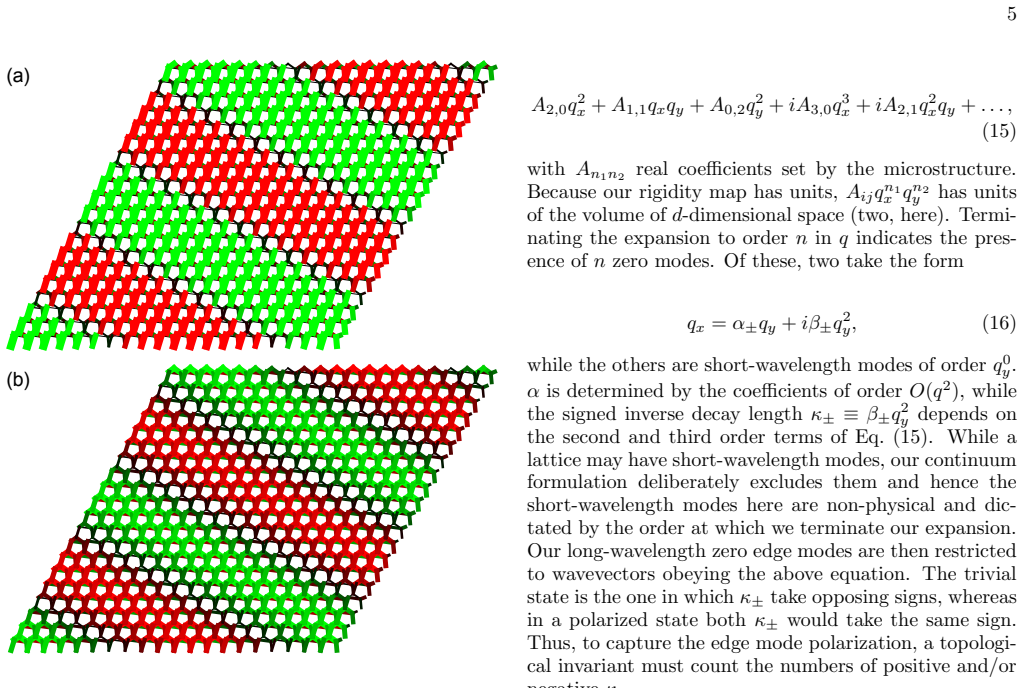
0.2 0.4 0.6 0.8 1. -2 -1 0 1 2 Parameter space x ΔN Topological transition (a) rn rn (b) (c) FIG. 4. (a) Topological transition as we deform the Kagome lattice. The geometry of the system is parametrized as g(x) = xg1 + (1−x)g2 where g1, g2 are geometric configurations of two Kagome systems with respective topological polarizations 0 and 2 along the ˆ rn...
-
[2]
G. W. Milton and A. V. Cherkaev, Journal of engineering materials and technology 117, 483 (1995)
work page 1995
-
[3]
Kadic, T
M. Kadic, T. B¨ uckmann, N. Stenger, M. Thiel, and M. Wegener, Applied Physics Letters100, 191901 (2012)
2012
-
[4]
C. P. Goodrich, A. J. Liu, and S. R. Nagel, Physical review letters 114, 225501 (2015)
work page 2015
-
[5]
J. N. Grima and K. E. Evans, Journal of Materials Sci- ence Letters 19, 1563 (2000)
work page 2000
-
[6]
Yang, Z.-M
W. Yang, Z.-M. Li, W. Shi, B.-H. Xie, and M.-B. Yang, Journal of materials science 39, 3269 (2004)
2004
Show all 39 references
-
[7]
Alderson and K
A. Alderson and K. Alderson, Proceedings of the In- stitution of Mechanical Engineers, Part G: Journal of Aerospace Engineering 221, 565 (2007)
2007
-
[8]
Hanifpour, C
M. Hanifpour, C. F. Petersen, M. J. Alava, and S. Zap- peri, The European Physical Journal B 91, 271 (2018)
2018
-
[9]
Bertoldi, V
K. Bertoldi, V. Vitelli, J. Christensen, and M. van Hecke, Nature Reviews Materials 2, 17066 (2017)
2017
-
[10]
M. K. Blees, A. W. Barnard, P. A. Rose, S. P. Roberts, K. L. McGill, P. Y. Huang, A. R. Ruyack, J. W. Kevek, B. Kobrin, D. A. Muller, et al. , Nature 524, 204 (2015)
2015
-
[11]
Q. Chen, S. C. Bae, and S. Granick, Nature 469, 381 (2011)
2011
-
[12]
J. Cha, K. W. Kim, and C. Daraio, Nature 564, 229 (2018)
2018
-
[13]
P. W. Rothemund, Nature 440, 297 (2006)
2006
-
[14]
C. E. Castro, F. Kilchherr, D.-N. Kim, E. L. Shiao, T. Wauer, P. Wortmann, M. Bathe, and H. Dietz, Na- ture methods 8, 221 (2011)
2011
-
[16]
Kane and T
C. Kane and T. Lubensky, Nature Physics 10, 39 (2014)
2014
-
[17]
Mao and T
X. Mao and T. C. Lubensky, Annual Review of Con- densed Matter Physics 9, 413 (2018)
2018
-
[18]
Paulose, B
J. Paulose, B. G.-g. Chen, and V. Vitelli, Nature Physics 11, 153 (2015)
2015
-
[19]
Paulose, A
J. Paulose, A. S. Meeussen, and V. Vitelli, Proceedings of the National Academy of Sciences 112, 7639 (2015)
2015
-
[20]
B. G.-g. Chen, B. Liu, A. A. Evans, J. Paulose, I. Cohen, V. Vitelli, and C. Santangelo, Physical review letters 116, 135501 (2016)
2016
-
[21]
D. Z. Rocklin, New Journal of Physics 19, 065004 (2017)
2017
-
[22]
Zhang and X
L. Zhang and X. Mao, New Journal of Physics 20, 063034 (2018)
2018
-
[23]
Lubensky, C
T. Lubensky, C. Kane, X. Mao, A. Souslov, and K. Sun, Reports on Progress in Physics 78, 073901 (2015)
2015
-
[24]
Calladine, International Journal of Solids and Struc- tures 14, 161 (1978)
C. Calladine, International Journal of Solids and Struc- tures 14, 161 (1978)
1978
-
[25]
Meiboom, J
S. Meiboom, J. P. Sethna, P. Anderson, and W. F. Brinkman, Physical Review Letters 46, 1216 (1981)
1981
-
[26]
B. G.-g. Chen, N. Upadhyaya, and V. Vitelli, Proceed- ings of the National Academy of Sciences 111, 13004 (2014)
2014
-
[27]
Guest and J
S. Guest and J. Hutchinson, Journal of the Mechanics and Physics of Solids 51, 383 (2003)
2003
-
[28]
Shankar, M
S. Shankar, M. J. Bowick, and M. C. Marchetti, Physical Review X 7, 031039 (2017)
2017
-
[29]
Souslov, B
A. Souslov, B. C. Van Zuiden, D. Bartolo, and V. Vitelli, Nature Physics 13, 1091 (2017)
2017
-
[30]
D. Z. Rocklin, B. G.-g. Chen, M. Falk, V. Vitelli, and T. Lubensky, Physical review letters 116, 135503 (2016). 10
2016
-
[31]
D. Z. Rocklin, S. Zhou, K. Sun, and X. Mao, Nature communications 8, 14201 (2017)
2017
- [33]
-
[34]
N. P. Mitchell, L. M. Nash, D. Hexner, A. M. Turner, and W. T. Irvine, Nature Physics 14, 380 (2018)
2018
-
[35]
J. W. Rocks, N. Pashine, I. Bischofberger, C. P. Goodrich, A. J. Liu, and S. R. Nagel, Proceedings of the National Academy of Sciences 114, 2520 (2017)
2017
-
[36]
L. Yan, R. Ravasio, C. Brito, and M. Wyart, Proceedings of the National Academy of Sciences 114, 2526 (2017)
2017
-
[37]
J. Z. Kim, Z. Lu, S. H. Strogatz, and D. S. Bassett, Nature Physics , 1 (2019)
2019
-
[38]
Coulais, C
C. Coulais, C. Kettenis, and M. van Hecke, Nature Physics 14, 40 (2018)
2018
-
[39]
B. Deng, C. Mo, V. Tournat, K. Bertoldi, and J. R. Raney, Physical review letters 123, 024101 (2019). Appendices A. DERIVING THE EQUILIBRIUM MAP Qij,m FROM THE RIGIDITY MAP Rm,ij We expect the components of the stress tensor to be linear in the spring tensions em, and we define...
2019
Reviewed August 14, 2026 · model on record in the stance chip above.
Discussion (0). Continue with ORCID to comment.