REVIEW 5 minor 63 references
Color-code lattice surgery can be drawn and optimized as pipe diagrams that match ZX calculus, then compiled down to syndrome circuits.
Reviewed by Pith at T0; open to challenge. T0 means a machine referee read the full paper against a public rubric. the ladder, T0–T4 →
T0 review · grok-4.5
2026-07-11 06:45 UTC pith:OHGOXNC3
load-bearing objection Solid constructive foundation for color-code pipe diagrams; the STDW/star-operator choice is a real design constraint but does not break the delivered framework.
Towards Lattice Surgery Compilation for the Color Code Using Pipe Diagrams
The pith
A machine-rendered reading of the paper's core claim, the machinery that carries it, and where it could break.
Core claim
A distance-independent pipe-diagram calculus for the triangular color code on the 6.6.6 lattice, built from semi-transparent domain walls and star-shaped logical operators, corresponds exactly to ZX diagrams and supplies both macroscopic spacetime embeddings and microscopic syndrome-extraction circuits for lattice-surgery computation.
What carries the argument
Color-code pipe diagrams: triangular prisms linked by vertical and horizontal pipes whose faces encode preparation/measurement bases and domain-wall type; star-shaped correlation surfaces are generated by reflection across the triangle group and match ZX spider fusion and π-copy rules.
Load-bearing premise
The clean ZX match and distance-independent surfaces only hold when semi-transparent single-type domain walls and default star-shaped logical operators are used; other surgery schemes would break the construction.
What would settle it
Compile a multi-gate color-code circuit both with the new pipe diagrams and with a fixed-gate lattice-surgery schedule, then measure whether the pipe-diagram version yields strictly lower spacetime volume and still produces the predicted logical observables under circuit-level noise.
If this is right
- Macroscopic compilers can now embed ZX-optimized color-code circuits into spacetime with fewer prisms than naive sequential stacking of CNOTs.
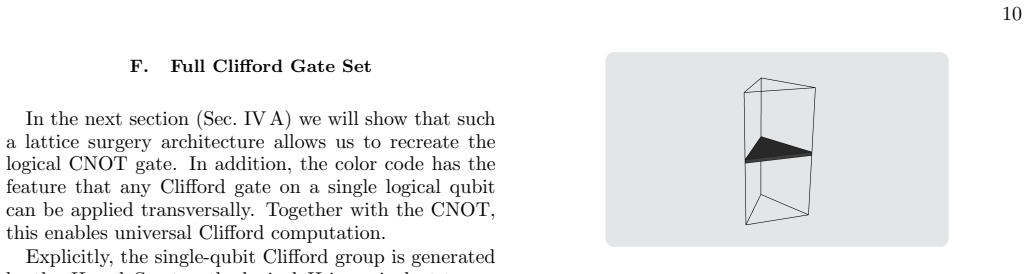
- Transversal single-qubit Cliffords can be inserted as zero-overhead black planes inside temporal pipes, cutting spacetime volume relative to surface-code deformation or Y-basis injection.
- Higher-degree (up to 5) ZX junctions embed directly, so fewer auxiliary nodes are required than for the surface code’s degree-4 limit.
- The same diagrams expand automatically into stabilizers and interleaved superdense/folding syndrome circuits for any odd distance d.
- Magic-state cultivation becomes simpler because grafting is unnecessary, extending the pipeline toward universal fault-tolerant computation.
Where Pith is reading between the lines
- If automated macroscopic embedding tools are built, color-code spacetime volume may undercut surface-code volume for Clifford-heavy subroutines even before decoding improvements.
- The 3-valent spatial connectivity of triangular patches may force extra routing overhead that offsets the higher-degree junction advantage; quantitative trade-off studies are needed.
- Weight-2 folding along domain walls reduces circuit distance only locally; large-scale layouts that keep most volume in the bulk should still approach full distance.
- Extending the diagrams to fully transparent domain walls or multi-logical-qubit patches would test how tightly the ZX correspondence is tied to the present surgery scheme.
Editorial analysis
A structured set of objections, weighed in public.
Referee Report
Summary. The manuscript develops a distance-independent pipe-diagram representation for the triangular color code on the 6.6.6 lattice, based on lattice surgery via semi-transparent domain walls with single-type stabilizers and default star-shaped logical operators. It constructs explicit correlation surfaces (vertical surfaces by triangle-group reflections of a seed star operator; horizontal CS_X/CS_Z via bulk sublattice rules or the linear system H_X^T cs_X = ℓ_X), establishes a direct correspondence to ZX diagrams (including degree-5 junctions), and supplies syndrome-extraction circuits that interleave superdense measurement of double-type plaquettes with inline folding for weight-2 STDW stabilizers. Macroscopic examples (CNOT, three consecutive CNOTs, single-qubit Cliffords) illustrate spacetime-volume reductions relative to naïve stacking, while microscopic simulations with stim and the tesseract decoder serve as proof-of-principle comparisons against surface-code baselines generated by tqec.
Significance. If the constructions hold, the paper supplies the first systematic pipe-diagram foundation for color-code lattice surgery, closing a clear gap relative to the mature surface-code literature (tqec, Topologiq, etc.). The explicit, distance-agnostic rules for stabilizers, correlation surfaces and ZX embedding, together with the transversal Clifford advantage and higher-valence junctions, give a concrete route to automated macroscopic spacetime optimization and microscopic circuit generation. Reproducible simulation code and the linear-algebra characterization of CS_X are concrete strengths that make the framework immediately usable by others. The work is constructive methodology rather than a performance claim, so its value lies in enabling subsequent compilation tools and comparative studies.
minor comments (5)
- Sec. III.C–E: the dependence of the clean ZX correspondence and reflection construction on the specific choice of semi-transparent single-type domain walls and star-shaped seeds is correctly noted in the conclusion, but a short explicit caveat in the abstract or introduction would help readers who might otherwise assume the framework is scheme-agnostic.
- Sec. V.A and Figs. 28–29: the folding schedule reduces circuit-level distance to ⌈d/2⌉ along STDWs and visibly degrades vertical correlation surfaces at small d; while the text already flags this, a quantitative estimate of the asymptotic impact (or a pointer to an alternative schedule that preserves full distance) would strengthen the microscopic section.
- Fig. 1 and the compilation pipeline description: the figure caption and surrounding text could more clearly distinguish the distance-independent pipe diagram from the subsequent d-dependent stabilizer and circuit realizations, to avoid any impression that the macroscopic STV counts already include microscopic overhead.
- Sec. IV.D: the comparison of spatial connectivity (3-valent vs 4-valent) and spatiotemporal valence (5-valent vs 4-valent) is useful; a brief remark on how the same-color horizontal-pipe restriction interacts with these numbers would complete the picture.
- Typographical and notational polish: occasional missing spaces after punctuation, inconsistent use of STV versus STV_naive, and a few figure labels that become hard to read when walls are removed (e.g., Fig. 23) could be cleaned in production.
Circularity Check
No significant circularity: constructive definitions of color-code pipes, STDW stabilizers, star-shaped correlation surfaces and ZX embedding rules, not predictions forced by fits or self-citation chains.
full rationale
The paper is a constructive methodology contribution. Pipe diagrams, correlation surfaces (vertical via triangle-group reflections of star-shaped seeds; horizontal via explicit CS_X stabilizer products or the linear equation H_X^T cs_X = ℓ_X), and syndrome-extraction circuits (superdense + inline folding) are defined from the chosen lattice-surgery scheme (semi-transparent single-type domain walls on the 6.6.6 lattice) and then shown to match ZX spider rules by direct anyon/STDW analysis. Spacetime-volume counts are obtained by enumerating prisms/nodes after ordinary ZX rewrites (spider fusion, identity insertion), not by free parameters fitted to a target. Self-citations ([7,8] on fixed-gate color-code compilation, Fowler’s surface-code pipe literature) supply background and contrast; none supplies a uniqueness theorem or numerical input that forces the new constructions. Simulations are explicitly proof-of-principle under a uniform depolarizing model and acknowledge decoder and folding-distance caveats. No step reduces a claimed prediction or first-principles result to its own inputs by construction.
Axiom & Free-Parameter Ledger
axioms (5)
- domain assumption Stabilizer formalism and lattice surgery implement logical multi-qubit operations via merges/splits with random outcomes tracked by correlation surfaces.
- domain assumption ZX calculus rewrite rules (spider fusion, π-copy, identity removal, etc.) correctly describe Pauli flow for lattice-surgery diagrams independent of code family.
- domain assumption Semi-transparent domain walls with single-type X or Z stabilizers (weight ≤6) correctly couple triangular 6.6.6 color-code patches and force the anyon condensation rules used for star-shaped operator extension.
- domain assumption Uniform circuit-level depolarizing noise and the chosen superdense + inline-folding schedules model relevant error mechanisms for the reported logical error rates.
- ad hoc to paper Triangle-group reflections of a seed star-shaped operator yield consistent vertical correlation surfaces across STDWs for arbitrary d.
invented entities (2)
-
Color-code pipe diagrams (triangular prisms, uncolored vertical walls, colored horizontal pipes, black Clifford planes)
independent evidence
-
Distance-agnostic graphical rules for horizontal CS_X/CS_Z on 3-colorable STDW tessellations
independent evidence
read the original abstract
Pipe diagrams have emerged as a powerful framework for flexible lattice surgery compilation and spacetime optimization for the surface code. In contrast, analogous compilation techniques for color code architectures remain largely unexplored, despite the color code's favorable properties, including reduced qubit overhead and transversal single-qubit Clifford gates. In this work, we develop a pipe diagram representation for the triangular color code on the 6.6.6 lattice and establish its correspondence to ZX-diagrammatic descriptions of computation. We present distance-independent constructions of color code pipe diagrams together with explicit realizations of correlation surfaces, stabilizers, and syndrome extraction circuits. This framework enables both macroscopic optimization of logical computations in spacetime and microscopic compilation to executable syndrome extraction circuits. We demonstrate the potential for compact spacetime embeddings with the color code's geometry. These results provide a foundation for automated lattice surgery compilation and diagrammatic optimization in color code architectures.
Figures




Reference graph
Works this paper leans on
-
[1]
The bulk is formed by all color code patches along the path that are supposed to have trivial action. In Fig. 8, the patches marked withb, c, d, eare bulk patches
-
[2]
free”. To choose the correct subset of stabilizers for the horizontalX-type correlation surfaceCS X, one has to determine the “color
In the given structure, each bulk patch has two sides that are connected to another patch via an STDW, and one of the triangle’s sides is “free”. To choose the correct subset of stabilizers for the horizontalX-type correlation surfaceCS X, one has to determine the “color” of the adjacent STDWs. The color of the STDW is determined by the color of the singl...
-
[3]
There are multiple possibilities, in particular if the sublattice differs between adjacent bulk patches
After the stabilizer subset is chosen from the bulk’s patches, one has to determine which stabilizers from the STDW are included in the subset as well. There are multiple possibilities, in particular if the sublattice differs between adjacent bulk patches. These possibilities are shown in Fig. 9
-
[4]
star-shaped
After the correct stabilizers from the bulk patches and STDWs are added to the subset, one has to take care of the two boundary patches. One can say that the star operators ‘split’ the patch into three thirds. In Fig. 8, one can see three sections of stabilizers in the boundary patchaandfindicated bya ′, a′′, a′′′ andf ′, f ′′, f ′′′ respectively. One nee...
-
[5]
free” sides have to be made trivial in the (a) (b) FIG. 10. (a) “Spreading
Then, also the subset from the STDW adjacent to each boundary patch has to be chosen accordingly, such that trivial action is guaranteed everywhere except the star operator. For this, a mixture of Fig. 9 is applied. While this example had the structure of a chain of triangular color code patches, the structures can differ from such shapes as, for instance...
-
[6]
Init. aux
In this section, however, we adopt a less conservative FIG. 17. By allowing open spatial ports, one can create a CNOT gate pipe diagram with only two involved nodes. a b c a' b' c' a b c a' b' c' a b c a b c a' b' c' a' b' c' FIG. 18. Three consecutive CNOT gates as a circuit and translated into a ZX diagram (left). Naively stacking the two variations of ...
2020
-
[7]
Bombin and M
H. Bombin and M. A. Martin-Delgado, Quantum mea- surements and gates by code deformation, Journal of Physics A: Mathematical and Theoretical42, 095302 (2009)
2009
-
[8]
Horsman, A
D. Horsman, A. G. Fowler, S. Devitt, and R. V. Meter, Surface code quantum computing by lattice surgery, New J. Phys.14, 123011, publisher: IOP Publishing
-
[9]
A. J. Landahl and C. Ryan-Anderson, Quantum comput- ing by color-code lattice surgery (2014), arXiv:1407.5103 [quant-ph]
Pith/arXiv arXiv 2014
-
[10]
Molavi, A
A. Molavi, A. Xu, S. Tannu, and A. Albarghouthi, Dependency-aware compilation for surface code quantum architectures, Proceedings of the ACM on Programming Languages9, 57–84 (2025)
2025
-
[11]
Beverland, V
M. Beverland, V. Kliuchnikov, and E. Schoute, Surface code compilation via edge-disjoint paths, PRX Quantum 3, 020342 (2022), publisher: American Physical Society
2022
-
[12]
G. Watkins, H. M. Nguyen, K. Watkins, S. Pearce, H.-K. Lau, and A. Paler, A high performance compiler for very large scale surface code computations, Quantum8, 1354 (2024), arXiv:2302.02459
Pith/arXiv arXiv 2024
-
[13]
L. S. Herzog, L. Berent, A. Kubica, and R. Wille, Lat- tice surgery compilation beyond the surface code, in2025 IEEE International Conference on Quantum Computing and Engineering (QCE), Vol. 01 (2025) pp. 489–500
2025
-
[14]
L. S. Herzog, L. Berent, A. Kubica, and R. Wille, Exploit- ing movable logical qubits for lattice surgery compilation (2025), arXiv:2512.04169 [quant-ph]
arXiv 2025
-
[15]
Fowler, Surface code quantum compu- tation,https://drive.google.com/file/d/ 1gCNpSdvE7Xtnf6Onh05vz9PX_WkjNv2r/view(2025), unpublished manuscript
A. Fowler, Surface code quantum compu- tation,https://drive.google.com/file/d/ 1gCNpSdvE7Xtnf6Onh05vz9PX_WkjNv2r/view(2025), unpublished manuscript
2025
-
[16]
A. Suau, Y. Zhang, P. Thakre, Y. Zhao, K. Dubey, J. A. Bolanos, A. Schelpe, T. Hao, P. Seitz, G. G. Guerreschi, A. E. A. P´ erez, R. Stahn, J. Lenssen, B. Reid, and A. Fowler, tqec: A python package for topological quan- tum error correction, Journal of Open Source Software 11, 9142 (2026)
2026
-
[17]
A. G. Fowler, M. Mariantoni, J. M. Martinis, and A. N. Cleland, Surface codes: Towards practical large-scale quantum computation, Phys. Rev. A86, 032324 (2012), arXiv:1208.0928
Pith/arXiv arXiv 2012
-
[18]
H. Bombin and M. A. Martin-Delgado, Topological quan- tum distillation, Phys. Rev. Lett.97, 180501 (2006), quant-ph/0605138
Pith/arXiv arXiv 2006
-
[19]
S. Koutsioumpas, T. Noszko, H. Sayginel, M. Webster, and J. Roffe, Colour codes reach surface code perfor- mance using vibe decoding (2025), 2508.15743 [quant- ph]
Pith/arXiv arXiv 2025
-
[20]
Kubica and N
A. Kubica and N. Delfosse, Efficient color code decoders ind≥2 dimensions from toric code decoders, Quantum 7, 929 (2023)
2023
-
[22]
C. Gidney and C. Jones, New circuits and an open source decoder for the color code (2023), arXiv:2312.08813 [quant-ph]
Pith/arXiv arXiv 2023
-
[23]
S.-H. Lee, A. Li, and S. D. Bartlett, Color code decoder with improved scaling for correcting circuit-level noise, Quantum9, 1609 (2025), arXiv:2404.07482
Pith/arXiv arXiv 2025
-
[24]
Silva, X
A. Silva, X. Zhang, Z. Webb, M. Kramer, C.-W. Yang, X. Liu, J. Lemieux, K.-W. Chen, A. Scherer, and P. Ron- agh, Multi-qubit Lattice Surgery Scheduling, in19th Conference on the Theory of Quantum Computation, Communication and Cryptography (TQC 2024), Leibniz International Proceedings in Informatics (LIPIcs), Vol. 310, edited by F. Magniez and A. B. Grilo...
2024
-
[25]
D. Herr, F. Nori, and S. J. Devitt, Lattice surgery transla- tion for quantum computation, New J. Phys.19, 013034 (2017), publisher: IOP Publishing
2017
-
[26]
M. Zhu, H. Fu, J. Wu, C. Zhang, W. Xie, and X.-Y. Li, Ecmas: Efficient circuit mapping and scheduling for sur- face code, in2024 IEEE/ACM International Symposium on Code Generation and Optimization (CGO)(2024) pp. 158–169
2024
-
[27]
J. Zhou, Y. Liu, E. Decker, J. Kalloor, M. Wei- den, K. Chen, C. Iancu, and G. Li, Topols: Lattice surgery compilation via topological program transforma- tions (2026), arXiv:2601.23109 [quant-ph]
arXiv 2026
-
[28]
TQEC Community, Topologiq: Algorithmic lattice surgery,https://github.com/tqec/topologiq(2025), accessed: 2026-05-15
2025
-
[29]
D. B. Tan, M. Y. Niu, and C. Gidney, A sat scalpel for lattice surgery: Representation and synthesis of subrou- tines for surface-code fault-tolerant quantum computing, in2024 ACM/IEEE 51st Annual International Sympo- sium on Computer Architecture (ISCA)(2024) pp. 325– 339
2024
-
[30]
Thomsen, M
F. Thomsen, M. S. Kesselring, S. D. Bartlett, and B. J. Brown, Low-overhead quantum computing with the color code, Phys. Rev. Res.6, 043125, publisher: American Physical Society
-
[31]
D. Litinski, M. S. Kesselring, J. Eisert, and F. v. Oppen, Combining topological hardware and topological soft- ware: Color code quantum computing with topological superconductor networks, Phys. Rev. X7, 031048 (2017), arXiv:1704.01589
Pith/arXiv arXiv 2017
-
[32]
Bombin, Topological subsystem codes, Phys
H. Bombin, Topological subsystem codes, Phys. Rev. A 81, 032301 (2010), publisher: American Physical Society
2010
-
[33]
Bomb´ ın, Topological codes, inQuantum Error Correc- tion, edited by D
H. Bomb´ ın, Topological codes, inQuantum Error Correc- tion, edited by D. A. Lidar and T. A. Brun (Cambridge University Press, 2013) p. 455–481
2013
-
[34]
D. E. Gottesman,Stabilizer Codes and Quantum Error Correction, Ph.D. thesis (1997)
1997
-
[35]
Kitaev, Fault-tolerant quantum computation by anyons, Annals of Physics303, 2–30 (2003)
A. Kitaev, Fault-tolerant quantum computation by anyons, Annals of Physics303, 2–30 (2003). 20
2003
-
[36]
Dennis, A
E. Dennis, A. Kitaev, A. Landahl, and J. Preskill, Topological quantum memory, Journal of Mathematical Physics43, 4452–4505 (2002)
2002
-
[37]
Kubica,The ABCs of the Color Code: A Study of Topological Quantum Codes as Toy Models for Fault- Tolerant Quantum Computation and Quantum Phases Of Matter, Ph.D
A. Kubica,The ABCs of the Color Code: A Study of Topological Quantum Codes as Toy Models for Fault- Tolerant Quantum Computation and Quantum Phases Of Matter, Ph.D. thesis (2018)
2018
-
[38]
The constructions of this work do not explicitly rely on a strict rotational symmetry
Note, however, in general, a ‘star-shaped’ logical operator does not necessarily require a strict symmetry of 2π/3 rotations. The constructions of this work do not explicitly rely on a strict rotational symmetry
-
[39]
A. G. Fowler and C. Gidney, Low overhead quantum com- putation using lattice surgery (2019), arXiv:1808.06709 [quant-ph]
Pith/arXiv arXiv 2019
-
[40]
Gidney, Inplace Access to the Surface Code Y Basis, Quantum8, 1310 (2024)
C. Gidney, Inplace Access to the Surface Code Y Basis, Quantum8, 1310 (2024)
2024
-
[41]
M. E. Beverland, A. Kubica, and K. M. Svore, Cost of universality: A comparative study of the overhead of state distillation and code switching with color codes, PRX Quantum2, 020341 (2021)
2021
-
[42]
Gidney and A
C. Gidney and A. G. Fowler, Efficient magic state facto- ries with a catalyzed ccz to 2 t transformation, Quantum 3, 135 (2019)
2019
-
[43]
J. v. d. Wetering, ZX-calculus for the working quantum computer scientist (2020), arXiv:2012.13966
Pith/arXiv arXiv 2020
-
[44]
Kissinger and J
A. Kissinger and J. van de Wetering,Picturing Quan- tum Software: An Introduction to the ZX-Calculus and Quantum Compilation(Preprint, 2024)
2024
-
[45]
N. de Beaudrap and D. Horsman, The ZX calculus is a language for surface code lattice surgery, Quantum4, 218 (2020), arXiv:1704.08670
Pith/arXiv arXiv 2020
-
[46]
J. C. Magdalena de la Fuente, J. Old, A. Townsend- Teague, M. Rispler, J. Eisert, and M. M¨ uller, XYZ ruby code: Making a case for a three-colored graphical cal- culus for quantum error correction in spacetime, PRX Quantum6, 010360 (2025)
2025
-
[47]
M. S. Kesselring, J. C. Magdalena de la Fuente, F. Thom- sen, J. Eisert, S. D. Bartlett, and B. J. Brown, Anyon condensation and the color code, PRX Quantum5, 010342 (2024), publisher: American Physical Society
2024
-
[48]
Kubica and M
A. Kubica and M. E. Beverland, Universal transversal gates with color codes: A simplified approach, Phys. Rev. A91, 032330, publisher: American Physical Society
-
[49]
Vuillot, L
C. Vuillot, L. Lao, B. Criger, C. G. Almud´ ever, K. Ber- tels, and B. M. Terhal, Code deformation and lattice surgery are gauge fixing, New J. Phys.21, 033028 (2019), publisher: IOP Publishing
2019
-
[50]
Simulations of pipe diagrams require a deterministic observable, i.e., a correlation surface with deterministic measurement outcomes
A few words on simulating such structures are in order here. Simulations of pipe diagrams require a deterministic observable, i.e., a correlation surface with deterministic measurement outcomes. To achieve this, one usually adds prisms/cubes at the open ports of a pipe diagram. While diagrams ending temporally are straightforward to sim- ulate, diagrams e...
-
[51]
But this adds logical action which is not desired here
Of course, if a spatial Hadamard was applied within a spatial pipe, blue and red prisms can be connected also in the bulk of a diagram. But this adds logical action which is not desired here
-
[52]
Note that the application of spatial gates would possibly further reduce the spacetime volume
-
[53]
C. Gidney, N. Shutty, and C. Jones, Magic state cultiva- tion: growing t states as cheap as CNOT gates (2024), 2409.17595
Pith/arXiv arXiv 2024
-
[54]
Koutsioumpas and J
S. Koutsioumpas and J. Roffe, Vibe Decoding Quantum Error Correction with CUDA
-
[55]
T. J. Yoder and I. H. Kim, The surface code with a twist, Quantum1, 2 (2017), arXiv:1612.04795
Pith/arXiv arXiv 2017
-
[56]
G. Kishony and A. Fowler, Surface code off-the- hook: diagonal syndrome-extraction scheduling (2026), arXiv:2602.09099 [quant-ph]
arXiv 2026
-
[57]
Chamberland, A
C. Chamberland, A. Kubica, T. J. Yoder, and G. Zhu, Triangular color codes on trivalent graphs with flag qubits, New Journal of Physics22, 023019 (2020)
2020
-
[58]
G. Kishony and A. Fowler, Color code off-the-hook: avoiding hook errors with a single auxiliary per plaquette (2026), arXiv:2603.28852 [quant-ph]
arXiv 2026
-
[59]
One timestep is defined by a multitude of gates that can be applied in parallel, i.e., with disjoint physical qubit overlap
-
[60]
Gidney, Stim: a fast stabilizer circuit simulator, Quan- tum5, 497 (2021)
C. Gidney, Stim: a fast stabilizer circuit simulator, Quan- tum5, 497 (2021)
2021
-
[61]
Higgott and C
O. Higgott and C. Gidney, Sparse Blossom: correcting a million errors per core second with minimum-weight matching, Quantum9, 1600 (2025)
2025
-
[62]
A. G. Fowler, Optimal complexity correction of corre- lated errors in the surface code (2013), arXiv:1310.0863 [quant-ph]
Pith/arXiv arXiv 2013
-
[63]
L. Aghababaie Beni, O. Higgott, and N. Shutty, Tesser- act: A search-based decoder for quantum error correction (2025), arXiv:2503.10988 [quant-ph]
Pith/arXiv arXiv 2025
-
[64]
An explanation of binomial confidence intervals in stim can be found here
discussion (0)
Sign in with ORCID, Apple, or X to comment. Anyone can read and Pith papers without signing in.