REVIEW 2 major objections 4 minor 135 references
Signatures of Many-Particle Interference
T0 review · 2 major / 4 minor · reviewed 2026-08-14 · deepseek-v4-flash
Pith's one-line read The paper establishes that the first two moments of two-port correlations separate four particle species and, under partial distinguishability, produce a statistical Hong-Ou-Mandel transition.
desk verdict A solid tutorial that repackages the author's own benchmark work; the single-interferometer claim needs a concentration caveat. read the letter →
The pith
A machine-rendered reading of the paper's core claim, the machinery that carries it, and where it could break.
The reading
What carries the argument
The carrying object is the two-port correlation cumulant $C_{o_1o_2}=\langle\hat{n}_{o_1}\hat{n}_{o_2}\rangle-\langle\hat{n}_{o_1}\rangle\langle\hat{n}_{o_2}\rangle$, computed for every pair of output ports of an $m$-mode interferometer; the paper calls the collection the C-dataset and studies its first two moments. The analytical work is done by Haar averaging over all $m\times m$ unitary matrices, using Weingarten functions, which are group-integral coefficients expressing averages of products of unitary matrix elements. This turns the moments of the C-dataset into closed-form functions of $n$, $m$, and the overlap matrix $|\langle\psi_k|\psi_l\rangle|^2$, independent of the specific interferometer. For suppression laws, the carrying object is the input state's permutation symmetry combined with the eigendecomposition $P_\pi=A^\dagger D A$ of the mode permutation, which forces any output event whose eigenvalue product $\prod_j\lambda_{o_j}$ is not $1$ (bosons) or $\mathrm{sign}(\pi)$ (fermions) to have zero transition amplitude.
What would settle it
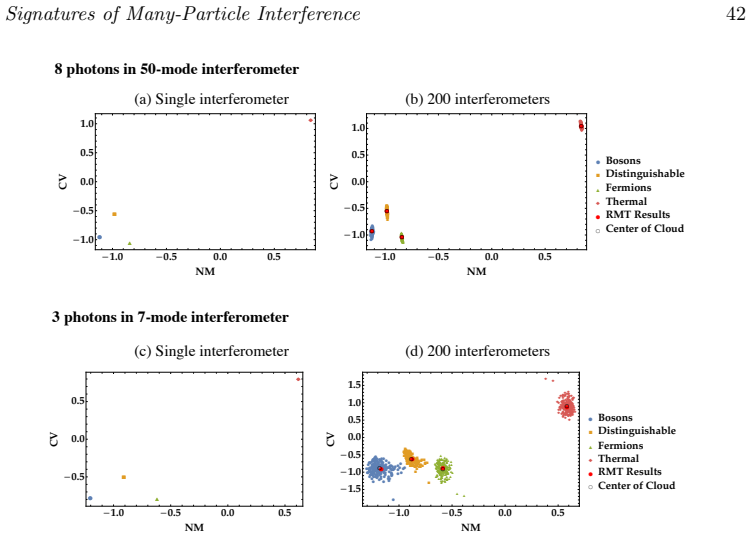
Take a single small interferometer (for example, three particles in seven modes), compute NM and CV from the two-port correlation dataset for many different Haar-random unitaries, and compare the spread of points with the distance between the four particle-type clusters predicted by Eqs. (200)-(208); if the spread is comparable to that distance, the benchmark cannot identify the particle type from one interferometer, contradicting the claim of an interferometer-independent statistical signature.
Extended reading notes
Core claim
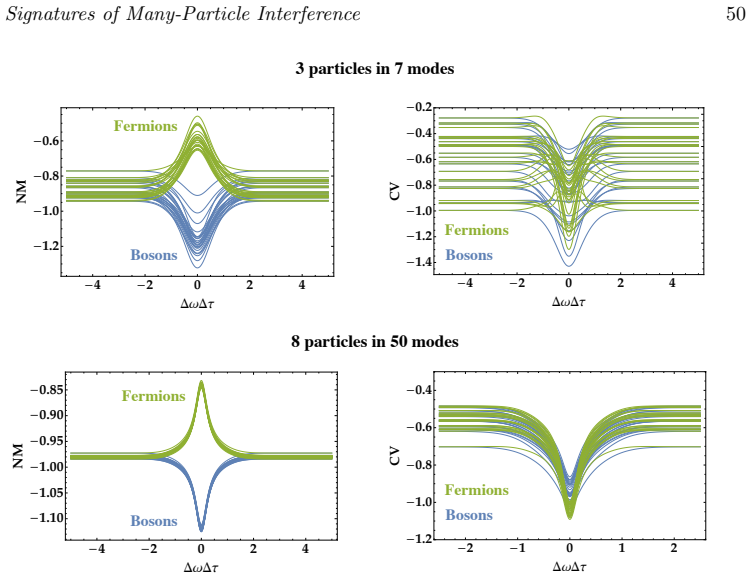
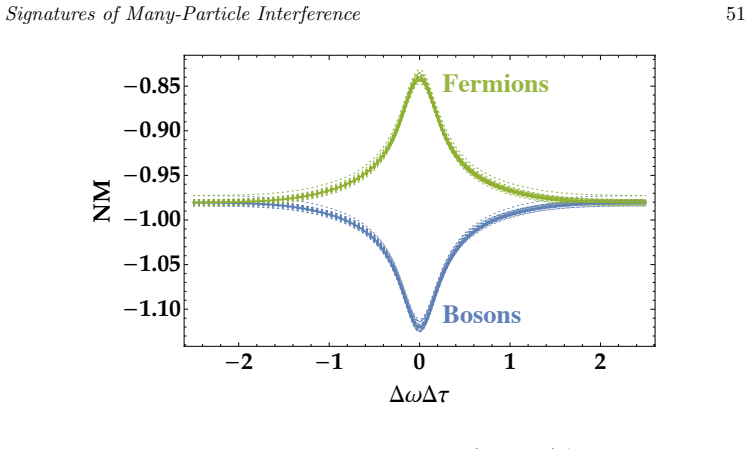
The central claim is that two-particle correlations at the output of an arbitrary linear interferometer carry a universal statistical fingerprint of the input particles' quantum statistics. Defining $C_{o_1o_2}=\mathrm{tr}[\hat{n}_{o_1}\hat{n}_{o_2}\rho]-\mathrm{tr}[\hat{n}_{o_1}\rho]\mathrm{tr}[\hat{n}_{o_2}\rho]$ for every pair of output ports, the empirical moments $m_1=\overline{C}$ and $m_2=\overline{C^2}$ across output pairs converge, for large $m$, to Haar-averaged values that are evaluated explicitly with Weingarten calculus in Eqs. (200)-(208). These values separate bosonic Fock states, thermal states, fermionic states, and distinguishable particles. When particles are partially distinguishable, the interference terms in $C_{o_1o_2}$ are multiplied by $|\langle\psi_k|\psi_l\rangle|^2$, so the first moment (215) depends monotonically on distinguishability, yielding a statistical Hong-Ou-Mandel transition: the normalized mean increases for bosons and decreases for fermions as particles become more distinguishable. The tutorial also proves general suppression laws for permutation-symmetric interferometers, where total destructive interference forbids selected output events.
Load-bearing premise
The whole statistical benchmark rests on the assumption that, for one fixed interferometer, the measured first and second moments of the C-dataset are well approximated by their averages over all unitary interferometers; the paper verifies this numerically, but does not prove a concentration bound, and its own Fig. 5 shows substantial scatter for three particles in seven modes.
Editorial extensions
If this is right
- A Boson Sampling validation protocol can be built from two-port correlation data alone, and it works for any unitary the device happens to implement, not just interferometers with special symmetries.
- For sufficiently large interferometers, the (NM, CV) point automatically separates bosonic Fock states from thermal states, fermionic states, and distinguishable particles, so the benchmark can rule out these alternative sampling models.
- The normalized mean NM rises monotonically with distinguishability for bosons and falls for fermions, giving a statistical version of the Hong-Ou-Mandel dip that is robust across different interferometers.
- The coefficient of variation CV has larger interferometric visibility than NM in the regime $n\ll m$, so combining both statistics is more discriminative than either one alone.
- Higher-order moments such as skewness and three-port correlations extend the same statistical strategy beyond two-particle interference processes.
Reading between the lines
- The paper does not prove concentration, but its 50-mode numerics suggest that for $m\gg n^2$ the single-interferometer moments converge to the Haar values; a rigorous measure-concentration bound would turn the benchmark from a heuristic validation into a certified test.
- Since only the overlap magnitudes $|\langle\psi_k|\psi_l\rangle|^2$ enter the formulas, the benchmark could be inverted to estimate an effective pairwise distinguishability, such as the time-frequency parameter $\Delta\omega\Delta\tau$, from measured NM and CV values without resolving the internal degrees of freedom.
- The same moment-benchmark structure is likely portable to Gaussian Boson Sampling and to weakly interacting many-body systems, though neither setting is covered by the tutorial's derivations.
- For intermediate system sizes, where the random-matrix limit is not yet accurate, supervised learning on simulated C-datasets can compensate for finite-size scatter and still identify the particle type.
Signed reviews
Editorial analysis
A structured set of objections, weighed in public.
Referee Report
Summary. The manuscript is a tutorial on many-particle interference and its observable signatures. It develops the first- and second-quantized formalism for identical particles, discusses distinguishability via internal and external degrees of freedom, and derives the Hong-Ou-Mandel effect, the permanent/determinant expressions for many-particle transition probabilities, and the partial-distinguishability generalization. The central new material is the statistical benchmark of Section 4.2: for a fixed interferometer U, the first and second moments (Eq. (190)) of the two-point correlation dataset are compared with Haar-averaged random-matrix predictions (Eqs. (200)-(208)) for bosonic Fock states, thermal bosons, fermions, and distinguishable particles. Section 4.3 extends the calculation to partially distinguishable particles through the overlaps |<psi_k|psi_l>|^2, leading to a statistical version of the Hong-Ou-Mandel effect. The tutorial also reviews suppression laws and includes appendices with explicit calculations for the Fourier interferometer and the first moment.
Significance. If the central claim is accepted, the statistical benchmark is a valuable validation tool for Boson Sampling: it uses all sampled events rather than only suppressed ones, it is not restricted to symmetric interferometers, and it has been demonstrated in proof-of-principle experiments. The tutorial is pedagogically useful, and its derivations of the permanent/determinant probabilities and of the two-point correlation functions are careful and self-contained. A notable strength is that no free parameters are fitted to the benchmark predictions: the random-matrix formulas are compared with direct numerical sampling of random unitaries and with cited experimental data. The main weakness is that the practical validity of the benchmark for a single fixed interferometer at intermediate system sizes rests on a self-averaging assumption that is numerically illustrated but not quantified.
major comments (2)
- [Section 4.2, Eqs. (190), (200)-(208), Fig. 5] The claim that the statistical benchmark works "regardless of the interferometer" is stronger than what the manuscript establishes. Equations (200)-(208) are Haar expectations of the moments (190); for a single fixed interferometer the empirical moments fluctuate around these ensemble averages. No concentration bound or variance estimate is provided, and Fig. 5(c) (n=3, m=7) shows large scatter with overlapping clouds for different particle types. The text itself concedes that the method "may fail for smaller (more realistic) setups", and near-term Boson-Sampling validation operates precisely in this regime. Please either rephrase the robustness claim as an asymptotic statement and give explicit guidance on the system sizes for which the clusters separate, or supply quantitative fluctuation estimates for m1 and m2 relative to the inter-species separations in the (NM, CV) plane. The proposed remedies (averaging over several interferometers or over different input ports) should be presented as part of the validation protocol rather than as an afterthought, since they change the experimental requirements.
- [Section 4.3, Eqs. (215)-(216)] Equation (216), the second-moment prediction for partially distinguishable particles, is the quantitative basis of the statistical Hong-Ou-Mandel effect, but it is quoted with only "a computation analogous to (204)" and no derivation or precise reference. The displayed formula is not fully parenthesized, the sums in (217)-(220) are written with indices running from 0 to n under conditions like k1 != k2 != l1 != l2, which is ambiguous, and the sign convention in the "+/-" of (216) and the "+/-" of (215) is not stated explicitly enough for a reader to verify the limiting cases. Since Eqs. (215)-(216) are central to the partial-distinguishability claim, please provide the derivation or a precise citation, state the sign convention, and explicitly verify that the expression reduces to (200)-(203) and (206)-(208) in the fully indistinguishable and fully distinguishable limits.
minor comments (4)
- [Title page and throughout] There are numerous typographical errors, including "Septembre", "W alschaers", "beamplitter", "paricles", and duplicated words such as "the the". A careful proofreading pass is needed.
- [Section 3.1, paragraph on SPDC] The reference placeholder "[ ?]" near the discussion of spontaneous parametric down-conversion should be replaced with an actual citation.
- [Section 4.3, Eq. (215)] The sign in Eq. (215) is easy to misread: the text before Eq. (214) says "+" gives bosons, while Eq. (215) uses "∓". A short sentence or table explicitly stating which sign corresponds to bosons and which to fermions would remove ambiguity.
- [Section 4.2, Fig. 5] The caption states that panels (a) and (c) are single interferometers and (b) and (d) are 200 interferometers, but it would help to state in the caption that the random-matrix prediction is shown for the corresponding particle type in all panels; currently this is only clear from the main text.
Circularity Check
No circularity: the tutorial's predictions are derived analytically from stated assumptions, checked against independent numerics, and not fitted to the data they claim to predict.
full rationale
This paper is a tutorial that derives many-particle interference and validation benchmarks from first principles. The statistical benchmark (Section 4.2) defines the C-dataset moments in Eq. (190), then evaluates Haar averages via Weingarten calculus in Eqs. (196)-(208) to obtain analytic estimates m1 and m2. These estimates are predictions from the stated model, not fits to observed data; the same formulas are checked against independent numerical sampling in Fig. 5 and against published experiments [21]. The distinguishability transition in Section 4.3 similarly follows from the derived correlation expressions (212)-(213) and closed-form RMT averages (215)-(216); no target quantity is inserted as an input. Suppression laws are derived in-text from permutation symmetries in Eqs. (155)-(165) rather than imported unexamined from the author's prior work. Self-citations appear ([30,31,67,93,96]), but they are not load-bearing: the tutorial reproduces the derivations or uses them only for omitted algebra and details, and the results are independently testable. The only substantive caveat is the unproven concentration assumption that single-interferometer empirical moments are close to Haar averages for intermediate system sizes; this is a correctness and robustness concern, not circularity, because the estimates are not fitted to the data they claim to predict.
Assumptions & free parameters
assumptions (6)
- domain assumption Exchange symmetry: identical-particle states are symmetric for bosons and antisymmetric for fermions under particle permutations.
- domain assumption Free, non-interacting evolution is described by second-quantizing a single-particle unitary U, yielding E(U).
- standard math Fermionic number states (Slater determinants) are Gaussian/quasi-free states, so Wick's theorem applies to their correlation functions.
- domain assumption For sufficiently large mode number m, empirical moments of the C-dataset for a single interferometer concentrate on Haar averages over random unitaries.
- domain assumption Detectors are blind to internal degrees of freedom; the measurement POVM sums over internal basis states.
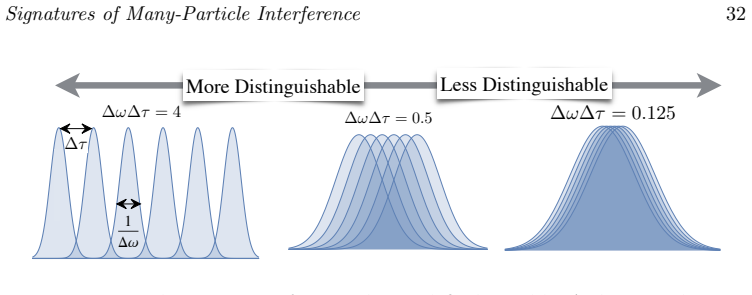
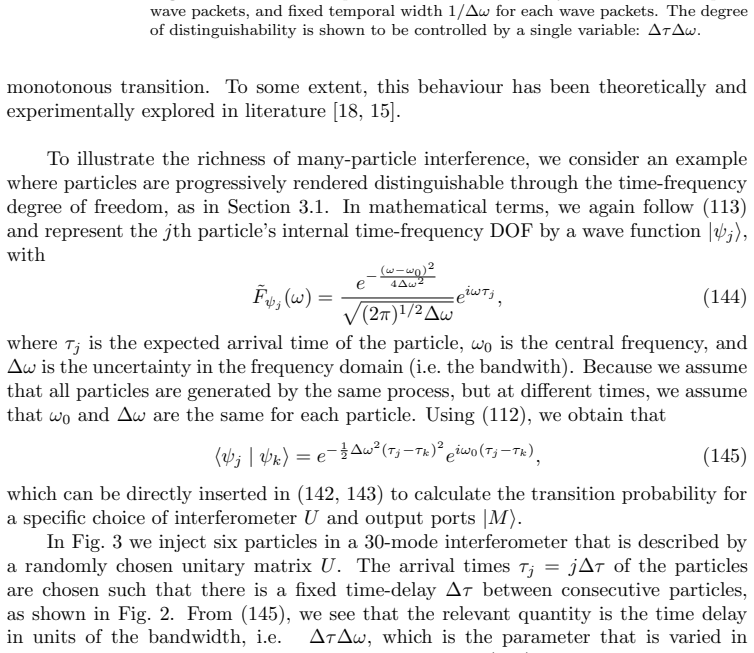
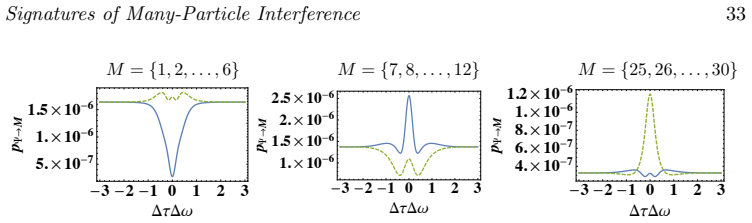
- domain assumption The illustrative input wave packets are Gaussian in time-frequency, with shared bandwidth Δω and arrival times τj.
Cite this review
Pith. "Pith review of Signatures of Many-Particle Interference." pith.science (2026). https://pith.science/paper/OHQTXPH4
@misc{pith2026190808370,
  author       = {Pith},
  title        = {Pith review of: Signatures of Many-Particle Interference},
  year         = {2026},
  howpublished = {\url{https://pith.science/paper/OHQTXPH4}},
  note         = {Machine review of arXiv:1908.08370}
}
read the original abstract
This Tutorial will introduce the mathematical framework for describing systems of identical particles, and explain the notion of indistinguishability. We will then focus our attention on dynamical systems of free particles and formally introduce the concept of many-particle interference. Its impact on many-particle transition probabilities is computationally challenging to evaluate, and it becomes rapidly intractable for systems with large numbers of identical particles. Hence, this Tutorial will build up towards alternative, more efficient methods for observing signatures of many-particle interference. A first type of signatures relies on the detection of a highly sensitive -but also highly fragile-processes of total destructive interference that occurs in interferometers with a high degree of symmetry. A second class of signatures is based on the statistical features that arise when we study the typical behaviour of correlations between a small number of the interferometer's output ports. We will ultimately show how these statistical signatures of many-particle interference lead us to a statistical version of the Hong-Ou-Mandel effect.
Figures

Figures from the paper (9 more)




Reference graph
Works this paper leans on
-
[67]
Walschaers M, Kuipers J, Urbina J-D, Mayer K, Tichy M C, Richter K, and Buchleitner A 2016 Statistical benchmark for BosonSampling. New. J. Phys. 18 032001
work page 2016
-
[93]
in Statistical Benchmarks for Quantum Transport in Complex Systems: From Characterisation to Design
Walschaers M 2018 Appendix B: Averaging over Random Unitary Matrices. in Statistical Benchmarks for Quantum Transport in Complex Systems: From Characterisation to Design . (Springer International Publishing, Cham) p 439–44
work page 2018
-
[1]
Dirac P A M 1930 The Principles of Quantum Mechanics (Oxford University Press, Oxford, 4th edition)
1930
-
[2]
Nature 198 255–6
Magyar G and Mandel L 1963 Interference fringes produced by superposition of two independent maser light beams. Nature 198 255–6
1963
-
[3]
Mandel L 1964 Quantum theory of interference effects produced by independent light beams. Phys. Rev. 134 A10–5
1964
-
[4]
Pfleegor R L and Mandel L 1967 Interference of independent photon beams. Phys. Rev. 159 1084–8
1967
-
[5]
Mandel L 1983 Photon interference and correlation effects produced by independent quantum sources. Phys. Rev. A 28 929–43
1983
-
[6]
Klyshko D N, Penin A N, and Polkovnikov B F 1970 Parametric luminescence and light scattering by polaritons. J. Exp. Theor. Phys. Lett. 11 5–8
1970
Show all 135 references
-
[7]
Burnham D C and Weinberg D L 1970 Observation of simultaneity in parametric production of optical photon pairs. Phys. Rev. Lett. 25 84–7
1970
-
[8]
Europhysics Letters (EPL) 1 173–9
Grangier P, Roger G, and Aspect A 1986 Experimental evidence for a photon anticorrelation effect on a beam splitter: A new light on single-photon interferences. Europhysics Letters (EPL) 1 173–9
1986
-
[9]
Hong C K, Ou Z Y, and Mandel L 1987 Measurement of subpicosecond time intervals between two photons by interference. Phys. Rev. Lett. 59 2044–6
1987
-
[10]
Shih Y H and Alley C O 1988 New type of Einstein-Podolsky-Rosen-Bohm experiment using pairs of light quanta produced by optical parametric down conversion. Phys. Rev. Lett. 61 2921–4
1988
-
[11]
Ou Z Y 1988 Quantum theory of fourth-order interference. Phys. Rev. A 37 1607–19
1988
-
[12]
Sadana S, Ghosh D, Joarder K, Lakshmi A N, Sanders B C, and Sinha U 2019 Near-100% two-photon-like coincidence-visibility dip with classical light and the role of complementarity. Phys. Rev. A 100 013839
2019
-
[13]
Soviet physics JETP 75 606–10
Belinskii A V and Klyshko D N 1992 Interference of multiphoton light and its classical model. Soviet physics JETP 75 606–10
1992
-
[14]
Banaszek K and Knight P L 1997 Quantum interference in three-photon down-conversion. Phys. Rev. A 55 2368–75
1997
-
[15]
Tichy M C, Lim H-T, Ra Y-S, Mintert F, Kim Y-H, and Buchleitner A 2011 Four-photon indistinguishability transition. Phys. Rev. A 83 062111
2011
-
[16]
Pan J-W, Chen Z-B, Lu C-Y, Weinfurter H, Zeilinger A, and ˙Zukowski M 2012 Multiphoton entanglement and interferometry. Rev. Mod. Phys. 84 777–838
2012
-
[17]
Tillmann M, Tan S-H, Stoeckl S E, Sanders B C, de Guise H, Heilmann R, Nolte S, Szameit A, and Walther P 2015 Generalized Multiphoton Quantum Interference. Phys. Rev. X 5 041015
2015
-
[18]
PNAS 110 1227–31
Ra Y-S, Tichy M C, Lim H T, Kwon O, Mintert F, Buchleitner A, and Kim Y-H 2013 Nonmonotonic quantum-to-classical transition in multiparticle interference. PNAS 110 1227–31
2013
-
[19]
Nat Commun 4 1606
Spagnolo N, Vitelli C, Aparo L, Mataloni P, Sciarrino F, Crespi A, Ramponi R, and Osellame R 2013 Three-photon bosonic coalescence in an integrated tritter. Nat Commun 4 1606
2013
-
[20]
Menssen A J, Jones A E, Metcalf B J, Tichy M C, Barz S, Kolthammer W S, and Walmsley I A 2017 Distinguishability and many-particle interference. Phys. Rev. Lett. 118 153603
2017
-
[21]
Nat Photon 12 173–8
Giordani T, Flamini F, Pompili M, Viggianiello N, Spagnolo N, Crespi A, Osellame R, Wiebe N, Walschaers M, Buchleitner A, and Sciarrino F 2018 Experimental statistical signature of many-body quantum interference. Nat Photon 12 173–8
2018
-
[22]
2019 Pattern recognition techniques for boson sampling validation
Agresti I, Viggianiello N, Flamini F, Spagnolo N, Crespi A, Osellame R, Wiebe N, and Sciarrino F. 2019 Pattern recognition techniques for boson sampling validation. Phys. Rev. X 9 011013
2019
-
[23]
Zhong H-S, Li Y, Li W, Peng L-C, Su Z-E, Hu Y, He Y-M, Ding X, Zhang W, Li H, Zhang L, Wang Z, You L, Wang X-L, Jiang X, Li L, Chen Y-A, Liu N-L, Lu C-Y, and Pan J- W 2018 12-photon entanglement and scalable scattershot boson sampling with optimal entangled-photon pairs from p...
2018
-
[24]
Nat Commun 7 10469
Crespi A, Osellame R, Ramponi R, Bentivegna M, Flamini F, Spagnolo N, Viggianiello N, Innocenti L, Mataloni P, and Sciarrino F 2016 Suppression law of quantum states in a 3D photonic fast Fourier transform chip. Nat Commun 7 10469
2016
-
[25]
Crespi A 2015 Suppression laws for multiparticle interference in Sylvester interferometers. Phys. Rev. A 91 013811
2015
-
[26]
Quantum Sci
Dittel C, Keil R, and Weihs G 2017 Many-body quantum interference on hypercubes. Quantum Sci. Technol. 2 015003
2017
-
[27]
Tichy M C, Tiersch M, Mintert F, and Buchleitner A 2012 Many-particle interference beyond many-boson and many-fermion statistics. New J. Phys. 14 093015
2012
-
[28]
Tichy M C, Tiersch M, de Melo F, Mintert F, and Buchleitner A 2010 Zero-transmission law for multiport beam splitters. Phys. Rev. Lett. 104 220405
2010
-
[29]
Viggianiello N, Flamini F, Innocenti L, Cozzolino D, Bentivegna M, Spagnolo N, Crespi A, Brod D J, Galvao E F, Osellame R, and Sciarrino F 2018 Experimental generalized quantum suppression law in Sylvester interferometers. New J. Phys. 20 033017
2018
-
[30]
Dittel C, Dufour G, Walschaers M, Weihs G, Buchleitner A, and Keil R 2018 Totally destructive many-particle interference. Phys. Rev. Lett. 120 240404
2018
-
[31]
Dittel C, Dufour G, Walschaers M, Weihs G, Buchleitner A, and Keil R 2018 Totally destructive interference for permutation-symmetric many-particle states. Phys. Rev. A 97 062116
2018
-
[32]
1999 Photon bunching and multiphoton interference in parametric down-conversion
Ou Z Y, Rhee J K, and Wang L J. 1999 Photon bunching and multiphoton interference in parametric down-conversion. Phys. Rev. A 60 593–604
1999
-
[33]
Nat Photon 8 621–6
Carolan J, Meinecke J D A, Shadbolt P J, Russell N J, Ismail N, W¨ orhoff K, Rudolph T, Thompson M G, O’Brien J L, Matthews J C F, and Laing A 2014 On the experimental verification of quantum complexity in linear optics. Nat Photon 8 621–6
2014
-
[34]
Shchesnovich V S 2016 Universality of generalized bunching and efficient assessment of boson sampling. Phys. Rev. Lett. 116 123601
2016
-
[35]
Nature 409 46–52
Knill E, Laflamme R, and Milburn G J 2001 A scheme for efficient quantum computation with linear optics. Nature 409 46–52
2001
-
[36]
2018 Nat Photon 12 534–9
Qiang X, Zhou X, Wang J, Wilkes C M, Loke T, O’Gara S, Kling L, Marshall G D, Santagati R, Ralph T C, Wang J B, O’Brien J L, Thompson M G, and Matthews J C F Large-scale silicon quantum photonics implementing arbitrary two-qubit processing. 2018 Nat Photon 12 534–9
2018
-
[37]
Theory Comput
Aaronson S and Arkhipov A 2013 The computational complexity of linear optics. Theory Comput. 9 143–252
2013
-
[38]
Science 339 794–8
Broome M A, Fedrizzi A, Rahimi-Keshari S, Dove J, Aaronson S, Ralph T C, and White A G 2013 Photonic Boson Sampling in a tunable circuit. Science 339 794–8
2013
-
[39]
Nat Photon 7 545–9
Crespi A, Osellame R, Ramponi R, Brod D J, Galv˜ ao E F, Spagnolo N, Vitelli C, Maiorino E, Mataloni P, and Sciarrino F 2013 Integrated multimode interferometers with arbitrary designs for photonic boson sampling. Nat Photon 7 545–9
2013
-
[40]
Science 339 798–801
Spring J B, Metcalf B J, Humphreys P C, Kolthammer W S, Jin X M, Barbieri M, Datta A, Thomas-Peter N, Langford N K, Kundys D, Gates J C, Smith B J, Smith P G R, and Walmsley I A 2013 Boson Sampling on a photonic chip. Science 339 798–801
2013
-
[41]
2013 Experimental boson sampling
Tillmann M, Daki´ c B, Heilmann R, Nolte S, Szameit A, and Walther P. 2013 Experimental boson sampling. Nat Photon 7 540–4
2013
-
[42]
Nat Photon 11 361
Wang H, He Y, Li Y-H, Su Z-E, Li B, Huang H-L, Ding X, Chen M-C, Liu C, Qin J, Li J-P, He Y-M, Schneider C, Kamp M, Peng C-Z, H¨ ofling S, Lu C-Y, and Pan J-W 2017 High-efficiency multiphoton boson sampling. Nat Photon 11 361
2017
-
[43]
Lund A P, Laing A, Rahimi-Keshari S, Rudolph T, O’Brien J L, and Ralph T C 2014 Boson Sampling from a Gaussian state. Phys. Rev. Lett. 113 100502
2014
-
[44]
Bentivegna M, Spagnolo N, Vitelli C, Flamini F, Viggianiello N, Latmiral L, Mataloni P, Brod D J, Galv˜ ao E F, Crespi A, Ramponi R, Osellame R, and Sciarrino F 2015 Experimental scattershot boson sampling. Sci. Adv. 1 e1400255
2015
-
[45]
Hamilton C S, Kruse R, Sansoni L, Barkhofen S, Silberhorn C, and Jex I 2017 Gaussian boson sampling. Phys. Rev. Lett. 119 170501
2017
-
[46]
Urbina J-D, Kuipers J, Matsumoto S, Hummel Q, and Richter K 2016 Multiparticle correlations in mesoscopic scattering: Boson sampling, birthday paradox, and Hong-Ou- Mandel profiles. Phys. Rev. Lett. 116 100401
2016
-
[47]
Nature 520 66
Lopes R, Imanaliev A, Aspect A, Cheneau M, Boiron D, and Westbrook C I 2015 Atomic Hong–Ou–Mandel experiment. Nature 520 66
2015
-
[48]
Nature 528 77
Islam R, Ma R, Preiss P M, Tai M E, Lukin A, Rispoli M, and Greiner M 2015 Measuring entanglement entropy in a quantum many-body system. Nature 528 77. Signatures of Many-Particle Interference 58
2015
-
[49]
Roos C F, Alberti A, Meschede D, Hauke P, and H¨ affner H 2017 Revealing quantum statistics with a pair of distant atoms. Phys. Rev. Lett. 119 160401
2017
-
[50]
Nature 444 733–6
Rom T, Best T, van Oosten D, Schneider U, F¨ olling S, Paredes B, and Bloch I 2006 Free fermion antibunching in a degenerate atomic fermi gas released from an optical lattice. Nature 444 733–6
2006
-
[51]
Science 284 296
Henny M, Oberholzer S, Strunk C, Heinzel T, Ensslin K, Holland M, and Sch¨ onenberger C 1999 The fermionic Hanbury Brown and Twiss experiment. Science 284 296
1999
-
[52]
Nature 445 402
Jeltes T, McNamara J M, Hogervorst W, Vassen W, Krachmalnicoff V, Schellekens M, Perrin A, Chang H, Boiron D, Aspect A, and Westbrook C I 2007 Comparison of the Hanbury Brown–Twiss effect for bosons and fermions. Nature 445 402
2007
-
[53]
Nature 418 392–4
Kiesel H, Renz A, and Hasselbach F 2002 Observation of Hanbury Brown–Twiss anticorrelations for free electrons. Nature 418 392–4
2002
-
[54]
Preiss P M, Becher J H, Klemt R, Klinkhamer V, Bergschneider A, Defenu N, and Jochim S 2019 High-contrast interference of ultracold fermions. Phys. Rev. Lett. 122 143602
2019
-
[55]
Bocquillon E, Parmentier F D, Grenier C, Berroir J M, Degiovanni P, Glattli D C, Pla¸ cais B, Cavanna A, Jin Y, and F` eve G 2012 Electron quantum optics: Partitioning electrons one by one. Phys. Rev. Lett. 108 196803
2012
-
[56]
Nature 502 659
Dubois J, Jullien T, Portier F, Roche P, Cavanna A, Jin Y, Wegscheider W, Roulleau P, and Glattli D C 2013 Minimal-excitation states for electron quantum optics using levitons. Nature 502 659
2013
-
[57]
Sansoni L, Sciarrino F, Vallone G, Mataloni P, Crespi A, Ramponi R, and Osellame R 2012 Two-particle bosonic-fermionic quantum walk via integrated photonics. Phys. Rev. Lett. 108 010502
2012
-
[58]
Dufour G, Br¨ unner T, Dittel C, Weihs G, Keil R, and Buchleitner A 2017 Many-particle interference in a two-component bosonic Josephson junction: an all-optical simulation. New J. Phys. 19 125015
2017
-
[59]
Br¨ unner T, Dufour G, Rodr´ ıguez A, and Buchleitner A 2018 Signatures of indistinguishability in bosonic many-body dynamics. Phys. Rev. Lett. 120 210401
2018
-
[60]
Nat Commun 6 8498
Aolita L, Gogolin C, Kliesch M, and Eisert J 2015 Reliable quantum certification of photonic state preparations. Nat Commun 6 8498
2015
-
[61]
arXiv:1306.3995
Gogolin C, Kliesch M, Aolita L, and Eisert J 2013 Boson-Sampling in the light of sample complexity. arXiv:1306.3995
2013 arXiv
-
[62]
Tichy M C, Mayer K, Buchleitner A, and Mølmer K 2014 Stringent and efficient assessment of Boson-Sampling devices. Phys. Rev. Lett. 113 020502
2014
-
[63]
Nat Photon 8 615–20
Spagnolo N, Vitelli C, Bentivegna M, Brod D J, Crespi A, Flamini F, Giacomini S, Milani G, Ramponi R, Mataloni P, Osellame R, Galv˜ ao E F, and Sciarrino F 2014 Experimental validation of photonic Boson Sampling. Nat Photon 8 615–20
2014
-
[64]
Quantum Info
Aaronson S and Arkhipov A 2014 Bosonsampling is far from uniform. Quantum Info. Comput. 14 1383–423
2014
-
[65]
Quantum Sci
Flamini F, Spagnolo N, and Sciarrino F 2019 Visual assessment of multi-photon interference. Quantum Sci. Technol. 4 024008
2019
-
[66]
quantum supremacy
Hangleiter D, Kliesch M, Eisert J, and Gogolin C 2019 Sample complexity of device- independently certified “quantum supremacy”. Phys. Rev. Lett. 122 210502
2019
-
[68]
Alicki R 2010 Field-theoretical methods. In Benatti F, Fannes M, Floreanini R, and Petritis D, editors, Quantum information, computation and cryptography , number 808 in Lecture notes in physics, (Springer Berlin Heidelberg) p 151–174
2010
-
[69]
(Oxford University Press)
Alicki R and Fannes M 2001 Quantum dynamical systems . (Oxford University Press)
2001
-
[70]
Symmetry groups
Bratteli O and Robinson D W 1987 Operator algebras and quantum statistical mechanics 1: C ∗- and W ∗-algebras. Symmetry groups. Decomposition of states. . (Springer, Berlin, Heidelberg)
1987
-
[71]
Models in quantum statistical mechanics
Bratteli O and Robinson D W 1997 Operator algebras and quantum statistical mechanics 2: Equilibrium states. Models in quantum statistical mechanics . (Springer, Berlin)
1997
-
[72]
Number 2 in Leuven notes in mathematical and theoretical physics series A
Petz D 1990 An invitation to the algebra of canonical comutation relations . Number 2 in Leuven notes in mathematical and theoretical physics series A. (Leuven Univ. Press, Leuven)
1990
-
[73]
(Dover Publications, New York)
Hamermesh M 1989 Group theory and its application to physical problems . (Dover Publications, New York)
1989
-
[74]
Number 35 in London Mathematical Society student texts
Fulton W 1997 Young tableaux: with applications to representation theory and geometry . Number 35 in London Mathematical Society student texts. (Cambridge University Press, Cambridge, [England] ; New York). Signatures of Many-Particle Interference 59
1997
-
[75]
Bloch I, Dalibard J, and Zwerger W 2008 Many-body physics with ultracold gases. Rev. Mod. Phys. 80 885
2008
-
[76]
Mosonyi M, Hiai F, Ogawa T, and Fannes M 2008 Asymptotic distinguishability measures for shift-invariant quasifree states of fermionic lattice systems. J. Math. Phys. 49 072104
2008
-
[77]
Treps N, Delaubert V, Maˆ ıtre A, Courty J M, and Fabre C 2015 Quantum noise in multipixel image processing. Phys. Rev. A 71 013820
2015
-
[78]
Physik 47 631–51
Jordan P and Wigner E 1928 ¨Uber das Paulische ¨ aquivalenzverbot.Z. Physik 47 631–51
1928
-
[79]
Hubbard J 1963 Electron correlations in narrow energy bands Proc. R. Soc. London, Ser. A 276 238
1963
-
[80]
Gutzwiller M C 1963 Effect of correlation on the ferromagnetism of transition metals Phys. Rev. Lett. 10 159
1963
-
[81]
Gersch H A and Knollman G C 1963 Quantum Cell Model for Bosons Phys. Rev. 129 959
1963
-
[82]
Zeilinger A 1981 General properties of lossless beam splitters in interferometry. Am. J. Phys. 49 882–3
1981
-
[83]
Brecht B, Reddy D V, Silberhorn C, and Raymer M G 2015 Photon Temporal Modes: A Complete Framework for Quantum Information Science Phys. Rev. X 5 041017
2015
-
[84]
In Proceedings of the Twenty-Ninth Annual ACM-SIAM Symposium on Discrete Algorithms , SODA ’18 (Philadelphia, PA, USA) p 146–155
Clifford P and Clifford R 2018 The classical complexity of boson sampling. In Proceedings of the Twenty-Ninth Annual ACM-SIAM Symposium on Discrete Algorithms , SODA ’18 (Philadelphia, PA, USA) p 146–155
2018
-
[85]
Bentivegna N, Spagnolo N, Vitelli C, Brod D J, Crespi A, Flamini F, Ramponi R, Mataloni P, Osellame R, Galv˜ ao E F, and Sciarrino F 2014 Bayesian approach to boson sampling validation. Int. J. Quantum Inf. 12 1560028
2014
-
[86]
Mayer K, Tichy M C, Mintert F, Konrad T, and Buchleitner A 2011 Counting statistics of many-particle quantum walks. Phys. Rev. A 83 062307
2011
-
[87]
(Cambridge university press)
St¨ ockmann H-J 2007 Quantum chaos: an introduction . (Cambridge university press)
2007
-
[88]
Creutz M 1978 On invariant integration over su(n). J. Math. Phys. 19 2043–6
1978
-
[89]
Weingarten D 1978 Asymptotic behavior of group integrals in the limit of infinite rank. J. Math. Phys. 19 999–1001
1978
-
[90]
Samuel S 1980 U(n) integrals, 1/n, and the De Wit–’t Hooft anomalies. J. Math. Phys. 21 2695–703
1980
-
[91]
Brouwer P W and Beenakker C W J 1996 Diagrammatic method of integration over the unitary group, with applications to quantum transport in mesoscopic systems. J. Math. Phys. 37 4904–34
1996
-
[92]
Collins B and ´Sniady P 2006 Integration with Respect to the Haar measure on unitary, orthogonal and symplectic group. Commun. Math. Phys. 264 773–95
2006
-
[94]
Science 349 711–6
Carolan J, Harrold C, Sparrow C, Mart´ ın-L´ opez E, Russell N J, Silverstone J W, Shadbolt P J, Matsuda N, Oguma M, Itoh M, Marshall G D, Thompson M G, Matthews J C F, Hashimoto T, O’Brien J L, and Laing A 2015 Universal linear optics. Science 349 711–6
2015
-
[95]
In Frontiers in Optics / Laser Science , (Optical Society of America, Washington, DC) p JTu3A.58
Taballione C, Wolterink T A W, Lugani J, Eckstein A, Bell B A, Grootjans R, Visscher I, Renema J J, Geskus D, Roeloffzen C G H, Walmsley I A, Pinkse P W H, and Boller K J 2018 8 × 8 programmable quantum photonic processor based on silicon nitride waveguides. In Frontiers in Opt...
2018
-
[96]
arXiv:1904.12318
Flamini F, Walschaers M, Spagnolo N, Wiebe N, Buchleitner A, and Sciarrino F 2019 Requirements for the validation of a quantum advantage in boson sampling. arXiv:1904.12318
2019 arXiv
-
[97]
Nat Phys 13 1153
Neville A, Sparrow C, Clifford R, Johnston E, Birchall P M, Montanaro A, and Laing A 2017 Classical boson sampling algorithms with superior performance to near-term experiments. Nat Phys 13 1153
2017
-
[98]
in Statistical Benchmarks for Quantum Transport in Complex Systems: From Characterisation to Design
Walschaers M 2018 Many-Particle Interference. in Statistical Benchmarks for Quantum Transport in Complex Systems: From Characterisation to Design . (Springer International Publishing, Cham) p 265–373
2018
-
[99]
Rigovacca L, Di Franco C, Metcalf B J, Walmsley I A, and Kim M S 2016 Nonclassicality criteria in multiport interferometry. Phys. Rev. Lett. 117 213602
2016
-
[100]
Rigovacca L, Kolthammer W S, Di Franco C, and Kim M S 2018 Optical nonclassicality test based on third-order intensity correlations. Phys. Rev. A 97 033809
2018
-
[101]
PhD Thesis, Albert- Ludwigs Universit¨ at Freiburg, Freiburg Signatures of Many-Particle Interference 60
Tichy M C 2011 Entanglement and interference of identical particles . PhD Thesis, Albert- Ludwigs Universit¨ at Freiburg, Freiburg Signatures of Many-Particle Interference 60
2011
-
[102]
Tichy M C 2014 Interference of identical particles from entanglement to boson-sampling. J. Phys. B: At. Mol. Opt. Phys. 47 103001
2014
-
[103]
Shchesnovich V S 2019 Noise in boson sampling and the threshold of efficient classical simulatability. Phys. Rev. A 100, 012340
2019
-
[104]
arXiv:1907.00022
Moylett A E, Garc´ ıa-Patr´ on R, Renema J J, and Turner P S 2019 Classically simulating near-term partially-distinguishable and lossy boson sampling. arXiv:1907.00022
2019 arXiv
-
[105]
Quantum Inf
Leverrier A and Garc´ ıa-Patr´ on R 2015 Analysis of circuit imperfections in bosonsampling. Quantum Inf. Comput. 15 489–512
2015
-
[106]
Gaussian noise sensitivity and bosonsampling
Kalai G and Kindler G. Gaussian noise sensitivity and bosonsampling. arXiv:1409.3093, 2014
2014 arXiv
-
[107]
Walschaers M, Kuipers J, and Buchleitner A 2016 From many-particle interference to correlation spectroscopy. Phys. Rev. A 94 020104
2016
-
[108]
Shchesnovich V S and Bezerra M E O 2018 Collective phases of identical particles interfering on linear multiports. Phys. Rev. A 98 033805
2018
-
[109]
Renema J J, Menssen A, Clements W R, Triginer G, Kolthammer W S, and Walmsley I A 2018 Efficient classical algorithm for boson sampling with partially distinguishable photons. Phys. Rev. Lett. 120 220502
2018
-
[110]
Moylett A E and Turner P S 2018 Quantum simulation of partially distinguishable boson sampling. Phys. Rev. A 97 062329
2018
-
[111]
arXiv:1901.02810
Dittel C, Dufour G, Weihs G, and Buchleitner A 2019 Wave-particle duality of many-body quantum states. arXiv:1901.02810
2019 arXiv
-
[112]
Flamini F, Spagnolo N, and Sciarrino F 2018 Photonic quantum information processing: a review. Rep. Prog. Phys. 82 016001
2018
-
[113]
npj Quantum Inf
Lund A P, Bremner M J, and Ralph T C 2017 Quantum sampling problems, bosonsampling and quantum supremacy. npj Quantum Inf. 3 15
2017
-
[114]
Nature 549 203
Harrow A W and Montanaro A 2017 Quantum computational supremacy. Nature 549 203
2017
-
[115]
Brod D J, Galv˜ ao E F, Crespi A, Osellame R, Spagnolo N, and Sciarrino F 2019 Photonic implementation of boson sampling: a review. Adv. Photon., 1 034001
2019
-
[116]
Tamma V and Laibacher S 2015 Multiboson correlation interferometry with arbitrary single- photon pure states. Phys. Rev. Lett. 114 243601
2015
-
[117]
Shchesnovich V S 2015 Partial indistinguishability theory for multiphoton experiments in multiport devices. Phys. Rev. A 91 013844
2015
-
[118]
Tichy M C 2015 Sampling of partially distinguishable bosons and the relation to the multidimensional permanent. Phys. Rev. A 91 022316
2015
-
[119]
Chakhmakhchyan L and Cerf N J 2017 Boson sampling with gaussian measurements. Phys. Rev. A 96:032326
2017
-
[120]
Chabaud U, Douce T, Markham D, van Loock P, Kashefi E, and Ferrini G 2017 Continuous- variable sampling from photon-added or photon-subtracted squeezed states. Phys. Rev. A 96 062307
2017
-
[121]
Nat Photon 9 615
Huh J, Guerreschi G G, Peropadre B, McClean J R, and Aspuru-Guzik A 2015 Boson sampling for molecular vibronic spectra. Nat Photon 9 615
2015
-
[122]
Clements W R, Renema J J, Eckstein A, Valido A A, Lita A, Gerrits T, Nam S W, Kolthammer W S, Huh J, and Walmsley I A 2018 Approximating vibronic spectroscopy with imperfect quantum optics. J. Phys. B: At. Mol. Opt. Phys. 51 245503
2018
-
[123]
Arrazola J M, Bromley T R, and Rebentrost P 2018 Quantum approximate optimization with Gaussian boson sampling. Phys. Rev. A 98 012322
2018
-
[124]
Arrazola J M and Bromley T R 2018 Using gaussian boson sampling to find dense subgraphs. Phys. Rev. Lett. 121 030503
2018
-
[125]
Br´ adler K, Dallaire-Demers P-L, Rebentrost P, Su D, and Weedbrook C 2018 Gaussian boson sampling for perfect matchings of arbitrary graphs. Phys. Rev. A 98 032310
2018
-
[126]
Phillips D S, Walschaers M, Renema J J, Walmsley I A, Treps N, and Sperling J 2019 Benchmarking of gaussian boson sampling using two-point correlators. Phys. Rev. A 99 023836
2019
-
[127]
Bartlett S D, Sanders B C, Braunstein S L, and Nemoto K 2002 Efficient classical simulation of continuous variable quantum information processes. Phys. Rev. Lett. 88 097904
2002
-
[128]
Mari A and Eisert J 2012 Positive Wigner functions render classical simulation of quantum computation efficient. Phys. Rev. Lett. 109 230503
2012
-
[129]
Rahimi-Keshari S, Ralph T C, and Caves C M 2016 Sufficient conditions for efficient classical simulation of quantum optics. Phys. Rev. X 6 021039
2016
-
[130]
Benatti F, Floreanini R, and Marzolino U 2012 Entanglement robustness and geometry in systems of identical particles. Phys. Rev. A 85 042329
2012
-
[131]
Benatti F, Floreanini R, and Marzolino U 2012 Bipartite entanglement in systems of identical Signatures of Many-Particle Interference 61 particles: The partial transposition criterion. Ann. Phys. 327 1304–19
2012
-
[132]
Fortschr
Tichy M C, de Melo F, Ku´ s M, Mintert F, and Buchleitner A 2013 Entanglement of identical particles and the detection process. Fortschr. Phys. 61 225–37
2013
-
[133]
Open Syst
Benatti F, Floreanini R, Franchini F, and Marzolino U 2017 Remarks on entanglement and identical particles. Open Syst. Inf. Dyn. 24 1740004
2017
-
[134]
Lo Franco R and Compagno G 2018 Indistinguishability of elementary systems as a resource for quantum information processing. Phys. Rev. Lett. 120 240403
2018
-
[135]
⊕” and the tensor product “⊗
Beenakker C W J, Venderbos J W F, and van Exter M P 2009 Two-photon speckle as a probe of multi-dimensional entanglement. Phys. Rev. Lett. 102 193601. Appendix A. Direct sums and tensor products Here we take a moment to briefly introduce some basic notions of the direct sum “⊕”...
2009
Reviewed August 14, 2026 · model on record in the stance chip above.
Discussion (0). Continue with ORCID to comment.