Massive boson stars: Waveform-based branch diagnosis with neural reconstruction
Pith reviewed 2026-06-26 01:00 UTC · model grok-4.3
The pith
Gravitational waveforms from massive boson-star mergers encode the merger outcome, recoverable by comparing neural reconstruction quality across branch hypotheses.
A machine-rendered reading of the paper's core claim, the machinery that carries it, and where it could break.
Core claim
The merger outcome is encoded in the waveform morphology and can be recovered through branch-conditioned reconstruction. Using an existing numerical-relativity catalogue, the authors construct a branch-conditioned neural reconstruction model and infer the outcome by comparing the reconstruction quality of candidate waveform hypotheses. Comparison of a supervised baseline model with a distilled student model confirms that the diagnosis works.
What carries the argument
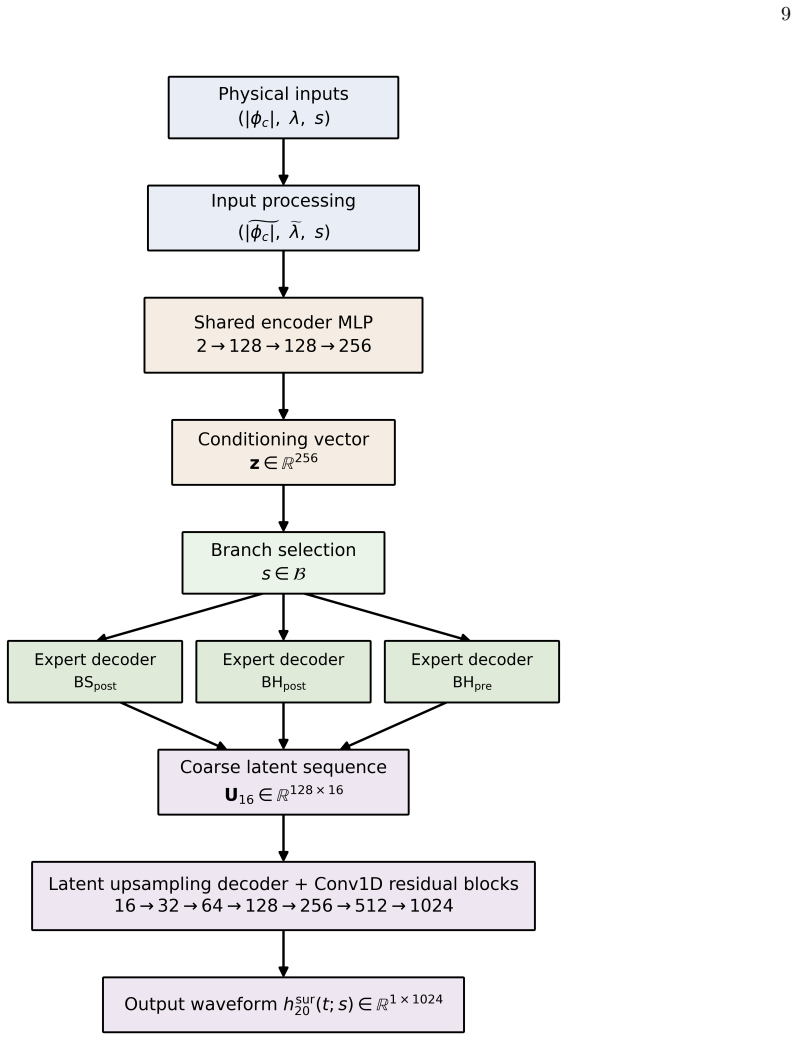
Branch-conditioned neural reconstruction model that selects the merger outcome by measuring which hypothesized branch produces the highest-fidelity waveform reconstruction.
If this is right
- Merger-outcome diagnosis shifts from initial-parameter classification to direct use of waveform morphology.
- Waveform shape alone distinguishes among multiple possible final states for massive boson-star mergers.
- Distilled student models match supervised performance on this reconstruction task.
- The method supplies a first concrete step toward waveform-based classification of exotic compact-object mergers that admit several possible end states.
Where Pith is reading between the lines
- The same reconstruction-comparison logic could be applied to other exotic mergers whose numerical catalogues already contain multiple post-merger branches.
- If the approach holds on independent simulations, it could be tested on real detector data once sufficiently dense catalogues exist.
- Systematic mismatches between reconstructed and true branches on held-out simulations would directly expose catalogue or architecture biases.
Load-bearing premise
Reconstruction quality under different branch hypotheses reliably identifies the true outcome without being dominated by limitations or biases in the existing numerical-relativity catalogue or the neural model architecture.
What would settle it
A new numerical-relativity simulation whose waveform is reconstructed more accurately by an incorrect branch hypothesis than by the true branch.
Figures
read the original abstract
We investigate whether gravitational waveforms from massive boson-star mergers can be used to diagnose the underlying merger outcome. Using an existing numerical-relativity catalogue, we construct a branch-conditioned neural reconstruction model and infer the outcome by comparing the reconstruction quality of candidate waveform hypotheses. This makes the diagnosis waveform-based rather than a direct classification in the initial parameter space. We compare a supervised baseline model with a distilled student model and find that the merger outcome is encoded in the waveform morphology and can be recovered through branch-conditioned reconstruction. Our results provide a first step toward waveform-based classification of exotic compact-object mergers with multiple possible final states.
Editorial analysis
A structured set of objections, weighed in public.
Referee Report
Summary. The manuscript claims that gravitational waveforms from massive boson-star mergers encode the underlying merger outcome, which can be diagnosed in a waveform-based manner by training a branch-conditioned neural reconstruction model on an existing numerical-relativity catalogue and comparing reconstruction quality across candidate branch hypotheses. The authors contrast a supervised baseline model with a distilled student model and conclude that the outcome is recoverable through this reconstruction approach, providing a first step toward classification of exotic compact-object mergers with multiple possible final states.
Significance. If the reported reconstruction-quality differences reliably indicate the true branch (rather than catalogue imbalances or model biases), the work would offer a meaningful advance by shifting diagnosis from initial-parameter classification to direct waveform morphology analysis, which could be useful for interpreting gravitational-wave signals from boson-star or other exotic mergers where multiple outcomes are possible.
major comments (3)
- [Abstract] Abstract: the claim of successful recovery via reconstruction quality comparison is stated without any quantitative metrics, error bars, data-split details, or statistical significance tests, preventing verification that the central claim is supported rather than affected by overfitting or chance.
- [Methods] Methods (model construction and evaluation): no branch population statistics, simulation counts per branch, or parameter-space coverage details from the NR catalogue are provided, so it is impossible to assess whether lower reconstruction error under the correct hypothesis arises from waveform encoding or from unequal training data volume or coverage across branches.
- [Results] Results (baseline vs. distilled comparison): the manuscript does not report controls or ablation tests that isolate the effect of catalogue imbalances from the neural architecture's inductive biases, leaving the weakest assumption (that quality differences identify the true outcome) untested.
minor comments (1)
- [Abstract] Abstract: the sentence 'Our results provide a first step toward...' is imprecise; specifying the concrete limitations addressed or left open would improve clarity.
Simulated Author's Rebuttal
We thank the referee for their constructive comments. We address each major point below and indicate the revisions that will be incorporated.
read point-by-point responses
-
Referee: [Abstract] Abstract: the claim of successful recovery via reconstruction quality comparison is stated without any quantitative metrics, error bars, data-split details, or statistical significance tests, preventing verification that the central claim is supported rather than affected by overfitting or chance.
Authors: We agree that the abstract should include quantitative support. The revised manuscript will report specific metrics (mean reconstruction error differences with standard deviations across splits), the train/validation/test split ratios, and results of statistical tests (e.g., Wilcoxon signed-rank tests) comparing correct versus incorrect branch hypotheses. revision: yes
-
Referee: [Methods] Methods (model construction and evaluation): no branch population statistics, simulation counts per branch, or parameter-space coverage details from the NR catalogue are provided, so it is impossible to assess whether lower reconstruction error under the correct hypothesis arises from waveform encoding or from unequal training data volume or coverage across branches.
Authors: The catalogue reference was provided but the per-branch counts and coverage were not tabulated. We will add an explicit table and paragraph in the Methods section listing the number of waveforms per branch, their parameter ranges, and any noted imbalances, allowing direct evaluation of data-volume effects. revision: yes
-
Referee: [Results] Results (baseline vs. distilled comparison): the manuscript does not report controls or ablation tests that isolate the effect of catalogue imbalances from the neural architecture's inductive biases, leaving the weakest assumption (that quality differences identify the true outcome) untested.
Authors: We accept that explicit controls are required. The revision will include ablation experiments: (i) retraining on balanced subsamples of the catalogue and (ii) reporting reconstruction errors stratified by branch population size. These will be compared against the original results to separate catalogue imbalance from architectural effects. revision: yes
Circularity Check
No circularity: empirical ML reconstruction on external catalogue
full rationale
The paper trains branch-conditioned neural models (supervised baseline and distilled student) on an external numerical-relativity catalogue, then diagnoses merger outcome by comparing reconstruction errors across hypotheses. This is a standard data-driven inference procedure whose success is measured empirically against held-out or cross-validated data; the central claim does not reduce by construction to any fitted parameter, self-definition, or self-citation chain. No equations or steps are shown that equate the reported recovery to the training inputs themselves. The approach therefore remains self-contained against external benchmarks.
Axiom & Free-Parameter Ledger
Reference graph
Works this paper leans on
-
[1]
In the numerical-relativity catalogue, this branch corresponds to configurations for which the collapse time of each individual boson star is shorter than the binary contact time
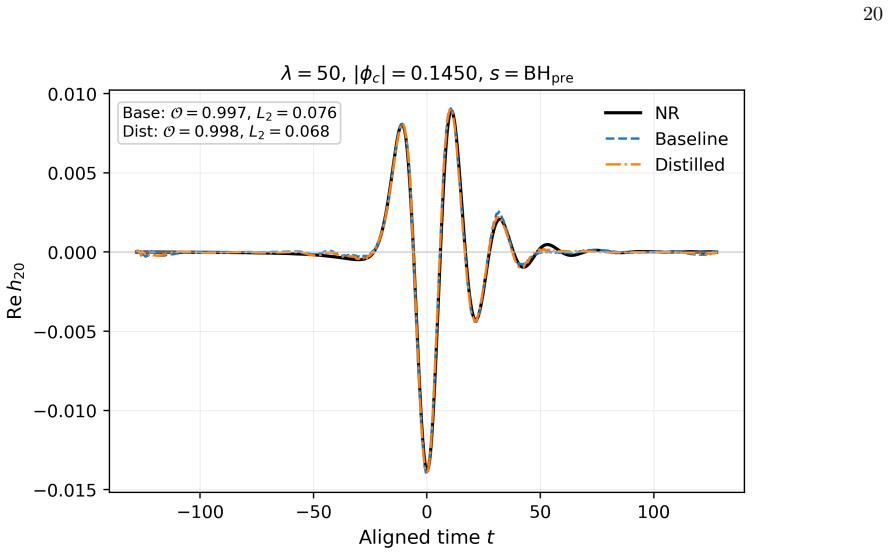
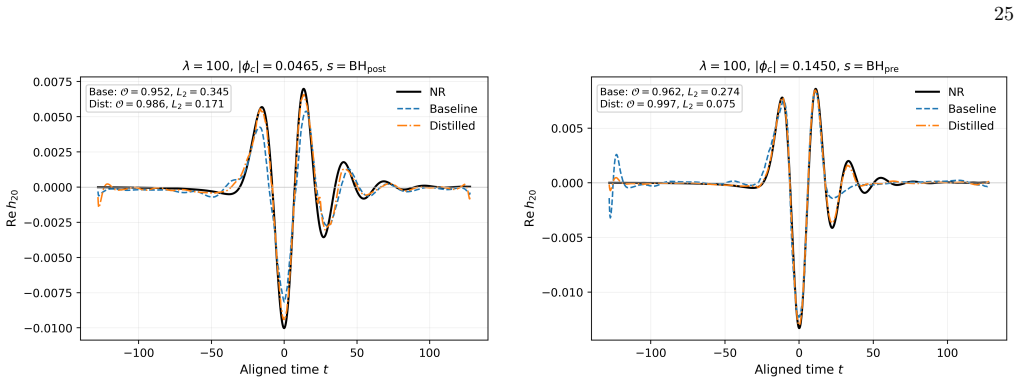
Collapse-before-contact branch:BH pre We begin with the collapse-before-contact branch BHpre, which is the best-reconstructed branch in the λ = 50 held-out test set. In the numerical-relativity catalogue, this branch corresponds to configurations for which the collapse time of each individual boson star is shorter than the binary contact time. Each star t...
2000
-
[2]
In this branch, the two boson stars first come into contact while their scalar-field profiles are still present, and the merged object subsequently collapses to a black hole
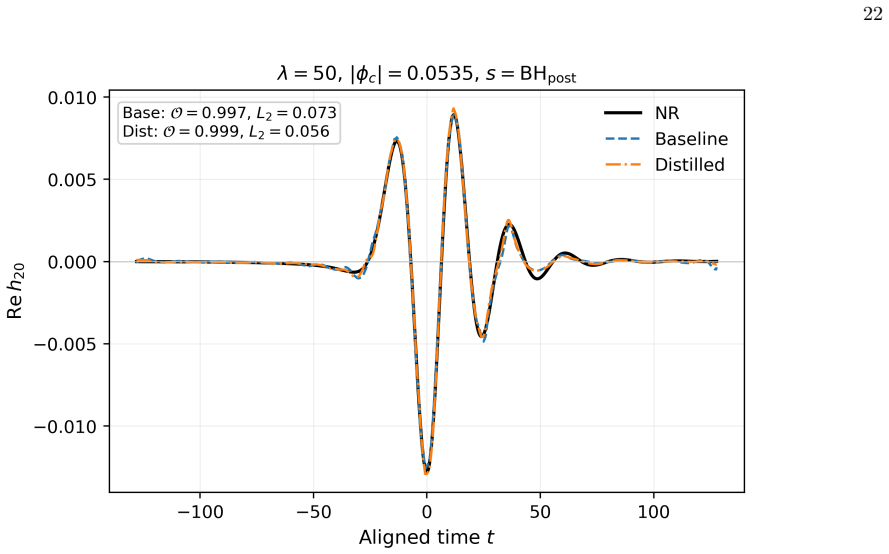
Post-contact black-hole formation branch:BH post We next consider the post-contact black-hole formation branch BHpost. In this branch, the two boson stars first come into contact while their scalar-field profiles are still present, and the merged object subsequently collapses to a black hole. The waveform therefore contains two ingredients: matter-mediate...
-
[3]
Quantum Universe Physical Simulation Platform
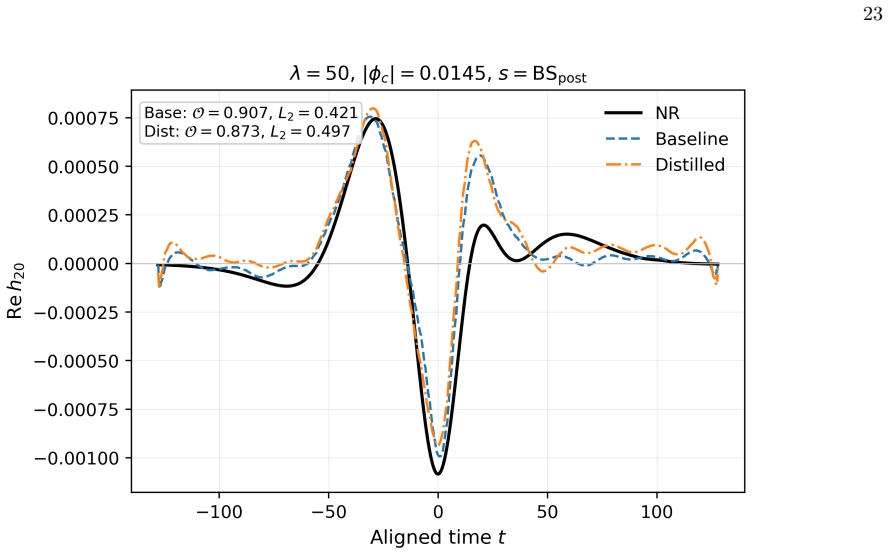
Boson-star-remnant branch:BS post We finally turn to the boson-star-remnant branch BSpost, which is the most challenging branch in the λ = 50 held-out test set. In this branch the merger does not produce a black hole during the simulated time interval. Instead, the post-merger object remains a non-black-hole scalar-field remnant. The corresponding wavefor...
2000
-
[4]
For theλ= 50 runs, the active subset is selected by requiring |λ−50| ≤10 −8, and for theλ= 100 runs by requiring |λ−100| ≤10 −8
Data preprocessing All models discussed in the main text are trained on fixed- λ active subsets of the numerical-relativity waveform catalogue. For theλ= 50 runs, the active subset is selected by requiring |λ−50| ≤10 −8, and for theλ= 100 runs by requiring |λ−100| ≤10 −8. Thus the models reported in the main text are trained separately on the λ = 50 and λ...
-
[5]
The split is performed in a branch-stratified way, so that the three merger-outcome branches are represented as evenly as possible in the training, validation, and test subsets
Train–validation–test split For each fixed-λ active subset, the catalogue is split into training, validation, and test sets after the active- λ filtering has been applied. The split is performed in a branch-stratified way, so that the three merger-outcome branches are represented as evenly as possible in the training, validation, and test subsets. The val...
-
[6]
The shared encoder maps the normalized two-dimensional input (|eϕc|,eλ) to a conditioning vector of dimension dcond = 256
Model hyperparameters The baseline and distilled models use the same branch-conditioned network architecture. The shared encoder maps the normalized two-dimensional input (|eϕc|,eλ) to a conditioning vector of dimension dcond = 256. The encoder hidden width is 128, and the implementation uses three encoder layers. The selected branch expert maps the condi...
-
[7]
Waveform loss coefficients The directly supervised baseline models are trained using the waveform loss described in Sec. III. The same waveform-loss functional is also used for the numerical-relativity loss and the teacher-alignment loss in the distilled runs. The implementation parameters are the same for theλ= 50 andλ= 100 runs. For the envelope-weighte...
-
[8]
Both runs use the waveform reconstruction objective defined in Sec
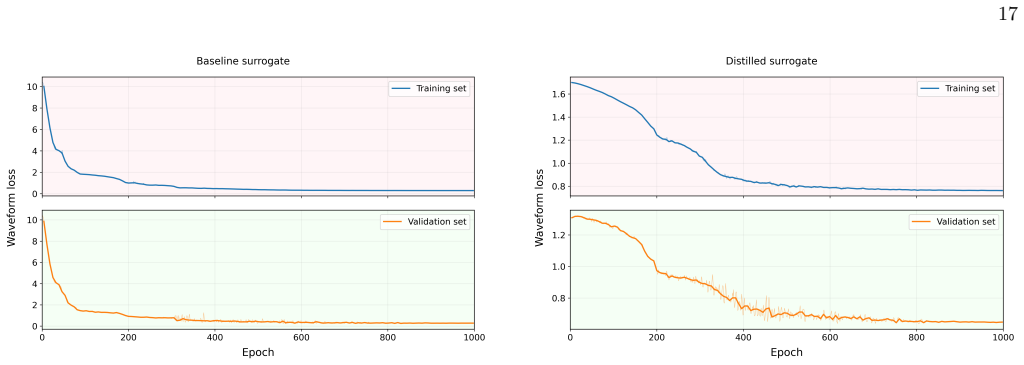
Baseline training The directly supervised baseline models at λ = 50 and λ = 100 are trained with identical hyperparameters, except for the active self-interaction slice. Both runs use the waveform reconstruction objective defined in Sec. III. The baseline training uses 1000 epochs and batch size 48. The initial learning rate is ηbase = 10−4, and the weigh...
-
[9]
Distilled student training The distilled student models use the same architecture, preprocessing, data split, and waveform-loss coefficients as the corresponding baseline models. For each value of λ, the frozen teacher is the best checkpoint of the directly 32 Quantity Baseline,λ= 50 Baseline,λ= 100 Activeλ50 100 Epochs 1000 1000 Batch size 48 48 Initial ...
-
[10]
In the branch-given reconstruction test, the true branch label of the held-out sample is supplied to the model, and only the corresponding expert decoder is used
Evaluation protocol All reported waveform metrics are evaluated on held-out numerical-relativity waveforms after restoring the original waveform normalization. In the branch-given reconstruction test, the true branch label of the held-out sample is supplied to the model, and only the corresponding expert decoder is used. This test measures the quality of ...
-
[11]
B. P. Abbottet al., Phys. Rev. Lett.116, 061102 (2016), arXiv:1602.03837 [gr-qc]
Pith/arXiv arXiv 2016
-
[12]
B. P. Abbottet al.(LIGO Scientific, Virgo), Phys. Rev. X9, 031040 (2019), arXiv:1811.12907 [astro-ph.HE]
Pith/arXiv arXiv 2019
-
[13]
Abbottet al.(LIGO Scientific, Virgo), Phys
R. Abbottet al.(LIGO Scientific, Virgo), Phys. Rev. X11, 021053 (2021), arXiv:2010.14527 [gr-qc]
Pith/arXiv arXiv 2021
-
[14]
Abbottet al.(LIGO Scientific, VIRGO, KAGRA), (2021), arXiv:2111.03606 [gr-qc]
R. Abbottet al.(LIGO Scientific, VIRGO, KAGRA), (2021), arXiv:2111.03606 [gr-qc]
Pith/arXiv arXiv 2021
-
[15]
D. J. Kaup, Phys. Rev.172, 1331 (1968)
1968
-
[16]
Ruffini and S
R. Ruffini and S. Bonazzola, Phys. Rev.187, 1767 (1969)
1969
-
[17]
Colpi, S
M. Colpi, S. L. Shapiro, and I. Wasserman, Phys. Rev. Lett.57, 2485 (1986)
1986
-
[18]
E. Seidel and W.-M. Suen, Phys. Rev. Lett.72, 2516 (1994), arXiv:gr-qc/9309015
Pith/arXiv arXiv 1994
-
[19]
F. E. Schunck and E. W. Mielke, Gen. Rel. Grav.31, 787 (1999)
1999
-
[20]
N. Sanchis-Gual, F. Di Giovanni, M. Zilh˜ ao, C. Herdeiro, P. Cerd´ a-Dur´ an, J. Font, and E. Radu, Phys. Rev. Lett.123, 221101 (2019), arXiv:1907.12565 [gr-qc]
arXiv 2019
-
[21]
N. Siemonsen and W. E. East, Phys. Rev. D107, 124018 (2023), arXiv:2302.06627 [gr-qc]
arXiv 2023
-
[22]
Seidel and W.-M
E. Seidel and W.-M. Suen, Phys. Rev. D42, 384 (1990)
1990
-
[23]
Kobayashi, M
Y. Kobayashi, M. Kasai, and T. Futamase, Phys. Rev. D50, 7721 (1994)
1994
-
[24]
F. D. Ryan, Phys. Rev. D55, 6081 (1997)
1997
-
[25]
F. E. Schunck and E. W. Mielke, Phys. Lett. A249, 389 (1998)
1998
-
[26]
J. Balakrishna, E. Seidel, and W.-M. Suen, Phys. Rev. D58, 104004 (1998), arXiv:gr-qc/9712064
Pith/arXiv arXiv 1998
-
[27]
Yoshida and Y
S. Yoshida and Y. Eriguchi, Phys. Rev. D56, 762 (1997)
1997
-
[28]
F. E. Schunck and D. F. Torres, Int. J. Mod. Phys. D9, 601 (2000), arXiv:gr-qc/9911038
Pith/arXiv arXiv 2000
-
[29]
F. E. Schunck and E. W. Mielke, Class. Quant. Grav.20, R301 (2003), arXiv:0801.0307 [astro-ph]
Pith/arXiv arXiv 2003
-
[30]
J. Balakrishna, R. Bondarescu, G. Daues, F. Siddhartha Guzman, and E. Seidel, Class. Quant. Grav.23, 2631 (2006), arXiv:gr-qc/0602078
Pith/arXiv arXiv 2006
-
[31]
J. Balakrishna, R. Bondarescu, G. Daues, and M. Bondarescu, Phys. Rev. D77, 024028 (2008), arXiv:0710.4131 [gr-qc]
Pith/arXiv arXiv 2008
-
[32]
B. Hartmann, B. Kleihaus, J. Kunz, and I. Schaffer, Phys. Lett. B714, 120 (2012), arXiv:1205.0899 [gr-qc]
Pith/arXiv arXiv 2012
-
[33]
N. Siemonsen and W. E. East, Phys. Rev. D103, 044022 (2021), arXiv:2011.08247 [gr-qc]
arXiv 2021
-
[34]
T. Evstafyeva, N. Siemonsen, and W. E. East, Phys. Rev. D113, 044024 (2026), arXiv:2508.11527 [gr-qc]
arXiv 2026
-
[35]
G. A. Marks, S. J. Staelens, T. Evstafyeva, and U. Sperhake, Phys. Rev. Lett.135, 131402 (2025), arXiv:2504.17775 [gr-qc]
arXiv 2025
-
[36]
T. Evstafyeva, R. Rosca-Mead, U. Sperhake, and B. Brugmann, Phys. Rev. D108, 104064 (2023), arXiv:2310.05200 [gr-qc]
arXiv 2023
-
[37]
G. A. Marks and A. A. Zaif, Class. Quant. Grav.43, 085014 (2026), arXiv:2510.13988 [gr-qc]
arXiv 2026
-
[38]
G. A. Marks, J. Phys. Conf. Ser.3177, 012047 (2026), arXiv:2508.11757 [gr-qc]
arXiv 2026
- [39]
-
[40]
P.-B. Ding, T.-X. Ma, T.-F. Fang, and Y.-Q. Wang, JHEP04, 033 (2024), arXiv:2305.19819 [gr-qc]
arXiv 2024
-
[41]
C. Liang, J.-R. Ren, S.-X. Sun, and Y.-Q. Wang, JHEP02, 249 (2023), arXiv:2207.11147 [gr-qc]
arXiv 2023
-
[42]
Y.-P. Zhang, S.-X. Sun, Y.-Q. Wang, S.-W. Wei, P. Laguna, and Y.-X. Liu, Phys. Rev. Res.6, 033187 (2024), arXiv:2310.01178 [gr-qc]
arXiv 2024
-
[43]
Emerging black hole shadow from collapsing boson star,
Y.-P. Zhang, S.-W. Wei, and Y.-X. Liu, “Emerging black hole shadow from collapsing boson star,” (2025), arXiv:2503.14159 [gr-qc]
arXiv 2025
-
[44]
P. L. B. de S´ a, H. C. D. Lima, C. A. R. Herdeiro, and L. C. B. Crispino, Phys. Rev. D113, 044037 (2026), arXiv:2511.19206 [gr-qc]
arXiv 2026
-
[45]
C. A. R. Herdeiro and E. Radu, JHEP08, 049 (2025), arXiv:2503.15069 [gr-qc]
arXiv 2025
-
[46]
C. Herdeiro, H. Huang, J. Kunz, and E. Radu, Phys. Lett. B856, 138939 (2024), arXiv:2405.10671 [gr-qc]
arXiv 2024
-
[47]
P. Ildefonso, M. Zilh˜ ao, C. Herdeiro, E. Radu, and N. M. Santos, Phys. Rev. D108, 064011 (2023), arXiv:2307.00044 [gr-qc]
arXiv 2023
- [48]
-
[49]
C. Palenzuela, I. Olabarrieta, L. Lehner, and S. L. Liebling, Phys. Rev. D75, 064005 (2007), arXiv:gr-qc/0612067
Pith/arXiv arXiv 2007
-
[50]
C. Palenzuela, L. Lehner, and S. L. Liebling, Phys. Rev. D77, 044036 (2008), arXiv:0706.2435 [gr-qc]
Pith/arXiv arXiv 2008
-
[51]
C. Palenzuela, P. Pani, M. Bezares, V. Cardoso, L. Lehner, and S. Liebling, Phys. Rev. D96, 104058 (2017), arXiv:1710.09432 [gr-qc]
Pith/arXiv arXiv 2017
- [52]
-
[53]
N. Sanchis-Gual, M. Zilh˜ ao, C. Herdeiro, F. Di Giovanni, J. A. Font, and E. Radu, Phys. Rev. D102, 101504 (2020), arXiv:2007.11584 [gr-qc]
arXiv 2020
-
[54]
M. Bezares, M. Boˇ skovi´ c, S. Liebling, C. Palenzuela, P. Pani, and E. Barausse, Phys. Rev. D105, 064067 (2022), arXiv:2201.06113 [gr-qc]
arXiv 2022
- [55]
-
[56]
N. Sanchis-Gual, M. Zilh˜ ao, and V. Cardoso, Phys. Rev. D106, 064034 (2022), arXiv:2207.05494 [gr-qc]
arXiv 2022
-
[57]
T. Evstafyeva, U. Sperhake, T. Helfer, R. Croft, M. Radia, B.-X. Ge, and E. A. Lim, Class. Quant. Grav.40, 085009 (2023), arXiv:2212.08023 [gr-qc]. 36
arXiv 2023
-
[58]
N. Siemonsen and W. E. East, Phys. Rev. D108, 124015 (2023), arXiv:2306.17265 [gr-qc]
arXiv 2023
-
[59]
Ge,Gravitational Waves in Boson Star Mergers, Ph.D
B.-X. Ge,Gravitational Waves in Boson Star Mergers, Ph.D. thesis, King’s College London (2024)
2024
-
[60]
T. Evstafyeva, U. Sperhake, I. M. Romero-Shaw, and M. Agathos, Phys. Rev. Lett.133, 131401 (2024), arXiv:2406.02715 [gr-qc]
arXiv 2024
- [61]
-
[62]
V. Jaramillo, N. Sanchis-Gual, J. Barranco, A. Bernal, J. C. Degollado, C. Herdeiro, M. Megevand, and D. N´ u˜ nez, Phys. Rev. D105, 104057 (2022), arXiv:2202.00696 [gr-qc]
arXiv 2022
-
[63]
Gravitational scattering of solitonic boson stars: Analytics vs Numerics,
T. Damour, T. Jain, and U. Sperhake, “Gravitational scattering of solitonic boson stars: Analytics vs Numerics,” (2025), arXiv:2512.00945 [gr-qc]
arXiv 2025
-
[64]
Boson star-black hole binaries: initial data and head-on collisions,
Z. Ning, “Boson star-black hole binaries: initial data and head-on collisions,” (2026), arXiv:2604.15240 [gr-qc]
Pith/arXiv arXiv 2026
-
[65]
Ge, (2026), arXiv:2605.19572 [gr-qc]
B.-X. Ge, (2026), arXiv:2605.19572 [gr-qc]
Pith/arXiv arXiv 2026
- [66]
-
[67]
B.-X. Ge, E. A. Lim, U. Sperhake, T. Evstafyeva, D. Cors, E. de Jong, R. Croft, and T. Helfer, Phys. Rev. D112, 124080 (2025), arXiv:2410.23839 [gr-qc]
arXiv 2025
- [68]
-
[69]
A. J. K. Chua, C. R. Galley, and M. Vallisneri, Phys. Rev. Lett.122, 211101 (2019), arXiv:1811.05491 [astro-ph.IM]
Pith/arXiv arXiv 2019
-
[70]
T. Andradeet al., J. Open Source Softw.6, 3703 (2021), arXiv:2201.03458 [gr-qc]
arXiv 2021
-
[71]
W. G. Cook, P. Figueras, M. Kunesch, U. Sperhake, and S. Tunyasuvunakool, Int. J. Mod. Phys. D25, 1641013 (2016), arXiv:1603.00362 [gr-qc]
Pith/arXiv arXiv 2016
-
[72]
W. G. Cook and U. Sperhake, Class. Quant. Grav.34, 035010 (2017), arXiv:1609.01292 [gr-qc]
Pith/arXiv arXiv 2017
-
[73]
Distilling the knowledge in a neural network,
G. Hinton, O. Vinyals, and J. Dean, “Distilling the knowledge in a neural network,” (2015), arXiv:1503.02531 [stat.ML]
Pith/arXiv arXiv 2015
discussion (0)
Sign in with ORCID, Apple, or X to comment. Anyone can read and Pith papers without signing in.