REVIEW 2 major objections 5 minor 3 cited by
Anatomy of the modern theory of orbital magnetism from first-principles: term-by-term analysis in the gauge-covariant formalism
T0 review · 2 major / 5 minor · reviewed 2026-07-13 · grok-4.5
Pith's one-line read Berry-phase terms, not just atomic orbitals, set how large orbital magnetism can get.
desk verdict Solid computational anatomy of modern orbital magnetism that cleanly shows when ACA is enough and when Berry-phase hybridization terms dominate. read the letter →
The pith
A machine-rendered reading of the paper's core claim, the machinery that carries it, and where it could break.
The reading
What carries the argument
The J-decomposition of the modern-theory orbital magnetization (M = M^(0) + M^(1) + M^(2)) obtained from the gauge-covariant Wannier objects A, B, C together with the occupation-weighted covariant derivative; it isolates atomic-like Wannier self-rotation from band-hybridization contributions while keeping the sum gauge-invariant.
What would settle it
Recompute the modern-theory terms for the same materials with deliberately delocalized or differently projected Wannier bases and check whether M^(0) still tracks the muffin-tin ACA and whether the total remains unchanged; a large residual interstitial contribution inside M^(0) would break the claimed ACA correspondence.
Extended reading notes
Core claim
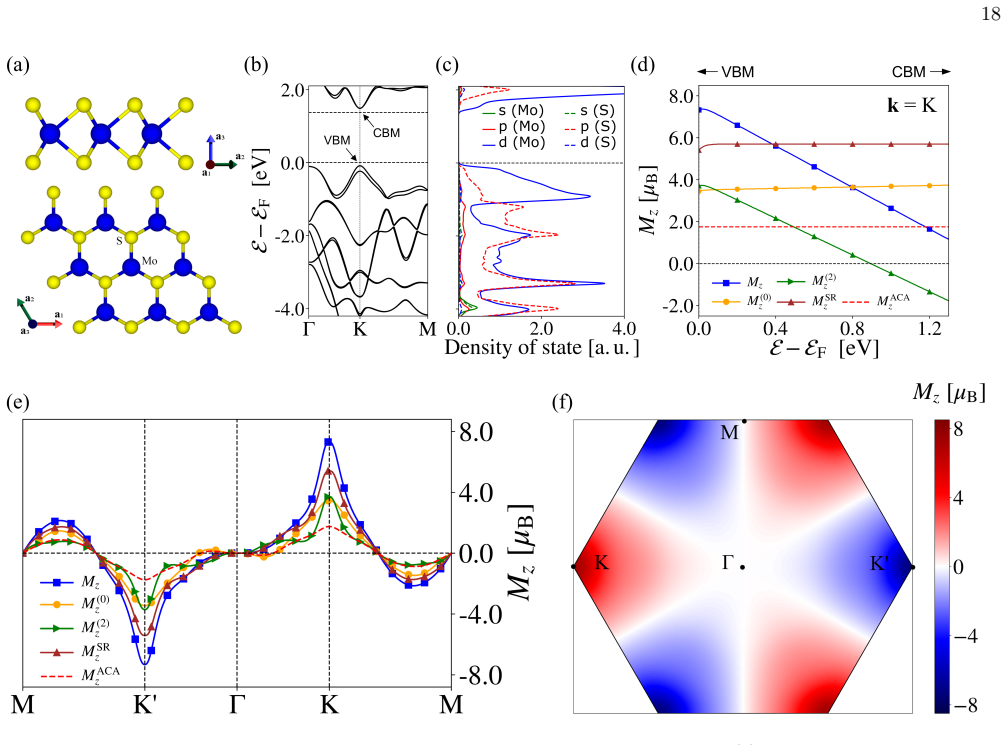
When orbital magnetization is evaluated with the gauge-covariant modern theory and decomposed by powers of the Wannier-to-Hamiltonian gauge connection J, the atom-centered approximation equals the leading (J^0) intracell self-rotation term for localized d electrons and therefore captures most of the total moment, while in sp metals and valley TMDs the higher-order hybridization terms dominate and can exceed the atomic value by factors of several.
Load-bearing premise
The claim that the intracell piece of the lowest-order Wannier term is quantitatively the same as the muffin-tin atom-centered approximation when the Wannier functions are chosen to look atomic.
Editorial extensions
If this is right
- For ordinary 3d magnets the simpler atom-centered approximation is already a reliable estimate of the full modern-theory orbital magnetization.
- In sp metals and TMDs, orbital moments can be many times larger than the atomic limit once Berry-phase hybridization is included.
- Valley materials with direct gaps (e.g., MoS2) offer a route to giant, chemically tunable orbital moments without needing strong atomic spin-orbit coupling.
- Effective tight-binding models that keep only the J^2 term systematically miss the dominant atomic contribution in localized systems.
- Orbitronic device design can target band geometry rather than only atomic orbital character.
Reading between the lines
- The same J-decomposition should diagnose when orbital Hall or orbital Edelstein calculations based on atom-centered operators become unreliable.
- Materials near avoided crossings or van-Hove singularities are natural places to look for hybridization-enhanced orbital responses far above atomic estimates.
- If the occupation-weighted covariant derivative operator can be promoted to a true current operator, nonequilibrium orbital transport formulas could inherit the same gauge consistency.
Editorial analysis
A structured set of objections, weighed in public.
Referee Report
Summary. The manuscript delivers a systematic first-principles anatomy of the modern (Berry-phase) theory of orbital magnetization, implemented in the gauge-covariant Wannier formalism of Lopez et al. It decomposes the magnetization into self-rotation versus center-of-mass pieces and, more originally, into a J-power series M^(0)+M^(1)+M^(2) that isolates atomic-like Wannier contributions from coherent interband hybridizations. Across d-transition metals, sp metals, and two TMD monolayers the authors compare these terms with the conventional atom-centered (muffin-tin) approximation, recover known experimental and prior theoretical values for Fe/Co/Ni, and show that ACA accounts for the bulk of the modern-theory result when d electrons are localized, while M^(2) (Berry-phase/hybridization) terms dominate and can exceed the atomic limit by large factors in sp metals and at the valleys of 1H-MoS2.
Significance. If the numerical trends hold, the work supplies a practical, gauge-controlled diagnostic that tells the community when the widely used ACA is quantitatively reliable and when Berry-phase enhancements must be retained. The explicit construction of an occupation-weighted orbital-moment operator (Eqs. 44–48), the gauge- and space-selection proofs (Appendices C–D), the tabulated computational parameters (Table II), and the recovery of experimental orbital moments for the 3d ferromagnets are concrete strengths that make the results reproducible and immediately usable for orbitronics materials screening. The demonstration that valley moments in MoS2 and avoided-crossing peaks in Td-WTe2 far exceed the atomic limit points to a concrete materials-design route beyond atomic-orbital control.
major comments (2)
- Sec. I B and the ACA–modern-theory comparisons throughout Sec. III: the introduction correctly notes that ACA results can depend on the muffin-tin radius R_μ and that saturation with increasing R_μ must be verified. No such R_μ-dependence test (or statement that the chosen R_MT values already saturate) appears for the materials in Table I / Figs. 4–8. Because the central claim that ACA captures >70 % of the modern-theory magnetization for most d metals rests on these numbers, a short supplementary check for at least Fe, Ni and W would remove residual doubt about the quantitative percentages.
- Sec. II F and Appendix G: the identification of the intracell self-rotation piece of M^(0) with the muffin-tin ACA is the interpretive link that lets the authors call M^(0) “atomic.” Appendix G already shows 3–15 % discrepancies for the localized d cases that underwrite the >70 % claim, which is reassuring. The manuscript should, however, state explicitly in the main text (not only in the appendix) that this quantitative equivalence is claimed only for atomic-like Wannier functions of well-localized d states, and that for sp metals and TMDs the residual interstitial/intercell content inside M^(0) itself is large (as their own hex-Bi and MoS2 data already demonstrate). A single sentence of this form would prevent over-reading of the correspondence.
minor comments (5)
- Throughout the text (abstract, Sec. III B–D) compound words such as “dtransition,” “spelectrons,” “delectrons,” “1H-MoS2” appear without spaces or hyphens; these are formatting artifacts that should be cleaned for readability.
- Fig. 7 caption and the accompanying discussion of (r/r_WS)^3 cite Ref. [100] but do not list the numerical values used for each element; a short table or explicit numbers would make the localization argument fully self-contained.
- Eq. (32) and the numerical implementation introduce a finite η = 0.0259 eV; a one-sentence remark on the sensitivity of M^(2) (especially near avoided crossings in WTe2 and the Bi van-Hove peak) to this broadening would be useful.
- Table I header “SQA” is never expanded; “spin-quantization axis” should be written out once.
- Author name “Mirco Sastges” appears once; confirm spelling against the institutional record.
Circularity Check
No significant circularity: modern-theory formulas and Wannier objects are taken from independent literature; numerical ACA vs. modern comparisons and J-decomposition results are independent first-principles evaluations, not forced by definition or self-citation.
full rationale
The paper adopts the gauge-invariant modern-theory expression (Eq. 11, from Ceresoli et al.) and the gauge-covariant Wannier implementation (Lopez et al. PRB 85, 014435) as established external inputs, then evaluates them term-by-term via independent FLAPW+Wannier90 calculations (Fleur, Orbitrans). The J-decomposition (M = M(0)+M(1)+M(2)) and SR/CM split are analytic rearrangements of those formulas (Sec. II F, Eqs. 52–53), not redefinitions of the target observables. The claimed ACA–modern correspondence is not definitional: ACA is the independent muffin-tin integral (Eq. 2), while M_SR(on) is the intracell piece of M(0) extracted from Wannier ABC matrices; the paper verifies their numerical proximity only for localized d cases (App. G, 3–15 % discrepancy) and reports large deviations elsewhere (hex-Bi ~12 imes, MoS2 valleys ~4 imes). Gauge-invariance proofs (Apps. C–D) and recovery of known benchmarks (Table I vs. prior DFT/experiment) are self-contained. Self-citations (own orbitronics papers, Orbitrans code) supply context or implementation but do not underwrite the formulas or the material-class trends. No fitted parameters are relabeled as predictions, no uniqueness theorems are imported from the authors, and no ansatz is smuggled via self-citation. Central numerical claims therefore stand as independent first-principles results.
Assumptions & free parameters
free parameters (5)
- Hubbard U and J (DFT+U) =
see Appendix I
- artificial spin-Zeeman field =
0.544 eV
- muffin-tin radii R_MT =
Table II
- inner (frozen) energy window =
5–12 eV above EF
- smearing temperature and eta =
300 K / 0.0259 eV
assumptions (4)
- domain assumption Modern theory of orbital magnetization (Berry-phase formula of Ceresoli/Thonhauser/Vanderbilt/Resta and Lopez et al.) is the correct total orbital magnetization.
- domain assumption DFT (PBE + optional DFT+U) plus FLAPW basis yields sufficiently accurate ground-state projectors and Wannier functions for the materials studied.
- standard math Zero-temperature projector limit (f_nk = 0 or 1) and the occupation-weighted covariant derivative correctly recover the finite-T trace formulas.
- domain assumption Inner window placed above EF guarantees gauge and space invariance of the occupied-state contribution.
invented entities (2)
-
occupation-weighted covariant derivative / orbital-moment operator (Eqs. 44–48)
-
J-decomposition of orbital magnetization into M(0)+M(1)+M(2)
Cite this review
Pith. "Pith review of Anatomy of the modern theory of orbital magnetism from first-principles: term-by-term analysis in the gauge-covariant formalism." pith.science (2026). https://pith.science/paper/OJ24434K
@misc{pith2026260319875,
  author       = {Pith},
  title        = {Pith review of: Anatomy of the modern theory of orbital magnetism from first-principles: term-by-term analysis in the gauge-covariant formalism},
  year         = {2026},
  howpublished = {\url{https://pith.science/paper/OJ24434K}},
  note         = {Machine review of arXiv:2603.19875}
}
read the original abstract
We present an in-depth analysis of the orbital magnetism by means of the so-called modern theory based on the Berry phase across distinct classes of materials-d transition metals, sp metals, and transition metal dichalcogenides-highlighting the microscopic nature of band structure characteristics. We adopt a gauge-covariant formulation of the modern theory proposed in [Lopez et al. Phys. Rev. B 85, 014435 (2012)], which enables the calculation of orbital magnetism in a controlled manner in any chosen gauge of Wannier functions and gives the total contribution as a gauge-invariant measurable. This captures consistently the contributions due to the anomalous position, velocity, and orbital angular momentum of Wannier basis, as well as the contributions due to Hamiltonian such that their sum is gauge-invariant. For d transition metals, we find that the atom-centered approximation captures the majority of the total contribution given by modern theory, which we attribute to localized nature of d electrons. However, 5d metals tend to exhibit larger deviation between the two methods than 3d metals do, as 5d electrons are more delocalized than 3d electrons. On the other hand, sp metals exhibit a strong deviation between the two methods, where large kinetic energy of sp electrons is important. Finally, in 1H-MoS2, we find that the valley orbital moment far exceeds the atomic limit of d electrons due to coherent hybridization between valence and conduction bands in direct band gaps. Our work elucidates the interplay of the chemical nature of electronic orbitals and the effect of band structures in a consistent manner and highlights the role of Berry phase in orbital magnetism. The results suggest a promising direction of orbitronics beyond controlling atomic orbitals, in which the orbital magnetism can be greatly enhanced by exploiting Berry phase.
Figures


Figures from the paper (8 more)




Forward citations
Cited by 3 Pith papers
-
Modern Approach to Orbital Hall Effect Based on Wannier Picture of Solids
A Wannier-function framework for the orbital angular momentum operator adds a non-Kubo term to the orbital Hall conductivity, correcting atom-centered approximations and changing predicted signs and magnitudes in tran...
-
Orbital Embedding and the Physical Definition of Quantum Geometry
The quantum geometric tensor is only physical when computed with the full position operator, which is equivalent to embedding orbital positions in the Bloch phase; standard k·p models miss this for bond-ordered gaps.
-
Stacking switching between correlation-protected radial Rashba field and persistent spin textures in graphene encapsulated by 1T-TaS$_2$ monolayers
Stacking order in graphene/1T-TaS2 heterostructures switches between radial Rashba-dominated unconventional Rashba-Edelstein effect and mirror-protected persistent spin texture with orbital Hall conductivity three ord...
Reference graph
Works this paper leans on
-
[1]
For all three materials, modern theory and ACA show good agreement:M ACA z reproduces both the value ofM z atE F and its overall trend with respect toE
[93]. For all three materials, modern theory and ACA show good agreement:M ACA z reproduces both the value ofM z atE F and its overall trend with respect toE. In partic- ular, the discrepancies betweenM z andM ACA z atE F– defined as|(M z −M ACA z )/Mz|–are 8% in hcp Co (0.2% in fcc Co) and 6% in Ni. The discrepancy is largest in Fe and smallest in Ni, re...
2024
-
[2]
D” as the “active subspace
Introduction to the gauge-covariant derivative In this section, we revisit the derivation of the gauge- invariant formula in Eq. (11). Since the partial deriva- tive of a state does not, in general, transform consistently (i.e., in a gauge-covariant manner) under a gauge trans- formation, the covariant derivative must be introduced when evaluating physica...
-
[3]
First, we focus on the quantum geometric tensor ˆFk,αβ =|u nk⟩ ⟨∂αunk|∂βumk⟩ ⟨umk|, 25 one of the building blocks of the orbital magnetiza- tion and Berry curvature
Gauge-covariant objects for orbital magnetization Now, we construct the gauge-covariant objects for or- bital magnetization. First, we focus on the quantum geometric tensor ˆFk,αβ =|u nk⟩ ⟨∂αunk|∂βumk⟩ ⟨umk|, 25 one of the building blocks of the orbital magnetiza- tion and Berry curvature. This is not covariant un- der the gauge transformation and thus ge...
-
[4]
J. H. V. Vleck,The Theory of Electric and Magnetic Susceptibilities(Oxford at the Clarendon Press, 1932)
1932
-
[5]
D. Go, D. Jo, H.-W. Lee, M. Kl¨ aui, and Y. Mokrousov, EPL135, 37001 (2021)
2021
-
[6]
D. Jo, D. Go, G.-M. Choi, and H.-W. Lee, npj Spin- tronics2, 19 (2024)
2024
-
[7]
P. Wang, F. Chen, Y. Yang, S. Hu, Y. Li, W. Wang, D. Zhang, and Y. Jiang, Adv. Electron. Mater.11, 32 2400554 (2025)
2025
-
[8]
T. P. Cysne, L. M. Canonico, M. Costa, R. B. Muniz, and T. G. Rappoport, npj Spintronics3, 39 (2025)
2025
Show all 133 references
-
[9]
R. B. Atencia, A. Agarwal, and D. Culcer, Adv. Phys.: X9, 2371972 (2024)
2024
-
[10]
Osumi, T
K. Osumi, T. Zhang, and S. Murakami, Commun. Phys. 4, 211 (2021)
2021
-
[11]
S. R. Park, C. H. Kim, J. Yu, J. H. Han, and C. Kim, Phys. Rev. Lett.107, 156803 (2011)
2011
-
[12]
Go, J.-P
D. Go, J.-P. Hanke, P. M. Buhl, F. Freimuth, G. Bihlmayer, H.-W. Lee, Y. Mokrousov, and S. Bl¨ ugel, Sci. Rep.7, 46742 (2017)
2017
-
[13]
T. Yoda, T. Yokoyama, and S. Murakami, Nano Lett. 18, 916 (2018)
2018
-
[14]
El Hamdi, J.-Y
A. El Hamdi, J.-Y. Chauleau, M. Boselli, C. Thibault, C. Gorini, A. Smogunov, C. Barreteau, S. Gariglio, J.- M. Triscone, and M. Viret, Nat. Phys.96, 1855 (2023)
2023
-
[15]
B. A. Bernevig, T. L. Hughes, and S.-C. Zhang, Phys. Rev. Lett.95, 066601 (2005)
2005
-
[16]
Kontani, T
H. Kontani, T. Tanaka, D. S. Hirashima, K. Yamada, and J. Inoue, Phys. Rev. Lett.102, 016601 (2009)
2009
-
[17]
D. Go, D. Jo, C. Kim, and H.-W. Lee, Phys. Rev. Lett. 121, 086602 (2018)
2018
-
[18]
D. Jo, D. Go, and H.-W. Lee, Phys. Rev. B98, 214405 (2018)
2018
-
[19]
Salemi and P
L. Salemi and P. M. Oppeneer, Phys. Rev. Mater.6, 095001 (2022)
2022
-
[20]
Y.-G. Choi, D. Jo, K.-H. Ko, D. Go, K.-H. Kim, H. G. Park, C. Kim, B.-C. Min, G.-M. Choi, and H.-W. Lee, Nature619, 52 (2023)
2023
-
[21]
Lyalin, S
I. Lyalin, S. Alikhah, M. Berritta, P. M. Oppeneer, and R. K. Kawakami, Phys. Rev. Lett.131, 156702 (2023)
2023
-
[22]
H. Liu, J. H. Cullen, D. P. Arovas, and D. Culcer, Phys. Rev. Lett.134, 036304 (2025)
2025
-
[23]
Liu and D
H. Liu and D. Culcer, Phys. Rev. Lett.132, 186302 (2024)
2024
-
[24]
B. C. Park, T. Ha, H. Lee, K. I. Sim, I. Baek, S. J. Yun, K. Lee, H.-W. Lee, and Y. H. Lee, Adv. Mater. , e03808 (2025)
2025
-
[25]
Go and H.-W
D. Go and H.-W. Lee, Phys. Rev. Res.2, 013177 (2020)
2020
-
[26]
D. Lee, D. Go, H.-J. Park, W. Jeong, H.-W. Ko, D. Yun, D. Jo, S. Lee, G. Go, J. H. Oh, K.-J. Kim, B.-G. Park, B.-C. Min, H. C. Koo, H.-W. Lee, O. Lee, and K.-J. Lee, Nat. Commun.12, 6710 (2021)
2021
-
[27]
J. Kim, D. Go, H. Tsai, D. Jo, K. Kondou, H.-W. Lee, and Y. Otani, Phys. Rev. B103, L020407 (2021)
2021
-
[28]
Sala and P
G. Sala and P. Gambardella, Phys. Rev. Res.4, 033037 (2022)
2022
-
[29]
Hayashi, D
H. Hayashi, D. Jo, D. Go, T. Gao, S. Haku, Y. Mokrousov, H.-W. Lee, and K. Ando, Commun. Phys.6, 32 (2023)
2023
-
[30]
D. Go, D. Jo, K.-W. Kim, S. Lee, M.-G. Kang, B.-G. Park, S. Bl¨ ugel, H.-W. Lee, and Y. Mokrousov, Phys. Rev. Lett.130, 246701 (2023)
2023
-
[31]
Fukunaga, S
R. Fukunaga, S. Haku, H. Hayashi, and K. Ando, Phys. Rev. Res.5, 023054 (2023)
2023
-
[32]
Ding, M.-G
S. Ding, M.-G. Kang, W. Legrand, and P. Gambardella, Phys. Rev. Lett.132, 236702 (2024)
2024
-
[33]
Lee and H.-W
H. Lee and H.-W. Lee, Curr. Appl. Phys.67, 60 (2024)
2024
-
[34]
Moriya, M
H. Moriya, M. Taniguchi, D. Jo, D. Go, N. Soya, H. Hayashi, Y. Mokrousov, H.-W. Lee, and K. Ando, Nano Lett.24, 6459 (2024)
2024
-
[35]
Chiba, Y
S. Chiba, Y. Marui, H. Ohno, and S. Fukami, Nano Lett. 24, 14028 (2024)
2024
-
[36]
Hayashi, D
H. Hayashi, D. Go, S. Haku, Y. Mokrousov, and K. Ando, Nat. Electron.7, 646 (2024)
2024
-
[37]
Han, H.-W
S. Han, H.-W. Ko, J. H. Oh, H.-W. Lee, K.-J. Lee, and K.-W. Kim, Phys. Rev. Lett.134, 036305 (2025)
2025
-
[39]
S. R. Park, J. Han, C. Kim, Y. Y. Koh, C. Kim, H. Lee, H. J. Choi, J. H. Han, K. D. Lee, N. J. Hur, M. Arita, K. Shimada, H. Namatame, and M. Taniguchi, Phys. Rev. Lett.108, 046805 (2012)
2012
-
[40]
Hagiwara, Y.-J
K. Hagiwara, Y.-J. Chen, D. Go, X. L. Tan, S. Grytsiuk, K.-H. O. Yang, G.-J. Shu, J. Chien, Y.-H. Shen, X.-L. Huang, I. Cojocariu, V. Feyer, M.-T. Lin, S. Bl¨ ugel, C. M. Schneider, Y. Mokrousov, and C. Tusche, Adv. Mater.37, 2418040 (2025)
2025
-
[41]
Bhowal and S
S. Bhowal and S. Satpathy, Phys. Rev. B101, 121112 (2020)
2020
-
[42]
Bhowal and S
S. Bhowal and S. Satpathy, Phys. Rev. B102, 035409 (2020)
2020
-
[43]
T. P. Cysne, M. Costa, L. M. Canonico, M. B. Nardelli, R. B. Muniz, and T. G. Rappoport, Phys. Rev. Lett. 126, 056601 (2021)
2021
-
[44]
T. P. Cysne, S. Bhowal, G. Vignale, and T. G. Rap- poport, Phys. Rev. B105, 195421 (2022)
2022
-
[45]
Costa, B
M. Costa, B. Focassio, L. M. Canonico, T. P. Cysne, G. R. Schleder, R. B. Muniz, A. Fazzio, and T. G. Rap- poport, Phys. Rev. Lett.130, 116204 (2023)
2023
-
[46]
S. D. Wilson and B. R. Ortiz, Nat. Rev. Mater.9, 420 (2024)
2024
-
[47]
Resta, Phys
R. Resta, Phys. Rev. Lett.80, 1800 (1998)
1998
-
[48]
Sharma, S
S. Sharma, S. Pittalis, S. Kurth, S. Shallcross, J. K. Dewhurst, and E. K. U. Gross, Phys. Rev. B76, 100401 (2007)
2007
-
[49]
Hanke, F
J.-P. Hanke, F. Freimuth, A. K. Nandy, H. Zhang, S. Bl¨ ugel, and Y. Mokrousov, Phys. Rev. B94, 121114 (2016)
2016
-
[50]
Thonhauser, Int
T. Thonhauser, Int. J. Mod. Phys. B25, 1429 (2011)
2011
-
[51]
Vanderbilt,Berry Phases in Electronic Structure Theory: Electric Polarization, Orbital Magnetization and Topological Insulators(Cambridge university press, 2018)
D. Vanderbilt,Berry Phases in Electronic Structure Theory: Electric Polarization, Orbital Magnetization and Topological Insulators(Cambridge university press, 2018)
2018
-
[52]
Aryasetiawan and K
F. Aryasetiawan and K. Karlsson, J. Phys. Chem. Solids 128, 87 (2019)
2019
-
[53]
R. D. King-Smith and D. Vanderbilt, Phys. Rev. B47, 1651 (1993)
1993
-
[54]
Vanderbilt and R
D. Vanderbilt and R. D. King-Smith, Phys. Rev. B48, 4442 (1993)
1993
-
[55]
Resta, D
R. Resta, D. Ceresoli, T. Thonhauser, and D. Vander- bilt, ChemPhysChem6, 1815 (2005)
2005
-
[56]
Thonhauser, D
T. Thonhauser, D. Ceresoli, D. Vanderbilt, and R. Resta, Phys. Rev. Lett.95, 137205 (2005)
2005
-
[57]
Ceresoli, T
D. Ceresoli, T. Thonhauser, D. Vanderbilt, and R. Resta, Phys. Rev. B74, 024408 (2006)
2006
-
[58]
Ceresoli, U
D. Ceresoli, U. Gerstmann, A. P. Seitsonen, and F. Mauri, Phys. Rev. B81, 060409 (2010)
2010
-
[59]
Chang and Q
M.-C. Chang and Q. Niu, Phys. Rev. B53, 7010 (1996)
1996
-
[60]
Sundaram and Q
G. Sundaram and Q. Niu, Phys. Rev. B59, 14915 (1999)
1999
-
[61]
D. Xiao, J. Shi, and Q. Niu, Phys. Rev. Lett.95, 137204 (2005)
2005
-
[62]
D. Xiao, Y. Yao, Z. Fang, and Q. Niu, Phys. Rev. Lett. 97, 026603 (2006). 33
2006
-
[63]
J. Shi, G. Vignale, D. Xiao, and Q. Niu, Phys. Rev. Lett.99, 197202 (2007)
2007
-
[64]
Bianco and R
R. Bianco and R. Resta, Phys. Rev. Lett.110, 087202 (2013)
2013
-
[65]
K. J. U. Vidarte, H. P. Veiga, J. M. V. P. Lopes, R. Car- dias, A. Ferreira, T. P. Cysne, and T. G. Rappoport, Real-space spectral approach to orbital magnetization (2025), arXiv:2512.01575 [cond-mat.mtrl-sci]
2025
-
[66]
Marrazzo and R
A. Marrazzo and R. Resta, Phys. Rev. Lett.116, 137201 (2016)
2016
-
[67]
S.-S. Wang, Y. Yu, J.-H. Guan, Y.-M. Dai, H.-H. Wang, and Y.-Y. Zhang, Phys. Rev. B106, 075136 (2022)
2022
-
[68]
L. M. Canonico, T. P. Cysne, A. Molina-Sanchez, R. B. Muniz, and T. G. Rappoport, Phys. Rev. B101, 161409 (2020)
2020
-
[69]
Bhowal and G
S. Bhowal and G. Vignale, Phys. Rev. B103, 195309 (2021)
2021
-
[70]
A. Pezo, D. Garc´ ıa Ovalle, and A. Manchon, Phys. Rev. B106, 104414 (2022)
2022
-
[71]
Busch, I
O. Busch, I. Mertig, and B. G¨ obel, Phys. Rev. Res.5, 043052 (2023)
2023
-
[72]
G¨ obel and I
B. G¨ obel and I. Mertig, Phys. Rev. Lett.133, 146301 (2024)
2024
-
[73]
M. G. Lopez, D. Vanderbilt, T. Thonhauser, and I. Souza, Phys. Rev. B85, 014435 (2012)
2012
-
[74]
Go, H.-W
D. Go, H.-W. Lee, P. M. Oppeneer, S. Bl¨ ugel, and Y. Mokrousov, Phys. Rev. B109, 174435 (2024)
2024
-
[75]
G. Go, D. An, H.-W. Lee, and S. K. Kim, Nano Lett. 24, 5968 (2024)
2024
-
[76]
J. M. Lee, Phys. Rev. B112, 054441 (2025)
2025
-
[77]
X. Wang, J. R. Yates, I. Souza, and D. Vanderbilt, Phys. Rev. B74, 195118 (2006)
2006
-
[78]
Souza and D
I. Souza and D. Vanderbilt, Phys. Rev. B77, 054438 (2008)
2008
-
[79]
Resta, Phys
R. Resta, Phys. Rev. Res.2, 023139 (2020)
2020
-
[80]
Mahfouzi, M
F. Mahfouzi, M. D. Stiles, and P. M. Haney, Phys. Rev. B111, 014415 (2025)
2025
-
[81]
Marzari and D
N. Marzari and D. Vanderbilt, Phys. Rev. B56, 12847 (1997)
1997
-
[82]
Souza, N
I. Souza, N. Marzari, and D. Vanderbilt, Phys. Rev. B 65, 035109 (2001)
2001
-
[83]
Marzari, A
N. Marzari, A. A. Mostofi, J. R. Yates, I. Souza, and D. Vanderbilt, Rev. Mod. Phys.84, 1419 (2012)
2012
-
[84]
Marrazzo, S
A. Marrazzo, S. Beck, E. R. Margine, N. Marzari, A. A. Mostofi, J. Qiao, I. Souza, S. S. Tsirkin, J. R. Yates, and G. Pizzi, Rev. Mod. Phys.96, 045008 (2024)
2024
-
[85]
A. Urru, I. Souza, O. P. Oca˜ na, S. S. Tsirkin, and D. Vanderbilt, Phys. Rev. B112, 045201 (2025)
2025
-
[86]
J. C. Slater and G. F. Koster, Phys. Rev.94, 1498 (1954)
1954
-
[87]
X. Liu, S. S. Tsirkin, and I. Souza, Covariant deriva- tives of Berry-type quantities: Application to nonlinear transport (2023), arXiv:2303.10129 [cond-mat.mtrl-sci]. [85]http://www.flapw.de
2023 arXiv
-
[88]
Wimmer, H
E. Wimmer, H. Krakauer, M. Weinert, and A. J. Free- man, Phys. Rev. B24, 864 (1981)
1981
-
[89]
J. P. Perdew, K. Burke, and M. Ernzerhof, Phys. Rev. Lett.77, 3865 (1996)
1996
-
[90]
H. J. Monkhorst and J. D. Pack, Phys. Rev. B13, 5188 (1976)
1976
-
[91]
A. B. Shick, A. I. Liechtenstein, and W. E. Pickett, Phys. Rev. B60, 10763 (1999)
1999
-
[92]
Pizzi, V
G. Pizzi, V. Vitale, R. Arita, S. Bl¨ ugel, F. Freimuth, G. G´ eranton, M. Gibertini, D. Gresch, C. John- son, T. Koretsune, J. Iba˜ nez-Azpiroz, H. Lee, J.- M. Lihm, D. Marchand, A. Marrazzo, Y. Mokrousov, J. I. Mustafa, Y. Nohara, Y. Nomura, L. Paulatto, S. Ponc´ e, T. Ponwe...
2020
-
[93]
Freimuth, Y
F. Freimuth, Y. Mokrousov, D. Wortmann, S. Heinze, and S. Bl¨ ugel, Phys. Rev. B78, 035120 (2008). [92]https://iffgit.fz-juelich.de/dgo/wann_interpol
2008
-
[94]
A. J. P. Meyer and G. Asch, J. Appl. Phys.32, S330 (1961)
1961
-
[95]
Strigl, C
F. Strigl, C. Espy, M. B¨ uckle, E. Scheer, and T. Pietsch, Nat. Commun.6, 6172 (2015)
2015
-
[96]
H. J. Albert and L. R. Rubin, Adv. Chem.98, 1 (1971)
1971
-
[97]
Simopoulos, E
A. Simopoulos, E. Devlin, A. Kostikas, A. Jankowski, M. Croft, and T. Tsakalakos, Phys. Rev. B54, 9931 (1996)
1996
-
[98]
Meier, S
F. Meier, S. Lounis, J. Wiebe, L. Zhou, S. Heers, P. Mavropoulos, P. H. Dederichs, S. Bl¨ ugel, and R. Wiesendanger, Phys. Rev. B83, 075407 (2011)
2011
-
[99]
Wilhelm, P
F. Wilhelm, P. Poulopoulos, G. Ceballos, H. Wende, K. Baberschke, P. Srivastava, D. Benea, H. Ebert, M. Angelakeris, N. K. Flevaris, D. Niarchos, A. Rogalev, and N. B. Brookes, Phys. Rev. Lett.85, 413 (2000)
2000
-
[100]
W. J. Antel, M. M. Schwickert, T. Lin, W. L. O’Brien, and G. R. Harp, Phys. Rev. B60, 12933 (1999)
1999
-
[101]
van der Marel and G
D. van der Marel and G. A. Sawatzky, Phys. Rev. B37, 10674 (1988)
1988
-
[102]
T. Cao, G. Wang, W. Han, H. Ye, C. Zhu, J. Shi, Q. Niu, P. Tan, E. Wang, B. Liu, and J. Feng, Nat. Commun. 3, 887 (2012)
2012
-
[103]
H. Zeng, J. Dai, W. Yao, D. Xiao, and X. Cui, Nat. Nanotechnol.7, 490 (2012)
2012
-
[104]
K. F. Mak, K. He, J. Shan, and T. F. Heinz, Nat. Nan- otechnol.7, 494 (2012)
2012
-
[105]
J. Lee, Z. Wang, H. Xie, K. F. Mak, and J. Shan, Nat. Mater.16, 887 (2017)
2017
-
[106]
S. Wu, J. S. Ross, G.-B. Liu, G. Aivazian, A. Jones, Z. Fei, W. Zhu, D. Xiao, W. Yao, D. Cobden, and X. Xu, Nat. Phys.9, 149 (2013)
2013
-
[107]
Tahir, A
M. Tahir, A. Manchon, and U. Schwingenschl¨ ogl, Phys. Rev. B90, 125438 (2014)
2014
-
[108]
F. Xue, V. Amin, and P. M. Haney, Phys. Rev. B102, 161103 (2020)
2020
-
[109]
Sallen, L
G. Sallen, L. Bouet, X. Marie, G. Wang, C. R. Zhu, W. P. Han, Y. Lu, P. H. Tan, T. Amand, B. L. Liu, and B. Urbaszek, Phys. Rev. B86, 081301 (2012)
2012
-
[110]
Arakawa and K
N. Arakawa and K. Yonemitsu, Phys. Rev. B111, L121110 (2025)
2025
-
[111]
Streda, J
P. Streda, J. Phys. C: Solid State Phys.15, L717 (1982)
1982
-
[112]
Xiao, M.-C
D. Xiao, M.-C. Chang, and Q. Niu, Rev. Mod. Phys. 82, 1959 (2010)
1959
-
[113]
Feng, C.-C
W. Feng, C.-C. Liu, G.-B. Liu, J.-J. Zhou, and Y. Yao, Comput. Mater. Sci.112, 428 (2016)
2016
-
[114]
S.-Y. Xu, Q. Ma, H. Shen, V. Fatemi, S. Wu, T.-R. Chang, G. Chang, A. M. M. Valdivia, C.-K. Chan, Q. D. Gibson, J. Zhou, Z. Liu, K. Watanabe, T. Taniguchi, H. Lin, R. J. Cava, L. Fu, N. Gedik, and P. Jarillo- Herrero, Nat. Phys.14, 900 (2018)
2018
-
[115]
X. Qian, J. Liu, L. Fu, and J. Li, Science346, 1344 (2014)
2014
-
[116]
S. Tang, C. Zhang, D. Wong, Z. Pedramrazi, H.-Z. Tsai, C. Jia, B. Moritz, M. Claassen, H. Ryu, S. Kahn, 34 J. Jiang, H. Yan, M. Hashimoto, D. Lu, R. G. Moore, C.-C. Hwang, C. Hwang, Z. Hussain, Y. Chen, M. M. Ugeda, Z. Liu, X. Xie, T. P. Devereaux, M. F. Crommie, S.-K. Mo, and...
2017
-
[117]
S. Wu, V. Fatemi, Q. D. Gibson, K. Watanabe, T. Taniguchi, R. J. Cava, and P. Jarillo-Herrero, Sci- ence359, 76 (2018)
2018
-
[118]
J.-S. You, S. Fang, S.-Y. Xu, E. Kaxiras, and T. Low, Phys. Rev. B98, 121109 (2018)
2018
-
[119]
Torbatian, D
Z. Torbatian, D. Novko, and R. Asgari, Phys. Rev. Appl. 14, 044014 (2020)
2020
-
[120]
Vila, C.-H
M. Vila, C.-H. Hsu, J. H. Garcia, L. A. Ben´ ıtez, X. Waintal, S. O. Valenzuela, V. M. Pereira, and S. Roche, Phys. Rev. Res.3, 043230 (2021)
2021
-
[121]
L. M. Canonico, J. H. Garcia, A. W. Cummings, and S. Roche, Spin polarization driven by itinerant orbital angular momentum in van der waals heterostructures (2025), arXiv:2507.12587 [cond-mat.mtrl-sci]
2025 arXiv
-
[122]
Nakahara,Geometry, Topology and Physics(Adam Hilger, Bristol and New York, 1990)
M. Nakahara,Geometry, Topology and Physics(Adam Hilger, Bristol and New York, 1990)
1990
-
[123]
A. Pezo, D. Garc´ ıa Ovalle, and A. Manchon, Phys. Rev. B108, 075427 (2023)
2023
-
[124]
G¨ obel, L
B. G¨ obel, L. Schimpf, and I. Mertig, Commun. Phys.8, 17 (2025)
2025
-
[125]
Ghosh and B
S. Ghosh and B. L. Chittari, Sci. Rep.15, 11085 (2025)
2025
-
[126]
M. A. W. Schoen, J. Lucassen, H. T. Nembach, T. J. Silva, B. Koopmans, C. H. Back, and J. M. Shaw, Phys. Rev. B95, 134410 (2017)
2017
-
[127]
Kirklin, J
S. Kirklin, J. E. Saal, B. Meredig, A. Thompson, J. W. Doak, M. Aykol, S. R¨ uhl, and C. Wolverton, npj Com- put. Mater.1, 15010 (2015)
2015
-
[128]
A. Fang, C. Adamo, S. Jia, R. J. Cava, S.-C. Wu, C. Felser, and A. Kapitulnik, Sci. Adv.4, eaaq0330 (2018)
2018
-
[129]
Cucka and C
P. Cucka and C. S. Barrett, Acta Crystallogr.15, 865 (1962)
1962
-
[130]
H. He, P. Lu, L. Wu, C. Zhang, Y. Song, P. Guan, and S. Wang, Nanoscale Res. Lett.11, 330 (2016)
2016
-
[131]
A. A. Soluyanov, D. Gresch, Z. Wang, Q. Wu, M. Troyer, X. Dai, and B. A. Bernevig, Nature527, 495 (2015)
2015
-
[132]
S ¸a¸ sıo˘ glu, C
E. S ¸a¸ sıo˘ glu, C. Friedrich, and S. Bl¨ ugel, Phys. Rev. B 83, 121101 (2011)
2011
-
[133]
Tung, H.-R
J.-C. Tung, H.-R. Fuh, and G.-Y. Guo, Phys. Rev. B 86, 024435 (2012)
2012
-
[134]
I. Yang, S. Y. Savrasov, and G. Kotliar, Phys. Rev. Lett. 87, 216405 (2001)
2001
Reviewed July 13, 2026 · model on record in the stance chip above.
Discussion (0). Continue with ORCID to comment.