REVIEW 3 major objections 5 minor 33 references
Channel Decomposition into Painting Actions
T0 review · 3 major / 5 minor · reviewed 2026-08-14 · deepseek-v4-flash
Pith's one-line read A pretrained image generator's intermediate layer can be decomposed into painting actions that produce new artistic styles without any additional training.
desk verdict A training-free channel-stroke renderer with a precise algorithm and a plausible but unquantified central claim about spatial preservation; referee-worthy if that gap is addressed. read the letter →
The pith
A machine-rendered reading of the paper's core claim, the machinery that carries it, and where it could break.
The reading
What carries the argument
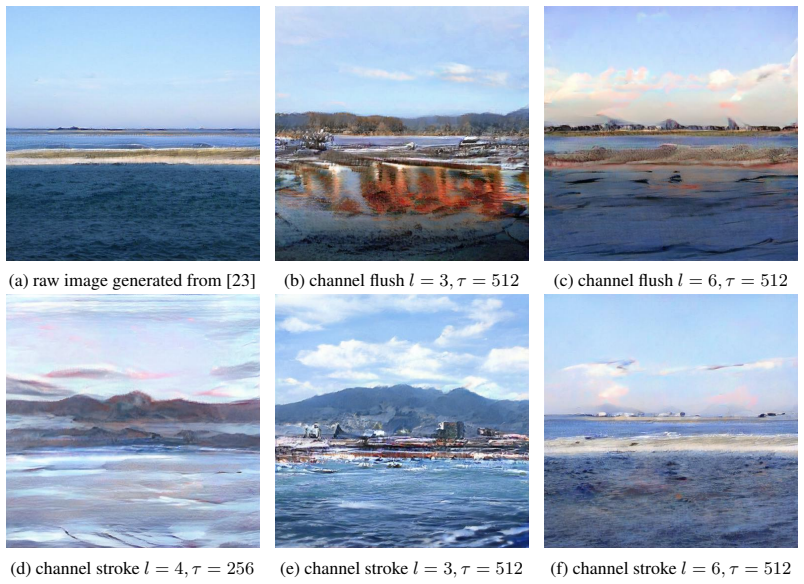
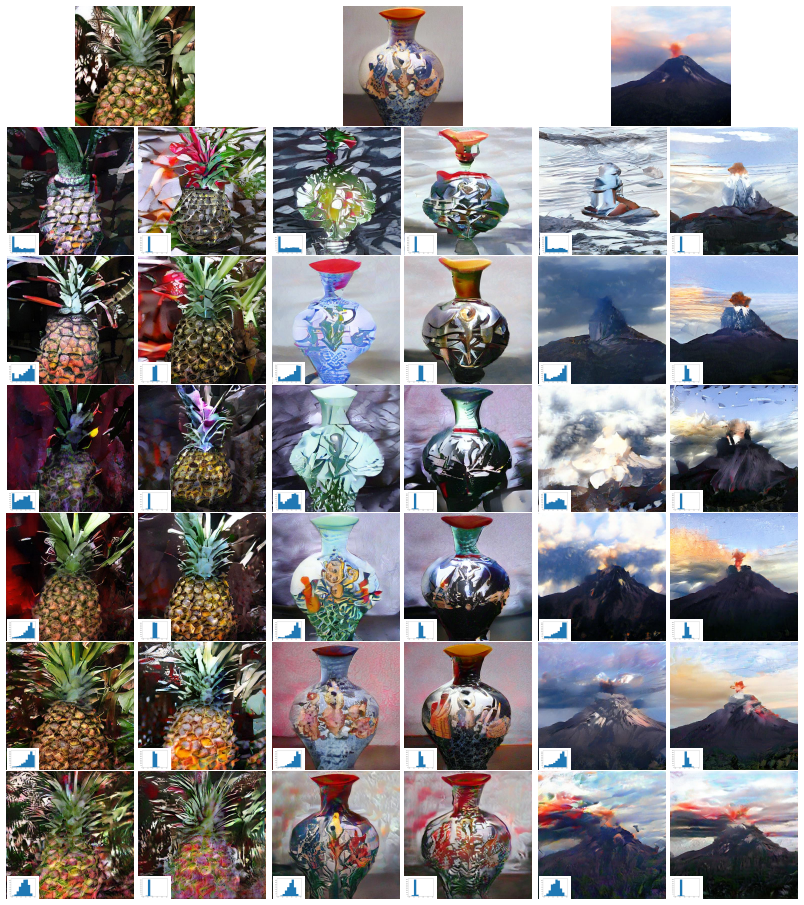
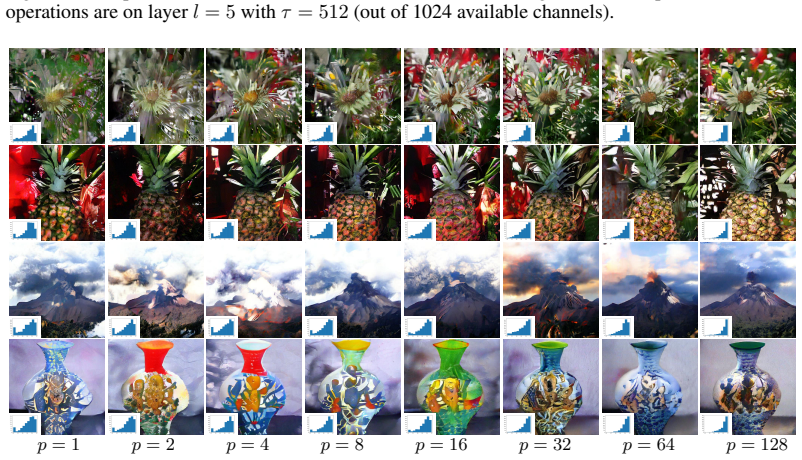
The load-bearing object is Algorithm 1, the channel stroke procedure. It maintains a binary mask $M\in\{0,1\}^{C\times H\times W}$ and a cost tensor $G$ over the operation layer's feature tensor; on each iteration it selects the unpainted pixel with the largest masked response $(1-G)\odot Y$, subject to the per-location channel limit $\tau$, extends the stroke over the neighborhood $N(c,h,w;m)$ of pixels whose response is at least $m\cdot Y_{c,h,w}$, and updates $G$ as the Hadamard product of the channel-change cost $J$ and the movement cost $K$. The neighborhood governs stroke shape, the sensitivity $m$ governs how far a stroke spreads, the penetration parameter $p$ lets a stroke turn on several similarly responsive channels at once, and the stopping rule $S$ decides when a region is finished. This machinery converts a single forward pass through a generator into a sequential, cost-driven painting process over feature channels, and channel flush appears as the limiting case without neighborhood extension.
What would settle it
Take a pretrained generator, pick a middle layer, run the channel flush with decreasing $\tau$, and measure the pixel-level or perceptual distance between the original output image and the flushed output across many inputs. If the distance does not grow as $\tau$ shrinks, or if randomly chosen channels preserve the layout as well as the top-response channels do, the paper's key claim about high-response channels carrying spatial information would be refuted.
Extended reading notes
Core claim
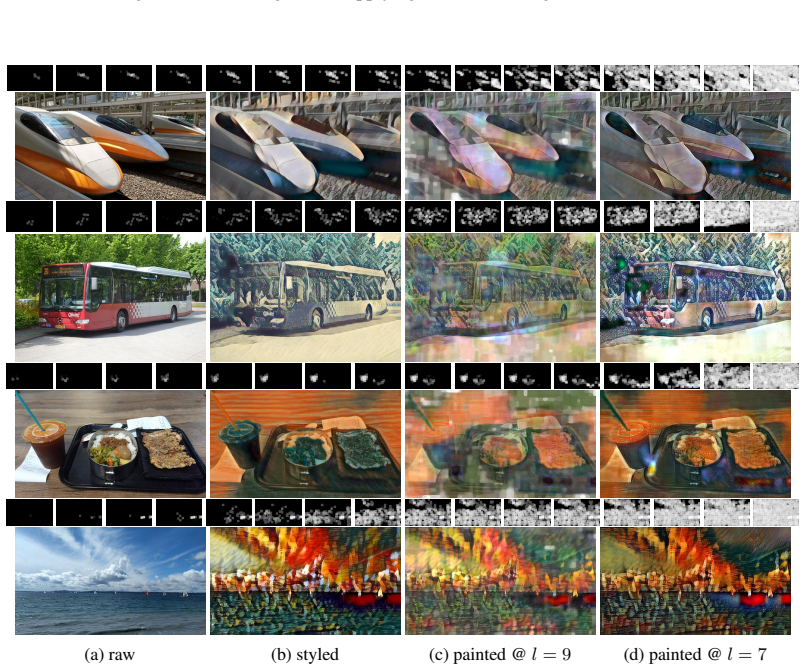
On the paper's own terms, the central discovery is that the spatial layout of a generator's final image survives even when an intermediate feature map is reduced to only the highest-responding channels at each location. The paper uses this finding to justify two layer operations: channel flush, which keeps the top $\tau$ channels per location and zeroes the rest, and channel stroke, which grows connected strokes through neighboring pixels whose response is at least a fraction $m$ of the current pixel's response, starting each stroke at the most responsive unpainted location. A cost tensor guides the next stroke position, combining a channel-change cost $g_c$ with a Gaussian movement cost, so the painter continues a stroke while that is cheaper than switching channels. Because the pretrained layers already encode object and style knowledge, the stroked features re-render as a painted image, and stroke masks applied at the generator output wipe away bleed from non-stroked regions. Object-region masks from a pretrained detection and segmentation network set the painting order and per-region focus.
Load-bearing premise
The load-bearing premise is that the later layers of a pretrained generator can rebuild the original image's spatial layout from an intermediate feature map in which most channels have been zeroed or stroked; the paper demonstrates this only with example images, not with a quantitative reconstruction test.
Editorial extensions
If this is right
- If the key finding holds, any pretrained generator's intermediate layer can serve as a stroke space, so stroke-order planning requires no paired stroke data and no retraining.
- Because the operation layer and the parameters $l$, $\tau$, $m$, $\sigma$, $g_c$, $p$, and $S$ are user-chosen, a single pretrained network yields a continuous family of painted styles.
- On a style-transfer transformer, the painted output keeps the original neural style and adds a controllable stroke texture on top, so the method extends style transfer rather than replacing it.
- When $\tau$ approaches the full channel count, the output approaches the original generator output, so the procedure degrades gracefully instead of failing abruptly.
Reading between the lines
- Inference: the same channel-stroke procedure could be applied at several layers at once, since the paper only operates on a single layer and lists multi-layer coordination as future work.
- Inference: if the spatial-layout claim is robust, channel flush could double as a diagnostic for which channels a generator truly needs for a given scene, because zeroing low-response channels at a middle layer should leave the scene's layout intact.
- Inference: adding directional or handwriting costs to the movement term, which the paper mentions but does not implement, would likely produce contour-following strokes and a more explicit drawing order.
Signed reviews
Editorial analysis
A structured set of objections, weighed in public.
Referee Report
Summary. The paper proposes channel painting in action (CPIA), an unsupervised method that decomposes a chosen convolutional layer of a pretrained generator network into stroke-like painting actions. The core operations are a channel flush, which keeps only the top-τ channels at each spatial location of an intermediate layer, and a channel stroke, which greedily extends strokes within that masked representation using hand-movement and channel-change costs; Mask R-CNN provides a painting plan by defining regions of interest. The method is demonstrated on BigGAN-generated images and on the MSG style-transfer transformer, with qualitative figures and histograms of channel coverage for parameters such as layer index l, channel limit τ, stroke sensitivity m, and stroke penetration p. The central claim is that masking intermediate features to high-response channels preserves the spatial layout of the generator output, so that later layers render a plausible painted version without retraining.
Significance. If the spatial-preservation claim were quantitatively established, CPIA would be a lightweight, training-free method for turning pretrained generators into stroke-based painters with user-controllable stroke parameters. Strengths include a precisely specified Algorithm 1, parameter sweeps over m and p in the appendix, and a public code/demo link. The main weakness is that the load-bearing empirical claim of Section 3.1 is supported only by selected qualitative panels and channel-coverage histograms; no quantitative reconstruction or layout-preservation metric is reported. The significance of the contribution therefore remains contingent on additional evaluation.
major comments (3)
- [Section 3.1, Eq. (3), Figs. 2 and 3] The central claim that the decomposed representation 'preserves the spatial information of the output image Y(L)' is asserted as a key finding but is never quantified. The paper reports no reconstruction error, no layout or object-preservation metric (e.g., mask IoU or detection consistency between Y(L) and the final output), and no systematic sweep across seeds, classes, and operation layers. Because the whole pipeline rests on the ability of later layers to tolerate hard zeroing of low-response channels, please add such measurements; without them the main claim is supported only by anecdotal figures.
- [Section 3.4] The post-generator stroke-map mask can only hide regions that were not stroked; it cannot restore spatial layout that the generator failed to produce. Therefore, if the later layers do not preserve the layout after the feature-space intervention, the final masking step in Section 3.4 cannot fix the problem. This makes the quantitative check requested above irreplaceable as evidence for the pipeline's central premise.
- [Algorithm 1, Steps 5 and 8] The τ-channel constraint is checked only when choosing the seed pixel in Step 5, but the neighborhood extension in Step 8 sets mask entries to 1 without verifying that the location has fewer than τ active channels. Over many strokes, a location can therefore receive more than τ active channels, which conflicts with the description in Section 3.4 that 'there can be as many as τ channels being stroked' at each location. Please enforce the cap during extension or clarify that τ is only a seed-selection threshold rather than a hard bound on the final mask.
minor comments (5)
- [Abstract and Appendix] The abstract says 'convolution layer' where 'convolutional layer' is standard, and the Appendix contains the typo 'futher' instead of 'further'.
- [Section 3.2, Eq. (3) and Algorithm 1] The notation N(c,h,w;m)∈N^3 should be 'a subset of N^3' rather than an element, and the top-τ condition in Eq. (3) would be clearer if the ranking was defined explicitly; the cardinality-based condition is easy to misread.
- [Algorithm 1, Step 9] The update of the cost tensor G is described only verbally as 'update G according to the chosen pixel'; a concrete update equation using J and K from Eqs. (4)-(5) is needed for reproducibility, especially since G is used in the argmax of Step 5.
- [Figures 6 and 7] The parameter sweeps for stroke sensitivity m and penetration p do not report the fixed values of z, σ, gc, the stopping criterion S, or the number of ROIs used; specifying these settings would make the comparisons reproducible.
- [Figure 5 caption] The caption states 'Images are painted with τ = 20 in (b) and with τ = 128 in (c)', but the subfigures are labeled (a)-(d); please align the caption labels with the panel labels to avoid confusion.
Circularity Check
No significant circularity: the painting pipeline is an empirical intervention on pretrained networks, and the load-bearing spatial-preservation claim is tested rather than encoded by construction.
full rationale
The central derivation is not circular. Equation (3) and Algorithm 1 define hard interventions (top-tau masking and neighborhood strokes) on a fixed pretrained generator; whether the later layers turn the masked or stroked feature maps into an image with the same spatial layout as Y(L) is an empirical property of the BigGAN and MSG networks, not a consequence of the equations. The paper fits no parameters to a target and makes no statistical prediction that is forced by construction. The cited pretrained systems (BigGAN, MSG, Mask R-CNN) are external, and there is no load-bearing self-citation, no imported uniqueness theorem, and no ansatz smuggled in via citation. Statements such as 'smaller m yields wider strokes' merely unpack the definition of the neighborhood threshold m and do not carry the main painting claim as a derived prediction. Lack of quantitative validation of the Section 3.1 'key finding' is an evidence concern, not circularity.
Assumptions & free parameters
free parameters (7)
- channel limit tau =
128-512 (BigGAN), 20-128 (MSG)
- stroke sensitivity m =
0.5-0.95 in Fig. 6
- stroke size z =
not fixed (square box 2z+1)
- Gaussian width sigma =
not specified
- channel-change cost gc =
not specified
- stroke penetration p =
1-128 in Fig. 7
- stopping criterion S =
global response-ratio threshold
assumptions (4)
- domain assumption Pre-trained generator networks (BigGAN, MSG) encode useful hierarchical image structures in their intermediate layers.
- ad hoc to paper Masking intermediate feature maps to top-tau channels preserves enough spatial information for the later layers to form a coherent image.
- domain assumption Later convolutional layers can propagate stroked (highly sparse or masked) activations to valid image pixels without normalization issues.
- domain assumption Mask R-CNN object regions provide useful painting order and region focus.
Cite this review
Pith. "Pith review of Channel Decomposition into Painting Actions." pith.science (2026). https://pith.science/paper/OK64CQUW
@misc{pith2026190804694,
  author       = {Pith},
  title        = {Pith review of: Channel Decomposition into Painting Actions},
  year         = {2026},
  howpublished = {\url{https://pith.science/paper/OK64CQUW}},
  note         = {Machine review of arXiv:1908.04694}
}
read the original abstract
This work presents a method to decompose a convolutional layer of the deep neural network into painting actions. To behave like the human painter, these actions are driven by the cost simulating the hand movement, the paint color change, the stroke shape and the stroking style. To help planning, the Mask R-CNN is applied to detect the object areas and decide the painting order. The proposed painting system introduces a variety of extensions in artistic styles, based on the chosen parameters. Further experiments are performed to evaluate the channel penetration and the channel sensitivity on the strokes.
Figures

Figures from the paper (4 more)


Reference graph
Works this paper leans on
-
[1]
Image style transfer using convolutional neural networks
Leon A Gatys, Alexander S Ecker, and Matthias Bethge. Image style transfer using convolutional neural networks. In Proceedings of the IEEE conference on computer vision and pattern recognition (CVPR), pages 2414–2423, 2016
work page 2016
-
[2]
Perceptual losses for real-time style transfer and super- resolution
Justin Johnson, Alexandre Alahi, and Li Fei-Fei. Perceptual losses for real-time style transfer and super- resolution. In Proceedings of the European conference on computer vision (ECCV) , pages 694–711, 2016
work page 2016
-
[3]
Texture networks: Feed- forward synthesis of textures and stylized images
Dmitry Ulyanov, Vadim Lebedev, Andrea Vedaldi, and Victor S Lempitsky. Texture networks: Feed- forward synthesis of textures and stylized images. In International Conference on Machine Learning (ICML), volume 1, page 4, 2016
work page 2016
-
[4]
Universal style transfer via feature transforms
Yijun Li, Chen Fang, Jimei Yang, Zhaowen Wang, Xin Lu, and Ming-Hsuan Yang. Universal style transfer via feature transforms. In Advances in neural information processing systems (NIPS) , pages 386–396, 2017
work page 2017
-
[5]
Stroke controllable fast style transfer with adaptive receptive fields
Yongcheng Jing, Yang Liu, Yezhou Yang, Zunlei Feng, Yizhou Yu, Dacheng Tao, and Mingli Song. Stroke controllable fast style transfer with adaptive receptive fields. In Proceedings of the European Conference on Computer Vision (ECCV), pages 238–254, 2018
work page 2018
-
[6]
Synthesizing programs for images using reinforced adversarial learning
Yaroslav Ganin, Tejas Kulkarni, Igor Babuschkin, SM Eslami, and Oriol Vinyals. Synthesizing programs for images using reinforced adversarial learning. International Conference on Learning Representations (ICLR), 2019
work page 2019
-
[7]
Strokenet: A neural painting environment
Ningyuan Zheng, Yifan Jiang, and Dingjiang Huang. Strokenet: A neural painting environment. In International Conference on Learning Representations (ICLR), 2019
work page 2019
-
[8]
Learning to paint with model-based deep reinforcement learning
Zhewei Huang, Wen Heng, and Shuchang Zhou. Learning to paint with model-based deep reinforcement learning. arXiv preprint arXiv:1903.04411, 2019
arXiv 1903
Show all 33 references
-
[9]
Mask r-cnn
Kaiming He, Georgia Gkioxari, Piotr Dollár, and Ross Girshick. Mask r-cnn. In Proceedings of the IEEE international conference on computer vision (ICCV), pages 2961–2969, 2017
2017
-
[10]
Multi-style generative network for real-time transfer
Hang Zhang and Kristin Dana. Multi-style generative network for real-time transfer. In Proceedings of the European Conference on Computer Vision (ECCV), 2018
2018
-
[11]
Learning internal representations by error propagation
David E Rumelhart, Geoffrey E Hinton, and Ronald J Williams. Learning internal representations by error propagation. Technical report, California Univ San Diego La Jolla Inst for Cognitive Science, 1985
1985
-
[12]
Modular learning in neural networks
Dana H Ballard. Modular learning in neural networks. In Proceedings of the sixth National conference on Artificial intelligence-Volume 1, pages 279–284. AAAI Press, 1987
1987
-
[13]
Auto-encoding variational bayes
Diederik P Kingma and Max Welling. Auto-encoding variational bayes. In International Conference on Learning Representations (ICLR), 2014
2014
-
[14]
Generative adversarial nets
Ian Goodfellow, Jean Pouget-Abadie, Mehdi Mirza, Bing Xu, David Warde-Farley, Sherjil Ozair, Aaron Courville, and Yoshua Bengio. Generative adversarial nets. In Advances in neural information processing systems (NIPS), pages 2672–2680, 2014
2014
-
[15]
Unsupervised representation learning with deep convolutional generative adversarial networks
Alec Radford, Luke Metz, and Soumith Chintala. Unsupervised representation learning with deep convolutional generative adversarial networks. In International Conference on Learning Representations (ICLR), 2016
2016
-
[16]
Image-to-image translation with conditional adversarial networks
Phillip Isola, Jun-Yan Zhu, Tinghui Zhou, and Alexei A Efros. Image-to-image translation with conditional adversarial networks. In Proceedings of the IEEE conference on computer vision and pattern recognition (CVPR), pages 1125–1134, 2017
2017
-
[17]
Unpaired image-to-image translation using cycle-consistent adversarial networks
Jun-Yan Zhu, Taesung Park, Phillip Isola, and Alexei A Efros. Unpaired image-to-image translation using cycle-consistent adversarial networks. In Proceedings of the IEEE international conference on computer vision (ICCV), pages 2223–2232, 2017
2017
-
[18]
Image-to-image translation via group-wise deep whitening-and-coloring transformation
Wonwoong Cho, Sungha Choi, David Keetae Park, Inkyu Shin, and Jaegul Choo. Image-to-image translation via group-wise deep whitening-and-coloring transformation. In Proceedings of the IEEE Conference on Computer Vision and Pattern Recognition (CVPR), pages 10639–10647, 2019
2019
-
[19]
Learning what and where to draw
Scott E Reed, Zeynep Akata, Santosh Mohan, Samuel Tenka, Bernt Schiele, and Honglak Lee. Learning what and where to draw. In Advances in Neural Information Processing Systems (NIPS), pages 217–225, 2016
2016
-
[20]
Pose guided person image generation
Liqian Ma, Xu Jia, Qianru Sun, Bernt Schiele, Tinne Tuytelaars, and Luc Van Gool. Pose guided person image generation. In Advances in Neural Information Processing Systems (NIPS), pages 406–416, 2017
2017
-
[21]
A style-based generator architecture for generative adversarial networks
Tero Karras, Samuli Laine, and Timo Aila. A style-based generator architecture for generative adversarial networks. In Proceedings of the IEEE Conference on Computer Vision and Pattern Recognition (CVPR), pages 4401–4410, 2019. 9
2019
-
[22]
Stackgan: Text to photo-realistic image synthesis with stacked generative adversarial networks
Han Zhang, Tao Xu, Hongsheng Li, Shaoting Zhang, Xiaogang Wang, Xiaolei Huang, and Dimitris N Metaxas. Stackgan: Text to photo-realistic image synthesis with stacked generative adversarial networks. In Proceedings of the IEEE International Conference on Computer Vision (CVPR) ...
2017
-
[23]
Large scale GAN training for high fidelity natural image synthesis
Andrew Brock, Jeff Donahue, and Karen Simonyan. Large scale GAN training for high fidelity natural image synthesis. In International Conference on Learning Representations (ICLR), 2019
2019
-
[24]
Towards the auto- matic anime characters creation with generative adversarial networks
Yanghua Jin, Jiakai Zhang, Minjun Li, Yingtao Tian, Huachun Zhu, and Zhihao Fang. Towards the auto- matic anime characters creation with generative adversarial networks. In Advances in neural information processing systems (NIPS), 2017
2017
-
[25]
Cartoongan: Generative adversarial networks for photo cartoonization
Yang Chen, Yu-Kun Lai, and Yong-Jin Liu. Cartoongan: Generative adversarial networks for photo cartoonization. In Proceedings of the IEEE Conference on Computer Vision and Pattern Recognition (CVPR), pages 9465–9474, 2018
2018
-
[26]
High- resolution image synthesis and semantic manipulation with conditional gans
Ting-Chun Wang, Ming-Yu Liu, Jun-Yan Zhu, Andrew Tao, Jan Kautz, and Bryan Catanzaro. High- resolution image synthesis and semantic manipulation with conditional gans. In Proceedings of the IEEE conference on computer vision and pattern recognition (CVPR), pages 8798–8807, 2018
2018
-
[27]
Very deep convolutional networks for large-scale image recogni- tion
Karen Simonyan and Andrew Zisserman. Very deep convolutional networks for large-scale image recogni- tion. In International Conference on Learning Representations (ICLR), 2015
2015
-
[28]
A learned representation for artistic style
Vincent Dumoulin, Jonathon Shlens, and Manjunath Kudlur. A learned representation for artistic style. International Conference on Learning Representations (ICLR), 2017
2017
-
[29]
Recurrent world models facilitate policy evolution
David Ha and Jürgen Schmidhuber. Recurrent world models facilitate policy evolution. In Advances in Neural Information Processing Systems (NIPS), pages 2450–2462, 2018
2018
-
[30]
Learning latent dynamics for planning from pixels
Danijar Hafner, Timothy Lillicrap, Ian Fischer, Ruben Villegas, David Ha, Honglak Lee, and James Davidson. Learning latent dynamics for planning from pixels. In International Conference on Machine Learning (ICML), pages 2555–2565, 2019
2019
-
[31]
Neural painters: A learned differentiable constraint for generating brushstroke paintings
Reiichiro Nakano. Neural painters: A learned differentiable constraint for generating brushstroke paintings. arXiv preprint arXiv:1904.08410, 2019
1904 arXiv
-
[32]
Learning methods for generic object recognition with invariance to pose and lighting
Yann LeCun, Fu Jie Huang, Leon Bottou, et al. Learning methods for generic object recognition with invariance to pose and lighting. In Proceedings of the IEEE conference on computer vision and pattern recognition (CVPR), pages 97–104, 2004
2004
-
[33]
Imagenet classification with deep convolutional neural networks
Alex Krizhevsky, Ilya Sutskever, and Geoffrey E Hinton. Imagenet classification with deep convolutional neural networks. In Advances in neural information processing systems (NIPS), pages 1097–1105, 2012. A Appendix In this section, we discuss additional parameters that can fut...
2012
Reviewed August 14, 2026 · model on record in the stance chip above.
Discussion (0). Continue with ORCID to comment.