REVIEW 3 major objections 5 minor 60 references
Optimal Scheduling in a Quantum Switch
T0 review · 3 major / 5 minor · reviewed 2026-08-10 · deepseek-v4-flash
Pith's one-line read For a general quantum switch with finite, decohering LLE buffers, the capacity region is exactly the stationary service rates of request-agnostic LLE policies, and the ARE policy—an average-reward MDP scheduler—is asymptotically…
desk verdict A real advance in quantum switch scheduling, with a concrete but repairable martingale gap in the fluid-limit proof; worth refereeing, not yet fully proven. read the letter →
The pith
A machine-rendered reading of the paper's core claim, the machinery that carries it, and where it could break.
The reading
What carries the argument
The load-bearing object is the LLE process $Z(t)$ together with its transition matrix $P^Q$, and the ARE policy's underlying average-reward MDP. The MDP's Bellman equation (12) chooses schedules to maximize long-run weighted successful swaps; because the LLE chain is unichain, a stationary optimal policy exists. The fluid-limit proof divides time into blocks of length $\tau(c)=(\log c)^2$: Lemma 1's coefficient-of-ergodicity bound $\rho(P^Q) \le \rho < 1$ ensures the LLE chain mixes within each block, letting the departure limit be written as an expectation under the stationary LLE distribution (Proposition 2); the MDP optimality of that stationary distribution then yields fluid inequality (15), and a quadratic Lyapunov argument gives fluid stability.
What would settle it
Compute the coefficient of ergodicity of the LLE transition matrices for a small switch, say $B=1$ with three links, across all request-queue states and decoherence probabilities; if any state gives $\rho(P^Q)=1$ with no uniform gap, Lemma 1 fails and the fluid-limit departure bound does not follow. A second check: simulate the ARE policy with $\tau(c)=(\log c)^2$ for a rate vector inside $C^{\circ}$ on the paper's three-link counterexample; if the fluid-scaled queue does not drain, Theorem 5 is wrong.
Extended reading notes
Core claim
The paper's central claim is that for a quantum switch with a general graph topology, finite LLE buffers, and decoherence, the capacity region is exactly the set of request arrival rates dominated by the stationary service rate of some request-agnostic LLE policy, and that the ARE policy, which re-solves the average-reward MDP (11)-(12) using current queue sizes, is asymptotically throughput optimal for that region. This is the first such characterization for a general switch topology, and it overturns the expectation that MaxWeight would inherit its classical throughput-optimality: the myopic rule of maximizing instantaneous queue-weighted service starves request types whose LLEs need to be preserved across time slots.
Load-bearing premise
The whole argument hinges on the claim that the LLE buffer process mixes uniformly fast—coefficient of ergodicity bounded below 1 for every request-queue state—so that a block of length $(\log c)^2$ is enough to reach stationarity; the paper sketches this proof but does not fully derive the numerical bound from the model's decoherence parameters.
Editorial extensions
If this is right
- For any general-topology quantum switch with finite buffering and decoherence, the stabilizable region is computable in principle from stationary LLE service rates, so capacity need not be inferred one topology at a time.
- A switch operator who implements MaxWeight can lose throughput: there are parameter regimes where MaxWeight is unstable while the capacity region is nonempty.
- Optimal scheduling can be precomputed offline as an average-reward MDP over the LLE state alone, using only current queue sizes as parameters; arrival-rate knowledge is not needed.
- The $(\log c)^2$ block fluid-limit method gives a general template for two-sided queues with a fast-mixing supply side and slow demand queues.
- Asymptotic throughput optimality means the guaranteed stability region approaches the full capacity region as queue scaling grows, with no per-arrival statistical assumptions.
Reading between the lines
- If the uniform mixing claim holds in practice, the ARE policy should be testable on near-term switches by measuring LLE decoherence and running value iteration; a natural experiment is to compare queue growth of ARE versus MaxWeight on the paper's three-link topology under Bernoulli arrivals.
- The same two-sided characterization likely transfers to any matching system with a fast-mixing supply process, such as ride-hailing pools or call centers, whenever the supply-side state is Markovian and mixes uniformly; the paper's Remark 2 gestures at this, and a concrete test would be a fluid-limit simulation on a simple vehicle-repositioning model.
- The counterexample suggests that MaxWeight's throughput loss is multiplicative in network size, as the paper's Remark 3 notes, so the gap between MaxWeight and ARE may widen with more request types; a testable extension is to measure the stability region of MaxWeight for N-queue generalizations.
Editorial analysis
A structured set of objections, weighed in public.
Referee Report
Summary. The paper studies a discrete-time quantum switch with finite LLE buffers, decoherence, and general request types that require LLEs from multiple links. The main claims are: (i) Theorem 1, the capacity region is characterized by request rates dominated by the stationary service rate of some request-agnostic LLE policy; (ii) the MaxWeight policy is not throughput-optimal for such switches (Theorem 2); and (iii) the proposed Average Reward Entanglement (ARE) policy, which solves an average-reward MDP at blocks of length τ(c)=(log c)^2, is asymptotically throughput optimal (Theorems 3–5). The proof strategy is a fluid limit with a two-time-scale separation: the LLE process is shown to mix quickly while the request queues move on a slower fluid timescale. The paper is ambitious and largely coherent, but several load-bearing proofs, notably the sufficiency direction of Theorem 1 and the MaxWeight counterexample in Appendix G, are not yet written at the level of rigor required for a journal.
Significance. If the results hold, this is a substantial contribution. It gives the first capacity-region characterization for a general quantum switch with finite LLE buffers and decoherence, and it provides an asymptotically throughput-optimal scheduling policy that is not simply MaxWeight. The fluid-limit methodology based on timescale separation is interesting in itself and may transfer to other two-sided matching systems. The paper is commendably concrete: the ARE policy is defined independently of fitted parameters, the capacity region is expressed through stationary distributions, and explicit numerical/structural counterexamples are supplied. The quantum networking motivation is also timely. However, the significance is conditional on repairing the gaps identified below, especially the sufficiency part of the capacity-region theorem and the formal proof that MaxWeight is not throughput-optimal.
major comments (3)
- [Appendix A (Theorem 1, sufficiency)] The sufficiency direction of Theorem 1 is not proved as written. After defining ε_r and a mixing time t0, the text asserts that for all t≥t0 and q_r>B, E[Q_r(t+1)-Q_r(t)|Q_r(t)=q_r]≤-ε_r/2, and then invokes Foster-Lyapunov. The displayed drift conditions only on the request queue length, not on the LLE state Z(t). For a fixed large q_r, the one-step drift can be positive when Z(t) is far from its stationary distribution, so the inequality does not hold uniformly for all states of the joint Markov chain (Z(t),Q_r(t)). A multi-step drift over a mixing block, or a renewal-cycle Foster-Lyapunov argument, is needed. This is local and repairable, but as it stands the characterization of the capacity region is not fully established.
- [Appendix G (Theorem 2, MaxWeight counterexample)] The proof of Theorem 2 is a heuristic continuous-time limit rather than a complete proof. The bounds such as P(Queue i is idle with an LLE) ≤ 1−λ_i/μ_i−O(h) are asserted without an explicit coupling between the prelimit DTMC and the lower-bound single-server queue, and the independence of Queues 1 and 2 under MaxWeight is not established for the prelimit process. The O(h^2) simultaneous-transition terms are controlled by assertion rather than by a constructed sample-path coupling. Since the MaxWeight counterexample is a headline contribution and motivates the ARE policy, this appendix needs a rigorous treatment, for example a coupling that preserves the ordering of events and detailed error estimates showing that conditions (A)-(C) imply the claimed stability/instability for sufficiently small h.
- [Definition (7) and Theorem 5] The definition of C_ε in equation (7) does not specify the quantification over the agnostic policy π; as written, μ and p appear without a preceding quantifier. The proof of Theorem 5 uses compactness of C_ε and uniformity of the fluid stability time T over λ∈C_ε, and both depend on making this definition precise. I suggest defining C_ε explicitly as, for example, the set of λ for which there exists a request-agnostic policy π with λ_r+ε ≤ E_{z∼μ_π}[γ_r n_r] for every r, and then verifying that this set is compact. This is a fixable but necessary clarification.
minor comments (5)
- [Section 2.3.6 and Appendix F (Lemma 1)] In Lemma 1 and its proof, δ is never defined, and the exponent B|Z| mixes state-space cardinality with buffer size; it should presumably be B·|L|, the total number of LLE storage slots, with δ = min_l d_l. The statement also uses Z to denote both the LLE process and its state space, which should be disambiguated.
- [Appendix E (Lemma 2)] The final sentence of Lemma 2 says that the sum over i of m_r(i,s) is a martingale difference sequence; it is a martingale, while the increments m_r(i,s) form the martingale difference sequence. More importantly, the filtration should be stated explicitly: m_r(i,s) is a martingale difference with respect to (F_{(i+1)τ})_i, with conditional expectation zero given F_{iτ}. This is a presentational issue, not a substantive gap in the argument.
- [Appendix C (Proposition 3)] In equations (45) and (46), the same symbol ar Q_r is used for the fluid limit and for the prelimit scaled queue-length process; the latter should be ar Q^c_r throughout, with the block-start index defined carefully, to avoid confusion in the Riemann-sum approximation.
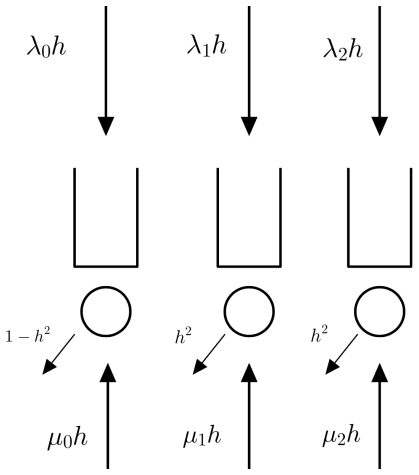
- [Section 3.4] The deterministic counterexample would benefit from a precise timing convention: it is not immediately clear whether an LLE generated in slot 1 that 'decoheres in 3 timesteps' is available at slots 2 and 3 or only at slots 2 and 3 after a delay, and the numerical claim λ_r=0.4 for all r should be stated as a per-time-slot rate. This would make the illustrative example easier to verify.
- [Throughout] There are several typographical issues: 'Azzuma-Hoeffding' in Appendix E should be 'Azuma-Hoeffding'; 'Bersekas' in Section 3.7 should be 'Bertsekas'; 'through-put' appears inconsistently; and reference [40] duplicates reference [31]. These should be corrected in revision.
Circularity Check
No circularity: capacity region, fluid limit, and ARE optimality are established by independent arguments; noted gaps are correctness issues, not definitional reductions.
full rationale
The derivation chain is not circular. Theorem 1 defines the capacity region through positive recurrence and characterizes it via stationary service rates of request-agnostic policies; the necessary direction constructs such a policy from conditional scheduling probabilities and verifies balance equations, and the sufficient direction uses Foster-Lyapunov. The ARE policy is independently defined as the solution of an average-reward MDP (11), with no fitted arrival-rate parameters. Theorem 3 proves the fluid limit using mixing and the time-scale-separation decomposition; Proposition 3 legitimately invokes the MDP optimality of pi-star, and Theorem 4 combines this with the capacity-region existence of an agnostic policy with service rate above lambda. No equation has its conclusion as an input: the fluid-model inequality (15) is derived, and the capacity-region benchmark is proved separately. The paper contains only non-load-bearing self-citations (refs. [32,33] are background on prior quantum-switch models), so they do not raise the circularity score. Two possible proof gaps noted in the manuscript, the sketched minorization bound in Lemma 1 (Appendix F) and the martingale-difference step in term (20), are, if real, correctness gaps in the fluid-limit argument, not circular reductions.
Assumptions & free parameters
free parameters (1)
- tau(c) = (log c)^2 =
(log c)^2
assumptions (5)
- domain assumption Finite LLE buffer size B (Section 2.2.2).
- domain assumption Each LLE decoheres independently with probability d_l in (0,1] at the end of each time slot (Section 2.3.5).
- domain assumption Request and LLE arrivals are i.i.d. with bounded increments and finite means (Section 2.3.2).
- domain assumption The schedule set N is monotone (Section 2.2.3).
- standard math Standard results in Markov chain theory, Foster-Lyapunov stability, fluid limit theory, and average-reward MDPs.
Cite this review
Pith. "Pith review of Optimal Scheduling in a Quantum Switch." pith.science (2026). https://pith.science/paper/OKG4JS5U
@misc{pith2026250105380,
  author       = {Pith},
  title        = {Pith review of: Optimal Scheduling in a Quantum Switch},
  year         = {2026},
  howpublished = {\url{https://pith.science/paper/OKG4JS5U}},
  note         = {Machine review of arXiv:2501.05380}
}
read the original abstract
With a growing number of quantum networks in operation, there is a pressing need for performance analysis of quantum switching technologies. A quantum switch establishes, distributes, and maintains entanglements across a network. In contrast to a classical switching fabric, a quantum switch is a two sided queueing network. The switch generates Link Level Entanglements (LLEs), which are then fused to process the networks entanglement requests. Our proof techniques analyse a two time scale separation phenomenon at the fluid scale for a general switch topology. This allows us to demonstrate that the optimal fluid dynamics are given by a scheduling algorithm that solves a certain average reward Markov Decision Process.
Figures


Reference graph
Works this paper leans on
-
[1]
Quantum internet: A vision for the road ahead,
S. Wehner, D. Elkouss, and R. Hanson, “Quantum internet: A vision for the road ahead,” Science, vol. 362, no. 6412, p. eaam9288, 2018. [Online]. Available: https://www.science.org/doi/abs/10.1126/science.aam9288
-
[2]
Quantum internet: from communication to distributed computing!
M. Caleffi, A. S. Cacciapuoti, and G. Bianchi, “Quantum internet: from communication to distributed computing!” in Proceedings of the 5th ACM International Conference on Nanoscale Computing and Communication , ser. NANOCOM ’18. New York, NY, USA: Association for Computing Machinery, 2018. [Online]. Available: https://doi.org/10.1145/3233188.3233224
-
[3]
Quantum repeaters: From quantum networks to the quantum internet,
K. Azuma, S. E. Economou, D. Elkouss, P. Hilaire, L. Jiang, H.-K. Lo, and I. Tzitrin, “Quantum repeaters: From quantum networks to the quantum internet,” Rev. Mod. Phys. , vol. 95, p. 045006, Dec 2023. [Online]. Available: https://link.aps.org/doi/10.1103/RevModPhys.95.045006 27
-
[4]
Entanglement-based secure quantum cryptography over 1,120 kilometres,
J. Yin, Y.-H. Li, S.-K. Liao, M. Yang, Y. Cao, L. Zhang, J.-G. Ren, W.-Q. Cai, W.- Y. Liu, S.-L. Li et al. , “Entanglement-based secure quantum cryptography over 1,120 kilometres,” Nature, vol. 582, no. 7813, pp. 501–505, 2020
work page 2020
-
[5]
Euroqci: Europe’s quantum communication infrastructure,
European Commission, “Euroqci: Europe’s quantum communication infrastructure,” European Commission publication, 2021, https://digital-strategy.ec.europa.eu/en/ policies/european-quantum-communication-infrastructure-euroqci
work page 2021
-
[6]
Toshiba and bt launch uk’s first commercial quantum secured metro network,
Toshiba Europe Press Release, “Toshiba and bt launch uk’s first commercial quantum secured metro network,” Press release, October 2021, https://www.global.toshiba/ww/ news/corporate/2022/04/news-20220427-01.html
work page 2021
-
[7]
Entangled photons maintained under new york streets,
C. Day, “Entangled photons maintained under new york streets,” Physics, vol. 17, p. 125, 2024
work page 2024
-
[8]
Creation of memory–memory entanglement in a metropolitan quantum network,
J.-L. Liu, X.-Y. Luo, Y. Yu, C.-Y. Wang, B. Wang, Y. Hu, J. Li, M.-Y. Zheng, B. Yao, Z. Yan et al., “Creation of memory–memory entanglement in a metropolitan quantum network,” Nature, vol. 629, no. 8012, pp. 579–585, 2024
work page 2024
Show all 60 references
-
[9]
’quantum internet’demonstration in cities is most advanced yet
D. Castelvecchi, “’quantum internet’demonstration in cities is most advanced yet.” Nature, 2024
2024
-
[10]
Programmable multimode quantum networks,
S. Armstrong, J.-F. Morizur, J. Janousek, B. Hage, N. Treps, P. K. Lam, and H.- A. Bachor, “Programmable multimode quantum networks,” Nature communications, vol. 3, no. 1, p. 1026, 2012
2012
-
[11]
Quantum internet: Networking challenges in distributed quantum computing,
A. S. Cacciapuoti, M. Caleffi, F. Tafuri, F. S. Cataliotti, S. Gherardini, and G. Bianchi, “Quantum internet: Networking challenges in distributed quantum computing,” IEEE Network, vol. 34, no. 1, pp. 137–143, 2020
2020
-
[12]
4 tough chemistry problems that quantum computers will solve [news],
K. Bourzac, “4 tough chemistry problems that quantum computers will solve [news],” IEEE Spectrum, vol. 54, pp. 7–9, 11 2017
2017
-
[13]
Dynamic cooling on contemporary quantum computers,
L. Bassman Oftelie, A. De Pasquale, and M. Campisi, “Dynamic cooling on contemporary quantum computers,” PRX Quantum , vol. 5, p. 030309, Jul 2024. [Online]. Available: https://link.aps.org/doi/10.1103/PRXQuantum.5.030309
2024 doi
-
[14]
M. A. Nielsen and I. L. Chuang, Quantum computation and quantum information . Cambridge university press Cambridge, 2001, vol. 2
2001
-
[15]
Quantum annealing: An overview,
A. Rajak, S. Suzuki, A. Dutta, and B. K. Chakrabarti, “Quantum annealing: An overview,” Philosophical Transactions of the Royal Society A , vol. 381, no. 2241, p. 20210417, 2023
2023
-
[16]
Measurement-based quantum computation,
H. J. Briegel, D. E. Browne, W. D¨ ur, R. Raussendorf, and M. Van den Nest, “Measurement-based quantum computation,” Nature Physics , vol. 5, no. 1, pp. 19– 26, 2009. 28
2009
-
[17]
Fusion-based quantum compu- tation,
S. Bartolucci, P. Birchall, H. Bombin, H. Cable, C. Dawson, M. Gimeno-Segovia, E. Johnston, K. Kieling, N. Nickerson, M. Pant et al., “Fusion-based quantum compu- tation,” Nature Communications, vol. 14, no. 1, p. 912, 2023
2023
-
[18]
Switch networks for photonic fusion-based quantum computing,
S. Bartolucci, P. Birchall, D. Bonneau, H. Cable, M. Gimeno-Segovia, K. Kieling, N. Nickerson, T. Rudolph, and C. Sparrow, “Switch networks for photonic fusion-based quantum computing,” arXiv preprint arXiv:2109.13760 , 2021
2021 arXiv
-
[19]
Ramaswami, K
R. Ramaswami, K. Sivarajan, and G. Sasaki, Optical networks: a practical perspective. Morgan Kaufmann, 2009
2009
-
[20]
Resource allocation and cross-layer control in wireless networks,
L. Georgiadis, M. J. Neely, L. Tassiulas et al. , “Resource allocation and cross-layer control in wireless networks,” Foundations and Trends® in Networking , vol. 1, no. 1, pp. 1–144, 2006
2006
-
[21]
Stability properties of constrained queueing systems and scheduling policies for maximum throughput in multihop radio networks,
L. Tassiulas and A. Ephremides, “Stability properties of constrained queueing systems and scheduling policies for maximum throughput in multihop radio networks,” in 29th IEEE Conference on Decision and Control . IEEE, 1990, pp. 2130–2132
1990
-
[22]
Achieving 100% throughput in an input-queued switch,
N. McKeown, A. Mekkittikul, V. Anantharam, and J. Walrand, “Achieving 100% throughput in an input-queued switch,” IEEE Transactions on Communications , vol. 47, no. 8, pp. 1260–1267, 1999
1999
-
[23]
The islip scheduling algorithm for input-queued switches,
N. McKeown, “The islip scheduling algorithm for input-queued switches,” IEEE/ACM transactions on networking , vol. 7, no. 2, pp. 188–201, 1999
1999
-
[24]
Matching queues with aban- donments in quantum switches: Stability and throughput analysis,
M. Zubeldia, P. R. Jhunjhunwala, and S. T. Maguluri, “Matching queues with aban- donments in quantum switches: Stability and throughput analysis,” arXiv preprint arXiv:2209.12324, 2022
2022 arXiv
-
[25]
Learning-based optimal quantum switch scheduling,
J. Huang and L. Huang, “Learning-based optimal quantum switch scheduling,” SIGMETRICS Perform. Eval. Rev. , vol. 51, no. 2, p. 75–77, Oct. 2023. [Online]. Available: https://doi.org/10.1145/3626570.3626597
2023
-
[26]
A brief introduction to quantum network control,
V. Valls, P. Promponas, and L. Tassiulas, “A brief introduction to quantum network control,” arXiv preprint arXiv:2407.19899 , 2024
2024 arXiv
-
[27]
Full exploitation of limited memory in quantum entanglement switching,
P. Promponas, V. Valls, and L. Tassiulas, “Full exploitation of limited memory in quantum entanglement switching,” in 2023 IFIP Networking Conference (IFIP Net- working). IEEE, 2023, pp. 1–9
2023
-
[28]
Quantum relays for long distance quan- tum cryptography,
D. Collins, N. Gisin, and H. De Riedmatten*, “Quantum relays for long distance quan- tum cryptography,” Journal of Modern Optics , vol. 52, no. 5, pp. 735–753, 2005
2005
-
[29]
Quantum key distribution in a packet-switched network,
R. Mandil, S. DiAdamo, B. Qi, and A. Shabani, “Quantum key distribution in a packet-switched network,” npj Quantum Information , vol. 9, no. 1, p. 85, 2023. 29
2023
-
[30]
Introduction: 2d-based quantum technologies,
C. Palacios-Berraquero, “Introduction: 2d-based quantum technologies,” Quantum Confined Excitons in 2-Dimensional Materials , pp. 1–30, 2018
2018
-
[31]
On the analysis of a multipartite entanglement distribution switch,
P. Nain, G. Vardoyan, S. Guha, and D. Towsley, “On the analysis of a multipartite entanglement distribution switch,” Proc. ACM Meas. Anal. Comput. Syst. , vol. 4, no. 2, Jun. 2020. [Online]. Available: https://doi.org/10.1145/3392141
2020 doi
-
[32]
A throughput optimal scheduling policy for a quantum switch,
T. Vasantam and D. Towsley, “A throughput optimal scheduling policy for a quantum switch,” in Quantum Computing, Communication, and Simulation II , P. R. Hemmer and A. L. Migdall, Eds., vol. 12015, International Society for Optics and Photonics. SPIE, 2022, p. 1201505. [Online...
2022 doi
-
[33]
On the capacity region of a quantum switch with entanglement purification,
N. K. Panigrahy, T. Vasantam, D. Towsley, and L. Tassiulas, “On the capacity region of a quantum switch with entanglement purification,” in IEEE INFOCOM 2023 - IEEE Conference on Computer Communications , 2023, pp. 1–10
2023
-
[34]
The capacity region of entanglement switch- ing: Stability and zero latency,
W. Dai, A. Rinaldi, and D. Towsley, “The capacity region of entanglement switch- ing: Stability and zero latency,” in 2022 IEEE International Conference on Quantum Computing and Engineering (QCE) , 2022, pp. 389–399
2022
-
[35]
Large loss networks,
P. Hunt and T. Kurtz, “Large loss networks,” Stochastic Processes and their Applica- tions, vol. 53, no. 2, pp. 363–378, 1994
1994
-
[36]
A stochastic analysis of resource sharing with logarithmic weights,
P. Robert and A. V´ eber, “A stochastic analysis of resource sharing with logarithmic weights,” The Annals of Applied Probability , vol. 25, no. 5, pp. 2626 – 2670, 2015. [Online]. Available: https://doi.org/10.1214/14-AAP1057
2015 doi
-
[37]
Large deviations of mean-field interacting particle systems in a fast varying environment,
S. Yasodharan and R. Sundaresan, “Large deviations of mean-field interacting particle systems in a fast varying environment,” The Annals of Applied Probability , vol. 32, no. 3, pp. 1666–1704, 2022
2022
-
[38]
Thinking fast and slow: Optimization decomposition across timescales,
G. Goel, N. Chen, and A. Wierman, “Thinking fast and slow: Optimization decomposition across timescales,” SIGMETRICS Perform. Eval. Rev. , vol. 45, no. 2, p. 27–29, Oct. 2017. [Online]. Available: https://doi.org/10.1145/3152042.3152052
2017
-
[39]
Teleporting an unknown quantum state via dual classical and einstein-podolsky-rosen channels,
C. H. Bennett, G. Brassard, C. Cr´ epeau, R. Jozsa, A. Peres, and W. K. Wootters, “Teleporting an unknown quantum state via dual classical and einstein-podolsky-rosen channels,” Physical review letters , vol. 70, no. 13, p. 1895, 1993
1993
-
[40]
On the analysis of a multipartite entanglement distribution switch,
P. Nain, G. Vardoyan, S. Guha, and D. Towsley, “On the analysis of a multipartite entanglement distribution switch,” Proceedings of the ACM on Measurement and Anal- ysis of Computing Systems , vol. 4, no. 2, pp. 1–39, 2020
2020
-
[41]
Nisq computing: where are we and where do we go?
J. W. Z. Lau, K. H. Lim, H. Shrotriya, and L. C. Kwek, “Nisq computing: where are we and where do we go?” AAPPS Bulletin , vol. 32, pp. 1–30, 2022. [Online]. Available: https://api.semanticscholar.org/CorpusID:252538719 30
2022
-
[42]
Special session: Noisy intermediate-scale quantum (nisq) computers—how they work, how they fail, how to test them?
S. Brandhofer, S. Devitt, T. Wellens, and I. Polian, “Special session: Noisy intermediate-scale quantum (nisq) computers—how they work, how they fail, how to test them?” in 2021 IEEE 39th VLSI Test Symposium (VTS) , 2021, pp. 1–10
2021
-
[43]
Single-qubit quantum memory exceeding 10-minute coherence time,
Y. Wang, M. Um, Z. Junhua, S. An, M. Lyu, J.-n. Zhang, L. Duan, D. Yum, and K. Kim, “Single-qubit quantum memory exceeding 10-minute coherence time,” Nature Photonics, vol. 11, 10 2017
2017
-
[44]
A Linear Algebraic Framework for Dynamic Scheduling Over Memory-Equipped Quantum Networks ,
P. Fittipaldi, A. Giovanidis, and F. Grosshans, “ A Linear Algebraic Framework for Dynamic Scheduling Over Memory-Equipped Quantum Networks ,” IEEE Transactions on Quantum Engineering , vol. 5, no. 01, pp. 1–18, Jan. 2024. [Online]. Available: https://doi.ieeecomputersociety.o...
2024
-
[45]
Scheduling in a queuing system with asynchronously varying service rates,
M. Andrews, K. Kumaran, K. Ramanan, A. Stolyar, R. Vijayakumar, and P. Whiting, “Scheduling in a queuing system with asynchronously varying service rates,”Probability in the Engineering and Informational Sciences , vol. 18, no. 2, pp. 191–217, 2004
2004
-
[46]
Impact of fairness on internet performance,
T. Bonald and L. Massouli´ e, “Impact of fairness on internet performance,” inProceed- ings of the 2001 ACM SIGMETRICS international conference on Measurement and modeling of computer systems , 2001, pp. 82–91
2001
-
[47]
M. L. Puterman, Markov decision processes: discrete stochastic dynamic programming. John Wiley & Sons, 2014
2014
-
[48]
Dynamic programming and optimal control: Volume ii,
D. P. Bertsekas, “Dynamic programming and optimal control: Volume ii,” Belmont, MA: Athena Scientific , vol. 1, 2011
2011
-
[49]
Billingsley, Convergence of probability measures
P. Billingsley, Convergence of probability measures. John Wiley & Sons, 2013
2013
-
[50]
Geometric bounds for stationary distributions of infinite markov chains via lyapunov functions,
D. Bertsimas, D. Gamarnik, and J. N. Tsitsiklis, “Geometric bounds for stationary distributions of infinite markov chains via lyapunov functions,” 1998
1998
-
[51]
Robert, Stochastic networks and queues
P. Robert, Stochastic networks and queues . Springer Science & Business Media, 2013, vol. 52
2013
-
[52]
Dudley, Real analysis and probability
R. Dudley, Real analysis and probability . Cambridge University Press, 2002
2002
-
[53]
On positive harris recurrence of multiclass queueing networks: a unified approach via fluid limit models,
J. G. Dai, “On positive harris recurrence of multiclass queueing networks: a unified approach via fluid limit models,” The Annals of Applied Probability , vol. 5, no. 1, pp. 49–77, 1995
1995
-
[54]
Bramson, Stability of queueing networks
M. Bramson, Stability of queueing networks . Springer, 2008
2008
-
[55]
Stability of open multiclass queueing networks via fluid models,
J. Dai, “Stability of open multiclass queueing networks via fluid models,” IMA Volumes in Mathematics and Its Applications , vol. 71, pp. 71–71, 1995
1995
-
[56]
Finite-time analysis of asynchronous stochastic approxima- tion and q-learning,
G. Qu and A. Wierman, “Finite-time analysis of asynchronous stochastic approxima- tion and q-learning,” in Conference on Learning Theory. PMLR, 2020, pp. 3185–3205. 31
2020
-
[57]
Probability inequalities for sums of bounded random variables,
W. Hoeffding, “Probability inequalities for sums of bounded random variables,” The collected works of Wassily Hoeffding , pp. 409–426, 1994
1994
-
[58]
Perturbation of the stationary distribution measured by ergodicity coeffi- cients,
E. Seneta, “Perturbation of the stationary distribution measured by ergodicity coeffi- cients,” Advances in Applied Probability, vol. 20, no. 1, pp. 228–230, 1988
1988
-
[59]
Springer Science & Business Media, 2006
——, Non-negative matrices and Markov chains . Springer Science & Business Media, 2006
2006
-
[60]
Central limit theorem for nonstationary markov chains. i,
R. L. Dobrushin, “Central limit theorem for nonstationary markov chains. i,” Theory of Probability & Its Applications , vol. 1, no. 1, pp. 65–80, 1956. A Proof of Theorem 1 We now restate and prove Theorem 1. Theorem 1. A necessary condition for λ ∈ Cis that there exists a req...
1956
Reviewed August 10, 2026 · model on record in the stance chip above.
Discussion (0). Continue with ORCID to comment.