REVIEW 2 major objections 3 minor 38 references
Further tests of lepton flavour universality from the charged lepton energy distribution in $b\to c$ semileptonic decays: The case of $\Lambda_b\to \Lambda_c \ell \bar\nu_\ell$
T0 review · 2 major / 3 minor · reviewed 2026-08-14 · deepseek-v4-flash
Pith's one-line read This paper derives two Standard Model predictions — a lepton-flavour-independent coefficient c2(ω) and a universal a2/c2 ratio — that turn any semileptonic decay into a lepton-flavour-universality test.
desk verdict A clean, algebraically solid pair of new SM LFU observables; the NP-discrimination illustration rests on non-public correlations but the core result stands. read the letter →
The pith
A machine-rendered reading of the paper's core claim, the machinery that carries it, and where it could break.
The reading
What carries the argument
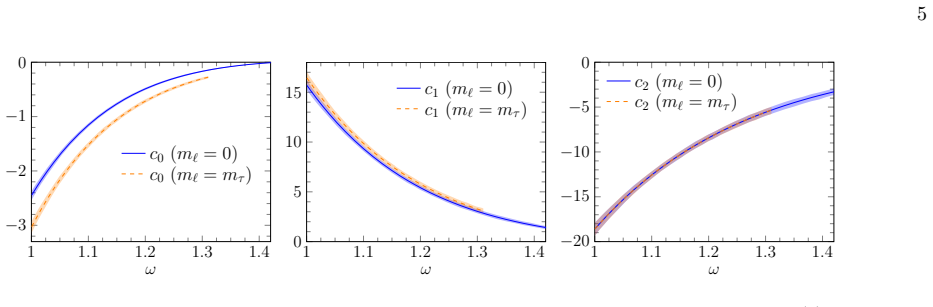
The machinery is the Lorentz decomposition of the unpolarized hadron tensor into five structure functions W1...W5, with the time-reversal-odd antisymmetric term omitted. In the lab-frame lepton energy distribution, the E_ℓ² coefficient is exactly c2 = −4W2; in the W⁻ rest-frame angular distribution, a2 = −(M'²/M²)(ω²−1)(1−m_ℓ²/q²)W2. Because both coefficients share W2, their ratio is universal and form-factor independent, which is what makes c2 and the a2/c2 ratio clean tests of the Standard Model.
What would settle it
Measure d²Γ/(dω dE_τ) for Λ_b→Λ_c τ ν̄ and extract c2(ω) at fixed ω; if it differs from c2(ω) extracted from the electron or muon mode beyond uncertainties, the Standard Model lepton-universality prediction fails. Separately, extract a2(ω) and c2(ω) in a decay such as D→Kℓν and check whether M² a2/[M'²(1−m_ℓ²/q²)c2] equals (ω²−1)/4; a deviation would falsify the five-structure-function decomposition.
Extended reading notes
Core claim
The central claim is that in the Standard Model the doubly differential width d²Γ/(dω dE_ℓ) factorizes kinematically into c0 + c1 E_ℓ/M + c2 E_ℓ²/M², with c2(ω)=−4W2(ω) independent of the charged lepton mass. Since W2 is a hadron structure function, c2 is not predicted to have a particular value, but it is predicted to be identical for e, μ, and τ at every ω. Separately, a2(ω), which controls the cos²θ_ℓ term in the W⁻ rest-frame angular distribution, satisfies M² a2(ω)/[M'²(1−m_ℓ²/q²)c2(ω)] = (ω²−1)/4, a universal relation valid for any H→H' semileptonic decay; the hadron structure function cancels. The paper then shows, within the effective-Hamiltonian scheme of Ref. [14], that left/right scalar new physics leaves both c2 and a2 unchanged, while left/right vector corrections rescale both but leave their ratio intact, so violations of the two Standard Model predictions point to specific Lorentz structures.
Load-bearing premise
The derivation assumes the hadron tensor for unpolarized H→H' decays is fully captured by the five structure functions of Eq. (4), omitting any time-reversal-odd antisymmetric piece; if spin-dependent or additional Lorentz terms contribute to the E_ℓ² coefficient, the identities c2 = −4W2 and Eq. (10) need not hold.
Editorial extensions
If this is right
- In any b→c semileptonic decay, the electron and muon modes provide a form-factor-independent Standard Model prediction for c2(ω) in the tau mode; a mismatch is direct evidence of lepton-flavour-universality violation.
- The universal a2/c2 ratio turns every measured semileptonic decay — meson or baryon, c→s, c→d, s→u, b→u — into a test of the Standard Model hadron-tensor structure.
- If a tau-mode c2 is rescaled relative to e/μ by a constant factor while the a2/c2 ratio still holds, the responsible new physics is a left- or right-handed vector current, not a scalar.
- For Λ_b→Λ_c, c2 (or a2) in the tau channel separates the new-physics Fits 6 and 7 of Ref. [14], which otherwise predict the same R_D, R_D*, R_Λ_c, and dΓ/dω.
- The coefficients c0, c1, and a1 also show fit-discriminating power, giving additional observables from the same data set.
Reading between the lines
- The same lepton-energy analysis could be applied to B→D(∗)ℓν data already being collected; the c2 equality between light leptons and tau would then become a high-statistics lepton-flavour-universality test complementary to R_D(∗).
- Equation (10) could be checked first in light-quark decays such as K→πℓν or D→Kℓν, where backgrounds are smaller, before tau-mode statistics catch up; any violation there would challenge the universal decomposition rather than b→c physics specifically.
- A differential measurement of c2(ω) rather than its integral could isolate kinematic regions where scalar new-physics effects are suppressed, sharpening the distinction between vector and scalar explanations.
- The helicity decomposition suggests that, combined with e/μ angular data, tau polarisation in the W⁻ frame can be extracted from unpolarized decay distributions, a testable prospect for future high-statistics samples.
Signed reviews
Editorial analysis
A structured set of objections, weighed in public.
Referee Report
Summary. This paper develops a general formalism for the double differential semileptonic decay widths d^2Γ/(dω dE_l) and d^2Γ/(dω d cosθ_l) for any H → H' l ν decay, expressing them in terms of hadronic structure functions. Within the Standard Model (SM), the coefficient c2(ω) in the E_l distribution is shown to be proportional to the structure function W2(ω) alone, so it is independent of the charged lepton mass. The authors also derive a universal ratio relating a2(ω) and c2(ω), Eq. (10). They generalize the formalism to include left/right scalar and vector NP operators (setting the tensor coefficient to zero) and apply it to Λ_b → Λ_c l ν using lattice QCD form factors from Ref. [20]. They show that Fits 6 and 7 of Ref. [14], which yield nearly identical R_D, R_D*, and dΓ/dω, predict different values of (c2)_NP/(c2)_SM and claim a separation by more than 5σ.
Significance. The SM relations (c2 = -4W2 and the universal ratio Eq. (10)) are elegant, self-contained, and constitute genuinely new model-independent tests of lepton flavour universality in semileptonic decays. The derivation is transparent and can be checked directly from Eqs. (6) and (8), and the application to Λ_b → Λ_c with modern LQCD form factors provides concrete numerical predictions. However, the advertised NP-discrimination power is conditional: it relies on neglecting the tensor operator and on private correlation matrices for the Wilson coefficients, so the quantitative 5σ claim is not yet fully supported.
major comments (2)
- [Sec. III.C, Eqs. (26)-(27) and Fig. 6] The NP predictions for c2 and a2 are obtained after setting the tensor Wilson coefficient C_T to zero, but the fits of Ref. [14] give C_T = 0.01^{+0.09}_{-0.07} (Fit 6) and -0.02^{+0.08}_{-0.07} (Fit 7). The authors only quantify the effect of dropping C_T on R_Λ_c (Fig. 6, bottom panels), not on c2 or a2. Since the separation between Fits 6 and 7 quoted for (c2)_NP/(c2)_SM at ω=1.15 is 1.40 ± 0.04 vs 2.06 ± 0.09, a tensor contribution of order C_T could shift the ratio by an amount comparable to the separation itself. The claim that a measurement of c2 (or a2) would distinguish the two fits requires an estimate of the tensor contribution to these observables.
- [Fig. 6 and surrounding text] The quantitative statement that the two NP scenarios are separated by more than 5σ is based on Wilson-coefficient correlation matrices obtained by private communication (Ref. [36]), because the correlation matrices are not publicly available from Ref. [14]. This makes the central numerical claim non-reproducible by the reader. The authors should either obtain permission to include the correlation matrices as supplementary material or present the separation as an estimate with the caveat that the uncertainties depend on unpublished correlations.
minor comments (3)
- [Sec. III.C] There is a typo: 'aproximation' should be 'approximation' in the paragraph discussing the flatness of (c2)_NP/(c2)_SM.
- [Fig. 6 caption] The label 'MPJP' is used in the bottom plots but is not defined; it should be identified (presumably as the predictions from Ref. [14], Murgui-Peñuelas-Jung-Pich).
- [Sec. IV] The summary sentence 'neither c2 nor a2 are modified by left and right scalar NP terms' should explicitly repeat the C_T = 0 caveat that appears in Sec. III.C, so that the conclusion is self-contained and not overgeneralized.
Circularity Check
No significant circularity: the SM LFU relations c2 = -4 W2 and Eq. (10) are algebraic consequences of the Lorentz decomposition, and the NP-discrimination numbers use external Wilson-coefficient fits rather than fitting the predicted observables.
full rationale
The paper's main results are identities derived from the general hadron tensor decomposition in Eq. (4) and the definitions of the differential widths. From Eq. (8), c2(omega) = -4 W2(omega), so its lepton-mass independence follows because W2 is a hadronic structure function independent of m_l; no fit enters. Eq. (10) follows by substituting a2 from Eq. (6) and c2 from Eq. (8) and canceling W2, giving (omega^2 - 1)/4; the universal ratio is therefore a derived algebraic identity, not a fitted or renamed input. The numerical SM predictions use LQCD form factors from Ref. [20] as external input, and the NP predictions use the Wilson-coefficient fits of Ref. [14], obtained from RD, RD*, differential distributions, F_D*_L, and B_c lifetime constraints; the c2/a2 values are then computed from those coefficients, not fitted to c2/a2 data, so there is no fitted-input-called-prediction structure. The paper's citations to [32,33] in footnote 1 concern the omission of a time-reversal-odd term; even if one viewed that as self-citation, it is not load-bearing for the algebraic identities. The dependence on private-communication correlation data [36] and the approximation C_T = 0 affect the reproducibility and uncertainty of the NP-discrimination claim, but those are correctness and robustness concerns, not circularity. Accordingly no circular step is identified.
Assumptions & free parameters
free parameters (3)
- LQCD form-factor parameters (11 parameters and correlations from Detmold et al. [20]) =
Tables VIII and IX of Ref. [20]
- Wilson coefficients C_VL, C_VR, C_SL, C_SR (and C_T) from Ref. [14] Fits 6 and 7 =
Fit 6 and Fit 7, Table 6 of Ref. [14] (values not reproduced in this paper)
- Tensor Wilson coefficient C_T =
0 (set by hand)
assumptions (5)
- domain assumption The semileptonic amplitude factorizes into a hadronic tensor W_mu_nu that depends only on hadron kinematics and a leptonic tensor L_mu_nu; the hadronic tensor is Lorentz-decomposed into five real structure functions W1..W5 (Eq. 4), with the antisymmetric T-odd term dropped.
- domain assumption The charged lepton mass is the only lepton-flavor dependence in the SM kinematics; neutrinos are massless and electroweak corrections are neglected.
- domain assumption The b to c current is pure V-A in the SM; NP extensions are restricted to the operator basis of Ref. [14] (left and right scalars, left and right vectors, tensor) with real Wilson coefficients.
- domain assumption Lattice QCD form factors of Detmold, Lehner, and Meinel [20] provide accurate hadronic matrix elements for Lambda_b to Lambda_c.
- domain assumption Quark masses m_b=4.18 GeV and m_c=1.27 GeV are used to convert scalar and pseudoscalar form factors.
Cite this review
Pith. "Pith review of Further tests of lepton flavour universality from the charged lepton energy distribution in $b\to c$ semileptonic decays: The case of $\Lambda_b\to \Lambda_c \ell \bar\nu_\ell$." pith.science (2026). https://pith.science/paper/OKJT2ELX
@misc{pith2026190802328,
  author       = {Pith},
  title        = {Pith review of: Further tests of lepton flavour universality from the charged lepton energy distribution in $b\to c$ semileptonic decays: The case of $\Lambda_b\to \Lambda_c \ell \bar\nu_\ell$},
  year         = {2026},
  howpublished = {\url{https://pith.science/paper/OKJT2ELX}},
  note         = {Machine review of arXiv:1908.02328}
}
abstract
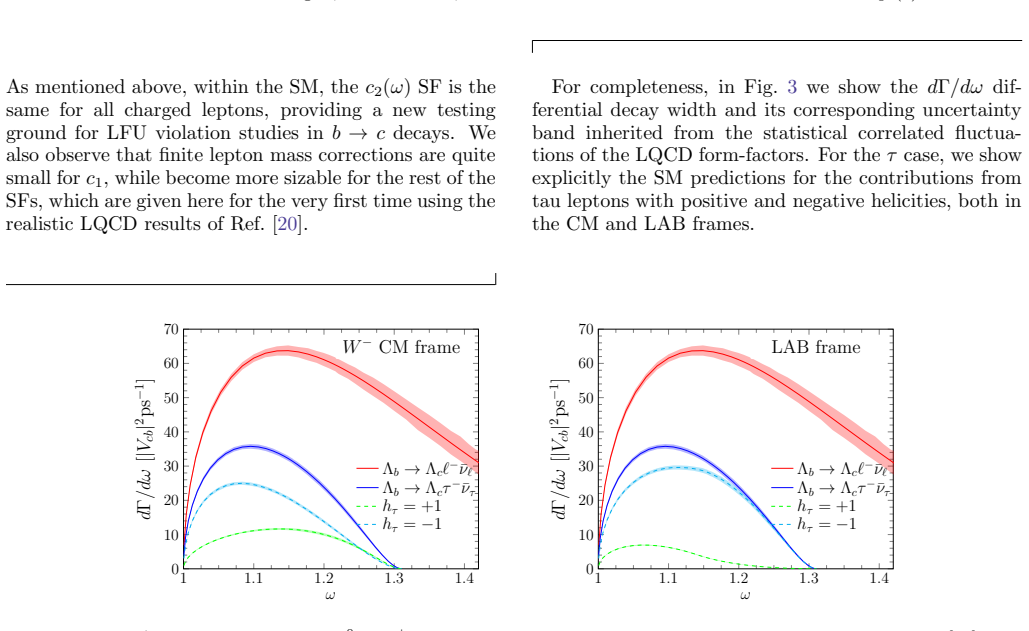
In a general framework, valid for any $H\to H'\ell^-\bar\nu_\ell$ semileptonic decay, we analyze the $d^2\Gamma/(d\omega d\cos\theta_\ell)$ and $d^2\Gamma/ (d\omega dE_\ell)$ distributions, with $\omega$ being the product of the hadron four-velocities, $\theta_\ell$ the angle made by the three-momenta of the charged lepton and the final hadron in the $W^-$ center of mass frame and $E_\ell$ the charged lepton energy in the decaying hadron rest frame. Within the Standard Model (SM), $ d^2\Gamma/(d\omega dE_\ell)\propto \left(c_0(\omega)+c_1(\omega)E_\ell/M+c_2(\omega)E^2_\ell/M^2\right)$, with $M$ the initial hadron mass. We find that $c_2(\omega)$ is independent of the lepton flavor and thus it is an ideal candidate to look for lepton flavor universality (LFU) violations. We also find a correlation between the $a_2(\omega)$ structure function, that governs the $(\cos\theta_\ell)^2$ dependence of $d^2\Gamma/(d\omega d\cos\theta_\ell)$, and $c_2(\omega)$. Apart from trivial kinematical and mass factors, the ratio of $a_2(\omega)/c_2(\omega)$ is a universal function that can be measured in any semileptonic decay, involving not only $b\to c$ transitions. These two SM predictions can be used as new tests in the present search for signatures of LFU violations. We also generalize the formalism to account for some new physics (NP) terms. Finally, in order to illustrate our findings, we apply our general framework to the $\Lambda_b\to \Lambda_c \ell \bar\nu_\ell$ decay. We show that a measurement of $c_2$ (or $a_2$) for $\tau$ decay would not only be a direct measurement of the possible existence of NP, but it would also allow to distinguish from NP fits to $b\to c\tau\bar\nu_\tau$ anomalies in the meson sector, that otherwise give the same total and differential $d\Gamma/d\omega$ widths.
Figures

Figures from the paper (3 more)


Reference graph
Works this paper leans on
-
[36]
C. Bourrely, I. Caprini, and L. Lellouch, Phys. Rev.D79, 013008 (2009), [Erratum: Phys. Rev.D82,099902(2010)], arXiv:0807.2722 [hep-ph]
arXiv 2009
- [20]
-
[14]
S. Jaiswal, S. Nandi, and S. K. Patra, JHEP 12, 060 (2017), arXiv:1707.09977 [hep-ph]
arXiv 2017
-
[1]
Results for the Λb→ Λc semileptonic transition In this case, we have JHrr′(p,p′) = ¯u(r′) Λc (⃗ p′ )[CSFS−CPFPγ5 ]u(r) Λb (⃗ p) (28) where FS and FP are the scalar and pseudoscalar form factors that are directly related (see Eqs. (2.12) and (2.13) of Ref. [26]) to the f0 vector and g0 axial ones given in [20] . We thus have WSP = 1 2Tr [ /p′ +MΛc 2MΛc (CS...
-
[2]
Y. Amhis et al. (HFLAV), Eur. Phys. J. C77, 895 (2017), online update at https://hflav.web.cern.ch/, arXiv:1612.07233 [hep-ex]
arXiv 2017
- [3]
-
[4]
J. P. Lees et al. (BaBar), Phys. Rev. D88, 072012 (2013), arXiv:1303.0571 [hep-ex]
arXiv 2013
-
[5]
J. P. Lees et al. (BaBar), Phys. Rev. Lett. 109, 101802 (2012), arXiv:1205.5442 [hep-ex]
arXiv 2012
Show all 38 references
-
[6]
6 and the chi-square values or the variations ∆RΛc(=RsWC Λc −R min Λc ) shown in the right plot of the figure
and middle (Fit 7) panels of Fig. 6 and the chi-square values or the variations ∆RΛc(=RsWC Λc −R min Λc ) shown in the right plot of the figure. Note that at some point for ∆RΛc <−0.02, the local Fit 7 collapses into Fit 6. 3 The χ2 function is defined in Eq. (3.1) of that refer...
2014
-
[7]
Huschle et al
M. Huschle et al. (Belle), Phys. Rev.D92, 072014 (2015), arXiv:1507.03233 [hep-ex]
2015 arXiv
-
[8]
Sato et al
Y. Sato et al. (Belle), Phys. Rev. D94, 072007 (2016), arXiv:1607.07923 [hep-ex]
2016 arXiv
-
[9]
Hirose et al
S. Hirose et al. (Belle), Phys. Rev. Lett. 118, 211801 (2017), arXiv:1612.00529 [hep-ex]
2017 arXiv
-
[10]
Aaij et al
R. Aaij et al. (LHCb), Phys. Rev. Lett. 115, 111803 (2015), [Erratum: Phys. Rev. Lett.115,no.15,159901(2015)], arXiv:1506.08614 [hep-ex]
2015
-
[11]
Aaij et al
R. Aaij et al. (LHCb), Phys. Rev. Lett. 120, 171802 (2018), arXiv:1708.08856 [hep-ex]
2018 arXiv
- [12]
-
[13]
Bigi and P
D. Bigi and P. Gambino, Phys. Rev.D94, 094008 (2016), arXiv:1606.08030 [hep-ph]
2016 arXiv
- [15]
-
[16]
Murgui, A
C. Murgui, A. Pe˜ nuelas, M. Jung, and A. Pich, JHEP 09, 103 (2019), arXiv:1904.09311 [hep-ph]
2019 arXiv
-
[17]
Fajfer, J
S. Fajfer, J. F. Kamenik, and I. Nisandzic, Phys. Rev. D85, 094025 (2012), arXiv:1203.2654 [hep-ph]
2012 arXiv
-
[18]
Aaij et al
R. Aaij et al. (LHCb), Phys. Rev. D96, 112005 (2017), arXiv:1709.01920 [hep-ex]
2017 arXiv
-
[19]
Cerri et al., (2018), arXiv:1812.07638 [hep-ph]
A. Cerri et al., (2018), arXiv:1812.07638 [hep-ph]
2018 arXiv
-
[21]
F. U. Bernlochner, Z. Ligeti, D. J. Robinson, and W. L. Sutcliffe, Phys. Rev. Lett. 121, 202001 (2018), arXiv:1808.09464 [hep-ph]
2018 arXiv
-
[22]
Detmold, C
W. Detmold, C. Lehner, and S. Meinel, Phys. Rev. D92, 034503 (2015), arXiv:1503.01421 [hep-lat]
2015 arXiv
-
[23]
Blanke, A
M. Blanke, A. Crivellin, S. de Boer, M. Moscati, U. Nier- ste, I. Niˇ sandˇ zi´ c, and T. Kitahara, Phys. Rev. D99, 075006 (2019)
2019
-
[24]
Blanke, A
M. Blanke, A. Crivellin, T. Kitahara, M. Moscati, U. Nierste, and I. Niˇ sandˇ zi´ c, Phys. Rev. D100, 035035 (2019)
2019
-
[25]
B¨ oer, A
P. B¨ oer, A. Kokulu, J.-N. Toelstede, and D. van Dyk, (2019), arXiv:1907.12554 [hep-ph]
2019 arXiv
-
[26]
Shivashankara, W
S. Shivashankara, W. Wu, and A. Datta, Phys. Rev. D 91, 115003 (2015)
2015
-
[27]
Li, Y.-D
X.-Q. Li, Y.-D. Yang, and X. Zhang, JHEP 02, 068 (2017), arXiv:1611.01635 [hep-ph]
2017 arXiv
-
[28]
Datta, S
A. Datta, S. Kamali, S. Meinel, and A. Rashed, JHEP 08, 131 (2017), arXiv:1702.02243 [hep-ph]
2017 arXiv
-
[29]
F. U. Bernlochner, Z. Ligeti, D. J. Robinson, and W. L. Sutcliffe, Phys. Rev. D99, 055008 (2019), arXiv:1812.07593 [hep-ph]
2019 arXiv
-
[30]
A. Ray, S. Sahoo, and R. Mohanta, Phys. Rev. D99, 015015 (2019), arXiv:1812.08314 [hep-ph]
2019 arXiv
-
[31]
Di Salvo, F
E. Di Salvo, F. Fontanelli, and Z. J. Ajaltouni, Int. J. Mod. Phys. A33, 1850169 (2018), arXiv:1804.05592 [hep- ph]
2018 arXiv
-
[32]
Ferrillo, A
M. Ferrillo, A. Mathad, P. Owen, and N. Serra, (2019), arXiv:1909.04608 [hep-ph]
2019 arXiv
-
[33]
Tanabashi et al
M. Tanabashi et al. (Particle Data Group), Phys. Rev. D98, 030001 (2018), and 2019 update
2018
-
[34]
Hernandez, J
E. Hernandez, J. Nieves, and M. Valverde, Phys. Rev. D76, 033005 (2007), arXiv:hep-ph/0701149 [hep-ph]
2007 arXiv
-
[35]
J. E. Sobczyk, E. Hern´ andez, S. X. Nakamura, J. Nieves, and T. Sato, Phys. Rev. D98, 073001 (2018), arXiv:1807.11281 [hep-ph]
2018 arXiv
-
[37]
Azizi and J
K. Azizi and J. Y. S¨ ung¨ u, Phys. Rev. D97, 074007 (2018)
2018
-
[38]
Pe˜ nuelas and C
A. Pe˜ nuelas and C. Murgui, private communication
Reviewed August 14, 2026 · model on record in the stance chip above.
Discussion (0). Continue with ORCID to comment.