Two bodies left behind
Pith reviewed 2026-05-22 02:55 UTC · model grok-4.3
The pith
High-energy breakup of shallow bound states is dominated by the on-shell pole of the heavy-particle propagator.
A machine-rendered reading of the paper's core claim, the machinery that carries it, and where it could break.
Core claim
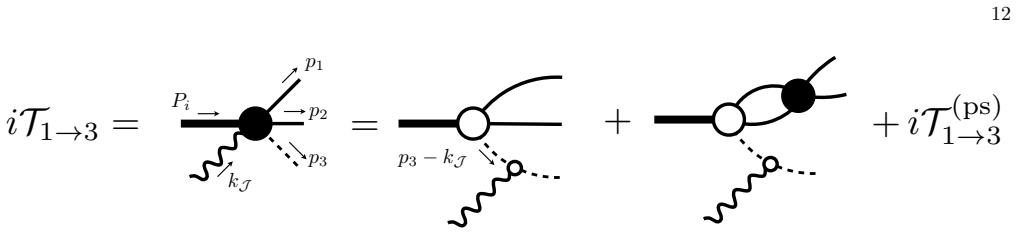
We prove that the amplitude is dominated by the nearby on-shell pole of the heavy-particle propagator and derive a closed-form expression for this contribution. When two bodies are left behind, the leading amplitude is the product of the scattering of the two light particles, a dynamical function depending on the probe, and a real function related to the bound-state wavefunction. Thus, quasi-free removal of a core nucleus from a system with halo neutrons provides access to on-shell data on multi-neutron interactions. The resulting amplitudes are relativistic and satisfy unitarity for the remnant subsystem exactly. Complementary non-relativistic derivations are also given.
What carries the argument
The nearby on-shell pole of the heavy-particle propagator in quasi-free kinematics, which supplies the leading contribution and permits exact factorization of the remnant two-body scattering.
Load-bearing premise
The probe energy is high compared to the binding energy and the kinematics are quasi-free, so corrections to heavy-particle knockout are suppressed by inverse powers of the probe momentum.
What would settle it
A precision measurement of the breakup cross section at fixed quasi-free kinematics but increasing probe momentum that fails to approach the predicted closed-form pole contribution would falsify the dominance result.
Figures




read the original abstract
We consider scenarios in which a shallow bound state undergoes breakup by a probe whose energy is high compared to the binding energy. The first two scenarios, which serve as warm-up exercises, involve a single heavy particle bound to a light particle, analogous to a core nucleus bound to a neutron. We show that in quasi-free kinematics, the leading effect comes from the heavy particle being knocked out by the probe, with corrections suppressed by inverse powers of the probe momentum. This formally justifies extracting neutron form factors from high-energy deuteron breakup in quasi-free kinematics. In Scenario 1, the probe is a local current; in Scenario 2, it is hadron scattering. In Scenarios 3 and 4 we consider, respectively, a local current and hadron scattering, but now on a three-body bound state of a heavy particle and two light particles. Hard knockout of the heavy particle leaves two low-energy particles behind, which can interact with one another. In all four scenarios, we prove that the amplitude is dominated by the nearby on-shell pole of the heavy-particle propagator and derive a closed-form expression for this contribution. When two bodies are left behind, the leading amplitude is the product of the scattering of the two light particles, a dynamical function depending on the probe, and a real function related to the bound-state wavefunction. Thus, quasi-free removal of a core nucleus from a system with halo neutrons provides access to on-shell data on multi-neutron interactions. The resulting amplitudes are relativistic and satisfy unitarity for the remnant subsystem exactly. We also provide complementary non-relativistic derivations. While the derivations are for spinless particles, the generalization to spin is straightforward, since the results depend only on quasi-free knockout kinematics; we make no assumptions about the inter-particle dynamics.
Editorial analysis
A structured set of objections, weighed in public.
Referee Report
Summary. The manuscript analyzes high-energy quasi-free breakup of shallow bound states consisting of a heavy particle bound to one or two light particles. It proves that the amplitude is dominated by the nearby on-shell pole of the heavy-particle propagator, with corrections suppressed by inverse powers of the probe momentum. Closed-form expressions for the leading contributions are derived in four scenarios (local current or hadron scattering on two-body or three-body systems). When two light particles remain, the leading amplitude factors as the product of their on-shell scattering, a probe-dependent dynamical function, and a real function related to the bound-state wavefunction. The resulting amplitudes are relativistic and satisfy unitarity for the remnant subsystem exactly; complementary non-relativistic derivations are provided. The results depend only on the stated kinematics and make no assumptions about the inter-particle dynamics.
Significance. If the derivations hold, the work supplies a rigorous kinematic justification for quasi-free knockout approximations, enabling model-independent extraction of neutron form factors from deuteron breakup and on-shell data on multi-neutron interactions from halo nuclei. The parameter-free character of the leading terms, the exact unitarity for the remnant subsystem, and the explicit provision of both relativistic and non-relativistic derivations are notable strengths that could directly inform the analysis of existing and future nuclear breakup experiments.
major comments (2)
- §3 (Scenario 1, local current on two-body bound state): the explicit residue calculation at the heavy-particle propagator pole is used to establish dominance, but the manuscript should display the leading off-shell correction term to confirm its suppression is O(1/p) or higher, as this power counting is load-bearing for the quasi-free claim across all scenarios.
- §5 (Scenarios 3 and 4, three-body bound state): the factorization of the leading amplitude into light-particle T-matrix, probe-dependent function, and real wavefunction factor is derived from the pole residue; an explicit check that no additional dynamical assumptions enter beyond the kinematic pole dominance would strengthen the central result.
minor comments (2)
- The non-relativistic derivations are presented as cross-checks; a short paragraph comparing the leading relativistic and non-relativistic expressions term-by-term would improve clarity for readers working in either framework.
- Notation for the bound-state wavefunction factor in the two-body remnant case is introduced without a dedicated equation number; assigning it an explicit label (e.g., Eq. (XX)) would facilitate reference in the text and figures.
Simulated Author's Rebuttal
We thank the referee for the careful reading of our manuscript and for the positive assessment of its potential impact. We respond to each major comment below and have revised the manuscript accordingly to strengthen the presentation.
read point-by-point responses
-
Referee: §3 (Scenario 1, local current on two-body bound state): the explicit residue calculation at the heavy-particle propagator pole is used to establish dominance, but the manuscript should display the leading off-shell correction term to confirm its suppression is O(1/p) or higher, as this power counting is load-bearing for the quasi-free claim across all scenarios.
Authors: We agree that displaying the leading off-shell correction explicitly would make the power counting more transparent and directly support the quasi-free claim. In the revised manuscript we have added, in §3, the explicit next-to-leading term obtained by expanding the heavy-particle propagator and the current vertex away from the pole. This term is suppressed by a single power of the probe momentum p in the quasi-free limit, with the coefficient remaining finite and independent of any specific dynamics beyond the existence of the bound state. revision: yes
-
Referee: §5 (Scenarios 3 and 4, three-body bound state): the factorization of the leading amplitude into light-particle T-matrix, probe-dependent function, and real wavefunction factor is derived from the pole residue; an explicit check that no additional dynamical assumptions enter beyond the kinematic pole dominance would strengthen the central result.
Authors: The factorization follows from a contour integration that encircles only the heavy-particle propagator pole in the quasi-free kinematics. In the revised §5 we have inserted a dedicated paragraph that isolates each step: (i) location of the pole, (ii) application of the residue theorem, (iii) on-shell projection of the remnant two-body subsystem, and (iv) emergence of the real wave-function factor as the residue at the two-body bound-state pole. No further dynamical input—such as a specific potential or off-shell continuation—is required at any stage. revision: yes
Circularity Check
Derivation self-contained from kinematic pole dominance
full rationale
The paper establishes on-shell pole dominance for the heavy-particle propagator and derives closed-form leading amplitudes explicitly from quasi-free high-energy kinematics, with off-shell and non-pole terms suppressed by inverse powers of probe momentum. All four scenarios receive direct derivations using the propagator residue and on-shell T-matrix insertion for remnant unitarity; complementary non-relativistic versions are supplied for cross-check. No fitted parameters are relabeled as predictions, no self-citations serve as load-bearing premises, and no ansatz or uniqueness theorem is smuggled in. The results depend only on the stated kinematic assumptions and make no assumptions about inter-particle dynamics, rendering the chain self-contained.
Axiom & Free-Parameter Ledger
axioms (2)
- standard math Relativistic kinematics and exact unitarity for the remnant two-body subsystem
- domain assumption Quasi-free kinematics with probe momentum large compared to binding energy
Lean theorems connected to this paper
-
IndisputableMonolith/Cost/FunctionalEquation.leanwashburn_uniqueness_aczel unclear?
unclearRelation between the paper passage and the cited Recognition theorem.
We prove that the amplitude is dominated by the nearby on-shell pole of the heavy-particle propagator and derive a closed-form expression for this contribution. When two bodies are left behind, the leading amplitude is the product of the scattering of the two light particles, a dynamical function depending on the probe, and a real function related to the bound-state wavefunction.
-
IndisputableMonolith/Foundation/AlexanderDuality.leanalexander_duality_circle_linking unclear?
unclearRelation between the paper passage and the cited Recognition theorem.
In all four scenarios, we prove that the amplitude is dominated by the nearby on-shell pole of the heavy-particle propagator...
What do these tags mean?
- matches
- The paper's claim is directly supported by a theorem in the formal canon.
- supports
- The theorem supports part of the paper's argument, but the paper may add assumptions or extra steps.
- extends
- The paper goes beyond the formal theorem; the theorem is a base layer rather than the whole result.
- uses
- The paper appears to rely on the theorem as machinery.
- contradicts
- The paper's claim conflicts with a theorem or certificate in the canon.
- unclear
- Pith found a possible connection, but the passage is too broad, indirect, or ambiguous to say the theorem truly supports the claim.
Reference graph
Works this paper leans on
-
[1]
poles associated with final-state rescattering. The goal is to show that each of these leads to kinematically suppressed contributions relative to the leading-order results already derived
-
[2]
III A and III C, comprises the remainder of the tree-level contributions already considered
Off-shell contributions to tree-level diagrams:The first class, defined asδTin Secs. III A and III C, comprises the remainder of the tree-level contributions already considered. These do not have a nearby pole. By construction, these have the leading pole subtracted and are therefore suppressed in the kinematic region of interest. We focus our attention o...
-
[3]
Subleading tree-level diagrams:Next, we consider the other tree-level contributions, shown in Fig. 7 for scenarios 1 and 3. These correspond to diagrams where the current couples to the slowly-moving particles in the final state. To show that these are kinematically suppressed, it suffices to show that the propagator appearing in these diagrams has no nea...
-
[4]
Loop contributions ` a la Landau:Loop diagrams generically soften singularities [25], so we expect their contributions to be kinematically suppressed. Here we give a simple explanation of why this is the case, without 17 i T (ps) 1 ! 3 , loops <latexit sha1_base64="zTn47s223Tw3S9fLzXqJIRg4fOs=">AAACG3icbVDLSgMxFM3UV62vUZdugkWoIGWmCrosunFZoS/ojCWTpm1oZhKSj...
-
[5]
Bound-state pole contributions:There is one further class of pole contributions to consider, arising from final-state interactions in which the system recombines into a bound state. This is depicted in Fig. 10 for scenario
-
[6]
Although this requires loops, it is sufficiently distinct from the loop contributions discussed above that we treat it separately. The final state couples to an off-shell pole of the form∼[(k J +P i)2 −M 2 b ], whereM b is the bound-state mass. 19 <latexit sha1_base64="WfXJcvCnaRzn+wqweCICKJqpfrY=">AAAB6nicbVBNS8NAEJ3Ur1q/qh69LBbBU0lEqseiF48V7Qe0oWy2k3bpZ...
- [7]
- [8]
- [9]
- [10]
-
[11]
Quasi-free (p,2p) and (p,pn) reactions with unstable nuclei
T. Aumann, C. A. Bertulani, and J. Ryckebusch, Phys. Rev. C88, 064610 (2013), arXiv:1311.6734 [nucl-th]
work page internal anchor Pith review Pith/arXiv arXiv 2013
- [12]
- [13]
- [14]
- [15]
- [16]
- [17]
-
[18]
E. E. W. Bruinset al., Phys. Rev. Lett.75, 21 (1995)
work page 1995
- [19]
-
[20]
H. Zhuet al.(E93026), Phys. Rev. Lett.87, 081801 (2001), arXiv:nucl-ex/0105001
work page internal anchor Pith review Pith/arXiv arXiv 2001
-
[21]
S. Tkachenkoet al.(CLAS), Phys. Rev. C89, 045206 (2014), [Addendum: Phys.Rev.C 90, 059901 (2014)], arXiv:1402.2477 [nucl-ex]
work page internal anchor Pith review Pith/arXiv arXiv 2014
-
[22]
A. Jentsch, Z. Tu, and C. Weiss, Phys. Rev. C104, 065205 (2021), arXiv:2108.08314 [hep-ph]
-
[23]
I. Friscicet al., Phys. Lett. B823, 136726 (2021), arXiv:2106.08805 [nucl-ex]
-
[24]
L. B. Weinsteinet al., Phys. Rev. Lett.64, 1646 (1990)
work page 1990
-
[25]
Aumannet al., RIKEN proposal No
T. Aumannet al., RIKEN proposal No. NP2012-SAMURAI55R1 (2020)
work page 2020
-
[26]
M. G¨ obel, T. Aumann, C. A. Bertulani, T. Frederico, H.-W. Hammer, and D. R. Phillips, Phys. Rev. C104, 024001 (2021), arXiv:2103.03224 [nucl-th]
-
[27]
H.-W. Hammer and D. T. Son, Proc. Nat. Acad. Sci.118, e2108716118 (2021), arXiv:2103.12610 [nucl-th]
-
[28]
K. M. Watson, Phys. Rev.88, 1163 (1952)
work page 1952
-
[29]
A. B. Migdal, Sov. Phys. JETP1, 2 (1955)
work page 1955
-
[30]
Nonrelativistic conformal field theories
Y. Nishida and D. T. Son, Phys. Rev. D76, 086004 (2007), arXiv:0706.3746 [hep-th]
work page internal anchor Pith review Pith/arXiv arXiv 2007
-
[31]
L. D. Landau, Nucl. Phys.13, 181 (1959)
work page 1959
-
[32]
H. W. Hammer, C. Ji, and D. R. Phillips, J. Phys. G44, 103002 (2017), arXiv:1702.08605 [nucl-th]
work page internal anchor Pith review Pith/arXiv arXiv 2017
- [33]
-
[34]
M. T. Hansen and S. R. Sharpe, Phys. Rev.D92, 114509 (2015), arXiv:1504.04248 [hep-lat]
work page internal anchor Pith review Pith/arXiv arXiv 2015
- [35]
- [36]
- [37]
- [38]
- [39]
- [40]
-
[41]
Pole position of the a1(1260) resonance in a three-body unitary framework,
D. Sadasivan, A. Alexandru, H. Akdag, F. Amorim, R. Brett, C. Culver, M. D¨ oring, F. X. Lee, and M. Mai, Phys. Rev. D105, 054020 (2022), arXiv:2112.03355 [hep-ph]
-
[42]
M. Mai, B. Hu, M. Doring, A. Pilloni, and A. Szczepaniak, PoSHadron2017, 140 (2018)
work page 2018
-
[43]
M. Mikhasenko, Y. Wunderlich, A. Jackura, V. Mathieu, A. Pilloni, B. Ketzer, and A. P. Szczepaniak, JHEP08, 080 (2019), arXiv:1904.11894 [hep-ph]
-
[44]
A. S. Sakthivasan, M. Mai, A. Rusetsky, and M. D¨ oring, JHEP10, 246 (2024), arXiv:2407.17969 [hep-ph]. 24 Appendix A: EFT Example: F ast breakup of a one-neutron halo nucleus To illustrate the general statements in the main text, we explicitly consider the fast breakup of a one-neutronS-wave halo nucleus with a spin-0 core by an external currentJ. The sy...
work page internal anchor Pith review Pith/arXiv arXiv 2024
discussion (0)
Sign in with ORCID, Apple, or X to comment. Anyone can read and Pith papers without signing in.