REVIEW 5 major objections 5 minor 22 references
Measurement-Induced Dynamical Quantum Thermalization
T0 review · 5 major / 5 minor · reviewed 2026-08-07 · deepseek-v4-flash
Pith's one-line read Measurement-induced partitioning into observed and unobserved Hilbert subspaces drives an isolated, interacting Bose gas to thermal equilibrium, with entanglement entropy and observables relaxing bi-exponentially to a common temperature.
desk verdict A plausible, honestly reported numerical follow-up to the authors' own DBG mechanism, with a real but fixable gap: no convergence check for the long-time propagator. read the letter →
The pith
A machine-rendered reading of the paper's core claim, the machinery that carries it, and where it could break.
The reading
What carries the argument
The central object is the reduced density matrix $\hat{\rho}_S(t) = \operatorname{tr}_R\{\hat{\rho}(t)\}$, obtained by partitioning the full Hilbert space into a measured subsystem $S$ and an unmeasured 'bath' $R$ and tracing out $R$, following the canonical-typicality idea that a large enough complement acts as a reservoir. Because $\hat{U}(t)$ and the incoherent sum over bath states do not commute when a Hamiltonian term couples $S$ and $R$, the entanglement entropy $S_S(t)$ is time-dependent even though the total system stays pure. The technical enabler is repeated exponentiation of a Taylor-truncated short-time evolution operator $\hat{U}(\delta t) \approx \sum_{k=0}^{k_{\max}} (-i\delta t)^k \hat{H}^k/k!$, recursively squared to reach evolution times up to $tJ \approx 10^4$ at linear numerical cost. Thermalization is certified by fitting fluctuation–dissipation relations, $G^K(E) = -i A(E) \coth(E/2k_B T)$, to computed two-time Green functions.
What would settle it
Re-run the same Bose-gas evolution ($N = 25$, five levels, $\Delta/J = 10$, $U/J = 1$, $U'/J = 0.1$) with exact diagonalization or a high-accuracy integrator on a segment of the evolution, and check whether the bi-exponential entropy fit ($\tau_1 J \approx 0.26$, $\tau_2 J \approx 1.58$) and the fluctuation–dissipation temperatures ($T/J \approx 198$–$200$ at $tJ = 100$) are reproduced; a mismatch beyond the reported error bars would indicate the long-time thermalization is numerical rather than physical.
Extended reading notes
Core claim
The central claim is that measurement-induced dynamical bath generation is a general thermalization mechanism for isolated quantum systems. When an observer measures an observable acting only on a subsystem $S$, the complementary, unobserved part of Hilbert space $R$ acts as an effective thermodynamic reservoir: the density matrix of $S$ is obtained by tracing over $R$, and because the time-evolution operator does not commute with that trace when $S$ and $R$ are coupled by the Hamiltonian, the entanglement entropy of $S$ becomes time-dependent and grows. The paper demonstrates, by explicit numerical time evolution of a non-integrable trapped Bose gas with $N = 25$ bosons in five levels, that this entropy approaches a global maximum bi-exponentially, that both local single-level occupation numbers and non-local level-occupation correlation functions satisfy the fluctuation–dissipation relation at a common temperature extracted as a single fit parameter, and that this happens for pure initial states with broad energy distributions, a regime outside the scope of ETH.
Load-bearing premise
The paper assumes its recursively exponentiated, Taylor-truncated time-stepping ($k_{\max} = 4$, time step times maximum Hamiltonian matrix element around $0.1$) stays accurate out to evolution times $tJ \approx 10^4$, but it gives no convergence check against exact evolution or smaller time steps; if rounding errors accumulate, the entropy plateau and the thermal fits could be numerical artifacts.
Editorial extensions
If this is right
- The observed subsystem's entanglement entropy and the measured level occupations relax bi-exponentially, fast ($\tau_1 J \approx 0.04$–$0.26$) then slow ($\tau_2 J \approx 1.6$–$2.1$), so the dynamics passes through an intermediate near-equilibrium state before full stationarity.
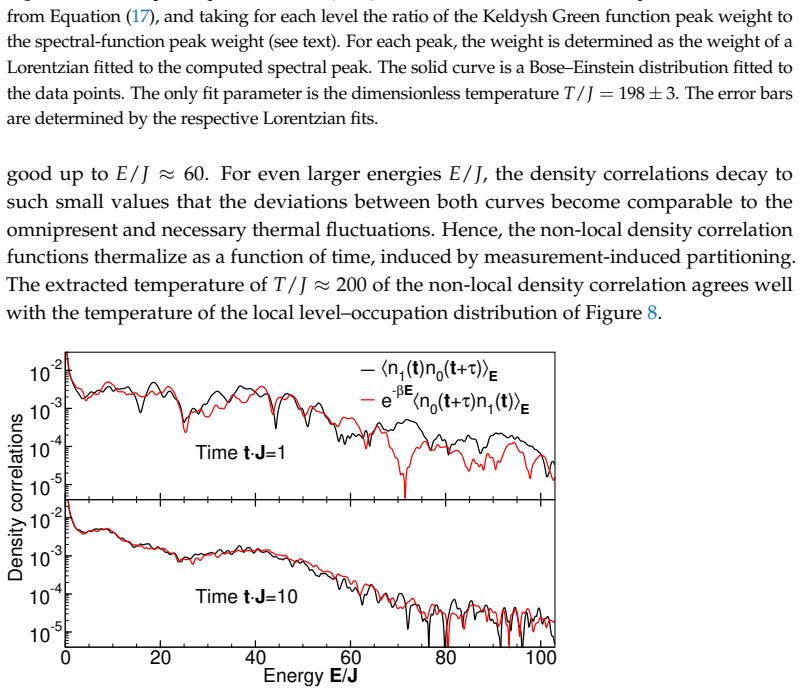
- Local occupation numbers and non-local occupation correlation functions both satisfy the fluctuation–dissipation relation with a single fitted temperature ($T/J \approx 198$–$200$), so one thermal ensemble describes the whole long-time subsystem.
- Thermalization occurs from pure, broad-energy initial states where the microcanonical precondition of ETH fails, making the mechanism more general than ETH for these systems.
- The same thermal behavior appears for $N = 25$ particles in five levels, which suggests that Hilbert-space dimension, not particle number, controls the thermodynamic limit.
Reading between the lines
- Because the split between 'observed' and 'unobserved' is fixed by which observable is chosen, the effective bath and any intermediate-time temperature depend on the observer's choice; comparing single-level versus multi-level partitions in the same evolution would make this observer-dependence explicit.
- The conjecture that large Hilbert-space dimension rather than particle number defines the thermodynamic limit could be tested by shrinking the level count or interaction strength until the level-spacing ratio leaves the random-matrix regime and checking where the thermal fits break down.
- The two relaxation times suggest a two-temperature description of the intermediate state; fitting the correlation spectra at intermediate times with two thermal distributions would be a direct test the paper leaves unperformed.
Signed reviews
Editorial analysis
A structured set of objections, weighed in public.
Referee Report
Summary. The paper proposes measurement-induced dynamical bath generation (DBG) as a general thermalization mechanism for isolated quantum systems. The authors simulate a trapped Bose gas of N=25 bosons in M=5 single-particle levels with a non-integrable Hamiltonian, using repeated exponentiation of a short-time Taylor-evolved propagator. For a broad-spectrum initial state they observe bi-exponential growth of the entanglement entropy of a subsystem (levels i>=3) to a stationary value, and they report that local level occupations, single-particle spectra, and non-local density correlations obey fluctuation-dissipation relations with a single fitted temperature. A narrow-spectrum microcanonical initial state is found to be essentially static. The paper contrasts DBG with ETH and claims greater generality, including for non-local correlations and independent of initial state.
Significance. If the numerical results are correct, the paper offers a concrete demonstration that measurement-induced partitioning into observed and unobserved Hilbert-space sectors can act as an effective bath, producing dynamical thermalization in an isolated system. The use of a full Hilbert-space propagator with repeated exponentiation is ambitious, and the GOE level-spacing ratio (langle r rangle=0.53) supports the claim that the model is chaotic. The paper is transparent about its fitting procedures and provides a data availability statement. However, the central thermalization claim rests on the accuracy of the long-time propagator, which is not validated, and the generality claims extend beyond the single parameter set and two initial states actually shown. These issues need to be addressed before the conclusions can be considered established.
major comments (5)
- [Sec. 3, Eqs. (9)-(10)] The repeated-exponentiation time-stepping is not validated. The paper states that 'precision does not significantly deteriorate for the relevant number of multiplications,' but it reports no unitarity check ||U-dagger U - I||, no convergence test against exact evolution for a smaller system, and no study of the dependence on delta-t or k_max. Since the long-time stationarity in Fig. 10 and the FDT fits in Figs. 8-9 depend on this propagator, unchecked error accumulation could produce artifactual plateaus and thermal ratios. Please provide a convergence study and report the unitarity defect as a function of recursion number.
- [Sec. 3, Eq. (9)] The truncation criterion uses delta-t * max(H) <= 0.1 with max(H) defined as the maximum matrix element, not the operator norm. For a many-body Hamiltonian with extensive off-diagonal couplings, the spectral norm can be substantially larger than the largest entry, so the estimated per-step precision O(10^{-k_max}) is not justified. The authors should report ||H|| and the actual per-step error, and choose delta-t accordingly.
- [Sec. 7 and Fig. 4] The claimed generality (independent of initial state, more general than ETH) is not supported by the data. All thermalization results are for one Hamiltonian parameter set (Delta/J=10, U/J=1, U'/J=0.1, N=25) and one broad initial state. The narrow-spectrum state in Fig. 4 is essentially static, so it does not demonstrate dynamical thermalization; the text attributes this to a single frequency, but a superposition of 74 eigenstates contains many frequencies. Either provide systematic parameter and initial-state scans or temper the universality claims.
- [Sec. 6, Fig. 10] The single-temperature interpretation is not established. The text states that temperatures extracted from different correlation functions deviate by more than their fit standard deviations and agree only after a time average over an unspecified 'characteristic fluctuation time.' This means no instantaneous global temperature exists in the simulation window. Please define the averaging procedure, report time-averaged temperatures with uncertainties, and discuss how this supports the claim of global thermalization.
- [Sec. 5.2, Fig. 7] The spectral function A(E) is shown with slightly negative values, which is incompatible with a thermal equilibrium state. The paper attributes this to numerical imprecision of the Fourier transform and finite evolution time, but negative spectral weight directly affects the ratio i G^K / A used for temperature extraction. Please quantify the influence of these negative regions on the fitted temperatures and on the FDT validation.
minor comments (5)
- [Data Availability] The repository name 'Zeneodo' should be 'Zenodo.'
- [Figs. 9-10] The level labels n0, n1, n2, n3, n4 in Figs. 9-10 are inconsistent with the model notation i=1,...,5 used in the text; please unify the indexing.
- [Sec. 3, Eq. (9)] The text says delta-t * max(H) <= 10^{-1} yields a precision of O(10^{-k_max}), but the next-order term is (delta-t ||H||)^{k_max+1}, which is 10^{-5} for k_max=4; please clarify whether the quoted precision is absolute or relative and use the operator norm consistently.
- [Fig. 3] The fit function includes sigma_S,infinity as a constant offset, while the text calls sigma_S,infinity the standard deviation calculated from the time series; please clarify the role of this parameter in the bi-exponential fit.
- [Sec. 4.1] The statement that the entanglement entropy approaches a 'global maximum' should be reconciled with the value S_infinity=5.15 and the maximum possible entropy ln(351) nearly equal to 5.86 for the 3-level subsystem; as written, the term is misleading.
Circularity Check
No significant circularity: the thermalization evidence is computed from the Hamiltonian dynamics and tested against the fluctuation-dissipation relation with temperature as a free parameter; self-citations to the authors' DBG work frame the interpretation but do not carry the derivation.
full rationale
The paper's core derivation is self-contained. The dynamics are computed from the explicit Hamiltonian (Eq. 8), a generic non-integrable model whose chaoticity is verified independently via the level-spacing ratio <r> = 0.53 (GOE). The long-time propagator (Eqs. 9-10) is a recursive Taylor exponentiation that contains no thermalization input. The reduced density matrix (Eq. 6) and entanglement entropy (Eq. 7) follow by definition, but their time dependence and saturation are computed, not assumed. The thermalization diagnosis is a falsifiable test: the spectral and Keldysh functions are computed from the time-evolved state, and the FDT relation (Eq. 17) is tested with temperature as the only free parameter. Nothing forces the computed spectra to obey the Bose-Einstein form; indeed the fits fail at short times (Sec. 6, Fig. 10: 'For short CoM times, Jt <~ 3, a single-parameter fit of temperature is not possible'), and the paper honestly reports that instantaneous fitted temperatures for different correlation functions deviate beyond their fit uncertainties and agree only in time average. The independent agreement of T ~ 198-200 across local occupations and non-local density correlations is a genuine cross-check, not a construction. The self-citations (Refs. [7,9]) supply the DBG interpretive framework and the two-exponential fitting form, but the numerical evidence is generated by this paper's own time evolution; the prior work does not force the outcome. The bi-exponential fits (Figs. 3, 6) are phenomenological descriptions of computed data with both slopes visible in the log-scale insets. The one caveat is a correctness risk, not circularity: the recursive-exponentiation method (kmax=4, delta-t * max(H) <~ 0.1) has no reported convergence test or unitarity check, so error accumulation at tJ ~ 10^4 (Fig. 10) is unverified; an inaccurate propagator is not an input-output equivalence by construction. Overall, no step of the derivation reduces to its own inputs.
Assumptions & free parameters
free parameters (6)
- Hamiltonian parameters =
Delta/J=10, U/J=1, U'/J=0.1, N=25, M=5
- Bi-exponential fit for S(t) =
a1=3.4, a2=0.35, tau1*J=0.26, tau2*J=1.58, sigma=6.9e-3
- Bi-exponential fit for nsys(t) =
a1=15.08, a2=1.81, tau1*J=0.041, tau2*J=2.12
- Temperature from local FDT =
T/J=198 +/- 3
- Temperature from non-local correlation FDT =
T1/J=193 +/- 17 (Jt=1), T2/J=200 +/- 7 (Jt=10)
- Lorentzian peak weights for G_K and A
assumptions (5)
- domain assumption A sufficiently complex system (large Hilbert space dimension, no dynamically disjoint sectors) can be partitioned into an observed subsystem and an unobserved reservoir that acts as a canonical bath.
- domain assumption The long-time reduced state satisfies the fluctuation-dissipation relation with a single temperature; negative spectral values are numerical noise.
- domain assumption The truncated, recursively exponentiated time-evolution operator (kmax=4, delta t*max(H) ~ 0.1) remains accurate up to tJ ~ 10^4.
- domain assumption A single occupation-number eigenstate (all 25 bosons in level 1) is representative of generic broad-spectrum initial states.
- domain assumption The chosen Hamiltonian is non-integrable and chaotic enough for DBG to apply; the GOE-like level spacing ratio (r=0.53) is sufficient.
invented entities (2)
-
Effective thermodynamic bath R (unobserved single-particle levels)
-
Measurement-induced Hilbert-space partitioning
Cite this review
Pith. "Pith review of Measurement-Induced Dynamical Quantum Thermalization." pith.science (2026). https://pith.science/paper/OMAFHOSC
@misc{pith2026250520593,
  author       = {Pith},
  title        = {Pith review of: Measurement-Induced Dynamical Quantum Thermalization},
  year         = {2026},
  howpublished = {\url{https://pith.science/paper/OMAFHOSC}},
  note         = {Machine review of arXiv:2505.20593}
}
read the original abstract
One of the fundamental problems of quantum statistical physics is how an ideally isolated quantum system can ever reach thermal equilibrium behavior despite the unitary time evolution of quantum-mechanical systems. Here, we study, via explicit time evolution for the generic model system of an interacting, trapped Bose gas with discrete single-particle levels, how the measurement of one or more observables subdivides the system into observed and non-observed Hilbert subspaces and the tracing over the non-measured quantum numbers defines an effective, thermodynamic bath, induces the entanglement of the observed Hilbert subspace with the bath, and leads to a bi-exponential approach of the entanglement entropy and of the measured observables to thermal equilibrium behavior as a function of time. We find this to be more generally fulfilled than in the scenario of the eigenstate thermalization hypothesis (ETH), namely for both local particle occupation numbers and non-local density correlation functions, and independent of the specific initial quantum state of the time evolution.
Figures


Figures from the paper (7 more)



Reference graph
Works this paper leans on
-
[1]
Quantum statistical mechanics in a closed system
Deutsch, J.M. Quantum statistical mechanics in a closed system. Phys. Rev. A 1991, 43, 2046–2049. [CrossRef]
work page 1991
-
[2]
Chaos and quantum thermalization
Srednicki, M. Chaos and quantum thermalization. Phys. Rev. E 1994, 50, 888–901. [CrossRef]
work page 1994
-
[3]
Thermalization and its mechanism for generic isolated quantum systems.Nature 2008, 452, 854
Rigol, M.; Dunjko, V .; Olshanii, M. Thermalization and its mechanism for generic isolated quantum systems.Nature 2008, 452, 854. [CrossRef] Entropy 2025, 27, 636 14 of 14
work page 2008
-
[4]
From quantum chaos and eigenstate thermalization to statistical mechanics and thermodynamics
D’Alessio, L.; Kafri, Y.; Polkovnikov, A.; Rigol, M. From quantum chaos and eigenstate thermalization to statistical mechanics and thermodynamics. Adv. Phys. 2016, 65, 239–362. [CrossRef]
work page 2016
-
[5]
Breakdown of Thermalization in Finite One-Dimensional Systems
Rigol, M. Breakdown of Thermalization in Finite One-Dimensional Systems. Phys. Rev. Lett. 2009, 103, 100403. [CrossRef]
work page 2009
-
[6]
Pozsgay, B. Failure of the generalized eigenstate thermalization hypothesis in integrable models with multiple particle species. J. Stat. Mech. Theory Exp. 2014, 2014, P09026. [CrossRef]
work page 2014
-
[7]
Thermalization of Isolated Bose-Einstein Condensates by Dynamical Heat Bath Generation
Posazhennikova, A.; Trujillo-Martinez, M.; Kroha, J. Thermalization of Isolated Bose-Einstein Condensates by Dynamical Heat Bath Generation. Ann. Phys. 2017, 530, 1700124. [CrossRef]
work page 2017
-
[8]
Why ETH? On thermalization and locality
Eccles, S. Why ETH? On thermalization and locality. arXiv 2025, arXiv:2502.04784. [CrossRef]
work page Pith review arXiv 2025
Show all 22 references
-
[9]
Inflationary Quasiparticle Creation and Thermalization Dynamics in Coupled Bose-Einstein Condensates
Posazhennikova, A.; Trujillo-Martinez, M.; Kroha, J. Inflationary Quasiparticle Creation and Thermalization Dynamics in Coupled Bose-Einstein Condensates. Phys. Rev. Lett. 2016, 116, 225304. [CrossRef]
2016
-
[10]
Canonical Typicality
Goldstein, S.; Lebowitz, J.L.; Tumulka, R.; Zanghì, N. Canonical Typicality. Phys. Rev. Lett. 2006, 96, 050403. [CrossRef]
2006
-
[11]
Pointer basis of quantum apparatus: Into what mixture does the wave packet collapse? Phys
Zurek, W.H. Pointer basis of quantum apparatus: Into what mixture does the wave packet collapse? Phys. Rev. D 1981, 24, 1516–1525. [CrossRef]
1981
-
[12]
Environment-induced superselection rules
Zurek, W.H. Environment-induced superselection rules. Phys. Rev. D 1982, 26, 1862–1880. [CrossRef]
1982
-
[13]
Decoherence, einselection, and the quantum origins of the classical
Zurek, W.H. Decoherence, einselection, and the quantum origins of the classical. Rev. Mod. Phys. 2003, 75, 715–775. [CrossRef]
2003
-
[14]
Intrinsic decoherence in quantum mechanics
Milburn, G.J. Intrinsic decoherence in quantum mechanics. Phys. Rev. A 1991, 44, 5401–5406. [CrossRef]
1991
-
[15]
Equilibration of quasi-isolated quantum systems
Yukalov, V . Equilibration of quasi-isolated quantum systems. Phys. Lett. A 2012, 376, 550–554. [CrossRef]
2012
-
[16]
Decoherence and equilibration under nondestructive measurements
Yukalov, V . Decoherence and equilibration under nondestructive measurements. Ann. Phys. 2012, 327, 253–263. [CrossRef]
2012
-
[17]
Thermalization and Canonical Typicality in Translation-Invariant Quantum Lattice Systems
Müller, M.P .; Adlam, E.; Masanes, L.; Wiebe, N. Thermalization and Canonical Typicality in Translation-Invariant Quantum Lattice Systems. Comm. Math. Phys. 2015, 340, 499–561. [CrossRef]
2015
-
[18]
Quench Dynamics and Nonequilibrium Phase Diagram of the Bose-Hubbard Model
Kollath, C.; Läuchli, A.M.; Altman, E. Quench Dynamics and Nonequilibrium Phase Diagram of the Bose-Hubbard Model. Phys. Rev. Lett. 2007, 98, 180601. [CrossRef]
2007
-
[19]
Localization of interacting fermions at high temperature
Oganesyan, V .; Huse, D.A. Localization of interacting fermions at high temperature. Phys. Rev. B 2007, 75, 155111. [CrossRef]
2007
-
[20]
Distribution of the Ratio of Consecutive Level Spacings in Random Matrix Ensembles
Atas, Y.Y.; Bogomolny, E.; Giraud, O.; Roux, G. Distribution of the Ratio of Consecutive Level Spacings in Random Matrix Ensembles. Phys. Rev. Lett. 2013, 110, 084101. [CrossRef]
2013
-
[21]
Entropy inequalities
Araki, H.; Lieb, E.H. Entropy inequalities. Commun. Math. Phys. 1970, 18, 160–170. [CrossRef]
1970
-
[22]
Quantum Field Theory of Non-Equilibrium States , 1st ed.; Cambridge University Press: Cambridge, UK, 2011
Rammer, J. Quantum Field Theory of Non-Equilibrium States , 1st ed.; Cambridge University Press: Cambridge, UK, 2011. Disclaimer/Publisher’s Note: The statements, opinions and data contained in all publications are solely those of the individual author(s) and contributor(s) an...
2011
Reviewed August 7, 2026 · model on record in the stance chip above.
Discussion (0). Continue with ORCID to comment.