REVIEW 4 major objections 4 minor 43 references
Adaptive Social Metaverse Streaming based on Federated Multi-Agent Deep Reinforcement Learning
T0 review · 4 major / 4 minor · reviewed 2026-08-06 · deepseek-v4-flash
Pith's one-line read A federated multi-agent reinforcement learning system, F-MAPPO, coordinates bitrate choices across XR headsets, and the paper reports it improves user experience by at least 14% over seven streaming baselines.
desk verdict A plausible systems paper whose central QoE metric—used as both reward and evaluation—contradicts its own text, so the headline 14% claim is not currently reproducible. read the letter →
The pith
A machine-rendered reading of the paper's core claim, the machinery that carries it, and where it could break.
The reading
What carries the argument
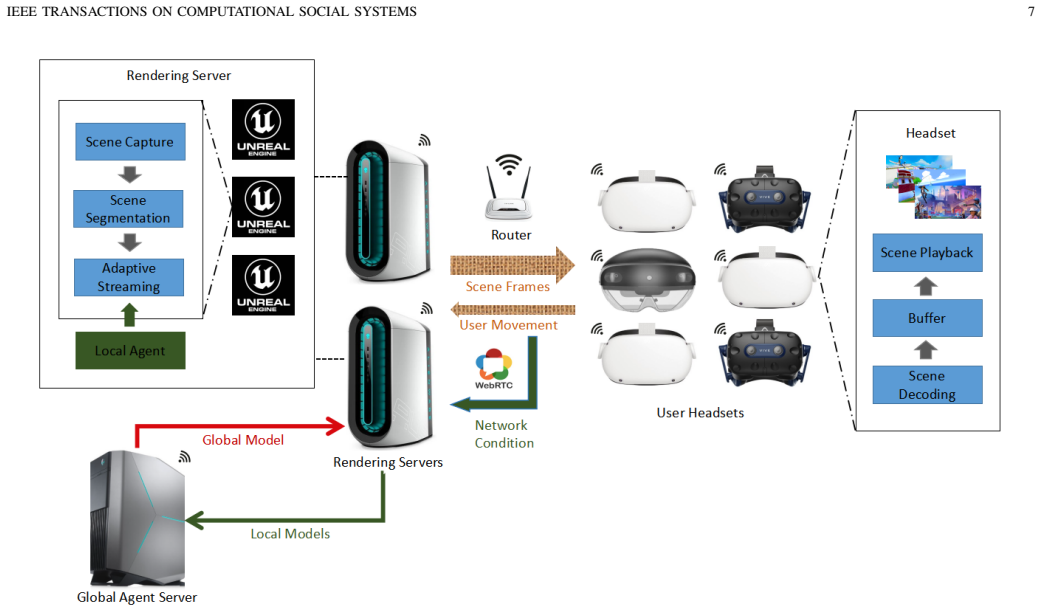
The machine doing the work is F-MAPPO, a federated multi-agent proximal policy optimization scheme. A global agent on the edge server periodically broadcasts actor-critic parameters, each headset runs a local PPO agent that collects trajectories and updates its policy, and the local updates are aggregated back at the server with FedAvg after Laplacian noise is added, so only perturbed parameters, never raw observations, are shared. The argument is carried by the reward signal: a time-step QoE model, Equation (1), whose five terms discount scene quality by user density, penalize choppiness against the target frame rate, penalize motion-to-photon latency scaled by throughput, penalize quality swings between steps, and penalize packet loss above a threshold. Its coefficients were fit by grid search to 192 Mean Opinion Score ratings from 8 users, and the same equation is used both as the RL reward and as the evaluation metric, so the reported quality improvements flow through it.
What would settle it
Run a blind user study with a larger and more diverse participant pool comparing F-MAPPO against GCC or BBR in the congestion scenario S5: if the mean user-rating difference is below the roughly 14% improvement the paper reports in QoE-score terms, or if users show no preference for F-MAPPO's streams, the claim that optimizing Equation (1) improves user experience is falsified.
Extended reading notes
Core claim
The paper's central claim is that social metaverse streaming should be treated as a multi-user, privacy-constrained decision problem rather than a single-user bitrate adaptation task, and that F-MAPPO solves it better than the alternatives. F-MAPPO models each headset as an agent in a decentralized partially observable Markov decision process whose state is six network features (last chosen bitrate, received bitrate, motion-to-photon latency, jitter, packet loss, and negative acknowledgments) and whose action is an increment, decrement, or hold on the bitrate. The reward is the average over agents of a time-step QoE score, Equation (1), that combines scene quality with a user-density discount, a choppiness penalty, a latency penalty scaled by throughput, a stability penalty, and a packet-loss disruption penalty. Training alternates local PPO updates with federated averaging of perturbed model updates, adding local differential privacy. In online tests across six scenarios, F-MAPPO reports the highest QoE in every scenario, with the largest margins under congestion and recovery.
Load-bearing premise
The load-bearing premise is that the time-step QoE model in Equation (1), whose coefficients were fitted by grid search to 192 Mean Opinion Score ratings from 8 users, captures how users actually perceive streaming quality in the social metaverse.
Editorial extensions
If this is right
- If F-MAPPO works as claimed, multi-user XR streaming can coordinate bitrate choices at the edge without centralizing personal data, removing the main privacy objection to learning-based adaptive bitrate control in the metaverse.
- The reported QoE gains are largest in the difficult cases of congestion and recovery, so the method's value lies in robustness to network shocks rather than only in steady-state quality.
- The measured overhead (about 0.5 MB per device per aggregation round and 74.5% GPU utilization for training, versus 68.2% for centralized MAPPO) suggests the federated loop is light enough to run on existing edge infrastructure.
- The framework is built so that additional headsets join as new local agents sharing the same global model, which is the stated path toward large-scale deployment.
Reading between the lines
- An implication the authors leave implicit is that the same F-MAPPO machinery would transfer to cloud gaming, telepresence, or remote guidance, wherever multiple clients share a bottleneck and quality is latency-dominated; that transfer is plausible but untested here.
- Because the QoE coefficients came from eight participants, a natural next step is to fit Equation (1) per user or per population segment and repeat the ±20% sensitivity analysis; larger RMSE changes across groups would indicate that personalized coefficients are needed.
- The privacy guarantee rests on Laplacian noise and FedAvg, but the paper does not quantify how the 14% margin degrades as the privacy budget is tightened over many aggregation rounds, which would be a direct test of the privacy-performance trade-off.
Editorial analysis
A structured set of objections, weighed in public.
Referee Report
Summary. The paper proposes ASMS, an adaptive streaming system for social metaverse applications, built on Federated Multi-Agent Proximal Policy Optimization (F-MAPPO). The authors model the problem as a Dec-POMDP, define a time-step QoE metric that incorporates bitrate, frame rate, latency, jitter, packet loss, and user density, and train multiple headset agents with federated averaging and local differential privacy. They report offline training curves and online comparisons against seven baselines across six network scenarios, claiming that ASMS improves user experience by at least 14% and consistently achieves the highest QoE scores. The paper also includes a small MOS study used to fit the QoE model coefficients and a feasibility analysis of communication and computational overhead.
Significance. The combination of federated learning and multi-agent deep RL for multi-user adaptive bitrate streaming in an XR/metaverse setting is a timely and relevant direction, and the paper provides a concrete MEC-based architecture and a hardware testbed with Unreal Engine and multiple headsets. If the reported results were supported by a validated QoE metric and statistically grounded comparisons, the work would be of interest to the computational social systems and multimedia networking communities. However, the central quantitative claims currently rest on a single fitted QoE model used both as the RL reward and as the outcome metric, and the paper ships no code or data. The paper's most distinctive contribution, privacy-preserving federated multi-agent coordination, is also under-specified: no privacy budget, sensitivity analysis, or details of the federated averaging weights are given. The direction is promising, but the evidence as presented does not yet support the stated user-experience claims.
major comments (4)
- [Section III-A, Eq. (1)] Equation (1) is internally inconsistent with its own description, and this is load-bearing because the same expression is used as the RL reward and as the evaluation metric throughout Section IV-E. The printed last term is '+ δ2·P(pt)', where P(pt)=max(0, pt−pthreshold), while the adjacent text states that δ2P(pt) 'penalizes packet losses' and 'addresses sudden network disruptions.' With a plus sign, packet loss above the threshold increases QoE, so the objective rewards the very disruptions the paper claims to suppress. In addition, the choppiness penalty is printed as β|yt − ftarget|, but the text defines it as β|ft − ftarget| where ft is the frame rate; since yt is defined in Section III-A as the received bitrate, the printed equation compares a bitrate with a frame-rate target. The MOS fitting in Section IV-B cannot resolve this ambiguity, and no code is provided to show which formula was actually implemented. The authors must correct Eq. (1), clarify the exact implemented reward, and either release the implementation or provide a version of the evaluation computed from the corrected expression.
- [Section IV-B] The validation of the QoE model is not sufficient to support the 'user experience' claims. The coefficients α, β, γ, δ1, δ2 are fit by grid search to 192 MOS ratings from 8 participants across 6 scenarios, with no held-out split, no cross-validation, and no confidence intervals; the reported R²=0.92 is a training goodness-of-fit, not a measure of predictive validity. The sensitivity analysis (±20% coefficient perturbations, 5.2% average RMSE change) only shows local stability of the fit. Moreover, because this model is both the reward function and the evaluation metric, the reported improvements in Section IV-E compare policies in terms of the fitted objective rather than measuring independent user-perceived quality. The abstract's 'improves user experience by at least 14%' therefore overstates what the experiment actually demonstrates; the authors should reframe the claims or add an independent validation of the learned policy against MOS ratings.
- [Section IV-E, Fig. 5] The online testing results are reported as single point QoE values with no number of runs, no variance or confidence intervals, and no statistical significance test. The text states that F-MAPPO 'consistently achieved the highest QoE scores across all network conditions,' but the data shown in Fig. 5 do not support a claim of consistency in a statistical sense. The abstract's 'at least 14% improvement' is not derived anywhere in Section IV-E: no per-scenario percentage improvements or averaging method are given, and it is unclear against which baseline or over which scenarios this number is computed. The authors should add run-to-run variability, explicit error bars, and a clear derivation of the reported improvement percentage.
- [Section III-C] The privacy-preservation claim is not quantifiable as presented. Equation (14) applies a Laplacian mechanism for local differential privacy, but the paper gives no privacy budget ε, no sensitivity bound Δθ, and no analysis of the privacy-utility tradeoff. Equation (15) says the federated averaging weights w_i are 'dynamically adjusted,' but the adjustment rule is not specified. Without these details, the reader cannot assess whether the privacy protection is meaningful or how the added noise affects the QoE results reported in Section IV-E. This is a central contribution of the paper and should be specified and, ideally, empirically characterized.
minor comments (4)
- [Section III-A, state definition] The state vector includes the received bitrate yt but the choppiness penalty in the text refers to frame rate ft; if ft is a derived quantity from yt or another source, its definition should be given explicitly.
- [Section IV-C, reference [36]] The description of Ruyi as a user-preference-aware ABR method does not match the cited paper, which is about a secure multi-party learning framework; please verify and correct the citation.
- [Section IV-F] The communication overhead comparison is not apples-to-apples: F-MAPPO transmits roughly 0.5 MB per device per aggregation round, while centralized MAPPO is said to transmit about 1 KB per episode, but the number of episodes per aggregation round is not stated, so the total cost comparison is ambiguous.
- [Throughout] There are minor typographical and formatting issues, including 'Adjucnt Professor' in the author biography, inconsistent spacing in the index terms, and a few malformed reference DOIs; these should be cleaned up in the final version.
Circularity Check
F-MAPPO's reported QoE improvements are computed from the same fitted QoE model used as its reward, making the headline 'user experience' claim self-referential.
-
fitted input called prediction
[Section III-A (Reward), Section IV-B (QoE calibration), Section IV-E (Online testing, Fig. 5)]
"Using a predefined QoE model for social metaverse streaming, we can quantify the local rewards for each agent, and then average the QoE values to obtain the global reward. A grid search optimization was performed to minimize the root mean square error (RMSE) between the model-predicted QoE and MOS ratings. As shown in Fig. 5, F-MAPPO consistently achieved the highest QoE scores across all network conditions, outperforming the baseline methods in every scenario."
The only outcome metric reported in Section IV-E is the QoE function of Eq. (1), and this same function is the reward that F-MAPPO is trained to maximize in Section III-A. The coefficients of Eq. (1) were themselves fit to MOS ratings in Section IV-B, and the test conditions are the same six scenarios used for that calibration. Therefore the 'QoE scores' in Fig. 5, and the abstract's 'at least 14%' improvement, are values of the fitted objective the policy was optimized against, not an independent measurement of user-perceived quality. No held-out MOS evaluation or separate user study is used to verify that the learned policy improves actual experience, so the central claim reduces to a comparison within the fitted reward function.
full rationale
The central result, the 'at least 14%' QoE improvement, is produced by the same QoE model (Eq. 1) that serves as the agent reward in Section III-A and as the evaluation metric in Section IV-E. The model coefficients were fit to 192 MOS ratings from 8 users in Section IV-B, using the same six scenario types that later appear as the online test conditions. Thus the reported QoE scores are values of the fitted objective, not an independent measurement of user experience. This is a partial but real circularity: the paper asserts the learned policy improves user experience, yet the only 'experience' measurement is the function the policy was trained to maximize. The comparison against baselines is not entirely vacuous, since F-MAPPO could in principle perform worse even on its own reward function, so I do not score the paper at the maximum. However, the headline claim is not externally grounded. The self-citations ([4], [32]) are background material and are not load-bearing. Separately, Eq. (1) as printed contains a sign inconsistency: the '+ δ2·P(p_t)' term is described as a packet-loss penalty, and the choppiness term uses y_t despite the text defining it as a frame-rate mismatch; these are correctness defects rather than circularity, but they further weaken the reliability of the fitted metric.
Assumptions & free parameters
free parameters (7)
- QoE scene quality coefficient alpha =
1
- QoE choppiness penalty coefficient beta =
0.4
- QoE latency penalty coefficient gamma =
0.2
- QoE stability penalty coefficient delta1 =
0.6
- QoE disruption penalty coefficient delta2 =
0.5
- Packet loss threshold p_threshold =
not specified
- Federated averaging weights w_i =
dynamically adjusted, not specified
assumptions (4)
- domain assumption QoE model in Eq (1) is an accurate scalar proxy for user-perceived experience in social metaverse streaming
- domain assumption The six network scenarios in Table I are representative of real deployment conditions
- domain assumption LDP-perturbed gradients (Eq 14) with unspecified privacy budget still allow a useful shared policy to be learned
- standard math Standard PPO clipped surrogate objective and GAE converge to a good policy for this Dec-POMDP
Cite this review
Pith. "Pith review of Adaptive Social Metaverse Streaming based on Federated Multi-Agent Deep Reinforcement Learning." pith.science (2026). https://pith.science/paper/OMGSZYUK
@misc{pith2026250617342,
  author       = {Pith},
  title        = {Pith review of: Adaptive Social Metaverse Streaming based on Federated Multi-Agent Deep Reinforcement Learning},
  year         = {2026},
  howpublished = {\url{https://pith.science/paper/OMGSZYUK}},
  note         = {Machine review of arXiv:2506.17342}
}
read the original abstract
The social metaverse is a growing digital ecosystem that blends virtual and physical worlds. It allows users to interact socially, work, shop, and enjoy entertainment. However, privacy remains a major challenge, as immersive interactions require continuous collection of biometric and behavioral data. At the same time, ensuring high-quality, low-latency streaming is difficult due to the demands of real-time interaction, immersive rendering, and bandwidth optimization. To address these issues, we propose ASMS (Adaptive Social Metaverse Streaming), a novel streaming system based on Federated Multi-Agent Proximal Policy Optimization (F-MAPPO). ASMS leverages F-MAPPO, which integrates federated learning (FL) and deep reinforcement learning (DRL) to dynamically adjust streaming bit rates while preserving user privacy. Experimental results show that ASMS improves user experience by at least 14% compared to existing streaming methods across various network conditions. Therefore, ASMS enhances the social metaverse experience by providing seamless and immersive streaming, even in dynamic and resource-constrained networks, while ensuring that sensitive user data remains on local devices.
Figures


Figures from the paper (2 more)


Reference graph
Works this paper leans on
-
[1]
A survey on metaverse: Fundamentals, security, and privacy,
Y . Wang, Z. Su, N. Zhang, R. Xing, D. Liu, T. H. Luan, and X. Shen, “A survey on metaverse: Fundamentals, security, and privacy,” IEEE Communications Surveys & Tutorials , 2022. [Online]. Available: https://doi.org/10.1109/COMST.2022.3202047
-
[2]
What is a Metaverse? And should you be buying in?
J. Wiles, “What is a Metaverse? And should you be buying in?” https: //www.gartner.com/en/articles/what-is-a-metaverse, 2022
work page 2022
-
[3]
W. Yang, W. Xiang, Y . Yang, and P. Cheng, “Optimizing federated learning with deep reinforcement learning for digital twin empowered industrial IoT,” IEEE Transactions on Industrial Informatics , vol. 19, no. 2, pp. 1884–1893, 2022. [Online]. Available: https://doi.org/10. 1109/TII.2022.3183465
-
[4]
Human-centric resource allocation for the metaverse with multi-access edge computing,
Z. Long, H. Dong, and A. El Saddik, “Human-centric resource allocation for the metaverse with multi-access edge computing,” IEEE Internet of Things Journal , vol. 10, no. 22, pp. 19 993–20 005, 2023. [Online]. Available: https://doi.org/10.1109/JIOT.2023.3283335
-
[5]
Freedom and restraint in dark forest: A peek at the metaverse through a blockchain game,
N. Yao, Z. Lin, X. Wu, and L. Wang, “Freedom and restraint in dark forest: A peek at the metaverse through a blockchain game,” IEEE Transactions on Computational Social Systems , vol. 10, no. 5, pp. 2189–2200, 2022. [Online]. Available: https://doi.org/10.1109/TCSS. 2022.3215885
arXiv 2022
-
[6]
G. Zhang, J. Wu, G. Jeon, Y . Chen, Y . Wang, and M. Tan, “Towards understanding metaverse engagement via social patterns and reward mechanism: A case study of nova empire,” IEEE Transactions on Computational Social Systems , vol. 10, no. 5, pp. 2165–2176, 2022. [Online]. Available: https://doi.org/10.1109/TCSS.2022.3211679
arXiv 2022
-
[7]
Social metaverse: Challenges and solutions,
Y . Wang, Z. Su, and M. Yan, “Social metaverse: Challenges and solutions,” IEEE Internet of Things Magazine, vol. 6, no. 3, pp. 144–150,
-
[8]
Social interactions in the metaverse: Framework, initial evidence, and research roadmap,
T. Hennig-Thurau, D. N. Aliman, A. M. Herting, G. P. Cziehso, M. Linder, and R. V . K ¨ubler, “Social interactions in the metaverse: Framework, initial evidence, and research roadmap,” Journal of the Academy of Marketing Science , vol. 51, no. 4, pp. 889–913, 2023. [Online]. Available: https://doi.org/10.1007/s11747-022-00908-0
Show all 43 references
-
[9]
The social metaverse: Battle for privacy,
B. Falchuk, S. Loeb, and R. Neff, “The social metaverse: Battle for privacy,” IEEE technology and society magazine , vol. 37, no. 2, pp. 52–61, 2018. [Online]. Available: https://doi.org/10.1109/MTS.2018. 2826060
2018 doi
-
[10]
Distributed resource optimization with blockchain security for immersive digital twin in IIoT,
J. Song, Y . Kang, Q. Song, L. Guo, and A. Jamalipour, “Distributed resource optimization with blockchain security for immersive digital twin in IIoT,” IEEE Transactions on Industrial Informatics , vol. 19, no. 5, pp. 7258–7267, 2022. [Online]. Available: https://doi.org/10. 1...
2022
-
[11]
Collaborative edge computing for social internet of things: Applications, solutions, and challenges,
P. Dong, J. Ge, X. Wang, and S. Guo, “Collaborative edge computing for social internet of things: Applications, solutions, and challenges,” IEEE Transactions on Computational Social Systems , vol. 9, no. 1, pp. 291–301, 2021. [Online]. Available: https: //doi.org/10.1109/TCSS....
2021
-
[12]
Oboe: Auto-tuning video ABR algorithms to network conditions,
Z. Akhtar, Y . S. Nam, R. Govindan, S. Rao, J. Chen, E. Katz- Bassett, B. Ribeiro, J. Zhan, and H. Zhang, “Oboe: Auto-tuning video ABR algorithms to network conditions,” in Proceedings of the 2018 Conference of the ACM Special Interest Group on Data Communication , 2018, pp. 4...
2018
-
[13]
Combating VR sickness through subtle dynamic field-of-view modification,
A. S. Fernandes and S. K. Feiner, “Combating VR sickness through subtle dynamic field-of-view modification,” in 2016 IEEE Symposium on 3D User Interfaces , 2016, pp. 201–210. [Online]. Available: https://doi.org/10.1109/3DUI.2016.7460053
2016
-
[14]
Prox- imal policy optimization algorithms,
J. Schulman, F. Wolski, P. Dhariwal, A. Radford, and O. Klimov, “Prox- imal policy optimization algorithms,” arXiv preprint arXiv:1707.06347,
-
[15]
The fairyland of second life: Virtual social worlds and how to use them,
A. M. Kaplan and M. Haenlein, “The fairyland of second life: Virtual social worlds and how to use them,” Business horizons, vol. 52, no. 6, pp. 563–572, 2009. [Online]. Available: https://doi.org/10.1016/j.bushor.2009.07.002
2009 doi
-
[16]
The digital dollhouse: Context and social norms in The Sims Online,
R. M. Martey and J. Stromer-Galley, “The digital dollhouse: Context and social norms in The Sims Online,” Games and Culture, vol. 2, no. 4, pp. 314–334, 2007. [Online]. Available: https://doi.org/10.1177/1555412007309583
2007 doi
-
[17]
Communication, coordination, and camaraderie in World of Warcraft,
M. G. Chen, “Communication, coordination, and camaraderie in World of Warcraft,” Games and Culture , vol. 4, no. 1, pp. 47–73, 2009. [Online]. Available: https://doi.org/10.1177/1555412008325478
2009 doi
-
[18]
A review of the key challenges of non-fungible tokens,
O. Ali, M. Momin, A. Shrestha, R. Das, F. Alhajj, and Y . K. Dwivedi, “A review of the key challenges of non-fungible tokens,” Technological Forecasting and Social Change , vol. 187, p. 122248, 2023. [Online]. Available: https://doi.org/10.1016/j.techfore.2022.122248
2023
-
[19]
Situating the appeal of Fortnite within children’s changing play cultures,
M. Carter, K. Moore, J. Mavoa, H. Horst, and L. Gaspard, “Situating the appeal of Fortnite within children’s changing play cultures,” Games and Culture , vol. 15, no. 4, pp. 453–471, 2020. [Online]. Available: https://doi.org/10.1177/155541202091377
2020 doi
-
[20]
Social games and Blockchain: Exploring the metaverse of Decentraland,
B. Guidi and A. Michienzi, “Social games and Blockchain: Exploring the metaverse of Decentraland,” in 2022 IEEE 42nd International Conference on Distributed Computing Systems Workshops . IEEE, 2022, pp. 199–204. [Online]. Available: https://doi.org/10.1177/10. 1109/ICDCSW56584...
2022
-
[21]
Communication-efficient learning of deep networks from decentralized data,
B. McMahan, E. Moore, D. Ramage, S. Hampson, and B. A. y Arcas, “Communication-efficient learning of deep networks from decentralized data,” in Proceedings of Machine Learning Research , 2017, pp. 1273–
2017
-
[22]
Federated learning for metaverse: A survey,
Y . Chen, S. Huang, W. Gan, G. Huang, and Y . Wu, “Federated learning for metaverse: A survey,” arXiv preprint arXiv:2303.17987 ,
-
[23]
Federated learning for 6G: Applications, challenges, and opportunities,
Z. Yang, M. Chen, K.-K. Wong, H. V . Poor, and S. Cui, “Federated learning for 6G: Applications, challenges, and opportunities,” Engineering, vol. 8, pp. 33–41, 2022. [Online]. Available: https: //doi.org/10.1145/3543873.3587584
2022
-
[24]
Toward resource-efficient federated learning in mobile edge computing,
R. Yu and P. Li, “Toward resource-efficient federated learning in mobile edge computing,” IEEE Network , vol. 35, no. 1, pp. 148–155, 2021. [Online]. Available: https://doi.org/10.1109/MNET.011.2000295
2021 doi
-
[25]
Blockchained on-device federated learning,
H. Kim, J. Park, M. Bennis, and S.-L. Kim, “Blockchained on-device federated learning,” IEEE Communications Letters , vol. 24, no. 6, pp. 1279–1283, 2019. [Online]. Available: 10.1109/LCOMM.2019.2921755
2019
- [26]
-
[27]
Neural adaptive video streaming with pensieve,
H. Mao, R. Netravali, and M. Alizadeh, “Neural adaptive video streaming with pensieve,” in Proceedings of the Conference of the ACM Special Interest Group on Data Communication , 2017, pp. 197–210. [Online]. Available: https://doi.org/10.1145/3098822.3098843
2017
-
[28]
Tiyuntsong: A self-play reinforcement learning approach for ABR video streaming,
T. Huang, X. Yao, C. Wu, R.-X. Zhang, Z. Pang, and L. Sun, “Tiyuntsong: A self-play reinforcement learning approach for ABR video streaming,” in Proceedings of IEEE International Conference on Multimedia and Expo , 2019, pp. 1678–1683. [Online]. Available: https://doi.org/10.1...
2019
-
[29]
T-gaming: A cost-efficient cloud gaming system at scale,
H. Chen, X. Zhang, Y . Xu, J. Ren, J. Fan, Z. Ma, and W. Zhang, “T-gaming: A cost-efficient cloud gaming system at scale,” IEEE Transactions on Parallel and Distributed Systems , vol. 30, no. 12, pp. 2849–2865, 2019. [Online]. Available: https: //doi.org/10.1109/TPDS.2019.2922205
2019
-
[30]
Statistically indifferent quality variation: An approach for reducing multimedia distribution cost for adaptive video streaming services,
B. Rainer, S. Petscharnig, C. Timmerer, and H. Hellwagner, “Statistically indifferent quality variation: An approach for reducing multimedia distribution cost for adaptive video streaming services,” IEEE Transactions on Multimedia , vol. 19, no. 4, pp. 849–860, 2016. [Online]....
2016
-
[31]
Tcp ex machina: Computer-generated congestion control,
K. Winstein and H. Balakrishnan, “Tcp ex machina: Computer-generated congestion control,” ACM SIGCOMM Computer Communication Review, vol. 43, no. 4, pp. 123–134, 2013. [Online]. Available: https://api.semanticscholar.org/CorpusID:2052171
2013
-
[32]
Interacting with New York City data by hololens through remote rendering,
Z. Long, H. Dong, and A. El Saddik, “Interacting with New York City data by hololens through remote rendering,” IEEE Consumer Electronics Magazine , vol. 11, no. 5, pp. 64–72, 2022. [Online]. Available: https://doi.org/10.1109/MCE.2022.3165961
2022
-
[33]
High-dimensional continuous control using generalized advantage estimation,
J. Schulman, P. Moritz, S. Levine, M. Jordan, and P. Abbeel, “High-dimensional continuous control using generalized advantage estimation,” arXiv preprint arXiv:1506.02438, 2015. [Online]. Available: https://doi.org/10.48550/arXiv.1506.02438
-
[34]
Reinforcement learning through asynchronous advantage actor-critic on a GPU,
M. Babaeizadeh, I. Frosio, S. Tyree, J. Clemons, and J. Kautz, “Reinforcement learning through asynchronous advantage actor-critic on a GPU,” arXiv preprint arXiv:1611.06256, 2016. [Online]. Available: https://openreview.net/forum?id=r1VGvBcxl
2016 arXiv
-
[35]
GreenABR: Energy-aware adaptive bitrate streaming with deep reinforcement learning,
B. O. Turkkan, T. Dai, A. Raman, T. Kosar, C. Chen, M. F. Bulut, J. Zola, and D. Sow, “GreenABR: Energy-aware adaptive bitrate streaming with deep reinforcement learning,” in Proceedings of the 13th IEEE TRANSACTIONS ON COMPUTATIONAL SOCIAL SYSTEMS 12 ACM Multimedia Systems Co...
2022
-
[36]
Ruyi: A configurable and efficient secure multi-party learning framework with privileged parties,
L. Song, Z. Wang, G. Lin, and W. Han, “Ruyi: A configurable and efficient secure multi-party learning framework with privileged parties,” IEEE Transactions on Information Forensics and Security , vol. 19, pp. 10 355–10 370, 2024. [Online]. Available: https://doi.org/10.1109/TI...
2024
-
[37]
ARTEMIS: Adaptive bitrate ladder optimization for live video streaming,
F. Tashtarian, A. Bentaleb, H. Amirpour, S. Gorinsky, J. Jiang, H. Hellwagner, and C. Timmerer, “ARTEMIS: Adaptive bitrate ladder optimization for live video streaming,” in 21st USENIX Symposium on Networked Systems Design and Implementation . USENIX Association, 2024, pp. 591...
2024
-
[38]
Soft actor- critic: Off-policy maximum entropy deep reinforcement learning with a stochastic actor,
T. Haarnoja, A. Zhou, P. Abbeel, and S. Levine, “Soft actor- critic: Off-policy maximum entropy deep reinforcement learning with a stochastic actor,” in Proceedings of International Conference on Machine Learning , 2018, pp. 1861–1870. [Online]. Available: https://doi.org/10.4...
-
[39]
BBR: Congestion-based congestion control: Measuring bottleneck bandwidth and round-trip propagation time,
N. Cardwell, Y . Cheng, C. S. Gunn, S. H. Yeganeh, and V . Jacobson, “BBR: Congestion-based congestion control: Measuring bottleneck bandwidth and round-trip propagation time,” Communications of the ACM , vol. 60, no. 2, pp. 58–66, 2017. [Online]. Available: https://doi.org/10...
2017
-
[42]
Analysis and design of the google congestion control for web real- time communication,
G. Carlucci, L. De Cicco, S. Holmer, and S. Mascolo, “Analysis and design of the google congestion control for web real- time communication,” in Proceedings of the 7th International Conference on Multimedia Systems , 2016, pp. 1–12. [Online]. Available: https://doi.org/10.1145...
2016
- [1282]
-
[2017]
Available: https://doi.org/10.1109/TSMC.2021.3098451
[Online]. Available: https://doi.org/10.1109/TSMC.2021.3098451
2021
-
[2023]
Available: https://doi.org/10.1109/IOTM.001.2200266
[Online]. Available: https://doi.org/10.1109/IOTM.001.2200266
Reviewed August 6, 2026 · model on record in the stance chip above.
Discussion (0). Sign in to comment.