REVIEW 2 major objections 5 minor 35 references
AMIGO makes all-sky imaging from a lunar-orbit radio array computationally feasible by cutting memory and time costs while folding in controllable physical priors.
Reviewed by Pith at T0; open to challenge. T0 means a machine referee read the full paper against a public rubric. the ladder, T0–T4 →
AMIGO reconstructs all-sky radio maps from lunar-orbit array visibilities by combining mini-batch gradient descent with ALM priors, cutting memory and time costs enough for NSIDE=256 maps on mock DSL data.
T0 review reviewed 2026-07-14 challenge →
load-bearing objection Solid engineering paper: AMIGO makes all-sky lunar-orbit imaging computationally tractable on mocks via MBGD+ALM, with clean scaling and honest limits. the 2 major comments →
Synthesis imaging with a lunar orbit array: III. Augmented lagrangian Multiplier Imaging using Gradient descent Optimization (AMIGO)
The pith
A machine-rendered reading of the paper's core claim, the machinery that carries it, and where it could break.
The reading
Core claim
AMIGO reconstructs all-sky maps from the dynamic, non-coplanar baselines of a lunar-orbit array by solving a constrained least-squares problem with mini-batch gradient descent and an augmented Lagrangian multiplier; memory falls from O(N^{2}) to O(N) and time falls from O(N^{3}+MN^{2}) to O(<MN^{2}), while adjustable residual thresholds let the user dial the strength of non-negativity and angular-power-spectrum priors.
What carries the argument
The AMIGO iteration: an outer ALM loop that updates Lagrange multipliers and penalty parameters for the equality constraint H_ℓ=0 (power-spectrum match) and inequality G_n≥0 (positive temperature), and an inner mini-batch gradient-descent step that updates sky temperatures from subsets of the visibility data without ever forming the full response matrix.
Load-bearing premise
That idealized mock visibilities—perfect orbits, opaque Moon, ideal beams, and pure thermal noise with no calibration or baseline errors—are realistic enough to prove the method will work on actual flight data.
What would settle it
Run AMIGO on the same mock data after injecting realistic baseline-determination phase errors or primary-beam model mismatches; if the residual maps and MSE degrade beyond the levels reported for pure thermal noise, the claim of practical feasibility fails.
Editorial analysis
A structured set of objections, weighed in public.
Referee Report
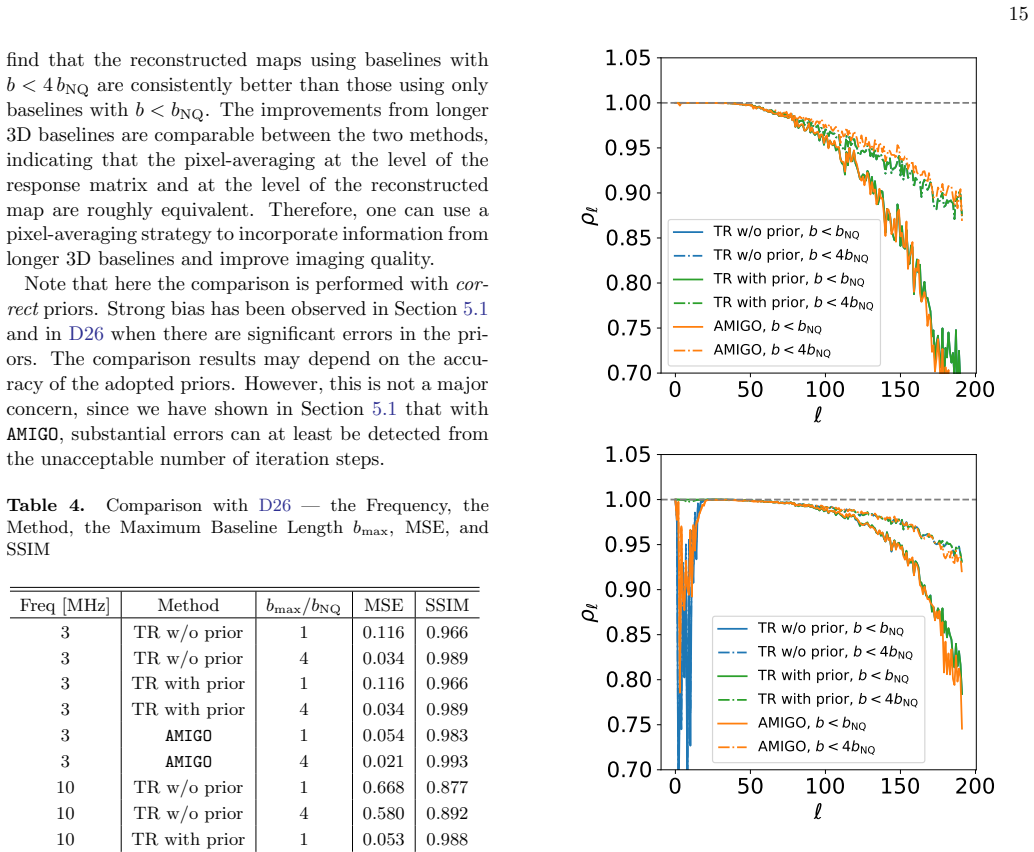
Summary. The paper introduces AMIGO, an imaging algorithm for lunar-orbiting interferometers such as DSL that combines Mini-Batch Gradient Descent with the Augmented Lagrangian Multiplier method. It formulates all-sky reconstruction as a constrained optimization problem (data fidelity plus non-negative temperature and angular-power-spectrum equality constraints), converts it via ALM into an unconstrained problem whose first sub-step is solved by MBGD, and controls prior strength through residual thresholds ΔH and ΔG. Mock visibilities generated under a realistic DSL orbit (breathing baselines, lunar shading, short-dipole beams) are used to reconstruct maps at 3, 10 and 30 MHz up to NSIDE = 256. The authors report MSE/SSIM/ρℓ metrics, demonstrate hierarchical initialization, and show that memory and wall-clock scaling improve relative to the Tikhonov-regularization matrix-inversion approach of Deng et al. (2026).
Significance. If the claimed scalings hold under more realistic systematics, AMIGO would remove a genuine computational bottleneck for all-sky imaging with dynamic 3-D baselines, making NSIDE ≥ 256 reconstructions feasible on modest hardware. The ALM residual-threshold mechanism supplies a transparent, adjustable way to inject physically motivated priors (non-negativity and Cℓ) without hard-wiring a full prior map. The hierarchical-initialization strategy and the explicit GPU/CPU benchmarks against D26 are concrete engineering contributions that other lunar-array concepts can reuse. The work is therefore a useful algorithmic step for the DSL and similar missions, even though it remains a proof-of-concept on idealized mocks.
major comments (2)
- §6 and §3 explicitly limit validation to mocks that omit calibration errors, baseline uncertainties and beam-model errors (opaque Moon, perfect antennas pointed at lunar center, white Gaussian noise only). The central feasibility claim for real DSL data therefore rests on an untested extrapolation. A quantitative stress test—e.g., injecting the phase errors already characterized in Zhou et al. (2026) and re-measuring MSE/SSIM/ρℓ—is needed before the claim can be regarded as demonstrated rather than projected.
- §5.1 and Table 2: when the prior Cℓ is scaled by 1.5 the reconstruction develops artificial stripes and MSE rises from 0.053 to 0.303. The only diagnostic offered is “unacceptable iteration count.” Because a true Cℓ will never be known a priori, the paper should supply a practical, data-driven procedure (or at least a quantitative criterion) for detecting and correcting such mismatches without access to the input map.
minor comments (5)
- Table 3 / Figure 7: wall-clock times are hardware-specific (RTX 3090 + EPYC 9654). State the software stack (CUDA version, BLAS library) and report FLOPs or iteration-normalized timings so that the O(Nvis Npix) scaling can be verified independently.
- Equation (9) and surrounding text: the learning-rate schedule (initial α = 1.0, decay 0.1, increase 1.2, floor 10−7) is described but never ablated. A short sensitivity check would strengthen the claim that imaging quality is insensitive to batch configuration.
- Figures 1–3: color-bar ranges differ between frequencies; a common fractional-residual scale or an additional panel of absolute residuals would aid visual comparison.
- Appendix A: the factor of 2 that appears after the spherical-harmonic chain rule is correct for real maps, but a one-sentence reminder that aℓ,−m = (−1)m a*ℓm would help readers less familiar with HEALPix conventions.
- Typographical: “Augmented lagrangian” should be consistently capitalized; “breathing” strategy is introduced without a citation to the earlier DSL papers that define it.
Circularity Check
No load-bearing circularity: AMIGO is a standard ALM+MBGD application whose claims are validated on independent mocks and measured against a prior method; only minor series self-citation for setup/comparison.
specific steps
-
self citation load bearing
[§1, §5.4–5.5, citations to D26 / Shi et al. 2022 / Huang et al. 2018]
"To enhance algorithm performance under practical issues, F. Deng et al. (2026) (hereinafter D26) incorporated a “breathing” strategy … We also compare AMIGO with previous approaches. … Comparisons with the TR approach in D26 quantitatively verify the computation gain of AMIGO"
The orbit configuration, visibility model, and Tikhonov baseline are taken from the authors’ own prior papers in the same series. This is ordinary cumulative work, not a uniqueness theorem or definitional reduction that forces the AMIGO results; the new algorithm, its gradients, residual control, and measured wall-clock/memory numbers stand independently. Flagged only as minor non-load-bearing self-citation.
full rationale
The paper formulates a constrained least-squares imaging problem (Eqs. 1–5), converts it via ALM (Eqs. 6–8) with explicit residual thresholds controlling prior strength, and solves the differentiable subproblem by mini-batch gradient descent with derived gradients (Appendix A). These steps are textbook optimization applied to the known interferometric forward model; nothing is defined in terms of the reconstructed map or fitted to force a later “prediction.” Validation uses mock visibilities generated from known input skies under stated orbit/beam/noise assumptions (§3); reconstruction quality (MSE, SSIM, ρ_ℓ) is measured against those inputs and against the Tikhonov method of D26 on identical data (§5.4–5.5, Tables 2–4, Figs. 7–8). When the C_ℓ prior is deliberately mismatched (§5.1, Fig. 5), quality degrades and iteration counts rise, confirming the prior is not circularly forced. Self-citations to the DSL series (Huang 2018, Shi 2022, D26) supply the mission configuration and a baseline comparator; they are not uniqueness theorems or load-bearing premises that make the computational-scaling or reconstruction claims true by construction. The claimed O(N) memory / <O(MN^{2}) time scalings are independently measured (Table 3, Fig. 7). The only residual softness is the mock-only validation already flagged by the authors (§6), which is a scope limitation, not circularity. Score 1 reflects ordinary series self-citation that is not load-bearing.
Axiom & Free-Parameter Ledger
free parameters (5)
- Δ_thres_H (angular-power-spectrum residual threshold) =
0.01 / 0.03
- Δ_thres_G (non-negativity residual threshold) =
0.01
- N_mini (mini-batch size) =
2^18
- learning-rate schedule (α init=1.0, decay 0.1, increase 1.2) =
init 1.0
- ρ1, ρ2 (ALM penalty factors)
axioms (5)
- domain assumption Visibility is a linear integral of sky temperature times beam, shading and fringe phase (Eq. 10).
- domain assumption Moon is a fully opaque sphere that neither radiates, diffracts nor reflects (§3.1).
- domain assumption Thermal noise is white Gaussian with variance given by the radiometer equation (Eq. 13).
- standard math ALM converts the constrained problem into an unconstrained one whose stationary points satisfy the original constraints when ρ→∞ (Eqs. 6–7).
- ad hoc to paper Hierarchical upgrade of lower-NSIDE solutions supplies good initial guesses that avoid many local minima (§4, §5.3).
Cite this review
Pith. "Pith review of Synthesis imaging with a lunar orbit array: III. Augmented lagrangian Multiplier Imaging using Gradient descent Optimization (AMIGO)." pith.science (2026). https://pith.science/paper/OMH25IHT
@misc{pith2026260711006,
  author       = {Pith},
  title        = {Pith review of: Synthesis imaging with a lunar orbit array: III. Augmented lagrangian Multiplier Imaging using Gradient descent Optimization (AMIGO)},
  year         = {2026},
  howpublished = {\url{https://pith.science/paper/OMH25IHT}},
  note         = {Machine review of arXiv:2607.11006}
}
read the original abstract
Ground-based radio observations below 30 MHz are severely limited by ionospheric interference and radio frequency interference (RFI) from Earth. A lunar-orbiting radio interferometer mission, the Discovering the Sky at the Longest wavelength (DSL, also known by its Chinese name ``Hongmeng''), has been proposed to overcome these obstacles. However, for such a mission, there are new challenges, such as the nearly all-sky field of view and dynamic 3D baselines, which require a huge computational cost for interferometric image reconstruction. In this work, we present AMIGO (Augmented lagrangian Multiplier Imaging using Gradient descent Optimization), a novel imaging algorithm tailored to lunar-orbiting arrays like DSL, combining the Mini-Batch Gradient Descent (MBGD) method with the Augmented Lagrangian Multiplier (ALM) technique. MBGD reduces the computational complexity and memory cost, enabling efficient handling of large datasets. ALM flexibly incorporates physical priors like non-negative sky temperature and prior angular power spectrum into the imaging algorithm, with adjustable stopping criteria to quantitatively control prior strength. We validate AMIGO using mock visibility data generated under realistic DSL orbit configurations. Reconstructed sky maps at various frequencies and spatial resolutions show that this approach provides a computationally feasible framework for all-sky imaging with a lunar-orbiting array.
Figures



Reference graph
Works this paper leans on
-
[1]
2015,, https://www.tensorflow.org/ Google
Abadi, M., Agarwal, A., Barham, P., et al. 2015,, https://www.tensorflow.org/ Google
2015
-
[2]
Afonso, M. V., Bioucas-Dias, J. M., & Figueiredo, M. A. T. 2010, IEEE Transactions on Image Processing, 19, 2345, doi: 10.1109/TIP.2010.2047910
-
[3]
Afonso, M. V., Bioucas-Dias, J. M., & Figueiredo, M. A. T. 2011, IEEE Transactions on Image Processing, 20, 681, doi: 10.1109/TIP.2010.2076294
-
[4]
2025, ApJ, 994, 226, doi: 10.3847/1538-4357/ae19e9
Ao, Q., Deng, F., Xu, Y., et al. 2025, ApJ, 994, 226, doi: 10.3847/1538-4357/ae19e9
-
[5]
2024, RAS Techniques and Instruments, 4, rzae061, doi: 10.1093/rasti/rzae061
Artuc, K., & de Lera Acedo, E. 2024, RAS Techniques and Instruments, 4, rzae061, doi: 10.1093/rasti/rzae061
-
[6]
Bale, S. D. 2023, in AGU Fall Meeting Abstracts, Vol. 2023, P31B–02
2023
-
[7]
2021, in 2021 IEEE Aerospace Conference (50100), 1–25, doi: 10.1109/AERO50100.2021.9438165
Bandyopadhyay, S., Mcgarey, P., Goel, A., et al. 2021, in 2021 IEEE Aerospace Conference (50100), 1–25, doi: 10.1109/AERO50100.2021.9438165
-
[8]
Borade, R., George, G. N., & Gharpure, D. C. 2021, in American Institute of Physics Conference Series, Vol. 2335, American Institute of Physics Conference Series (AIP), 030005, doi: 10.1063/5.0043435
-
[9]
Burns, J. O. 2021, Philosophical Transactions of the Royal Society of London Series A, 379, 20190564, doi: 10.1098/rsta.2019.0564
-
[10]
O., Bale, S., & Bradley, R
Burns, J. O., Bale, S., & Bradley, R. F. 2019, in American Astronomical Society Meeting Abstracts, Vol. 234, American Astronomical Society Meeting Abstracts #234, 212.02
2019
-
[11]
O., Bradley, R., Tauscher, K., et al
Burns, J. O., Bradley, R., Tauscher, K., et al. 2017, ApJ, 844, 33, doi: 10.3847/1538-4357/aa77f4
-
[12]
2010, Multiscale Modeling & Simulation, 8, 337, doi: 10.1137/090753504
Cai, J.-F., Osher, S., & Shen, Z. 2010, Multiscale Modeling & Simulation, 8, 337, doi: 10.1137/090753504
-
[13]
Camacho, H., Rotermund, K. M., Slosar, A., et al. 2025, arXiv e-prints, arXiv:2508.16773, doi: 10.48550/arXiv.2508.16773
-
[14]
Chen, X., Yan, J., Deng, L., et al. 2021, Philosophical Transactions of the Royal Society of London Series A, 379, 20190566, doi: 10.1098/rsta.2019.0566
-
[15]
2023, Chinese Journal of Space Science, 43, 43
Chen, X., Yan, J., Xu, Y., et al. 2023, Chinese Journal of Space Science, 43, 43
2023
-
[16]
2024, arXiv e-prints, arXiv:2403.16409, doi: 10.48550/arXiv.2403.16409
Chen, X., Gao, F., Wu, F., et al. 2024, arXiv e-prints, arXiv:2403.16409, doi: 10.48550/arXiv.2403.16409
-
[17]
Demmel, J., Marques, O., Parlett, B. N., & V¨ omel, C. 2007, SIAM Journal on Scientific Computing, 29, 1365, doi: 10.1137/06065029X
-
[18]
2026, AJ, 171, 100, doi: 10.3847/1538-3881/ae2d21
Deng, F., Xu, Y., Wu, F., et al. 2026, AJ, 171, 100, doi: 10.3847/1538-3881/ae2d21
-
[19]
Eckstein, J., & Bertsekas, D. P. 1992, Mathematical programming, 55, 293
1992
-
[20]
2009, SIAM Journal on Imaging Sciences, 2, 323, doi: 10.1137/080725891
Goldstein, T., & Osher, S. 2009, SIAM Journal on Imaging Sciences, 2, 323, doi: 10.1137/080725891
-
[21]
Hestenes, M. R. 1969, Journal of optimization theory and applications, 4, 303
1969
-
[22]
Hibbard, J. J., Burns, J. O., MacDowall, R., et al. 2026, AJ, 171, 26, doi: 10.3847/1538-3881/ae18d8
-
[23]
2018, AJ, 156, 43, doi: 10.3847/1538-3881/aac6c6 18
Huang, Q., Sun, S., Zuo, S., et al. 2018, AJ, 156, 43, doi: 10.3847/1538-3881/aac6c6 18
-
[24]
Khirirat, S., Feyzmahdavian, H. R., & Johansson, M. 2017, in 2017 IEEE 56th Annual Conference on Decision and Control (CDC), 2880–2887, doi: 10.1109/CDC.2017.8264077 Klein Wolt, M., Falcke, H., & Koopmans, L. 2024, in American Astronomical Society Meeting Abstracts, Vol. 243, American Astronomical Society Meeting Abstracts, 264.01
-
[25]
Li, H., Deng, F., Zhou, M., Xu, Y., & Chen, X. 2025, arXiv e-prints, arXiv:2507.13102, doi: 10.48550/arXiv.2507.13102 Mart´ ınez, H., Catal´ an, S., Igual, F. D., Herrero, J. R., & Quintana-Ort´ ı, E. S. 2025, Cluster Computing, 28, 779, doi: 10.1007/s10582-025-02456-1
-
[26]
2018, arXiv e-prints, arXiv:1804.07612, doi: 10.48550/arXiv.1804.07612
Masters, D., & Luschi, C. 2018, arXiv e-prints, arXiv:1804.07612, doi: 10.48550/arXiv.1804.07612
-
[27]
Nocedal, J., & Wright, S. J. 2006, Numerical Optimization, 2nd edn. (Springer)
2006
-
[28]
2019, in Advances in Neural Information Processing Systems, 8024–8035
Paszke, A., Gross, S., Massa, F., et al. 2019, in Advances in Neural Information Processing Systems, 8024–8035
2019
-
[29]
Polidan, R. S., Burns, J. O., Ignatiev, A., et al. 2024, Advances in Space Research, 74, 528, doi: 10.1016/j.asr.2024.04.008
-
[30]
Powell, M. J. D. 1969, in Proceedings of the 1969 IFIP Congress (Amsterdam: North-Holland), 283–298
1969
-
[31]
Rockafellar, R. T. 1974, SIAM Journal on Control, 12, 268, doi: 10.1137/0312021 Sathyanarayana Rao, M., Singh, S., K. S., S., et al. 2023, Experimental Astronomy, 56, 741, doi: 10.1007/s10686-023-09909-5
doi:10.1137/0312021 1974
-
[32]
2022, MNRAS, 510, 3046, doi: 10.1093/mnras/stab3623
Shi, Y., Xu, Y., Deng, L., et al. 2022, MNRAS, 510, 3046, doi: 10.1093/mnras/stab3623
-
[33]
2023, Research in Astronomy and Astrophysics, 23, 125017, doi: 10.1088/1674-4527/ad019d
Yang, X., Wang, M., Wu, L., et al. 2023, Research in Astronomy and Astrophysics, 23, 125017, doi: 10.1088/1674-4527/ad019d
-
[34]
2026, AJ, 171, 298, doi: 10.3847/1538-3881/ae5935
Zhou, M., Deng, F., Xu, Y., Zhou, L., & Chen, X. 2026, AJ, 171, 298, doi: 10.3847/1538-3881/ae5935
-
[35]
Zhu, J., Acedo, E. d. L., Artuc, K., & Chen, X. 2025, RAS Techniques and Instruments, 4, rzae064, doi: 10.1093/rasti/rzae064
This paper was first reviewed by grok-4.5 on July 14, 2026.
discussion (0)
Sign in with ORCID, Apple, or X to comment. Anyone can read and Pith papers without signing in.