REVIEW 4 major objections 5 minor 55 references
SalFormer360, a lightweight transformer model, claims state-of-the-art saliency prediction on three 360-degree video benchmarks while running at ~196 fps.
Reviewed by Pith at T0; open to challenge. T0 means a machine referee read the full paper against a public rubric. the ladder, T0–T4 →
T0 review · deepseek-v4-flash
2026-08-03 04:31 UTC pith:OMK4SD5X
load-bearing objection Solid lightweight model with clean ablations, but the SOTA claim rests on cross-protocol comparisons and a 2.5% PVS-HM margin that could evaporate under unified evaluation. the 4 major comments →
SalFormer360: a transformer-based saliency estimation model for 360-degree videos
The pith
A machine-rendered reading of the paper's core claim, the machinery that carries it, and where it could break.
Core claim
The central claim is that a transformer encoder trained for segmentation can be transferred to 360-degree video saliency estimation with a small custom decoder and a viewing-bias prior, achieving top results on all three largest public benchmarks. SalFormer360 takes the current frame and a frame five time steps earlier, concatenates them into a six-channel input, and runs them through the fine-tuned SegFormer MiT-B0 encoder. The decoder upsamples the final feature map to produce an initial saliency map, which is blended with a dataset-specific viewing center bias whose weight decays exponentially over time with learnable parameters. Ablations show that both the time-decaying and the persiste
What carries the argument
The key machinery is the SegFormer MiT-B0 encoder, a hierarchical transformer modified to accept a six-channel input formed by concatenating the current and t-5 frames. A custom decoder of convolutions, batch norm, ReLU, upsampling, and a sigmoid head produces an initial saliency map. A viewing center bias, computed as the average first-frame saliency of training videos, is fused via S = w_t·CB + (1-w_t)·S_init, with w_t = (1-β)·exp(-α(t/C)^2) + β, where α and β are learnable per dataset. Training uses a four-part loss combining Pearson correlation, KL divergence, spherical mean squared error with latitudinal weighting, and binary cross-entropy.
Load-bearing premise
The reported superiority rests on cross-paper baseline comparisons whose evaluation conditions are not fully aligned: the previous best on PVS-HM was measured with uniform spherical sampling while SalFormer360 uses sinusoidal weighting, and the ground-truth saliency maps for PVS-HM and VR-EyeTracking were generated with a hand-chosen 7-degree Gaussian kernel that may differ from kernels used by prior methods.
What would settle it
Re-run all baseline methods under a single protocol: identical ground-truth saliency maps (same Gaussian kernel and fixation-to-map pipeline), identical evaluation sampling (same sinusoidal weighting), and identical train/test splits. If, under that protocol, 360Spred or another prior method achieves a CC above SalFormer360's 0.807 on PVS-HM or above 0.722 on Sport360, then the paper's central claim of state-of-the-art performance is contradicted.
If this is right
- Saliency maps accurate enough to aid viewport prediction can be produced in real time on client devices, given the model's 3.7M parameters and ~196 fps throughput.
- The successful transfer from segmentation to saliency suggests that other segmentation backbones may serve as strong starting points for attention prediction, potentially reducing training data requirements.
- The learnable center-bias formulation provides a compact way to encode dataset-specific viewing tendencies, which could be injected into other 360-degree models.
- The released extended datasets for PVS-HM and VR-EyeTracking give the community standardized splits and ground-truth saliency maps for training and evaluation.
- The four-part loss with spherical weighting offers a training recipe that balances correlation, distribution, point accuracy, and geometry.
Where Pith is reading between the lines
- If evaluation protocols were fully aligned—same sampling scheme and same ground-truth generation kernel—the reported margins, especially the 2.5% gain on PVS-HM, could shrink; the comparison against 360Spred on PVS-HM is the one to scrutinize.
- The architecture implies that a single frame pair (t and t-5) carries enough temporal signal for 360-degree saliency; testing with larger frame gaps or with optical flow as an extra input would show whether more motion information adds anything.
- The per-dataset learned bias parameters are a compact diagnostic of viewing behavior: Sport360's beta near zero indicates almost no persistent center bias, while PVS-HM's higher beta reflects stronger sustained center fixation.
- A testable extension is to apply the same encoder-decoder and learnable center bias to single 360-degree images, isolating how much of the gain comes from the temporal input versus the bias mechanism.
Editorial analysis
A structured set of objections, weighed in public.
Referee Report
Summary. The paper proposes SalFormer360, a transformer-based saliency estimation model for 360-degree video. The architecture uses a SegFormer MiT-B0 encoder modified to accept two concatenated RGB frames (current and t-5), a custom convolutional decoder, and a center-bias term with a learnable dynamic/static weighting. The model is trained with a combination of Pearson correlation, KL divergence, spherical MSE, and binary cross-entropy losses. Experiments on Sport360, PVS-HM, and VR-EyeTracking report state-of-the-art CC values of 0.722, 0.807, and 0.593, respectively, with 3.70M parameters and about 196 fps inference. The authors also generated ground-truth saliency maps for PVS-HM and VR-EyeTracking from head/gaze data and released code and resources.
Significance. If the claimed results hold, the paper makes a useful contribution: a lightweight, real-time transformer-based model for 360-degree video saliency, with informative ablations showing the benefit of the center-bias components and the multi-term loss. The release of the extended PVS-HM and VR-EyeTracking datasets is also valuable. However, the headline superiority over prior art is not yet established because the comparisons in Table I mix evaluation protocols: spherical weighting differs across methods, and ground-truth maps for two datasets were generated by the authors with a different kernel than those used by prior baseline reports. The ablations and efficiency analysis are solid, and the central architectural idea is plausible, but the SOTA claim needs a unified re-evaluation before it can be accepted.
major comments (4)
- [Table I, Sec. IV-D and IV-E.1] The central SOTA claim is not yet supported because the comparison mixes spherical sampling protocols. 360Spred, the previous best on PVS-HM, is marked with a dagger (uniform spherical sampling) while SalFormer360 uses the latitudinal sinusoidal factor (asterisk). Since CC is computed over spherical sample points, this weighting difference can change scores non-trivially, especially for maps with polar content. The PVS-HM margin is only 2.5% (0.807 vs 0.787); without re-evaluating 360Spred under the same sinusoidal weighting and the same ground-truth maps, this margin could shrink or reverse. Please provide a unified evaluation of all top baselines using identical spherical weighting, GT maps, and test splits.
- [Sec. IV-A, Saliency maps generation] Ground-truth saliency maps for PVS-HM and VR-EyeTracking were generated by the authors using a hand-chosen 7-degree Gaussian kernel, while Sport360's GT maps come from the original dataset with a different kernel (3.34 degrees at lower resolution). If prior methods reported scores on different GT maps, then CC and KL numbers are not directly comparable across rows in Table I. This is particularly load-bearing for the small PVS-HM gain. Please either use the original datasets' GT maps or re-evaluate all competing methods on the same GT maps as SalFormer360.
- [Sec. III-A3, Eqs. (2)-(3)] The center bias is computed from the training-set first-frame ground truth, and alpha/beta are learned per dataset. This is not a test-label leak, and the ablation shows the components contribute. However, this design makes the model dataset-specific: the reported gains on PVS-HM and VR-EyeTracking may reflect fitting to each dataset's initial center-bias tendency rather than a generalizable saliency model. Please report cross-dataset evaluation (e.g., train on one dataset, test on another) or explicitly discuss this limitation, since the abstract's general claim of improved saliency estimation should not be overstated.
- [Sec. IV-C, Table I] Several baseline numbers are taken from secondary sources ([40], [42]) rather than original papers, and many table cells are missing ('–'). This makes the 'consistently outperforms' claim hard to verify. Please provide a table footnote listing the exact source for every baseline value and, ideally, run a unified evaluation of the top-5 competitors on all three datasets with the same metric implementation and preprocessing.
minor comments (5)
- [Eq. (4)] The loss equation uses L_BCE(1, S), but the text describes binary cross-entropy between predicted and ground-truth maps. This appears to be a typo; it should likely be L_BCE(ˆS, S).
- [Fig. 1] The figure legend contains 'OthersOurs' with unclear alignment. The categories and their correspondence to the listed methods need clarification.
- [Table I] Several entries are malformed, e.g., '0.6205.125– 0.937' and '0.2913.768– 0.899'. Please fix spacing and formatting for readability.
- [Sec. IV-A] The statement that a 7-degree kernel is chosen to approximate the Sport360 kernel of '3.34 degrees for 128×256 pixels' is unclear. Are these values directly comparable given different resolutions and projection formats? Clarify the relationship.
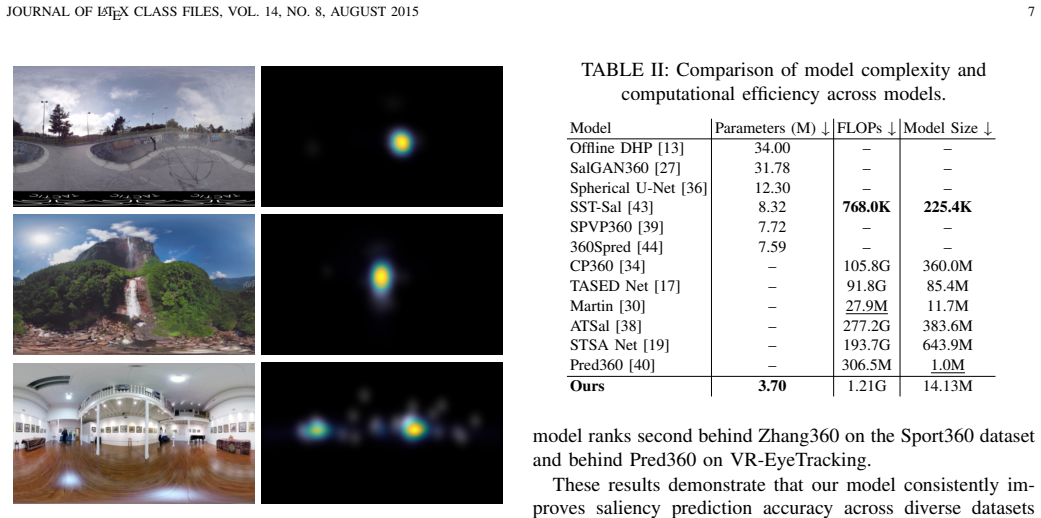
- [Sec. IV-E.3] The text says the model 'ranks fourth in terms of FLOPs and model size,' but Table II does not provide complete FLOPs/model-size data for all methods. Please show the ranking explicitly or qualify the statement.
Circularity Check
No circularity: the paper reports an empirical benchmark result with no derivation that reduces to its inputs.
full rationale
The paper does not claim a first-principles derivation or a prediction that is equivalent to fitted inputs. The viewing center bias CB is computed from the average ground-truth saliency map of the first frame in training videos only, and alpha/beta are learnable parameters optimized on training data; the held-out test evaluation is therefore not leaking test labels. The loss includes CC and the reported metric is CC, but optimizing a metric and then reporting it is standard supervised learning, not circularity. The cross-paper baseline comparisons in Table I use differing evaluation protocols (uniform spherical sampling marked with dagger, sinusoidal weighting marked with asterisk) and the authors generated ground-truth maps for PVS-HM and VR-EyeTracking with a 7-degree Gaussian kernel. This is a legitimate comparison-validity concern, but it is not a circular derivation: the authors' reported numbers are not defined to equal their inputs by construction. The only self-citations (e.g., refs. [2] and [32]) appear in related work and are not load-bearing for the central claim. No self-citation chain, uniqueness theorem, or ansatz-via-citation is used to force the reported outcome. The results are externally benchmarked against held-out data, so the empirical superiority claim has independent content even if protocol alignment would be needed for a fully fair comparison.
Axiom & Free-Parameter Ledger
free parameters (5)
- α_i (center-bias decay rate) =
Sport360: 908.50, PVS-HM: 573.55, VR-EyeTracking: 436.30
- β_i (persistent center-bias weight) =
Sport360: 0.0030, PVS-HM: 0.1773, VR-EyeTracking: 0.1079
- C (time-scaling constant) =
600
- Gaussian kernel σ for GT generation =
7 degrees
- Frame offset k =
5
axioms (4)
- domain assumption SegFormer-B0 pretrained on ImageNet-1K and ADE20K transfers to equirectangular 360-degree frames
- domain assumption Viewing center bias is present and decays over time
- domain assumption Generated saliency maps from head/gaze data with a 7-degree Gaussian are valid ground truth
- domain assumption Reported baseline numbers are directly comparable despite differing evaluation protocols
Cite this review
Pith. "Pith review of SalFormer360: a transformer-based saliency estimation model for 360-degree videos." pith.science (2026). https://pith.science/paper/OMK4SD5X
@misc{pith2026260204584,
  author       = {Pith},
  title        = {Pith review of: SalFormer360: a transformer-based saliency estimation model for 360-degree videos},
  year         = {2026},
  howpublished = {\url{https://pith.science/paper/OMK4SD5X}},
  note         = {Machine review of arXiv:2602.04584}
}
read the original abstract
Saliency estimation has received growing attention in recent years due to its importance in a wide range of applications. In the context of 360-degree video, it has been particularly valuable for tasks such as viewport prediction and immersive content optimization. In this paper, we propose SalFormer360, a novel saliency estimation model for 360-degree videos built on a transformer-based architecture. Our approach is based on the combination of an existing encoder architecture, SegFormer, and a custom decoder. The SegFormer model was originally developed for 2D segmentation tasks, and it has been fine-tuned to adapt it to 360-degree content. To further enhance prediction accuracy in our model, we incorporated Viewing Center Bias to reflect user attention in 360-degree environments. Extensive experiments on the three largest benchmark datasets for saliency estimation demonstrate that SalFormer360 outperforms existing state-of-the-art methods. In terms of Pearson Correlation Coefficient, our model achieves 8.4% higher performance on Sport360, 2.5% on PVS-HM, and 18.6% on VR-EyeTracking compared to previous state-of-the-art.
Figures



Reference graph
Works this paper leans on
-
[1]
F.743-10 - Requirements for mobile edge computing-enabled content delivery networks,
ITU-T, “F.743-10 - Requirements for mobile edge computing-enabled content delivery networks,” International Telecommunication Union (ITU), Tech. Rep., 2019
2019
-
[2]
A feature-based approach for saliency estimation of omni-directional images,
F. Battisti, S. Baldoni, M. Brizzi, and M. Carli, “A feature-based approach for saliency estimation of omni-directional images,”Signal Processing: Image Communication, vol. 69, pp. 53–59, 2018, salient360: Visual attention modeling for 360° Images. [Online]. Available: https://www.sciencedirect.com/science/article/pii/S092359651830242X
2018
-
[3]
Applying Transformer-Based Computer Vision Models to Adaptive Bitrate Allocation for 360° Live Streaming,
A. Ao and S. Park, “Applying Transformer-Based Computer Vision Models to Adaptive Bitrate Allocation for 360° Live Streaming,” in2024 IEEE Wireless Communications and Networking Conference (WCNC), 2024, pp. 1–6
2024
-
[4]
Enhancing 360 video streaming through salient content in head-mounted displays,
A. Nguyen and Z. Yan, “Enhancing 360 video streaming through salient content in head-mounted displays,”Sensors, vol. 23, no. 8,
-
[5]
Track: A new method from a re-examination of deep architectures for head motion prediction in 360° videos,
M. F. R. Rond ´on, L. Sassatelli, R. Aparicio-Pardo, and F. Precioso, “Track: A new method from a re-examination of deep architectures for head motion prediction in 360° videos,”IEEE Transactions on Pattern Analysis and Machine Intelligence, vol. 44, no. 9, pp. 5681–5699, 2022
2022
-
[6]
Optimizing fixation prediction using recurrent neural networks for 360 ◦ video streaming in head-mounted virtual reality,
C.-L. Fan, S.-C. Yen, C.-Y . Huang, and C.-H. Hsu, “Optimizing fixation prediction using recurrent neural networks for 360 ◦ video streaming in head-mounted virtual reality,”IEEE Transactions on Multimedia, vol. 22, no. 3, pp. 744–759, 2020
2020
-
[7]
Spherical convolution-based saliency detection for fov prediction in 360-degree video streaming,
S. Peng, J. Hu, Z. Li, H. Xiao, S. Yang, and C. Xu, “Spherical convolution-based saliency detection for fov prediction in 360-degree video streaming,” in2023 International Wireless Communications and Mobile Computing (IWCMC), 2023, pp. 162–167
2023
-
[8]
CoLive: An Edge-Assisted Online Learning Framework for Viewport Prediction in 360°Live Streaming,
M. Wang, S. Peng, X. Chen, Y . Zhao, M. Xu, and C. Xu, “CoLive: An Edge-Assisted Online Learning Framework for Viewport Prediction in 360°Live Streaming,” in2022 IEEE International Conference on Multimedia and Expo (ICME), 2022, pp. 1–6
2022
-
[9]
MADRL-Based Rate Adaptation for 360°Video Streaming With Multiviewpoint Prediction,
H. Wang, Z. Long, H. Dong, and A. El Saddik, “MADRL-Based Rate Adaptation for 360°Video Streaming With Multiviewpoint Prediction,” IEEE Internet of Things Journal, vol. 11, no. 15, pp. 26 503–26 517, 2024
2024
-
[10]
Towards attention- aware interactive 360-degree video streaming on smartphones,
L. Zhang, H. Zhou, L. Shen, J. Liu, and L. Cui, “Towards attention- aware interactive 360-degree video streaming on smartphones,”IEEE Network, pp. 1–1, 2025
2025
-
[11]
Viewport prediction, bitrate selection, and beamforming design for thz-enabled 360°video streaming,
M. Setayesh and V . W. S. Wong, “Viewport prediction, bitrate selection, and beamforming design for thz-enabled 360°video streaming,”IEEE Transactions on Wireless Communications, vol. 24, no. 3, pp. 1849– 1865, 2025
2025
-
[12]
Segformer: Simple and efficient design for semantic segmentation with transformers,
E. Xie, W. Wang, Z. Yu, A. Anandkumar, J. M. ´Alvarez, and P. Luo, “Segformer: Simple and efficient design for semantic segmentation with transformers,”CoRR, vol. abs/2105.15203, 2021. [Online]. Available: https://arxiv.org/abs/2105.15203 JOURNAL OF LATEX CLASS FILES, VOL. 14, NO. 8, AUGUST 2015 11
Pith/arXiv arXiv 2021
-
[13]
Predicting head movement in panoramic video: A deep reinforcement learning approach,
M. Xu, Y . Song, J. Wang, M. Qiao, L. Huo, and Z. Wang, “Predicting head movement in panoramic video: A deep reinforcement learning approach,”IEEE Transactions on Pattern Analysis and Machine Intelli- gence, vol. PP, pp. 1–1, 07 2018
2018
-
[14]
Gaze Prediction in Dynamic 360° Immersive Videos,
Y . Xu, Y . Dong, J. Wu, Z. Sun, Z. Shi, J. Yu, and S. Gao, “Gaze Prediction in Dynamic 360° Immersive Videos,” in2018 IEEE/CVF Conference on Computer Vision and Pattern Recognition, 2018, pp. 5333–5342
2018
-
[15]
Saliency Detection in 360° Videos,
Z. Zhang, Y . Xu, J. Yu, and S. Gao, “Saliency Detection in 360° Videos,” inProceedings of the European Conference on Computer Vision (ECCV), September 2018
2018
-
[16]
TranSalNet: Towards perceptually relevant visual saliency prediction,
J. Lou, H. Lin, D. Marshall, D. Saupe, and H. Liu, “TranSalNet: Towards perceptually relevant visual saliency prediction,”Neurocomputing, vol. 494, p. 455–467, jul 2022. [Online]. Available: http://dx.doi.org/10. 1016/j.neucom.2022.04.080
2022
-
[17]
Tased-net: Temporally-aggregating spatial encoder-decoder network for video saliency detection,
K. Min and J. Corso, “Tased-net: Temporally-aggregating spatial encoder-decoder network for video saliency detection,” 08 2019. [Online]. Available: https://arxiv.org/abs/1908.05786
Pith/arXiv arXiv 2019
-
[18]
Spatio-temporal self-attention network for video saliency prediction,
Z. Wang, Z. Liu, L. Gongyang, Y . Wang, T. Zhang, L. Xu, and J. Wang, “Spatio-temporal self-attention network for video saliency prediction,” IEEE Transactions on Multimedia, vol. PP, pp. 1–1, 12 2021
2021
-
[19]
Revisiting video saliency prediction in the deep learning era,
W. Wang, J. Shen, J. Xie, M.-M. Cheng, H. Ling, and A. Borji, “Revisiting video saliency prediction in the deep learning era,”IEEE Transactions on Pattern Analysis and Machine Intelligence, vol. 43, no. 1, pp. 220–237, 2021
2021
-
[20]
Salsac: A video saliency pre- diction model with shuffled attentions and correlation-based convlstm,
X. Wu, Z. Wu, J. Zhang, and L. Ju, “Salsac: A video saliency pre- diction model with shuffled attentions and correlation-based convlstm,” Proceedings of the AAAI Conference on Artificial Intelligence, vol. 34, pp. 12 410–12 417, 04 2020
2020
-
[21]
Droste, J
R. Droste, J. Jiao, and J. Noble,Unified Image and Video Saliency Modeling. Springer-Verlag, 10 2020, pp. 419–435
2020
-
[22]
Mobilenets: Efficient convolutional neural networks for mobile vision applications,
A. G. Howard, M. Zhu, B. Chen, D. Kalenichenko, W. Wang, T. Weyand, M. Andreetto, and H. Adam, “Mobilenets: Efficient convolutional neural networks for mobile vision applications,” 2017. [Online]. Available: https://arxiv.org/abs/1704.04861
Pith/arXiv arXiv 2017
-
[23]
An Ablation Study on 360-Degree Saliency Estimation,
S. Baldoni, O. Poci, G. Calvagno, and F. Battisti, “An Ablation Study on 360-Degree Saliency Estimation,” in2023 International Symposium on Image and Signal Processing and Analysis (ISPA), 2023, pp. 1–6
2023
-
[24]
Your Attention is Unique: De- tecting 360-Degree Video Saliency in Head-Mounted Display for Head Movement Prediction,
A. Nguyen, Z. Yan, and K. Nahrstedt, “Your Attention is Unique: De- tecting 360-Degree Video Saliency in Head-Mounted Display for Head Movement Prediction,” inProceedings of the 26th ACM International Conference on Multimedia, ser. MM ’18. New York, NY , USA: Association for Computing Machinery, 2018, p. 1190–1198
2018
-
[25]
Track: a Multi-Modal Deep Architecture for Head Motion Prediction in 360°Videos,
M. F. R. Rond ´on, L. Sassatelli, R. A. Pardo, and F. Precioso, “Track: a Multi-Modal Deep Architecture for Head Motion Prediction in 360°Videos,” in2020 IEEE International Conference on Image Pro- cessing (ICIP), 2020, pp. 2586–2590
2020
-
[26]
Viewport prediction with cross modal multiscale transformer for 360°video streaming,
Y . Tian, Y . Zhong, Y . Han, and F. Chen, “Viewport prediction with cross modal multiscale transformer for 360°video streaming,”Scientific Reports, vol. 15, 08 2025
2025
-
[27]
Salgan360: Visual saliency prediction on 360 degree images with generative adver- sarial networks,
F.-Y . Chao, L. Zhang, W. Hamidouche, and O. D ´eforges, “Salgan360: Visual saliency prediction on 360 degree images with generative adver- sarial networks,” in2018 IEEE International Conference on Multimedia & Expo Workshops (ICMEW), 07 2018
2018
-
[28]
Salgan: Visual saliency prediction with generative adversarial networks,
J. Pan, C. C. Ferrer, K. McGuinness, N. E. O’Connor, J. Torres, E. Sayrol, and X. G. i Nieto, “Salgan: Visual saliency prediction with generative adversarial networks,” 2018. [Online]. Available: https://arxiv.org/abs/1701.01081
Pith/arXiv arXiv 2018
-
[29]
Generative adversarial networks,
I. J. Goodfellow, J. Pouget-Abadie, M. Mirza, B. Xu, D. Warde-Farley, S. Ozair, A. Courville, and Y . Bengio, “Generative adversarial networks,” 2014. [Online]. Available: https://arxiv.org/abs/1406.2661
Pith/arXiv arXiv 2014
-
[30]
Panoramic convolutions for360 ◦ single-image saliency prediction,
D. Martin, A. Serrano, and B. Masia, “Panoramic convolutions for360 ◦ single-image saliency prediction,” inCVPR Workshop on Computer Vision for Augmented and Virtual Reality, 2020
2020
-
[31]
Spherenet: Learning spher- ical representations for detection and classification in omnidirectional images,
B. Coors, A. P. Condurache, and A. Geiger, “Spherenet: Learning spher- ical representations for detection and classification in omnidirectional images,” inProceedings of the European Conference on Computer Vision (ECCV), September 2018
2018
-
[32]
Sphere-GAN: a GAN-based Approach for Saliency Estimation in 360°Videos,
M. Z. A. Wahba, S. Baldoni, and F. Battisti, “Sphere-GAN: a GAN-based Approach for Saliency Estimation in 360°Videos,” 2025. [Online]. Available: https://arxiv.org/abs/2509.11948
arXiv 2025
-
[33]
U-net: Convolutional networks for biomedical image segmentation,
O. Ronneberger, P. Fischer, and T. Brox, “U-net: Convolutional networks for biomedical image segmentation,” 2015. [Online]. Available: https://arxiv.org/abs/1505.04597
Pith/arXiv arXiv 2015
-
[34]
Cube padding for weakly-supervised saliency prediction in 360 ◦ videos,
H.-T. Cheng, C.-H. Chao, J.-D. Dong, H.-K. Wen, T.-L. Liu, and M. Sun, “Cube padding for weakly-supervised saliency prediction in 360 ◦ videos,” 2018. [Online]. Available: https://arxiv.org/abs/1806.01320
Pith/arXiv arXiv 2018
-
[35]
Convolutional lstm network: A machine learning approach for precipitation nowcasting,
X. Shi, Z. Chen, H. Wang, D.-Y . Yeung, W. kin Wong, and W. chun Woo, “Convolutional lstm network: A machine learning approach for precipitation nowcasting,” 2015. [Online]. Available: https://arxiv.org/abs/1506.04214
Pith/arXiv arXiv 2015
-
[36]
Saliency detection in 360°videos,
Z. Zhang, Y . Xu, J. Yu, and S. Gao, “Saliency detection in 360°videos,” inComputer Vision – ECCV 2018: 15th European Conference, Munich, Germany, September 8–14, 2018, Proceedings, Part VII. Berlin, Heidelberg: Springer-Verlag, 2018, p. 504–520. [Online]. Available: https://doi.org/10.1007/978-3-030-01234-2 30
-
[37]
Viewing bias matters in 360° videos visual saliency prediction,
P.-W. Chen, T.-S. Yang, G.-L. Huang, C.-W. Huang, Y .-C. Chao, C.-H. Lu, and P.-Y . Wu, “Viewing bias matters in 360° videos visual saliency prediction,”IEEE Access, vol. 11, pp. 46 084–46 094, 2023
2023
-
[38]
Atsal: An attention based architecture for saliency prediction in 360 videos,
Y . Dahou, M. Tliba, K. McGuinness, and N. O’Connor, “Atsal: An attention based architecture for saliency prediction in 360 videos,”
-
[39]
J. Li, L. Han, C. Zhang, Q. Li, and Z. Liu, “Spherical convolution empowered fov prediction in 360-degree video multicast with limited fov feedback,” 2022. [Online]. Available: https://arxiv.org/abs/2201.12525
Pith/arXiv arXiv 2022
-
[40]
Predicting 360° video saliency: A convlstm encoder-decoder network with spatio- temporal consistency,
Z. Wan, H. Qin, R. Xiong, Z. Li, X. Fan, and D. Zhao, “Predicting 360° video saliency: A convlstm encoder-decoder network with spatio- temporal consistency,”IEEE Journal on Emerging and Selected Topics in Circuits and Systems, vol. 14, no. 2, pp. 311–322, 2024
2024
-
[41]
Q. Yang, Y . Li, C. Li, H. Wang, S. Yan, L. Wei, W. Dai, J. Zou, H. Xiong, and P. Frossard, “Svgc-ava: 360-degree video saliency prediction with spherical vector-based graph convolution and audio-visual attention,”Trans. Multi., vol. 26, p. 3061–3076, Jan. 2024. [Online]. Available: https://doi.org/10.1109/TMM.2023.3306596
arXiv 2024
-
[42]
Saliency prediction network for360 ◦ videos,
Y . Zhang, F. Dai, Y . Ma, H. Li, Q. Zhao, and Y . Zhang, “Saliency prediction network for360 ◦ videos,”IEEE Journal of Selected Topics in Signal Processing, vol. 14, no. 1, pp. 27–37, 2020
2020
-
[43]
Sst-sal: A spherical spatio-temporal approach for saliency prediction in 360°videos,
E. Bernal-Berdun, D. Martin, D. Gutierrez, and B. Masia, “Sst-sal: A spherical spatio-temporal approach for saliency prediction in 360°videos,”Computers & Graphics, vol. 106, pp. 200–209, 2022. [Online]. Available: https://www.sciencedirect.com/science/article/pii/ S0097849322001042
2022
-
[44]
360spred: Saliency prediction for 360-degree videos based on 3d separable graph convolutional networks,
Q. Yang, W. Gao, C. Li, H. Wang, W. Dai, J. Zou, H. Xiong, and P. Frossard, “360spred: Saliency prediction for 360-degree videos based on 3d separable graph convolutional networks,”IEEE Transactions on Circuits and Systems for Video Technology, vol. 34, no. 10, pp. 9979– 9996, 2024
2024
-
[45]
Rotation equiv- ariant graph convolutional network for spherical image classification,
Q. Yang, C. Li, W. Dai, J. Zou, G.-J. Qi, and H. Xiong, “Rotation equiv- ariant graph convolutional network for spherical image classification,” inProceedings of the IEEE/CVF Conference on Computer Vision and Pattern Recognition (CVPR), June 2020
2020
-
[46]
Viewing bias matters in 360° videos visual saliency prediction,
P.-W. Chen, T.-S. Yang, G.-L. Huang, C.-W. Huang, Y .-C. Chao, C.-H. Lu, and P.-Y . Wu, “Viewing bias matters in 360° videos visual saliency prediction,”IEEE Access, vol. PP, pp. 1–1, 01 2023
2023
-
[47]
A. Vaswani, N. Shazeer, N. Parmar, J. Uszkoreit, L. Jones, A. N. Gomez, L. Kaiser, and I. Polosukhin, “Attention is all you need,” 2023. [Online]. Available: https://arxiv.org/abs/1706.03762
Pith/arXiv arXiv 2023
-
[48]
Imagenet: A large-scale hierarchical image database,
J. Deng, W. Dong, R. Socher, L.-J. Li, K. Li, and L. Fei-Fei, “Imagenet: A large-scale hierarchical image database,” in2009 IEEE Conference on Computer Vision and Pattern Recognition, 2009, pp. 248–255
2009
-
[49]
Semantic understanding of scenes through the ade20k dataset,
B. Zhou, H. Zhao, X. Puig, T. Xiao, S. Fidler, A. Barriuso, and A. Torralba, “Semantic understanding of scenes through the ade20k dataset,” 2018. [Online]. Available: https://arxiv.org/abs/1608.05442
Pith/arXiv arXiv 2018
-
[50]
Pytorch: An imperative style, high-performance deep learning library,
A. Paszke, S. Gross, F. Massa, A. Lerer, J. Bradbury, G. Chanan, T. Killeen, Z. Lin, N. Gimelshein, L. Antiga, A. Desmaison, A. K ¨opf, E. Yang, Z. DeVito, M. Raison, A. Tejani, S. Chilamkurthy, B. Steiner, L. Fang, J. Bai, and S. Chintala, “Pytorch: An imperative style, high-performance deep learning library,” 2019. [Online]. Available: https://arxiv.org...
Pith/arXiv arXiv 2019
-
[51]
Torchvision: Pytorch’s com- puter vision library [software],
TorchVision, maintainers and contributors, “Torchvision: Pytorch’s com- puter vision library [software],” Available: https://github.com/pytorch/ vision, 2016
2016
-
[52]
What do different evaluation metrics tell us about saliency models?
Z. Bylinskii, T. Judd, A. Oliva, A. Torralba, and F. Durand, “What do different evaluation metrics tell us about saliency models?”IEEE Transactions on Pattern Analysis and Machine Intelligence, vol. 41, no. 3, pp. 740–757, 2019
2019
-
[53]
Introducing un salient360! benchmark: A platform for evaluating visual attention models for 360° contents,
J. Guti ´errez, E. J. David, A. Coutrot, M. P. Da Silva, and P. L. Callet, “Introducing un salient360! benchmark: A platform for evaluating visual attention models for 360° contents,” in2018 Tenth International Conference on Quality of Multimedia Experience (QoMEX), 2018, pp. 1–3
2018
-
[2020]
Available: https://arxiv.org/abs/2011.10600
[Online]. Available: https://arxiv.org/abs/2011.10600
Pith/arXiv arXiv 2011
-
[2023]
Available: https://www.mdpi.com/1424-8220/23/8/4016
[Online]. Available: https://www.mdpi.com/1424-8220/23/8/4016
discussion (0)
Sign in with ORCID, Apple, or X to comment. Anyone can read and Pith papers without signing in.