Topological zero-reflection points in multi-terminal quantum wire junctions
Pith reviewed 2026-07-01 03:53 UTC · model grok-4.3
The pith
Junctions with dihedral symmetry exhibit exact zero-reflection points for four or more terminals, protected by a winding number.
A machine-rendered reading of the paper's core claim, the machinery that carries it, and where it could break.
Core claim
Junctions with dihedral symmetry can exhibit exact zero-reflection points for N ≥ 4 terminals. By analyzing the scattering matrix, these reflectionless points are identified in the (E,t') parameter space. The points exhibit an even-odd dependence on N and converge asymptotically to a common limiting value in the large-N limit. The reflectionless points are characterized by an integer winding number associated with the phase of the reflection amplitude, providing a topological description for their stability against weak on-site disorder. A magnetic flux can induce additional reflectionless points, including for the N = 3 case. For a four-terminal junction threaded by a π-flux, the reflection
What carries the argument
The scattering matrix in the (E, t') parameter space, with the integer winding number of the phase of the reflection amplitude providing topological protection.
If this is right
- The zero-reflection points remain stable under weak on-site disorder due to the topological winding number.
- Broken time-reversal symmetry via magnetic flux induces extra reflectionless points even for three terminals.
- In four-terminal junctions with π flux, zero reflection holds across the full energy band.
- Friedel oscillations provide a way to observe these points experimentally.
- The points show stability even with weak interactions.
Where Pith is reading between the lines
- The asymptotic convergence for large N suggests a universal scattering behavior that might apply to junctions with many leads in mesoscopic systems.
- The topological characterization could inspire similar winding number analyses in other multi-terminal scattering setups.
- Realization in specific materials like semiconductor heterostructures could test the even-odd N dependence.
Load-bearing premise
The junctions consist of noninteracting particles whose scattering is fully captured by a scattering matrix in the (E, t') parameter space under exact dihedral symmetry.
What would settle it
Observation of finite reflection at the predicted zero-reflection points in the energy-hopping parameter space for a dihedrally symmetric junction, or absence of the winding number in the reflection phase.
Figures
read the original abstract
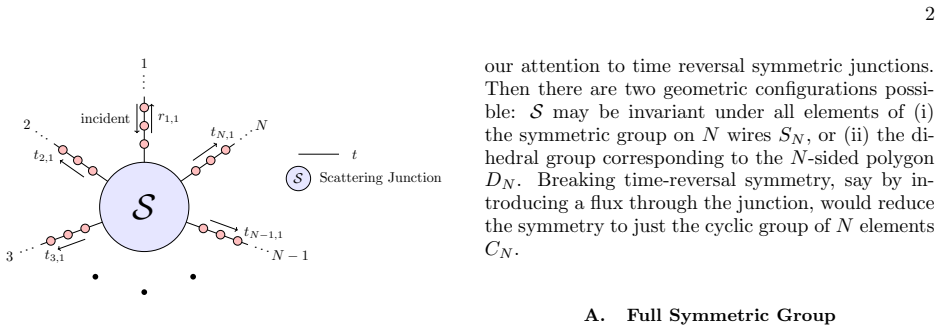
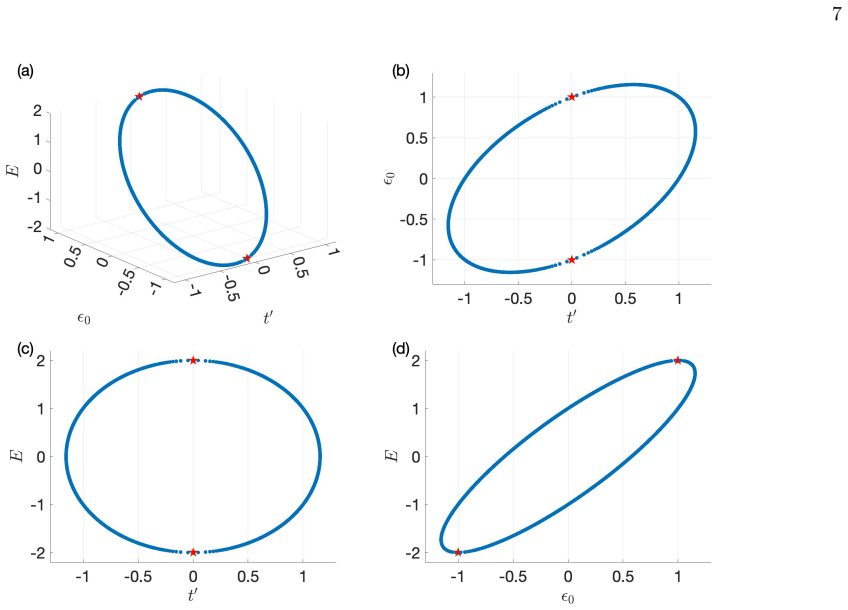
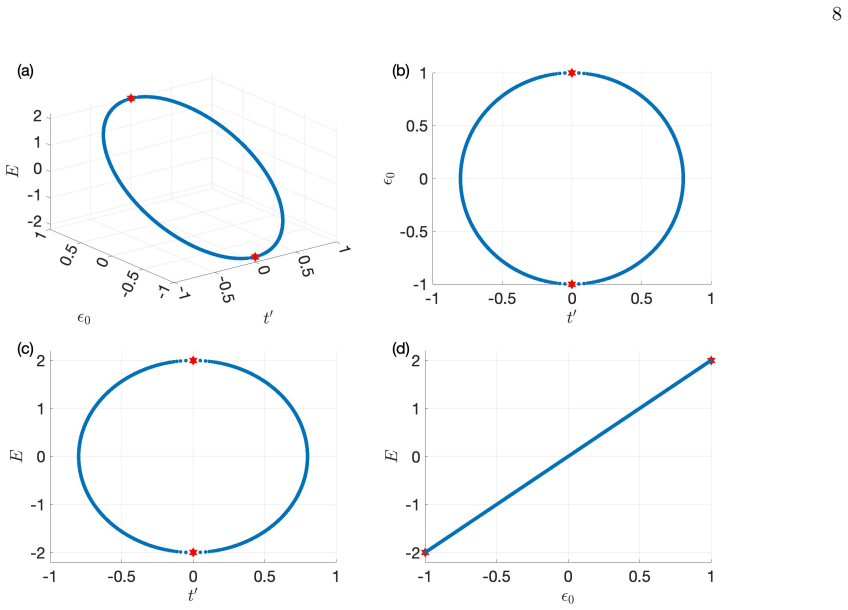
We study scattering in noninteracting multi-terminal quantum wire junctions and show that junctions with dihedral symmetry can exhibit exact zero-reflection points for $N \ge 4$ terminals. By analyzing the scattering matrix, we identify these reflectionless points in the $(E,t')$ parameter space, where $E$ is the incident particle energy and $t'$ is the junction hopping amplitude. These points exhibit an even-odd dependence on $N$ and converge asymptotically to a common limiting value in the large-$N$ limit. We show that the reflectionless points are characterized by an integer winding number associated with the phase of the reflection amplitude, providing a topological description for their stability against weak on-site disorder. We also consider junctions with broken time-reversal symmetry and find that a magnetic flux can induce additional reflectionless points, including for the $N = 3$ case. For a four-terminal junction threaded by a $\pi$-flux, we identify a unique parameter regime in which the reflection amplitude vanishes over the entire energy band. Finally, we discuss experimental signatures through the behavior of Friedel oscillations and examine the stability of these reflectionless points in the presence of weak interactions.
Editorial analysis
A structured set of objections, weighed in public.
Referee Report
Summary. The manuscript studies scattering in noninteracting multi-terminal quantum wire junctions with dihedral symmetry. It identifies exact zero-reflection points in the (E, t') parameter space for N ≥ 4 terminals via scattering-matrix analysis, shows an even-odd N dependence with asymptotic convergence for large N, and associates these points with an integer winding number of the reflection-amplitude phase that protects them against weak on-site disorder. Additional results include flux-induced zeros for N=3 under broken time-reversal symmetry, a special N=4 π-flux regime of band-wide reflectionlessness, discussion of Friedel-oscillation signatures, and perturbative stability under weak interactions.
Significance. If the central claims are correct, the work supplies a concrete topological classification of reflectionless points in symmetric multi-terminal junctions using standard single-particle scattering theory and dihedral-group constraints. The winding-number protection and the explicit flux-induced examples (including complete band suppression for N=4) furnish falsifiable predictions that could be tested in mesoscopic devices. The perturbative treatment of disorder and interactions is consistent with the topological argument and adds practical relevance for quantum-wire experiments.
major comments (2)
- [§4] §4 (scattering-matrix derivation): the claim that the reflection block is constrained to allow isolated zeros relies on the representation theory of the dihedral group together with unitarity; the manuscript should explicitly display the block-diagonal form of the reflection submatrix for general N to confirm that the zero condition is not an artifact of the chosen basis.
- [§5.2] §5.2 (π-flux N=4 case): the statement that reflection vanishes over the entire energy band for a specific (E, t') regime requires an explicit check that the transmission block remains unitary when the reflection amplitude is identically zero; without this, the band-wide claim rests on numerical observation rather than an analytic identity.
minor comments (3)
- Figure 2 caption: the color scale for the winding number is not defined; add an explicit legend or statement that the integer values are obtained by contour integration around the zero.
- Eq. (12): the definition of the phase θ(E,t') should include the branch-cut convention used for the winding-number integral to avoid ambiguity in the large-N limit.
- Reference list: the manuscript cites standard texts on scattering theory but omits recent works on multi-terminal topological transport (e.g., papers on Andreev reflection in junctions); adding 2–3 targeted references would strengthen the context.
Simulated Author's Rebuttal
We thank the referee for the positive assessment and constructive comments on our manuscript. We address each major comment below and will incorporate revisions to strengthen the presentation.
read point-by-point responses
-
Referee: §4 (scattering-matrix derivation): the claim that the reflection block is constrained to allow isolated zeros relies on the representation theory of the dihedral group together with unitarity; the manuscript should explicitly display the block-diagonal form of the reflection submatrix for general N to confirm that the zero condition is not an artifact of the chosen basis.
Authors: We agree that an explicit display of the block-diagonal form will improve clarity. In the revised manuscript we will add the explicit block structure of the reflection submatrix obtained from the dihedral-group representation theory (for both even and odd N), together with the unitarity constraints. This will confirm that the isolated zeros are enforced by symmetry and are independent of basis choice. revision: yes
-
Referee: §5.2 (π-flux N=4 case): the statement that reflection vanishes over the entire energy band for a specific (E, t') regime requires an explicit check that the transmission block remains unitary when the reflection amplitude is identically zero; without this, the band-wide claim rests on numerical observation rather than an analytic identity.
Authors: We thank the referee for this observation. While numerical checks confirm unitarity, we will add an analytic argument in the revision: when the reflection block vanishes identically, the overall unitarity of the scattering matrix together with the dihedral symmetry and π-flux constraints forces the transmission block to be unitary on its own. This supplies the required analytic identity supporting the band-wide reflectionless regime. revision: yes
Circularity Check
Direct scattering-matrix analysis; no circularity
full rationale
The central results follow from explicit construction and diagonalization of the scattering matrix for a finite junction with imposed dihedral symmetry, using the standard single-particle tight-binding model for noninteracting leads. Reflection amplitudes are obtained by solving the linear system imposed by unitarity and the representation of the dihedral group; zeros are located by direct root-finding in the (E,t') plane, and the winding number is the integer change in arg(r) along closed contours around those zeros. None of these steps invoke fitted parameters, self-referential definitions, or load-bearing self-citations whose content is itself unverified. The treatment of weak disorder and interactions is perturbative and does not alter the topological count derived from the clean S-matrix.
Axiom & Free-Parameter Ledger
Reference graph
Works this paper leans on
-
[1]
Therefore, such a junction does not have any reflectionless points
N = 3 Since the dihedral groupD 3 is isomorphic to the symmetric groupS 3, we note that our results for the fully symmetric case immediately carry over (for a junction with three leads) if time-reversal symmetry is not broken. Therefore, such a junction does not have any reflectionless points. In fact, the minimal reflection amplitude isr= 1− 2 3 = 1
-
[2]
The case of time-reversal symmetry broken junctions is consid- ered in section VII
-
[3]
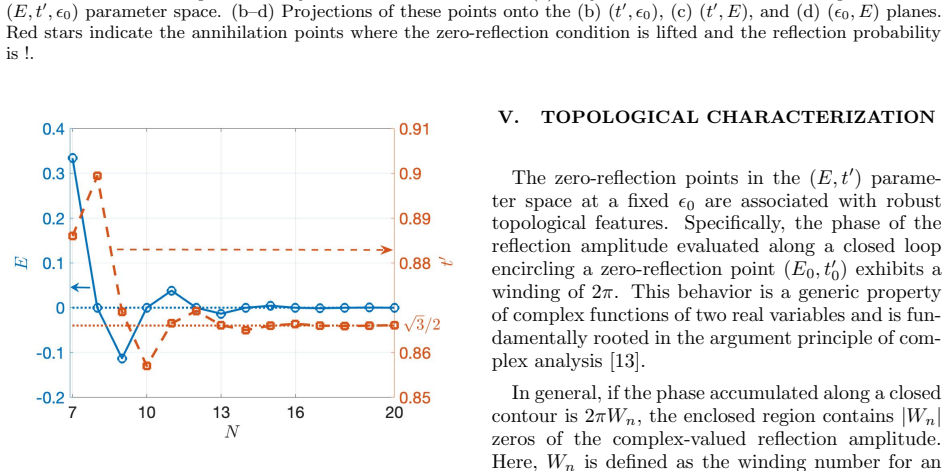
N = 4 S= r t 1 t2 t1 t1 r t 1 t2 t2 t1 r t 1 t1 t2 t1 r (3) As before, we assume (without loss of generality) thatris real, implying that there are 5 real parame- ters inS. Imposing unitarity onS, gives 3 equations of the form:D= 1,O 1 = 0,O 2 = 0, where, D=r 2 +|t 2|2 + 2|t1|2,(4) O1 = 2 Re rt1 +t 1t∗ 2 ,(5) O2 = 2 Re rt2 +|t 1|2,(6) These equa...
-
[4]
(5) and (6) yields two relations among the four angular parameters
Substituting these ex- pressions into Eqs. (5) and (6) yields two relations among the four angular parameters. Imposing the zero-reflection condition,r= 0, requires sinψ= 0 and cos(ϕ 1 −ϕ 2) = 0, which consequently yields t1 = 0 andt 2 =e iϕ2. Physically, this indicates that wires 1 and 3 are perfectly coupled with vanishing reflection, while scattering f...
-
[5]
We label the wiresn= 1,2,
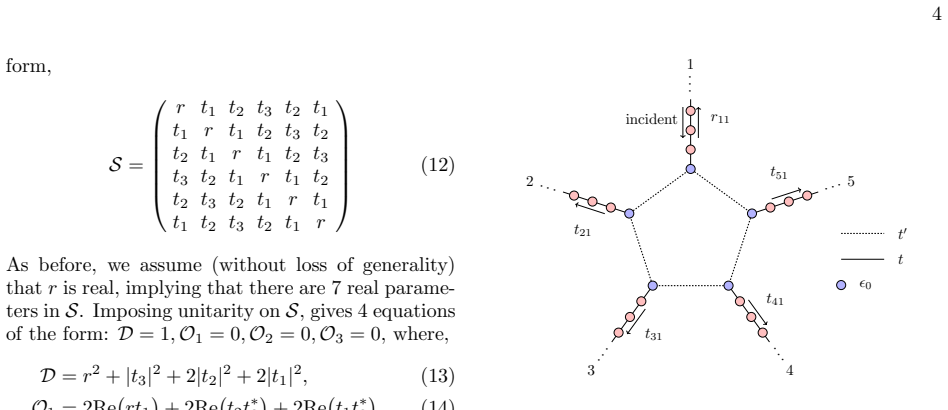
N = 5 Consider a 5-terminal junction with the dihedral symmetryD 5. We label the wiresn= 1,2, . . . ,5 and assume thatn= 1 is the incident wire. Due to the symmetry, there are 2 independent transmission amplitudes:t 2,1 =t 5,1 =t 1 andt 3,1 =t 4,1 =t 2. Then the S-matrix takes the form, S= r t 1 t2 t2 t1 t1 r t 1 t2 t2 t2 t1 r t 1 t2 t2 t2 t1 r t 1...
-
[6]
As before we label the wiresn= 1,2,
N = 6 Consider a 6-terminal junction with the dihedral symmetryD 6. As before we label the wiresn= 1,2, . . . ,6 and assume thatn= 1 is the incident wire. Due to the symmetry, there are 3 independent transmission amplitudes:t 2,1 =t 6,1 =t 1,t 3,1 = t5,1 =t 2 andt 4,1 =t 3. Then the S-matrix takes the 4 form, S= r t 1 t2 t3 t2 t1 t1 r t 1 t2 t3 t...
1902
-
[7]
This behavior is a generic property of complex functions of two real variables and is fun- damentally rooted in the argument principle of com- plex analysis [13]
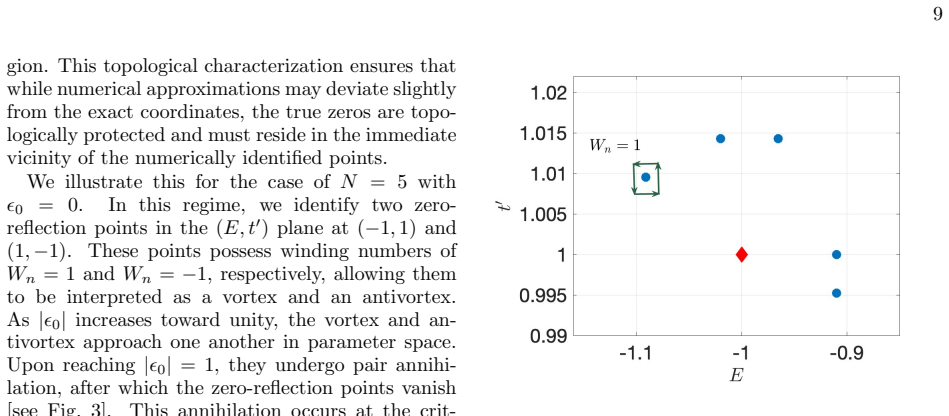
exhibits a winding of 2π. This behavior is a generic property of complex functions of two real variables and is fun- damentally rooted in the argument principle of com- plex analysis [13]. In general, if the phase accumulated along a closed contour is 2πW n, the enclosed region contains|W n| zeros of the complex-valued reflection amplitude. Here,W n is de...
-
[8]
Eq. (24) then gives the following matrix equation M4 1 t2,1 t3,1 t4,1 = 0 0 0 0 ,where M4 = −eik t′e−iϕ/4 0t ′eiϕ/4 t′eiϕ/4 −e−ik t′e−iϕ/4 0 0t ′eiϕ/4 −e−ik t′e−iϕ/4 t′e−iϕ/4 0t ′eiϕ/4 −e−ik , (53) wherek= cos −1[−E/2]. This will have a solution if det(M) = 0. It can be shown that this holds when 2ϵ0 =E, 2t′2 sin ϕ 2 + E2 4...
-
[9]
This implies that an arbitrary wave packet that is incident on any wire will not be reflected at all
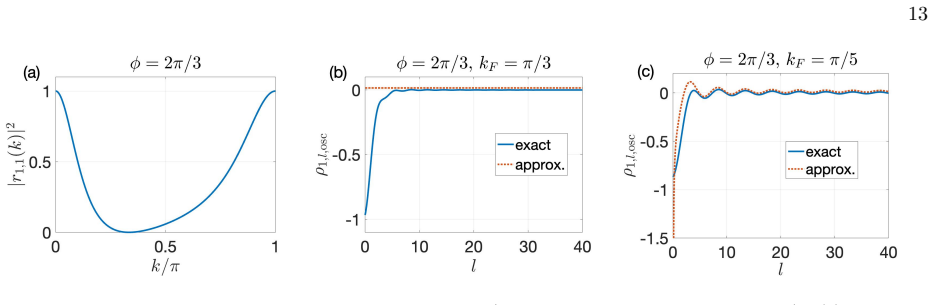
Because the numerator is completely independent of the incident momentum k, this specific tuning of the junction hopping guar- antees an extraordinary result that a zero-reflection amplitude,r k = 0, occurs for allk. This implies that an arbitrary wave packet that is incident on any wire will not be reflected at all. The cross-terminal transmission amplit...
-
[10]
For repulsive (attractive) interactions,α n >0 (<
-
[11]
We will simplify our notation by denoting the re- flection amplitude in wirenasr nn =r n,n(kF ) and the transmission amplitude from wiremto wirenas tnm =t n,m(kF )
and thereforeK n <1 (>1) respectively. We will simplify our notation by denoting the re- flection amplitude in wirenasr nn =r n,n(kF ) and the transmission amplitude from wiremto wirenas tnm =t n,m(kF ). These define a scattering matrixS as usual. Next, we define a diagonal matrixFwhose entries are given by Fnn =− 1 2 αn rnn.(70) Ref. [2] then shows that ...
2022
-
[12]
Tan and R
E. Tan and R. Ganesh, Scattering off a junction, Can. J. Phys.103, 577 (2025)
2025
-
[13]
S. Lal, S. Rao, and D. Sen, Junction of several weakly interacting quantum wires: A renormaliza- 15 tion group study, Phys. Rev. B66, 165327 (2002)
2002
-
[14]
Chamon, M
C. Chamon, M. Oshikawa, and I. Affleck, Junctions of three quantum wires and the dissipative Hofs- tadter model, Phys. Rev. Lett.91, 206403 (2003)
2003
-
[15]
Oshikawa, C
M. Oshikawa, C. Chamon, and I. Affleck, Junctions of three quantum wires, J. Stat. Mech.: Theory Exp. 2006(02), P02008
2006
-
[16]
Soori and D
A. Soori and D. Sen, Conductance of Tomonaga- Luttinger liquid wires and junctions with resis- tances, EPL93, 57007 (2011)
2011
-
[17]
W. R. Sweeney, C. W. Hsu, and A. D. Stone, Theory of reflectionless scattering modes, Phys. Rev. A102, 063511 (2020)
2020
- [18]
-
[19]
J. E. Avron, A. Elgart, G. M. Graf, and L. Sadun, Optimal quantum pumps, Phys. Rev. Lett.87, 236601 (2001)
2001
-
[20]
Entin-Wohlman and A
O. Entin-Wohlman and A. Aharony, Quantized adi- abatic charge pumping and resonant transmission, Phys. Rev. B66, 035329 (2002)
2002
-
[21]
J. E. Avron, A. Elgart, G. M. Graf, and L. Sadun, Transport and dissipation in quantum pumps, J. Stat. Phys.116, 425 (2004)
2004
-
[22]
A. R. Goni, L. N. Pfeiffer, K. W. West, A. Pinczuk, H. U. Baranger, and H. L. Stormer, Observation of quantum wire formation at intersecting quantum wells, Appl. Phys. Lett.61, 1956 (1992)
1956
-
[23]
Hamermesh,Group Theory and Its Applica- tion to Physical Problems, Dover Books on Physics (Dover Publications, 2012)
M. Hamermesh,Group Theory and Its Applica- tion to Physical Problems, Dover Books on Physics (Dover Publications, 2012)
2012
-
[24]
J. W. Brown and R. V. Churchill,Complex Vari- ables and Applications, 8th ed. (McGrawHill Higher Education, 2009)
2009
-
[25]
Datta,Quantum Transport: Atom to Transis- tor(Cambridge University Press, Cambridge, UK, 2005)
S. Datta,Quantum Transport: Atom to Transis- tor(Cambridge University Press, Cambridge, UK, 2005)
2005
-
[26]
Friedel, Metallic alloys, Il Nuovo Cimento (1955- 1965)7, 287 (1958)
J. Friedel, Metallic alloys, Il Nuovo Cimento (1955- 1965)7, 287 (1958)
1955
-
[27]
T¨ utto and A
I. T¨ utto and A. Zawadowski, Quantum theory of local perturbation of the charge-density wave by an impurity: Friedel oscillations, Phys. Rev. B32, 2449 (1985)
1985
-
[28]
Egger and H
R. Egger and H. Grabert, Friedel oscillations for interacting fermions in one dimension, Phys. Rev. Lett.75, 3505 (1995)
1995
-
[29]
D. Yue, L. I. Glazman, and K. A. Matveev, Conduc- tion of a weakly interacting one-dimensional elec- tron gas through a single barrier, Phys. Rev. B49, 1966 (1994)
1966
discussion (0)
Sign in with ORCID, Apple, or X to comment. Anyone can read and Pith papers without signing in.