Qudit extension of parameterized IQP circuits: A generative quantum machine learning approach to integer data
Pith reviewed 2026-06-29 03:22 UTC · model grok-4.3
The pith
Parameterized IQP circuits extended to qudits allow generative learning on integer data while keeping the original distances intact.
A machine-rendered reading of the paper's core claim, the machinery that carries it, and where it could break.
Core claim
By mapping each integer pixel to a fixed-length bit-string and converting the IQP gates to the corresponding qudit operations, the circuit can be trained with a tailored loss function and feature covariance matrix to generate distributions over integer data that respect the original metric structure, as verified on single-particle electron shower energy deposits recorded in the CLIC electromagnetic calorimeter.
What carries the argument
The qudit-adapted parameterized IQP circuit that encodes integers directly via fixed-length bit-strings and applies transformed gates to operate in the qudit formalism.
If this is right
- The trained circuit produces generative samples of integer energy deposits that preserve the metric structure of the input data.
- A covariance matrix among features can be computed directly from the circuit output to guide training.
- The same loss function and circuit adaptation apply to any other non-binary integer dataset.
- The construction extends existing parameterized IQP generative models beyond binary distributions.
Where Pith is reading between the lines
- Detector simulation tasks that rely on integer energy values could adopt this encoding to reduce preprocessing artifacts.
- Hardware implementations on qudit-capable devices would need to verify whether the gate transformations retain their theoretical advantage.
- The same integer-to-qudit mapping could be tested on other discrete data types such as counts or quantized sensor readings.
Load-bearing premise
Converting the gates to qudit form while using fixed-length bit-string encodings for integers keeps the metric distances of the original data better than ordinary binary qubit mappings.
What would settle it
Measure the average distance between generated and true samples under the original integer metric on the calorimeter dataset and compare the qudit model against an otherwise identical binary IQP model; a statistically significant improvement for the qudit version would support the claim.
Figures
read the original abstract
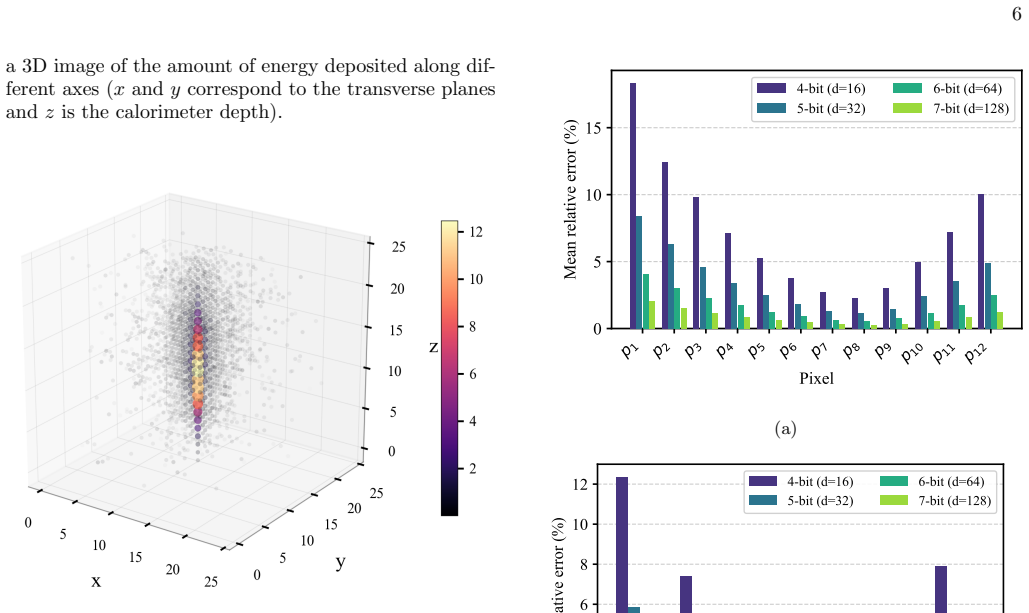
Parameterized Instantaneous Quantum Polynomial (IQP) circuits have proven useful in quantum generative learning models, particularly for binary distributions. However, when applied to non-binary datasets, they exhibit notable limitations: mapping integer values into qubit-compatible binary representations often destroys the original metric structure of the data. In this paper we aim to extend them to a qudits formulation operating on an integer mapping of the data. The IQP quantum circuit is adapted to encode each integer valued pixel into a bit-string of fixed length and quantum gates are transformed to follow the qudit formalism. As a generative machine learning approach, a suitable loss function for the circuit training and the calculation of the covariance matrix among features are developed and validated on the energy deposits from single-particle electron showers in the electromagnetic calorimeter of the CLIC detector. The method proposed in this work can be also extended to other applications that utilize quantum generative machine learning for non-binary data.
Editorial analysis
A structured set of objections, weighed in public.
Referee Report
Summary. The manuscript proposes extending parameterized Instantaneous Quantum Polynomial (IQP) circuits from qubits to qudits for generative quantum machine learning on integer-valued data. The approach encodes each integer pixel into a fixed-length bit-string, transforms the quantum gates to qudit formalism, introduces a loss function and covariance matrix calculation for training, and validates the method on energy deposits from single-particle electron showers in the CLIC detector electromagnetic calorimeter. The work claims this enables better handling of non-binary data compared to standard binary qubit mappings.
Significance. If the qudit extension demonstrably improves metric preservation and generative performance on integer data without introducing new inconsistencies, it would provide a concrete route for applying IQP-based generative models to non-binary datasets in high-energy physics and similar domains. The use of real detector data for validation is a strength, but the absence of any reported quantitative results, baselines, error bars, or explicit metric comparisons in the abstract prevents a full assessment of impact.
major comments (1)
- [Abstract] Abstract: The central motivation is that binary mappings of integers to qubits destroy the original metric structure of the data. However, the described procedure still encodes each integer valued pixel into a bit-string of fixed length before transforming gates to the qudit formalism. This encoding step appears identical to the binary case being criticized, so any claimed advantage must derive solely from the subsequent gate transformation; no analysis, distance metric comparison, or ablation is indicated to show that metric structure is restored or better preserved.
minor comments (1)
- The abstract states that validation occurred but supplies no quantitative results, performance metrics, baseline comparisons, or derivation details for the loss function or covariance calculation, making it impossible to evaluate the method's effectiveness from the provided text.
Simulated Author's Rebuttal
We thank the referee for their careful reading of the manuscript and for identifying an important point of clarification in the abstract. We respond to the major comment below.
read point-by-point responses
-
Referee: [Abstract] Abstract: The central motivation is that binary mappings of integers to qubits destroy the original metric structure of the data. However, the described procedure still encodes each integer valued pixel into a bit-string of fixed length before transforming gates to the qudit formalism. This encoding step appears identical to the binary case being criticized, so any claimed advantage must derive solely from the subsequent gate transformation; no analysis, distance metric comparison, or ablation is indicated to show that metric structure is restored or better preserved.
Authors: We agree that the initial encoding of each integer pixel into a fixed-length bit-string is a shared preliminary step with binary qubit mappings, and that the abstract does not explicitly demonstrate via distance metrics or ablations how metric structure is restored. The claimed advantage therefore rests on the subsequent transformation of the IQP gates into qudit formalism together with the integer-specific loss function and covariance matrix. These elements are developed in the body of the manuscript and validated on the CLIC electromagnetic calorimeter data. To address the referee's concern directly, we will revise the abstract to state explicitly that metric preservation is intended to arise from the qudit gate transformations and the associated training procedure rather than from the encoding step itself, and we will add a cross-reference to the relevant sections. revision: yes
Circularity Check
No significant circularity; method extension is self-contained with external validation.
full rationale
The paper describes a methodological extension of IQP circuits to qudits for integer-valued data, including an encoding step and loss function, validated on external CLIC detector data. No equations, fitted parameters called predictions, or self-citations are visible in the abstract or description that would reduce any claimed result to its own inputs by construction. The derivation chain (if present in full text) appears independent of the enumerated circularity patterns, with the external benchmark providing falsifiability outside any internal fit.
Axiom & Free-Parameter Ledger
axioms (1)
- domain assumption Qudit formalism can be applied to IQP circuits by transforming gates to follow the qudit version while encoding integers into fixed-length bit-strings
Reference graph
Works this paper leans on
-
[1]
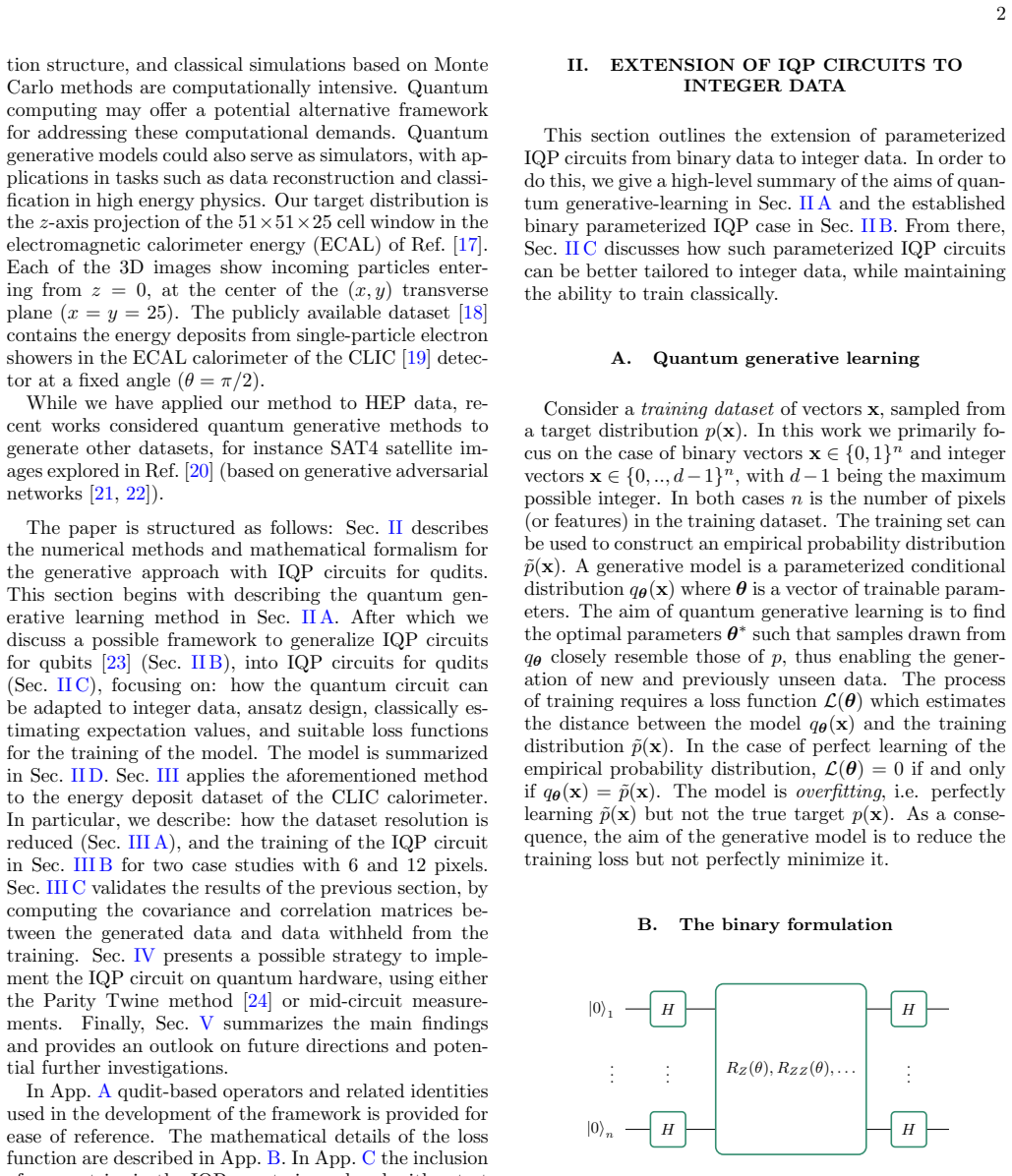
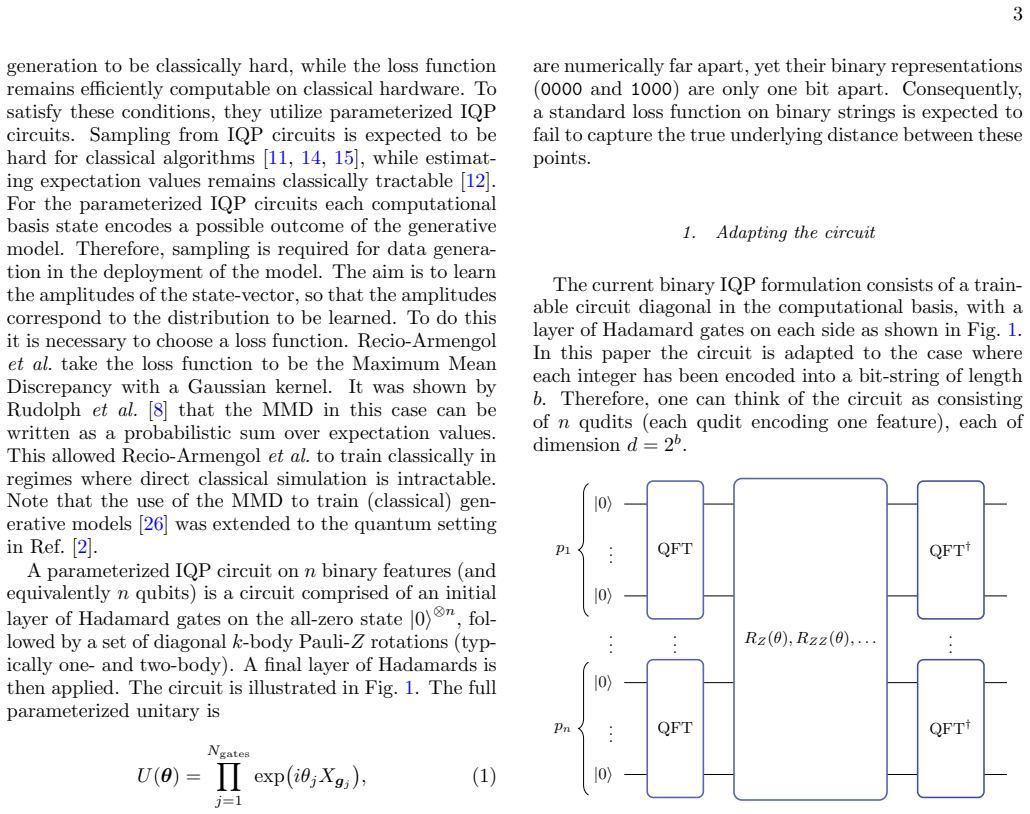
Adapting the circuit The current binary IQP formulation consists of a train- able circuit diagonal in the computational basis, with a layer of Hadamard gates on each side as shown in Fig. 1. In this paper the circuit is adapted to the case where each integer has been encoded into a bit-string of length b. Therefore, one can think of the circuit as consist...
-
[2]
Note that for qudits, these Pauli operators are defined such that ap- plying themdtimes returns the identity operator,X d d = Z d d =I d
Estimating expectation values Having looked at the generalization of the Hadamard to qudits, we now define the Pauli-Zand Pauli-Xoper- ators to be [28]: Zd = d−1X j=0 ωj d |j⟩ ⟨j|,(4) Xd = d−1X j=0 |j+ 1 modd⟩ ⟨j|,(5) with the latter acting as a cyclic shift. Note that for qudits, these Pauli operators are defined such that ap- plying themdtimes returns t...
-
[3]
Selecting a loss-function The loss-function used in Ref. [9] is the Maximum Mean Discrepancy: MMD2(p, qθ) =E a∼Pσ(a) h (⟨Za⟩p − ⟨Za⟩qθ)2 i (9) for qubits in the binary IQP case, wherea∼P σ(a) de- notes sampling each term inafrom an independent and identical Bernoulli trial. The success probability of the Bernoulli trial is parameterized by the bandwidthσ....
-
[4]
The form of this diagonal ansatz is left as a design choice
Ansatz design The IQP circuit contains a parameterized unitary which is diagonal in the computational basis. The form of this diagonal ansatz is left as a design choice. In Sec. III a hardware efficient ansatz [30] is considered, on the as- sumption that the hardware is ultimately qubit based, all one- and two- body qubitZrotations available on the hardwa...
-
[5]
Train on classical To evaluate the loss-function:
-
[6]
SampleN ops operators from Eq. (12). This value affects the precision of the MMD estimate
-
[7]
Each string is of lengthnand each element takes integer values between 0 andd−1
SampleN s strings from a uniform distribution. Each string is of lengthnand each element takes integer values between 0 andd−1
-
[8]
(8) approximate the expectation values of theN ops operators using theN s random strings
Using Eq. (8) approximate the expectation values of theN ops operators using theN s random strings. Note that the statistical error scales as∼1/ √Ns
-
[9]
The loss-function and the gradient can then be used to update the classical optimizer that tunes the parameter- ized quantum gates in the IQP circuit
While fixing the samples, the gradient of the loss- function can be found with automatic differentia- tion [31]. The loss-function and the gradient can then be used to update the classical optimizer that tunes the parameter- ized quantum gates in the IQP circuit
-
[10]
In the next section, the IQP qudit model is applied to calorimeter data, which is mapped onto integers with finite precision
Deploy on quantum Once the model has been classically trained, each im- age can be generated from sampling the IQP circuit in the computational basis. In the next section, the IQP qudit model is applied to calorimeter data, which is mapped onto integers with finite precision. In App. C, a second application is an- alyzed, namely the Potts model [32], at f...
-
[11]
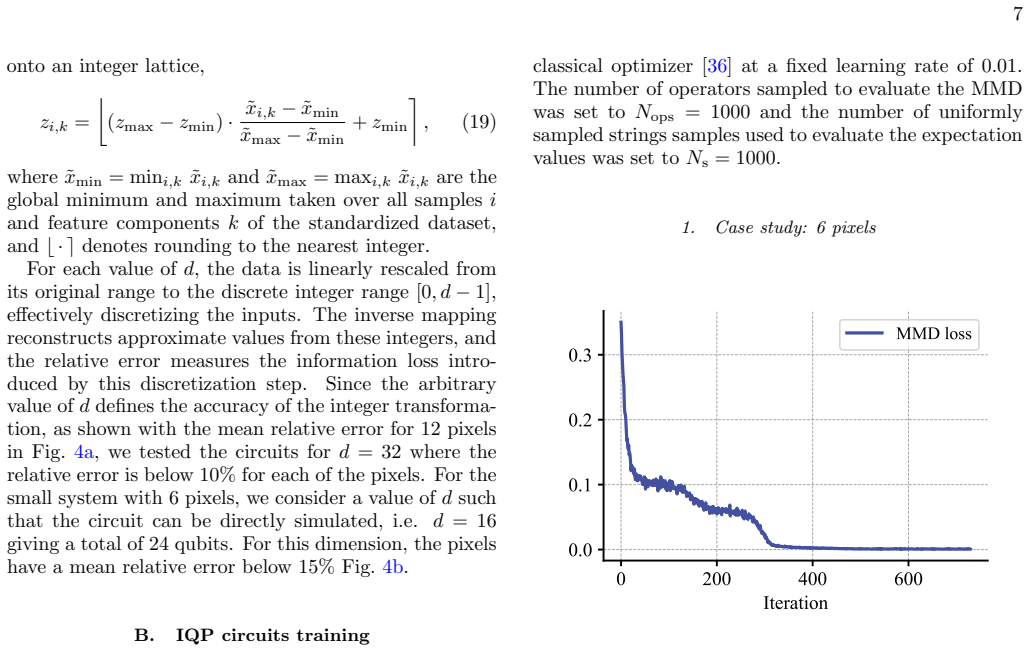
Case study: 6 pixels 0 200 400 600 Iteration 0.0 0.1 0.2 0.3 MMD loss FIG. 5:Loss function for 6 pixels images and qudit dimension d=16:The MMD loss function in the IQP circuits training with kernel bandwidthσ= 5 and scale for the initial gates parameters of 0.03. The first analysis performed was a training on a 6- pixels dataset with qudit dimensiond= 16...
-
[12]
A case, where quantum hardware is required for sampling the final probability distribution
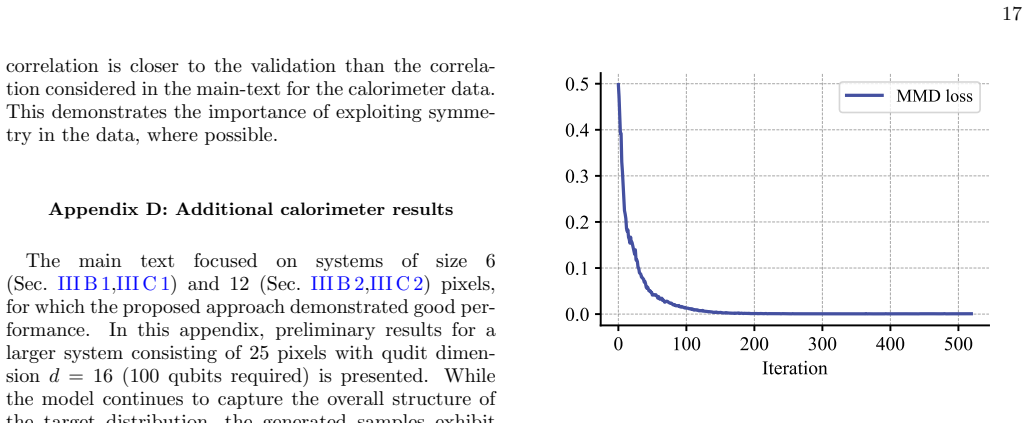
Case study: 12 pixels As a second example of training with the IQP circuit, a larger dataset of 12 pixels withd= 32 is explored, thus requiring a total of 60 qubits. A case, where quantum hardware is required for sampling the final probability distribution. A total number of 1830 variational param- eters are used in the training. As in the previous case, ...
-
[13]
error (%) FIG
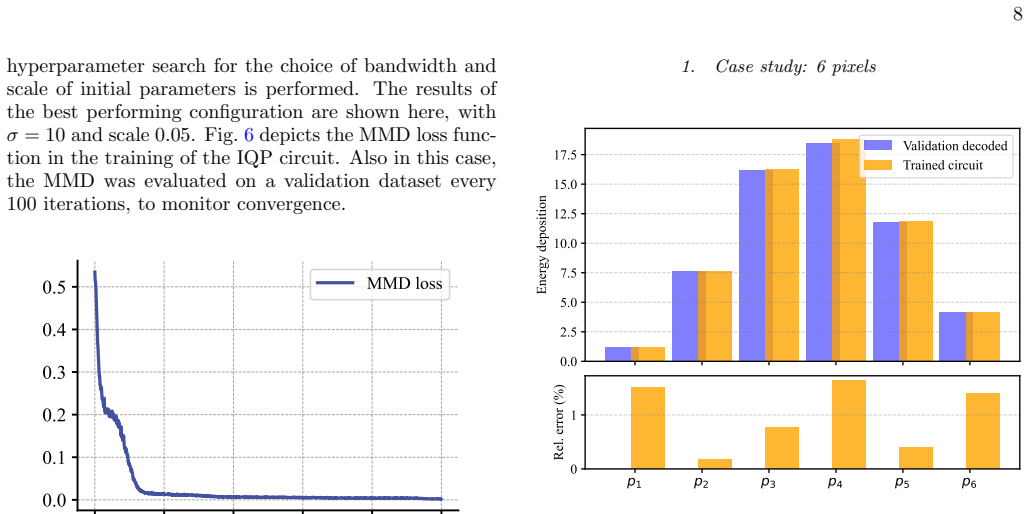
Case study: 6 pixels 0.0 2.5 5.0 7.5 10.0 12.5 15.0 17.5Energy deposition Validation decoded Trained circuit p1 p2 p3 p4 p5 p6 0 1Rel. error (%) FIG. 7:Mean energy deposition for 6 pixels images with d=16:(top panel) Energy deposition values of rescaled integer validation distribution (blue) and generated samples from the trained IQP circuit (orange) with...
-
[14]
The trained model is first compared to the withheld validation dataset
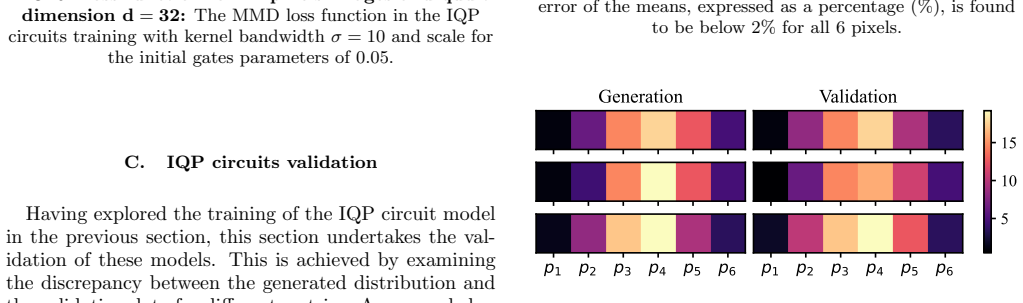
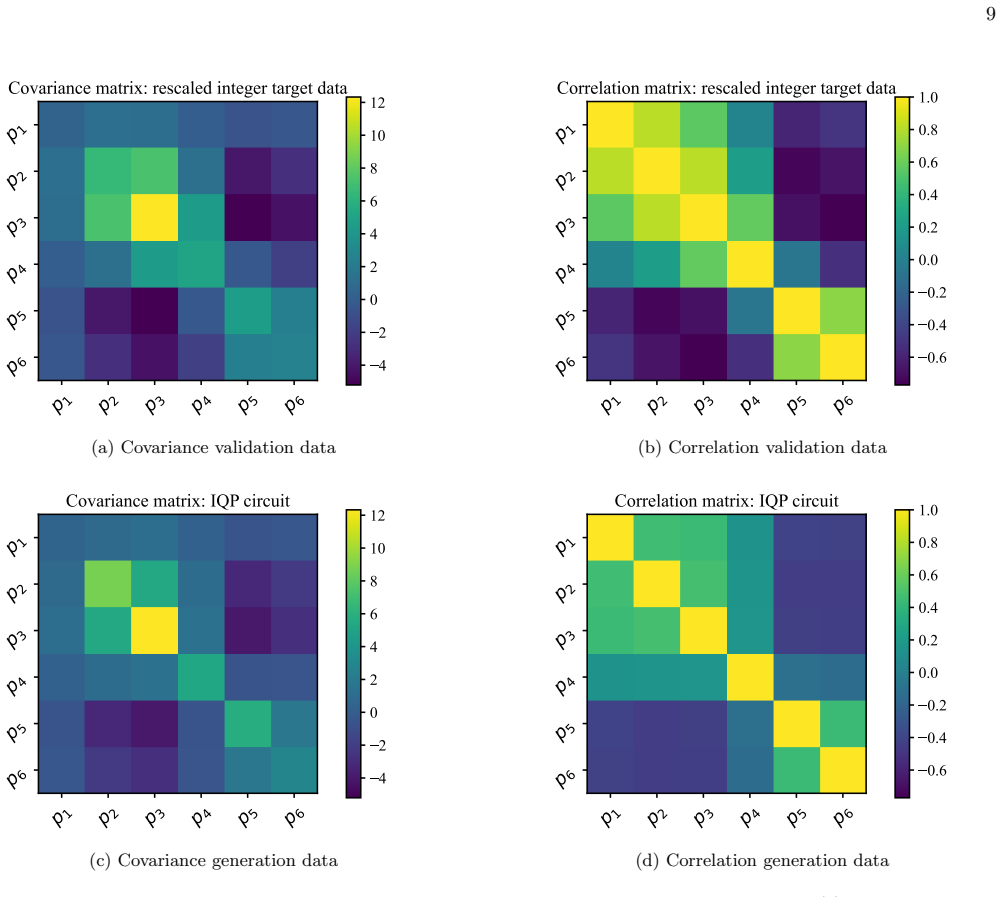
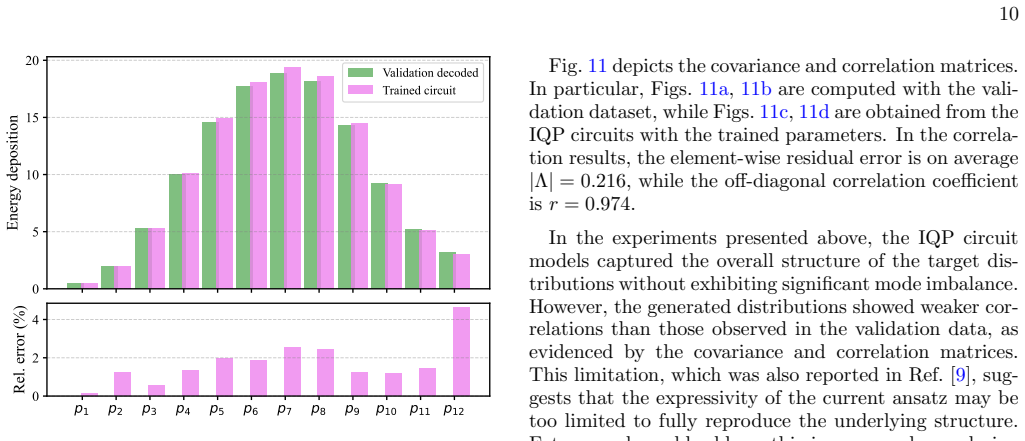
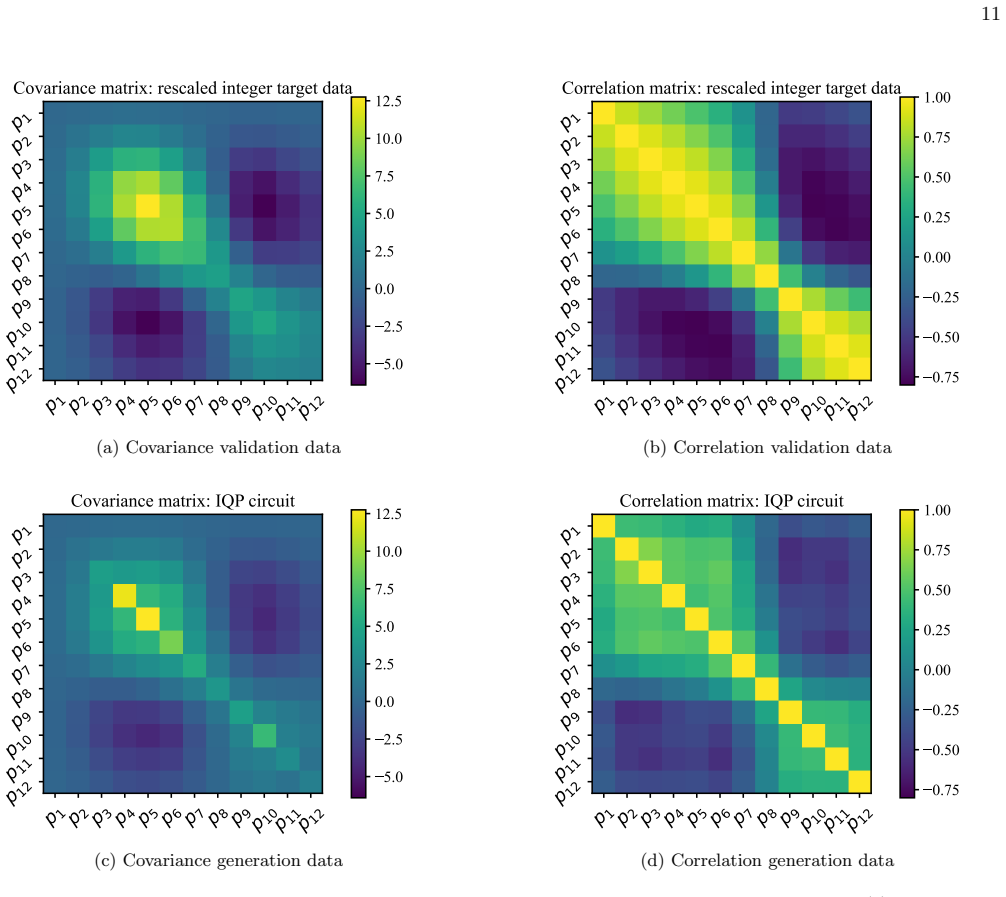
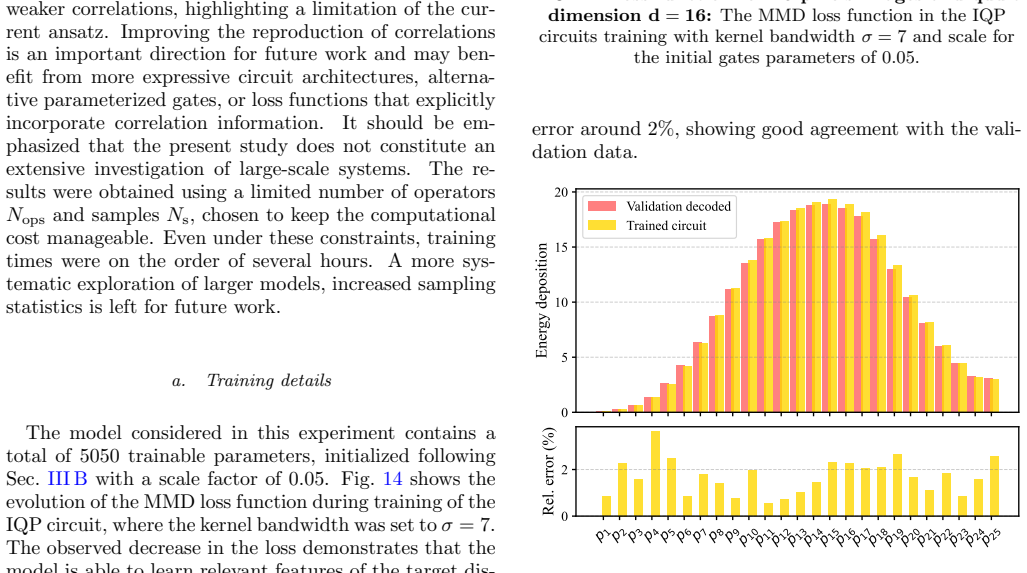
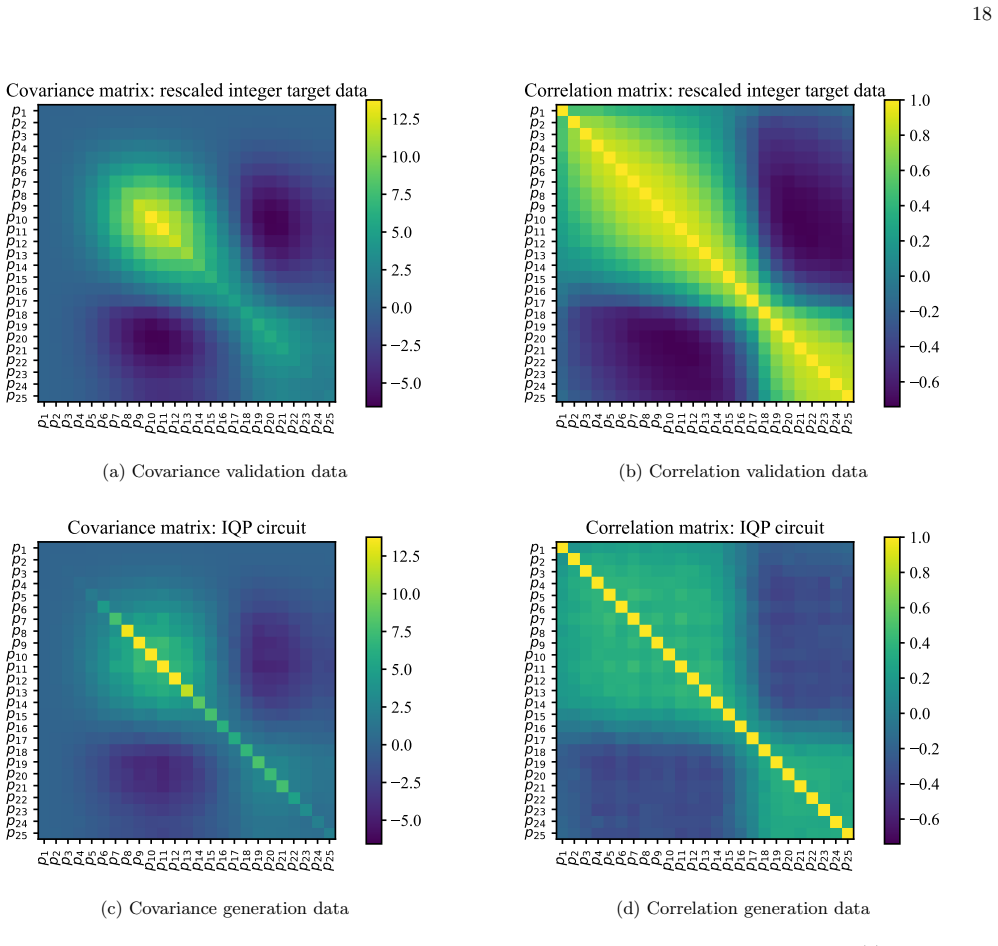
Case study: 12 pixels The same analysis, as in the previous section, is now repeated for the 12 pixels case. The trained model is first compared to the withheld validation dataset. A MMD 2 value of (2.9±0.1)×10 −3 is found. Since, single images using a simulator cannot be generated in this case , we estimate the expectation value of the number operator fo...
-
[15]
, d−1, a permu- tationscan be applied to the labels of the data
Estimating expectation values Given dataxlabelled by integers 0, . . . , d−1, a permu- tationscan be applied to the labels of the data. An ex- ample permutation could be 0→1,1→2, . . . , d−1→0. We desire a model that has the property pθ(x) =p θ(s(x)).(C1) This can be achieved by modifying the initial state of the IQP qudit-based model to be invariant unde...
-
[16]
A suitable loss-function The MMD relies on a kernel function; here, a ker- nel that better incorporates the categorical nature of the data labels is constructed. Eq. (B3) shows a kernel oper- ator acting between data encoded in two registers. The distance between the states is defined to be zero if they are the same and 1 otherwise, this gives the kernel:...
-
[17]
The Hamil- tonian for the Potts model is given by HPotts =− X ⟨i,j⟩ Ji,j1(S i =S j),(C10) and is defined on a square lattice of sizeL×Lwith peri- odic boundary conditions
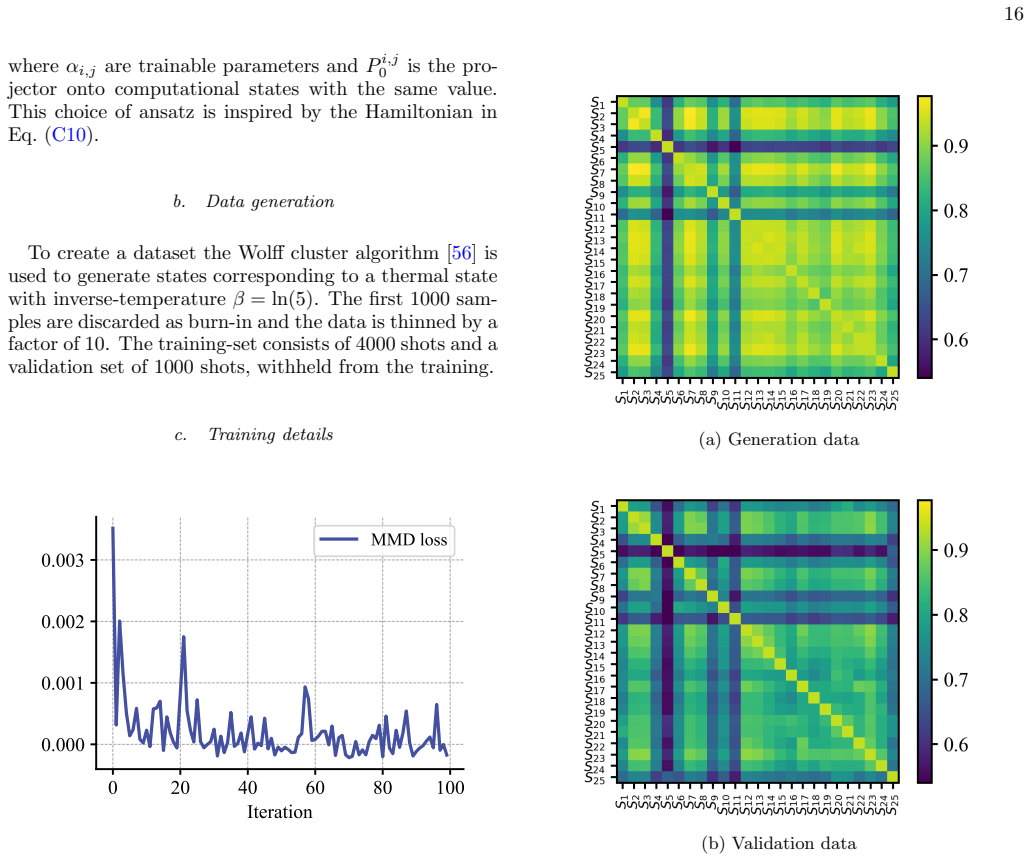
The Potts model To assess the performance of the method, we consider the Potts model [32] at finite temperature. The Hamil- tonian for the Potts model is given by HPotts =− X ⟨i,j⟩ Ji,j1(S i =S j),(C10) and is defined on a square lattice of sizeL×Lwith peri- odic boundary conditions. EachJ i,j is randomly sampled from a uniform distribution between 0 and ...
-
[18]
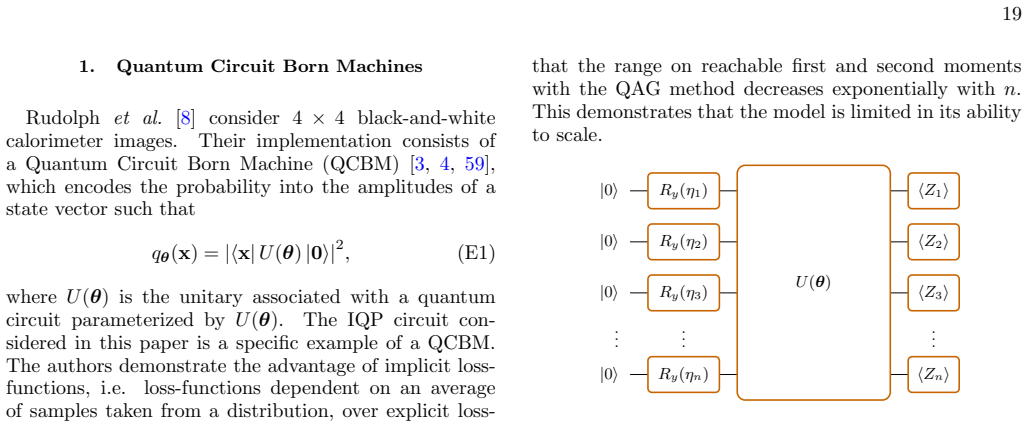
Quantum Circuit Born Machines Rudolphet al.[8] consider 4×4 black-and-white calorimeter images. Their implementation consists of a Quantum Circuit Born Machine (QCBM) [3, 4, 59], which encodes the probability into the amplitudes of a state vector such that qθ(x) =|⟨x|U(θ)|0⟩| 2,(E1) whereU(θ) is the unitary associated with a quantum circuit parameterized ...
-
[19]
Amplitude encoding Encoding the intensity of each pixel as the ampli- tude of a quantum state was considered by Changet al.in Ref. [60]. The model they consider is an ex- ample of a Quantum Generative Adversarial Networks (QGAN) [21, 22], where amplitude encoding means that the number of qubits required is logarithmic in the num- ber of pixels. However, a...
-
[20]
Tr U †(θ)ZiU(θ) nO k=1 ρ0(ηk) ! Tr U †(θ)ZjU(θ) nO k=1 ρ0(ηk) !# −E η
The Quantum Angle Generator The Quantum Angle Generator (QAG), applied to calorimeter data in Ref. [34], encodesnfeatures inton qubits. Each grey-scale pixel is encoded as theZex- pectation value of the corresponding qubit. The circuit consists of a trainable unitaryU(θ), whereθdenotes the trainable parameters. To allow for the generation of multiple imag...
-
[21]
The paper decouples the number of features, using three qubits to learn images of size 12 and 25 pixels
Quantum Feature Amplification Network In a recent work a model referred to as a Quantum Feature Amplification Network (QFAN) was proposed by Slimet al.[63] to tackle calorimeter data. The paper decouples the number of features, using three qubits to learn images of size 12 and 25 pixels. Table 1 in Ref. [63] implies 10 qubits are sufficient for grey-scale...
-
[22]
The IQP circuits consid- ered in the work are sparse in terms of two qubit gates between qubits
Sparse binary IQP circuits During the preparation of this manuscript, a paper ap- plying binary IQP circuits to the calorimeter data was published by Slimet al.[25]. The IQP circuits consid- ered in the work are sparse in terms of two qubit gates between qubits. The diagonal part of the IQP circuits considered in Ref. [25] consist of single qubit rotation...
-
[23]
If two qubits in a binary IQP circuit share neither common nodes nor an edge, the two qubits have zero covariance (hence zero correlation)
-
[24]
[25], the fraction of nodes with zero correlation approaches 1 asnapproaches infinity
For the fixed average degree graphs considered in Ref. [25], the fraction of nodes with zero correlation approaches 1 asnapproaches infinity. The rest of this section elaborates on these points. Consider the two point function⟨Z iZj⟩for a binary IQP circuit withnqubits. Since all diagonal gates com- mute, the Heisenberg evolution of anyZonly has support o...
-
[25]
At ∆ = 6 andn= 64 consid- ered in Ref
If nbr(i)∩nbr(j) =∅then Cov(Zi, Zj) =⟨Z iZj⟩ − ⟨Zi⟩⟨Zj⟩= 0.(E12) So the number of qubits with non-zero correlation van- ishes asntends to infinity. At ∆ = 6 andn= 64 consid- ered in Ref. [25],P(nbr(i)∩nbr(j) =∅)≈0.514. Hence, for the average Erd˝ os–R´ enyi graph with ∆ = 6,n= 64, approximately half of the qubit correlations should be zero. This suggests ...
-
[26]
Perdomo-Ortiz, M
A. Perdomo-Ortiz, M. Benedetti, J. Realpe-G´ omez, and R. Biswas, Opportunities and challenges for quantum- assisted machine learning in near-term quantum comput- ers, Quantum science and technology3, 030502 (2018)
2018
-
[27]
J.-G. Liu and L. Wang, Differentiable learning of quan- tum circuit born machines, Physical Review A98, 10.1103/physreva.98.062324 (2018)
-
[28]
Benedetti, D
M. Benedetti, D. Garcia-Pintos, O. Perdomo, V. Leyton- Ortega, Y. Nam, and A. Perdomo-Ortiz, A generative modeling approach for benchmarking and training shal- low quantum circuits, npj Quantum information5, 45 (2019)
2019
-
[29]
Coyle, D
B. Coyle, D. Mills, V. Danos, and E. Kashefi, The born supremacy: quantum advantage and training of an ising born machine, npj Quantum Information6, 60 (2020)
2020
-
[30]
J. R. McClean, S. Boixo, V. N. Smelyanskiy, R. Bab- bush, and H. Neven, Barren plateaus in quantum neural network training landscapes, Nature communications9, 4812 (2018)
2018
-
[31]
Cerezo, A
M. Cerezo, A. Sone, T. Volkoff, L. Cincio, and P. J. Coles, Cost function dependent barren plateaus in shal- low parametrized quantum circuits, Nature communica- tions12, 1791 (2021)
2021
-
[32]
Ortiz Marrero, M
C. Ortiz Marrero, M. Kieferov´ a, and N. Wiebe, Entanglement-induced barren plateaus, PRX quantum2, 040316 (2021)
2021
-
[33]
M. S. Rudolph, S. Lerch, S. Thanasilp, O. Kiss, O. Shaya, S. Vallecorsa, M. Grossi, and Z. Holmes, Trainability bar- riers and opportunities in quantum generative modeling, npj Quantum Information10, 116 (2024)
2024
-
[34]
E. Recio-Armengol, S. Ahmed, and J. Bowles, Train on classical, deploy on quantum: scaling generative quantum machine learning to a thousand qubits, arXiv preprint arXiv:2503.02934 (2026), arXiv:2503.02934 [quant-ph]
arXiv 2026
-
[35]
Nakata and M
Y. Nakata and M. Murao, Diagonal quantum circuits: Their computational power and applications, The Euro- pean Physical Journal Plus129, 152 (2014)
2014
-
[36]
M. J. Bremner, A. Montanaro, and D. J. Shepherd, Average-case complexity versus approximate simulation 22 of commuting quantum computations, Physical review letters117, 080501 (2016)
2016
-
[37]
M. V. den Nest, Simulating quantum computers with probabilistic methods (2010), arXiv:0911.1624 [quant- ph]
Pith/arXiv arXiv 2010
-
[38]
Gretton, K
A. Gretton, K. M. Borgwardt, M. J. Rasch, B. Sch¨ olkopf, and A. Smola, A kernel two-sample test, The journal of machine learning research13, 723 (2012)
2012
-
[39]
M. J. Bremner, R. Jozsa, and D. J. Shepherd, Classical simulation of commuting quantum computations implies collapse of the polynomial hierarchy, Proceedings of the Royal Society A: Mathematical, Physical and Engineer- ing Sciences467, 459 (2011)
2011
-
[40]
S. C. Marshall, S. Aaronson, and V. Dunjko, Im- proved separation between quantum and classical com- puters for sampling and functional tasks, arXiv preprint arXiv:2410.20935 (2024)
arXiv 2024
-
[41]
Hangleiter and J
D. Hangleiter and J. Eisert, Computational advantage of quantum random sampling, Reviews of Modern Physics 95, 035001 (2023)
2023
-
[42]
Belayneh, F
D. Belayneh, F. Carminati, A. Farbin, B. Hooberman, G. Khattak, M. Liu, J. Liu, D. Olivito, V. B. Pacela, M. Pierini,et al., Calorimetry with deep learning: par- ticle simulation and reconstruction for collider physics, The European Physical Journal C80, 1 (2020)
2020
-
[43]
M. Pierini and M. Zhang, Clic calorimeter 3d images: Electron showers at fixed angle, 10.5281/zenodo.3603122 (2020)
-
[44]
L. Linssen, A. Miyamoto, M. Stanitzki, and H. Weerts, Physics and detectors at clic: Clic conceptual design re- port, arXiv preprint arXiv:1202.5940 (2012)
Pith/arXiv arXiv 2012
-
[45]
M. Liepelt and J. Baglio, Exponential capacity scaling of classical gans compared to hybrid latent style-based quantum gans (2026), arXiv:2601.05036 [quant-ph]
arXiv 2026
-
[46]
P.-L. Dallaire-Demers and N. Killoran, Quantum gen- erative adversarial networks, Physical Review A98, 10.1103/physreva.98.012324 (2018)
-
[47]
C. Zoufal, A. Lucchi, and S. Woerner, Quantum gen- erative adversarial networks for learning and load- ing random distributions, npj Quantum Information5, 10.1038/s41534-019-0223-2 (2019)
-
[48]
E. Armengol and J. Bowles, Iqpopt: Fast optimization of instantaneous quantum polynomial circuits in jax (2026), arXiv:2501.04776 [quant-ph]
Pith/arXiv arXiv 2026
- [49]
-
[50]
J. Slim, S. Monaco, F. Rehm, D. Kr¨ ucker, and K. Bor- ras, An iqp born machine for calorimeter image genera- tion at 64 qubits with compiled-iqp deployment (2026), arXiv:2605.27735 [quant-ph]
Pith/arXiv arXiv 2026
-
[51]
Y. Li, K. Swersky, and R. Zemel, Generative moment matching networks, inInternational conference on ma- chine learning(PMLR, 2015) pp. 1718–1727
2015
- [52]
- [53]
- [54]
-
[55]
Leone, S
L. Leone, S. F. Oliviero, L. Cincio, and M. Cerezo, On the practical usefulness of the hardware efficient ansatz, Quantum8, 1395 (2024)
2024
-
[56]
Griewank and A
A. Griewank and A. Walther,Evaluating derivatives: principles and techniques of algorithmic differentiation (SIAM, 2008)
2008
-
[57]
F. Y. Wu, The potts model, Rev. Mod. Phys.54, 235 (1982)
1982
-
[58]
Agostinelli, J
S. Agostinelli, J. Allison, K. a. Amako, J. Apostolakis, H. Araujo, P. Arce, M. Asai, D. Axen, S. Banerjee, G. Barrand,et al., Geant4—a simulation toolkit, Nuclear instruments and methods in physics research section A: Accelerators, Spectrometers, Detectors and Associated Equipment506, 250 (2003)
2003
-
[59]
F. Rehm, S. Vallecorsa, K. Borras, D. Kr¨ ucker, M. Grossi, and V. Varo, Precise image generation on current noisy quantum computing devices, Quantum Science and Tech- nology9, 015009 (2024)
2024
-
[60]
Monaco, F
S. Monaco, F. Rehm, K. Borras, D. Kr¨ ucker, M. Scham, and J. Slim, Quantum generative modeling for calorime- ter simulations on noisy quantum devices, PoS , 639 (2025)
2025
-
[61]
D. P. Kingma and J. Ba, Adam: A method for stochastic optimization (2017), arXiv:1412.6980 [cs.LG]
Pith/arXiv arXiv 2017
-
[62]
Kullback and R
S. Kullback and R. A. Leibler, On information and suf- ficiency, The annals of mathematical statistics22, 79 (1951)
1951
-
[63]
L. Placidi, E. Rinaldi, K. Fujii, and C.-Y. Liu, The im- pact of qubit connectivity on quantum advantage in noisy iqp circuits (2026), arXiv:2604.12635 [quant-ph]
Pith/arXiv arXiv 2026
-
[64]
R. B. Griffiths and C.-S. Niu, Semiclassical fourier trans- form for quantum computation, Physical Review Letters 76, 3228–3231 (1996)
1996
-
[65]
Cao and J
C. Cao and J. Eisert, Measurement-driven quantum ad- vantages in shallow circuits, Physical Review Letters 136, 080601 (2026)
2026
-
[66]
Kumar, D
V. Kumar, D. Alevras, M. Metkar, E. Welling, C. Cade, I. Niesen, T. Friedhoff, J.-E. Park, S. Shivpuje, M. LaDue,et al., Towards secondary structure prediction of longer mrna sequences using a quantum-centric opti- mization scheme, in2025 IEEE International Conference on Quantum Computing and Engineering (QCE), Vol. 1 (IEEE, 2025) pp. 2334–2345
2025
-
[67]
Ball´ o-Gimbernat and M
O. Ball´ o-Gimbernat and M. Arroyo-Sanchez, Generative graph modeling on nisq computers, in2025 IEEE Inter- national Conference on Quantum Computing and Engi- neering (QCE), Vol. 2 (IEEE, 2025) pp. 452–453
2025
-
[68]
Ball´ o-Gimbernat, M
O. Ball´ o-Gimbernat, M. Arroyo-S´ anchez, P. Garc´ ıa- Molina, A. Garriga, and F. Vilari˜ no, Shallow instanta- neous quantum polynomial-time circuits for generative modeling on noisy intermediate-scale quantum hardware, Physical Review A113, 042617 (2026)
2026
- [69]
- [70]
- [71]
-
[72]
K. Shen, S. Pielawa, V. Dunjko, and H. Wang, Character- izing trainability of instantaneous quantum polynomial circuit born machines (2026), arXiv:2602.11042 [quant- ph]
arXiv 2026
-
[73]
G. D. Luca, Trainability of iqp quantum circuit born machines under gaussian initialization (2026), arXiv:2606.10179 [quant-ph]
Pith/arXiv arXiv 2026
-
[74]
M. Herrero-Gonzalez, B. Coyle, K. McDowall, R. Grassie, S. Beentjes, A. Khamseh, and E. Kashefi, The born ul- timatum: Conditions for classical surrogation of quan- tum generative models with correlators, arXiv preprint arXiv:2511.01845 (2025)
arXiv 2025
-
[75]
S. Shravan, M. Raza, and A. Shlosberg, Efficient simula- tion of noisy iqp circuits with amplitude-damping noise (2026), arXiv:2604.05036 [quant-ph]
Pith/arXiv arXiv 2026
-
[76]
Hangleiter, M
D. Hangleiter, M. Kalinowski, D. Bluvstein, M. Cain, N. Maskara, X. Gao, A. Kubica, M. D. Lukin, and M. J. Gullans, Fault-tolerant compiling of classically hard in- stantaneous quantum polynomial circuits on hypercubes, PRX Quantum6, 020338 (2025)
2025
-
[77]
F. Gottlieb, R. Mezher, B. Ventura, S. Mansfield, and A. Salavrakos, Efficient training of photonic quantum generative models (2026), arXiv:2603.08793 [quant-ph]
arXiv 2026
-
[78]
Z. Kolarovszki, B. Bak´ o, M. Oszmaniec, C. Oh, and Z. Zimbor´ as, Generative modeling with gaussian boson sampling: classically trainable bosonic born machines (2026), arXiv:2603.11195 [quant-ph]
arXiv 2026
- [79]
-
[80]
R. Banks and A. Crippa, Dataset for numerical results and figures in ”qudit extension of parameterized iqp cir- cuits: A generative quantum machine learning approach to integer data”, 10.5281/zenodo.20544613 (2026)
discussion (0)
Sign in with ORCID, Apple, or X to comment. Anyone can read and Pith papers without signing in.