REVIEW 3 major objections 4 minor 28 references
Cosmic acceleration via space-time-matter theory
T0 review · 3 major / 4 minor · reviewed 2026-08-14 · deepseek-v4-flash
Pith's one-line read A five-dimensional vacuum metric can induce an effective matter source that accelerates the universe, with present-day equation of state near -0.6.
desk verdict A clean, readable STM cosmology paper whose central claim fails because the metric is never shown to be a 5D vacuum and the acceleration parameter is inserted from ΛCDM. read the letter →
The pith
A machine-rendered reading of the paper's core claim, the machinery that carries it, and where it could break.
The reading
What carries the argument
The load-bearing object is the induced-matter correspondence of space-time-matter theory: the four-dimensional Einstein tensor is identified with an effective energy-momentum tensor built from the fifth-dimension scale factor $\varphi$ and the metric function $f(x^4)$, through the identity $^{(4)}G_{\mu\nu} = {}^{(4)}T^{[\rm IM]}_{\mu\nu}$. The argument then reduces to the state-parameter formula $w(z) = -1 + \frac{4\varphi'(1+z)+2\varphi''(1+z)^2}{3(\varphi-\varphi'(1+z))}$; under the linear ansatz $\varphi = \varphi_0 + \varphi_0' z$ this becomes $w(z) = -1 + \frac{4\varphi_0'(1+z)}{3(\varphi_0-\varphi_0')}$, and the condition $z_{\rm trans}\approx 0.67$ fixes $\varphi_0/\varphi_0'$, producing $w(0)\approx -0.6$. This chain of identities converts extra-dimensional geometry into a fluid equation of state.
What would settle it
Compute the extra-dimensional Ricci component $R_{44}$ for the metric $dS^2 = f(x^4)[-dt^2 + a(t)^2 \delta_{ij} dx^i dx^j] + \varphi(t)^2 (dx^4)^2$ with $f \propto (x^4)^{1/2}$; an explicit evaluation gives a term $4n(1-n)f/(x^4)^2$ plus $\varphi(\ddot{\varphi}+3H\dot{\varphi})/f$, so at $n=1/4$ it cannot vanish at all times and positions unless the scalar dynamics are artificially suppressed. If $R_{44}\neq 0$, the five-dimensional vacuum premise fails and the claimed acceleration from pure geometry collapses.
Extended reading notes
Core claim
The central discovery is that a five-dimensional vacuum space-time, foliated into four-dimensional FLRW hypersurfaces, produces an effective matter energy-momentum tensor in four dimensions, and that this induced matter can accelerate the universe. With the fifth-dimension scale factor $\varphi(z)$ linear in redshift, the Bianchi constraint fixes the extra-dimensional metric power to $n=1/4$, and matching the transition redshift $z_{\rm trans}\approx 0.67$ gives $w(z) = -1 + 4(1+z)/10.02$, so $w(0)\approx -0.6$. Because this lies below $-1/3$ today, the model yields a late-time accelerating phase without dark energy. The same effective-fluid description is then used to derive the geodesic deviation equation; for null geodesics it reduces to a second-order equation whose solution gives an observer area-distance nearly matching that of a cosmological-constant model and of a minimal matter-curvature coupling model.
Load-bearing premise
The load-bearing premise is that the chosen five-dimensional metric is an actual vacuum solution of the theory; the argument uses the Bianchi identity to fix $n=1/4$ but never checks the extra-dimensional Ricci component, so if $R_{44}$ does not vanish, the induced-matter interpretation has no basis.
Editorial extensions
If this is right
- The observed acceleration would need no cosmological constant or dark energy if a fifth dimension with the assumed linear $\varphi(z)$ is taken seriously.
- The present-day equation of state is fixed near $w(0)\approx -0.6$, a value that distinguishes this geometry-driven acceleration from a pure vacuum-energy source with $w=-1$; the deceleration-to-acceleration transition sits at $z\approx 0.67$.
- For time-like observers, the geodesic deviation equation reproduces the generalized Raychaudhuri equation, so cosmic acceleration corresponds exactly to $\rho+3p<0$ for the induced fluid.
- For null geodesics, the derived observer area-distance as a function of redshift stays close to the two comparison models, meaning standard distance indicators may not easily separate this model from them.
Reading between the lines
- The derivation never explicitly imposes the vanishing of the fifth-dimensional Ricci component $R_{44}$; if that condition is enforced, the $n=1/4$ metric may fail, which would invalidate the vacuum premise. A direct check of $R_{44}$ is the cheapest way to test the model.
- The formula for $w(z)$ can be read as a reconstruction tool: given an observed distance-redshift relation, one could infer $\varphi(z)$ rather than assume linearity, turning the ansatz into a testable function.
- If future surveys rule out a time-varying $w$ and push its present value to $-1$, this class of induced-matter models would be disfavoured; conversely, a $w(z)$ that tilts above $-1$ with redshift would support the geometric-fluid picture.
- The same geodesic-deviation machinery could be applied to non-flat spatial curvature or to different $f(x^4)$ powers to see whether the closeness to the standard cosmological-constant model's area-distance persists.
Signed reviews
Editorial analysis
A structured set of objections, weighed in public.
Referee Report
Summary. The manuscript considers a five-dimensional space-time-matter (STM) theory with a generalized FLRW metric and derives four-dimensional induced field equations. It constructs a cosmological model in which the extra-dimension scale factor is a linear function of redshift and claims that this yields an accelerating phase at late times without dark energy. The paper also derives a geodesic deviation equation for time-like and null geodesics and computes an observer area-distance, comparing the results with the ΛCDM model and an f(R,T) model.
Significance. If the central claim were established, the paper would offer a notable mechanism for cosmic acceleration from a five-dimensional vacuum geometry. The manuscript is clearly written and provides a self-contained derivation of the induced-matter formalism. The geodesic deviation framework and area-distance calculation are potentially interesting. However, the main conclusion is not supported: the assumed metric is not shown to satisfy the full 5D vacuum equations, the acceleration result is obtained by fixing a free parameter to the ΛCDM transition redshift, and the later geodesic-deviation section contains a serious algebraic error. These are load-bearing defects, so the result as stated cannot be accepted.
major comments (3)
- [§3, Eq. (11)] The paper assumes the 5D metric (11) is a vacuum solution, but it never imposes the condition (5)R44=0. For f(x4)=(x4/x4_0)^{2n}, a direct evaluation of Eq. (4) yields (5)R44 containing a t-dependent term proportional to φ(φ¨−3Hφ˙)/f and an x4-dependent term 4n(1−n)/(x4)^2. With n=1/4 chosen via Eq. (13), the geometric term is 3/(4(x4)^2), whereas the t-dependent term scales as f^{-1}=(x4/x4_0)^{-1/2}; no choice of φ(t) can make the full expression vanish for all x4. Hence the metric is not Ricci-flat in five dimensions, and the induced-matter interpretation based on Eq. (7), which underlies the entire paper, is not justified.
- [§3, Eqs. (33)–(34)] The claimed prediction w(0)≈−0.6 is not a prediction: Eq. (33) and Eq. (32) involve a single free parameter ratio φ0/φ0'. By choosing z_trans=0.67 (the ΛCDM value), the paper fixes this ratio, and then Eq. (34) follows automatically. No independent observable determines the parameter, so the resulting acceleration is a restatement of the assumed ΛCDM transition redshift rather than a new consequence of the extra dimension. The linear ansatz (31) is also introduced ad hoc without a dynamical justification.
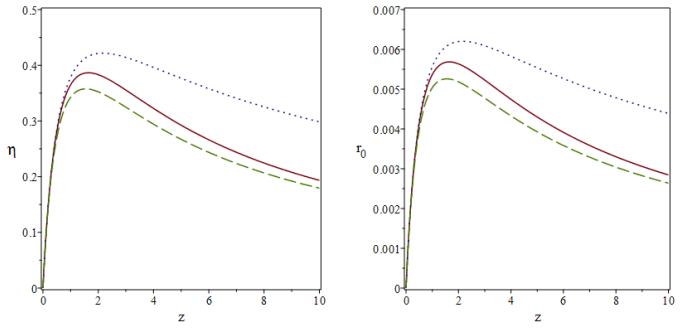
- [§4.2, Eq. (53)] Substituting Eq. (34) into Eq. (52) does not give Eq. (53). Since 1+w=4(1+z)/10.02, the correct coefficients are (7+3w)/(2(1+z))=(5.1976+1.1976z)/(2(1+z)) and 3(1+w)/(2(1+z)^2)=0.5988/(1+z). These differ from the coefficients in Eq. (53), which contain the denominator (8.76+3.24z). Consequently, the solution (54) does not satisfy Eq. (53) (direct substitution, for example at z=0, leaves a nonzero residual). The subsequent comparison of deviation vectors and observer area-distance in Fig. 2 is therefore not supported by the derived equations.
minor comments (4)
- [§3, below Eq. (13)] The phrase 'by considering φdot and n ≠ 0' should read 'by considering φdot ≠ 0 and n ≠ 0'.
- [§3, Eq. (34)] The expression w(z) ≃ −1 + 4(1+z)/10.02 is ambiguous; inserting parentheses, e.g., w(z) ≃ −1 + [4(1+z)]/10.02, would eliminate the possible reading w(z) ≃ −(1+4(1+z))/10.02.
- [§4, Eq. (37)] The step from Eq. (36) to Eq. (37) is presented without detailed algebra; adding the intermediate computation would improve readability and verifiability.
- [§4.2, Eq. (56)] The notation H(0) is used inconsistently with H0 introduced earlier; please use a single symbol, preferably H0, for the present-day Hubble parameter.
Circularity Check
The acceleration 'prediction' reduces to the calibrated input z_trans = 0.67: Eq. (34) is a one-parameter rewriting of the assumed transition redshift, not an independent result from the 5D vacuum.
-
fitted input called prediction
[Section 3, Eqs. (31)-(34) and Figure 1]
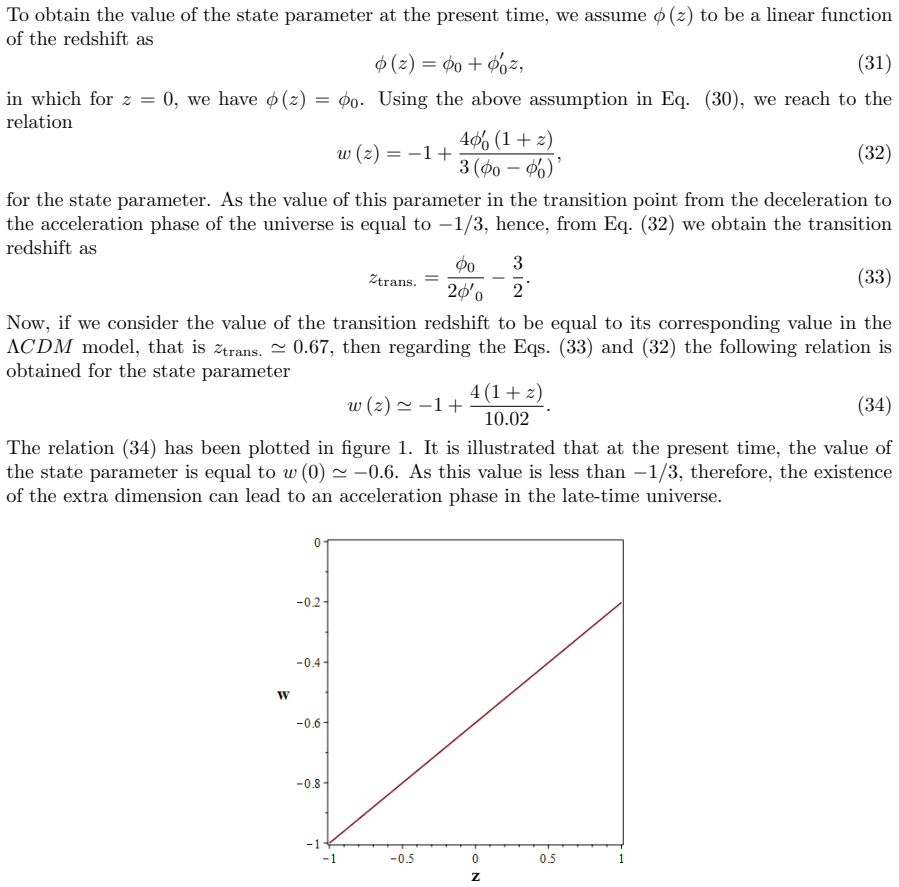
"Now, if we consider the value of the transition redshift to be equal to its corresponding value in the ΛCDM model, that is ztrans.≃ 0.67, then regarding the Eqs. (33) and (32) the following relation is obtained for the state parameter w (z)≃− 1 + 4 (1+z)/10.02 . ... As this value is less than −1/3, therefore, the existence of the extra dimension can lead to an acceleration phase in the late-time universe."
Equation (33) is obtained from Eq. (32) by imposing w(z_trans) = −1/3, so z_trans is by construction the root of w(z). Setting z_trans = 0.67 fixes the only free ratio φ0/φ0' = 4.34, and Eq. (34) is just the same one-parameter family expressed in another variable: w(0) = −1 + 2/[3(1+z_trans)] ≈ −0.6. Thus the reported present-day acceleration is not an independent prediction of the 5D vacuum geometry; it is the calibration choice z_trans > 0 restated. Moreover, the calibration target is imported from the ΛCDM model, so the conclusion that the extra dimension explains acceleration without dark energy is not derived from the model but imposed by matching its transition point.
full rationale
The central late-time claim is the w(z) curve. That curve comes from a linear ansatz for φ(z) with one free parameter φ0'/φ0; the paper fixes this parameter by requiring z_trans ≃ 0.67, which is exactly where w = −1/3. The subsequent statement w(0) ≃ −0.6 < −1/3 is a restatement of that same choice, not a prediction from the 5D vacuum equations. Separately, the paper never imposes R44 = 0 for the metric (11), so the '5D vacuum' premise used to justify the induced-matter interpretation is unverified; this is a genuine correctness gap rather than circularity. No load-bearing self-citation was found: reference [14] is used only for comparison with an f(R,T) model, and the STM formalism is standard external machinery from Wesson. Score 7 reflects that the main acceleration conclusion reduces, for the chosen parameter value, to the input transition redshift; the geodesic-deviation and area-distance sections are derived consequences but inherit the same calibrated background.
Assumptions & free parameters
free parameters (1)
- phi0' / phi0 ratio (equivalently phi0 / phi0') =
phi0 / phi0' approximately 4.34 from z_trans approximately 0.67
assumptions (5)
- domain assumption The 5D metric (11) is a vacuum solution with 5D Ricci tensor components zero.
- ad hoc to paper phi(z) = phi0 + phi0' z is a valid extra-dimension scale factor.
- ad hoc to paper f(x4) = (x4/x4_0)^(2n) with n = 1/4 from the Bianchi constraint.
- domain assumption The 4D universe is spatially flat FLRW.
- standard math Standard Riemann decomposition and Pirani-type geodesic deviation equations apply in 4D.
Cite this review
Pith. "Pith review of Cosmic acceleration via space-time-matter theory." pith.science (2026). https://pith.science/paper/ONITZCFU
@misc{pith2026190804414,
  author       = {Pith},
  title        = {Pith review of: Cosmic acceleration via space-time-matter theory},
  year         = {2026},
  howpublished = {\url{https://pith.science/paper/ONITZCFU}},
  note         = {Machine review of arXiv:1908.04414}
}
read the original abstract
We consider the space-time-matter theory (STM) in a five-dimensional vacuum space-time with a generalized FLRW metric to investigate the late-time acceleration of the universe. For this purpose, we derive the four-dimensional induced field equations and obtain the evolution of the state parameter with respect to the redshift. Then, we show that with consideration of the extra dimension scale factor to be a linear function of redshift, this leads to a model which gives an accelerating phase in the universe. Moreover, we derive the geodesic deviation equation in the STM theory to study the relative acceleration of the parallel geodesics of this space-time, and also, obtain the observer area-distance as a measurable quantity to compare this theory with two other models.
Figures
Reference graph
Works this paper leans on
-
[1]
Observational evidence from supernovae for an accelerating universe and a cosmological constant
A.G. Riess, et al. , “Observational evidence from supernovae for an accelerating universe and a cosmological constant”, Astron. J. 116, 1009 (1998)
work page 1998
-
[2]
Measurements of Omega and Lambda from 42 high–redshift supernovae
S. Perlmutter, et al. [The Supernova Cosmology Project], “Measurements of Omega and Lambda from 42 high–redshift supernovae”, Astrophys. J. 517, 565 (1999)
work page 1999
-
[3]
A.G. Riess, et al. , “Type Ia supernova discoveries at z > 1 from the Hubble space telescope: Evidence for past deceleration and constraints on dark energy evolution”, Astrophys. J. 607, 665 (2004)
work page 2004
-
[4]
S.M. Carroll, “The cosmological constant”, Living. Rev. Rel. 4, 1 (2001)
work page 2001
-
[5]
E.J. Copeland, M. Sami and S. Tsujikawa, “Dynamics of dark energy”, Int. J. Mod. Phys. D 15, 1753 (2006)
work page 2006
-
[6]
Dark energy and dark gravity: Theory overview
R. Durrer and R. Maartens, “Dark energy and dark gravity: Theory overview”, Gen. Rel. Grav. 40, 301 (2008)
work page 2008
-
[7]
K. Bamba, S. Capozziello, S. Nojiri and S.D. Odintsov, “Dark energy cosmology: The equivalent description via different theoretical models and cosmography tests”, Astrophys. Space Sci. 342, 155 (2012)
work page 2012
-
[8]
M. Farhoudi, “On higher order gravities, their analogy to GR, and dimensional dependent version of Duff’s trace anomaly relation”, Gen. Rel. Grav. 38, 1261 (2006)
work page 2006
Show all 28 references
-
[9]
Introduction to modified gravity and gravitational alternative for dark energy
S. Nojiri and S.D. Odintsov, “Introduction to modified gravity and gravitational alternative for dark energy”, Int. J. Geom. Meth. Mod. Phys. 04, 115 (2007)
2007
-
[10]
Amendola and S
L. Amendola and S. Tsujikawa, Dark Energy: Theory and Observations , (Cambridge University Press, Cambridge, 2010)
2010
-
[11]
f(R) theories of gravity
T.P. Sotiriou and V. Faraoni, “ f(R) theories of gravity”, Rev. Mod. Phys. 82, 451 (2010)
2010
-
[12]
f(R,T ) gravity
T. Harko, F.S.N. Lobo, S. Nojiri and S.D. Odintsov, “ f(R,T ) gravity”, Phys. Rev. D 84, 024020 (2011)
2011
-
[13]
f(R,T ) cosmological models in phase space
H. Shabani and M. Farhoudi, “ f(R,T ) cosmological models in phase space”, Phys. Rev. D 88, 044048 (2013)
2013
-
[14]
Cosmic acceleration from matter–curvature coupling
R. Zaregonbadi and M. Farhoudi, “Cosmic acceleration from matter–curvature coupling”, Gen. Relativ. Gravit. 48, 142 (2016)
2016
-
[15]
The simplest non-minimal matter-geometry coupling in the f(R,T ) cosmology
P.H.R.S. Moraes and P.K. Sahoo, “The simplest non-minimal matter-geometry coupling in the f(R,T ) cosmology”, Eur. phys. J. C 77, 480 (2017)
2017
-
[16]
Palatini formulation of f(R,T ) gravity theory, and its cosmological implications
J. Wu, G. Li, T. Harko and S.D. Liang, “Palatini formulation of f(R,T ) gravity theory, and its cosmological implications”, Eur. phys. J. C 78, 430 (2018). 9
2018
-
[17]
Klein, “Quantum theory and five-dimensional relativity, Phys
O. Klein, “Quantum theory and five-dimensional relativity, Phys. Z. 37, 895 (1926)
1926
-
[18]
Appelquist, A.Chodos and P.G.O
T. Appelquist, A.Chodos and P.G.O. Freund, Modern kaluza-Klein theories , (Addison-Wesley, Reading MA, 1987)
1987
-
[19]
Kaluza-Klein equations, Einstein’s equations, and an effective energy- momentum tensor
P.S. Wesson, J.P. de Leon, “Kaluza-Klein equations, Einstein’s equations, and an effective energy- momentum tensor”, J. Math. Phys . 33, 3883 (1992)
1992
-
[20]
Wesson, Space-time-matter: Modern Kaluza-Klein theory , (World Scientific, Singapore, 1999)
P.S. Wesson, Space-time-matter: Modern Kaluza-Klein theory , (World Scientific, Singapore, 1999)
1999
-
[21]
Wald, General Relativity, (University of Chicago, Chicago, 1984)
R.M. Wald, General Relativity, (University of Chicago, Chicago, 1984)
1984
-
[22]
d’Inverno, Introducing Einstein ’s Relativity, (Clarendon Press, Oxford, 1992)
R. d’Inverno, Introducing Einstein ’s Relativity, (Clarendon Press, Oxford, 1992)
1992
-
[23]
On the deviation of geodesics and null-geodesics, particularly in relation to the properties of spaces of constant curvature and indefinite line-element
J.L. Synge, “On the deviation of geodesics and null-geodesics, particularly in relation to the properties of spaces of constant curvature and indefinite line-element”,Ann. Math. 35, 705 (1934), Republished in: Gen. Rel. Grav. 41, 1205 (2009)
1934
-
[24]
Deviation of geodesics in FLRW space-time geometries
G.F.R. Ellis and H. van Elst, “Deviation of geodesics in FLRW space-time geometries”, arXiv: gr-qc/9709060
-
[25]
On the physical significance of the Riemann tensor
F.A.E. Pirani, “On the physical significance of the Riemann tensor”, Acta Phys. Polon. 15, 389 (1956), Republished in: Gen. Rel. Grav. 41, 1215 (2009)
1956
-
[26]
¨Uber den Zusammenhang zwischen Rotverschiebung und scheinbarer Helligkeit (About the relation between redshift and apparent magnitude)
W. Mattig, “ ¨Uber den Zusammenhang zwischen Rotverschiebung und scheinbarer Helligkeit (About the relation between redshift and apparent magnitude)”, Astron. Nachr. 284, 109 (1957)
1957
-
[27]
Schneider, J
P. Schneider, J. Ehlers and E.E. Falco, Gravitational Lenses, (Springer–Verlag, Berlin, 1992)
1992
-
[28]
A note on the observer area–distance formula
D.R. Matravers and A.M. Aziz, “A note on the observer area–distance formula”, Mon. Not. R. Astron. Soc. 47, 124 (1988). 10
1988
Reviewed August 14, 2026 · model on record in the stance chip above.
Discussion (0). Continue with ORCID to comment.