REVIEW 1 major objections 6 minor 44 references
S2A2 shows that adding acoustic spatial maps and spectrograms to vision lets imitation-learning robots pick the sounding object and place it in the matching box.
Reviewed by Pith at T0; open to challenge. T0 means a machine referee read the full paper against a public rubric. the ladder, T0–T4 →
T0 review · deepseek-v4-flash
2026-08-01 00:44 UTC pith:OPCAGQLK
load-bearing objection Genuinely new integration of array audition with imitation learning; the key ablation is confounded and real-robot evidence is thin, but the core S2A2-vs-vision result survives. the 1 major comments →
S2A2: Audio-Visual Imitation Learning for Manipulation Tasks Using Acoustic Spatial Information
The pith
A machine-rendered reading of the paper's core claim, the machinery that carries it, and where it could break.
Core claim
The paper's central claim is that manipulation policies for tasks where sound determines the target should integrate two complementary acoustic representations alongside vision: a MUSIC-based acoustic spatial map, which projects the likelihood of a sound source's direction onto a 2D workspace plane, and a Spotforming-derived spectrogram, which isolates and amplifies the target source's timbre. Neither representation alone is enough when a robot must both find which object is sounding and decide which box to place it in. In simulation, S2A2 reaches 78.7–89.7% success on the Localization & Identification task depending on the policy, while vision-only baselines sit at 9.3–11.0%. Real-robot exp
What carries the argument
Two acoustic processing pipelines feed a multimodal policy. The acoustic spatial map pipeline uses MUSIC on each microphone array to compute direction-of-arrival scores, then projects them with distance attenuation onto a 224×224 plane corresponding to the workspace. The spectrogram pipeline picks the highest peak in that map, beamforms toward it, applies Spotforming (NMF-based source separation) to suppress noise and sidelobes, and produces a single-channel log-power spectrogram. Both acoustic representations are encoded by small ResNets and concatenated with RGB-vision features and proprioception before being passed to the action-generation policy, which the paper implements with four diff
Load-bearing premise
The pipeline assumes at most one task-relevant dominant sound source at a time: the spectrogram branch takes only the highest peak in the acoustic spatial map, and MUSIC is run with a fixed assumed source count, so competing simultaneous sources would degrade the inputs and undermine the claimed policy gains—the paper itself defers multi-source environments to future work.
What would settle it
Run the Localization & Identification task with two sound-emitting objects present, one that should be grasped and one distractor, while keeping the visual observation unchanged; if success drops to the vision-only baseline level, the single-source assumption is the load-bearing element of the method.
If this is right
- In tasks requiring both sound position and timbre, providing only one acoustic representation leaves success near vision-only levels; both are necessary for the reported gains.
- Acoustic input that is irrelevant to the task can reduce success, so the framework implies that representations should be matched to the acoustic capabilities a task actually requires.
- The magnitude of the acoustic benefit depends strongly on the policy: the largest gains appear for the transformer action-chunking and diffusion-style policies, while a discretizing policy and a large pretrained flow policy show smaller or more variable improvement.
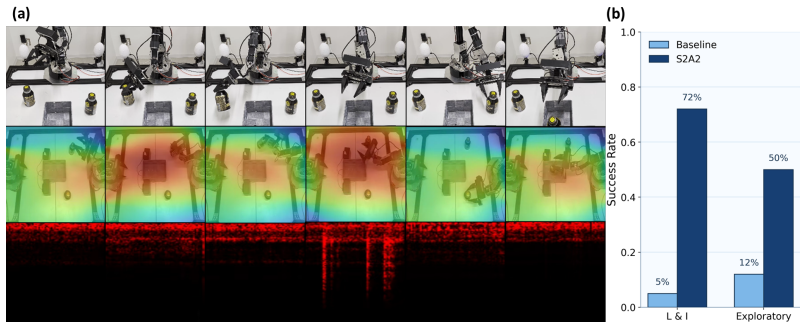
- Real-robot trials on the Localization & Identification and Exploratory tasks reproduce the simulation result that S2A2 beats a vision-only baseline, indicating the acoustic representations transfer beyond synthetic audio.
Where Pith is reading between the lines
- A natural next step is to replace single-peak selection with multi-source separation, which could extend S2A2 to environments with several simultaneous sound sources—the paper's own stated limitation.
- Because the assumed number of MUSIC sources is fixed (3 in simulation, 1 on the real robot), a future version could estimate source count adaptively rather than requiring it as a hyperparameter.
- The observed performance drop when unnecessary acoustic channels are present suggests that learned gating or task-conditioned modality selection could improve sample efficiency beyond simply concatenating features.
- The sensitivity analysis showing an optimal number of microphone arrays points toward a scaling question: how sparse can the microphone array be before the localization signal is too weak for the policy to use.
Editorial analysis
A structured set of objections, weighed in public.
Referee Report
Summary. The paper introduces 'acoustic-aware manipulation tasks' and an imitation-learning framework, S2A2, that fuses RGB images with two acoustic representations: a MUSIC-derived acoustic spatial map (which object is sounding) and a Spotforming-based spectrogram (what sound it is). Four policy backbones (ACT, Diffusion Policy, VQ-BeT, π0) are evaluated in simulation on four tasks designed to require source localization, sound identification, both, or active exploration; S2A2 is reported to give the largest gains on the Localization & Identification task (e.g., 78.7±2.1% with ACT and 89.7±2.1% with Diffusion Policy vs. 11.0±3.5% and 9.3±6.1% vision-only baselines). A real-robot experiment with ACT on the L&I and exploratory tasks is reported as confirming the simulation trend. The central claim is that acoustic spatial and spectral streams make independent, complementary contributions to policy learning.
Significance. If the results hold, the paper makes a useful contribution by connecting robot audition (MUSIC, Spotforming, microphone arrays) to imitation learning and by proposing a benchmark of four tasks that isolate spatial, spectral, and exploratory acoustic demands. The simulation study is systematic: three seeds, four policy families, task-matched ablations, and sensitivity analyses in Appendix C. The real-robot setup is described in unusual detail (Appendix E), which is commendable. However, the main mechanistic claim about independent contributions of spatial and spectral streams rests on an ablation that is confounded as currently defined, and the real-robot confirmation rests on a single-seed, numerically under-reported experiment. These issues are fixable and do not appear to invalidate the headline S2A2-vs-vision result, but they do affect the strength of the paper's internal causal story.
major comments (1)
- [§4.2, Appendix E, Fig. 5(b)] The real-robot validation is reported with a single seed: Appendix E states 'evaluated the success rate over 100 trials with a single seed,' and no numeric success rates or confidence intervals are given in the main text or appendix. Figure 5(b) shows bars but the actual values and error bars are not reported in the text. With one seed and no trial-level statistics, the claim in Section 4.2 that the real-robot experiments 'confirm' the simulation findings is weaker than the simulation evidence. Please report the exact per-condition success counts, provide multiple seeds or at least a confidence interval, and clarify whether the two tasks were evaluated on the same policy checkpoint.
minor comments (6)
- [Abstract] Grammar: 'We implemented S2A2 models that integrates policies' should be 'that integrate policies.'
- [Fig. 5(b)] The bar chart is difficult to read without numeric labels; add success-rate values on the bars or in a table.
- [§2.3] The sentence 'This work can be positioned as the first to connect these robot audition techniques to manipulation imitation learning' is stronger than the evidence; suggest softening to 'one of the first' or citing concurrent work if any.
- [Acknowledgments] The placeholder text ('If a paper is accepted...') is not appropriate for a submitted manuscript and should be replaced by actual acknowledgments or removed.
- [§A.3] The MUSIC assumed source count differs between simulation (3) and real robot (1) without an analysis of sensitivity to this parameter. Since multi-source robustness is explicitly deferred to future work, a brief note explaining why the simulation uses 3 when the tasks contain one source would help.
- [§B.1] The t-SNE visualizations are discussed qualitatively but no quantitative separation metric (e.g., silhouette score) is provided. Since the claim that latent structure explains success is central to Fig. 4, a simple numeric measure would strengthen the presentation.
Circularity Check
w/o Spat ablation is self-definitional because the spectrogram it retains is generated from the acoustic spatial map; central S2A2-vs-baseline result remains independent.
specific steps
-
self definitional
[Section 3.3.2 (Spectrogram Pipeline) / Section 4.1 (w/o Spat. condition) / Appendix D.2]
""From the acoustic spatial map S, the source presence likelihood is computed, and peak extraction selects source candidates. Since only one source is present at a time, the highest peak is taken as the candidate. Source separation by Spotforming is applied to the candidate to generate the spectrogram." ... "w/o Spat. removes the acoustic spatial map pipeline, using visual information and acoustic signal information from the spectrogram.""
The w/o Spat. condition is defined as removing the acoustic spatial map while keeping the spectrogram, but the spectrogram pipeline itself is defined in terms of the spatial map: peak extraction selects the source from the acoustic spatial map S, and Appendix D.2 beamforms toward that selected azimuth. Therefore the spectrogram input is not independent spectrogram-only signal information; it carries acoustic spatial information by construction. Table 2 results for w/o Spat. (and the claimed independent contribution of the spectral stream) are therefore not cleanly separable from spatial information, and the L&I gap between w/o Spat. and S2A2 cannot be attributed solely to the presence of the policy-level spatial-map channel.
full rationale
The derivation itself is not circular: acoustic features come from external MUSIC/Spotforming algorithms, policies are trained with the behavioral-cloning loss Eq. (1), and success is measured against task outcomes (grasp correct object, place in correct box) that are independent of the acoustic feature values. No fitted parameter is renamed as a prediction, no uniqueness theorem is imported from the authors' prior work, and self-citations (e.g., [34] co-authored by Kojima) are not load-bearing. Selecting hyperparameters on the same tasks in Appendix C is standard tuning, not circularity. The one concrete circular/self-definitional issue is the w/o Spat. ablation, whose spectrogram is generated from the spatial map by construction, so the independent-contribution claim for spectral information is confounded. Because the main S2A2-versus-baseline result does not depend on this ablation and the policy outputs are measured externally, the overall circularity is moderate rather than central.
Axiom & Free-Parameter Ledger
free parameters (6)
- Number of microphone arrays N =
4
- Acoustic information update rate =
10 Hz
- MUSIC assumed source count =
3 (simulation) / 1 (real robot)
- Spotforming NMF constants (R, threshold delta, max mask ratio) =
50, 1.6e-3, 0.2
- Distance attenuation d_floor and gamma =
10.0 m and 1.0 (sim); 0.0 and 0.0 (real)
- Exploratory-task sound trigger speed =
0.5 mm/s
axioms (5)
- standard math MUSIC direction-of-arrival estimation: the noise subspace is orthogonal to steering vectors of the true source directions, given the assumed number of sources.
- domain assumption Pyroomacoustics image-source simulation with a 10m x 10m x 3m room and third-order reflections is a faithful enough proxy for real acoustic conditions to transfer policy improvements.
- domain assumption A single task-relevant sound source dominates, so selecting the highest peak in the acoustic spatial map yields the correct source for Spotforming.
- domain assumption Expert demonstrations generated with privileged information (ground-truth sound position and sound label) are appropriate training data for imitation learning.
- domain assumption The objects are visually indistinguishable in the provided images, so vision-only policies cannot solve the tasks by appearance.
read the original abstract
Acoustic information provides rich cues about object location, material properties, and changes caused by contact or motion. This paper introduces a new set of acoustic-aware manipulation tasks for imitation learning, in which robots must use auditory cues to determine manipulation targets. These tasks require sound source localization and identification for active exploration in robotic manipulation. Also, we propose a multimodal imitation learning framework, Spatial-Spectral Audio Action (S2A2), that integrates visual features with acoustic spatial and acoustic signal information for the acoustic-aware manipulation tasks. We implemented S2A2 models that integrates policies such as ACT, Diffusion Policy, VQ-BeT, and $\pi_0$, into our framework. Simulation experiments showed that the proposed method is the most effective for tasks requiring both position and timbre. Furthermore, real-robot experiments confirm the applicability of the proposed tasks and framework to real-world manipulation.
Figures




Reference graph
Works this paper leans on
-
[1]
D. A. Pomerleau. Efficient training of artificial neural networks for autonomous navigation. Neural Computation, 3(1):88–97, 1991. doi:10.1162/neco.1991.3.1.88
-
[2]
B. D. Argall, S. Chernova, M. Veloso, and B. Browning. A survey of robot learning from demonstration.Robotics and Autonomous Systems, 57(5):469–483, 2009. ISSN 0921-8890. doi:https://doi.org/10.1016/j.robot.2008.10.024. URLhttps://www.sciencedirect.com/ science/article/pii/S0921889008001772
-
[3]
T. Osa, J. Pajarinen, G. Neumann, J. A. Bagnell, P. Abbeel, and J. Peters. An al- gorithmic perspective on imitation learning. 7(1):1–179. ISSN 1935-8253, 1935-8261. doi:10.1561/2300000053. URLhttps://www.emerald.com/ftrob/article/7/1-2/1/ 1328576/An-Algorithmic-Perspective-on-Imitation-Learning
-
[4]
M. U. Din, W. Akram, L. S. Saoud, J. Rosell, and I. Hussain. Vision language action models in robotic manipulation: A systematic review, 2025. URLhttps://arxiv.org/abs/2507. 10672
2025
-
[5]
M. Du, O. Y . Lee, S. Nair, and C. Finn. Play it by ear: Learning skills amidst occlusion through audio-visual imitation learning. InRobotics: Science and Systems XVIII. Robotics: Science and Systems Foundation. ISBN 978-0-9923747-8-5. doi:10.15607/RSS.2022.XVIII.009. URL http://www.roboticsproceedings.org/rss18/p009.pdf
-
[6]
H. Li, Y . Zhang, J. Zhu, S. Wang, M. A. Lee, H. Xu, E. Adelson, L. Fei-Fei, R. Gao, and J. Wu. See, hear, and feel: Smart sensory fusion for robotic manipulation. InCoRL, 2022
2022
-
[7]
Y . Chen, M. V . d. Merwe, A. Sipos, and N. Fazeli. Visuo-tactile transformers for manipu- lation. In K. Liu, D. Kulic, and J. Ichnowski, editors,Proceedings of The 6th Conference on Robot Learning, volume 205 ofProceedings of Machine Learning Research, pages 2026–2040. PMLR, 14–18 Dec 2023. URLhttps://proceedings.mlr.press/v205/chen23d.html
2026
- [8]
-
[9]
F. Liu, C. Li, Y . Qin, J. Xu, P. Abbeel, and R. Chen. Vitamin: Learning contact-rich tasks through robot-free visuo-tactile manipulation interface, 2025. URLhttps://arxiv.org/ abs/2504.06156
Pith/arXiv arXiv 2025
-
[10]
Y . Li, Y . Chen, Z. Zhao, P. Li, T. Liu, S. Huang, and Y . Zhu. Simultaneous tactile-visual perception for learning multimodal robot manipulation, 2026. URLhttps://arxiv.org/ abs/2512.09851
arXiv 2026
-
[11]
S. Suresh, H. Qi, T. Wu, T. Fan, L. Pineda, M. Lambeta, J. Malik, M. Kalakrishnan, R. Calandra, M. Kaess, J. Ortiz, and M. Mukadam. Neuralfeels with neural fields: Vi- suotactile perception for in-hand manipulation.Science Robotics, 9(96):eadl0628, 2024. doi:10.1126/scirobotics.adl0628. URLhttps://www.science.org/doi/abs/10.1126/ scirobotics.adl0628. 9
-
[12]
Thankaraj and L
A. Thankaraj and L. Pinto. That sounds right: Auditory self-supervision for dynamic robot manipulation. In J. Tan, M. Toussaint, and K. Darvish, editors,Proceedings of The 7th Confer- ence on Robot Learning, volume 229 ofProceedings of Machine Learning Research, pages 1036–1049. PMLR, 06–09 Nov 2023. URLhttps://proceedings.mlr.press/v229/ thankaraj23a.html
2023
-
[13]
J. Mejia, V . Dean, T. Hellebrekers, and A. Gupta. Hearing touch: Audio-visual pretraining for contact-rich manipulation, 2024. URLhttps://arxiv.org/abs/2405.08576
Pith/arXiv arXiv 2024
-
[14]
Z. Liu, C. Chi, E. Cousineau, N. Kuppuswamy, B. Burchfiel, and S. Song. Maniwav: Learning robot manipulation from in-the-wild audio-visual data, 2024. URLhttps://arxiv.org/ abs/2406.19464
Pith/arXiv arXiv 2024
-
[15]
R. Wang, H. Geng, T. Li, P. Wu, F. Wang, G. Anumanchipalli, T. Darrell, B. Li, P. Abbeel, J. Malik, and A. A. Efros. The sound of simulation: Learning multimodal sim-to-real robot policies with generative audio. In J. Lim, S. Song, and H.-W. Park, editors,Proceedings of The 9th Conference on Robot Learning, volume 305 ofProceedings of Machine Learning Res...
2025
-
[16]
Clarke, T
S. Clarke, T. Rhodes, C. G. Atkeson, and O. Kroemer. Learning audio feedback for estimating amount and flow of granular material. In A. Billard, A. Dragan, J. Peters, and J. Morimoto, editors,Proceedings of The 2nd Conference on Robot Learning, volume 87 ofProceedings of Machine Learning Research, pages 529–550. PMLR, 29–31 Oct 2018. URLhttps:// proceedin...
2018
-
[18]
H. Liang, S. Li, X. Ma, N. Hendrich, T. Gerkmann, F. Sun, and J. Zhang. Making sense of audio vibration for liquid height estimation in robotic pouring. In2019 IEEE/RSJ In- ternational Conference on Intelligent Robots and Systems (IROS), page 5333–5339. IEEE Press, 2019. doi:10.1109/IROS40897.2019.8968303. URLhttps://doi-org.kyoto-u. idm.oclc.org/10.1109/...
arXiv 2019
-
[19]
Z. Wang, G. Tian, and H. Pan. Robot gaining robust pouring skills through fusing vision and audio.ISA Transactions, 135:428–437, 2023. ISSN 0019-0578. doi:https://doi.org/10.1016/ j.isatra.2022.09.022. URLhttps://www.sciencedirect.com/science/article/pii/ S0019057822004815
2023
-
[20]
M. Eppe, M. Kerzel, E. Strahl, and S. Wermter. Deep neural object analysis by interactive auditory exploration with a humanoid robot. In2018 IEEE/RSJ International Conference on Intelligent Robots and Systems (IROS), page 284–289. IEEE Press, 2018. doi:10.1109/IROS. 2018.8593838. URLhttps://doi-org.kyoto-u.idm.oclc.org/10.1109/IROS.2018. 8593838
arXiv 2018
-
[21]
L. Macesanu, B. Folefack, S. Singh, R. Ray, B. Abbatematteo, and R. Mart ´ın-Mart´ın. Caver: Curious audiovisual exploring robot, 2026. URLhttps://arxiv.org/abs/2511.07619
arXiv 2026
-
[22]
G. Tatiya, J. Francis, H.-H. Wu, Y . Bisk, and J. Sinapov. MOSAIC: Learning Unified Multi- Sensory Object Property Representations for Robot Learning via Interactive Perception.arXiv e-prints, art. arXiv:2309.08508, Sept. 2023. doi:10.48550/arXiv.2309.08508
work page internal anchor Pith review Pith/arXiv arXiv doi:10.48550/arxiv.2309.08508 2023
-
[23]
X. Wei, H. Zhang, X. Cao, S. Xie, W. Ge, Y . Li, and C. Wang. Audio-vla: Adding contact audio perception to vision-language-action model for robotic manipulation, 2025. URLhttps: //arxiv.org/abs/2511.09958. 10
arXiv 2025
-
[24]
K. Nakadai and H. G. Okuno. Robot audition and computational auditory scene analysis. 2 (9):2000050. ISSN 2640-4567, 2640-4567. doi:10.1002/aisy.202000050. URLhttps:// advanced.onlinelibrary.wiley.com/doi/10.1002/aisy.202000050
-
[25]
Jalayer, M
R. Jalayer, M. Jalayer, and A. Baniasadi. A review on sound source localization in robotics: Focusing on deep learning methods.Applied Sciences, 15(17):9354, Aug. 2025. ISSN 2076-
2025
-
[26]
R. Schmidt. Multiple emitter location and signal parameter estimation.IEEE Transactions on Antennas and Propagation, 34(3):276–280, 1986. doi:10.1109/TAP.1986.1143830
arXiv 1986
-
[27]
A. A. Salama. Direction of arrival estimation: A tutorial survey of classical and modern meth- ods, 2025. URLhttps://arxiv.org/abs/2508.11675
Pith/arXiv arXiv 2025
-
[28]
Y . Kagimoto, K. Itoyama, K. Nishida, and K. Nakadai. Spotforming by NMF using multiple microphone arrays. In2022 IEEE/RSJ International Conference on Intelligent Robots and Systems (IROS), pages 9253–9258. IEEE. ISBN 978-1-6654-7927-1. doi:10.1109/IROS47612. 2022.9981808. URLhttps://ieeexplore.ieee.org/document/9981808/
arXiv 2022
-
[29]
Z. Li, A. Chapin, E. Xiang, R. Yang, B. Machado, N. Lei, E. Dellandrea, D. Huang, and L. Chen. Robotic manipulation via imitation learning: Taxonomy, evolution, benchmark, and challenges, 2025. URLhttps://arxiv.org/abs/2508.17449
Pith/arXiv arXiv 2025
-
[30]
Zitkovich, T
B. Zitkovich, T. Yu, S. Xu, P. Xu, T. Xiao, F. Xia, J. Wu, P. Wohlhart, S. Welker, A. Wahid, Q. Vuong, V . Vanhoucke, H. Tran, R. Soricut, A. Singh, J. Singh, P. Sermanet, P. R. San- keti, G. Salazar, M. S. Ryoo, K. Reymann, K. Rao, K. Pertsch, I. Mordatch, H. Michalewski, Y . Lu, S. Levine, L. Lee, T.-W. E. Lee, I. Leal, Y . Kuang, D. Kalashnikov, R. Jul...
2023
-
[31]
M. J. Kim, K. Pertsch, S. Karamcheti, T. Xiao, A. Balakrishna, S. Nair, R. Rafailov, E. Foster, G. Lam, P. Sanketi, Q. Vuong, T. Kollar, B. Burchfiel, R. Tedrake, D. Sadigh, S. Levine, P. Liang, and C. Finn. Openvla: An open-source vision-language-action model, 2024. URL https://arxiv.org/abs/2406.09246
Pith/arXiv arXiv 2024
-
[32]
S. Jin, H. Liu, B. Wang, and F. Sun. Open-environment robotic acoustic perception for object recognition.Frontiers in Neurorobotics, V olume 13 - 2019, 2019. ISSN 1662-
2019
-
[33]
J. Wang, Y . He, D. Su, K. Itoyama, K. Nakadai, J. Wu, S. Huang, Y . Li, and H. Kong. Slam- based joint calibration of multiple asynchronous microphone arrays and sound source localiza- tion.IEEE Transactions on Robotics, 40:4024–4044, 2024. doi:10.1109/TRO.2024.3410456
arXiv 2024
-
[34]
Gabriel, R
D. Gabriel, R. Kojima, K. Hoshiba, K. Itoyama, K. Nishida, and K. Nakadai. 2d sound source position estimation using microphone arrays and its application to a vr-based bird song analysis system.Advanced Robotics, 33(7-8):403–414, 2019
2019
-
[35]
Yamada, K
T. Yamada, K. Itoyama, K. Nishida, and K. Nakadai. Sound source tracking by drones with microphone arrays. In2020 IEEE/SICE International Symposium on System Integration (SII), pages 796–801. IEEE, 2020. 11
2020
-
[36]
T. Zhao, V . Kumar, S. Levine, and C. Finn. Learning fine-grained bimanual manipulation with low-cost hardware. InRobotics: Science and Systems XIX. Robotics: Science and Systems Foundation. ISBN 978-0-9923747-9-2. doi:10.15607/RSS.2023.XIX.016. URLhttp:// www.roboticsproceedings.org/rss19/p016.pdf
-
[37]
C. Chi, Z. Xu, S. Feng, E. Cousineau, Y . Du, B. Burchfiel, R. Tedrake, and S. Song. Diffusion policy: Visuomotor policy learning via action diffusion. 44(10):1684–1704. ISSN 0278-3649, 1741-3176. doi:10.1177/02783649241273668. URLhttps://journals.sagepub.com/ doi/10.1177/02783649241273668
-
[38]
S. Lee, Y . Wang, H. Etukuru, H. J. Kim, N. M. M. Shafiullah, and L. Pinto. Behavior generation with latent actions. In R. Salakhutdinov, Z. Kolter, K. Heller, A. Weller, N. Oliver, J. Scarlett, and F. Berkenkamp, editors,Proceedings of the 41st International Conference on Machine Learning, volume 235 ofProceedings of Machine Learning Research, pages 2699...
2024
-
[39]
K. Black, N. Brown, D. Driess, A. Esmail, M. Equi, C. Finn, N. Fusai, L. Groom, K. Haus- man, B. Ichter, S. Jakubczak, T. Jones, L. Ke, S. Levine, A. Li-Bell, M. Mothukuri, S. Nair, K. Pertsch, L. X. Shi, J. Tanner, Q. Vuong, A. Walling, H. Wang, and U. Zhilinsky.π 0: A vision-language-action flow model for general robot control, 2026. URLhttps://arxiv. o...
Pith/arXiv arXiv 2026
-
[40]
G. Authors. Genesis: A generative and universal physics engine for robotics and beyond, December 2024. URLhttps://github.com/Genesis-Embodied-AI/Genesis
2024
-
[41]
R. Scheibler, E. Bezzam, and I. Dokmani ´c. Pyroomacoustics: A python package for audio room simulations and array processing algorithms. In2018 IEEE International Conference on Acoustics, Speech and Signal Processing (ICASSP), pages 351–355. doi:10.1109/ICASSP. 2018.8461310. URLhttp://arxiv.org/abs/1710.04196
arXiv 2018
-
[42]
L. v. d. Maaten and G. Hinton. Visualizing data using t-SNE. 9(86):2579–2605. URLhttp: //jmlr.org/papers/v9/vandermaaten08a.html
-
[43]
D. Lee, C. Kim, S. Kim, M. Cho, and W.-S. Han. Autoregressive image generation using resid- ual quantization. In2022 IEEE/CVF Conference on Computer Vision and Pattern Recognition (CVPR), pages 11513–11522, 2022. doi:10.1109/CVPR52688.2022.01123. 12 A Implementation Details This appendix describes the implementation details of the S2A2 model. Specifically...
arXiv 2022
-
[3417]
URLhttp://dx.doi.org/10.3390/app15179354
doi:10.3390/app15179354. URLhttp://dx.doi.org/10.3390/app15179354
-
[5218]
URLhttps://www.frontiersin.org/journals/ neurorobotics/articles/10.3389/fnbot.2019.00096
doi:10.3389/fnbot.2019.00096. URLhttps://www.frontiersin.org/journals/ neurorobotics/articles/10.3389/fnbot.2019.00096
arXiv 2019
discussion (0)
Sign in with ORCID, Apple, or X to comment. Anyone can read and Pith papers without signing in.