REVIEW 4 major objections 5 minor 1 cited by
Addressing Imbalanced Domain-Incremental Learning through Dual-Balance Collaborative Experts
T0 review · 4 major / 5 minor · reviewed 2026-08-06 · deepseek-v4-flash
Pith's one-line read DCE claims that imbalanced domain-incremental learning can be solved by three frequency-aware experts plus a selector trained on Gaussian-sampled pseudo-features, and reports state-of-the-art accuracy on four benchmarks.
desk verdict Legit new problem framing and strong results, but the few-shot gains depend on an underspecified synthetic-feature selector and the CPD metric has a sign error. read the letter →
The pith
A machine-rendered reading of the paper's core claim, the machinery that carries it, and where it could break.
The reading
What carries the argument
The dynamic expert selector is the central object: a small MLP that maps a frozen-encoder feature to soft weights over the accumulated expert pool, trained only on synthetic features $\hat{D}$ sampled with uniform counts from every stored domain-class Gaussian. Balanced sampling is what lets new domains transfer into old few-shot classes, while the expert pool with its three complementary losses is what contains intra-domain imbalance; Oracle Approximating Shrinkage stabilizes the covariance estimates and a single-domain covariance average controls storage cost. The frozen prompt-tuned feature space from the first task keeps the statistics comparable across domains.
What would settle it
Replace the Gaussian-sampled training set for the selector with real balanced features drawn from held-out classes on the same frozen encoder, keeping everything else fixed; if final accuracy does not drop, the synthetic-feature assumption is not what carries the gains. A second check is to test real test features for multimodality within each class: if many per-class feature clouds are clearly not unimodal, the stored covariances misrepresent the data and the selector is being trained on the wrong geometry.
Extended reading notes
Core claim
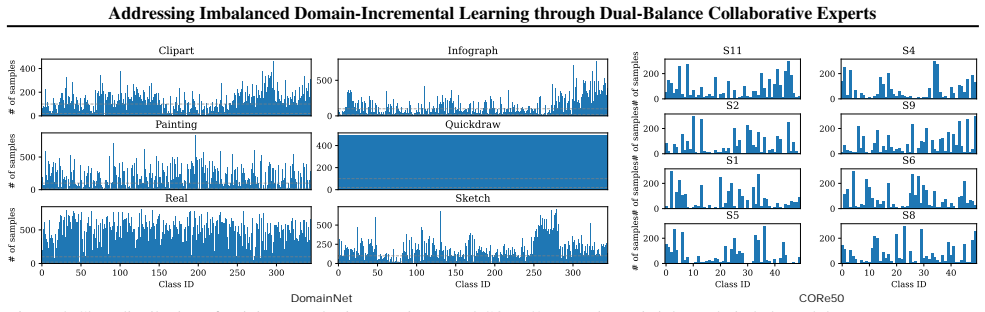
The central claim is that both failure modes of pre-trained-model domain-incremental learning under class imbalance—shared-prompt methods forget many-shot classes and domain-specific-prompt methods fail to share knowledge into few-shot classes—can be jointly avoided. DCE does this by training one many-shot-biased expert with $\ell_{\mathrm{CE}}$, one balanced expert with $\ell_{\mathrm{Bal}}$, and one few-shot-biased expert with $\ell_{\mathrm{Rev}}$, and then learning a soft expert selector on synthetic features drawn uniformly from per-class Gaussians $N(\mu^c_b, \Sigma^c_b)$ built from stored class statistics. At inference the selector weights all accumulated experts; the paper reports that this raises few-shot accuracy while keeping many-shot accuracy stable, and that the overall accuracy on all four benchmark datasets is the highest reported in its comparisons.
Load-bearing premise
The method depends on the belief that, in the frozen pre-trained encoder, each class forms a single bell-shaped cloud of features, and that one averaged cloud width per domain still catches enough class detail for the synthetic samples used to train the expert selector.
Editorial extensions
If this is right
- Final accuracy improves over the best baseline by 5.6 points on DomainNet and 0.9 points on Office-Home, with the few-shot accuracy gap much larger.
- Few-shot classes in earlier domains can show negative Class Performance Drift, meaning accuracy rises after later domains are seen, while many-shot drift stays moderate.
- DCE needs only one forward pass through the encoder after the first task, reducing both training and inference cost relative to prompt methods that require two passes.
- Adding a fourth expert with a stronger inverse-frequency loss gives only marginal gains, so the three-expert configuration is a deliberate efficiency-accuracy trade-off.
Reading between the lines
- The balanced-Gaussian selector recipe is more general than the paper's setting: it converts any frozen encoder with unimodal per-class features into a router for old-versus-new knowledge, so a similar selector could be plugged into class-incremental or task-incremental pipelines.
- A direct test the paper does not run is to train the selector on real balanced features, subsampling every class to the same count, instead of Gaussian samples; the size of the accuracy drop would quantify how much the synthetic assumption carries the result.
- The inverse-frequency loss is logit adjustment with weight $2\log p$, so the same Bayesian derivation could justify frequency reweighting in other continual-learning losses.
- The Class Performance Drift metric could serve as a standard complement to accuracy in imbalanced DIL, because conventional forgetting measures miss the beneficial drift of few-shot classes.
Editorial analysis
A structured set of objections, weighed in public.
Referee Report
Summary. The paper introduces Dual-Balance Collaborative Experts (DCE), a framework for domain-incremental learning under class imbalance. DCE trains, for each domain, three frequency-aware experts using cross-entropy, balanced softmax, and an inverse-distribution loss (Eqs. 2–4), and then trains a dynamic expert selector on synthetic features sampled from per-class Gaussian statistics with domain-level averaged OAS-regularized covariances (Section 4.2, Eq. 6). The authors report state-of-the-art results on Office-Home, DomainNet, CORe50, and CDDB-Hard, with means and standard deviations over five task orders, and introduce a Class Performance Drift (CPD) metric to analyze forgetting versus improvement. The main claim is that DCE simultaneously preserves many-shot class accuracy and improves few-shot class accuracy by routing test samples across experts.
Significance. If the reported results hold, DCE is a meaningful contribution to an underexplored setting: imbalanced domain-incremental learning with pre-trained models. The paper's strengths include a reasonable problem formulation, a valid Bayes-rule derivation for the inverse-distribution loss (Appendix A), a thorough comparison against existing prompt- and exemplar-based methods, and evaluation over multiple task orders with released code. The proposed dynamic expert selector is an interesting mechanism, and the balanced synthetic-data training idea is worth further study. However, the current manuscript leaves several load-bearing implementation details unspecified, particularly around the covariance estimation for few-shot classes and the synthetic sample count, and one proposed metric (CPD) contains an internal sign inconsistency. These issues must be resolved before the empirical claims can be fully trusted.
major comments (4)
- [Section 4.2 and Appendix B, Eq. (6)] The construction of the synthetic dataset is underspecified for the few-shot classes that drive the paper's main gains. Appendix B states that OAS-regularized covariances are computed only for classes with at least 10 samples and then aggregated into a shared domain-level covariance, but it never states what covariance is used for sampling classes with fewer than 10 samples. Since these classes are exactly the 'few-shot' classes whose Afew improvements are reported in Table 1, the paper must specify the fallback (e.g., using the domain-level covariance) and verify that this choice does not distort the synthetic features. In addition, the number of synthetic samples per class-domain pair, K in Eq. (6), is never reported or ablated anywhere in the main text or appendices, despite controlling the size and class balance of the synthetic training set. Both pieces of information are essential for reproducibility and for assessing the validity of the few-shot claims.
- [Section 4.2] The domain-level averaged covariance discards class-specific geometry, and the paper provides no evidence that synthetic features sampled from N(µ_c^b, Σ_domain^b) are representative of real test features for the purpose of training the selector. Because the selector is trained on synthetic features but evaluated on real features, a misspecified covariance model could make the routing miscalibrated, meaning the reported few-shot gains could be an artifact of the synthetic training distribution rather than a genuine cross-domain transfer effect. Please add a quantitative validation (e.g., a distributional distance between synthetic and real features, a control experiment training the selector on real features, or an ablation comparing domain-averaged to class-specific covariances) to support the central assumption.
- [Section 5.3, Figure 7 (left)] The number of experts per task (three) is selected via an ablation on DomainNet, which is also one of the evaluation benchmarks, without a held-out validation split. The DomainNet state-of-the-art results in Table 1 are therefore partly in-sample with respect to model selection. Please report the ablation on a validation split, perform the selection using another dataset, or disclose the selection procedure and show that the three-expert choice is stable across datasets. This is important because the claimed superiority over the best baseline on DomainNet (AB = 63.5 vs. 57.9) may be inflated by tuning on the test benchmark.
- [Section 5.3, CPD definition] The Class Performance Drift definition and its interpretation are inconsistent. The paper defines CPD_c^b = a_c^B − a_c^b, so a positive value means final accuracy is higher than accuracy immediately after training on domain b, i.e., an improvement. However, the text states that 'a positive CPD indicates performance degradation, while a negative value signifies performance improvement.' This sign error affects all conclusions drawn from Figure 6 about forgetting versus improvement for many-shot, medium-shot, and few-shot classes. Please correct either the formula or the interpretation and re-examine the qualitative claims in that section.
minor comments (5)
- [Table 2] The MEMO† row reports identical values for CORe50 and CDDB-Hard (66.0±2.7 and 68.2±1.7 for both), which appears to be a copy-paste error; please report the correct CDDB-Hard numbers.
- [Section 5.2] The statement that DCE shows 'a significant performance improvement on few-shot classes' uses 'significant' without a statistical test or confidence intervals on the per-frequency-group comparisons; please either add significance tests or rephrase to avoid a statistical claim.
- [Appendix F.4] The parameter-count formula '3 × D × D/2 × |Y| + (D × D + D × |Y|)' is notationally inconsistent (D × D vs. D × D/2) and the storage term for covariance matrices should specify whether the stored object is the domain-level averaged matrix per domain and how many such matrices are kept.
- [Section 5.1 and Figure 7 caption] The experiments are said to be run on NVIDIA 4090 in Section 5.1, while the Figure 7 caption says RTX 3090; please reconcile the hardware description.
- [Section 3.2 and Figure 2 caption] The method name is spelled 'S-iPrompt' in the text and 'S-iprompt' in the Figure 2 caption; please use consistent capitalization and hyphenation throughout.
Circularity Check
No significant circularity: DCE's central results are evaluated against held-out test sets; the synthetic-feature selector is trained on training statistics and tested externally, and self-citations are not load-bearing.
full rationale
The derivation chain is self-contained. Stage 1 trains experts with explicit losses (Eqs. 2-5) constructed from class-frequency priors; Appendix A proves Eq. (4) under an explicitly stated identical-class-conditional assumption, so the loss follows by algebra rather than being imported from the target claim. Stage 2 trains the selector on Gaussian-sampled pseudo-features (Eqs. 6-7) using statistics computed from training-domain features, then evaluates on class-balanced held-out test sets from the same four datasets; no reported accuracy number is produced by the fitting procedure itself. The Gaussian unimodality premise is attributed to an external paper (Zhang et al., 2023a), not to the authors' own prior work. Self-citations (SimpleCIL, DUCT, Pilot, etc.) appear only as baselines, toolbox references, or related work and are not used to justify the method's load-bearing assumptions. The skeptical concerns about underspecification—K not being reported, and Appendix B defining OAS covariances only for classes with n >= 10 without stating the fallback for rarer classes—are correctness and reproducibility risks, not circular reductions: they do not make any reported number equal to a fitted input by construction. The mild selection of the expert count on the same datasets is disclosed (Figure 7) and does not constitute a circular reduction. Accordingly, no circular step meets the evidence bar.
Assumptions & free parameters
free parameters (4)
- number of experts per task =
3
- synthetic samples per class-domain pair (K) =
not reported
- covariance estimation cutoff =
n >= 10
- many/medium/few-shot thresholds =
20/60 (Office-Home), 20/100 (DomainNet)
assumptions (4)
- domain assumption Class-conditional features of the frozen pre-trained encoder are unimodal Gaussian per class
- domain assumption Bayes-derived logit adjustment in Appendix A assumes identical class-conditional distributions between source and target domains
- ad hoc to paper Domain-level averaging of covariance matrices preserves enough class structure
- domain assumption DIL with frozen pre-trained model and exemplar-free constraint is the right operating regime
invented entities (2)
-
dynamic expert selector
-
Class Performance Drift (CPD) metric
Cite this review
Pith. "Pith review of Addressing Imbalanced Domain-Incremental Learning through Dual-Balance Collaborative Experts." pith.science (2026). https://pith.science/paper/OQ67ZBAQ
@misc{pith2026250707100,
  author       = {Pith},
  title        = {Pith review of: Addressing Imbalanced Domain-Incremental Learning through Dual-Balance Collaborative Experts},
  year         = {2026},
  howpublished = {\url{https://pith.science/paper/OQ67ZBAQ}},
  note         = {Machine review of arXiv:2507.07100}
}
read the original abstract
Domain-Incremental Learning (DIL) focuses on continual learning in non-stationary environments, requiring models to adjust to evolving domains while preserving historical knowledge. DIL faces two critical challenges in the context of imbalanced data: intra-domain class imbalance and cross-domain class distribution shifts. These challenges significantly hinder model performance, as intra-domain imbalance leads to underfitting of few-shot classes, while cross-domain shifts require maintaining well-learned many-shot classes and transferring knowledge to improve few-shot class performance in old domains. To overcome these challenges, we introduce the Dual-Balance Collaborative Experts (DCE) framework. DCE employs a frequency-aware expert group, where each expert is guided by specialized loss functions to learn features for specific frequency groups, effectively addressing intra-domain class imbalance. Subsequently, a dynamic expert selector is learned by synthesizing pseudo-features through balanced Gaussian sampling from historical class statistics. This mechanism navigates the trade-off between preserving many-shot knowledge of previous domains and leveraging new data to improve few-shot class performance in earlier tasks. Extensive experimental results on four benchmark datasets demonstrate DCE's state-of-the-art performance.
Figures


Figures from the paper (6 more)


Forward citations
Cited by 1 Pith paper
-
MIDiff: Tackling Sparsity and Imbalance in Mobile Usage Generation via Multivariate-Imaging Diffusion
A diffusion model trained on C-GASF images of mobile usage generates synthetic user traces that match real trace statistics far better than prior time-series generative baselines.
Reference graph
Works this paper leans on
-
[1]
Aggarwal, C. C. A survey of stream clustering algorithms. In Data Clustering, pp.\ 231--258. Chapman and Hall/CRC, 2018
work page 2018
-
[2]
Learning imbalanced datasets with label-distribution-aware margin loss
Cao, K., Wei, C., Gaidon, A., Arechiga, N., and Ma, T. Learning imbalanced datasets with label-distribution-aware margin loss. Advances in neural information processing systems, 2019
work page 2019
-
[3]
Chawla, N. V., Bowyer, K. W., Hall, L. O., and Kegelmeyer, W. P. Smote: synthetic minority over-sampling technique. Journal of artificial intelligence research, 2002
work page 2002
-
[4]
Adaptformer: Adapting vision transformers for scalable visual recognition
Chen, S., Ge, C., Tong, Z., Wang, J., Song, Y., Wang, J., and Luo, P. Adaptformer: Adapting vision transformers for scalable visual recognition. NeurIPS, 35: 0 16664--16678, 2022
work page 2022
-
[5]
Chen, Y., Wiesel, A., Eldar, Y. C., and Hero, A. O. Shrinkage algorithms for mmse covariance estimation. IEEE transactions on signal processing, 2010
work page 2010
-
[6]
Cui, Y., Jia, M., Lin, T., Song, Y., and Belongie, S. J. Class-balanced loss based on effective number of samples. In IEEE Conference on Computer Vision and Pattern Recognition , 2019
work page 2019
-
[7]
A continual learning survey: Defying forgetting in classification tasks
De Lange, M., Aljundi, R., Masana, M., Parisot, S., Jia, X., Leonardis, A., Slabaugh, G., and Tuytelaars, T. A continual learning survey: Defying forgetting in classification tasks. TPAMI, 44 0 (7): 0 3366--3385, 2021
work page 2021
-
[8]
Imagenet: A large-scale hierarchical image database
Deng, J., Dong, W., Socher, R., Li, L.-J., Li, K., and Fei-Fei, L. Imagenet: A large-scale hierarchical image database. In CVPR, pp.\ 248--255, 2009
work page 2009
Show all 66 references
-
[9]
An image is worth 16x16 words: Transformers for image recognition at scale
Dosovitskiy, A., Beyer, L., Kolesnikov, A., Weissenborn, D., Zhai, X., Unterthiner, T., Dehghani, M., Minderer, M., Heigold, G., Gelly, S., et al. An image is worth 16x16 words: Transformers for image recognition at scale. In ICLR, 2020
2020
-
[10]
and Chiriatti, M
Floridi, L. and Chiriatti, M. Gpt-3: Its nature, scope, limits, and consequences. Minds and Machines, 30 0 (4): 0 681--694, 2020
2020
-
[11]
A survey on concept drift adaptation
Gama, J., Z liobait \.e , I., Bifet, A., Pechenizkiy, M., and Bouchachia, A. A survey on concept drift adaptation. ACM computing surveys, 46 0 (4): 0 1--37, 2014
2014
-
[12]
Pre-trained models: Past, present and future
Han, X., Zhang, Z., Ding, N., Gu, Y., Liu, X., Huo, Y., Qiu, J., Yao, Y., Zhang, A., Zhang, L., et al. Pre-trained models: Past, present and future. AI Open, 2: 0 225--250, 2021
2021
-
[13]
A., and Li, S
He, H., Bai, Y., Garcia, E. A., and Li, S. Adasyn: Adaptive synthetic sampling approach for imbalanced learning. In 2008 IEEE international joint conference on neural networks, 2008
2008
-
[14]
Deep residual learning for image recognition
He, K., Zhang, X., Ren, S., and Sun, J. Deep residual learning for image recognition. In CVPR, pp.\ 770--778, 2016
2016
-
[15]
J., Hariharan, B., and Lim, S
Jia, M., Tang, L., Chen, B., Cardie, C., Belongie, S. J., Hariharan, B., and Lim, S. Visual prompt tuning. In ECCV, pp.\ 709--727. Springer, 2022
2022
-
[16]
Decoupling representation and classifier for long-tailed recognition
Kang, B., Xie, S., Rohrbach, M., Yan, Z., Gordo, A., Feng, J., and Kalantidis, Y. Decoupling representation and classifier for long-tailed recognition. 2020
2020
-
[17]
Learnability and algorithm for continual learning
Kim, G., Xiao, C., Konishi, T., and Liu, B. Learnability and algorithm for continual learning. In International Conference on Machine Learning, 2023
2023
-
[18]
P., Wang, Y., Shahbazi, M., Hong, X., and Van Gool, L
Li, C., Huang, Z., Paudel, D. P., Wang, Y., Shahbazi, M., Hong, X., and Van Gool, L. A continual deepfake detection benchmark: Dataset, methods, and essentials. In WACV, pp.\ 1339--1349, 2023
2023
-
[19]
Enhancing class-imbalanced learning with pre-trained guidance through class-conditional knowledge distillation
Li, L., Li, X.-C., Ye, H.-J., and Zhan, D.-C. Enhancing class-imbalanced learning with pre-trained guidance through class-conditional knowledge distillation. In Forty-first International Conference on Machine Learning, 2024
2024
-
[20]
S., Indyk, P., and Katabi, D
Li, T., Cao, P., Yuan, Y., Fan, L., Yang, Y., Feris, R. S., Indyk, P., and Katabi, D. Targeted supervised contrastive learning for long-tailed recognition. In Proceedings of the IEEE/CVF conference on computer vision and pattern recognition, 2022
2022
-
[21]
Scaling & shifting your features: A new baseline for efficient model tuning
Lian, D., Daquan, Z., Feng, J., and Wang, X. Scaling & shifting your features: A new baseline for efficient model tuning. In NeurIPS, pp.\ 109--123, 2022
2022
-
[22]
Liu, Z., Miao, Z., Zhan, X., Wang, J., Gong, B., and Yu, S. X. Large-scale long-tailed recognition in an open world. In Proceedings of the IEEE/CVF conference on computer vision and pattern recognition, 2019
2019
-
[23]
and Maltoni, D
Lomonaco, V. and Maltoni, D. Core50: a new dataset and benchmark for continuous object recognition. In Conference on robot learning, pp.\ 17--26. PMLR, 2017
2017
-
[24]
D., and van de Weijer, J
Masana, M., Liu, X., Twardowski, B., Menta, M., Bagdanov, A. D., and van de Weijer, J. Class-incremental learning: Survey and performance evaluation on image classification. TPAMI, 45 0 (05): 0 5513--5533, 2023
2023
-
[25]
D., Gong, D., Parveneh, A., Abbasnejad, E., and Hengel, A
McDonnell, M. D., Gong, D., Parveneh, A., Abbasnejad, E., and Hengel, A. v. d. Ranpac: Random projections and pre-trained models for continual learning. In NeurIPS, 2023
2023
-
[26]
K., Jayasumana, S., Rawat, A
Menon, A. K., Jayasumana, S., Rawat, A. S., Jain, H., Veit, A., and Kumar, S. Long-tail learning via logit adjustment. arXiv preprint arXiv:2007.07314, 2020
2007 arXiv
-
[27]
A novel neighborhood-weighted sampling method for imbalanced datasets
Mingjian, G., Chungang, Y., Guanjun, L., Junli, W., and Changjun, J. A novel neighborhood-weighted sampling method for imbalanced datasets. Chinese Journal of Electronics, 2022. doi:10.1049/cje.2021.00.121
2022 doi
-
[28]
Pytorch: An imperative style, high-performance deep learning library
Paszke, A., Gross, S., Massa, F., Lerer, A., Bradbury, J., Chanan, G., Killeen, T., Lin, Z., Gimelshein, N., Antiga, L., et al. Pytorch: An imperative style, high-performance deep learning library. In NeurIPS, pp.\ 8026--8037, 2019
2019
-
[29]
Moment matching for multi-source domain adaptation
Peng, X., Bai, Q., Xia, X., Huang, Z., Saenko, K., and Wang, B. Moment matching for multi-source domain adaptation. In ICCV, pp.\ 1406--1415, 2019
2019
-
[30]
Adaptive adapter routing for long-tailed class-incremental learning
Qi, Z.-H., Zhou, D.-W., Yao, Y., Ye, H.-J., and Zhan, D.-C. Adaptive adapter routing for long-tailed class-incremental learning. Machine Learning, 114 0 (3): 0 1--20, 2025
2025
-
[31]
Rebuffi, S.-A., Kolesnikov, A., Sperl, G., and Lampert, C. H. icarl: Incremental classifier and representation learning. In CVPR, pp.\ 2001--2010, 2017
2001
-
[32]
Balanced meta-softmax for long-tailed visual recognition
Ren, J., Yu, C., Sheng, S., Ma, X., Zhao, H., Yi, S., and Li, H. Balanced meta-softmax for long-tailed visual recognition. In Proceedings of Neural Information Processing Systems(NeurIPS), Dec 2020
2020
-
[33]
Fscil-eaca: Few-shot class-incremental learning network based on embedding augmentation and classifier adaptation for image classification
Ruru, Z., Haihong, E., and Meina, S. Fscil-eaca: Few-shot class-incremental learning network based on embedding augmentation and classifier adaptation for image classification. Chinese Journal of Electronics, 2024. doi:10.23919/cje.2022.00.396
2024 doi
-
[34]
Imagenet large scale visual recognition challenge
Russakovsky, O., Deng, J., Su, H., Krause, J., Satheesh, S., Ma, S., Huang, Z., Karpathy, A., Khosla, A., Bernstein, M., et al. Imagenet large scale visual recognition challenge. IJCV, 115 0 (3): 0 211--252, 2015
2015
-
[35]
and Wang, H
Shi, H. and Wang, H. A unified approach to domain incremental learning with memory: Theory and algorithm. In NeurIPS, 2023
2023
-
[36]
Meta-weight-net: Learning an explicit mapping for sample weighting
Shu, J., Xie, Q., Yi, L., Zhao, Q., Zhou, S., Xu, Z., and Meng, D. Meta-weight-net: Learning an explicit mapping for sample weighting. Advances in neural information processing systems, 2019
2019
-
[37]
S., Karlinsky, L., Gutta, V., Cascante-Bonilla, P., Kim, D., Arbelle, A., Panda, R., Feris, R., and Kira, Z
Smith, J. S., Karlinsky, L., Gutta, V., Cascante-Bonilla, P., Kim, D., Arbelle, A., Panda, R., Feris, R., and Kira, Z. Coda-prompt: Continual decomposed attention-based prompting for rehearsal-free continual learning. In CVPR, pp.\ 11909--11919, 2023
2023
-
[38]
Pilot: A pre-trained model-based continual learning toolbox, 2025
Sun, H.-L., Zhou, D.-W., Zhan, D.-C., and Ye, H.-J. Pilot: A pre-trained model-based continual learning toolbox, 2025
2025
-
[39]
M., Tuytelaars, T., and Tolias, A
van de Ven, G. M., Tuytelaars, T., and Tolias, A. S. Three types of incremental learning. Nature Machine Intelligence, pp.\ 1--13, 2022
2022
-
[40]
Deep hashing network for unsupervised domain adaptation
Venkateswara, H., Eusebio, J., Chakraborty, S., and Panchanathan, S. Deep hashing network for unsupervised domain adaptation. In CVPR, pp.\ 5018--5027, 2017
2017
-
[41]
A comprehensive survey of continual learning: Theory, method and application
Wang, L., Zhang, X., Su, H., and Zhu, J. A comprehensive survey of continual learning: Theory, method and application. IEEE Transactions on Pattern Analysis and Machine Intelligence, 2024
2024
-
[42]
Wang, X., Lian, L., Miao, Z., Liu, Z., and Yu, S. X. Long-tailed recognition by routing diverse distribution-aware experts. arXiv preprint arXiv:2010.01809, 2020
2010 arXiv
-
[43]
S-prompts learning with pre-trained transformers: An occam’s razor for domain incremental learning
Wang, Y., Huang, Z., and Hong, X. S-prompts learning with pre-trained transformers: An occam’s razor for domain incremental learning. NeurIPS, 35: 0 5682--5695, 2022 a
2022
-
[44]
Dualprompt: Complementary prompting for rehearsal-free continual learning
Wang, Z., Zhang, Z., Ebrahimi, S., Sun, R., Zhang, H., Lee, C.-Y., Ren, X., Su, G., Perot, V., Dy, J., et al. Dualprompt: Complementary prompting for rehearsal-free continual learning. In ECCV, pp.\ 631--648, 2022 b
2022
-
[45]
Learning to prompt for continual learning
Wang, Z., Zhang, Z., Lee, C.-Y., Zhang, H., Sun, R., Ren, X., Su, G., Perot, V., Dy, J., and Pfister, T. Learning to prompt for continual learning. In CVPR, pp.\ 139--149, 2022 c
2022
-
[46]
Herding dynamical weights to learn
Welling, M. Herding dynamical weights to learn. In ICML, pp.\ 1121--1128, 2009
2009
-
[47]
Multi-view correlation distillation for incremental object detection
Yang, D., Zhou, Y., Zhang, A., Sun, X., Wu, D., Wang, W., and Ye, Q. Multi-view correlation distillation for incremental object detection. Pattern Recognition, 131: 0 108863, 2022
2022
-
[48]
and Xu, Z
Yang, Y. and Xu, Z. Rethinking the value of labels for improving class-imbalanced learning. Advances in neural information processing systems, 2020
2020
-
[49]
Identifying and compensating for feature deviation in imbalanced deep learning
Ye, H.-J., Chen, H.-Y., Zhan, D.-C., and Chao, W.-L. Identifying and compensating for feature deviation in imbalanced deep learning. arXiv preprint arXiv:2001.01385, 2020
2001 arXiv
-
[50]
Contextualizing meta-learning via learning to decompose
Ye, H.-J., Zhou, D.-W., Hong, L., Li, Z., Wei, X.-S., and Zhan, D.-C. Contextualizing meta-learning via learning to decompose. IEEE Transactions on Pattern Analysis and Machine Intelligence, 46 0 (1): 0 117--133, 2024
2024
-
[51]
Boosting continual learning of vision-language models via mixture-of-experts adapters
Yu, J., Zhuge, Y., Zhang, L., Hu, P., Wang, D., Lu, H., and He, Y. Boosting continual learning of vision-language models via mixture-of-experts adapters. In CVPR, 2024
2024
-
[52]
Slca: Slow learner with classifier alignment for continual learning on a pre-trained model
Zhang, G., Wang, L., Kang, G., Chen, L., and Wei, Y. Slca: Slow learner with classifier alignment for continual learning on a pre-trained model. In ICCV, pp.\ 19148--19158, October 2023 a
2023
-
[53]
Range loss for deep face recognition with long-tailed training data
Zhang, X., Fang, Z., Wen, Y., Li, Z., and Qiao, Y. Range loss for deep face recognition with long-tailed training data. In Proceedings of the IEEE international conference on computer vision, 2017
2017
-
[54]
Test-agnostic long-tailed recognition by test-time aggregating diverse experts with self-supervision
Zhang, Y., Hooi, B., Hong, L., and Feng, J. Test-agnostic long-tailed recognition by test-time aggregating diverse experts with self-supervision. arXiv preprint arXiv:2107.09249, 2021
2021 arXiv
-
[55]
Deep long-tailed learning: A survey
Zhang, Y., Kang, B., Hooi, B., Yan, S., and Feng, J. Deep long-tailed learning: A survey. IEEE Transactions on Pattern Analysis and Machine Intelligence, 2023 b
2023
-
[56]
Mgsvf: Multi-grained slow versus fast framework for few-shot class-incremental learning
Zhao, H., Fu, Y., Kang, M., Tian, Q., Wu, F., and Li, X. Mgsvf: Multi-grained slow versus fast framework for few-shot class-incremental learning. IEEE Transactions on Pattern Analysis and Machine Intelligence, 46 0 (3): 0 1576--1588, 2021
2021
-
[57]
Multi-layer rehearsal feature augmentation for class-incremental learning
Zheng, B., Zhou, D.-W., Ye, H.-J., and Zhan, D.-C. Multi-layer rehearsal feature augmentation for class-incremental learning. In ICML, pp.\ 61649--61663, 2024
2024
-
[58]
Deep class-incremental learning: A survey
Zhou, D.-W., Wang, Q.-W., Qi, Z.-H., Ye, H.-J., Zhan, D.-C., and Liu, Z. Deep class-incremental learning: A survey. arXiv preprint arXiv:2302.03648, 2023 a
2023 arXiv
-
[59]
A model or 603 exemplars: Towards memory-efficient class-incremental learning
Zhou, D.-W., Wang, Q.-W., Ye, H.-J., and Zhan, D.-C. A model or 603 exemplars: Towards memory-efficient class-incremental learning. In ICLR, 2023 b
2023
-
[60]
Revisiting class-incremental learning with pre-trained models: Generalizability and adaptivity are all you need
Zhou, D.-W., Cai, Z.-W., Ye, H.-J., Zhan, D.-C., and Liu, Z. Revisiting class-incremental learning with pre-trained models: Generalizability and adaptivity are all you need. International Journal of Computer Vision, pp.\ 1--21, 2024 a
2024
-
[61]
Dual consolidation for pre-trained model-based domain-incremental learning
Zhou, D.-W., Cai, Z.-W., Ye, H.-J., Zhang, L., and Zhan, D.-C. Dual consolidation for pre-trained model-based domain-incremental learning. arXiv preprint arXiv:2410.00911, 2024 b
2024 arXiv
-
[62]
Expandable subspace ensemble for pre-trained model-based class-incremental learning
Zhou, D.-W., Sun, H.-L., Ye, H.-J., and Zhan, D.-C. Expandable subspace ensemble for pre-trained model-based class-incremental learning. In CVPR, 2024 c
2024
-
[63]
Acil: Analytic class-incremental learning with absolute memorization and privacy protection
Zhuang, H., Weng, Z., Wei, H., Xie, R., Toh, K.-A., and Lin, Z. Acil: Analytic class-incremental learning with absolute memorization and privacy protection. Advances in Neural Information Processing Systems, 2022
2022
-
[64]
Gkeal: Gaussian kernel embedded analytic learning for few-shot class incremental task
Zhuang, H., Weng, Z., He, R., Lin, Z., and Zeng, Z. Gkeal: Gaussian kernel embedded analytic learning for few-shot class incremental task. In Proceedings of the IEEE/CVF conference on computer vision and pattern recognition, 2023
2023
-
[65]
Ds-al: A dual-stream analytic learning for exemplar-free class-incremental learning
Zhuang, H., He, R., Tong, K., Zeng, Z., Chen, C., and Lin, Z. Ds-al: A dual-stream analytic learning for exemplar-free class-incremental learning. In Proceedings of the AAAI Conference on Artificial Intelligence, 2024
2024
-
[66]
write newline
" write newline "" before.all 'output.state := FUNCTION n.dashify 't := "" t empty not t #1 #1 substring "-" = t #1 #2 substring "--" = not "--" * t #2 global.max substring 't := t #1 #1 substring "-" = "-" * t #2 global.max substring 't := while if t #1 #1 substring * t #2 gl...
Reviewed August 6, 2026 · model on record in the stance chip above.
Discussion (0). Sign in to comment.