REVIEW 4 major objections 4 minor 9 cited by
Bubble wall dynamics from nonequilibrium quantum field theory
T0 review · 4 major / 4 minor · reviewed 2026-08-16 · deepseek-v4-flash
Pith's one-line read The standard bubble-wall equation of motion is incomplete, and the missing term adds friction from particle production.
desk verdict Likely right about the missing nonlocal friction term in the kinetic bubble-wall EoM, but the quantitative friction estimates are under-controlled and need revision before the paper is used for phenomenology. read the letter →
The pith
A machine-rendered reading of the paper's core claim, the machinery that carries it, and where it could break.
The reading
What carries the argument
The central object is the retarded condensate self-energy, $\Pi^R_\varphi(x,x') \equiv \Pi^{++}_\varphi(x,x') - \Pi^{+-}_\varphi(x,x')$, defined by varying the two-particle-irreducible effective action twice with respect to the background field. In a planar-wall frame with translational symmetry along the wall and in time, its Fourier transform with respect to $z-z'$ enters the vertex friction as an integral of $q_z |\tilde\varphi(q_z)|^2 \operatorname{Im}\tilde\Pi^R_\varphi(q_z)$. The imaginary part behaves like a collision term, so the wall equation gains dissipative dynamics through the same object that describes particle production. The VEV insertion approximation, in which $\varphi$-dependent masses are treated as insertions of the background field, converts mixing and transition-radiation effects into induced self-energies of the same non-local form. A phase-space transform and gradient expansion then localise the term into a field-dependent mass correction $\Delta m^2_{\Pi_\varphi}\varphi$ and a damping term $-(\partial_\mu\varphi)\lim_{q\to 0}\operatorname{Im}\Pi^R_\varphi(q,x)/q_\mu$.
What would settle it
Compute the next-order, three-loop, three-condensate-insertion contribution to the condensate self-energy for the scalar model with a $\varphi\phi\chi^2$ vertex and evaluate its friction pressure in the ultrarelativistic limit; if that pressure grows with $\gamma_w$ as fast as the two-loop result, the truncation is not the leading dissipative effect. Equivalently, solve the full coupled equations for the one- and two-point functions numerically for a single planar wall and compare the terminal velocity with the localised equation's prediction.
Extended reading notes
Core claim
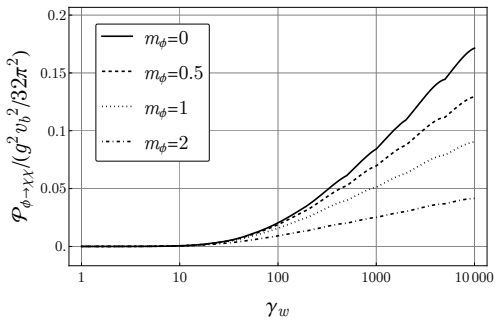
The paper shows that the retarded condensate self-energy, $\Pi^R_\varphi = \Pi^{++}_\varphi - \Pi^{+-}_\varphi$, originating from two-loop two-particle-irreducible vacuum diagrams with two insertions of the background field, belongs in the wall equation of motion. Its imaginary part is a collision term: cutting the diagrams gives particle-production processes in which a plasma particle extracts momentum from the wall. Integrating the self-energy against the wall profile yields a vertex-induced friction $P_{\rm vertex}$ distinct from the familiar mass-change friction $P_{\rm mass}$. In the ultrarelativistic limit the formalism recovers the known logarithmic growth of pair-production pressure with $\gamma_w$, and with a VEV insertion approximation, which expands propagators in powers of the background field, it also reproduces the pressure from scalar and fermion mixing and from gauge-boson transition radiation, including the linear growth with $\gamma_w$ that prevents runaway walls. A gradient expansion localises the non-local term into a mass correction plus a standard dissipative damping term, giving an equation of motion suitable for numerical wall-velocity computations.
Load-bearing premise
The calculation depends on assuming that the simplest set of loop diagrams considered gives the dominant friction and that all neglected diagrams are only small corrections; the paper states this but does not prove it, and the quantitative friction results rely on it.
Editorial extensions
If this is right
- Conventional wall-velocity calculations that use only mass-dependent friction undercount the stopping force whenever the theory has condensate-particle vertices such as $\varphi\phi\chi^2$.
- The kinetic approach can recover the kick-approach results, namely pair production with logarithmic growth in $\gamma_w$, mixing friction, and transition-radiation friction linear in $\gamma_w$, without assuming ballistic particle motion.
- In dark-sector phase transitions where the light-field mass change is loop-suppressed, the new pair-production pressure can exceed the mass-gain pressure and dominate the wall's terminal velocity.
- The localised equation of motion provides a concrete dissipative damping term that can be inserted into numerical bubble-wall calculations, extending them to non-ultrarelativistic walls.
- Transition radiation tends to prevent runaway bubble walls in gauged phase transitions because its pressure grows with the Lorentz factor.
Reading between the lines
- The same condensate self-energy should also appear in the collision terms of the Boltzmann equations for the fluctuations, not only in the wall equation; the paper notes this possibility but leaves it for future work.
- If the two-loop truncation is robust, the framework implies a testable interpolation for friction at intermediate wall velocities, where the kick approach has no prediction and local-thermal-equilibrium estimates break down.
- Comparing the localised equation's terminal velocity against a direct numerical solution of the full coupled equations for the one- and two-point functions in a simple scalar model would quantify the error from dropping subleading local terms.
- For electroweak-scale transitions, the same formalism should generate new collision terms involving the Higgs self-interactions $h \to hh$ and $h \to W^+W^-,ZZ$; the paper lists these processes as natural next applications.
Signed reviews
Editorial analysis
A structured set of objections, weighed in public.
Referee Report
Summary. This paper derives the bubble wall equation of motion from the closed-time-path (CTP) formalism and the two-particle-irreducible (2PI) effective action. The central claim is that the conventional kinetic equation for the condensate, Eq. (1a), is incomplete: it misses a non-local condensate self-energy term of the form ∫d⁴x' Π^R_φ(x,x')φ(x'), shown in Eq. (30). This term arises from two-loop 2PI vacuum diagrams with two condensate insertions, Eq. (21), and describes particle production from condensate-dependent vertices such as φϕχ². The paper identifies this as a new source of dissipative friction, P_vertex in Eq. (37), and shows how the kinetic approach can also accommodate, via the VEV insertion approximation (VIA), the previously kick-approach-only processes of 1-to-1 mixing and 1-to-2 transition radiation. It closes with a localization procedure, Eq. (134), that makes the non-local term usable in numerical computations. The derivation of the exact operator equation, Eq. (8), and the 2PI-based identification of the missing term are internally consistent, but several quantitative steps rely on control assumptions that are not fully established.
Significance. If the central claim holds, this paper fills a genuine conceptual gap between the kinetic and kick approaches to bubble wall dynamics: it provides a first-principles derivation that reproduces the existing kick-approach friction formulas for particle production, mixing, and transition radiation from a single nonequilibrium field-theoretic framework. The strength of the paper is the clean derivation of Eq. (30), the explicit cutting-rule interpretation of Im Π^R_φ, and the verification in Appendix B that the VIA expansions satisfy the Dyson-Schwinger equations. The paper also delivers a locally approximated equation of motion that can be implemented in existing codes such as WallGo. However, the quantitative content is uneven: the pair-production formula has an undetermined O(1) constant fixed only by fitting to numerics, the mixing result is stated to match the literature only up to a factor of two, and the transition-radiation analysis yields a scaling law rather than a controlled coefficient. These issues do not undermine the existence of the new term, but they do affect the claim that the kinetic approach quantitatively reproduces all kick-approach friction processes.
major comments (4)
- [Section 3.1, Eq. (21)] The reduction of the condensate self-energy to the two-loop 2PI vacuum diagrams with two condensate insertions is asserted rather than derived. No power-counting argument is given for neglecting higher-loop diagrams or for the VIA expansion parameters κφ/m_χ² and g₂φ/m_A used in Section 4, and these parameters are not bounded for realistic wall amplitudes. Because the pressure formulas in Eqs. (65), (84), and (128) rely on this truncation, and because large log γ_w enhancements could in principle compensate coupling suppression, the quantitative estimates are not controlled. Please provide a systematic power-counting estimate, or state explicitly the regime in which the truncation is valid and soften the quantitative claims accordingly.
- [Appendix A.3, Eq. (A190)] The paper itself shows that the cumulant expansion of Eq. (A170) does not fix an O(1) constant: Eq. (A185) contains the factor √e σ in the logarithm, and Eq. (A190) drops this factor by hand to match numerics. The final formula quoted in the main text, Eq. (65), therefore contains a fitted constant. This is a legitimate diagnostic, but it means that the prefactor in Eq. (65) has an undetermined order-one uncertainty. Since Eq. (65) is used in the phenomenological comparison of Section 3.3, the uncertainty should be stated explicitly and propagated into the dominance condition g²v_b² ≳ 32π²Δm_φ².
- [Section 4.1.1, Eq. (84)] The text says that Eq. (84) 'matches' the result of Ref. [92] but 'up to a factor of two'. A factor of two is not a benign normalization difference for a quantitative recovery claim, and the source of this mismatch is not identified. Please determine whether it originates in the definition of κ versus 2B, in the Fourier transform convention, in the treatment of both chiralities/spins, or in an actual discrepancy, and either resolve the factor or explicitly state that the kinetic approach reproduces the mixing pressure only up to an unexplained factor of two.
- [Section 4.2.2, Eqs. (123)-(128)] The transition-radiation result is derived only at the level of a scaling law, P_TR ∝ γ_w T³ v_b, under several uncontrolled approximations: the soft limit x≪1, the replacement |φ̃₂(Δp_z)|² by v_b⁴/(Δp_z)², and the use of a thermal screening mass as the IR cutoff. The paper also acknowledges differences from Ref. [89], including a factor of 1/2 and the replacement of 1/k⊥⁴ by 1/(k⊥²+m_A²)². This is sufficient to show that the kinetic approach contains the transition-radiation process, but it does not quantitatively reproduce the existing kick-approach result. The text should distinguish 'captured in principle' from 'quantitatively reproduced', otherwise the central claim is overstated.
minor comments (4)
- [Eq. (63) and Appendix A.1] The notation Δ² = 4m_χ² − m_φ² is introduced but the radicand in Eq. (63) and the derivation in Appendix A.1 would be clearer if the dimensionless variables x, y, z defined in Eq. (A153) were used consistently in the main text as well.
- [Fig. 6] The right panel of Fig. 6, showing the ratio of numerical to analytic pressure, uses an inset with small axis labels; the figure should be reproduced at larger size or with a separate panel so that the claimed factor-of-two discrepancy is legible.
- [Section 3.3, after Eq. (64)] The phenomenological paragraph discusses the electroweak phase transition and processes such as h→hh, h→WW, and Z→hZ, but it does not give the corresponding formula or estimate for these light-particle cases. A brief indication of which terms in Eq. (64) would dominate, or a reference to future numerical work, would help the reader assess the phenomenological relevance.
- [Section 5, Eq. (132)] The localization procedure identifies the last term of Eq. (132) as 'the standard form for a friction term', but the sign convention relative to the frictional pressure P_vertex in Eq. (37) is not discussed; a short comment on the sign would avoid confusion when the local equation is used in practice.
Circularity Check
Self-contained derivation with one fitted constant in a subleading asymptotic formula; no central circularity.
-
fitted input called prediction
[Appendix A.3, Eq. (A190); used in Sec. 3.3, Eq. (65)]
"To make the comparison between numerical and analytical more quantitative, we fix the constant by demanding that the numerical and the analytical estimates overlap in the asymptotic region γw ≫ 1. Interestingly, it is sufficient to eliminate the factor √eσ from the argument of the logarithm in Eq.(A185), namely, we use the pressure Pγw→∞ϕ→χχ ≈ g²v²b/(32π²) T²/24 log(γwT/(2πLwm²χ))."
The O(1) constant in the asymptotic pressure is not derived from the cumulant expansion; the paper explicitly fixes it by requiring the analytic estimate to overlap with the numerical evaluation of the same exact expression (Eq. A165). Eq. (65) then presents this fitted form as the asymptotic prediction. The logarithmic γw growth is derived and the fitted constant is subleading, so this affects only the coefficient of the asymptotic formula, not the central claim that the non-local self-energy term captures pair-production friction.
full rationale
The central derivation is self-contained: Eq. (30) follows from the exact operator EoM (8) and the CTP/2PI variational principle, with the new term ∫ΠRφ descending from the two-loop 2PI diagrams in Eq. (21). The subsequent pressure formulas are derived by evaluating this self-energy with quasi-particle Wightman functions, and the paper checks them against independent kick-approach results (Refs. [92,95]) rather than using those results as input. The only genuinely circular element is the post-hoc fixing of an O(1) constant in the ultrarelativistic pair-production asymptotics (A.190), where the constant is chosen to match the numerical evaluation of the same integral; this is a fitted coefficient in a subleading term and does not control the derived log γw scaling or the existence of the missing friction term. The truncation of the 2PI action at two loops is asserted without a full power-counting proof, but that is a correctness/validity concern, not evidence of circularity. Overall score 2.
Assumptions & free parameters
free parameters (1)
- O(1) constant in ultrarelativistic pair production pressure =
absorbed into the prefactor by replacing √eσ with 1 (Eq. A190)
assumptions (5)
- ad hoc to paper The two-loop 2PI vacuum diagrams with two condensate insertions (Eq. 21) give the leading condensate self-energy; subleading local terms are higher-order corrections.
- domain assumption In the ultrarelativistic wall frame, the two-point functions are z-translation invariant, so the non-local self-energy can be Fourier transformed (Eq. 48).
- domain assumption Quasi-particle approximation with on-shell delta functions (Eqs. 25) for the Wightman functions.
- domain assumption Ballistic approximation, L_w ≪ γ_w L_MFP (Eq. 43).
- domain assumption For VIA expansions, the perturbative parameters κφ/m_χ² (Eq. 72) and g₂φ/m_A (Eq. 97) are small.
Cite this review
Pith. "Pith review of Bubble wall dynamics from nonequilibrium quantum field theory." pith.science (2026). https://pith.science/paper/OQEMTU5A
@misc{pith2026250413725,
  author       = {Pith},
  title        = {Pith review of: Bubble wall dynamics from nonequilibrium quantum field theory},
  year         = {2026},
  howpublished = {\url{https://pith.science/paper/OQEMTU5A}},
  note         = {Machine review of arXiv:2504.13725}
}
abstract
We derive the coupled dynamics between the bubble wall and the plasma from first principles using nonequilibrium quantum field theory. The commonly used equation of motion of the bubble wall in the kinetic approach is shown to be incomplete. In the language of the two-particle-irreducible effective action, the conventional equation misses higher-loop terms generated by the condensate-particle type vertices (e.g.,~$\varphi\phi\chi^2$, where $\varphi$ is the background field describing the bubble wall, $\phi$ the corresponding particle excitation and $\chi$ another particle species in the plasma). From the missing terms, we identify an additional dissipative friction which is contributed by particle production processes from the condensate-particle type vertices. We also show how other transmission processes beyond the 1-to-1 elementary transmission studied in the literature for ultrarelativistic bubble walls, e.g., 1-to-1 mixing and 1-to-2 transition radiation, can be understood from the kinetic approach.
Figures


Figures from the paper (3 more)


Forward citations
Cited by 9 Pith papers
-
Can the universe be matter-dominated after a supercooled first-order phase transition?
After a supercooled first-order phase transition, the scalar field's equation of state is set by the bubble-wall Lorentz factor γ*, and matter domination is delayed until a/a* ≃ γ* in the free-streaming limit.
-
Bubble velocities in local equilibrium from a pseudopotential
Terminal bubble-wall velocities in local equilibrium can be found by requiring degenerate minima of a field-only pseudopotential, avoiding scalar equations of motion and profile or equation-of-state assumptions.
-
Entropy production at electroweak bubble walls from scalar field fluctuations
Scalar fluctuations produce a nonvanishing entropy discontinuity across an electroweak bubble wall even in the zero-friction limit, showing LTE-based wall velocity upper bounds cannot be saturated.
-
Thermal Masses and Bubble-Wall Friction in Cosmological Phase Transitions
Including thermal masses in both the Boltzmann source and collision terms removes the infrared gauge-boson enhancement, making W-boson friction subleading in the singlet-extended Standard Model.
-
The Domain Wall String's Anti-Stokes Scattering Cross Section
The authors compute the anti-Stokes scattering cross section for a domain wall string shape mode in a scalar theory, yielding a wave-packet-independent analytic formula for arbitrary incident angle and impact parameter.
-
Electroweak Phase Transition and Bubble Wall Velocity in Local Thermal Equilibrium
Bubble wall velocities in local thermal equilibrium are computed for three BSM models and found to be nearly universal when expressed via the critical temperature and supercooling, with only deflagration solutions.
-
Cosmological Vacuum Decays from Schwinger-Keldysh Formalism
Tracing out short-wavelength modes in a radiation-dominated FLRW universe gives a non-Markovian, non-Gaussian Langevin equation for the order parameter, with explicitly computed memory and noise kernels.
-
Electroweak Baryogenesis: Advances in Sphaleron Rate Calculations and Implications of Thermal Phase Transitions
Sphaleron rates can be computed gauge-invariantly in 3D thermal EFT, yielding a new baryon-washout criterion x = lambda3/g3^2 that replaces v_c/T_c > 1 for electroweak baryogenesis.
-
The Bubble Wall Velocity in Local Thermal Equilibrium and Energy Budget with Full Effective Potential
Using the full one-loop effective potential with the LTE approximation, the authors find that for xSM deflagration, bag-model gravitational wave peak predictions can differ by up to 48% in frequency and 90% in amplitu...
Reference graph
Works this paper leans on
-
[105]
From Boltzmann equations to steady wall velocities,
T. Konstandin, G. Nardini, and I. Rues, “From Boltzmann equations to steady wall velocities,” JCAP 09 (2014) 028, arXiv:1407.3132 [hep-ph]
arXiv 2014
-
[92]
Bubble wall velocity: heavy physics effects,
A. Azatov and M. Vanvlasselaer, “Bubble wall velocity: heavy physics effects,”JCAP 01 (2021) 058, arXiv:2010.02590 [hep-ph]
arXiv 2021
-
[89]
Electroweak Bubble Wall Speed Limit,
D. Bodeker and G. D. Moore, “Electroweak Bubble Wall Speed Limit,”JCAP 05 (2017) 025, arXiv:1703.08215 [hep-ph]
arXiv 2017
-
[1]
Cosmic Separation of Phases,
E. Witten, “Cosmic Separation of Phases,”Phys. Rev. D30 (1984) 272–285
1984
-
[2]
Gravitational radiation from cosmological phase transitions,
C. J. Hogan, “Gravitational radiation from cosmological phase transitions,”Mon. Not. Roy. Astron. Soc. 218 (1986) 629–636
1986
-
[3]
A. Kosowsky and M. S. Turner, “Gravitational radiation from colliding vacuum bubbles: envelope approximation to many bubble collisions,”Phys. Rev. D47 (1993) 4372–4391, arXiv:astro-ph/9211004 [astro-ph]
arXiv 1993
-
[4]
Gravitational waves from first order cosmological phase transitions,
A. Kosowsky, M. S. Turner, and R. Watkins, “Gravitational waves from first order cosmological phase transitions,”Phys. Rev. Lett. 69 (1992) 2026–2029
1992
-
[5]
Gravitational radiation from first order phase transitions,
M. Kamionkowski, A. Kosowsky, and M. S. Turner, “Gravitational radiation from first order phase transitions,”Phys. Rev. D49 (1994) 2837–2851, arXiv:astro-ph/9310044 [astro-ph]
arXiv 1994
Show all 138 references
-
[6]
On the Anomalous Electroweak Baryon Number Nonconservation in the Early Universe,
V. A. Kuzmin, V. A. Rubakov, and M. E. Shaposhnikov, “On the Anomalous Electroweak Baryon Number Nonconservation in the Early Universe,”Phys. Lett. B 155 (1985) 36
1985
-
[7]
Possible Appearance of the Baryon Asymmetry of the Universe in an Electroweak Theory,
M. Shaposhnikov, “Possible Appearance of the Baryon Asymmetry of the Universe in an Electroweak Theory,” JETP Lett. 44 (1986) 465–468
1986
-
[8]
Why there is something rather than nothing: Matter from weak interactions,
A. E. Nelson, D. B. Kaplan, and A. G. Cohen, “Why there is something rather than nothing: Matter from weak interactions,”Nucl. Phys. B 373 (1992) 453–478
1992
-
[9]
Opening the window for electroweak baryogenesis,
M. Carena, M. Quiros, and C. E. M. Wagner, “Opening the window for electroweak baryogenesis,” Phys. Lett. B 380 (1996) 81–91, arXiv:hep-ph/9603420
1996 arXiv
-
[10]
Baryogenesis at a Lepton-Number-Breaking Phase Transition,
A. J. Long, A. Tesi, and L.-T. Wang, “Baryogenesis at a Lepton-Number-Breaking Phase Transition,” JHEP 10 (2017) 095, arXiv:1703.04902 [hep-ph]
2017 arXiv
-
[11]
Electroweak Phase Transition and Baryogenesis in Composite Higgs Models,
S. Bruggisser, B. Von Harling, O. Matsedonskyi, and G. Servant, “Electroweak Phase Transition and Baryogenesis in Composite Higgs Models,”JHEP 12 (2018) 099, arXiv:1804.07314 [hep-ph]
2018 arXiv
-
[12]
Baryon Asymmetry from a Composite Higgs Boson,
S. Bruggisser, B. Von Harling, O. Matsedonskyi, and G. Servant, “Baryon Asymmetry from a Composite Higgs Boson,”Phys. Rev. Lett. 121 no. 13, (2018) 131801, arXiv:1803.08546 [hep-ph]
2018 arXiv
-
[13]
Electroweak baryogenesis,
D. E. Morrissey and M. J. Ramsey-Musolf, “Electroweak baryogenesis,”New J. Phys. 14 (2012) 125003, arXiv:1206.2942 [hep-ph]
2012 arXiv
-
[14]
Baryogenesis via relativistic bubble walls,
A. Azatov, M. Vanvlasselaer, and W. Yin, “Baryogenesis via relativistic bubble walls,” JHEP 10 (2021) 043, arXiv:2106.14913 [hep-ph]
2021 arXiv
-
[15]
Baryogenesis via relativistic bubble expansion,
I. Baldes, S. Blasi, A. Mariotti, A. Sevrin, and K. Turbang, “Baryogenesis via relativistic bubble expansion,” Phys. Rev. D 104 no. 11, (2021) 115029,arXiv:2106.15602 [hep-ph]
2021 arXiv
-
[16]
Leptogenesis triggered by a first-order phase transition,
P. Huang and K.-P. Xie, “Leptogenesis triggered by a first-order phase transition,”JHEP 55 09 (2022) 052, arXiv:2206.04691 [hep-ph]
2022 arXiv
-
[17]
Bubble-assisted leptogenesis,
E. J. Chun, T. P. Dutka, T. H. Jung, X. Nagels, and M. Vanvlasselaer, “Bubble-assisted leptogenesis,” JHEP 09 (2023) 164, arXiv:2305.10759 [hep-ph]
2023 arXiv
-
[18]
Baryogenesis and leptogenesis from supercooled confinement,
M. Dichtl, J. Nava, S. Pascoli, and F. Sala, “Baryogenesis and leptogenesis from supercooled confinement,” JHEP 02 (2024) 059, arXiv:2312.09282 [hep-ph]
2024 arXiv
-
[19]
Leptogenesis via bubble collisions,
M. Cataldi and B. Shakya, “Leptogenesis via bubble collisions,”JCAP 11 (2024) 047, arXiv:2407.16747 [hep-ph]
2024 arXiv
-
[20]
Magnetic fields from cosmological phase transitions,
T. Vachaspati, “Magnetic fields from cosmological phase transitions,”Phys. Lett. B 265 (1991) 258–261
1991
-
[21]
Magnetic field generation in first order phase transition bubble collisions,
J. Ahonen and K. Enqvist, “Magnetic field generation in first order phase transition bubble collisions,” Phys. Rev. D 57 (1998) 664–673, arXiv:hep-ph/9704334
1998 arXiv
-
[22]
Estimate of the primordial magnetic field helicity,
T. Vachaspati, “Estimate of the primordial magnetic field helicity,”Phys. Rev. Lett. 87 (2001) 251302, arXiv:astro-ph/0101261
2001 arXiv
-
[23]
Intergalactic Magnetic Fields from First-Order Phase Transitions,
J. Ellis, M. Fairbairn, M. Lewicki, V. Vaskonen, and A. Wickens, “Intergalactic Magnetic Fields from First-Order Phase Transitions,”JCAP 1909 no. 09, (2019) 019, arXiv:1907.04315 [astro-ph.CO]
2019 arXiv
-
[24]
Magnetic Field and Gravitational Waves from the First-Order Phase Transition,
Y. Di, J. Wang, R. Zhou, L. Bian, R.-G. Cai, and J. Liu, “Magnetic Field and Gravitational Waves from the First-Order Phase Transition,”Phys. Rev. Lett. 126 no. 25, (2021) 251102, arXiv:2012.15625 [astro-ph.CO]
2021 arXiv
-
[25]
Primordial magnetogenesis in the two-Higgs-doublet model,
M. O. Olea-Romacho, “Primordial magnetogenesis in the two-Higgs-doublet model,” Phys. Rev. D 109 no. 1, (2024) 015023,arXiv:2310.19948 [hep-ph]
2024 arXiv
-
[26]
Magnetogenesis with gravitational waves and primordial black hole dark matter,
S. Balaji, M. Fairbairn, and M. O. Olea-Romacho, “Magnetogenesis with gravitational waves and primordial black hole dark matter,”Phys. Rev. D 109 no. 7, (2024) 075048, arXiv:2402.05179 [hep-ph]
2024 arXiv
-
[27]
Non-thermal Dark Matter Production from the Electroweak Phase Transition: Multi-TeV WIMPs and ’Baby-Zillas’,
A. Falkowski and J. M. No, “Non-thermal Dark Matter Production from the Electroweak Phase Transition: Multi-TeV WIMPs and ’Baby-Zillas’,”JHEP 02 (2013) 034, arXiv:1211.5615 [hep-ph]
2013 arXiv
-
[28]
String Fragmentation in Supercooled Confinement and Implications for Dark Matter,
I. Baldes, Y. Gouttenoire, and F. Sala, “String Fragmentation in Supercooled Confinement and Implications for Dark Matter,”JHEP 04 (2021) 278, arXiv:2007.08440 [hep-ph]
2021 arXiv
-
[29]
Fermi-ball dark matter from a first-order phase transition,
J.-P. Hong, S. Jung, and K.-P. Xie, “Fermi-ball dark matter from a first-order phase transition,” Phys. Rev. D 102 no. 7, (2020) 075028,arXiv:2008.04430 [hep-ph]
2020 arXiv
-
[30]
Dark Matter production from relativistic bubble walls,
A. Azatov, M. Vanvlasselaer, and W. Yin, “Dark Matter production from relativistic bubble walls,” JHEP 03 (2021) 288, arXiv:2101.05721 [hep-ph]
2021 arXiv
-
[31]
Supercool composite Dark Matter beyond 100 TeV,
I. Baldes, Y. Gouttenoire, F. Sala, and G. Servant, “Supercool composite Dark Matter beyond 100 TeV,”JHEP 07 (2022) 084, arXiv:2110.13926 [hep-ph]
2022 arXiv
-
[32]
Thermal squeezeout of dark matter,
P. Asadi, E. D. Kramer, E. Kuflik, G. W. Ridgway, T. R. Slatyer, and J. Smirnov, 56 “Thermal squeezeout of dark matter,”Phys. Rev. D 104 no. 9, (2021) 095013, arXiv:2103.09827 [hep-ph]
2021 arXiv
-
[33]
Hot and heavy dark matter from a weak scale phase transition,
I. Baldes, Y. Gouttenoire, and F. Sala, “Hot and heavy dark matter from a weak scale phase transition,” SciPost Phys. 14 (2023) 033, arXiv:2207.05096 [hep-ph]
2023 arXiv
-
[34]
Ultra-relativistic bubbles from the simplest Higgs portal and their cosmological consequences,
A. Azatov, G. Barni, S. Chakraborty, M. Vanvlasselaer, and W. Yin, “Ultra-relativistic bubbles from the simplest Higgs portal and their cosmological consequences,”JHEP 10 (2022) 017, arXiv:2207.02230 [hep-ph]
2022 arXiv
-
[35]
Ultrahigh-Energy Particle Collisions and Heavy Dark Matter at Phase Transitions,
I. Baldes, M. Dichtl, Y. Gouttenoire, and F. Sala, “Ultrahigh-Energy Particle Collisions and Heavy Dark Matter at Phase Transitions,”Phys. Rev. Lett. 134 no. 6, (2025) 061001, arXiv:2306.15555 [hep-ph]
2025 arXiv
-
[36]
Conformal model for gravitational waves and dark matter: a status update,
M. Kierkla, A. Karam, and B. Swiezewska, “Conformal model for gravitational waves and dark matter: a status update,”JHEP 03 (2023) 007, arXiv:2210.07075 [astro-ph.CO]
2023 arXiv
-
[37]
Recycled dark matter,
T. C. Gehrman, B. Shams Es Haghi, K. Sinha, and T. Xu, “Recycled dark matter,” JCAP 03 (2024) 044, arXiv:2310.08526 [hep-ph]
2024 arXiv
-
[38]
Nonthermal heavy dark matter from a first-order phase transition,
G. F. Giudice, H. M. Lee, A. Pomarol, and B. Shakya, “Nonthermal heavy dark matter from a first-order phase transition,”JHEP 12 (2024) 190, arXiv:2403.03252 [hep-ph]
2024 arXiv
-
[39]
Non-thermal production of heavy vector dark matter from relativistic bubble walls,
W.-Y. Ai, M. Fairbairn, K. Mimasu, and T. You, “Non-thermal production of heavy vector dark matter from relativistic bubble walls,”arXiv:2406.20051 [hep-ph]
-
[40]
Scalar dark matter production through the bubble expansion mechanism: the role of the Lorentz factor and non-renormalizable interactions,
J. A. R. Cembranos, J. Luque, and J. Rubio, “Scalar dark matter production through the bubble expansion mechanism: the role of the Lorentz factor and non-renormalizable interactions,” Eur. Phys. J. C 85 no. 4, (2025) 368,arXiv:2407.14592 [hep-ph]
2025 arXiv
-
[41]
Dark matter phase-in: producing feebly-interacting particles after a first-order phase transition,
C. Benso, F. Kahlhoefer, and H. Mansour, “Dark matter phase-in: producing feebly-interacting particles after a first-order phase transition,”arXiv:2504.10593 [hep-ph]
-
[42]
Abundance of Primordial Holes Produced by Cosmological First Order Phase Transition,
H. Kodama, M. Sasaki, and K. Sato, “Abundance of Primordial Holes Produced by Cosmological First Order Phase Transition,”Prog. Theor. Phys. 68 (1982) 1979
1982
-
[43]
Primordial black holes from a cosmic phase transition: The collapse of Fermi-balls,
K. Kawana and K.-P. Xie, “Primordial black holes from a cosmic phase transition: The collapse of Fermi-balls,”Phys. Lett. B 824 (2022) 136791, arXiv:2106.00111 [astro-ph.CO]
2022 arXiv
-
[44]
Primordial black hole production during first-order phase transitions,
J. Liu, L. Bian, R.-G. Cai, Z.-K. Guo, and S.-J. Wang, “Primordial black hole production during first-order phase transitions,”Phys. Rev. D 105 no. 2, (2022) L021303, arXiv:2106.05637 [astro-ph.CO]
2022 arXiv
-
[45]
Primordial black holes from bubble collisions during a first-order phase transition,
T. H. Jung and T. Okui, “Primordial black holes from bubble collisions during a first-order phase transition,”Phys. Rev. D 110 no. 11, (2024) 115014,arXiv:2110.04271 [hep-ph]
2024 arXiv
-
[46]
Primordial black holes from supercooled phase transitions,
Y. Gouttenoire and T. Volansky, “Primordial black holes from supercooled phase transitions,” Phys. Rev. D 110 no. 4, (2024) 043514,arXiv:2305.04942 [hep-ph] . 57
2024 arXiv
-
[47]
Black Holes and Gravitational Waves from Slow First-Order Phase Transitions,
M. Lewicki, P. Toczek, and V. Vaskonen, “Black Holes and Gravitational Waves from Slow First-Order Phase Transitions,”Phys. Rev. Lett. 133 no. 22, (2024) 221003, arXiv:2402.04158 [astro-ph.CO]
2024 arXiv
-
[48]
Primordial black holes from an interrupted phase transition,
W.-Y. Ai, L. Heurtier, and T. H. Jung, “Primordial black holes from an interrupted phase transition,” arXiv:2409.02175 [astro-ph.CO]
-
[49]
Primordial Black Hole Formation via Inverted Bubble Collapse,
K. Murai, K. Sakurai, and F. Takahashi, “Primordial Black Hole Formation via Inverted Bubble Collapse,” arXiv:2502.02291 [astro-ph.CO]
-
[50]
Observational prospects for phase transitions at LISA: Fisher matrix analysis,
C. Gowling and M. Hindmarsh, “Observational prospects for phase transitions at LISA: Fisher matrix analysis,”JCAP 10 (2021) 039, arXiv:2106.05984 [astro-ph.CO]
2021 arXiv
-
[51]
Bubble wall velocity from holography,
Y. Bea, J. Casalderrey-Solana, T. Giannakopoulos, D. Mateos, M. Sanchez-Garitaonandia, and M. Zilhão, “Bubble wall velocity from holography,”Phys. Rev. D 104 no. 12, (2021) L121903,arXiv:2104.05708 [hep-th]
2021 arXiv
-
[52]
Bubble wall velocity at strong coupling,
F. Bigazzi, A. Caddeo, T. Canneti, and A. L. Cotrone, “Bubble wall velocity at strong coupling,” JHEP 08 (2021) 090, arXiv:2104.12817 [hep-ph]
2021 arXiv
-
[53]
Perfect Fluid Hydrodynamic Picture of Domain Wall Velocities at Strong Coupling,
R. A. Janik, M. Jarvinen, H. Soltanpanahi, and J. Sonnenschein, “Perfect Fluid Hydrodynamic Picture of Domain Wall Velocities at Strong Coupling,”Phys. Rev. Lett. 129 no. 8, (2022) 081601,arXiv:2205.06274 [hep-th]
2022 arXiv
-
[54]
Bubble expansion at strong coupling,
L. Li, S.-J. Wang, and Z.-Y. Yuwen, “Bubble expansion at strong coupling,”Phys. Rev. D 108 no. 9, (2023) 096033,arXiv:2302.10042 [hep-th]
2023 arXiv
-
[55]
Bubble dynamics in a QCD-like phase diagram,
Y. Bea, M. Giliberti, D. Mateos, M. Sanchez-Garitaonandia, A. Serantes, and M. Zilhão, “Bubble dynamics in a QCD-like phase diagram,”arXiv:2412.09588 [hep-th]
-
[56]
Bubble wall velocity in a first order electroweak phase transition,
G. D. Moore and T. Prokopec, “Bubble wall velocity in a first order electroweak phase transition,” Phys. Rev. Lett. 75 (1995) 777–780, arXiv:hep-ph/9503296
1995 arXiv
-
[57]
How fast can the wall move? A Study of the electroweak phase transition dynamics,
G. D. Moore and T. Prokopec, “How fast can the wall move? A Study of the electroweak phase transition dynamics,”Phys. Rev. D 52 (1995) 7182–7204, arXiv:hep-ph/9506475
1995 arXiv
-
[58]
Energy Budget of Cosmological First-order Phase Transitions,
J. R. Espinosa, T. Konstandin, J. M. No, and G. Servant, “Energy Budget of Cosmological First-order Phase Transitions,”JCAP 1006 (2010) 028, arXiv:1004.4187 [hep-ph]
2010 arXiv
-
[59]
Bubble nucleation and growth at a baryon number producing electroweak phase transition,
B.-H. Liu, L. D. McLerran, and N. Turok, “Bubble nucleation and growth at a baryon number producing electroweak phase transition,”Phys. Rev. D 46 (1992) 2668–2688
1992
-
[60]
Hydrodynamic obstruction to bubble expansion,
T. Konstandin and J. M. No, “Hydrodynamic obstruction to bubble expansion,”JCAP 02 (2011) 008, arXiv:1011.3735 [hep-ph]
2011 arXiv
-
[61]
The bubble wall velocity in the minimal supersymmetric light stop scenario,
S. J. Huber and M. Sopena, “The bubble wall velocity in the minimal supersymmetric light stop scenario,”Phys. Rev. D 85 (2012) 103507, arXiv:1112.1888 [hep-ph]
2012 arXiv
-
[62]
Bubble Expansion and the Viability of Singlet-Driven Electroweak Baryogenesis,
J. Kozaczuk, “Bubble Expansion and the Viability of Singlet-Driven Electroweak Baryogenesis,” JHEP 10 (2015) 135, arXiv:1506.04741 [hep-ph]
2015 arXiv
-
[63]
Bubble wall velocities in the Standard 58 Model and beyond,
G. C. Dorsch, S. J. Huber, and T. Konstandin, “Bubble wall velocities in the Standard 58 Model and beyond,”JCAP 1812 no. 12, (2018) 034,arXiv:1809.04907 [hep-ph]
2018 arXiv
-
[64]
Wall speed and shape in singlet-assisted strong electroweak phase transitions,
A. Friedlander, I. Banta, J. M. Cline, and D. Tucker-Smith, “Wall speed and shape in singlet-assisted strong electroweak phase transitions,”Phys. Rev. D 103 no. 5, (2021) 055020, arXiv:2009.14295 [hep-ph]
2021 arXiv
-
[65]
Cosmological bubble friction in local equilibrium,
S. Balaji, M. Spannowsky, and C. Tamarit, “Cosmological bubble friction in local equilibrium,” JCAP 03 (2021) 051, arXiv:2010.08013 [hep-ph]
2021 arXiv
-
[66]
Baryogenesis and gravity waves from a UV-completed electroweak phase transition,
J. M. Cline, A. Friedlander, D.-M. He, K. Kainulainen, B. Laurent, and D. Tucker-Smith, “Baryogenesis and gravity waves from a UV-completed electroweak phase transition,” Phys. Rev. D 103 no. 12, (2021) 123529,arXiv:2102.12490 [hep-ph]
2021 arXiv
-
[67]
Bubble wall velocities in local equilibrium,
W.-Y. Ai, B. Garbrecht, and C. Tamarit, “Bubble wall velocities in local equilibrium,” JCAP 03 no. 03, (2022) 015,arXiv:2109.13710 [hep-ph]
2022 arXiv
-
[68]
Electroweak bubble wall expansion: gravitational waves and baryogenesis in Standard Model-like thermal plasma,
M. Lewicki, M. Merchand, and M. Zych, “Electroweak bubble wall expansion: gravitational waves and baryogenesis in Standard Model-like thermal plasma,”JHEP 02 (2022) 017, arXiv:2111.02393 [astro-ph.CO]
2022 arXiv
-
[69]
A sonic boom in bubble wall friction,
G. C. Dorsch, S. J. Huber, and T. Konstandin, “A sonic boom in bubble wall friction,” JCAP 04 no. 04, (2022) 010,arXiv:2112.12548 [hep-ph]
2022 arXiv
-
[70]
Bubble wall velocity during electroweak phase transition in the inert doublet model,
S. Jiang, F. P. Huang, and X. Wang, “Bubble wall velocity during electroweak phase transition in the inert doublet model,”Phys. Rev. D 107 no. 9, (2023) 095005, arXiv:2211.13142 [hep-ph]
2023 arXiv
-
[71]
First principles determination of bubble wall velocity,
B. Laurent and J. M. Cline, “First principles determination of bubble wall velocity,” Phys. Rev. D 106 no. 2, (2022) 023501,arXiv:2204.13120 [hep-ph]
2022 arXiv
-
[72]
Hydrodynamic backreaction force of cosmological bubble expansion,
S.-J. Wang and Z.-Y. Yuwen, “Hydrodynamic backreaction force of cosmological bubble expansion,” Phys. Rev. D 107 no. 2, (2023) 023501,arXiv:2205.02492 [hep-ph]
2023 arXiv
-
[73]
Model-independent bubble wall velocities in local thermal equilibrium,
W.-Y. Ai, B. Laurent, and J. van de Vis, “Model-independent bubble wall velocities in local thermal equilibrium,”JCAP 07 (2023) 002, arXiv:2303.10171 [astro-ph.CO]
2023 arXiv
-
[74]
Hydrodynamical constraints on the bubble wall velocity,
T. Krajewski, M. Lewicki, and M. Zych, “Hydrodynamical constraints on the bubble wall velocity,” Phys. Rev. D 108 no. 10, (2023) 103523,arXiv:2303.18216 [astro-ph.CO]
2023 arXiv
-
[75]
General backreaction force of cosmological bubble expansion,
J.-C. Wang, Z.-Y. Yuwen, Y.-S. Hao, and S.-J. Wang, “General backreaction force of cosmological bubble expansion,”Phys. Rev. D 110 no. 1, (2024) 016031, arXiv:2310.07691 [hep-ph]
2024 arXiv
-
[76]
Bubble wall velocities with an extended fluid Ansatz,
G. C. Dorsch and D. A. Pinto, “Bubble wall velocities with an extended fluid Ansatz,” JCAP 04 (2024) 027, arXiv:2312.02354 [hep-ph]
2024 arXiv
-
[77]
Confinement Bubble Wall Velocity via Quasiparticle Determination,
Z. Kang and J. Zhu, “Confinement Bubble Wall Velocity via Quasiparticle Determination,” arXiv:2401.03849 [hep-ph]
-
[78]
Criterion for ultra-fast bubble walls: the impact of hydrodynamic obstruction,
W.-Y. Ai, X. Nagels, and M. Vanvlasselaer, “Criterion for ultra-fast bubble walls: the impact of hydrodynamic obstruction,”JCAP 03 (2024) 037, arXiv:2401.05911 [hep-ph]. 59
2024 arXiv
-
[79]
Bubble-wall velocity in local thermal equilibrium: hydrodynamical simulations vs analytical treatment,
T. Krajewski, M. Lewicki, and M. Zych, “Bubble-wall velocity in local thermal equilibrium: hydrodynamical simulations vs analytical treatment,”JHEP 05 (2024) 011, arXiv:2402.15408 [astro-ph.CO]
2024 arXiv
-
[80]
Bubble wall velocity and gravitational wave in the minimal left-right symmetric model,
D.-W. Wang, Q.-S. Yan, and M. Huang, “Bubble wall velocity and gravitational wave in the minimal left-right symmetric model,”Phys. Rev. D 110 no. 7, (2024) 076011, arXiv:2405.01949 [gr-qc]
2024 arXiv
-
[81]
The hydrodynamics of inverse phase transitions,
G. Barni, S. Blasi, and M. Vanvlasselaer, “The hydrodynamics of inverse phase transitions,” JCAP 10 (2024) 042, arXiv:2406.01596 [hep-ph]
2024 arXiv
-
[82]
How fast does the WallGo? A package for computing wall velocities in first-order phase transitions,
A. Ekstedt, O. Gould, J. Hirvonen, B. Laurent, L. Niemi, P. Schicho, and J. van de Vis, “How fast does the WallGo? A package for computing wall velocities in first-order phase transitions,” arXiv:2411.04970 [hep-ph]
-
[83]
Bounds on the bubble wall velocity,
W.-Y. Ai, B. Laurent, and J. van de Vis, “Bounds on the bubble wall velocity,”JHEP 02 (2025) 119, arXiv:2411.13641 [hep-ph]
2025 arXiv
-
[84]
Thermalization effects on the dynamics of growing vacuum bubbles,
T. Krajewski, M. Lewicki, M. Vasar, V. Vaskonen, H. Veermäe, and M. Zych, “Thermalization effects on the dynamics of growing vacuum bubbles,” arXiv:2411.15094 [hep-ph]
-
[85]
Non-singular solutions to the Boltzmann equation with a fluid Ansatz,
G. C. Dorsch, T. Konstandin, E. Perboni, and D. A. Pinto, “Non-singular solutions to the Boltzmann equation with a fluid Ansatz,”arXiv:2412.09266 [hep-ph]
-
[86]
The Discriminant Power of Bubble Wall Velocities: Gravitational Waves and Electroweak Baryogenesis,
M. Carena, A. Ireland, T. Ou, and I. R. Wang, “The Discriminant Power of Bubble Wall Velocities: Gravitational Waves and Electroweak Baryogenesis,”arXiv:2504.17841 [hep-ph]
-
[87]
Towards the theory of the electroweak phase transition,
M. Dine, R. G. Leigh, P. Y. Huet, A. D. Linde, and D. A. Linde, “Towards the theory of the electroweak phase transition,”Phys. Rev. D 46 (1992) 550–571, arXiv:hep-ph/9203203
1992 arXiv
-
[88]
Can electroweak bubble walls run away?,
D. Bodeker and G. D. Moore, “Can electroweak bubble walls run away?,”JCAP 05 (2009) 009, arXiv:0903.4099 [hep-ph]
2009 arXiv
-
[90]
Field-theoretic derivation of bubble-wall force,
M. Barroso Mancha, T. Prokopec, and B. Swiezewska, “Field-theoretic derivation of bubble-wall force,” JHEP 01 (2021) 070, arXiv:2005.10875 [hep-th]
2021 arXiv
-
[91]
Towards an all-orders calculation of the electroweak bubble wall velocity,
S. Höche, J. Kozaczuk, A. J. Long, J. Turner, and Y. Wang, “Towards an all-orders calculation of the electroweak bubble wall velocity,”JCAP 03 (2021) 009, arXiv:2007.10343 [hep-ph]
2021 arXiv
-
[93]
Friction pressure on relativistic bubble walls,
Y. Gouttenoire, R. Jinno, and F. Sala, “Friction pressure on relativistic bubble walls,” JHEP 05 (2022) 004, arXiv:2112.07686 [hep-ph] . 60
2022 arXiv
-
[94]
Reflections on Bubble Walls,
I. Garcia Garcia, G. Koszegi, and R. Petrossian-Byrne, “Reflections on Bubble Walls,” arXiv:2212.10572 [hep-ph]
-
[95]
Logarithmically divergent friction on ultrarelativistic bubble walls,
W.-Y. Ai, “Logarithmically divergent friction on ultrarelativistic bubble walls,”JCAP 10 (2023) 052, arXiv:2308.10679 [hep-ph]
2023 arXiv
-
[96]
Quantisation across bubble walls and friction,
A. Azatov, G. Barni, R. Petrossian-Byrne, and M. Vanvlasselaer, “Quantisation across bubble walls and friction,”JHEP 05 (2024) 294, arXiv:2310.06972 [hep-ph]
2024 arXiv
-
[97]
Particle shells from relativistic bubble walls,
I. Baldes, M. Dichtl, Y. Gouttenoire, and F. Sala, “Particle shells from relativistic bubble walls,” JHEP 07 (2024) 231, arXiv:2403.05615 [hep-ph]
2024 arXiv
-
[98]
NLO friction in symmetry restoring phase transitions,
A. Azatov, G. Barni, and R. Petrossian-Byrne, “NLO friction in symmetry restoring phase transitions,” JHEP 12 (2024) 056, arXiv:2405.19447 [hep-ph]
2024 arXiv
-
[99]
Brownian motion of a quantum oscillator,
J. S. Schwinger, “Brownian motion of a quantum oscillator,”J. Math. Phys. 2 (1961) 407–432
1961
-
[100]
Diagram technique for nonequilibrium processes,
L. V. Keldysh, “Diagram technique for nonequilibrium processes,”Sov. Phys. JETP 20 (1965) 1018
1965
-
[101]
Equilibrium and Nonequilibrium Formalisms Made Unified,
K.-C. Chou, Z.-B. Su, B.-L. Hao, and L. Yu, “Equilibrium and Nonequilibrium Formalisms Made Unified,”Phys. Rept. 118 (1985) 1–131
1985
-
[102]
Effective Action for Composite Operators,
J. M. Cornwall, R. Jackiw, and E. Tomboulis, “Effective Action for Composite Operators,” Phys. Rev. D 10 (1974) 2428–2445
1974
-
[103]
False vacuum decay beyond the quadratic approximation: summation of non-local self-energies,
M. Carosi and B. Garbrecht, “False vacuum decay beyond the quadratic approximation: summation of non-local self-energies,”arXiv:2411.18421 [hep-th]
-
[104]
The growth of bubbles in cosmological phase transitions,
J. Ignatius, K. Kajantie, H. Kurki-Suonio, and M. Laine, “The growth of bubbles in cosmological phase transitions,”Phys. Rev. D 49 (1994) 3854–3868, arXiv:astro-ph/9309059
1994 arXiv
-
[106]
Bubble wall velocity from Kadanoff-Baym equations: fluid dynamics and microscopic interactions,
M. J. Ramsey-Musolf and J. Zhu, “Bubble wall velocity from Kadanoff-Baym equations: fluid dynamics and microscopic interactions,”arXiv:2504.13724 [hep-ph]
-
[107]
Nonequilibrium Quantum Fields: Closed Time Path Effective Action, Wigner Function and Boltzmann Equation,
E. Calzetta and B. L. Hu, “Nonequilibrium Quantum Fields: Closed Time Path Effective Action, Wigner Function and Boltzmann Equation,”Phys. Rev. D 37 (1988) 2878
1988
-
[108]
Introduction to nonequilibrium quantum field theory,
J. Berges, “Introduction to nonequilibrium quantum field theory,”AIP Conf. Proc. 739 no. 1, (2004) 3–62,arXiv:hep-ph/0409233
2004 arXiv
-
[109]
From QFT to Boltzmann: freeze-in in the presence of oscillating condensates,
W.-Y. Ai, A. Beniwal, A. Maggi, and D. J. E. Marsh, “From QFT to Boltzmann: freeze-in in the presence of oscillating condensates,”JHEP 02 (2024) 122, arXiv:2310.08272 [hep-ph]
2024 arXiv
-
[110]
Effective Action for Cosmological Scalar Fields at Finite Temperature,
Y.-K. E. Cheung, M. Drewes, J. U. Kang, and J. C. Kim, “Effective Action for Cosmological Scalar Fields at Finite Temperature,”JHEP 08 (2015) 059, arXiv:1504.04444 [hep-ph] . 61
2015 arXiv
-
[111]
Oscillating scalar dissipating in a medium,
W.-Y. Ai, M. Drewes, D. Glavan, and J. Hajer, “Oscillating scalar dissipating in a medium,” JHEP 11 (2021) 160, arXiv:2108.00254 [hep-ph]
2021 arXiv
-
[112]
Dissipation of oscillating scalar backgrounds in an FLRW universe,
Z.-L. Wang and W.-Y. Ai, “Dissipation of oscillating scalar backgrounds in an FLRW universe,” JHEP 11 (2022) 075, arXiv:2202.08218 [hep-ph]
2022 arXiv
-
[113]
Fate of oscillating homogeneousZ2-symmetric scalar condensates in the early Universe,
W.-Y. Ai and Z.-L. Wang, “Fate of oscillating homogeneousZ2-symmetric scalar condensates in the early Universe,”JCAP 06 (2024) 075, arXiv:2307.14811 [hep-ph]
2024 arXiv
-
[114]
Singularities and discontinuities of Feynman amplitudes,
R. E. Cutkosky, “Singularities and discontinuities of Feynman amplitudes,”J. Math. Phys. 1 (1960) 429–433
1960
-
[115]
Simple Rules for Discontinuities in Finite Temperature Field Theory,
H. A. Weldon, “Simple Rules for Discontinuities in Finite Temperature Field Theory,” Phys. Rev. D 28 (1983) 2007
1983
-
[116]
Discontinuities of Green Functions in Field Theory at Finite Temperature and Density,
R. L. Kobes and G. W. Semenoff, “Discontinuities of Green Functions in Field Theory at Finite Temperature and Density,”Nucl. Phys. B 260 (1985) 714–746
1985
-
[117]
Discontinuities of Green Functions in Field Theory at Finite Temperature and Density. 2,
R. L. Kobes and G. W. Semenoff, “Discontinuities of Green Functions in Field Theory at Finite Temperature and Density. 2,”Nucl. Phys. B 272 (1986) 329–364
1986
-
[118]
Simple physical approach to thermal cutting rules,
P. V. Landshoff, “Simple physical approach to thermal cutting rules,”Phys. Lett. B 386 (1996) 291–296, arXiv:hep-ph/9606426
1996 arXiv
-
[119]
Cutting rules in the real time formalisms at finite temperature,
F. Gelis, “Cutting rules in the real time formalisms at finite temperature,”Nucl. Phys. B 508 (1997) 483–505, arXiv:hep-ph/9701410
1997 arXiv
-
[120]
Cutting rules at finite temperature,
P. F. Bedaque, A. K. Das, and S. Naik, “Cutting rules at finite temperature,”Mod. Phys. Lett. A 12 (1997) 2481–2496, arXiv:hep-ph/9603325
1997 arXiv
-
[121]
Transport equations for chiral fermions to order h bar and electroweak baryogenesis. Part 1,
T. Prokopec, M. G. Schmidt, and S. Weinstock, “Transport equations for chiral fermions to order h bar and electroweak baryogenesis. Part 1,”Annals Phys. 314 (2004) 208–265, arXiv:hep-ph/0312110
2004 arXiv
-
[122]
Why is there more matter than antimatter? Calculational methods for leptogenesis and electroweak baryogenesis,
B. Garbrecht, “Why is there more matter than antimatter? Calculational methods for leptogenesis and electroweak baryogenesis,”Prog. Part. Nucl. Phys. 110 (2020) 103727, arXiv:1812.02651 [hep-ph]
2020 arXiv
-
[123]
Bubble-wall speed with loop corrections,
A. Dashko and A. Ekstedt, “Bubble-wall speed with loop corrections,”JHEP 25 (2020) 024, arXiv:2411.05075 [hep-ph]
2020 arXiv
-
[124]
Bubble wall dynamics at the electroweak phase transition,
S. De Curtis, L. D. Rose, A. Guiggiani, A. G. Muyor, and G. Panico, “Bubble wall dynamics at the electroweak phase transition,”arXiv:2201.08220 [hep-ph]
-
[125]
Collision integrals for cosmological phase transitions,
S. De Curtis, L. Delle Rose, A. Guiggiani, A. Gil Muyor, and G. Panico, “Collision integrals for cosmological phase transitions,”JHEP 05 (2023) 194, arXiv:2303.05846 [hep-ph]
2023 arXiv
-
[126]
Non-linearities in cosmological bubble wall dynamics,
S. De Curtis, L. Delle Rose, A. Guiggiani, A. Gil Muyor, and G. Panico, “Non-linearities in cosmological bubble wall dynamics,”JHEP 05 (2024) 009, arXiv:2401.13522 [hep-ph]
2024 arXiv
-
[127]
Populating secluded dark sector 62 with ultra-relativistic bubbles,
A. Azatov, X. Nagels, M. Vanvlasselaer, and W. Yin, “Populating secluded dark sector 62 with ultra-relativistic bubbles,”JHEP 11 (2024) 129, arXiv:2406.12554 [hep-ph]
2024 arXiv
-
[128]
M. L. Bellac,Thermal Field Theory . Cambridge Monographs on Mathematical Physics. Cambridge University Press, 3, 2011
2011
-
[129]
Electroweak Beautygenesis: From b \to s CP-violation to the Cosmic Baryon Asymmetry,
T. Liu, M. J. Ramsey-Musolf, and J. Shu, “Electroweak Beautygenesis: From b \to s CP-violation to the Cosmic Baryon Asymmetry,”Phys. Rev. Lett. 108 (2012) 221301, arXiv:1109.4145 [hep-ph]
2012 arXiv
-
[130]
Electroweak baryogenesis from light fermion sources: A critical study,
J. M. Cline and B. Laurent, “Electroweak baryogenesis from light fermion sources: A critical study,” Phys. Rev. D 104 no. 8, (2021) 083507,arXiv:2108.04249 [hep-ph]
2021 arXiv
-
[131]
Superradiance in stars: non-equilibrium approach to damping of fields in stellar media,
F. Chadha-Day, B. Garbrecht, and J. McDonald, “Superradiance in stars: non-equilibrium approach to damping of fields in stellar media,”JCAP 12 (2022) 008, arXiv:2207.07662 [hep-ph]
2022 arXiv
-
[132]
Theoretical uncertainties for cosmological first-order phase transitions,
D. Croon, O. Gould, P. Schicho, T. V. I. Tenkanen, and G. White, “Theoretical uncertainties for cosmological first-order phase transitions,”JHEP 04 (2021) 055, arXiv:2009.10080 [hep-ph]
2021 arXiv
-
[133]
Higher-order-operator corrections to phase-transition parameters in dimensional reduction,
M. Chala, J. C. Criado, L. Gil, and J. L. Miras, “Higher-order-operator corrections to phase-transition parameters in dimensional reduction,”JHEP 10 (2024) 025, arXiv:2406.02667 [hep-ph]
2024 arXiv
-
[134]
Gravitational waves from supercooled phase transitions: dimensional transmutation meets dimensional reduction,
M. Kierkla, B. Swiezewska, T. V. I. Tenkanen, and J. van de Vis, “Gravitational waves from supercooled phase transitions: dimensional transmutation meets dimensional reduction,” JHEP 02 (2024) 234, arXiv:2312.12413 [hep-ph]
2024 arXiv
-
[135]
Finite-temperature bubble nucleation with shifting scale hierarchies,
M. Kierkla, P. Schicho, B. Swiezewska, T. V. I. Tenkanen, and J. van de Vis, “Finite-temperature bubble nucleation with shifting scale hierarchies,” arXiv:2503.13597 [hep-ph]
-
[136]
Higher-dimensional operators at finite-temperature affect gravitational-wave predictions,
F. Bernardo, P. Klose, P. Schicho, and T. V. I. Tenkanen, “Higher-dimensional operators at finite-temperature affect gravitational-wave predictions,”arXiv:2503.18904 [hep-ph]
-
[137]
Nonperturbative test of nucleation calculations for strong phase transitions,
O. Gould, A. Kormu, and D. J. Weir, “Nonperturbative test of nucleation calculations for strong phase transitions,”Phys. Rev. D 111 no. 5, (2025) L051901,arXiv:2404.01876 [hep-th]
2025
-
[138]
Real-Time Nucleation and Off-Equilibrium Effects in High-Temperature Quantum Field Theories,
J. Hirvonen, “Real-Time Nucleation and Off-Equilibrium Effects in High-Temperature Quantum Field Theories,”arXiv:2403.07987 [hep-ph] . 63
Reviewed August 16, 2026 · model on record in the stance chip above.
Discussion (0). Continue with ORCID to comment.