REVIEW 4 major objections 5 minor 38 references
Improving Aviation Safety Analysis: Automated HFACS Classification Using Reinforcement Learning with Group Relative Policy Optimization
T0 review · 4 major / 5 minor · reviewed 2026-08-05 · deepseek-v4-flash
Pith's one-line read Reinforcement learning fine-tuning of a small open-weights model can outperform much larger general-purpose LLMs on structured multi-label aviation-safety classification, the paper argues.
desk verdict A clean, reproducible GRPO-for-HFACS application whose headline claim is not statistically supported by a single 100-sample evaluation with inconsistent numbers. read the letter →
The pith
A machine-rendered reading of the paper's core claim, the machinery that carries it, and where it could break.
The reading
What carries the argument
GRPO is the central mechanism: instead of training a separate value/critic model as PPO does, GRPO samples a group of G completions per prompt, computes a scalar reward for each, and assigns advantage by group-relative normalization (reward minus group mean, divided by group standard deviation). The policy is updated with a clipped probability-ratio objective plus KL penalty to the reference policy. The reward function has five weighted components—+2.0 for exact code match, a scaled partial-match reward, +0.25 for format compliance, -0.25 per invalid or hallucinated HFACS code, and a 0-0.5 GPT-5-nano judge score on reasoning quality—and these rewards shape the model toward accurate, valid, a
What would settle it
Retrain the same GRPO pipeline on real GAHFACS narratives only, using class-balanced sampling instead of synthetic generation, and evaluate on a held-out set of purely real NTSB reports: if exact-match accuracy falls back to baseline (below 0.10), the gain is an artifact of the synthetic data distribution rather than the RL optimization. Alternatively, run the released model on a fresh, independently annotated sample of real NTSB narratives and check whether exact match stays above 0.15.
Extended reading notes
Core claim
The central claim is that the optimization method, not model scale, drives performance on complex multi-label classification: an 8B model fine-tuned with GRPO reaches exact-match HFACS accuracy of about 0.18-0.19, surpassing GPT-5-mini (0.07), Gemini-2.5-flash (0.12), GPT-OSS 20B (0.06), and several other open models, while also achieving the highest partial-match accuracy (0.88) and micro F1 (0.5906). The authors treat exact match as a strict test of multi-label reasoning—every predicted code must coincide with the ground-truth set—and they interpret the low absolute scores as typical of hard reasoning tasks, citing ARC-AGI-2. They also show that training dynamics reduce hallucinated HFACS
Load-bearing premise
The reported gains depend on GPT-5-generated synthetic accident narratives being statistically similar to real NTSB reports; if they are not, the exact-match improvements observed on the real test set will not generalize to real-world deployment.
Editorial extensions
If this is right
- A domain-tuned 8B model can beat much larger general-purpose LLMs on a specialized classification task, enabling low-cost, low-latency deployment on resource-constrained edge hardware.
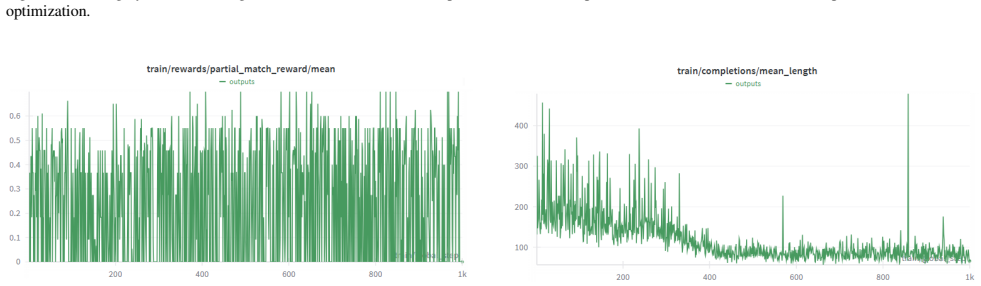
- RL with a shaped reward function reduces hallucinated codes over training, with validity penalties dropping from -1.4 to roughly -0.2 to -0.4 after step 400.
- The multi-component reward, including an LLM judge, produces not only higher accuracy but also more concise reasoning, with completion length shrinking from about 350 to 100 tokens.
- Exact-match accuracy for multi-label HFACS classification is proposed as a new benchmark for evaluating advanced reasoning in language models.
- Synthetic data generation for rare classes enables balanced training and improves coverage of under-represented but critical safety factors.
Reading between the lines
- If exact-match HFACS accuracy is genuinely hard for current LLMs, aviation-accident narratives could become a low-cost, domain-grounded reasoning benchmark complementing synthetic reasoning suites—this is my inference, not the paper's claim.
- The validity-penalty reward component targets a failure mode that generalizes to other high-stakes coding tasks, such as clinical coding or hazard classification, where outputting a nonexistent code is dangerous; extending the same reward structure is a natural next step.
- The paper does not isolate how much of the gain comes from GRPO versus the synthetic data distribution; a testable extension is training on real-only class-balanced sampling and comparing exact-match accuracy.
- The observed collapse in completion length suggests GRPO discovered that brevity is implicitly rewarded by the reward mix, which would reduce inference cost and latency in deployed safety-analysis pipelines.
Editorial analysis
A structured set of objections, weighed in public.
Referee Report
Summary. The paper applies Group Relative Policy Optimization (GRPO) to fine-tune Llama-3.1-8B-Instruct for multi-label HFACS classification of aviation accident narratives. The reward function combines exact-match, partial-match, format, validity, and GPT-5-nano judge components, and GPT-5-generated synthetic data are used to balance underrepresented HFACS categories. On a held-out real test set, the authors report exact-match accuracy rising from 0.0400 to 0.1800 (or 0.1900), partial-match accuracy from 0.7400 to 0.8800, and claim that their 8B model outperforms GPT-5-mini and Gemini-2.5-flash on exact match. The paper also proposes exact-match HFACS accuracy as a new benchmark for evaluating LLM reasoning.
Significance. If the performance claims were statistically reliable, this would be a useful demonstration that domain-specific RL fine-tuning of a small open model with a transparent reward decomposition can compete with much larger general-purpose LLMs on a structured multi-label classification task, while enabling low-latency deployment. The reward design and synthetic-data pipeline are clearly described, and the availability of code and data is a strength. However, the headline comparison currently rests on a single stochastic evaluation of about 100 items, no confidence intervals or significance tests, an internal 0.18/0.19 discrepancy, and an ambiguous test-set size. These issues are load-bearing for the central claim and require additional experiments or analysis to resolve.
major comments (4)
- [§3.3, Table 1, §3.1, Abstract] The paper is internally inconsistent about the headline exact-match accuracy of the GRPO model. Abstract and §3.1/Figure 4 report 0.1800, Table 1 lists 0.1800, but §3.3 states 'Our GRPO-optimized model achieves the highest exact match accuracy (0.1900)'. This discrepancy makes the main quantitative result unreproducible from the manuscript. The authors must correct the number and ensure all references, including text, tables, and figures, agree.
- [§2.5, §3.3, Table 1] The evaluation is a single run on 100 test items sampled at temperature 1.0 with no seeds, confidence intervals, or significance tests. A proportion of 0.18 on n=100 has a standard error of roughly 0.038; the gap of 0.06 versus Gemini-2.5-flash is within that noise (about 1.2 SE of the difference), and the gap of 0.11 versus GPT-5-mini is only about 2.4 SE, with stochastic sampling at T=1.0 adding further variance. The claim that the GRPO model 'outperforms' these LLMs is therefore not statistically established. Report results over multiple seeds, give confidence intervals, and ideally use a paired evaluation with the same test items for all models.
- [§2.2 and §2.5] The test-set size and composition are ambiguous. §2.2 says 'The test set comprises 100 samples with an intentionally imbalanced distribution', while §2.5 says the loader 'forms a test set of 100 uniformly sampled real items plus %10 additional real data from underrepresented classes'. If the latter means 100 + 10 = 110 items, all reported proportions (0.04, 0.18, 0.12, etc.) have an ambiguous denominator. Clarify the exact number of test items, how the 10% was computed, and report the per-class breakdown.
- [§2.2, Figure 2] The synthetic-data generation pipeline assumes that GPT-5-generated narratives for AD000, PC200, and PE200 are distributionally similar to real NTSB narratives, but no validation is provided. Because synthetic data are used to balance the training set and the test set deliberately over-represents those classes, the model's performance on rare classes could be inflated if synthetic narratives differ systematically from real accident reports. Provide per-class results on real data, include a human or automated realism check of the synthetic narratives, or analyze distribution shift (e.g., embedding distance between real and synthetic samples). This is important for the generalization claim in the conclusion.
minor comments (5)
- [§2.5] Typo: 'tempreture' should be 'temperature'. Also, the justification for using temperature 1.0 for all models because 'GPT-5 only supports the value 1' is unusual; please verify and clarify whether GPT-5-mini and Gemini-2.5-flash evaluations were also single stochastic samples.
- [Abstract] Typo: 'Gemini-2.5-fiash' should be 'Gemini-2.5-flash'. Also be consistent in naming 'GPT-5-mini' vs 'GPT-5 Mini'.
- [§3.3] Reference [38] is the LMSYS-Chat-1M dataset paper, but the text cites 'LM-SYS benchmark' with specific scores that appear to come from a leaderboard. Provide the correct reference for the leaderboard and scores.
- [§4] The claim of 'the first successful application of GRPO to an aviation safety classification task' is difficult to verify and too strong; consider softening to 'an application'.
- [§2.2] Please provide the exact numbers of real vs synthetic samples per category in the training set. The paper says 'exactly 100 samples per HFACS category', but the composition (real vs synthetic) for each category is not tabulated.
Circularity Check
No circularity found; the central empirical claim is supported by held-out real-label evaluation and no equation reduces to its inputs.
full rationale
The paper's chain of evidence is empirical: GRPO fine-tuning optimizes a multi-component reward (exact match, partial match, format, validity, and GPT-5-nano reasoning quality) on a balanced training set (Section 2.4), and performance is then measured on a separately constructed 100-sample test set of real GAHFACS narratives with synthetic rows explicitly excluded (Section 2.5). All reported metrics (exact match, partial match, macro/micro F1, precision, recall) are computed against ground-truth labels on held-out data, not against the training rewards or the judge model. No fitted parameter is renamed as a prediction, no uniqueness theorem is imported, and no self-citation carries a load-bearing premise: the GAHFACS dataset [8], GRPO [22], and the base model [25] are all external citations. The internal inconsistency between Table 1 (0.1800) and Section 3.3 (0.1900) and the single temperature-1.0 evaluation without variance estimates are statistical and correctness concerns, but they are not definitional circularity. Under the specified criteria, no circular step can be exhibited with a quote-and-reduction, so the appropriate finding is no significant circularity.
Assumptions & free parameters
free parameters (4)
- Reward component weights =
correctness +2.0, partial 0.1+0.9x, format +0.25, validity -0.25 per invalid code, judge 0/0.25/0.5
- Training set size per class =
100 samples per HFACS category, 1000 total
- Test set size and composition =
100 real samples plus an additional 10% of rare classes, ambiguous in text
- GRPO and LLM sampling hyperparameters =
group size G=6, temperature 1.0, top_p 0.95, max 1024 tokens
assumptions (5)
- domain assumption GAHFACS labels are correct ground truth for human factors in each accident narrative.
- domain assumption The first two HFACS 8.0 layers cover the relevant human factors for general aviation accidents.
- domain assumption GPT-5-generated synthetic narratives are representative of real NTSB accident reports for rare classes.
- domain assumption GPT-5-nano's reasoning-quality scores are a valid reward signal that improves classification rather than merely style.
- standard math Standard GRPO/PPO theory, including group-relative advantages, clipping, and KL penalty, is applicable to this text-generation setup.
Cite this review
Pith. "Pith review of Improving Aviation Safety Analysis: Automated HFACS Classification Using Reinforcement Learning with Group Relative Policy Optimization." pith.science (2026). https://pith.science/paper/OQJTHKSL
@misc{pith2026250821201,
  author       = {Pith},
  title        = {Pith review of: Improving Aviation Safety Analysis: Automated HFACS Classification Using Reinforcement Learning with Group Relative Policy Optimization},
  year         = {2026},
  howpublished = {\url{https://pith.science/paper/OQJTHKSL}},
  note         = {Machine review of arXiv:2508.21201}
}
read the original abstract
Analyzing the human factors behind aviation accidents is crucial for preventing future incidents, yet traditional methods using the Human Factors Analysis and Classification System (HFACS) are limited by scalability and consistency. To address this, we introduce an automated HFACS classification framework for aviation safety analysis that utilizes Reinforcement Learning with Group Relative Policy Optimization (GRPO) to fine-tune a Llama-3.1 8B language model. Our approach incorporates a multi-component reward system tailored for aviation safety analysis and integrates synthetic data generation to overcome class imbalance in accident datasets. The resulting GRPO-optimized model achieved noticeable performance gains, including a 350% increase in exact match accuracy (from 0.0400 to 0.1800) and an improved partial match accuracy of 0.8800. Significantly, our specialized model outperforms state-of-the-art LLMs (Large Language Models), including GPT-5-mini and Gemini-2.5-fiash, on key metrics. This research also proposes exact match accuracy in multi-label HFACS classification problem as a new benchmarking methodology to evaluate the advanced reasoning capabilities of language models. Ultimately, our work validates that smaller, domain-optimized models can provide a computationally efficient and better solution for critical safety analysis. This approach makes powerful, low-latency deployment on resource-constrained edge devices feasible.
Figures


Figures from the paper (9 more)




Reference graph
Works this paper leans on
-
[1]
M. Morales, D. E. Sandlin, Managing airborne relief during international disasters, Journal of Humanitar- ian Logistics and Supply Chain Management 5 (1) (2015) 12–34
work page 2015
-
[2]
Q. Wu, F. Ren, Emergency management capability evaluation system in civil aviation industry, in: 2016 International Conference on Industrial Informatics- Computing Technology, Intelligent Technology, In- dustrial Information Integration (ICIICII), IEEE, 2016, pp. 356–359
work page 2016
- [3]
-
[4]
B. C. Kuo, W.-l. Guan, P.-c. Chen, In search of general aviation flight data monitoring: Lightweight record- ing system, in: 17th AIAA Aviation Technology, In- tegration, and Operations Conference, 2017, p. 3439
work page 2017
-
[5]
C. J. L. e Silva, M. O. de Andrade, V . A. Falcão, C. F. A. da Silva, The geographical characteristics of subsidized air routes serving as lifelines, Journal of Air Transport Management 104 (2022) 102280
work page 2022
-
[6]
S. A. Shappell, D. A. Wiegmann, The human factors analysis and classification system–hfacs (2000)
work page 2000
- [7]
-
[8]
Q. Liu, F. Li, K. K. Ng, J. Han, S. Feng, Accident investigation via llms reasoning: Hfacs-guided chain- of-thoughts enhance general aviation safety, Expert Systems with Applications 269 (2025) 126422
work page 2025
Show all 38 references
-
[9]
J. Wei, X. Wang, D. Schuurmans, M. Bosma, F. Xia, E. Chi, Q. V . Le, D. Zhou, et al., Chain-of-thought prompting elicits reasoning in large language models, Advances in neural information processing systems 35 (2022) 24824–24837
2022
-
[10]
K. Wu, W. Li, X. Xiao, Accidentgpt: Large multi- modal foundation model for tra ffic accident analysis, arXiv preprint arXiv:2401.03040 (2024)
2024 arXiv
-
[11]
R. S. Sutton, A. G. Barto, et al., Reinforcement learn- ing: An introduction, V ol. 1, MIT press Cambridge, 1998
1998
-
[12]
C. J. Watkins, P. Dayan, Q-learning, Machine learning 8 (3) (1992) 279–292
1992
-
[13]
Wang, T.-H
Y .-H. Wang, T.-H. S. Li, C.-J. Lin, Backward q- learning: The combination of sarsa algorithm and q- learning, Engineering Applications of Artificial Intel- ligence 26 (9) (2013) 2184–2193
2013
-
[14]
V . Mnih, K. Kavukcuoglu, D. Silver, A. Graves, I. Antonoglou, D. Wierstra, M. Riedmiller, Playing atari with deep reinforcement learning, arXiv preprint arXiv:1312.5602 (2013)
2013 arXiv
-
[15]
Van Hasselt, A
H. Van Hasselt, A. Guez, D. Silver, Deep reinforce- ment learning with double q-learning, in: Proceed- ings of the AAAI conference on artificial intelligence, V ol. 30, 2016
2016
-
[16]
Halat, M
S. Halat, M. M. Ebadzadeh, K. Amani, Modified double-dqn: addressing stability, in: 2024 11th Inter- national Symposium on Telecommunications (IST), IEEE, 2024, pp. 697–702
2024
-
[17]
Li, Deep reinforcement learning: An overview, arXiv preprint arXiv:1701.07274 (2017)
Y . Li, Deep reinforcement learning: An overview, arXiv preprint arXiv:1701.07274 (2017)
2017 arXiv
-
[18]
Babaeizadeh, I
M. Babaeizadeh, I. Frosio, S. Tyree, J. Clemons, J. Kautz, Reinforcement learning through asyn- chronous advantage actor-critic on a gpu, arXiv preprint arXiv:1611.06256 (2016). 10
2016 arXiv
-
[19]
M. Hariharan, Reinforcement learning: Advanced techniques for llm behavior optimization, ESP Inter- national Journal of Advancements in Computational Technology (ESP-IJACT) 2 (2) (2025) 84–101
2025
-
[20]
Schulman, F
J. Schulman, F. Wolski, P. Dhariwal, A. Radford, O. Klimov, Proximal policy optimization algorithms, arXiv preprint arXiv:1707.06347 (2017)
2017 arXiv
-
[21]
Silver, J
D. Silver, J. Schrittwieser, K. Simonyan, I. Antonoglou, A. Huang, A. Guez, T. Hubert, L. Baker, M. Lai, A. Bolton, et al., Mastering the game of go without human knowledge, nature 550 (7676) (2017) 354–359
2017
-
[22]
Z. Shao, P. Wang, Q. Zhu, R. Xu, J. Song, X. Bi, H. Zhang, M. Zhang, Y . Li, Y . Wu, et al., Deepseek- math: Pushing the limits of mathematical rea- soning in open language models, arXiv preprint arXiv:2402.03300 (2024)
2024 arXiv
-
[23]
Jaech, A
A. Jaech, A. Kalai, A. Lerer, A. Richardson, A. El- Kishky, A. Low, A. Helyar, A. Madry, A. Beutel, A. Carney, et al., Openai o1 system card, arXiv preprint arXiv:2412.16720 (2024)
2024 arXiv
-
[24]
rep., OpenAI (August 2025)
OpenAI, Gpt-5 system card, Tech. rep., OpenAI (August 2025). URL https://cdn.openai.com/ gpt-5-system-card.pdf
2025
-
[25]
U. AI, D. Han-Chen, M. Han-Chen, unsloth /llama- 3.1-8b-instruct, https://huggingface.co/ unsloth/Llama-3.1-8B-Instruct (2024)
2024
-
[26]
Z. Xu, S. Jain, M. Kankanhalli, Hallucination is in- evitable: An innate limitation of large language mod- els, arXiv preprint arXiv:2401.11817 (2024)
2024 arXiv
-
[27]
N. V . Chawla, K. W. Bowyer, L. O. Hall, W. P. Kegelmeyer, Smote: synthetic minority over- sampling technique, Journal of artificial intelligence research 16 (2002) 321–357
2002
-
[28]
Lamari, N
M. Lamari, N. Azizi, N. E. Hammami, A. Boukhamla, S. Cheriguene, N. Dendani, N. E. Benzebouchi, Smote–enn-based data sampling and improved dy- namic ensemble selection for imbalanced medical data classification, in: Advances on smart and soft computing: Proceedings of ICACIn 2...
2020
-
[29]
Han, W.-Y
H. Han, W.-Y . Wang, B.-H. Mao, Borderline-smote: a new over-sampling method in imbalanced data sets learning, in: International conference on intelligent computing, Springer, 2005, pp. 878–887
2005
-
[30]
Demidova, I
L. Demidova, I. Klyueva, Svm classification: Opti- mization with the smote algorithm for the class im- balance problem, in: 2017 6th mediterranean confer- ence on embedded computing (MECO), IEEE, 2017, pp. 1–4
2017
-
[31]
Hairani, A
H. Hairani, A. Anggrawan, D. Priyanto, Improvement performance of the random forest method on unbal- anced diabetes data classification using smote-tomek link, JOIV: international journal on informatics visu- alization 7 (1) (2023) 258–264
2023
-
[32]
Hayaty, S
M. Hayaty, S. Muthmainah, S. M. Ghufran, Random and synthetic over-sampling approach to resolve data imbalance in classification, International Journal of Artificial Intelligence Research 4 (2) (2020) 86–94
2020
-
[33]
Devlin, M.-W
J. Devlin, M.-W. Chang, K. Lee, K. Toutanova, Bert: Pre-training of deep bidirectional transformers for language understanding, in: Proceedings of the 2019 conference of the North American chapter of the asso- ciation for computational linguistics: human language technologies,...
2019
-
[34]
Brown, B
T. Brown, B. Mann, N. Ryder, M. Subbiah, J. D. Ka- plan, P. Dhariwal, A. Neelakantan, P. Shyam, G. Sas- try, A. Askell, et al., Language models are few-shot learners, Advances in neural information processing systems 33 (2020) 1877–1901
2020
-
[35]
Petruzzellis, A
F. Petruzzellis, A. Testolin, A. Sperduti, Benchmark- ing gpt-4 on algorithmic problems: A systematic evaluation of prompting strategies, arXiv preprint arXiv:2402.17396 (2024)
2024 arXiv
-
[36]
W. Kwon, Z. Li, S. Zhuang, Y . Sheng, L. Zheng, C. H. Yu, J. Gonzalez, H. Zhang, I. Stoica, E fficient mem- ory management for large language model serving with pagedattention, in: Proceedings of the 29th sym- posium on operating systems principles, 2023, pp. 611–626
2023
-
[37]
Chollet, M
F. Chollet, M. Knoop, G. Kamradt, B. Landers, H. Pinkard, Arc-agi-2: A new challenge for frontier ai reasoning systems, arXiv preprint arXiv:2505.11831 (2025)
2025 arXiv
-
[38]
Zheng, W.-L
L. Zheng, W.-L. Chiang, Y . Sheng, T. Li, S. Zhuang, Z. Wu, Y . Zhuang, Z. Li, Z. Lin, E. P. Xing, et al., Lmsys-chat-1m: A large-scale real-world llm con- versation dataset, arXiv preprint arXiv:2309.11998 (2023). 11
2023 arXiv
Reviewed August 5, 2026 · model on record in the stance chip above.
Discussion (0). Sign in to comment.