REVIEW 3 major objections 6 minor 23 references
NeuroMask: Explaining Predictions of Deep Neural Networks through Mask Learning
T0 review · 3 major / 6 minor · reviewed 2026-08-14 · deepseek-v4-flash
Pith's one-line read NeuroMask learns a sparse, smooth mask over the input image that preserves a pre-trained classifier's prediction, and claims this mask localizes the pixels that drove the decision.
desk verdict A clearly-written mask-learning explanation method that is essentially Fong & Vedaldi with a different loss, undermined by purely qualitative evaluation and a concrete inconsistency in the objective. read the letter →
The pith
A machine-rendered reading of the paper's core claim, the machinery that carries it, and where it could break.
The reading
What carries the argument
The central object is the relevance mask $m$, a per-pixel weight in $[0,1]$ learned through RMSProp by minimizing a weighted sum of three losses: $\mathcal{L}_{\text{pred}}$, the cross-entropy between the outputs of two frozen copies of the classifier, one fed the original image and one fed the masked image; $\mathcal{L}_{\text{sparse}}$, an $\ell^1$ penalty on mask weights that drives most pixels toward zero; and $\mathcal{L}_{\text{smooth}}$, an $\ell^1$ penalty on the mask convolved with a discrete Laplacian filter that forces highlighted regions to be contiguous. The trainable weights $W$ are mapped to $m$ through a sigmoid, and the two frozen model copies supply the constraint that a good explanation must be sufficient: hiding everything outside the mask should not change the verdict.
What would settle it
A concrete test: on images with ground-truth object segmentations, if a NeuroMask mask preserves the classifier's class probability while its high-weight pixels have near-zero overlap with the object, the localization claim is falsified; the same test with known spurious background cues would reveal whether the explanation tracks bias instead of the object.
Extended reading notes
Core claim
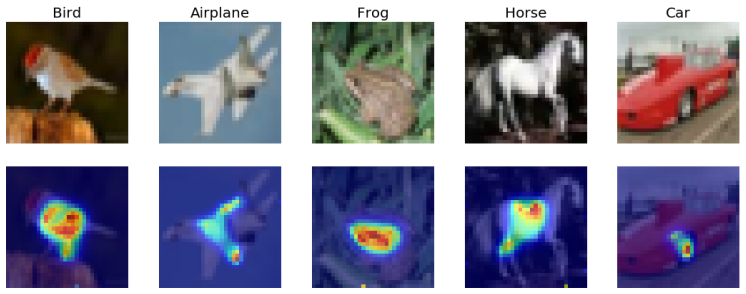
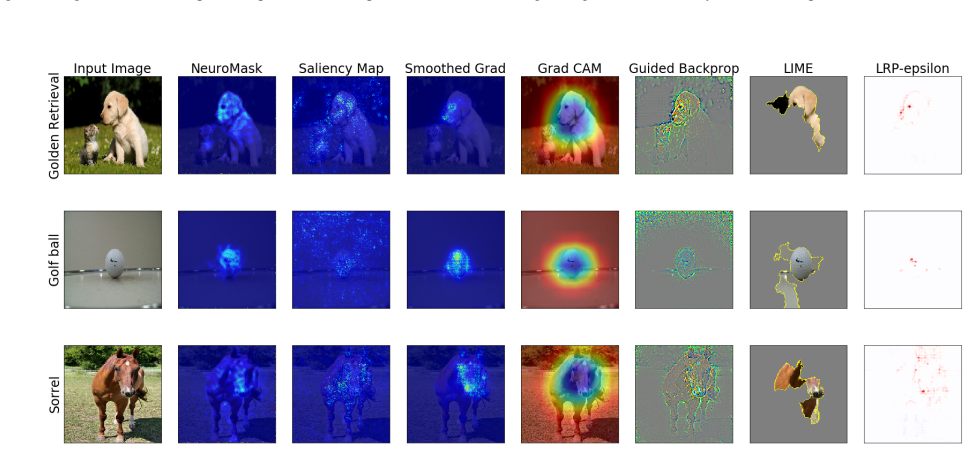
The paper's central claim is that explanation can be framed as mask optimization. Given an input image $x$ and a frozen pre-trained classifier $f$, NeuroMask learns $m \in [0,1]^{H\times W}$ so that $f(x)$ and $f(m \odot x)$ predict the same class, where the prediction cost is cross-entropy between the two softmax outputs, while $\ell^1$ penalties push the mask toward being sparse and spatially smooth. The authors argue that the resulting mask is both accurate, in the sense that it localizes the parts of the image most relevant to the decision, and interpretable, in the sense that a human sees contiguous object parts rather than scattered pixels. They support this with qualitative comparison against Saliency Map, Smoothed Grad, Grad-CAM, Guided Backprop, LIME, and LRP-epsilon on CIFAR-10 and ImageNet examples.
Load-bearing premise
The load-bearing premise is that a mask that preserves the classifier's output while being sparse and smooth is necessarily showing the evidence the network used; the paper asserts this link but never tests it against ground-truth object locations or human judgment, so a mask could in principle preserve the verdict while pointing at irrelevant pixels.
Editorial extensions
If this is right
- A mask that preserves the predicted class while being sparse and smooth is a candidate minimal evidence set: pixels outside it are, by construction, dispensable for the decision.
- Because the network weights are never updated, NeuroMask can be applied to any already-deployed image classifier that supports gradient backpropagation through the input.
- The same three-term objective could be ported to other outputs and modalities, which the paper names as future directions: image captioning, text, and sound.
- The visual comparisons imply NeuroMask's masks sit between overly noisy pixel-level methods and overly coarse region-level methods: cleaner than saliency and guided backprop, finer than Grad-CAM, and less dependent on superpixel boundaries than LIME.
Reading between the lines
- A natural quantitative extension the paper does not run is to score masks by deletion and insertion, removing the highlighted pixels and measuring how fast the class probability drops; if the mask is truly decision-relevant, removal should be devastating.
- Because the objective only enforces output preservation, the method could in principle highlight a spurious background cue instead of the object; comparing masks on counterfactual image pairs, same object with different backgrounds, would reveal whether NeuroMask tracks the object or the dataset bias.
- The smoothness penalty's scale is a free parameter; varying it and checking masks against ground-truth object segmentations would provide the first objective test of the accuracy claim, which the paper currently supports only by visual inspection.
Signed reviews
Editorial analysis
A structured set of objections, weighed in public.
Referee Report
Summary. The paper proposes NeuroMask, a model-agnostic method for explaining image classification decisions by learning a multiplicative mask over the input image. Two frozen copies of a pretrained classifier receive the original image and the masked image; the mask weights are optimized with RMSProp to minimize a weighted sum of a prediction-preservation term (cross-entropy between the two model outputs), a sparsity term, and a smoothness term. The authors evaluate NeuroMask on CIFAR-10 and ImageNet with pretrained convolutional networks and compare the resulting masks qualitatively against saliency maps, SmoothGrad, Grad-CAM, Guided Backprop, LIME, and LRP-epsilon. Based on visual inspection, they conclude that NeuroMask produces accurate and interpretable explanations that localize the parts of the image most relevant to the model's decision.
Significance. If the central claim were fully supported, NeuroMask would be a useful addition to the interpretability toolbox: it is model-agnostic, requires no retraining or architecture modification, and produces a directly visualizable mask. The paper also compares against six established explanation methods, which is a reasonable starting point. The conceptual formulation, combining output preservation with sparsity and smoothness, is clear and the visual examples in Figures 2 and 3 are suggestive. However, the current evidence is almost entirely qualitative. The abstract and Section IV-B claim that NeuroMask 'successfully localizes' relevant image parts, but no quantitative localization, faithfulness, or human-evaluation evidence is provided, and the paper itself concedes the missing validation at the end of Section IV-B. In addition, the sparsity term is defined inconsistently between Section III and Algorithm 1, which directly affects what objective is actually optimized. No code, hyperparameters, or numerical results are supplied, limiting reproducibility. The central idea is defensible, but the empirical claim needs substantially more support.
major comments (3)
- [Abstract and Section IV-B] The central claim that NeuroMask 'successfully localizes the parts of the input image which are most relevant to the DNN decision' rests entirely on visual inspection of a small number of examples. There are no quantitative localization metrics (e.g., pointing game or IoU with ground-truth object masks), no deletion/insertion or output-preservation statistics, no comparison against a model with a known decision rule, and no user study. Because the objective itself encourages the masked input to preserve the classifier's output, output preservation alone cannot distinguish a mask that reflects the model's actual evidence from a mask that merely finds some small sufficient pixel set. The paper explicitly acknowledges this gap in Section IV-B ('in the future, we plan to conduct more comprehensive evaluation studies that include doing user's surveys'). I request quantitative evaluation on a benchmark with ground-truth annotations, plus at least one faithfulness measure, before the localization claim can be accepted.
- [Section III, Sparseness cost, and Algorithm 1, line 9] There is a direct inconsistency in the definition of the sparsity objective. In Section III, the paper defines Lsparse(W) = sum_{i,j} |W_{i,j} + tau| with tau = 20, chosen so that sigma(-tau) is approximately zero, which biases mask weights toward -tau and hence mask values toward 0. In contrast, Algorithm 1 line 9 sets Lsparse = |W|_1, which biases mask weights toward 0. These are different objectives and will produce different masks and different gradients. The paper provides no reconciliation of the two formulations. The authors must state which objective is actually minimized and ensure that Algorithm 1, the text, and any released code agree.
- [Section III, Ltotal and Algorithm 1] The behavior of NeuroMask depends critically on the weighting coefficients lambda_p, lambda_sp, lambda_sm, the sparsity offset tau, the RMSProp learning rate alpha and decay beta, and the number of optimization steps T, but none of these values are reported anywhere in the manuscript. Without this information the experiments are not reproducible, and it is unclear how sensitive the qualitative results are to the balance between prediction preservation, sparsity, and smoothness. I request that all hyperparameters be reported and that at least a small ablation study over the main loss weights be included.
minor comments (6)
- [Section III, Smoothness cost] The heading 'Smoothness cost Lsparse' and the following sentence 'the definition of Lsparse is chosen to be the L1 norm of the 2nd derivative' should refer to Lsmooth, not Lsparse.
- [Section IV-B] The paper cites Inception-v3 as reference [22], but [22] is Montavon et al.'s deep Taylor decomposition paper; the Inception-v3 architecture should be cited as [21] (Szegedy et al.).
- [Algorithm 1] The algorithm input is written as x in R^{H x W}, whereas the text defines x in R^{H x W x 3}; the notation should be aligned.
- [Section I] The introduction says Section III describes the 'assumptions' of NeuroMask, but Section III contains no explicit list of assumptions; please adjust the wording or add an assumptions subsection.
- [Section IV-C] Figure 4 is referred to as 'Figure IV-C' in the text; the cross-reference should be to Figure 4.
- [Throughout] There are repeated typos and grammatical errors, including 'state-of-art', 'intepretability', 'the the model', and 'systemically occlude'; these should be corrected in a journal version.
Circularity Check
Central claim reduces to the optimization objective by construction.
-
self definitional
[Section III (Algorithm Design, Lpred definition); Abstract]
"The basic idea behind NeuroMask is that input features which are not strongly relevant to the model’s classification decision can be suppressed from the input without affecting the model’s output. ... Lpred(y, ŷ) = −∑ i∈{1,2,..L} 1 (i = arg max j∈{1,2,..L} yj) log (ˆyi)"
By defining relevance through the ability to suppress features without changing the output, and then optimizing the mask m to minimize Lpred (the cross-entropy between f(x) and f(m⊙x)), the mask is constructed to satisfy exactly the property later cited as evidence of success. The Abstract's claim that NeuroMask 'successfully localizes the parts of the input image which are most relevant' is a restatement of the optimization objective: any mask that drives Lpred to zero, while meeting sparsity and smoothness penalties, will by construction suppress output-preserving features.
full rationale
The only substantive circularity is self-definitional: the paper equates 'relevant' with 'suppressible without changing the prediction' and then optimizes the mask to enforce that property, so the abstract's success claim is, in its accuracy component, a tautology backed only by visual inspection. No load-bearing self-citation exists: reference [16] is a related-work survey by overlapping authors and is not used to justify the method. No uniqueness theorem, imported ansatz, or renamed empirical pattern appears. A secondary reproducibility inconsistency (Lsparse = |W+τ|_1 in the text vs. Lsparse = |W|_1 in Algorithm 1) is a correctness concern, not circularity, and does not change the verdict. Because the method has independent content in its sparsity and smoothness terms and the visual examples are genuine outputs, the circularity is partial rather than total, warranting a score of 6.
Assumptions & free parameters
free parameters (4)
- tau =
20
- lambda_p, lambda_sp, lambda_sm =
not specified
- RMSProp learning rate and beta =
not specified
- optimization iterations T =
not specified
assumptions (3)
- domain assumption The suppression premise: features not relevant to the classifier's decision can be removed without changing its output.
- domain assumption Cross-entropy between the original and masked softmax outputs is an adequate measure of explanation fidelity.
- domain assumption L1 sparsity plus Laplacian smoothness produces human-interpretable masks.
Cite this review
Pith. "Pith review of NeuroMask: Explaining Predictions of Deep Neural Networks through Mask Learning." pith.science (2026). https://pith.science/paper/OR2QB44R
@misc{pith2026190804389,
  author       = {Pith},
  title        = {Pith review of: NeuroMask: Explaining Predictions of Deep Neural Networks through Mask Learning},
  year         = {2026},
  howpublished = {\url{https://pith.science/paper/OR2QB44R}},
  note         = {Machine review of arXiv:1908.04389}
}
read the original abstract
Deep Neural Networks (DNNs) deliver state-of-the-art performance in many image recognition and understanding applications. However, despite their outstanding performance, these models are black-boxes and it is hard to understand how they make their decisions. Over the past few years, researchers have studied the problem of providing explanations of why DNNs predicted their results. However, existing techniques are either obtrusive, requiring changes in model training, or suffer from low output quality. In this paper, we present a novel method, NeuroMask, for generating an interpretable explanation of classification model results. When applied to image classification models, NeuroMask identifies the image parts that are most important to classifier results by applying a mask that hides/reveals different parts of the image, before feeding it back into the model. The mask values are tuned by minimizing a properly designed cost function that preserves the classification result and encourages producing an interpretable mask. Experiments using state-of-the-art Convolutional Neural Networks for image recognition on different datasets (CIFAR-10 and ImageNet) show that NeuroMask successfully localizes the parts of the input image which are most relevant to the DNN decision. By showing a visual quality comparison between NeuroMask explanations and those of other methods, we find NeuroMask to be both accurate and interpretable.
Figures

Figures from the paper (1 more)

Reference graph
Works this paper leans on
-
[15]
Interpretable explanations of black boxes by meaningful perturbation,
R. C. Fong and A. Vedaldi, “Interpretable explanations of black boxes by meaningful perturbation,” in Proceedings of the IEEE International Conference on Computer Vision , 2017, pp. 3429–3437
work page 2017
-
[1]
Amazon scraps secret ai recruiting tool that showed bias against women,
REUTERS news, “Amazon scraps secret ai recruiting tool that showed bias against women,” https://www. reuters.com/article/us-amazon-com-jobs-automation-insight/ amazon-scraps-secret-ai-recruiting-tool-that-showed-bias-against-women-idUSKCN1MK08G, 2018
work page 2018
-
[2]
General data protection regulation,
Parliament and Council of the European Union, “General data protection regulation,” 2016
work page 2016
-
[3]
Explainable artificial intelligence (xai),
D. Gunning, “Explainable artificial intelligence (xai),” Defense Ad- vanced Research Projects Agency (DARPA), nd Web , 2017
2017
-
[4]
Deep inside convolutional networks: Visualising image classification models and saliency maps,
K. Simonyan, A. Vedaldi, and A. Zisserman, “Deep inside convolutional networks: Visualising image classification models and saliency maps,” arXiv preprint arXiv:1312.6034 , 2013
arXiv 2013
-
[6]
Smoothgrad: removing noise by adding noise,
D. Smilkov, N. Thorat, B. Kim, F. Vi ´egas, and M. Wattenberg, “Smoothgrad: removing noise by adding noise,” arXiv preprint arXiv:1706.03825, 2017
arXiv 2017
-
[7]
Imagenet: A large-scale hierarchical image database,
J. Deng, W. Dong, R. Socher, L.-J. Li, K. Li, and L. Fei-Fei, “Imagenet: A large-scale hierarchical image database,” in 2009 IEEE conference on computer vision and pattern recognition . Ieee, 2009, pp. 248–255
2009
-
[8]
Learning multiple layers of features from tiny images,
A. Krizhevsky and G. Hinton, “Learning multiple layers of features from tiny images,” Citeseer, Tech. Rep., 2009
2009
Show all 23 references
-
[9]
Striving for simplicity: The all convolutional net,
J. T. Springenberg, A. Dosovitskiy, T. Brox, and M. Riedmiller, “Striving for simplicity: The all convolutional net,” arXiv preprint arXiv:1412.6806, 2014
2014 arXiv
-
[10]
On pixel-wise explanations for non-linear classifier deci- sions by layer-wise relevance propagation,
S. Bach, A. Binder, G. Montavon, F. Klauschen, K.-R. M ¨uller, and W. Samek, “On pixel-wise explanations for non-linear classifier deci- sions by layer-wise relevance propagation,” PloS one , vol. 10, no. 7, p. e0130140, 2015
2015
-
[11]
The mythos of model interpretability,
Z. C. Lipton, “The mythos of model interpretability,” CoRR, vol. abs/1606.03490, 2016. [Online]. Available: http://arxiv.org/abs/1606. 03490
2016 arXiv
-
[12]
Visualizing and understanding convolu- tional networks,
M. D. Zeiler and R. Fergus, “Visualizing and understanding convolu- tional networks,” in European conference on computer vision . Springer, 2014, pp. 818–833
2014
-
[13]
Grad-cam: Visual explanations from deep networks via gradient-based localization,
R. R. Selvaraju, M. Cogswell, A. Das, R. Vedantam, D. Parikh, and D. Batra, “Grad-cam: Visual explanations from deep networks via gradient-based localization,” in Proceedings of the IEEE International Conference on Computer Vision , 2017, pp. 618–626
2017
-
[14]
On pixel-wise explanations for non-linear classifier decisions by layer-wise relevance propagation,
S. Bach, A. Binder, G. Montavon, F. Klauschen, K.-R. Mller, and W. Samek, “On pixel-wise explanations for non-linear classifier decisions by layer-wise relevance propagation,” PLOS ONE , vol. 10, no. 7, pp. 1–46, 07 2015. [Online]. Available: https://doi.org/10.1371/ journal.po...
2015
-
[16]
Interpretability of deep learning models: a survey of results,
S. Chakraborty, R. Tomsett, R. Raghavendra, D. Harborne, M. Alzantot, F. Cerutti, M. Srivastava, A. Preece, S. Julier, R. M. Rao et al. , “Interpretability of deep learning models: a survey of results,” in 2017 IEEE SmartWorld, Ubiquitous Intelligence & Computing, Advanced & T...
2017
-
[17]
A survey of methods for explaining black box models,
R. Guidotti, A. Monreale, S. Ruggieri, F. Turini, F. Giannotti, and D. Pedreschi, “A survey of methods for explaining black box models,” ACM computing surveys (CSUR) , vol. 51, no. 5, p. 93, 2018
2018
-
[18]
Lecture 6.5-rmsprop: Divide the gradient by a running average of its recent magnitude,
T. Tieleman and G. Hinton, “Lecture 6.5-rmsprop: Divide the gradient by a running average of its recent magnitude,” COURSERA: Neural networks for machine learning , vol. 4, no. 2, pp. 26–31, 2012
2012
-
[19]
Interpretable convolutional neural networks,
Q. Zhang, Y . Nian Wu, and S.-C. Zhu, “Interpretable convolutional neural networks,” in Proceedings of the IEEE Conference on Computer Vision and Pattern Recognition , 2018, pp. 8827–8836
2018
-
[20]
Towards evaluating the robustness of neural networks,
N. Carlini and D. Wagner, “Towards evaluating the robustness of neural networks,” in 2017 IEEE Symposium on Security and Privacy (SP) . IEEE, 2017, pp. 39–57
2017
-
[21]
Rethinking the inception architecture for computer vision,
C. Szegedy, V . Vanhoucke, S. Ioffe, J. Shlens, and Z. Wojna, “Rethinking the inception architecture for computer vision,” CoRR, vol. abs/1512.00567, 2015. [Online]. Available: http://arxiv.org/abs/1512. 00567
2015 arXiv
-
[22]
Explaining nonlinear classification decisions with deep taylor decomposition,
G. Montavon, S. Bach, A. Binder, W. Samek, and K. M ¨uller, “Explaining nonlinear classification decisions with deep taylor decomposition,” CoRR, vol. abs/1512.02479, 2015. [Online]. Available: http://arxiv.org/abs/1512.02479
2015 arXiv
-
[23]
innvestigate neural networks!
M. Alber, S. Lapuschkin, P. Seegerer, M. H ¨agele, K. T. Sch ¨utt, G. Montavon, W. Samek, K. M ¨uller, S. D ¨ahne, and P. Kindermans, “innvestigate neural networks!” CoRR, vol. abs/1808.04260, 2018. [Online]. Available: http://arxiv.org/abs/1808.04260
2018 arXiv
-
[2016]
Available: http://arxiv.org/abs/1602.04938
[Online]. Available: http://arxiv.org/abs/1602.04938
Reviewed August 14, 2026 · model on record in the stance chip above.
Discussion (0). Continue with ORCID to comment.