REVIEW 2 major objections 2 minor 1 cited by
Beyond Single Slot: Joint Optimization for Multi-Slot Guaranteed Display Advertising
T0 review · 2 major / 2 minor · reviewed 2026-05-22 · grok-4.3
Pith's one-line read Joint optimization of multi-slot ad allocations using bipartite matching and roulette mechanisms boosts platform revenue and contract stability.
desk verdict Joint multi-slot optimization with roulette and constraints delivers a real 29% ARPU lift in live A/B tests, but the offline bipartite matching needs explicit handling for sequential online arrivals. read the letter →
The pith
A machine-rendered reading of the paper's core claim, the machinery that carries it, and where it could break.
The reading
What carries the argument
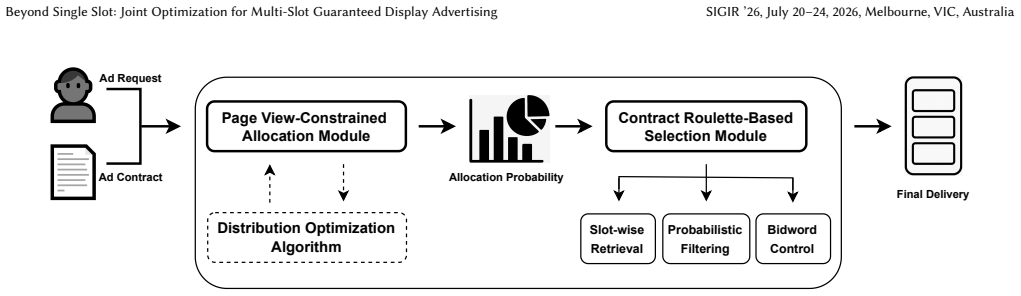
Offline bipartite matching problem augmented with a contract roulette mechanism for slot exclusivity and Page View constraints for impression control.
What would settle it
An A/B test comparing the joint optimization against a single-slot baseline where the revenue per user increase disappears or contract stability worsens would falsify the claim.
Extended reading notes
Core claim
The authors formulate the multi-slot guaranteed display allocation as an offline bipartite matching problem incorporating a contract roulette mechanism to enforce slot exclusivity and Page View constraints to regulate impression distribution, solved via a scalable allocation optimization algorithm that enables efficient deployment, leading to measured gains in revenue efficiency and robustness.
Load-bearing premise
The contract roulette mechanism and page view constraints are assumed to sufficiently address slot-level redundancy, contract imbalance, and exposure concentration in live traffic without creating new allocation biases or scalability failures.
Editorial extensions
If this is right
- Merchant return on investment increases through reduced slot redundancy and better exposure balance.
- Platform revenue efficiency rises as shown by the 28.99 percent lift in average revenue per user.
- Contract fulfillment becomes more stable according to the difference-in-differences analysis.
- The approach scales to large traffic volumes without proportional increases in computation time.
Reading between the lines
- Similar joint optimization techniques could apply to other resource allocation tasks involving multiple constraints, such as inventory management in e-commerce.
- Long-term effects might include changes in advertiser bidding strategies as they adapt to more reliable fulfillment.
- Extending the model to include dynamic real-time adjustments could further enhance performance beyond offline planning.
Editorial analysis
A structured set of objections, weighed in public.
Referee Report
Summary. The paper claims that existing single-slot methods limit multi-slot guaranteed display advertising optimization, and proposes a joint framework that casts allocation as an offline bipartite matching problem augmented by a contract roulette mechanism for slot exclusivity and Page View constraints for impression control. It further introduces a scalable allocation optimization algorithm and reports online A/B tests on the Meituan platform showing a 28.99% ARPU lift under 70% traffic plus improved contract stability via DID analysis.
Significance. If the offline matching solution can be shown to remain near-optimal under sequential impression arrivals and the roulette/Page-View mechanisms provably mitigate redundancy and concentration without introducing new biases, the work would offer a practical advance for large-scale guaranteed display systems. The reported A/B and DID results supply external grounding, but the absence of competitive-ratio bounds, regret analysis, or detailed ablations leaves the theoretical grounding thin.
major comments (2)
- [Proposed framework / Abstract] The central formulation treats allocation as an offline bipartite matching problem (described in the abstract and the proposed framework section). This assumes all impressions and contracts are known in advance, yet live traffic involves sequential page-view arrivals; without a competitive-ratio guarantee, online primal-dual adjustment, or regret bound, it is unclear whether the offline optimum remains feasible or revenue-optimal once contracts must be honored in real time.
- [Abstract and experimental results] The abstract states positive online A/B and DID results but supplies no equations for the matching objective, no ablation studies isolating the roulette mechanism or Page View constraints, and no statistical details or error analysis. This leaves the 28.99% ARPU claim without visible derivation or verification support inside the manuscript.
minor comments (2)
- Notation for the bipartite graph, contract roulette probabilities, and Page View constraint formulation should be introduced with explicit symbols and a small illustrative example to improve readability.
- The manuscript should clarify whether the scalable allocation algorithm is a heuristic, an approximation algorithm, or an exact solver, and report its per-impression runtime on production traffic volumes.
Simulated Author's Rebuttal
We thank the referee for the constructive and detailed feedback. We address each major comment below and have revised the manuscript to strengthen the presentation of our framework and experimental results.
read point-by-point responses
-
Referee: [Proposed framework / Abstract] The central formulation treats allocation as an offline bipartite matching problem (described in the abstract and the proposed framework section). This assumes all impressions and contracts are known in advance, yet live traffic involves sequential page-view arrivals; without a competitive-ratio guarantee, online primal-dual adjustment, or regret bound, it is unclear whether the offline optimum remains feasible or revenue-optimal once contracts must be honored in real time.
Authors: We acknowledge the distinction between the offline bipartite matching formulation and the sequential arrival of impressions in live traffic. In our system, the matching is solved periodically on aggregated historical data to obtain allocation plans, which are then executed online using the contract roulette mechanism for slot exclusivity and Page View constraints for impression control. This hybrid approach allows the offline optimum to guide real-time decisions while adapting to incoming page views. Although we do not derive competitive-ratio bounds or regret analysis in the current work, the framework's practical performance is demonstrated by the online A/B tests and DID analysis. We have added a dedicated discussion subsection on the offline-to-online deployment strategy and its limitations. revision: partial
-
Referee: [Abstract and experimental results] The abstract states positive online A/B and DID results but supplies no equations for the matching objective, no ablation studies isolating the roulette mechanism or Page View constraints, and no statistical details or error analysis. This leaves the 28.99% ARPU claim without visible derivation or verification support inside the manuscript.
Authors: We agree that additional details would improve transparency. The matching objective is defined in the proposed framework section of the full manuscript, but we have now included its equation in the abstract for quick reference. We have also added ablation studies in the experimental results section that isolate the contributions of the contract roulette mechanism and Page View constraints, along with statistical details including confidence intervals, p-values, and error analysis supporting the 28.99% ARPU increase under 70% traffic. revision: yes
Circularity Check
No significant circularity in derivation or claims
full rationale
The paper introduces a joint optimization framework that formulates multi-slot GD allocation as an offline bipartite matching problem augmented by a contract roulette mechanism and Page View constraints. These are presented as novel modeling choices to address redundancy, imbalance, and concentration. Effectiveness is evaluated via online A/B tests (28.99% ARPU lift) and DID analysis on live traffic, which constitute external empirical grounding rather than internal reduction to fitted parameters or prior self-citations. No equations or steps in the abstract or described approach reduce by construction to the inputs; the central claims rest on the proposed mechanisms plus real-world deployment results, keeping the derivation self-contained.
Assumptions & free parameters
invented entities (1)
-
contract roulette mechanism
Cite this review
Pith. "Pith review of Beyond Single Slot: Joint Optimization for Multi-Slot Guaranteed Display Advertising." pith.science (2026). https://pith.science/paper/ORZXTMWW
@misc{pith2026260521556,
  author       = {Pith},
  title        = {Pith review of: Beyond Single Slot: Joint Optimization for Multi-Slot Guaranteed Display Advertising},
  year         = {2026},
  howpublished = {\url{https://pith.science/paper/ORZXTMWW}},
  note         = {Machine review of arXiv:2605.21556}
}
read the original abstract
Guaranteed display advertising is crucial for platform monetization, yet existing methods often operate under a single-slot assumption, limiting their ability to optimize allocation across multi-slot page views. In this paper, we propose a novel joint optimization framework for multi-slot GD allocation, addressing key challenges such as slot-level redundancy, contract imbalance, and exposure concentration. Our approach formulates the allocation as an offline bipartite matching problem with a contract roulette mechanism for slot exclusivity and Page View constraints for impression control, and incorporates a scalable allocation optimization algorithm for efficient large-scale deployment. Extensive online tests on the Meituan advertising platform demonstrate that our method significantly improves merchant ROI, platform revenue efficiency, and contract fulfillment robustness. Specifically, online A/B tests show a 28.99% increase in Average Revenue Per User under 70% traffic, and DID analysis further indicates improved contract stability, demonstrating the strong applicability and effectiveness of our framework in real-world advertising deployments.
Figures
Forward citations
Cited by 1 Pith paper
-
HMAF: A Hierarchical Multi-Slot GD-RTB Allocation Framework
HMAF is a Plan-Calibrate-Execute framework for GD-RTB impression allocation that claims to improve delivery rates and revenue when deployed at Meituan.
Reference graph
Works this paper leans on
-
[1]
Vijay Bharadwaj, Peiji Chen, Wenjing Ma, Chandrashekhar Nagarajan, John Tomlin, Sergei Vassilvitskii, Erik Vee, and Jian Yang. 2012. Shale: an efficient algorithm for allocation of guaranteed display advertising. InProceedings of the 18th ACM SIGKDD international conference on Knowledge discovery and data mining. 1195–1203
work page 2012
-
[2]
Ye Chen, Pavel Berkhin, Bo Anderson, and Nikhil R Devanur. 2011. Real-time bidding algorithms for performance-based display ad allocation. InProceedings of the 17th ACM SIGKDD international conference on Knowledge discovery and data mining. 1307–1315
work page 2011
-
[3]
Xiao Cheng, Chuanren Liu, Liang Dai, Peng Zhang, Zhen Fang, and Zhonglin Zu. 2022. An adaptive unified allocation framework for guaranteed display advertising. InProceedings of the Fifteenth ACM International Conference on Web Search and Data Mining. 132–140
work page 2022
-
[4]
Liang Dai, Kejie Lyu, Chengcheng Zhang, Guangming Zhao, Zhonglin Zu, Liang Wang, and Bo Zheng. 2024. Percentile risk-constrained budget pacing for guar- anteed display advertising in online optimization. InProceedings of the AAAI Conference on Artificial Intelligence, Vol. 38. 7987–7994
work page 2024
-
[5]
Liang Dai, Zhonglin Zu, Hao Wu, Liang Wang, and Bo Zheng. 2023. Fairness- aware guaranteed display advertising allocation under traffic cost constraint. In Proceedings of the ACM Web Conference 2023. 3572–3580
work page 2023
-
[6]
Zhen Fang, Yang Li, Chuanren Liu, Wenxiang Zhu, Yu Zheng, and Wenjun Zhou
-
[7]
In2019 IEEE International Conference on Data Mining (ICDM)
Large-scale personalized delivery for guaranteed display advertising with real-time pacing. In2019 IEEE International Conference on Data Mining (ICDM). IEEE, 190–199
-
[8]
Ali Hojjat, John Turner, Suleyman Cetintas, and Jian Yang. 2014. Delivering guaranteed display ads under reach and frequency requirements. InProceedings of the AAAI Conference on Artificial Intelligence, Vol. 28
work page 2014
Show all 14 references
-
[9]
Hang Lei, Yin Zhao, and Longjun Cai. 2020. Multi-objective optimization for guaranteed delivery in video service platform. InProceedings of the 26th ACM SIGKDD International Conference on Knowledge Discovery & Data Mining. 3017– 3025
2020
-
[10]
Yu Lei, Jiayang Zhao, Yilei Zhao, Zhaoqi Zhang, Linyou Cai, Qianlong Xie, and Xingxing Wang. 2025. Generative Large-Scale Pre-trained Models for Automated Ad Bidding Optimization.arXiv preprint arXiv:2508.02002(2025)
2025
-
[11]
Yan Li, Yundu Huang, Wuyang Mao, Furong Ye, Xiang He, Zhonglin Zu, and Shaowei Cai. 2024. Bi-Objective Contract Allocation for Guaranteed Delivery Advertising. InProceedings of the 30th ACM SIGKDD Conference on Knowledge Discovery and Data Mining. 1691–1700
2024
-
[12]
Wuyang Mao, Chuanren Liu, Yundu Huang, Zhonglin Zu, M Harshvardhan, Liang Wang, and Bo Zheng. 2023. End-to-End Inventory Prediction and Contract Allocation for Guaranteed Delivery Advertising. InProceedings of the 29th ACM SIGKDD Conference on Knowledge Discovery and Data Mini...
2023
-
[13]
XiaoYu Wang, Bin Tan, Yonghui Guo, Tao Yang, Dongbo Huang, Lan Xu, Niko- laos M Freris, Hao Zhou, and Xiang-Yang Li. 2022. CONFLUX: A Request-level Fusion Framework for Impression Allocation via Cascade Distillation. InPro- ceedings of the 28th ACM SIGKDD Conference on Knowled...
2022
-
[14]
Hong Zhang, Lan Zhang, Lan Xu, Xiaoyang Ma, Zhengtao Wu, Cong Tang, Wei Xu, and Yiguo Yang. 2020. A request-level guaranteed delivery advertising planning: Forecasting and allocation. InProceedings of the 26th ACM SIGKDD International Conference on Knowledge Discovery & Data M...
2020
Reviewed May 22, 2026 · model on record in the stance chip above.
Discussion (0). Sign in to comment.