Sovereign Assurance Boundary: Certificate-Bound Admission for Agentic Infrastructure
Pith reviewed 2026-06-27 09:34 UTC · model grok-4.3
The pith
A certificate-bound airlock and broker turn agent proposals into scoped, revocable execution contracts before any infrastructure change.
A machine-rendered reading of the paper's core claim, the machinery that carries it, and where it could break.
Core claim
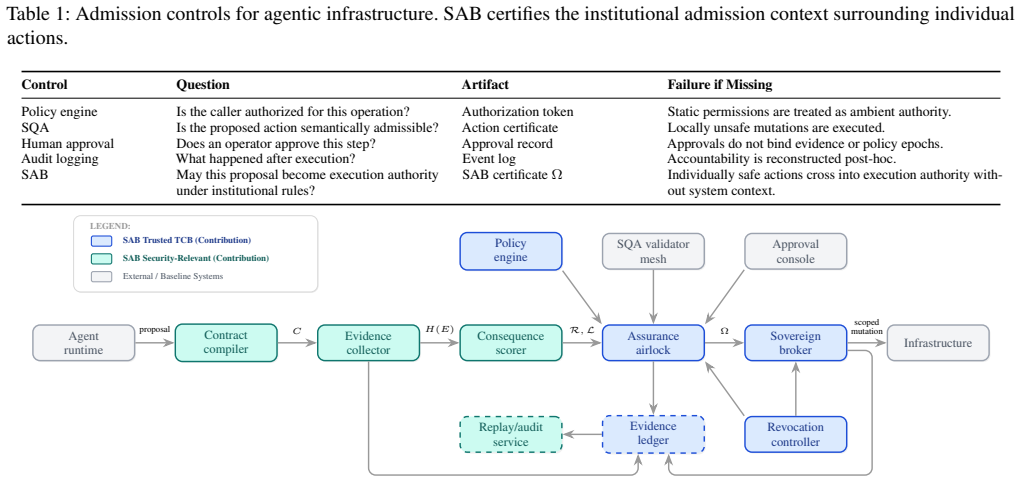
The Sovereign Assurance Boundary intercepts agent proposals at an assurance airlock, compiles them into typed execution contracts bound to cryptographic evidence digests and policy versions, routes the contracts through consequence-aware certification paths, and upon admission emits a signed Sovereign Assurance Certificate strictly scoped to a specific execution identity, revocation epoch, and validity window; a sovereign execution broker then verifies the certificate and performs fresh pre-execution revocation and drift checks before any infrastructure API invocation, thereby preventing autonomous reasoning from directly mutating state.
What carries the argument
The Sovereign Assurance Certificate (Ω), a signed artifact that carries the admission decision and is strictly scoped to execution identity, revocation epoch, and validity window.
If this is right
- Autonomous agents lose the ability to mutate production state directly.
- Every execution decision becomes a replayable, evidence-bound artifact.
- Revocation checks occur immediately before each API call rather than only at policy definition time.
- Admission decisions remain traceable to specific cryptographic evidence and policy versions.
Where Pith is reading between the lines
- The same airlock-broker pattern could apply to other domains where non-deterministic controllers propose physical or financial actions.
- Chaining multiple certificates across cooperating agents would require additional invariants on certificate composition.
- The approach separates policy evaluation from execution in a way that may simplify regulatory audit trails.
Load-bearing premise
Consequence-aware certification paths can be implemented in practice without prohibitive latency or new vulnerabilities.
What would settle it
A production deployment in which an agent proposal bypasses the broker verification step and directly mutates infrastructure state, or admission latency measurements from the Go prototype that exceed operational thresholds for the target environment.
Figures
read the original abstract
Agentic infrastructure introduces a critical control-plane authorization problem: non-deterministic reasoning systems can propose high-stakes mutations to production resources, yet existing security mechanisms -- such as identity and access management (IAM), policy engines, consensus protocols, and audit logs -- either enforce static, context-unaware permissions or merely record actions post-execution. This paper introduces the Sovereign Assurance Boundary (SAB), a certificate-bound runtime admission layer for autonomous execution authority. SAB intercepts agent proposals at an assurance airlock, compiles them into typed execution contracts $C$, and binds these contracts to cryptographic evidence digests $H(E)$ and policy versions. The contracts are then routed through consequence-aware certification paths. Upon successful admission, the system emits a signed Sovereign Assurance Certificate ($\Omega$) that is strictly scoped to a specific execution identity, revocation epoch, and validity window. Finally, a sovereign execution broker verifies $\Omega$ and performs fresh pre-execution revocation and drift checks before invoking infrastructure APIs. We detail the airlock-broker architecture, formalize its admission and revocation invariants, and report preliminary feasibility measurements from a Go prototype evaluated over 2,500 admission attempts. Ultimately, this broker-enforced model prevents autonomous reasoning from directly mutating state, transforming delegated execution authority into a cryptographically verifiable, evidence-bound, revocable, and replayable runtime artifact.
Editorial analysis
A structured set of objections, weighed in public.
Referee Report
Summary. The paper proposes the Sovereign Assurance Boundary (SAB), a certificate-bound runtime admission layer for agentic infrastructure. Agent proposals are intercepted at an assurance airlock, compiled into typed execution contracts C bound to cryptographic evidence digests H(E) and policy versions, routed through consequence-aware certification paths, and result in issuance of a signed Sovereign Assurance Certificate (Ω) scoped to execution identity, revocation epoch, and validity window. A sovereign execution broker verifies Ω with fresh pre-execution checks before API invocation. The manuscript details the airlock-broker architecture, formalizes admission/revocation invariants, and reports Go prototype results over 2,500 admission attempts, claiming this model prevents autonomous reasoning from directly mutating state.
Significance. If the formalized invariants hold under the stated cryptographic and policy assumptions and the prototype generalizes, the approach could provide a practical mechanism for making delegated execution authority in non-deterministic agent systems cryptographically verifiable, revocable, and replayable, addressing a gap between static IAM/policy engines and post-hoc audit logs.
major comments (3)
- [§4] §4 (Formalization of invariants): The manuscript states that admission and revocation invariants are formalized, yet supplies no equations, proof sketches, or machine-checked artifacts establishing that the consequence-aware certification paths and Ω scoping prevent direct mutations; without these, the central security claim remains an unverified assertion.
- [§5] §5 (Prototype evaluation): The report of 2,500 admission attempts is presented as feasibility evidence, but the text provides no breakdown of success/failure rates, latency distributions, adversarial test cases against the cryptographic primitives, or measurements isolating policy-engine drift or revocation failures, leaving the 'no new vulnerabilities' guarantee untested.
- [§3.2] §3.2 (Certification paths): The description of consequence-aware certification paths assumes reliable underlying cryptographic primitives and policy engines without any validation or threat model addressing implementation-induced vulnerabilities or latency overheads that could undermine the broker's pre-execution checks.
minor comments (2)
- Notation for the certificate Ω and contract C is introduced without an explicit table of symbols or scoping rules, which would aid readability.
- The abstract and introduction use the term 'parameter-free' in passing for the architecture; clarify whether any policy-version or epoch parameters are treated as free or fixed.
Simulated Author's Rebuttal
We thank the referee for the constructive and detailed review. The comments identify key opportunities to increase the rigor of the formalization, evaluation, and threat analysis. We respond to each major comment below and indicate the revisions that will be incorporated.
read point-by-point responses
-
Referee: [§4] §4 (Formalization of invariants): The manuscript states that admission and revocation invariants are formalized, yet supplies no equations, proof sketches, or machine-checked artifacts establishing that the consequence-aware certification paths and Ω scoping prevent direct mutations; without these, the central security claim remains an unverified assertion.
Authors: We agree that while §4 describes the invariants narratively, it does not supply explicit equations or proof sketches. In the revised manuscript we will add a dedicated formalization subsection that states the admission and revocation invariants as equations, defines the scoping properties of Ω, and includes brief proof sketches showing how consequence-aware paths and evidence binding prevent direct mutations under the stated cryptographic and policy assumptions. Machine-checked artifacts are not available at this stage. revision: yes
-
Referee: [§5] §5 (Prototype evaluation): The report of 2,500 admission attempts is presented as feasibility evidence, but the text provides no breakdown of success/failure rates, latency distributions, adversarial test cases against the cryptographic primitives, or measurements isolating policy-engine drift or revocation failures, leaving the 'no new vulnerabilities' guarantee untested.
Authors: Section §5 presents the 2,500 attempts strictly as preliminary feasibility data rather than a comprehensive security evaluation. We will expand the section to report success/failure rates, latency distributions, and any adversarial testing performed on the cryptographic components. The manuscript does not claim a 'no new vulnerabilities' guarantee; it shows that the broker-enforced model prevents direct state mutation. We will add explicit language clarifying these scope limitations. revision: partial
-
Referee: [§3.2] §3.2 (Certification paths): The description of consequence-aware certification paths assumes reliable underlying cryptographic primitives and policy engines without any validation or threat model addressing implementation-induced vulnerabilities or latency overheads that could undermine the broker's pre-execution checks.
Authors: We acknowledge that §3.2 relies on standard assumptions without an accompanying threat model. The revised manuscript will add a threat-model subsection that enumerates assumptions on the cryptographic primitives and policy engines, discusses potential implementation vulnerabilities and latency overheads, and explains how the broker's fresh pre-execution checks address these risks within the model. revision: yes
Circularity Check
Architectural proposal with no derivations or fitted predictions
full rationale
The paper introduces an architectural system (SAB airlock-broker), formalizes admission/revocation invariants, and reports Go prototype measurements over 2,500 attempts. No equations, parameters, or first-principles derivations are present that could reduce to inputs by construction. No self-citations, uniqueness theorems, or ansatzes are invoked. The work is self-contained as a design proposal with empirical feasibility data; invariants are stated as design properties rather than derived from fitted data.
Axiom & Free-Parameter Ledger
invented entities (1)
-
Sovereign Assurance Certificate (Ω)
no independent evidence
Forward citations
Cited by 2 Pith papers
-
Sovereign Execution Broker: Enforcing Certificate-Bound Authority in Agentic Control Planes
The Sovereign Execution Broker (SEB) enforces certificate-bound authority at execution time by verifying mutations against certified contracts, validity windows, and policy epochs before invoking infrastructure APIs.
-
Governing Actions, Not Agents: Institutional Attestation as a Governance Model for Autonomous AI Systems
The paper formalizes a computational governance model where AI agents retain planning autonomy but require cryptographically bound, independently attested preconditions for executing high-risk actions, supported by ta...
Reference graph
Works this paper leans on
-
[1]
ReAct: Synergizing reasoning and acting in language models
Shunyu Yao, Jeffrey Zhao, Dian Yu, Nan Du, Izhak Shafran, Karthik Narasimhan, and Yuan Cao. ReAct: Synergizing reasoning and acting in language models. arXiv preprint arXiv:2210.03629, 2022
Pith/arXiv arXiv 2022
-
[2]
Toolformer: Language models can teach themselves to use tools.arXiv preprint arXiv:2302.04761, 2023
Timo Schick, Jane Dwivedi-Yu, Roberto Dessì, Roberta Raileanu, Maria Lomeli, Luke Zettlemoyer, Nicola Can- cedda, and Thomas Scialom. Toolformer: Language models can teach themselves to use tools.arXiv preprint arXiv:2302.04761, 2023
Pith/arXiv arXiv 2023
-
[3]
Jun He and Deying Yu. Semantic quorum assurance: Collective certification for non-deterministic ai infras- tructure.arXiv preprint arXiv:2606.08021, 2026
Pith/arXiv arXiv 2026
-
[4]
Using simplicity to control complexity.IEEE Software, 18(4):20–28, 2001
Lui Sha. Using simplicity to control complexity.IEEE Software, 18(4):20–28, 2001
2001
-
[5]
Shield synthesis: Runtime enforcement for reactive systems
Roderick Bloem, Bettina Könighofer, Robert Könighofer, and Chao Wang. Shield synthesis: Runtime enforcement for reactive systems. InPro- ceedings of the International Conference on Tools and Algorithms for the Construction and Analysis of Systems (TACAS), pages 533–548, 2015
2015
-
[6]
Security assurance cases: Motivation and research agenda.System Safety Society, 2001
John Rushby. Security assurance cases: Motivation and research agenda.System Safety Society, 2001
2001
-
[7]
Zero trust architecture
Scott Rose, Oliver Borchert, Stu Mitchell, and Sean Con- nelly. Zero trust architecture. Technical Report Special Publication 800-207, National Institute of Standards and Technology (NIST), 2020
2020
-
[8]
Aws identity and access management (iam) user guide
AWS. Aws identity and access management (iam) user guide. InAmazon Web Services Technical Documenta- tion, 2024
2024
-
[9]
Policy language
Open Policy Agent. Policy language. Open Policy Agent documentation, 2026. Accessed 2026-06-05
2026
-
[10]
The part-time parliament.ACM Trans- actions on Computer Systems (TOCS), 16(2):133–169, 1998
Leslie Lamport. The part-time parliament.ACM Trans- actions on Computer Systems (TOCS), 16(2):133–169, 1998
1998
-
[11]
In search of an understandable consensus algorithm
Diego Ongaro and John Ousterhout. In search of an understandable consensus algorithm. InProceedings of the USENIX Annual Technical Conference (ATC), pages 305–320, 2014
2014
-
[12]
OW ASP top 10 for large language model applications
OW ASP Foundation. OW ASP top 10 for large language model applications. OW ASP project page, 2025
2025
-
[13]
Smolka, and Scott D
Dzung Phan, Radu Grosu, Nils Jansen, Nicola Paoletti, Scott A. Smolka, and Scott D. Stoller. Neural simplex architecture. InNASA Formal Methods Symposium, pages 97–114, 2020
2020
-
[14]
Practical byzantine fault tolerance
Miguel Castro and Barbara Liskov. Practical byzantine fault tolerance. InProceedings of the Symposium on Operating Systems Design and Implementation (OSDI), pages 173–186, 1999
1999
-
[15]
Dynamic admission control
Kubernetes. Dynamic admission control. Kubernetes documentation, 2026. Accessed 2026-06-05
2026
-
[16]
Hakan Inan, Kartikeya Upasani, Jian Zhang, Rashi Rungta, Riza Aktas, Felipe Cruz, Jason Ramapuram, Stephen Hicks, Onur Dilek, Igor Molybog, et al. Llama Guard: LLM-based input-output safeguard for human- AI conversations.arXiv preprint arXiv:2312.06674, 2023
Pith/arXiv arXiv 2023
-
[17]
PROV-DM: The PROV data model
Luc Moreau and Paolo Missier. PROV-DM: The PROV data model. Technical report, World Wide Web Consor- tium, 2013
2013
-
[18]
Artifi- cial intelligence risk management framework (AI RMF 1.0)
National Institute of Standards and Technology. Artifi- cial intelligence risk management framework (AI RMF 1.0). Technical Report NIST AI 100-1, National Institute of Standards and Technology, 2023. 12
2023
discussion (0)
Sign in with ORCID, Apple, or X to comment. Anyone can read and Pith papers without signing in.