Distance Determination of Southern Galactic Plane Supernova Remnants with the Mopra CO Survey and DECaPS 3D Dust Map
Pith reviewed 2026-07-03 09:59 UTC · model grok-4.3
The pith
Precise distances are measured for nine southern Galactic plane supernova remnants by linking them to molecular clouds via CO emission and 3D dust extinction.
A machine-rendered reading of the paper's core claim, the machinery that carries it, and where it could break.
Core claim
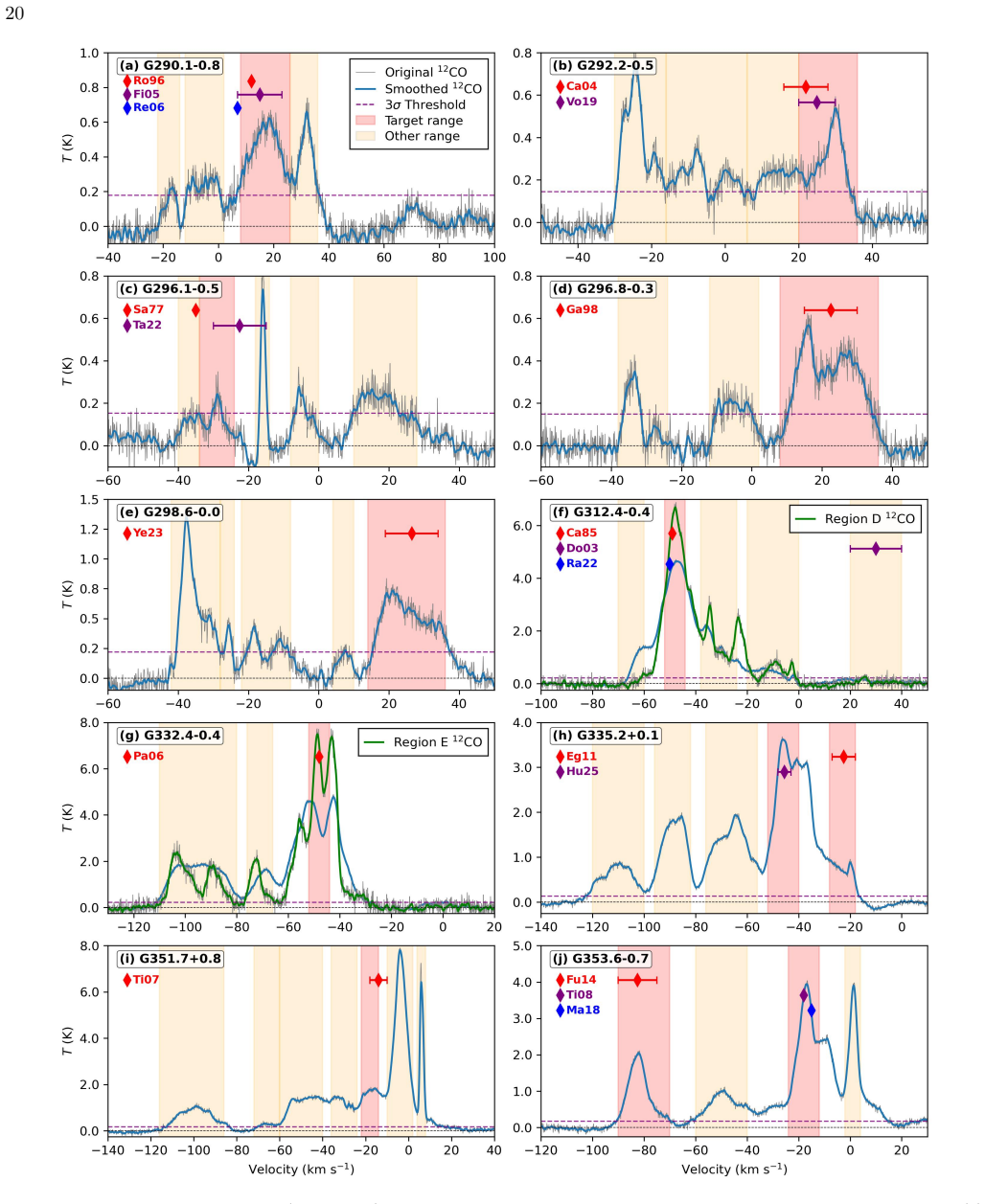
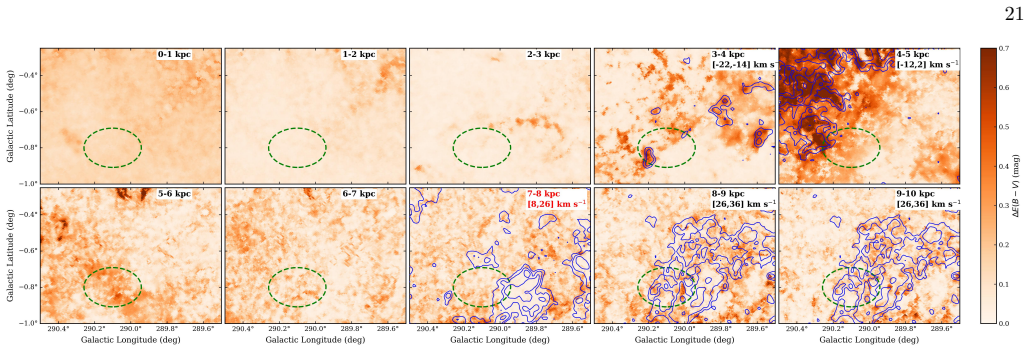
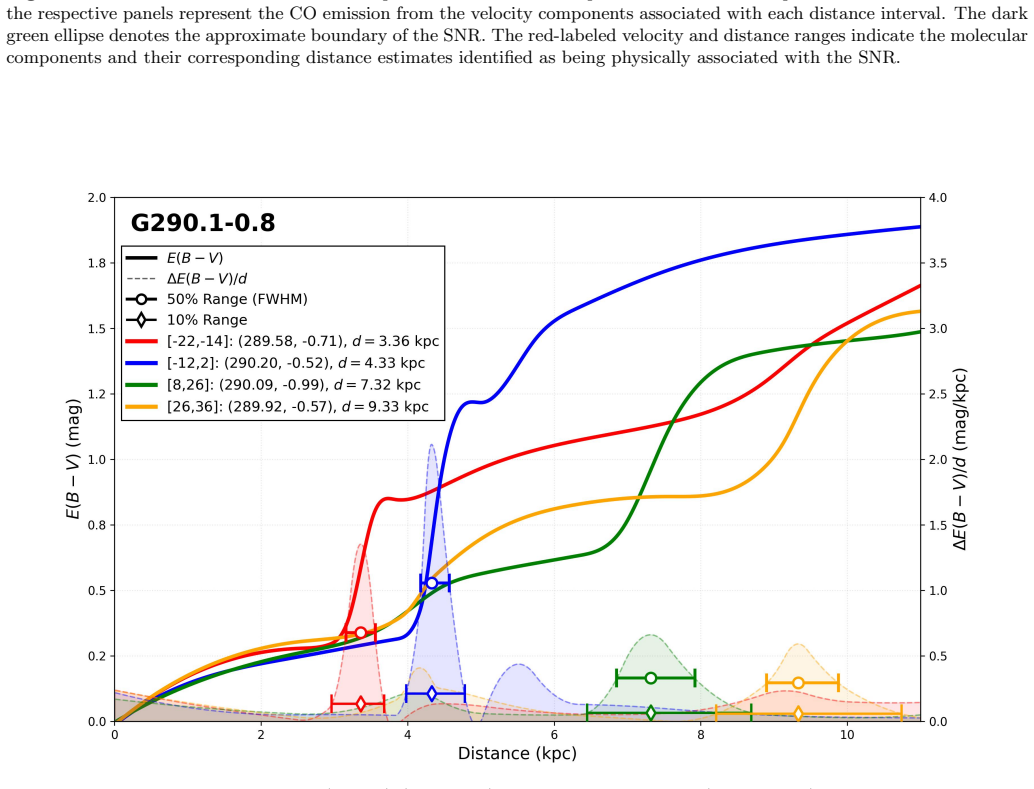
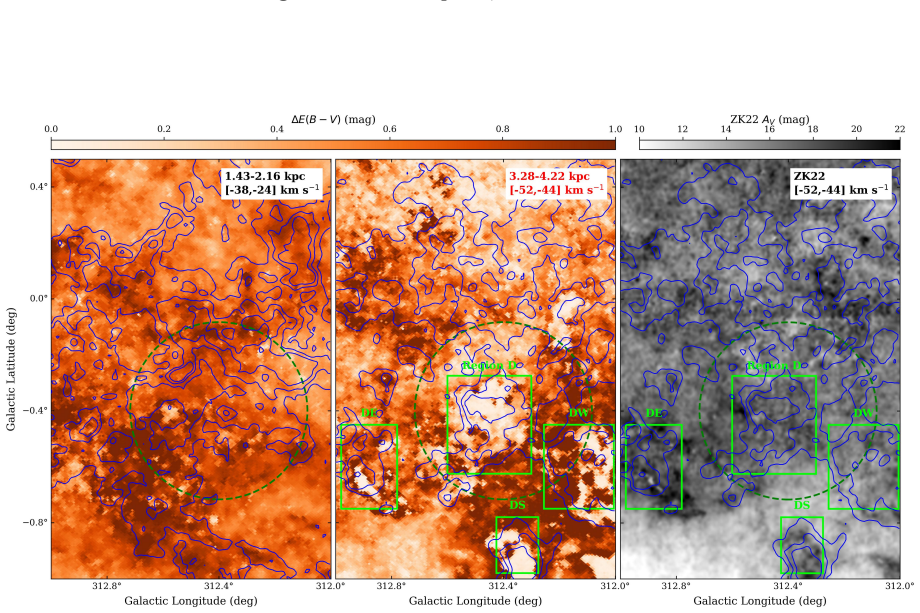
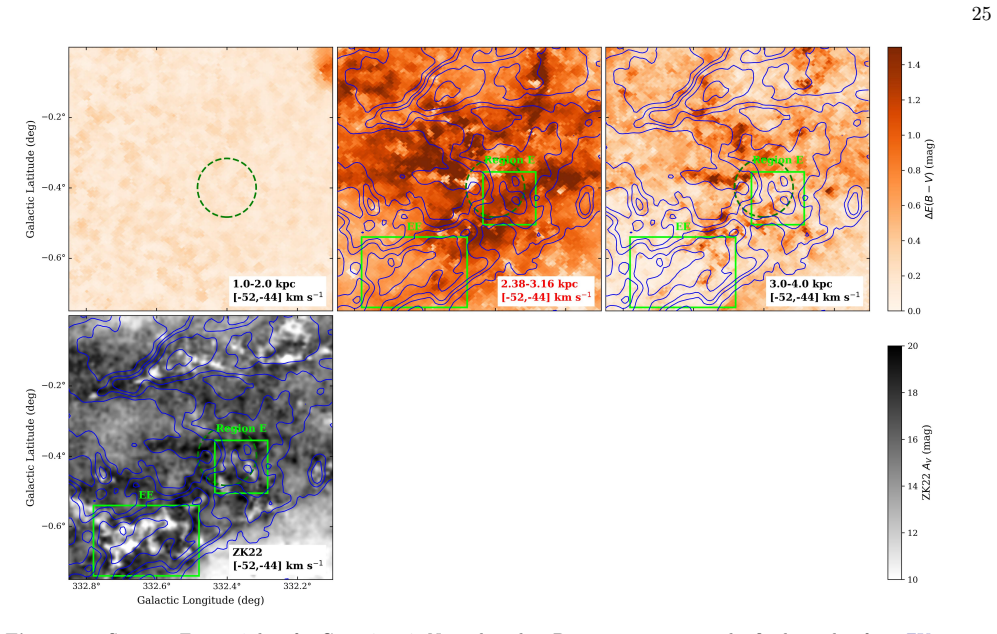
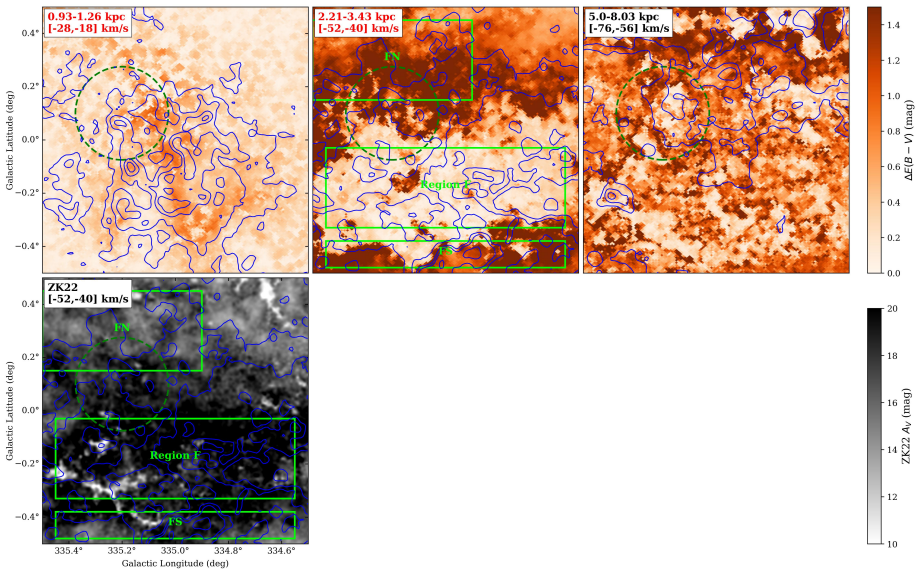
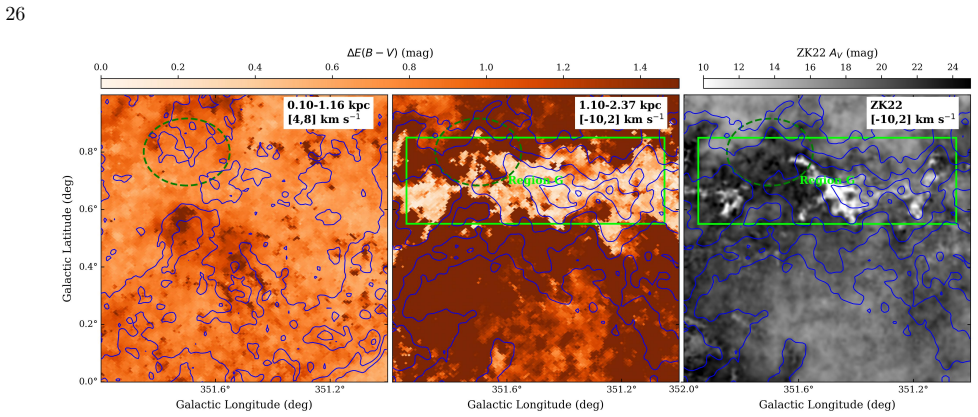
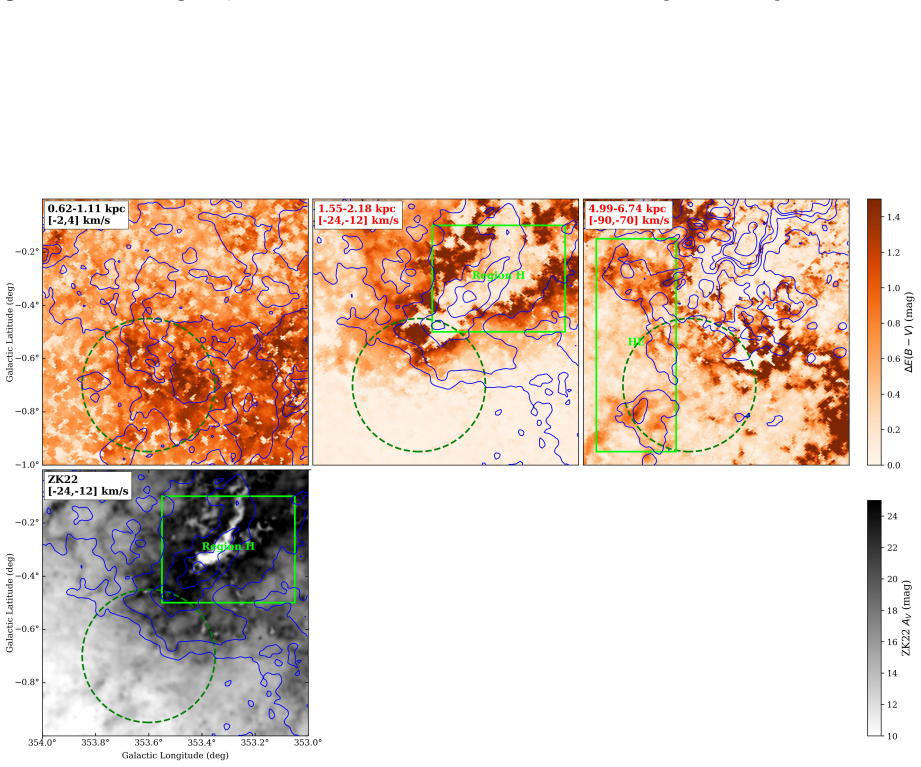
By identifying molecular clouds that interact with supernova remnants through their CO emission and then reading the distance to each cloud from the DECaPS three-dimensional extinction map, the authors obtain distances for nine remnants: G290.1-0.8 at 7.32 kpc, G292.2-0.5 at 10.85 kpc, G296.1-0.5 at 4.59 kpc, G296.8-0.3 at 8.74 kpc, G298.6-0.0 at 6.50 kpc, G312.4-0.4 at 3.60 kpc, G332.4-0.4 at 2.66 kpc, G335.2+0.1 at 2.76 kpc, and G353.6-0.7 at 1.81 kpc, plus a lower limit of 1.34 kpc for G351.7+0.8.
What carries the argument
Association of CO-emitting molecular clouds with supernova remnants, combined with extinction-distance profiles from the DECaPS 3D map to assign distances to the clouds.
If this is right
- Physical sizes, expansion velocities, and ages of the remnants become calculable from observed angular sizes and velocities.
- Energy released by each supernova and the mass of swept-up material can be estimated more reliably.
- The contribution of these remnants to the galactic interstellar medium cycle can be quantified.
- Comparison with models of supernova remnant evolution becomes possible at known distances.
Where Pith is reading between the lines
- Similar distance measurements could be made for other supernova remnants where CO and dust maps exist.
- If the interaction assumption holds for additional remnants, the method provides a scalable way to build a more complete catalog of galactic SNR distances.
- Independent verification with parallax or other methods on these same objects would strengthen the results.
Load-bearing premise
The molecular clouds detected in CO are physically interacting with the supernova remnants rather than merely lying along the same line of sight.
What would settle it
A direct measurement showing that one of the listed remnants lies at a distance inconsistent with its assigned molecular cloud distance, such as through proper motion or X-ray absorption column density that does not match.
Figures
read the original abstract
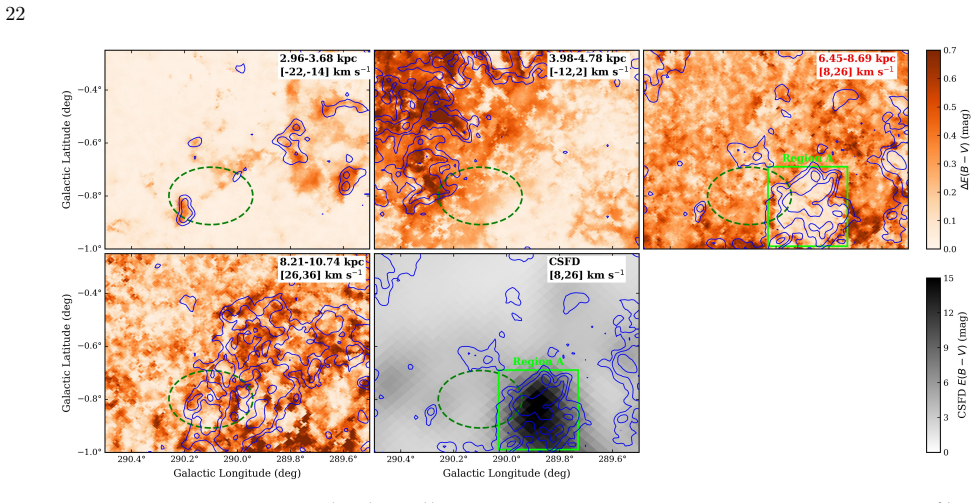
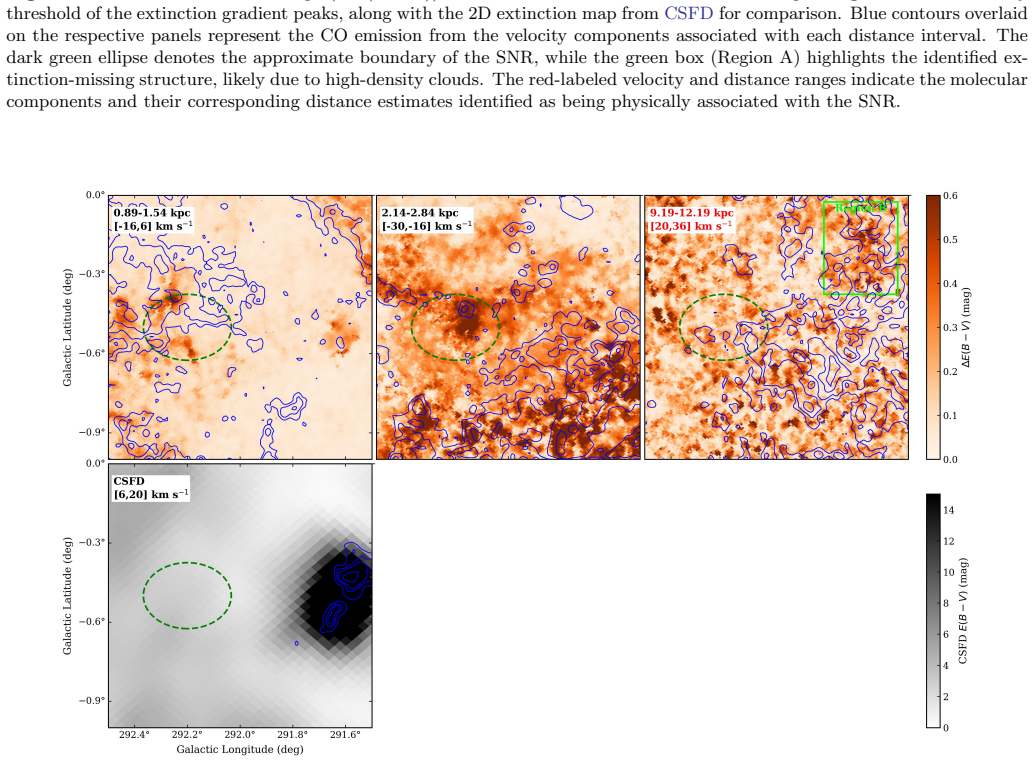
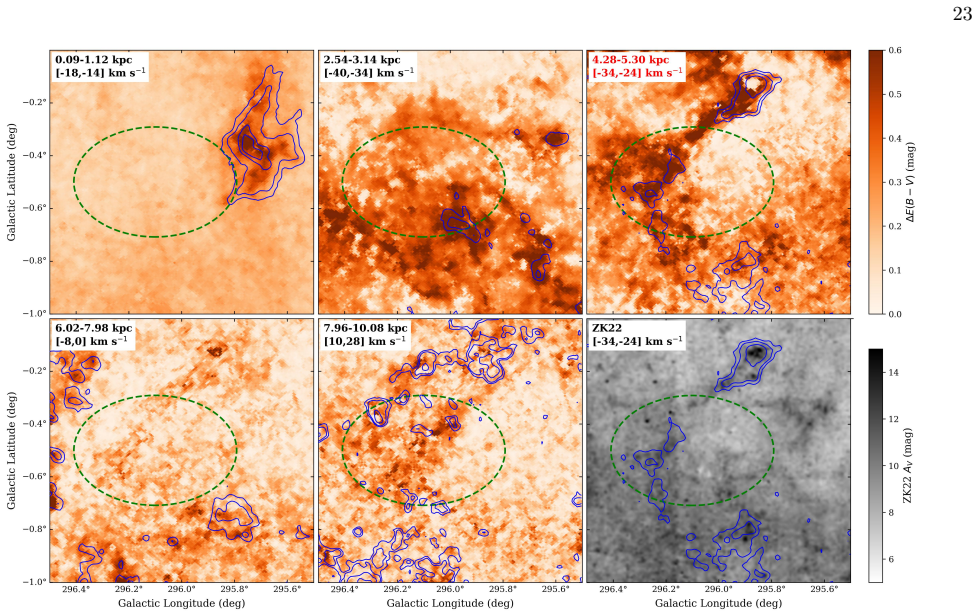
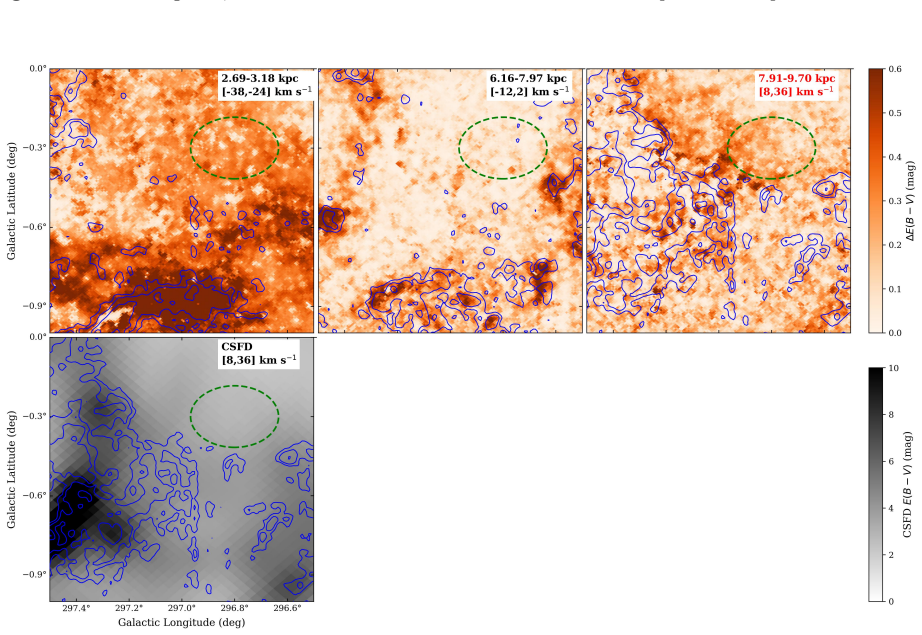
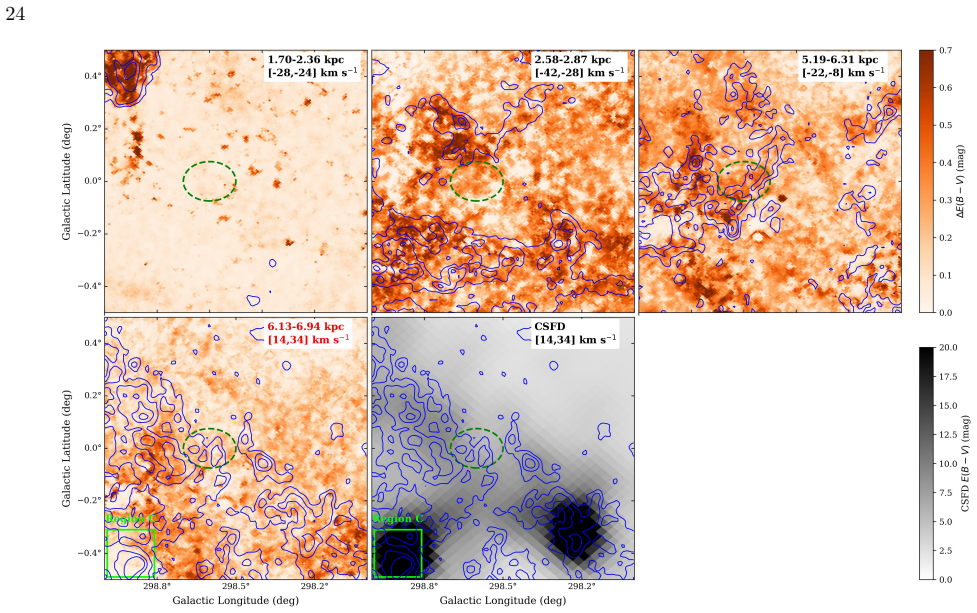
Accurate distance measurements to supernova remnants (SNRs) are crucial for understanding their physical properties, evolutionary processes, and role in the Galactic interstellar medium (ISM) cycle. In this study, we apply for the first time to the southern Galactic plane a distance determination method that utilizes CO emission data from the Mopra survey to identify molecular clouds (MCs) interacting with SNRs. By combining this with extinction-distance profiles from the DECaPS three-dimensional (3D) extinction map, we directly measure the distances to the associated MCs, thereby obtaining precise distances to the remnants. To overcome the extinction-missing bias in extremely dense regions where the 3D map suffers from a deficit of background stars, we supplement our analysis with two-dimensional (2D) extinction maps as cross-validation. Applying this method, we have derived precise distances for nine SNRs: G290.1-0.8 (7.32+0.60/-0.47 kpc), G292.2-0.5 (10.85+0.43/-0.68 kpc), G296.1-0.5 (4.59+0.18/-0.19 kpc), G296.8-0.3 (8.74+0.40/-0.29 kpc), G298.6-0.0 (6.50 +/- 0.21 kpc), G312.4-0.4 (3.60+0.19/-0.23 kpc), G332.4-0.4 (2.66+0.23/-0.15 kpc), G335.2+0.1 (2.76+0.37/-0.31 kpc), and G353.6-0.7 (1.81+0.18/-0.14 kpc). Additionally, we established a robust lower distance limit of 1.34 kpc for G351.7+0.8.
Editorial analysis
A structured set of objections, weighed in public.
Referee Report
Summary. The manuscript applies a distance-determination technique to nine southern Galactic-plane supernova remnants (SNRs) by first identifying candidate molecular clouds (MCs) via CO emission in the Mopra survey and then assigning distances to those MCs from extinction-distance profiles extracted from the DECaPS 3D dust map (with 2D extinction maps used for cross-validation in dense regions). Precise distances with asymmetric uncertainties are reported for G290.1-0.8, G292.2-0.5, G296.1-0.5, G296.8-0.3, G298.6-0.0, G312.4-0.4, G332.4-0.4, G335.2+0.1 and G353.6-0.7, together with a firm lower limit for G351.7+0.8.
Significance. If the MC-SNR associations are shown to be physical rather than line-of-sight projections, the work supplies a set of observationally anchored distances that can be used to calibrate SNR physical parameters, ages and energetics in the southern plane, where such measurements have historically been sparse. The combination of Mopra CO data with DECaPS extinction profiles is a straightforward and potentially reproducible approach.
major comments (3)
- [Methods] Methods (association criteria): The central claim that each reported distance can be assigned to the SNR rests on the assertion that the identified CO cloud is physically interacting with the remnant. The manuscript must explicitly state, for each of the nine objects, which interaction diagnostics (shock-broadened CO lines, OH masers, morphological correspondence, gamma-ray coincidence, or other indicators) were applied in addition to positional and velocity overlap; without this information the possibility of chance alignment cannot be quantified.
- [Results] Results (extinction-profile fitting): The procedure used to extract a cloud distance from each DECaPS extinction-distance profile (e.g., identification of the step or break corresponding to the MC, handling of multiple breaks, and propagation of profile uncertainties into the final distance error) is not described in sufficient detail to allow independent reproduction or assessment of systematic bias.
- [Discussion] Discussion (validation against independent indicators): No comparison is presented between the new distances and any previously published distance estimates (kinematic, HI absorption, or X-ray) for the same remnants; such a table would directly test whether the MC-association assumption produces consistent results.
minor comments (2)
- [Introduction] The abstract states that the method is applied 'for the first time to the southern Galactic plane'; a brief sentence in the introduction citing any prior northern-plane applications of the same CO+extinction technique would clarify the novelty claim.
- [Results] Table 1 (or equivalent) listing the nine SNRs should include the adopted interaction indicators and the velocity range of the CO feature used for each object.
Simulated Author's Rebuttal
We thank the referee for the constructive comments, which highlight areas where additional clarity will improve the manuscript. We address each major point below and commit to revisions where appropriate.
read point-by-point responses
-
Referee: [Methods] Methods (association criteria): The central claim that each reported distance can be assigned to the SNR rests on the assertion that the identified CO cloud is physically interacting with the remnant. The manuscript must explicitly state, for each of the nine objects, which interaction diagnostics (shock-broadened CO lines, OH masers, morphological correspondence, gamma-ray coincidence, or other indicators) were applied in addition to positional and velocity overlap; without this information the possibility of chance alignment cannot be quantified.
Authors: We agree that explicit per-object documentation of interaction diagnostics is required to allow readers to assess the robustness of each MC-SNR association. The current manuscript identifies candidate MCs via positional and velocity overlap with Mopra CO emission but does not tabulate additional indicators. In the revised manuscript we will add a dedicated table (or expanded Methods subsection) that, for each of the nine SNRs, lists the specific diagnostics applied (morphological correspondence from radio images, presence/absence of shock-broadened lines, OH masers, gamma-ray coincidence, etc.) and notes cases where only positional/velocity criteria were available. revision: yes
-
Referee: [Results] Results (extinction-profile fitting): The procedure used to extract a cloud distance from each DECaPS extinction-distance profile (e.g., identification of the step or break corresponding to the MC, handling of multiple breaks, and propagation of profile uncertainties into the final distance error) is not described in sufficient detail to allow independent reproduction or assessment of systematic bias.
Authors: We acknowledge that the current description of the extinction-profile analysis is insufficient for independent reproduction. We will expand the Methods section with a step-by-step account of the fitting procedure, including: (i) the algorithm or visual criteria used to identify the extinction step/break linked to the MC, (ii) the protocol for selecting among multiple breaks, (iii) how the DECaPS profile uncertainties are propagated into the reported asymmetric distance errors, and (iv) the cross-validation approach with 2D extinction maps in dense regions. revision: yes
-
Referee: [Discussion] Discussion (validation against independent indicators): No comparison is presented between the new distances and any previously published distance estimates (kinematic, HI absorption, or X-ray) for the same remnants; such a table would directly test whether the MC-association assumption produces consistent results.
Authors: We agree that a systematic comparison with literature distances would strengthen the validation of the method. We will add a new table (or subsection) in the Discussion that compiles previously published distance estimates (kinematic, HI absorption, X-ray) for the nine SNRs where such measurements exist, and we will discuss the level of agreement or any discrepancies with our new values. revision: yes
Circularity Check
No significant circularity; distances derived from independent datasets
full rationale
The paper's method identifies MC-SNR associations via Mopra CO data and assigns distances from the independent DECaPS 3D extinction map. No equations or steps reduce the final distances to fitted inputs or self-citations by construction. The core assumption of physical interaction is an observational criterion, not a definitional loop. The derivation chain remains self-contained against external benchmarks with no load-bearing self-citation or ansatz smuggling.
Axiom & Free-Parameter Ledger
axioms (1)
- domain assumption CO-emitting molecular clouds identified via Mopra survey are physically interacting with the target SNRs
Reference graph
Works this paper leans on
-
[1]
Astropy Collaboration, Robitaille, T. P., Tollerud, E. J., et al. 2013, A&A, 558, A33, doi: 10.1051/0004-6361/201322068
-
[2]
2016, PASJ, 68, S5, doi: 10.1093/pasj/psv096
Bamba, A., Sawada, M., Nakano, Y., et al. 2016, PASJ, 68, S5, doi: 10.1093/pasj/psv096
-
[3]
Bohlin, R. C., Savage, B. D., & Drake, J. F. 1978, ApJ, 224, 132, doi: 10.1086/156357
-
[4]
Burton, M., Cubuk, K., Braiding, C., et al. 2023, The Mopra Southern Galactic Plane Carbon Monoxide (CO) Survey, 3 CSIRO, doi: 10.25919/9z4p-mj92
-
[5]
Case, G. L., & Bhattacharya, D. 1998, ApJ, 504, 761, doi: 10.1086/306089
-
[6]
Caswell, J. L., & Barnes, P. J. 1985, MNRAS, 216, 753, doi: 10.1093/mnras/216.3.753
-
[7]
Caswell, J. L., & Barnes, P. L. 1983, ApJL, 271, L55, doi: 10.1086/184094
-
[8]
Caswell, J. L., McClure-Griffiths, N. M., & Cheung, M. C. M. 2004, MNRAS, 352, 1405, doi: 10.1111/j.1365-2966.2004.08030.x
-
[9]
Cooke, D. J. 1975, A&A, 45, 239
1975
-
[10]
2023, ApJ, 959, 97, doi: 10.3847/1538-4357/ad09b9
Sinha, A., & Eagle, J. 2023, ApJ, 959, 97, doi: 10.3847/1538-4357/ad09b9
-
[11]
2017, MNRAS, 472, 3924, doi: 10.1093/mnras/stx2287
Chen, B.-Q., Liu, X.-W., Ren, J.-J., et al. 2017, MNRAS, 472, 3924, doi: 10.1093/mnras/stx2287
-
[12]
2025, ApJ, 988, 176, doi: 10.3847/1538-4357/ade688
Chen, X., Wang, S., & Chen, X. 2025, ApJ, 988, 176, doi: 10.3847/1538-4357/ade688
-
[13]
2017, A&A, 604, A13, doi: 10.1051/0004-6361/201630003
Chen, X., Xiong, F., & Yang, J. 2017, A&A, 604, A13, doi: 10.1051/0004-6361/201630003
-
[14]
2023, ApJ, 958, 118, doi: 10.3847/1538-4357/acf4a1
Chiang, Y.-K. 2023, ApJ, 958, 118, doi: 10.3847/1538-4357/acf4a1
-
[15]
Clark, D. H., Caswell, J. L., & Green, A. J. 1973, Nature, 246, 28, doi: 10.1038/246028a0
-
[16]
Cubuk, K. O., Burton, M. G., Braiding, C., et al. 2023, PASA, 40, e047, doi: 10.1017/pasa.2023.44
-
[17]
M., Hartmann, D., & Thaddeus, P
Dame, T. M., Hartmann, D., & Thaddeus, P. 2001, ApJ, 547, 792, doi: 10.1086/318388
work page internal anchor Pith review doi:10.1086/318388 2001
-
[18]
Dickel, J. R. 1973, Astrophys. Lett., 15, 61
1973
-
[19]
Doherty, M., Johnston, S., Green, A. J., et al. 2003, MNRAS, 339, 1048, doi: 10.1046/j.1365-8711.2003.06265.x
-
[20]
2017, A&A, 608, A23, doi: 10.1051/0004-6361/201730983
Doroshenko, V., P¨ uhlhofer, G., Bamba, A., et al. 2017, A&A, 608, A23, doi: 10.1051/0004-6361/201730983
-
[21]
2011, A&A, 526, A82, doi: 10.1051/0004-6361/201015727
Eger, P., Rowell, G., Kawamura, A., et al. 2011, A&A, 526, A82, doi: 10.1051/0004-6361/201015727
-
[22]
Elmegreen, B. G., & Lada, C. J. 1977, ApJ, 214, 725, doi: 10.1086/155302
-
[23]
2012, Advances in Space Research, 49, 1313, doi: 10.1016/j.asr.2012.02.004
Ferrand, G., & Safi-Harb, S. 2012, Advances in Space Research, 49, 1313, doi: 10.1016/j.asr.2012.02.004
-
[24]
Filipovic, M. D., Payne, J. L., & Jones, P. A. 2005, Serbian Astronomical Journal, 170, 47, doi: 10.2298/SAJ0570047F
-
[25]
Frail, D. A., Goss, W. M., Reynoso, E. M., et al. 1996, AJ, 111, 1651, doi: 10.1086/117904
-
[26]
Frerking, M. A., Langer, W. D., & Wilson, R. W. 1982, ApJ, 262, 590, doi: 10.1086/160451
-
[27]
2014, ApJ, 788, 94, doi: 10.1088/0004-637X/788/1/94
Fukuda, T., Yoshiike, S., Sano, H., et al. 2014, ApJ, 788, 94, doi: 10.1088/0004-637X/788/1/94
-
[28]
Gaensler, B. M., Manchester, R. N., & Green, A. J. 1998, MNRAS, 296, 813, doi: 10.1046/j.1365-8711.1998.01387.x Gaia Collaboration, Vallenari, A., Brown, A. G. A., et al. 2023, A&A, 674, A1, doi: 10.1051/0004-6361/202243940
-
[29]
2015, in Astronomical Society of the Pacific Conference Series, Vol
Ginsburg, A., Robitaille, T., Beaumont, C., et al. 2015, in Astronomical Society of the Pacific Conference Series, Vol. 499, Revolution in Astronomy with ALMA: The Third Year, ed. D. Iono, K. Tatematsu, A. Wootten, & L. Testi, 363–364
2015
-
[30]
2005, ApJ, 619, 856, doi: 10.1086/426576
Gonzalez, M., & Safi-Harb, S. 2005, ApJ, 619, 856, doi: 10.1086/426576
-
[31]
Gotthelf, E. V., & Kaspi, V. M. 1998, ApJL, 497, L29, doi: 10.1086/311266 15
-
[32]
Green, D. A. 2005, Mem. Soc. Astron. Italiana, 76, 534, doi: 10.48550/arXiv.astro-ph/0505428
work page internal anchor Pith review Pith/arXiv arXiv doi:10.48550/arxiv.astro-ph/0505428 2005
-
[33]
Green, D. A. 2024, A Catalogue of Galactic Supernova Remnants (2024 October version) (Cavendish
2024
-
[34]
Green, D. A. 2025, Journal of Astrophysics and Astronomy, 46, 14, doi: 10.1007/s12036-024-10038-4
-
[35]
Green, G. M. 2018, The Journal of Open Source Software, 3, 695, doi: 10.21105/joss.00695
-
[36]
2019, ApJ, 887, 93, doi: 10.3847/1538-4357/ab5362
Finkbeiner, D. 2019, ApJ, 887, 93, doi: 10.3847/1538-4357/ab5362
work page internal anchor Pith review doi:10.3847/1538-4357/ab5362 2019
-
[37]
Halpern, J. P., Tomsick, J. A., Gotthelf, E. V., et al. 2014, ApJL, 795, L27, doi: 10.1088/2041-8205/795/2/L27
-
[38]
2025, PASA, 42, e071, doi: 10.1017/pasa.2025.10042
Hopkins, A., Kapinska, A., Marvil, J., et al. 2025, PASA, 42, e071, doi: 10.1017/pasa.2025.10042
-
[39]
2025, ApJ, 990, 213, doi: 10.3847/1538-4357/adf4d8
Huang, C., Zhang, X., Chen, Y., et al. 2025, ApJ, 990, 213, doi: 10.3847/1538-4357/adf4d8
-
[40]
2023, ApJ, 950, 177, doi: 10.3847/1538-4357/accd60
Tomsick, J. 2023, ApJ, 950, 177, doi: 10.3847/1538-4357/accd60
-
[41]
2004, ApJL, 605, L113, doi: 10.1086/420869
Lee, J.-J., Koo, B.-C., & Tatematsu, K. 2004, ApJL, 605, L113, doi: 10.1086/420869
-
[42]
Lombardi, M., Alves, J., & Lada, C. J. 2006, A&A, 454, 781, doi: 10.1051/0004-6361:20042474
-
[43]
Longmore, A. J., Clark, D. H., & Murdin, P. 1977, MNRAS, 181, 541, doi: 10.1093/mnras/181.3.541
-
[44]
Mauch, T., Murphy, T., Buttery, H. J., et al. 2003, MNRAS, 342, 1117, doi: 10.1046/j.1365-8711.2003.06605.x
-
[45]
2018, MNRAS, 474, 662, doi: 10.1093/mnras/stx2727
Maxted, N., Burton, M., Braiding, C., et al. 2018, MNRAS, 474, 662, doi: 10.1093/mnras/stx2727
-
[46]
Minniti, D., Lucas, P. W., Emerson, J. P., et al. 2010, NewA, 15, 433, doi: 10.1016/j.newast.2009.12.002
-
[47]
Paron, S. A., Reynoso, E. M., Purcell, C., Dubner, G. M., & Green, A. 2006, PASA, 23, 69, doi: 10.1071/AS06003
-
[48]
2014, A&A, 562, A122, doi: 10.1051/0004-6361/201322588 Pavlovi´ c, M
Pavan, L., Bordas, P., P¨ uhlhofer, G., et al. 2014, A&A, 562, A122, doi: 10.1051/0004-6361/201322588 Pavlovi´ c, M. Z., Uroˇ sevi´ c, D., Vukoti´ c, B., Arbutina, B., & G¨ oker,¨U. D. 2013, ApJS, 204, 4, doi: 10.1088/0067-0049/204/1/4
-
[49]
2022, ApJ, 940, 63, doi: 10.3847/1538-4357/ac940a
Ranasinghe, S., & Leahy, D. 2022, ApJ, 940, 63, doi: 10.3847/1538-4357/ac940a
-
[50]
Ranasinghe, S., & Leahy, D. A. 2018a, MNRAS, 477, 2243, doi: 10.1093/mnras/sty817
-
[51]
Ranasinghe, S., & Leahy, D. A. 2018b, AJ, 155, 204, doi: 10.3847/1538-3881/aab9be
-
[52]
Reynoso, E. M., Green, A. J., Johnston, S., et al. 2004, PASA, 21, 82, doi: 10.1071/AS03053
-
[53]
Reynoso, E. M., Johnston, S., Green, A. J., & Koribalski, B. S. 2006, MNRAS, 369, 416, doi: 10.1111/j.1365-2966.2006.10325.x
-
[54]
Rice, T. S., Goodman, A. A., Bergin, E. A., Beaumont, C., & Dame, T. M. 2016, ApJ, 822, 52, doi: 10.3847/0004-637X/822/1/52
-
[55]
2012, APLpy: Astronomical Plotting Library in Python,, Astrophysics Source Code Library, record ascl:1208.017
Robitaille, T., & Bressert, E. 2012, APLpy: Astronomical Plotting Library in Python,, Astrophysics Source Code Library, record ascl:1208.017
2012
-
[56]
Roman-Duval, J., Jackson, J. M., Heyer, M., et al. 2009, ApJ, 699, 1153, doi: 10.1088/0004-637X/699/2/1153
-
[57]
1996, A&A, 315, 243 S´ anchez-Ayaso, E., Combi, J
Rosado, M., Ambrocio-Cruz, P., Le Coarer, E., & Marcelin, M. 1996, A&A, 315, 243 S´ anchez-Ayaso, E., Combi, J. A., Albacete Colombo, J. F., et al. 2012, Ap&SS, 337, 573, doi: 10.1007/s10509-011-0886-4
-
[58]
Savage, B. D., Bohlin, R. C., Drake, J. F., & Budich, W. 1977, ApJ, 216, 291, doi: 10.1086/155471
-
[59]
Saydjari, A. K., Schlafly, E. F., Lang, D., et al. 2023, ApJS, 264, 28, doi: 10.3847/1538-4365/aca594
-
[60]
Schlafly, E. F., Meisner, A. M., & Green, G. M. 2019, ApJS, 240, 30, doi: 10.3847/1538-4365/aafbea
-
[61]
2019, Research in Astronomy and Astrophysics, 19, 092, doi: 10.1088/1674-4527/19/7/92
Shan, S.-S., Zhu, H., Tian, W.-W., et al. 2019, Research in Astronomy and Astrophysics, 19, 092, doi: 10.1088/1674-4527/19/7/92
-
[62]
Skrutskie, M. F., Cutri, R. M., Stiening, R., et al. 2006, AJ, 131, 1163, doi: 10.1086/498708
-
[63]
2022, ApJ, 933, 101, doi: 10.3847/1538-4357/ac738f
Tanaka, Y., Uchida, H., Tanaka, T., et al. 2022, ApJ, 933, 101, doi: 10.3847/1538-4357/ac738f
-
[64]
Taylor, J. H., & Cordes, J. M. 1993, ApJ, 411, 674, doi: 10.1086/172870
-
[65]
Tian, W. W., Haverkorn, M., & Zhang, H. Y. 2007, MNRAS, 378, 1283, doi: 10.1111/j.1365-2966.2007.11613.x
-
[66]
Tian, W. W., Leahy, D. A., Haverkorn, M., & Jiang, B. 2008, ApJL, 679, L85, doi: 10.1086/589506
-
[67]
Voisin, F. J., Rowell, G. P., Burton, M. G., et al. 2019, PASA, 36, e014, doi: 10.1017/pasa.2019.7
-
[68]
2020, A&A, 639, A72, doi: 10.1051/0004-6361/201936868
Wang, S., Zhang, C., Jiang, B., et al. 2020, A&A, 639, A72, doi: 10.1051/0004-6361/201936868
-
[69]
Woosley, S. E., & Weaver, T. A. 1995, ApJS, 101, 181, doi: 10.1086/192237
-
[70]
Yeung, P. K. H., Bamba, A., & Sano, H. 2023, PASJ, 75, 384, doi: 10.1093/pasj/psad006
-
[71]
Yu, B., Chen, B. Q., Jiang, B. W., & Zijlstra, A. 2019, MNRAS, 488, 3129, doi: 10.1093/mnras/stz1940
-
[72]
2022, MNRAS, 517, 5180, doi: 10.1093/mnras/stac3012 16
Zhang, M., & Kainulainen, J. 2022, MNRAS, 517, 5180, doi: 10.1093/mnras/stac3012 16
-
[73]
2026, arXiv e-prints, arXiv:2603.20881
Zhang, Z., Li, J., Jiang, B., Zhao, H., & Liu, F. 2026, arXiv e-prints, arXiv:2603.20881. https://arxiv.org/abs/2603.20881
-
[74]
2018, ApJ, 855, 12, doi: 10.3847/1538-4357/aaacd0
Zhao, H., Jiang, B., Gao, S., Li, J., & Sun, M. 2018, ApJ, 855, 12, doi: 10.3847/1538-4357/aaacd0
-
[75]
2020, ApJ, 891, 137, doi: 10.3847/1538-4357/ab75ef
Zhao, H., Jiang, B., Li, J., et al. 2020, ApJ, 891, 137, doi: 10.3847/1538-4357/ab75ef
-
[76]
2016, ApJ, 833, 4, doi: 10.3847/0004-637X/833/1/4
Zhou, X., Yang, J., Fang, M., et al. 2016, ApJ, 833, 4, doi: 10.3847/0004-637X/833/1/4
-
[77]
2023, ApJS, 268, 61, doi: 10.3847/1538-4365/acee7f
Zhou, X., Su, Y., Yang, J., et al. 2023, ApJS, 268, 61, doi: 10.3847/1538-4365/acee7f
-
[78]
Zucker, C., Saydjari, A. K., Speagle, J. S., et al. 2025, ApJ, 992, 39, doi: 10.3847/1538-4357/adfbe6 17 T able 1.SNR information and proposed velocity ranges for the associations Name SizeV LSR(literature)V LSR(this work) References (arcmin) (km s −1) (km s −1) G290.1−0.8 19×14 12 (Hα), [7, 23] (CO), 7 (HI) [8, 26] 1, 2, 3 G292.2−0.5 20×15 [16, 28] (HI),...
discussion (0)
Sign in with ORCID, Apple, or X to comment. Anyone can read and Pith papers without signing in.