REVIEW 3 major objections 6 minor 45 references
Thermodynamics of switching in multistable non-equilibrium systems
T0 review · 3 major / 6 minor · reviewed 2026-08-14 · deepseek-v4-flash
Pith's one-line read Switching in multistable systems is governed by the entropy produced along the switching path, not by steady-state entropy.
desk verdict A solid, honest stochastic thermodynamics paper whose genuinely new relation (Eq. 20) is supported by systematic numerics, but whose headline MaxEPP claim is conditional on an approximation that fails for ~10% of toggle switch parameterizations. read the letter →
The pith
A machine-rendered reading of the paper's core claim, the machinery that carries it, and where it could break.
The reading
What carries the argument
The load-bearing object is the Freidlin–Wentzell action $\mathcal{A}[x] = \frac{1}{2}\int_0^\tau (\dot{x} - f)^{T} D^{-1} (\dot{x} - f)\, dt$, which assigns an exponential cost to switching paths in the large-volume limit. The paper splits this action as $\Omega \mathcal{A}_{A\to B} = C_{A\to B} - \frac{1}{2}\Delta S^{L}_{A\to B}$, identifying the dissipative part with the entropy produced along the path, and uses the identity that every point of a minimum-action path has equal kinetic and potential contributions to justify $C_{A\to B}\approx C_{B\to A}$. This decomposition, together with the fluctuation theorem for Langevin paths, converts the action-minimization problem into a statement about entropy production, yielding Eq. (19) and the relation $\frac{1}{2}(\Delta S^{L}_{B\to A} - \Delta S^{L}_{A\to B}) \approx \Omega(\mathcal{A}_{A\to B} - \mathcal{A}_{B\to A})$.
What would settle it
Construct a two-dimensional multistable system whose saddle point is at low copy number, compute the forward and reverse minimum actions and path entropy productions, and test whether $\frac{1}{2}(\Delta S^{L}_{B\to A} - \Delta S^{L}_{A\to B}) = \Omega(\mathcal{A}_{A\to B} - \mathcal{A}_{B\to A})$; a clear violation in a slowly varying force regime would falsify the claimed universality.
Extended reading notes
Core claim
The central claim is that a reduced maximum-entropy-production principle holds for switching paths in the large volume limit: the probability of the most probable path from macrostate A to macrostate B is $P_{A\to B} = \exp(\Delta S^{L}_{A\to B}/2 - C_{A\to B})/Q_{A\to B}$, where $\Delta S^{L}$ is the entropy produced along the path and $C$ is a conservative action that penalizes deviations from the deterministic dynamics. Because the conservative actions of the two opposite switching paths are nearly equal when the deterministic force varies slowly, the difference in action between A$\to$B and B$\to$A is set by the difference in path entropy production. The paper demonstrates on random parameterizations of two bistable models that this linear relation holds, that state entropy and diffusive noise strength have negligible effect on stability, and that steady-state entropy production shows only a weak correlation with occupation probabilities. The authors state the primary conclusion as extending the rule that exergonic reactions occur spontaneously to switching in multistable systems.
Load-bearing premise
The reduced maximum-entropy-production relation rests on the approximation that the two opposite switching paths have nearly equal conservative actions; the paper finds this holds for 90% of its toggle-switch parameter sets but fails when the saddle point is at low copy number.
Editorial extensions
If this is right
- In a bistable chemical system at large volume, the ratio of occupation probabilities is fixed by the minimum-action difference, which equals half the difference in path entropy productions; steady-state entropy production and state entropy can be dropped from the stability calculation.
- Switches that produce more entropy along the path are exponentially more likely, so in a system with many macrostates the most dissipative transitions dominate at sufficiently large volume.
- For one-dimensional systems, forward and reverse switching paths are time-reverses of each other, so the two switching rates are equal and the rate ratio is determined solely by the path entropy production.
- The theory identifies when the simple rule breaks down: when the saddle point sits at low copy number, the conservative actions of opposite paths diverge and the clean relation between action differences and path entropy production no longer holds.
Reading between the lines
- Eq. (20) could be used as a diagnostic on single-molecule data: forward and reverse switching rates together with per-path entropy measurements should obey the relation in slowly-varying-force regimes, and the first violations would pinpoint low-copy-number saddles where the reduced MaxEPP fails.
- The same least-action plus entropy-production argument should extend to non-chemical multistable systems, such as ecological or climate models written as Langevin dynamics, predicting that basins reachable by more dissipative transitions are the more stable ones; this is a testable extension the paper does not carry out.
- Should the action split generalize to spatially extended systems, relative stability of multiple coexisting attractors could be inferred from path entropy production alone, bypassing explicit minimization of the action.
Signed reviews
Editorial analysis
A structured set of objections, weighed in public.
Referee Report
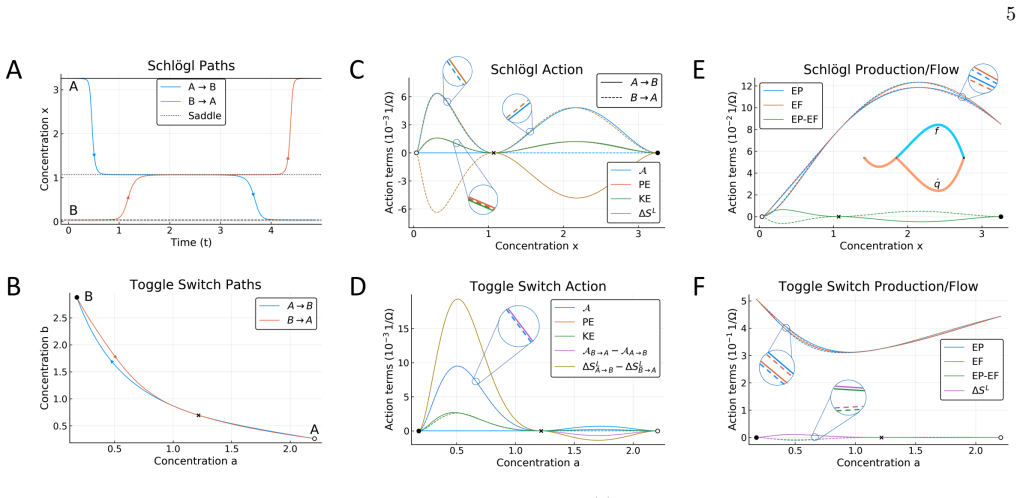
Summary. This paper asks which thermodynamic quantities control the relative stability and the switching rates between macrostates of multistable non-equilibrium chemical systems in the large-volume limit. The authors combine the Freidlin–Wentzell (FW) action of the chemical Langevin equation (Eq. 7) with the coarse-grained (Langevin) entropy production along a path, defined via the action difference between forward and time-reversed paths (Eq. 8). Splitting the action into a conservative part C (Eq. 18) and the path entropy production ΔS_L yields Eq. (19), P_A→B = exp(ΔS_L/2 − C)/Q_A→B, which is interpreted as a trade-off between minimizing the conservative action and maximizing path entropy production, i.e., a 'maximum entropy production principle (MaxEPP) for switching paths'. To obtain a criterion for relative stability of the two states, the authors introduce the approximation C_A→B ≈ C_B→A, which converts Eq. (19) into Eq. (20), an approximate proportionality between the difference of the minimum actions and the difference of the path entropy productions. The theory is tested numerically on the one-dimensional Schlögl model and the two-dimensional toggle switch model, using 100 random parameter sets for each: Fig. 3D reports strong linear correlations between action differences and path-entropy-production differences (r = 0.9445 and 1.0000), Figs.
Significance. The paper is a potentially useful contribution to stochastic thermodynamics and systems biology, provided the claims are properly qualified. The decomposition behind Eq. (19) is parameter-free given the Langevin model, and the reformulation of the FW action in thermodynamic terms (conservative action versus path entropy production) is conceptually attractive. The main strengths are the systematic numerical protocol — 100 random parameter sets per model with Gillespie simulations and geometric minimum-action path calculations — and the honest reporting of the failure statistics for the central approximation. The near-perfect linear relation in Fig. 3D, if confirmed with the fitted slope reported, would give practitioners a practical shortcut for estimating relative stability from path dissipation. On the critical side, the paper's primary novelty claim is partly a relabeling: Eq. (19) is an identity, and the falsifiable content lives in Eq. (20), whose validity is restricted by the C_A→B ≈ C_B→A approximation and its documented 10% failure rate.
major comments (3)
- [Section III, Eq. (19); Discussion, first paragraph] The paper presents Eq. (19) as the derivation of a 'maximum entropy production principle for switching paths', but the decomposition ΩA = C − (1/2)ΔS_L is an algebraic identity given the definitions in Eqs. (7), (8), and (18); substituting Eq. (18) into Eq. (19) reproduces the expanded action term by term, so maximizing ΔS_L at fixed C is exactly equivalent to minimizing the FW action. Eq. (19) is therefore a rearrangement of the least-action principle rather than an independent derivation of a maximum principle. The reformulation may still be useful, but the paper should state this explicitly and locate the novel, falsifiable content in Eq. (20) and its numerical support; as written, the 'primary conclusion' overstates the status of Eq. (19).
- [Section III, paragraph after Eq. (19); Abstract; Discussion] The reduced MaxEPP statement — that more dissipative switches are exponentially more probable and that the relative stability of A versus B is governed by the difference in path entropy production — rests on the approximation C_A→B ≈ C_B→A that converts Eq. (19) into Eq. (20). The manuscript reports that this approximation holds for only 90% of the toggle-switch parameterizations and that 'significant divergence from the relation was generally observed in cases where the saddle point occurred at a low copy number compared to the steady states'. Since C_A→B − C_B→A is an O(Ω) quantity in the large-Ω limit, the divergence for the excluded parameter sets is not a finite-volume artifact and contributes to ln(k_A→B/k_B→A) at the same exponential order as the path-entropy-production difference. For those parameter sets, relative stability is therefore not determined by path entropy production alone, and the unqualified claims in the Abstract ('the entropy production during switching is key') and in the Discussion ('for sufficiently large volumes switches that produce more entropy will be favoured') overreach. The Discussion's secondary conclusion is already appropriately qualified, but the headline claims should be made explicitly conditional on the conservative-action approximation, or the failure regime should be characterized further (for example, by testing whether the 10% failure set persists and how it scales with Ω).
- [Section III, Fig. 3D and Eq. (20)] The numerical support for the central quantitative relation is reported only as Pearson correlation coefficients (r = 0.9445 for the toggle switch and r = 1.0000 for the Schlögl model). Eq. (20) predicts a specific linear relation with a definite slope (including the factor 1/2 and a definite sign), so the fitted slope and intercept with confidence intervals should be reported, and the roughly 90% of parameter sets where the approximation holds should be analyzed separately from the divergent ones. A high correlation alone does not establish the quantitative form of Eq. (20), which is the paper's main predictive statement.
minor comments (6)
- [Section II.B, Eq. (11)] The chain of statements 'k_A→B = k_B→A' and 'k_A→B/k_B→A = exp(ΔS_L_{A→B})' is mutually inconsistent unless ΔS_L_{A→B} = 0, which would contradict the nonzero equal-and-opposite path entropy productions shown for the Schlögl model in Fig. 2C. Please clarify whether the ratio in Eq. (11) compares the switching rate with the rate of the time-reversed path ensemble (k̄_A→B) or with the reverse-switching rate (k_B→A), and correct the corresponding sentence.
- [Section II.A, after Eq. (2)] The claim that the boundary term ⟨ln(P(X0)/P(XN))⟩ in Eq. (2) 'becomes negligibly small' in the large-Ω limit is not justified as stated; the logarithms of the stationary probabilities at the two macrostates generally differ by an O(Ω) amount in the WKB regime, the same order as the medium term. This statement should be derived or rephrased.
- [Section II.B, after Eq. (8)] The sentence 'the Langevin formalism within the steady state is equivalent to a quasi-equilibrium' is a strong interpretive claim that appears to conflict with the nonzero steady-state entropy production computed for the same models (Fig. 3A) and with the authors' own EP/EF decomposition (Figs. 2E and 2F); it should be softened or justified.
- [Fig. 3] Please report the values of Ω used for the simulations underlying Figs. 3B and 3D and state the range of action values sampled; the text notes that the results in Fig. 3B are coarsely discretized because a low Ω was used, and the reader needs this context to judge the large-volume relevance of the comparisons.
- [Section II.A, notation] The bars denoting time-reversed quantities are not rendered reliably in the text (for example, 'ln(WΓ/WΓ)' and 'kA→B/kA→B' in the paragraph after Eq. (2)); please fix the typography so the forward and time-reversed rates are clearly distinguishable.
- [References, novelty relative to ref. 31] Eqs. (8) and the action split leading to Eq. (19) are attributed to the authors' own earlier work (ref. 31, Endres 2017); the text should state explicitly which results are new to this paper so that the incremental contribution is clear.
Circularity Check
Eq. 19 is an algebraic re-labeling of the FW action; the 'MaxEPP for switching paths' is not independently derived, while Eq. 20 and the numerical tests remain non-circular.
-
self definitional
[Section III, paragraph after Fig. 3, unnumbered equations surrounding Eqs. 18-19]
"We shall proceed with our derivation by noting that the action can be split into two parts as Ω A_{A→B} = C_{A→B} − 1/2 ΔS^L_{A→B}, where C_{A→B} is the conservative action along the path A→B and ΔS^L_{A→B} is the Langevin path entropy production (Eq. 8). ... By substituting the expanded form of the action into the expression for switching path probability, a reduced form of MaxEPP can be obtained P_{A→B} = exp(1/2 ΔS^L_{A→B} − C_{A→B}) / Q_{A→B}, (19)"
Equation 18 defines C exactly so that Eq. 19 is the FW exponential P = exp(−ΩA)/Q rewritten as exp(1/2 ΔS − C)/Q. Consequently, 'maximizing path entropy production' at fixed conservative action is the same operation as minimizing the FW action; the MaxEPP formulation is a re-labeling of the least-action principle rather than an independent derivation. The paper itself calls this a 'reduced form of MaxEPP' and later treats it as its 'primary conclusion,' so the headline predictive statement is equivalent by construction to the input action functional. The numerical tests of Eq. 20 and the parameter surveys are not circular; they independently test the additional approximation C_{A→B} ≈ C_{B→A} against Gillespie simulations.
full rationale
The derivation of Eq. 8 from the fluctuation theorem and the Freidlin–Wentzell action is self-contained and not circular: it follows from the path probabilities and the definition of entropy production. The numerical results in Figs. 3B and 3D compare independent Gillespie simulations with FW action predictions and show strong correlations, so those are genuine empirical checks rather than fitted inputs. The only definitional circularity is Eq. 19: splitting the action into conservative and dissipative parts and presenting the resulting rearrangement as a 'MaxEPP' does not add independent content, because maximizing ΔS at fixed C is exactly minimizing A. The paper's secondary relation Eq. 20 rests on the explicitly stated approximation C_{A→B} ≈ C_{B→A}, which the authors report holds for only 90% of the toggle-switch parameterizations; that is a substantive limitation on the universality of the relative-stability criterion, but it is an assumption rather than a circular step and does not increase the circularity score. Because the central MaxEPP claim reduces to an identity while the quantitative switching-rate relations are independently tested, a moderate score of 4 is appropriate.
Assumptions & free parameters
free parameters (1)
- model rate constants
assumptions (6)
- standard math Freidlin-Wentzell theorem: rare switching paths are exponentially suppressed with rate set by the action functional (Eq. 7) in the large volume limit.
- standard math Steady-state fluctuation theorem for path probabilities (Eq. 2), giving total entropy production as log ratio of forward and time-reversed path probabilities.
- standard math Chemical Fokker-Planck and Langevin coarse-graining of the chemical master equation is valid for large but finite volume Ω.
- domain assumption Switching between macrostates is rare and Poisson in the large volume limit, so occupation probabilities are determined by the ratio of switching rates.
- domain assumption The coarse-grained Langevin entropy production ΔS_L (Eq. 8) is an adequate proxy for the thermodynamic entropy production relevant to switching, despite being an apparent entropy production.
- ad hoc to paper Conservative actions of opposite switching paths are nearly equal, C_A→B ≈ C_B→A.
Cite this review
Pith. "Pith review of Thermodynamics of switching in multistable non-equilibrium systems." pith.science (2026). https://pith.science/paper/OTFJNQLN
@misc{pith2026190807405,
  author       = {Pith},
  title        = {Pith review of: Thermodynamics of switching in multistable non-equilibrium systems},
  year         = {2026},
  howpublished = {\url{https://pith.science/paper/OTFJNQLN}},
  note         = {Machine review of arXiv:1908.07405}
}
read the original abstract
Multistable non-equilibrium systems are abundant outcomes of nonlinear dynamics with feedback but still relatively little is known about what determines the stability of the steady states and their switching rates in terms of entropy and entropy production. Here, we will link fluctuation theorems for the entropy production along trajectories with the action obtainable from the Freidlin--Wentzell theorem to elucidate the thermodynamics of switching between states in the large volume limit of multistable systems. We find that the entropy production at steady state plays no role, but the entropy production during switching is key. Steady-state entropy and diffusive noise strength can be neglected in this limit. The relevance to biology, ecological, and climate models is apparent.
Figures


Reference graph
Works this paper leans on
-
[1]
Bohr ,\ @noop journal journal Nature \ volume 131 ,\ pages 421 ( year 1933 ) NoStop
author author N. Bohr ,\ @noop journal journal Nature \ volume 131 ,\ pages 421 ( year 1933 ) NoStop
work page 1933
-
[2]
author author E. Schr\"odinger ,\ @noop title What is Life? The Physical Aspect of the Living Cell \ ( publisher Cambridge University Press ,\ year 1944 ) NoStop
work page 1944
-
[3]
author author D.J. Searles \ and\ author D.J. Evans ,\ @noop journal journal Phys. Rev. E \ volume 60 ,\ pages 159 ( year 1999 ) NoStop
work page 1999
-
[4]
author author D.J. Evans \ and\ author D.J. Searles ,\ @noop journal journal Advan. Phys. \ volume 51 ,\ pages 1529 ( year 2002 ) NoStop
work page 2002
-
[5]
Seifert ,\ @noop journal journal Rep
author author U. Seifert ,\ @noop journal journal Rep. Prog. Phys. \ volume 75 ,\ pages 126001 ( year 2012 ) NoStop
work page 2012
-
[6]
author author A.C. Barato \ and\ author U. Seifert ,\ @noop journal journal Phys. Rev. Lett. \ volume 114 ,\ pages 158101 ( year 2015 ) NoStop
work page 2015
-
[7]
author author C. Battle, C.P. Broedersz, N. Fakhri, V.F. Geyer, J. Howard, C.F. Schmidt and F.C. MacKintosh ,\ @noop journal journal Science \ volume 352 ,\ pages 604 ( year 2016 ) NoStop
work page 2016
-
[8]
orpinghaus, H. Meyr, and F. J\
author author \'E. Rold\'an, I. Neri, M. D\"orpinghaus, H. Meyr, and F. J\"ulicher ,\ @noop journal journal Phys. Rev. Lett. \ volume 115 ,\ pages 250602 ( year 2015 ) NoStop
work page 2015
Show all 45 references
-
[9]
Assaf \ and\ author B
author author M. Assaf \ and\ author B. Meerson ,\ @noop journal journal J. Phys. A: Math. Theor. \ volume 50 ,\ pages 263001 ( year 2017 ) NoStop
2017
-
[10]
Arnold ,\ @noop journal journal Phys
author author P. Arnold ,\ @noop journal journal Phys. Rev. E \ volume 61 ,\ pages 6099 ( year 2000 ) NoStop
2000
-
[11]
Perez-Carrasco, P
author author R. Perez-Carrasco, P. Guerrero, J. Briscoe, and K.M. Page ,\ @noop journal journal PLoS Comput. Biol. \ volume 12 ,\ pages e1005154 ( year 2016 ) NoStop
2016
-
[12]
de la Cruz, R
author author R. de la Cruz, R. Perez-Carrasco, P. Guerrero, T. Alarcon, and K.M. Page ,\ @noop journal journal Phys. Rev. Lett. \ volume 120 ,\ pages 128102 ( year 2018 ) NoStop
2018
-
[13]
Schl\"ogl ,\ @noop journal journal Z
author author F. Schl\"ogl ,\ @noop journal journal Z. Physik. \ volume 253 ,\ pages 147 ( year 1972 ) NoStop
1972
-
[14]
Vellela \ and\ author H
author author M. Vellela \ and\ author H. Qian ,\ @noop journal journal J. Roy. Soc. Interface \ volume 6 ,\ pages 925 ( year 2009 ) NoStop
2009
-
[15]
Endres ,\ @noop journal journal PLoS One \ volume 10 ,\ pages e0121681 ( year 2015 ) NoStop
author author R.G. Endres ,\ @noop journal journal PLoS One \ volume 10 ,\ pages e0121681 ( year 2015 ) NoStop
2015
-
[16]
Cherry \ and\ author F.R
author author J.L. Cherry \ and\ author F.R. Adler ,\ @noop journal journal J. Theor. Biol. \ volume 203 ,\ pages 117 ( year 2000 ) NoStop
2000
-
[17]
Wang ,\ @noop journal journal Adv
author author J. Wang ,\ @noop journal journal Adv. Phys. \ volume 64 ,\ pages 1 ( year 2015 ) NoStop
2015
-
[18]
author author H. Feng, K. Zhang, and J. Wang ,\ @noop journal journal Chem. Sci. \ volume 5 ,\ pages 3761 ( year 2014 ) NoStop
2014
-
[19]
Gaspard ,\ @noop journal journal J
author author P. Gaspard ,\ @noop journal journal J. Chem. Phys. \ volume 120 ,\ pages 8898 ( year 2004 ) NoStop
2004
-
[20]
Seifert ,\ @noop journal journal Phys
author author U. Seifert ,\ @noop journal journal Phys. Rev. Lett. \ volume 95 ,\ pages 040602 ( year 2005 ) NoStop
2005
-
[21]
author author M. M. \ Mansour \ and\ author F. Baras ,\ @noop journal journal Chaos \ volume 27 ,\ pages 104609 ( year 2017 ) NoStop
2017
-
[22]
Gillespie ,\ @noop journal journal J
author author D.T. Gillespie ,\ @noop journal journal J. Chem. Phys. \ volume 113 ,\ pages 297 ( year 2000 ) NoStop
2000
-
[23]
Grima, P
author author R. Grima, P. Thomas, and A.V. Straube ,\ @noop journal journal J. Chem. Phys. \ volume 135 ,\ pages 084103 ( year 2011 ) NoStop
2011
-
[24]
Hanggi, H
author author P. Hanggi, H. Grabert, P. Talkner, and H. Thomas ,\ @noop journal journal Phys. Rev. A \ volume 29 ,\ pages 371 ( year 1984 ) NoStop
1984
-
[25]
Mannella and P.V.E
author author R. Mannella and P.V.E. McClintock ,\ @noop journal journal Fluct. Noise Lett. \ volume 11 ,\ pages 1240010 ( year 2012 ) NoStop
2012
-
[26]
Chernyak, M
author author V.Y. Chernyak, M. Chertkov, and C. Jarzynski ,\ @noop journal journal J. Stat. Mech.: Theory Exp \ volume 2006 ,\ pages P08001 ( year 2006 ) NoStop
2006
-
[27]
Touchette ,\ @noop journal journal Phys
author author H. Touchette ,\ @noop journal journal Phys. Rep. \ volume 478 ,\ pages 1 ( year 2009 ) NoStop
2009
-
[28]
Ventsel’ \ and\ author M.I
author author A.D. Ventsel’ \ and\ author M.I. Freidlin ,\ @noop journal journal Russ. Math. Surv. \ volume 25 ,\ pages 1 ( year 1970 ) NoStop
1970
-
[29]
Bouchet and J
author author F. Bouchet and J. Reygner ,\ @noop journal journal Ann. Henri Poincar\'e \ volume 17 ,\ pages 3499 ( year 2016 ) NoStop
2016
-
[30]
Fiasconaro, B
author author A. Fiasconaro, B. Spagnolo, and S. Boccaletti ,\ @noop journal journal Phys. Rev. E \ volume 72 ,\ pages 061110 ( year 2005 ) NoStop
2005
-
[31]
Endres ,\ @noop journal journal Sci
author author R.G. Endres ,\ @noop journal journal Sci. Rep. \ volume 7 ,\ pages 14437 ( year 2017 ) NoStop
2017
-
[32]
author author J. Mehl, B. Lander, C. Bechinger, V. Blickle, and U. Seifert ,\ @noop journal journal Phys. Rev. Lett. \ volume 108 ,\ pages 220601 ( year 2012 ) NoStop
2012
-
[33]
author author J.C. Neu, A. Ghanta, and S. Teitsworth ,\ in\ @noop booktitle Coupled Mathematical Models for Physical and Biological Nanoscale Systems and their Applications ,\ series Springer Proceedings in Mathematics & Statistics , Vol.\ volume 232 \ ( publisher Springer Int...
2018
-
[34]
Heymann \ and\ author E
author author M. Heymann \ and\ author E. Vanden-Eijnden ,\ @noop journal journal Phys. Rev. Lett. \ volume 100 ,\ pages 140601 ( year 2008 a ) NoStop
2008
-
[35]
Heymann \ and\ author E
author author M. Heymann \ and\ author E. Vanden-Eijnden ,\ @noop journal journal Commun. Pure Appl. Math. \ volume 61 ,\ pages 1052 ( year 2008 b ) NoStop
2008
-
[36]
Gillespie ,\ @noop journal journal J
author author D.T. Gillespie ,\ @noop journal journal J. Phys. Chem. \ volume 81 ,\ pages 2340 ( year 1977 ) NoStop
1977
-
[37]
Schnakenberg ,\ @noop journal journal Rev
author author J. Schnakenberg ,\ @noop journal journal Rev. Mod. Phys. \ volume 48 ,\ pages 571 ( year 1976 ) NoStop
1976
-
[38]
Dewar ,\ @noop journal journal Entropy \ volume 11 ,\ pages 931 ( year 2009 ) NoStop
author author R. Dewar ,\ @noop journal journal Entropy \ volume 11 ,\ pages 931 ( year 2009 ) NoStop
2009
-
[39]
Lorenz, J.I
author author R.D. Lorenz, J.I. Lunine, P.G. Withers, and C.P. McKay ,\ @noop journal journal Geophys. Res. Lett. \ volume 28 ,\ pages 415 ( year 2001 ) NoStop
2001
-
[40]
Bagci, U
author author G.B. Bagci, U. Tirnakli, and J. Kurths ,\ @noop journal journal Phys. Rev. E \ volume 87 ,\ pages 032161 ( year 2013 ) NoStop
2013
-
[41]
Hatano \ and\ author S.I
author author T. Hatano \ and\ author S.I. Sasa ,\ @noop journal journal Phys. Rev. Lett. \ volume 86 ,\ pages 3463 ( year 2001 ) NoStop
2001
-
[42]
Ruelle ,\ @noop journal journal J
author author D. Ruelle ,\ @noop journal journal J. Stat. Phys. \ volume 164 ,\ pages 463 ( year 2016 ) NoStop
2016
-
[43]
de Vladar \ and\ author N.H
author author H.P. de Vladar \ and\ author N.H. Barton ,\ @noop journal journal Trends Ecol. Evol. \ volume 26 ,\ pages 424 ( year 2011 ) NoStop
2011
-
[44]
Mustonen \ and\ author M
author author V. Mustonen \ and\ author M. L\"assig ,\ @noop journal journal Proc. Natl. Acad. Sci. U.S.A. \ volume 107 ,\ pages 4248 ( year 2010 ) NoStop
2010
-
[45]
Scheffer, J
author author M. Scheffer, J. Bascompte, W.A. Brock, V. Brovkin, S.R. Carpenter, V. Dakos, H. Held, E.H. van Nes, M. Rietkerk, and G. Sugihara ,\ @noop journal journal Nature \ volume 461 ,\ pages 53 ( year 2009 ) NoStop
2009
Reviewed August 14, 2026 · model on record in the stance chip above.
Discussion (0). Continue with ORCID to comment.