REVIEW 3 major objections 4 minor 60 references
Propagator from Nonperturbative Worldline Dynamics
T0 review · 3 major / 4 minor · reviewed 2026-08-14 · deepseek-v4-flash
Pith's one-line read A nonperturbative worldline calculation traces the toy-model electron pole mass toward zero as the coupling approaches the critical value 0.72.
desk verdict A solid extension of worldline numerics to propagators, but the headline mass-vanishing curve is built on an extrapolation the paper itself has not validated. read the letter →
The pith
A machine-rendered reading of the paper's core claim, the machinery that carries it, and where it could break.
The reading
What carries the argument
The load-bearing object is the worldline representation of the propagator, $G(\Delta x) = \frac{1}{(4\pi)^2}\int_0^\infty \frac{dT}{T^2} e^{-m_{WR}^2 T - \frac{\Delta x^2}{4T}} \langle e^{-gV[x]}\rangle$, where $V[x]$ is the self-interaction of one worldline with its own photon field. The evaluation is carried by the v-lines algorithm, which generates open discretized worldlines with Gaussian velocity distribution, and by a gamma-type probability density $P(v,\Delta y)=\frac{\beta^{1+\alpha}}{\Gamma(\alpha+1)}(v-v_0)^\alpha e^{-\beta(v-v_0)}$ for the potential. The parameters $\alpha(\Delta y)$ and $\beta(\Delta y)$ are fitted as polynomials in the rescaled distance $\Delta y$, while $v_0$ carries the logarithmic divergence and is fixed using the analytically known one-loop expectation value; this turns the path integral into a one-dimensional propertime integral whose large-distance fit yields the pole mass.
What would settle it
Compute the same propagator at distances $5 \lesssim \Delta \bar x \lesssim 10$ and couplings around $\bar g = 0.5$ using direct worldline Monte Carlo with $N$ large enough to measure the PDF parameters at those $\Delta y$ instead of extrapolating them, then compare the pole mass from a fresh fit; a statistically significant difference would falsify the gamma-PDF extrapolation and the critical-coupling estimate.
Extended reading notes
Core claim
The paper's central claim is that in S2QED the quenched propagator can be computed to all orders in the coupling by evaluating the worldline expectation value $\langle e^{-gV[x]}\rangle$ numerically, and that the result, after a nonperturbative mass renormalization, contains physics absent from one-loop resummation. Concretely, the pole mass $m_\star$ extracted from the large-distance exponential decay $A x^{-3/2} e^{-m_\star x}$ agrees with the one-loop result for weak coupling, but for $\bar g \gtrsim 0.2$ the all-order dressing makes $m_\star$ decrease more rapidly than the one-loop estimate, and the semi-analytic propertime integrand becomes non-decaying for $\bar g > \bar g_c \simeq 0.72$. The paper interprets this as the photon cloud compensating the bare mass completely at the critical coupling, and notes that the value of $\bar g_c$ is regularization dependent while the trend is not. It also claims that the short-distance propagator remains $G \sim 1/(4\pi^2 \Delta x^2)$, so the scalar electron has zero anomalous dimension beyond perturbation theory.
Load-bearing premise
The central mass curve rests on the assumption that the gamma-shaped probability distribution and the polynomial fits for $\alpha$ and $\beta$ remain valid at rescaled distances $\Delta y$ above about 5, where the paper's own validation criterion $T_{\mathrm{peak}} > 0.04$ no longer holds, so the pole-mass fit is made on an extrapolation.
Editorial extensions
If this is right
- Below $\bar g \simeq 0.2$, the nonperturbative pole mass matches the one-loop result, validating the method in the perturbative regime.
- Above that coupling, the all-order photon dressing lowers the pole mass faster than the one-loop estimate, implying that resummed radiative corrections dominate the mass shift in the strong-coupling regime.
- At $\bar g \to \bar g_c \simeq 0.72$ the extracted pole mass approaches zero, meaning the dressed scalar electron would become massless at a finite, scheme-dependent critical coupling.
- The short-distance propagator remains equal to the free one to leading order, so the anomalous dimension of the charged scalar stays zero even beyond perturbation theory, consistent with the super-renormalizable structure.
- For all accessible couplings the propagator stays positive, so no violation of reflection positivity is observed in this computation.
Reading between the lines
- If the mass-vanishing signal persists in a model with genuine gauge invariance, it would suggest that photon dressing alone can drive a massive charged particle to zero mass at strong coupling; the scalar toy model lacks the local symmetry that would make that statement directly about QED.
- Because $\bar g_c$ is explicitly non-universal, a decisive test is to repeat the pole-mass extraction with direct simulations at larger $N$ and larger $\Delta y$ rather than the extrapolated PDF; the qualitative trend should persist, but the critical value and even its existence could shift.
- The gamma-PDF ansatz determines all higher cumulants of $V$ from just two parameters, so computing the variance or skewness of the binned histogram at large $\Delta y$ would test the ansatz directly and could suggest a better family of fits.
- The same PDF machinery should transfer to other worldline observables with stable one-peak distributions, such as effective actions or pair-production rates, connecting this propagator computation to existing all-order worldline results.
Signed reviews
Editorial analysis
A structured set of objections, weighed in public.
Referee Report
Summary. The paper develops a worldline Monte Carlo method to compute the quenched (small-N_f) propagator of S2QED, a two-scalar toy model with cubic interaction. The worldline expression (10) formally resums all photon-dressing diagrams of the charged scalar line. To evaluate it, the authors introduce a new algorithm for open worldlines ('v lines'), compute the one-loop expectation value of the worldline potential analytically, and parameterize the probability distribution of the potential by a gamma distribution (Eq. 30). The distance-dependent parameters alpha and beta are fitted to histograms and then represented by cubic polynomials (Eq. 35); the parameter v0 is fixed by the analytic one-loop mean value. This yields a semi-analytic propertime representation of the propagator (Eqs. 46-47). The paper compares the result with the one-loop propagator, extracts the pole mass from large-distance fits f(x)=A x^{-3/2} e^{-m_* x} in the window x in [5,10], and reports that the pole mass decreases faster than the one-loop estimate, vanishing near a critical coupling gbar_c ~ 0.72 (Fig. 10).
Significance. If the central claim were established, the paper would provide both a new nonperturbative worldline technique for correlation functions and a surprising strong-coupling phenomenon: the photon cloud completely screens the bare mass in a super-renormalizable toy QED. Strengths of the manuscript include the exact one-loop benchmark, the successful test of the v-lines algorithm against known Gaussian path-integral results, and the explicit self-consistency check of the PDF parameters up to Delta y ~ 5 (Eq. 34 and Fig. 5). These elements show that the numerical infrastructure is carefully tested. However, the headline physical result—the accelerated decrease of the pole mass and its vanishing at gbar_c—rests on an unvalidated extrapolation of the gamma-PDF fits beyond the region where they were checked, and on an assumed exponential tail of the potential distribution. The paper itself correctly identifies Delta y ~ 5 as the confidence limit, but the propagator integral and the pole-mass fits then venture outside that limit. The significance of the paper is therefore conditional: the method is promising, but the mass-vanishing claim is not yet supported by the evidence presented.
major comments (3)
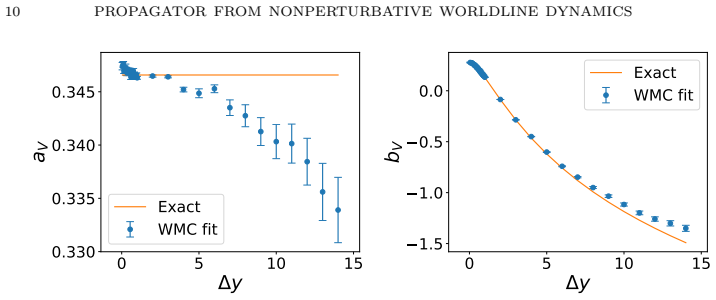
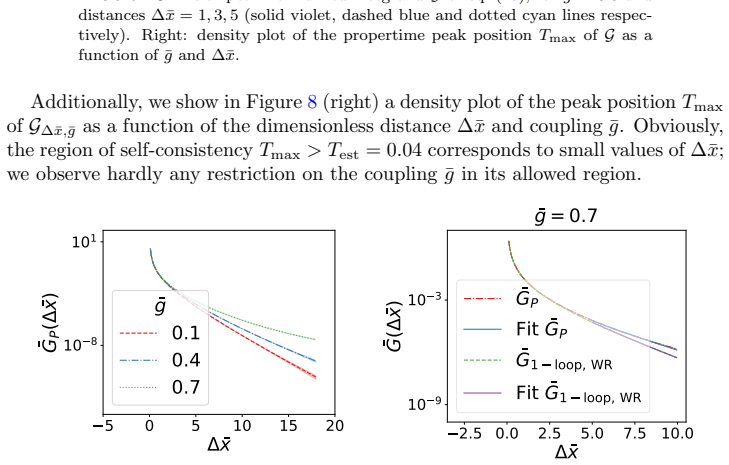
- [Sec. 4.3, Eq. (47) and Fig. 8] The pole-mass fits use the window x in [5,10], but in the rescaled integrand Delta y = 1/sqrt(T), so large distances x correspond to small propertimes. For x=10, the maximum of T^{-2} exp(-x^2 T - 1/(4T)) lies at T approximately 0.041, only marginally above the paper's own validity threshold T_est = 0.04. The integrand at T=0.04 is comparable to the peak, so a substantial fraction of the propagator integral samples Delta y > 5, where alpha and beta are continued by the unvalidated cubic fits (35). The paper describes a systematic-error estimate by integrating T<0.04, but that uncertainty is not propagated into the pole-mass points shown in Fig. 10. Thus the central mass curve is extracted from a region where the underlying PDF parameters are not validated.
- [Sec. 4.2, Eqs. (30), (34), and (48)] The self-consistency check in Eq. (34) and Fig. 5 tests only the first moment of the potential distribution. The propagator, however, requires the Laplace transform F(gT) = integral dv P(v) exp(-gT v), which is sensitive to the full distribution and especially to its large-v tail. The gamma ansatz (30) has an exponential tail, and the critical-coupling condition (48) is controlled by b_v0(0), which is determined from the fitted alpha(0) and beta(0). The numerical histogram in Fig. 3 (left) already shows a systematic excess over the gamma fit at large v for Delta y=0, and no tail validation is provided for finite Delta y. Consequently the value gbar_c ~ 0.72 is not a direct observation of a vanishing pole mass but an algebraic consequence of an assumed exponential tail. A slower-decaying true tail would remove or shift the apparent large-T divergence, so the mass-vanishing claim is not robust.
- [Sec. 4.3, Fig. 10] Near gbar_c the pole mass is small, so the condition m_* x >> 1 fails inside the fit window x in [5,10]. The one-loop benchmark (green triangles versus orange squares in Fig. 10) tests only the one-loop propagator, whose functional form and asymptotic regime are known from App. E; it does not validate the same fit procedure for the full nonperturbative propagator, especially when the correlation length grows. The red circles in Fig. 10 therefore represent an extrapolation of the fit ansatz in a regime where the asymptotic form f(x)=A x^{-3/2} e^{-m_* x} has not been independently justified. This is load-bearing for the claim that the mass vanishes at gbar_c rather than merely becoming very small within the approximation.
minor comments (4)
- [Sec. 3, Eq. (22)] The short-distance limit should read <V> ~ (T/2) H_{N-1} + O(Delta y^2), not (1/(2T)) H_{N-1}; with the stated form the cancellation in Eqs. (24)-(25) does not work dimensionally. This appears to be a typographical error, but it should be corrected because Eq. (22) is used to motivate the mass counterterm.
- [Sec. 4.3, Eq. (40)] The last exponential in Eq. (40) is written as exp(-gT b_v0 + g^2 T gamma); comparing with Eq. (47), the correct finite remainder is exp(-gT b_v0 + g T gamma/2). The g^2 is a typo that could mislead a reader tracking the renormalization.
- [Sec. 4.3, Fig. 8] The statement that there is 'hardly any restriction on the coupling' in the T_max > T_est region should be quantified, since for Delta xbar near 10 the peak position is only marginally above 0.04. The axes and the normalization of the integrand in the left panel should also be labeled more explicitly.
- [Sec. 5 and throughout] The algorithm is called 'v lines' in the main text but 'newv lines' in the conclusions; this should be made consistent.
Circularity Check
No significant circularity: the pole-mass and critical-coupling results are derived outputs of a Monte-Carlo-calibrated PDF model, benchmarked against independent one-loop analytic expressions.
full rationale
The derivation is not circular. The starting point, Eq. (10), is obtained from the generating functional by a Gaussian functional integration and a small-Nf/quenched projection, not by assuming the final propagator. The numerical input consists of histograms of the worldline potential V[y]; the gamma-distribution fit (30) is an ansatz whose parameters α and β are calibrated to those histograms. The expectation ⟨V⟩ entering v0 is taken from the analytic one-loop expression (20) rather than from a fit to the propagator, and α, β are checked against that same analytic expression in Fig. 1 and in the self-consistency relation (34). The pole mass is then a secondary output: the propagator GP in Eqs. (46)-(47) is built from the calibrated PDF parameters, and m⋆ is obtained from the large-distance fit (49), not used as an input to the PDF fits. The critical coupling (48) follows algebraically from the large-T behavior of this semi-analytic integrand with the measured Δy=0 parameters; it is a consequence of the fitted ansatz and therefore an extrapolation whose reliability is a correctness question, but it is not a quantity that was fitted beforehand and then relabeled as a prediction. Citations to [18] are methodological provenance for S2QED and the PDF idea, not a load-bearing uniqueness theorem; the v-lines algorithm is independently tested against the exact action distribution in App. A.1. Any weakness in the Δy>5 regime is a validity and uncertainty concern, not a circular reduction.
Assumptions & free parameters
free parameters (4)
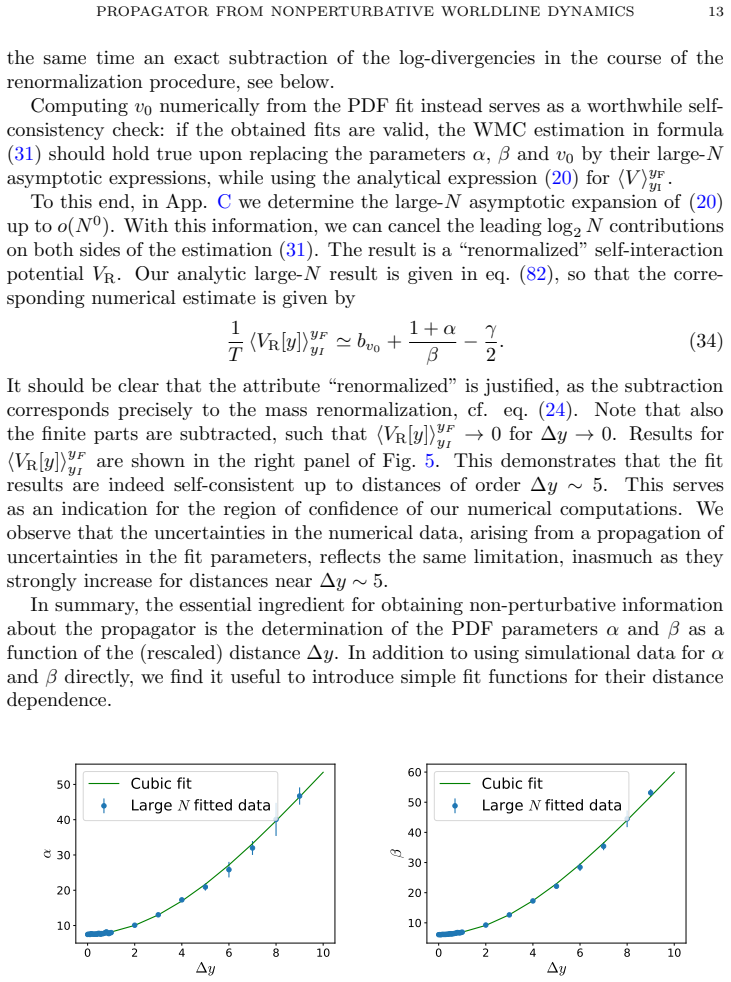
- alpha(Delta y) polynomial coefficients =
alpha = 7.51168 + 0.67579 x^2 - 0.021643 x^3
- beta(Delta y) polynomial coefficients =
beta = 6.12762 + 0.80933 x^2 - 0.0271248 x^3
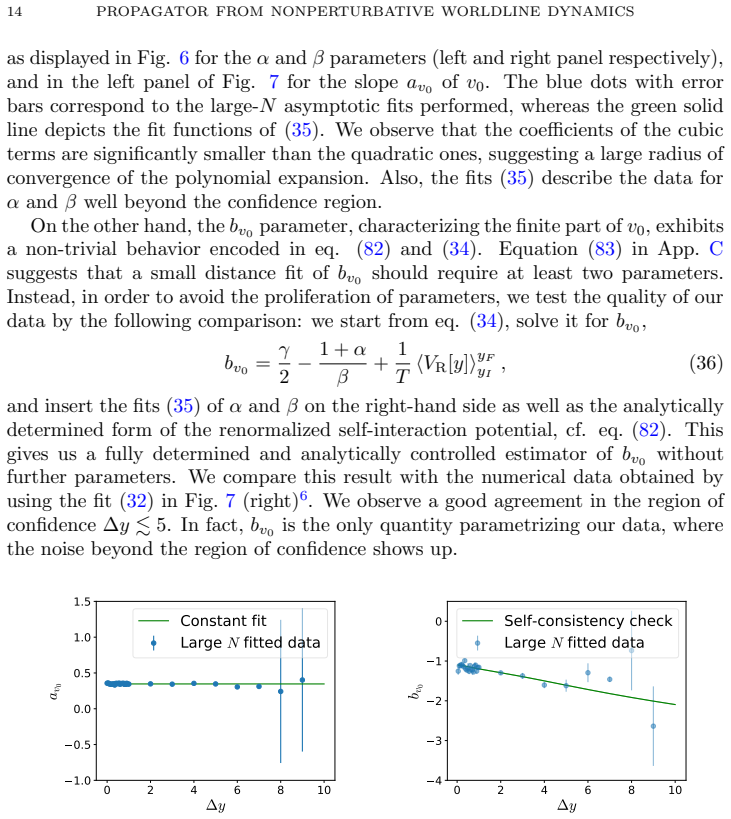
- b_v0(0) =
approx -1.10 in units of m_WR^2
- T_est =
0.04
assumptions (5)
- domain assumption The worldline representation (Eq. 4) exactly represents the Klein-Gordon propagator in an A background.
- domain assumption Quenched limit: the determinant det^{-1/2}(K[A]) is dropped as an O(Nf) correction (Eq. 3).
- domain assumption All UV divergences are contained in the disconnected part of <e^{-gV}> and are removed by a single mass counterterm (Eqs. 23-25).
- ad hoc to paper The PDF of V has the gamma form P(v) = beta^{1+alpha}/Gamma(alpha+1) (v-v0)^alpha e^{-beta(v-v0)} (Eq. 30).
- ad hoc to paper The polynomial fits for alpha and beta (Eq. 35) can be extrapolated beyond the confidence region Delta y < about 5.
Cite this review
Pith. "Pith review of Propagator from Nonperturbative Worldline Dynamics." pith.science (2026). https://pith.science/paper/OW262WOG
@misc{pith2026190804532,
  author       = {Pith},
  title        = {Pith review of: Propagator from Nonperturbative Worldline Dynamics},
  year         = {2026},
  howpublished = {\url{https://pith.science/paper/OW262WOG}},
  note         = {Machine review of arXiv:1908.04532}
}
abstract
We use the worldline representation for correlation functions together with numerical path integral methods to extract nonperturbative information about the propagator to all orders in the coupling in the quenched limit (small-$N_{\text{f}}$ expansion). Specifically, we consider a simple two-scalar field theory with cubic interaction (S${}^2$QED) in four dimensions as a toy model for QED-like theories. Using a worldline regularization technique, we are able to analyze the divergence structure of all-order diagrams and to perform the renormalization of the model nonperturbatively. Our method gives us access to a wide range of couplings and coordinate distances. We compute the pole mass of the S${}^2$QED electron and observe sizable nonperturbative effects in the strong-coupling regime arising from the full photon dressing. We also find indications for the existence of a critical coupling where the photon dressing compensates the bare mass such that the electron mass vanishes. The short distance behavior remains unaffected by the photon dressing in accordance with the power-counting structure of the model.
Figures


Figures from the paper (8 more)





Reference graph
Works this paper leans on
-
[1]
Mathematical formulation of the quantum theory of electro- magnetic interaction
R.P. Feynman. “Mathematical formulation of the quantum theory of electro- magnetic interaction”. Phys.Rev. 80 (1950), pp. 440–457 (cit. on p. 1)
work page 1950
-
[2]
Slow Electrons in a Polar Crystal
R. P. Feynman. “Slow Electrons in a Polar Crystal”. Phys. Rev. 97 (1955), pp. 660–665 (cit. on p. 1). 28 REFERENCES
work page 1955
-
[3]
The Particle Limit of Field Theory: A New Strong Coupling Expansion
M. B. Halpern and W. Siegel. “The Particle Limit of Field Theory: A New Strong Coupling Expansion”. Phys. Rev. D16 (1977), p. 2486 (cit. on pp. 1, 2)
work page 1977
-
[4]
Alexander M. Polyakov. “Gauge Fields and Strings”. Contemp. Concepts Phys. 3 (1987), pp. 1–301 (cit. on p. 1)
work page 1987
-
[5]
A New Approach to One Loop Calculations in Gauge Theories
Zvi Bern and David A. Kosower. “A New Approach to One Loop Calculations in Gauge Theories”. Phys.Rev. D38 (1988), p. 1888 (cit. on p. 1)
work page 1988
-
[6]
Field theory without Feynman diagrams: One loop effective actions
Matthew J. Strassler. “Field theory without Feynman diagrams: One loop effective actions”. Nucl. Phys. B385 (1992), pp. 145–184. arXiv: hep - ph / 9205205 [hep-ph] (cit. on p. 1)
work page 1992
-
[7]
On the calculation of effective actions by string methods
Michael G. Schmidt and Christian Schubert. “On the calculation of effective actions by string methods”. Phys. Lett. B318 (1993), pp. 438–446. arXiv: hep-th/9309055 [hep-th] (cit. on p. 1)
arXiv 1993
-
[8]
Vacuum polarization in QED with world- line methods
W. Dittrich and R. Shaisultanov. “Vacuum polarization in QED with world- line methods”. Phys. Rev. D62 (2000), p. 045024. arXiv: hep- th/0001171 [hep-th] (cit. on p. 1)
Show all 60 references
-
[9]
Perturbative quantum field theory in the string inspired formalism
Christian Schubert. “Perturbative quantum field theory in the string inspired formalism”. Phys. Rept. 355 (2001), pp. 73–234. arXiv: hep - th / 0101036 [hep-th] (cit. on pp. 1, 2, 5)
2001
-
[10]
Pair Production at Strong Coupling in Weak External Fields
Ian K. Affleck, Orlando Alvarez, and Nicholas S. Manton. “Pair Production at Strong Coupling in Weak External Fields”. Nucl.Phys. B197 (1982), p. 509 (cit. on pp. 1, 2)
1982
-
[11]
Variational treatment of quenched QED using the worldline technique
A. W. Schreiber, C. Alexandrou, and R. Rosenfelder. “Variational treatment of quenched QED using the worldline technique”. Nucl. Phys. A631 (1998), pp. 635C–639C. arXiv: nucl-th/9709052 [nucl-th] (cit. on pp. 1, 2)
1998 arXiv
-
[12]
From the Feynman-Schwinger represen- tation to the nonperturbative relativistic bound state interaction
Nora Brambilla and Antonio Vairo. “From the Feynman-Schwinger represen- tation to the nonperturbative relativistic bound state interaction”.Phys. Rev. D56 (1997), pp. 1445–1454. arXiv: hep-ph/9703378 [hep-ph] (cit. on p. 1)
1997 arXiv
-
[13]
Feynman-Schwinger representa- tion approach to nonperturbative physics
Cetin Savkli, John Tjon, and Franz Gross. “Feynman-Schwinger representa- tion approach to nonperturbative physics”. Phys. Rev. C60 (1999). [Erratum: Phys. Rev.C61,069901(2000)], p. 055210. arXiv: hep-ph/9906211 [hep-ph] (cit. on p. 1)
1999 arXiv
-
[14]
Nonperturbative quenched propaga- tor beyond the infrared approximation
J. Sanchez-Guillen and R. A. Vazquez. “Nonperturbative quenched propaga- tor beyond the infrared approximation”. Phys. Rev. D65 (2002), p. 105001. arXiv: hep-th/0201065 [hep-th] (cit. on p. 1)
2002 arXiv
-
[15]
Nonperturbative dynamics of scalar field theories through the Feynman-Schwinger representation
Cetin Savkli, Franz Gross, and John Tjon. “Nonperturbative dynamics of scalar field theories through the Feynman-Schwinger representation”. Phys. Atom. Nucl. 68 (2005). [Yad. Fiz.68,874(2005)], pp. 842–860. arXiv: nucl- th/0404068 [nucl-th] (cit. on pp. 1, 2)
2005
-
[16]
Worldline variational approximation: A New approach to the relativistic binding problem
K. Barro-Bergflodt, R. Rosenfelder, and M. Stingl. “Worldline variational approximation: A New approach to the relativistic binding problem”. Mod. Phys. Lett. A20 (2005), pp. 2533–2544. arXiv: hep- ph/0403304 [hep-ph] (cit. on pp. 1, 2)
2005
-
[17]
Chirality and parity in a first quantized representation
C. D. Fosco. “Chirality and parity in a first quantized representation” (2004). arXiv: hep-th/0404068 [hep-th] (cit. on p. 1)
2004 arXiv
-
[18]
Quantum effective actions from nonperturbative worldline dynamics
H. Gies, J. Sanchez-Guillen, and R. A. Vazquez. “Quantum effective actions from nonperturbative worldline dynamics”. JHEP 08 (2005), p. 067. arXiv: hep-th/0505275 [hep-th] (cit. on pp. 1–3, 5, 7, 10, 11, 19, 20, 22)
2005 arXiv
-
[19]
New tests and applica- tions of the worldline path integral in the first order formalism
C. D. Fosco, J. Sanchez-Guillen, and R. A. Vazquez. “New tests and applica- tions of the worldline path integral in the first order formalism”. Phys. Rev. D73 (2006), p. 045010. arXiv: hep-th/0511026 [hep-th] (cit. on p. 1). REFERENCES 29
2006 arXiv
-
[20]
Pair creation in inhomogeneous fields from worldline instantons
Gerald Dunne and Christian Schubert. “Pair creation in inhomogeneous fields from worldline instantons”. AIP Conf.Proc. 857 (2006), pp. 240–248. arXiv: hep-ph/0604089 [hep-ph] (cit. on pp. 1, 2)
2006 arXiv
-
[21]
Variational worldline approximation for the relativistic two-body bound state in a scalar model
K. Barro-Bergflodt, R. Rosenfelder, and M. Stingl. “Variational worldline approximation for the relativistic two-body bound state in a scalar model”. Few Body Syst. 39 (2006), pp. 193–253. arXiv: hep- ph/0601220 [hep-ph] (cit. on pp. 1, 2)
2006
-
[22]
Integral representations combining ladders and crossed- ladders
F. Bastianelli et al. “Integral representations combining ladders and crossed- ladders”. JHEP 07 (2014), p. 066. arXiv: 1405.7770 [hep-ph] (cit. on p. 1)
2014 arXiv
-
[23]
Lattice worldline represen- tation of correlators in a background field
Thomas Epelbaum, Francois Gelis, and Bin Wu. “Lattice worldline represen- tation of correlators in a background field”. JHEP 06 (2015), p. 148. arXiv: 1503.05333 [hep-ph] (cit. on p. 1)
2015 arXiv
-
[24]
Worldline holography to all orders and higher spins
Dennis D. Dietrich. “Worldline holography to all orders and higher spins”. Phys. Rev. D94.8 (2016), p. 086013. arXiv: 1507.04350 [hep-ph] (cit. on p. 1)
2016 arXiv
-
[25]
Dressed scalar propagator in a non-Abelian background from the worldline formalism
Naser Ahmadiniaz, Fiorenzo Bastianelli, and Olindo Corradini. “Dressed scalar propagator in a non-Abelian background from the worldline formalism”.Phys. Rev. D93.2 (2016). [Addendum: Phys. Rev.D93,no.4,049904(2016)], p. 025035. arXiv: 1508.05144 [hep-th] (cit. on p. 1)
2016 arXiv
-
[26]
Thermal Schwinger pair production at arbitrary coupling
Oliver Gould and Arttu Rajantie. “Thermal Schwinger pair production at arbitrary coupling”. Phys. Rev. D96.7 (2017), p. 076002. arXiv: 1704.04801 [hep-th] (cit. on p. 1)
2017 arXiv
-
[27]
Worldline sphaleron for ther- mal Schwinger pair production
Oliver Gould, Arttu Rajantie, and Cheng Xie. “Worldline sphaleron for ther- mal Schwinger pair production”. Phys. Rev. D98.5 (2018), p. 056022. arXiv: 1806.02665 [hep-th] (cit. on p. 1)
2018 arXiv
-
[28]
FEYN CALC: Computer algebraic calculation of Feynman amplitudes
R. Mertig, M. Bohm, and Ansgar Denner. “FEYN CALC: Computer algebraic calculation of Feynman amplitudes”. Comput. Phys. Commun. 64 (1991), pp. 345–359 (cit. on p. 1)
1991
-
[29]
Three- loop Euler-Heisenberg Lagrangian in 1+1 QED, part 1: single fermion-loop part
Idrish Huet, Michel Rausch De Traubenberg, and Christian Schubert. “Three- loop Euler-Heisenberg Lagrangian in 1+1 QED, part 1: single fermion-loop part” (2018). arXiv: 1812.08380 [hep-th] (cit. on p. 2)
2018 arXiv
-
[30]
Euler-Heisenberg lagrangians and asymptotic analysis in 1+1 QED, part 1: Two-loop
I. Huet, D. G. C. McKeon, and C. Schubert. “Euler-Heisenberg lagrangians and asymptotic analysis in 1+1 QED, part 1: Two-loop”. JHEP 12 (2010), p. 036. arXiv: 1010.5315 [hep-th] (cit. on p. 2)
2010 arXiv
-
[31]
The Euler-Heisenberg Lagrangian Beyond One Loop
Idrish Huet, Michel Rausch de Traubenberg, and Christian Schubert. “The Euler-Heisenberg Lagrangian Beyond One Loop”. Int. J. Mod. Phys. Conf. Ser. 14 (2012), pp. 383–393. arXiv: 1112.1049 [hep-th] (cit. on p. 2)
2012 arXiv
-
[32]
Multiloop Euler–Heisenberg Lagrangians, Schwinger Pair Creation, and the Photon S-Matrix
I. Huet, M. R. Traubenberg, and C. Schubert. “Multiloop Euler–Heisenberg Lagrangians, Schwinger Pair Creation, and the Photon S-Matrix”.Russ. Phys. J. 59.11 (2017), pp. 1746–1751 (cit. on p. 2)
2017
-
[33]
Mul- tiloop Euler-Heisenberg Lagrangians, Schwinger pair creation, and the QED N - photon amplitudes
Idrish Huet, Michel Rausch de Traubenberg, and Christian Schubert. “Mul- tiloop Euler-Heisenberg Lagrangians, Schwinger pair creation, and the QED N - photon amplitudes”. PoS LL2018 (2018), p. 035. arXiv: 1807 . 05938 [hep-th] (cit. on p. 2)
2018
-
[34]
Worldline instantons. II. The Fluctuation prefactor
Gerald V. Dunne et al. “Worldline instantons. II. The Fluctuation prefactor”. Phys. Rev. D73 (2006), p. 065028. arXiv: hep-th/0602176 [hep-th] (cit. on p. 2)
2006 arXiv
-
[35]
Dynamically assisted Schwinger mechanism
Ralf Schutzhold, Holger Gies, and Gerald Dunne. “Dynamically assisted Schwinger mechanism”. Phys. Rev. Lett.101 (2008), p. 130404. arXiv:0807.0754 [hep-th] (cit. on p. 2)
2008 arXiv
-
[36]
Localisation in worldline pair production and lightfront zero- modes
Anton Ilderton. “Localisation in worldline pair production and lightfront zero- modes”. JHEP 09 (2014), p. 166. arXiv: 1406.1513 [hep-th] (cit. on p. 2). 30 REFERENCES
2014 arXiv
-
[37]
Pair production from residues of complex worldline instantons
Anton Ilderton, Greger Torgrimsson, and Jonatan W˚ ardh. “Pair production from residues of complex worldline instantons”. Phys. Rev. D92.2 (2015), p. 025009. arXiv: 1503.08828 [hep-th] (cit. on p. 2)
2015 arXiv
-
[38]
Doubly assisted Sauter-Schwinger effect
Greger Torgrimsson, Johannes Oertel, and Ralf Sch¨ utzhold. “Doubly assisted Sauter-Schwinger effect”. Phys. Rev. D94.6 (2016), p. 065035. arXiv: 1607. 02448 [hep-th] (cit. on p. 2)
2016
-
[39]
Dynamically assisted Sauter-Schwinger effect — non-perturbative versus perturbative aspects
Greger Torgrimsson et al. “Dynamically assisted Sauter-Schwinger effect — non-perturbative versus perturbative aspects”.JHEP 06 (2017), p. 043. arXiv: 1703.09203 [hep-th] (cit. on p. 2)
2017 arXiv
-
[40]
Euclidean mirrors: enhanced vac- uum decay from reflected instantons
Ibrahim Akal and Gudrid Moortgat-Pick. “Euclidean mirrors: enhanced vac- uum decay from reflected instantons”. J. Phys. G45.5 (2018), p. 055007. arXiv: 1706.06447 [hep-th] (cit. on p. 2)
2018 arXiv
-
[41]
The self-energy of the scalar nucleon
Koichi Mano. “The self-energy of the scalar nucleon”. PhD thesis. Caltech, 1955 (cit. on p. 2)
1955
-
[42]
Stochastic solution to highly nonlocal actions: The Polaron problem
C. Alexandrou and R. Rosenfelder. “Stochastic solution to highly nonlocal actions: The Polaron problem”. Phys. Rept. 215 (1992), pp. 1–48 (cit. on p. 2)
1992
-
[43]
Polaron variational methods in the particle representation of field theory. 1. General Formalism
R. Rosenfelder and A. W. Schreiber. “Polaron variational methods in the particle representation of field theory. 1. General Formalism”.Phys. Rev. D53 (1996), pp. 3337–3353. arXiv: nucl-th/9504002 [nucl-th] (cit. on p. 2)
1996 arXiv
-
[44]
Polaron variational methods in the par- ticle representation of field theory. 2. Numerical results for the propagator
R. Rosenfelder and A. W. Schreiber. “Polaron variational methods in the par- ticle representation of field theory. 2. Numerical results for the propagator”. Phys. Rev. D53 (1996), pp. 3354–3365. arXiv: nucl-th/9504005 [nucl-th] (cit. on p. 2)
1996 arXiv
-
[45]
UV Completion on the Worldline
Steven Abel and Nicola Andrea Dondi. “UV Completion on the Worldline” (2019). arXiv: 1905.04258 [hep-th] (cit. on p. 2)
2019 arXiv
-
[46]
Quantum diffusion of magnetic fields in a numerical worldline approach
Holger Gies and Kurt Langfeld. “Quantum diffusion of magnetic fields in a numerical worldline approach”. Nucl. Phys. B613 (2001), pp. 353–365. arXiv: hep-ph/0102185 [hep-ph] (cit. on pp. 2, 5)
2001 arXiv
-
[47]
Loops and loop clouds: A Numerical ap- proach to the worldline formalism in QED
Holger Gies and Kurt Langfeld. “Loops and loop clouds: A Numerical ap- proach to the worldline formalism in QED”. Int. J. Mod. Phys. A17 (2002), pp. 966–978. arXiv: hep-ph/0112198 [hep-ph] (cit. on p. 2)
2002 arXiv
-
[48]
Casimir effect on the worldline
Holger Gies, Kurt Langfeld, and Laurent Moyaerts. “Casimir effect on the worldline”. JHEP 0306 (2003), p. 018. arXiv: hep - th / 0303264 [hep-th] (cit. on pp. 2, 20)
2003
-
[49]
Quantum energies with worldline numer- ics
Holger Gies and Klaus Klingmuller. “Quantum energies with worldline numer- ics”. J. Phys. A39 (2006), pp. 6415–6422. arXiv: hep-th/0511092 [hep-th] (cit. on p. 2)
2006 arXiv
-
[50]
Worldline algorithms for Casimir con- figurations
Holger Gies and Klaus Klingmuller. “Worldline algorithms for Casimir con- figurations”. Phys. Rev. D74 (2006), p. 045002. arXiv: quant- ph/0605141 [quant-ph] (cit. on p. 2)
2006
-
[51]
Casimir Forces via Worldline Numerics: Method Improve- ments and Potential Engineering Applications
Klaus Aehlig et al. “Casimir Forces via Worldline Numerics: Method Improve- ments and Potential Engineering Applications” (2011). arXiv: 1110 . 5936 [hep-th] (cit. on p. 2)
2011
-
[52]
Parallel Worldline Numerics: Implementa- tion and Error Analysis
Dan Mazur and Jeremy S. Heyl. “Parallel Worldline Numerics: Implementa- tion and Error Analysis” (2014). arXiv: 1407.7486 [hep-th] (cit. on p. 2)
2014 arXiv
-
[53]
Pair production in inhomogeneous fields
Holger Gies and Klaus Klingmuller. “Pair production in inhomogeneous fields”. Phys.Rev. D72 (2005), p. 065001. arXiv: hep-ph/0505099 [hep-ph] (cit. on p. 2)
2005 arXiv
-
[54]
Integral transforms of the quantum mechanical path integral: hit function and path averaged potential
James P. Edwards et al. “Integral transforms of the quantum mechanical path integral: hit function and path averaged potential”. Phys. Rev. E97.4 (2018), p. 042114. arXiv: 1709.04984 [quant-ph] (cit. on p. 2). REFERENCES 31
2018 arXiv
-
[55]
Applications of the worldline Monte Carlo formalism in quantum mechanics
James P. Edwards et al. “Applications of the worldline Monte Carlo formalism in quantum mechanics” (2019). arXiv: 1903.00536 [quant-ph] (cit. on p. 2)
2019 arXiv
-
[56]
Scalar model of effective field theory in curved space
Tiago G. Ribeiro and Ilya L. Shapiro. “Scalar model of effective field theory in curved space” (2019). arXiv: 1908.01937 [hep-th] (cit. on p. 3)
2019 arXiv
-
[57]
Unitarity, stability and loops of unstable ghosts
John F. Donoghue and Gabriel Menezes. “Unitarity, stability and loops of unstable ghosts” (2019). arXiv: 1908.02416 [hep-th] (cit. on p. 3)
2019 arXiv
-
[58]
Worldline Numerics for Energy- Momentum Tensors in Casimir Geometries
Marco Schafer, Idrish Huet, and Holger Gies. “Worldline Numerics for Energy- Momentum Tensors in Casimir Geometries”.J. Phys. A49.13 (2016), p. 135402. arXiv: 1509.03509 [hep-th] (cit. on p. 20)
2016 arXiv
-
[59]
Energy-Momentum Tensors with Worldline Numerics
Marco Schafer, Idrish Huet, and Holger Gies. “Energy-Momentum Tensors with Worldline Numerics”. Int. J. Mod. Phys. Conf. Ser. 14 (2012), pp. 511–
2012
-
[520]
arXiv: 1112.0469 [hep-th] (cit. on p. 20)
Reviewed August 14, 2026 · model on record in the stance chip above.
Discussion (0). Continue with ORCID to comment.