REVIEW 2 major objections 4 minor 2 cited by
Fully Tunable Strong Spin-Orbit Interactions in Light Hole Germanium Quantum Channels
T0 review · 2 major / 4 minor · reviewed 2026-08-15 · deepseek-v4-flash
Pith's one-line read Strained germanium on germanium-tin can host a fully gate-switchable light-hole spin-orbit interaction.
desk verdict The quantum-channel and dot calculations are new and mostly sound, but the g⊥=0 'leakage-free' claim rests on a Schrieffer-Wolff expansion that may break down exactly where the zero occurs. read the letter →
The pith
A machine-rendered reading of the paper's core claim, the machinery that carries it, and where it could break.
The reading
What carries the argument
The load-bearing object is the light-hole-like ground state of tensile-strained Ge on relaxed Ge$_{1-x}$Sn$_x$, produced when tensile strain overcomes the heavy-hole confinement advantage. The argument is carried by 6-band $k\cdot p$ theory plus a perturbative reduction to effective two-dimensional Hamiltonians, which yield formulas for the effective mass, the Rashba parameters $\beta_1,\beta_2,\beta_3$, and the $g$-tensor components $g_\perp$ and $g_\parallel$ from subband envelopes at zero in-plane momentum. A characteristic electric length $l_F$ compared with the well thickness $l_z$ organizes the parameter space into confinement-dominated and field-dominated regimes. The vanishing of all three Rashba parameters on a single contour is what makes the on/off switch possible; the vanishing of $g_\perp$ near that contour is what makes leakage-free qubits possible.
What would settle it
Grow the Ge/GeSn heterostructure with a 15 nm well and a thin Si or oxide barrier, define a quantum dot, and measure the electric-dipole spin resonance Rabi frequency while sweeping the gate field at a fixed field angle, for instance perpendicular to the plane. The paper predicts three sharp zeros of the Rabi frequency ($\beta$-line near $F_z\approx4.4$ V/µm and two $g_\perp=0$ lines), with the $\beta$-line independent of lateral confinement; if those zeros do not appear, or if $g_\perp$ does not pass through zero, the central claim is refuted.
Extended reading notes
Core claim
The central claim is that the built-in asymmetry of a MOS-like Ge/Ge$_{1-x}$Sn$_x$ heterostructure with a light-hole ground state yields a Rashba spin-orbit interaction that is inherently large and fully tunable by an out-of-plane gate field. Specifically, the linear Rashba parameter $\beta_1$ and the two cubic Rashba parameters all vanish on the same contour in the (well thickness, gate field) plane, so the device acts as an on/off spin-orbit switch at a particular field $F_z^* \approx 4.4$ V/µm for a 15 nm well. The same gate tunability drives the out-of-plane $g$-factor $g_\perp$ through zero, which the paper identifies as the route to leakage-free, 'spinless' spin qubits, while the large in-plane $g$-factor $g_\parallel \sim -8$ relaxes magnetic-field orientation constraints and is attractive for hybrid superconductor devices. The mechanism is inherited directly from the planar geometry, in contrast to quasi-one-dimensional systems where direct Rashba coupling requires lateral confinement.
Load-bearing premise
The whole design depends on being able to put a very thin capping layer on top of the strained germanium (a few ångströms of silicon, an oxide, or both) that keeps the light holes inside the well under strong gate fields, without relaxing the tensile strain or creating unwanted interface states.
Editorial extensions
If this is right
- A single gate voltage can put a planar hole-spin qubit into an operational (Rabi-active) or idle state, because EDSR driving vanishes at the $\beta_1 = 0$ contour.
- Qubits defined in this system can be made leakage-free by biasing to a gate field where $g_\perp = 0$, implementing the proposed spinless qubit regime.
- The large in-plane $g$-factor weakens the requirement on magnetic-field orientation, simplifying device layout and operation.
- The same large spin-orbit coupling and gate-controlled switch can be used in superconductor–semiconductor hybrids, where a strong, tunable $g$-factor and SOI are desirable.
- The on/off condition is stable against the lateral confinement length and the magnetic-field angle, so it survives the transition from quantum well to quantum channel to quantum dot.
Reading between the lines
- If the surface barrier can be grown as assumed, the same device should also work as a fast electric-field-controlled spin-orbit switch in hybrid superconductor/semiconductor circuits, a use the paper mentions but does not develop.
- The fact that all three Rashba parameters share one zero contour suggests a common origin in the field-induced wavefunction symmetry of the light-hole subband; checking whether this persists at other Sn contents and well thicknesses would test the generality of the mechanism.
- A direct falsifier available to experiment is the gate-field dependence of the Rabi frequency: the predicted $\beta$-line and $g_\perp=0$ lines should appear as sharp zeros in EDSR as $F_z$ is swept, with the $\beta$-line independent of $l_x$, $l_y$, and field angle.
Signed reviews
Editorial analysis
A structured set of objections, weighed in public.
Referee Report
Summary. The manuscript proposes a MOS-like epitaxial Ge quantum well on relaxed Ge1−xSnx as a platform for light-hole (LH) spin qubits. Using 6-band k·p theory and Schrieffer-Wolff perturbation theory, the authors derive effective Hamiltonians for the planar two-dimensional system, a quantum channel (QC), and a quantum dot, and compute spin-orbit interaction parameters, g-factors, and Rabi frequencies. The central claims are that the planar asymmetric confinement produces a large linear Rashba spin-orbit interaction that can be completely switched off at a specific gate field Fz* (the 'beta-line'), and that the out-of-plane g-factor g⊥c can be tuned to zero at two gate fields (the 'g-lines'), enabling leakage-free spin qubits. The paper presents phase diagrams in (Fz, lx) space and Rabi-frequency maps showing these zero lines, and argues that the beta-line is robust because it is inherited from the planar geometry, whereas the g-lines arise from the combined effect of in-plane confinement and nonzero planar Rashba coupling.
Significance. If the central claims hold, this work would identify a practically relevant material system with an unusually large and fully gate-tunable spin-orbit interaction, providing both an efficient EDSR driving mechanism and an on/off SOI switch, along with a gate-tunable g⊥ that could eliminate leakage transitions in spin qubits. The paper benefits from using established 6-band k.p theory and from building on earlier parameter-free derivations by the same group (Refs. [56,57]), which gives the planar results a solid foundation. The beta-line (Rashba off-switch) is particularly credible because it exists already in the planar limit and is shown to be insensitive to lx and θ. The falsifiable predictions, such as the zero lines in Figs. 2–3, are a strength. However, the g⊥=0 claim rests on a perturbative expansion that, as the authors acknowledge, is used exactly in the regime where its small parameter is not small; this is a load-bearing gap that must be addressed before the paper's headline conclusions can be accepted.
major comments (2)
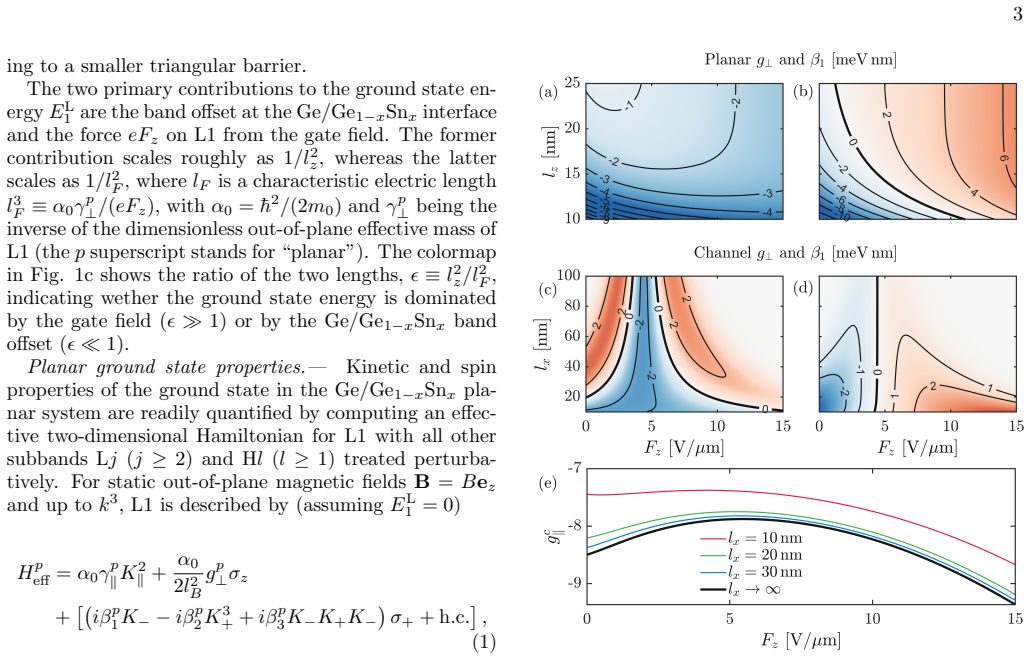
- [Quantum channel ground state properties, Eq. (3) and Fig. 2(c)–(d)] The approximation g⊥c ≈ g⊥p + (β1p lx/α0)^2 / sqrt(γ∥p) is introduced with the condition |β1p lx/α0| ≪ 1. However, setting g⊥c = 0 with g⊥p ≈ −3 requires |β1p lx/α0| ≈ sqrt(3 sqrt(γ∥p)), which is O(1) for typical values of γ∥p. The paper's own text states that the regime where g⊥c → 0 'corresponds to the linear Rashba term dominating the in-plane confinement energy', which is precisely the regime in which treating that term perturbatively is uncontrolled. Therefore the g-lines in Figs. 2(c) and 3(a) may be artifacts of the truncated Schrieffer-Wolff expansion rather than genuine properties of the full 6-band k.p Hamiltonian. I ask the authors to verify the g⊥c = 0 points by exact (or numerically converged) diagonalization of the 6-band k.p Hamiltonian in the QC geometry at the relevant (Fz, lx) values, or to provide a quantitative convergence criterion showing that the truncated expansion remains valid there.
- [Quantum channel ground state properties and Fig. 3(a)] The central claims about the QC and QD rely entirely on effective parameters (g⊥c, g∥c, β1c, β3c) that are computed with a Schrieffer-Wolff transformation whose detailed derivation is deferred to the Supplemental Material [60], and no convergence or consistency checks are reported in the main text. Given that the g-lines are load-bearing for the leakage-free claim, the main text should include at least one quantitative check, such as a comparison of the effective-model g-factors and spin splittings against a direct numerical diagonalization of the full 6-band k.p Hamiltonian at selected (Fz, lx) points, including near the purported g⊥c = 0 lines. Without such a check, the reader cannot distinguish a physical zero from a breakdown of the perturbation theory.
minor comments (4)
- [The proposed heterostructure] The surface barrier is only assumed to be a thin, large-band-offset material. A brief discussion of candidate materials (e.g., Si capping, oxide barriers) and their expected band offsets, strain effects, and interface defect densities would make the experimental pathway more concrete.
- [Fig. 1(c) caption and text] There is a typo: 'wether' should be 'whether'. Also, the contour labels in Fig. 1(c) would benefit from a direct indication of the three regions described in the text.
- [Eq. (3)] The equation appears to have a formatting error: '1q γ∥p' should presumably read (1/√γ∥p) β1p lx/α0 squared. Please correct the typesetting.
- [Quantum dot ground state properties] The statement that the beta-line is 'unperturbed' by lx and θ could be quantified; the reader would benefit from a measure of how close to zero Ω remains along that line in the finite-size QD calculations.
Circularity Check
No significant circularity: the predictions are computed from a stated 6-band k.p model with standard parameters, and the self-cited planar inputs are parameter-free prior derivations rather than fits to the new QC/QD results.
full rationale
The derivation chain is self-contained in the relevant sense. The planar effective Hamiltonian, Eq. (1), is obtained by a Schrieffer-Wolff transformation from 6-band k.p theory, and the text states that the transformation 'provides exact formulas for these parameters in terms of the envelopes and energies at kx=ky=0 and B=0 [56, 57, 60].' Refs. [56,57] are by two of the present authors, but they supply the model building blocks (planar masses, g factors, Rashba parameters) as parameter-free derivations, not as fits to the quasi-1D or quantum-dot quantities being predicted. The QC effective Hamiltonian, Eq. (2), and the approximate relation, Eq. (3), are derived quantities from that model; the beta-line is traced to the planar beta_p1=0 contour, and the g-lines follow from solving g_c_perp=0 in Eq. (3). No parameter is fitted to a subset of data and then renamed as a prediction. The strongest challenge visible in the manuscript—that the g=0 point may lie where the linear Rashba term dominates the in-plane confinement energy, i.e., outside the regime where the Schrieffer-Wolff expansion leading to Eq. (3) is controlled—is a validity or accuracy concern about the perturbative treatment, not a circularity: it does not show that any predicted quantity is equivalent to an input by construction. Accordingly, no circular step is identified, and the self-citations do not raise the circularity score under the stated rules.
Assumptions & free parameters
assumptions (3)
- domain assumption The 6-band k.p model with the Ge/GeSn material parameters (Luttinger parameters, deformation potentials, band offsets) accurately describes the valence bands of strained Ge and GeSn.
- domain assumption The Schrieffer-Wolff perturbative expansion is valid for the studied parameter range, with l_z=15 nm keeping energy denominators finite.
- ad hoc to paper The surface barrier has a large band offset and does not alter the confinement, strain, or band structure beyond the assumed infinite/offset barrier.
Cite this review
Pith. "Pith review of Fully Tunable Strong Spin-Orbit Interactions in Light Hole Germanium Quantum Channels." pith.science (2026). https://pith.science/paper/OWI3UWR6
@misc{pith2026250614759,
  author       = {Pith},
  title        = {Pith review of: Fully Tunable Strong Spin-Orbit Interactions in Light Hole Germanium Quantum Channels},
  year         = {2026},
  howpublished = {\url{https://pith.science/paper/OWI3UWR6}},
  note         = {Machine review of arXiv:2506.14759}
}
abstract
Spin-orbit interaction (SOI) is a fundamental component for electrically driven spin qubits and hybrid superconducting-semiconducting systems. In particular, Rashba SOI (RSOI) is a key mechanism enabling all-electrical spin manipulation schemes. However, in common planar systems, RSOI is weak because of the small mixing between heavy holes (HH) and light holes (LH), and instead relies on complex strain and interface phenomena that are hard to reliably harness in experiment. Here, MOS-like epitaxial Ge on relaxed \GeSn{} is introduced and shown to exhibit an inherently large, highly gate-tunable RSOI that is compatible with both spin qubits and hybrid devices. This large RSOI is a consequence of the LH-like ground state in Ge. Notably, the built-in asymmetry of the device causes the RSOI to completely vanish at specific gate fields, effectively acting as an on/off SOI switch. The LH $g$-tensor is less anisotropic than that of state-of-the-art HH qubits, alleviating precise magnetic field orientation requirements. The large in-plane $g$-factor also facilitates the integration of superconductors. Moreover, the out-of-plane $g$-factor is strongly gate-tunable and completely vanishes at specific gate fields. Thus, this material system combines the large RSOI with the scalability of planar devices, paving the way towards robust spin qubit applications and enabling access to new regimes of complex spin physics.
Figures


Forward citations
Cited by 2 Pith papers
-
Light-hole states and hyperfine interaction in electrically-defined Ge/GeSn quantum dots
In tensile-strained Ge/GeSn light-hole qubits, hyperfine coupling is dominated by the Fermi contact term via s-type conduction-band admixtures, and it grows with Sn barrier concentration.
-
Fast readout of quantum dot spin qubits via Andreev spins
A switchable quantum-dot-plus-Andreev-spin coupler can read a germanium dot-spin qubit in under a microsecond with theoretical fidelity above 99.9%.
Reference graph
Works this paper leans on
-
[60]
Details on thek·pmodel, the perturbative framework, the cubic Rashba parameters, the consistency of the quantum channel theory at largel x and the Ge 1−xSnx material parametrization are provided in the Supplemen- tal Material
-
[1]
D. V. Bulaev and D. Loss, Phys. Rev. Lett.95, 076805 (2005)
work page 2005
- [2]
- [3]
-
[4]
A. S. Ivlev, H. Tidjani, S. D. Oosterhout, A. Sammak, G. Scappucci, and M. Veldhorst, Applied Physics Letters 125, 023501 (2024)
work page 2024
-
[5]
C.-A. Wang, C. D´ eprez, H. Tidjani, W. I. L. Lawrie, N. W. Hendrickx, A. Sammak, G. Scappucci, and M. Veldhorst, npj Quantum Information9, 58 (2023)
work page 2023
-
[6]
W. I. L. Lawrie, M. Rimbach-Russ, F. v. Riggelen, N. W. Hendrickx, S. L. d. Snoo, A. Sammak, G. Scappucci, J. Helsen, and M. Veldhorst, Nature Communications14, 3617 (2023)
work page 2023
-
[7]
F. van Riggelen, N. W. Hendrickx, W. I. L. Lawrie, M. Russ, A. Sammak, G. Scappucci, and M. Veldhorst, Applied Physics Letters118, 044002 (2021)
work page 2021
Show all 63 references
-
[8]
N. W. Hendrickx, W. I. L. Lawrie, M. Russ, F. van Rigge- len, S. L. de Snoo, R. N. Schouten, A. Sammak, G. Scap- pucci, and M. Veldhorst, Nature591, 580 (2021)
2021
-
[9]
N. W. Hendrickx, D. P. Franke, A. Sammak, G. Scap- pucci, and M. Veldhorst, Nature577, 487 (2020)
2020
-
[10]
W. I. L. Lawrie, H. G. J. Eenink, N. W. Hendrickx, J. M. Boter, L. Petit, S. V. Amitonov, M. Lodari, B. Paquelet Wuetz, C. Volk, S. G. J. Philips, G. Droulers, N. Kalhor, F. van Riggelen, D. Brousse, A. Sammak, L. M. K. Vandersypen, G. Scappucci, and M. Veldhorst, Applied Phys...
2020
-
[11]
N. W. Hendrickx, W. I. L. Lawrie, L. Petit, A. Sammak, G. Scappucci, and M. Veldhorst, Nature Communications 11, 3478 (2020)
2020
-
[12]
W. J. Hardy, C. T. Harris, Y.-H. Su, Y. Chuang, J. Moussa, L. N. Maurer, J.-Y. Li, T.-M. Lu, and D. R. Luhman, Nanotechnology30, 215202 (2019)
2019
-
[13]
Scappucci, C
G. Scappucci, C. Kloeffel, F. A. Zwanenburg, D. Loss, M. Myronov, J.-J. Zhang, S. De Franceschi, G. Kat- saros, and M. Veldhorst, Nature Reviews Materials 10.1038/s41578-020-00262-z (2020)
2020 doi
-
[14]
Philippopoulos, S
P. Philippopoulos, S. Chesi, and W. A. Coish, Phys. Rev. B101, 115302 (2020)
2020
-
[15]
Testelin, F
C. Testelin, F. Bernardot, B. Eble, and M. Chamarro, Phys. Rev. B79, 195440 (2009)
2009
-
[16]
Moutanabbir, S
O. Moutanabbir, S. Assali, A. Attiaoui, G. Daligou, P. Daoust, P. D. Vecchio, S. Koelling, L. Luo, and N. Ro- taru, Advanced Materials36, 2305703 (2024)
2024
-
[17]
Bihlmayer, O
G. Bihlmayer, O. Rader, and R. Winkler, New Journal of Physics17, 050202 (2015)
2015
-
[18]
Y. B. Lyanda-Geller, Solid State Communications352, 114815 (2022)
2022
-
[19]
Bosco and D
S. Bosco and D. Loss, Phys. Rev. Appl.18, 044038 (2022)
2022
-
[20]
Bosco and D
S. Bosco and D. Loss, Phys. Rev. Lett.127, 190501 (2021)
2021
-
[21]
Kloeffel, M
C. Kloeffel, M. J. Ranˇ ci´ c, and D. Loss, Phys. Rev. B97, 235422 (2018)
2018
-
[22]
Luo, S.-S
J.-W. Luo, S.-S. Li, and A. Zunger, Phys. Rev. Lett.119, 126401 (2017)
2017
-
[23]
Kloeffel, M
C. Kloeffel, M. Trif, and D. Loss, Phys. Rev. B84, 195314 (2011)
2011
-
[24]
Csontos, P
D. Csontos, P. Brusheim, U. Z¨ ulicke, and H. Q. Xu, Phys. Rev. B79, 155323 (2009)
2009
-
[25]
Adelsberger, S
C. Adelsberger, S. Bosco, J. Klinovaja, and D. Loss, Phys. Rev. B106, 235408 (2022)
2022
-
[26]
Adelsberger, M
C. Adelsberger, M. Benito, S. Bosco, J. Klinovaja, and D. Loss, Phys. Rev. B105, 075308 (2022)
2022
-
[27]
C. X. Yu, S. Zihlmann, J. C. Abadillo-Uriel, V. P. Michal, N. Rambal, H. Niebojewski, T. Bedecarrats, M. Vinet, ´E. Dumur, M. Filippone, B. Bertrand, S. De Franceschi, Y.-M. Niquet, and R. Maurand, Nature Nanotechnology 18, 741 (2023)
2023
-
[28]
H. Liu, K. Wang, F. Gao, J. Leng, Y. Liu, Y.-C. Zhou, G. Cao, T. Wang, J. Zhang, P. Huang, H.-O. Li, and G.-P. Guo, Nano Letters23, 3810 (2023)
2023
-
[29]
N. Piot, B. Brun, V. Schmitt, S. Zihlmann, V. P. Michal, A. Apra, J. C. Abadillo-Uriel, X. Jehl, B. Bertrand, H. Niebojewski, L. Hutin, M. Vinet, M. Urdampilleta, T. Meunier, Y.-M. Niquet, R. Maurand, and S. D. Franceschi, Nature Nanotechnology17, 1072 (2022)
2022
-
[30]
L. C. Camenzind, S. Geyer, A. Fuhrer, R. J. Warburton, D. M. Zumb¨ uhl, and A. V. Kuhlmann, Nature Electronics 5, 178 (2022)
2022
-
[31]
K. Wang, G. Xu, F. Gao, H. Liu, R.-L. Ma, X. Zhang, Z. Wang, G. Cao, T. Wang, J.-J. Zhang, D. Culcer, X. Hu, H.-W. Jiang, H.-O. Li, G.-C. Guo, and G.-P. Guo, Nature Communications13, 206 (2022)
2022
-
[32]
F. N. M. Froning, L. C. Camenzind, O. A. H. van der Molen, A. Li, E. P. A. M. Bakkers, D. M. Zumb¨ uhl, and F. R. Braakman, Nature Nanotechnology16, 308 (2021). 6
2021
-
[33]
F. N. M. Froning, M. J. Ranˇ ci´ c, B. Het´ enyi, S. Bosco, M. K. Rehmann, A. Li, E. P. A. M. Bakkers, F. A. Zwa- nenburg, D. Loss, D. M. Zumb¨ uhl, and F. R. Braakman, Phys. Rev. Res.3, 013081 (2021)
2021
-
[34]
G. Xu, F. Gao, K. Wang, T. Zhang, H. Liu, G. Cao, T. Wang, J.-J. Zhang, H.-W. Jiang, H.-O. Li, and G.-P. Guo, Applied Physics Express13, 065002 (2020)
2020
-
[35]
Watzinger, J
H. Watzinger, J. Kukuˇ cka, L. Vukuˇ si´ c, F. Gao, T. Wang, F. Sch¨ affler, J.-J. Zhang, and G. Katsaros, Nature Com- munications9, 3902 (2018)
2018
-
[36]
Vukuˇ si´ c, J
L. Vukuˇ si´ c, J. Kukuˇ cka, H. Watzinger, J. M. Milem, F. Sch¨ affler, and G. Katsaros, Nano Letters18, 7141 (2018)
2018
-
[37]
Z.-H. Liu, R. Li, X. Hu, and J. Q. You, Scientific Reports 8, 2302 (2018)
2018
-
[38]
D. Q. Wang, O. Klochan, J.-T. Hung, D. Culcer, I. Far- rer, D. A. Ritchie, and A. R. Hamilton, Nano Letters16, 7685 (2016)
2016
-
[39]
Maurand, X
R. Maurand, X. Jehl, D. Kotekar-Patil, A. Corna, H. Bo- huslavskyi, R. Lavi´ eville, L. Hutin, S. Barraud, M. Vinet, M. Sanquer, and S. De Franceschi, Nature Communica- tions7, 13575 (2016)
2016
-
[40]
A. P. Higginbotham, T. W. Larsen, J. Yao, H. Yan, C. M. Lieber, C. M. Marcus, and F. Kuemmeth, Nano Letters 14, 3582 (2014)
2014
-
[41]
Nadj-Perge, S
S. Nadj-Perge, S. M. Frolov, E. P. A. M. Bakkers, and L. P. Kouwenhoven, Nature468, 1084 (2010)
2010
-
[42]
Bosco, B
S. Bosco, B. Het´ enyi, and D. Loss, PRX Quantum2, 010348 (2021)
2021
-
[43]
Kloeffel, M
C. Kloeffel, M. Trif, P. Stano, and D. Loss, Phys. Rev. B 88, 241405 (2013)
2013
-
[44]
N. W. Hendrickx, L. Massai, M. Mergenthaler, F. J. Schupp, S. Paredes, S. W. Bedell, G. Salis, and A. Fuhrer, Nature Materials23, 920 (2024)
2024
-
[45]
C.-A. Wang, H. E. Ercan, M. F. Gyure, G. Scappucci, M. Veldhorst, and M. Rimbach-Russ, npj Quantum In- formation10, 102 (2024)
2024
-
[46]
Z. Wang, E. Marcellina, A. R. Hamilton, J. H. Cullen, S. Rogge, J. Salfi, and D. Culcer, npj Quantum Informa- tion7, 54 (2021)
2021
-
[47]
L. A. Terrazos, E. Marcellina, Z. Wang, S. N. Copper- smith, M. Friesen, A. R. Hamilton, X. Hu, B. Koiller, A. L. Saraiva, D. Culcer, and R. B. Capaz, Phys. Rev. B 103, 125201 (2021)
2021
-
[48]
D. V. Bulaev and D. Loss, Phys. Rev. Lett.98, 097202 (2007)
2007
-
[49]
D. V. Bulaev and D. Loss, Phys. Rev. B71, 205324 (2005)
2005
-
[50]
Xiong, S
J.-X. Xiong, S. Guan, J.-W. Luo, and S.-S. Li, Phys. Rev. B103, 085309 (2021)
2021
-
[51]
E. A. Rodr´ ıguez-Mena, J. C. Abadillo-Uriel, G. Veste, B. Martinez, J. Li, B. Skl´ enard, and Y.-M. Niquet, Phys. Rev. B108, 205416 (2023)
2023
-
[52]
S. D. Liles, F. Martins, D. S. Miserev, A. A. Kiselev, I. D. Thorvaldson, M. J. Rendell, I. K. Jin, F. E. Hudson, M. Veldhorst, K. M. Itoh, O. P. Sushkov, T. D. Ladd, A. S. Dzurak, and A. R. Hamilton, Phys. Rev. B104, 235303 (2021)
2021
-
[53]
J. C. Abadillo-Uriel, E. A. Rodr´ ıguez-Mena, B. Martinez, and Y.-M. Niquet, Phys. Rev. Lett.131, 097002 (2023)
2023
-
[54]
Martinez and Y.-M
B. Martinez and Y.-M. Niquet, Phys. Rev. Appl.17, 024022 (2022)
2022
-
[55]
Assali, A
S. Assali, A. Attiaoui, P. Del Vecchio, S. Mukherjee, J. Nicolas, and O. Moutanabbir, Advanced Materials34, 2201192 (2022)
2022
-
[56]
Del Vecchio and O
P. Del Vecchio and O. Moutanabbir, Phys. Rev. B107, L161406 (2023)
2023
-
[57]
Del Vecchio and O
P. Del Vecchio and O. Moutanabbir, Phys. Rev. B110, 045409 (2024)
2024
-
[58]
Winkler,Spin-orbit Coupling Effects in Two- Dimensional Electron and Hole Systems, Vol
R. Winkler,Spin-orbit Coupling Effects in Two- Dimensional Electron and Hole Systems, Vol. 191 (Springer, 2003)
2003
-
[59]
Moriya, K
R. Moriya, K. Sawano, Y. Hoshi, S. Masubuchi, Y. Shi- raki, A. Wild, C. Neumann, G. Abstreiter, D. Bougeard, T. Koga, and T. Machida, Phys. Rev. Lett.113, 086601 (2014)
2014
-
[61]
Bosco, M
S. Bosco, M. Benito, C. Adelsberger, and D. Loss, Phys. Rev. B104, 115425 (2021)
2021
-
[62]
M. J. Carballido, S. Svab, R. S. Eggli, T. Patlatiuk, P. C. Kwon, J. Schuff, R. M. Kaiser, L. C. Camen- zind, A. Li, N. Ares, E. P. A. M. Bakkers, S. Bosco, J. C. Egues, D. Loss, and D. M. Zumb¨ uhl, arXiv preprint arXiv:2402.07313 (2024)
2024 arXiv
-
[63]
Rimbach-Russ, V
M. Rimbach-Russ, V. John, B. van Straaten, and S. Bosco, arXiv preprint arXiv:2412.13658 (2024)
2024
Reviewed August 15, 2026 · model on record in the stance chip above.
Discussion (0). Continue with ORCID to comment.