REVIEW 3 major objections 6 minor 22 references
A language model plus group-relative RL generates OLED emitters that hit target singlet energies, with 98.3 percent validity and 94.4 percent novelty.
Reviewed by Pith at T0; open to challenge. T0 means a machine referee read the full paper against a public rubric. the ladder, T0–T4 →
T0 review · deepseek-v4-flash
2026-08-01 10:29 UTC pith:OWPHPR7H
load-bearing objection Competent engineering, but the headline property and novelty claims are both undermined by circular and mis-targeted evaluation. the 3 major comments →
OLEDLM: A Unified Language Model for OLED Molecular Design
The pith
A machine-rendered reading of the paper's core claim, the machinery that carries it, and where it could break.
Core claim
The central discovery is that a domain-adapted BERT property predictor, used as a reward within a group-relative policy optimization, enables a pretrained LLaMA-style generator to produce structurally valid, novel OLED SMILES that hit target S1 and f windows. The paper's key results across 10,000 generated samples: GRPO reaches 98.3% validity, 94.4% novelty, and S1/f prediction errors of 0.25 eV and 0.15. Independent DFT calculations on 20 converged molecules per method give GRPO an S1 MAE of 0.260 eV and f MAE of 0.134, better than the 3-epoch SFT baseline (0.339 eV, 0.166) while SFT-20x achieves the lowest DFT error (0.138 eV) at the cost of collapsing novelty to 58%. The paper interprets
What carries the argument
The load-bearing mechanism is GRPO, which replaces a value network with a group-relative baseline. For each target property pair, the model samples G=20 candidate SMILES, scores each with the BERT predictor, and computes the advantage as the reward minus the group mean, divided by the group standard deviation (Eq. 1). The reward function (Eq. 2) combines a validity term from a standard cheminformatics parser with penalties for the distance between predicted S1/f and the target. The BERT predictor, pretrained on 9M OLED SMILES and fine-tuned on 9,000 DFT-labeled molecules, supplies the reward and is what makes the algorithm domain-specific.
Load-bearing premise
The entire pipeline leans on a machine-learned property predictor trained on only 9,000 DFT-labeled molecules; if that predictor's errors grow too large on the novel structures the generator produces, the reward signal no longer tracks the true S1/f, and the pipeline cannot know.
What would settle it
Train a second property predictor on the same 9,000 DFT-labeled molecules, run GRPO with the first predictor as reward, then measure the second predictor's errors on the top 200 generated molecules. If the GRPO-selected molecules are no closer to target on the second predictor than random SFT samples, the reward signal is an artifact of predictor bias rather than real property control.
If this is right
- If the predictor's reward is reliable, GRPO's 98.3% validity shows that reinforcement learning can correct SMILES grammar without sacrificing property alignment.
- The 94.4% novelty with 67.2% uniqueness indicates the model finds new molecules rather than recalling training examples, contrasting with SFT-20x's 58% novelty.
- The DFT comparison (GRPO 0.260 eV vs SFT 0.339 eV vs SFT-20x 0.138 eV S1 MAE) quantifies the trade-off between property precision and novel discovery.
- In a matched 100-generation comparison, GRPO beats PPO on property error (S1 MAE 0.250 vs 0.267 eV, f MAE 0.130 vs 0.178) using the same generator, reward, and KL coefficient.
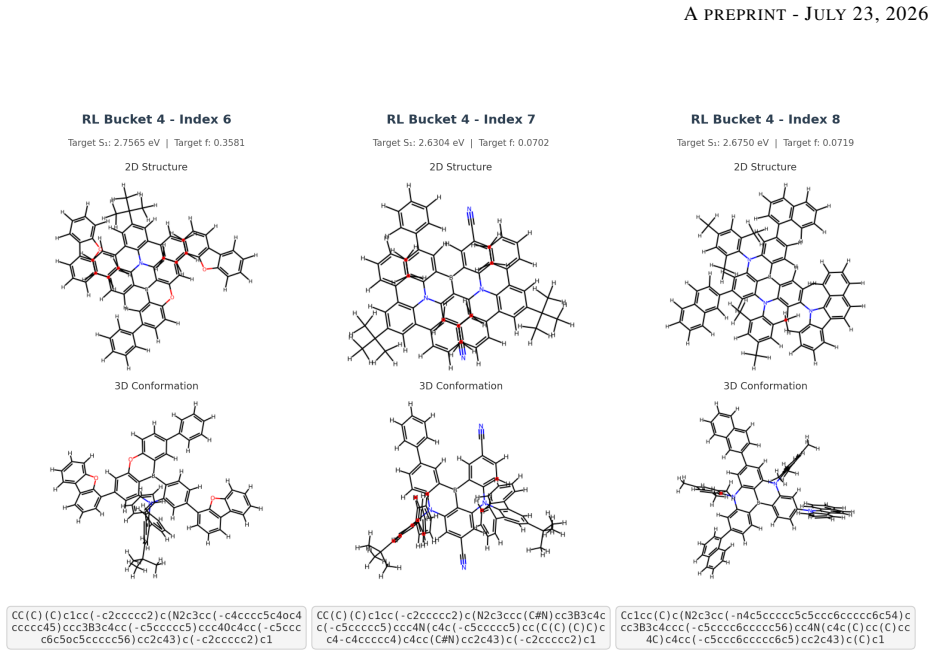
- Ablations show both the validity penalty and moderate KL regularization (β=0.5) are necessary to balance validity, uniqueness, and property alignment.
Where Pith is reading between the lines
- A testable extension would be to run the same GRPO loop with a second, independently trained property predictor as a validation filter, then check whether the top molecules selected by the first predictor are also ranked well by the second; if not, the reward signal is a predictor artifact.
- The group-relative advantage mechanism may transfer to other materials domains with scarce labeled data and a differentiable-quality predictor, though the paper does not test this.
- Because the predictor is the only property signal during RL, the pipeline's ceiling is set by predictor generalization; as DFT-labeled datasets grow, the same loop should improve without architectural changes.
- An inference-time filter that rejects generated molecules within a fixed Tanimoto similarity of the training set could raise GRPO's 67.2% uniqueness while retaining most of its property alignment.
Editorial analysis
A structured set of objections, weighed in public.
Referee Report
Summary. This paper presents OLEDLM, a multi-stage language-model pipeline for inverse design of OLED emitters. A LLaMA-style transformer is pretrained on ~9M OLED-relevant SMILES; a BERT encoder is domain-pretrained and fine-tuned on 9,000 DFT-labeled (S1, f) pairs to serve as a property predictor; conditional SFT with quantized property tokens is followed by GRPO using the predictor as reward. On 10,000 generated SMILES the authors report validity 98.3%, novelty 94.4%, and predictor-based S1/f MAEs of 0.25 eV/0.15 for GRPO; an independent DFT study on 20 converged molecules per method reports S1 MAE 0.260 eV and f MAE 0.134 for GRPO, which is worse than SFT-20x (0.138, 0.076) but better than SFT (0.339, 0.166). The paper concludes that GRPO offers a favorable trade-off between property precision and novelty.
Significance. If the claims held, OLEDLM would be a useful demonstration that a generative LLM can be aligned with a learned property predictor to propose valid, novel OLED candidates, reducing DFT screening burden. The paper has notable strengths: a purpose-built OLED pretraining corpus, a domain-adaptive BERT predictor that outperforms generic encoders in the reported ablations, a controlled GRPO/PPO comparison, and an independent DFT check that goes beyond predictor-based metrics. However, the evaluation as reported does not establish the central property-optimization claim: the headline MAEs are computed with the same predictor used as the GRPO reward, and the independent DFT subset is small and shows GRPO with larger errors than SFT-20x. The novelty metric is defined against the 9k labeled set rather than the 9M pretraining corpus, so the 94.4% novelty figure is not evidence of de novo discovery. The contribution is therefore promising but requires substantial re-evaluation and reframing before publication.
major comments (3)
- [Section 4.1.6 / Table 1] The novelty metric is not informative for the paper's claim. Novelty is defined 'against the labeled training set' (9,000 molecules), not against the 9M-molecule pretraining corpus. Since the generator was pretrained on the 9M corpus, a molecule can be a verbatim retrieval from pretraining and still be counted as novel. This is demonstrated by the Unconditional model, which achieves 100% novelty purely by construction. Because the SFT-20x vs GRPO contrast in Section 6 is framed as 'property precision versus genuinely novel molecular discovery,' the 94.4% novelty of GRPO cannot support that framing. The authors should recompute novelty against the full pretraining set (or a large held-out sample) and report Tanimoto/scaffold distances to pretraining molecules.
- [Sections 4.2–4.3, Eq. (2)] The main property-alignment results in Table 1 are circular. The S1/f MAE values are obtained by applying the same BERT predictor that serves as the reward in Eq. (2), so low MAE can partly reflect reward exploitation rather than true property accuracy. The independent DFT validation in Table 2 is the correct check, but with n=20 per method it is underpowered and actually contradicts the claim that GRPO improves precision: GRPO's DFT S1 MAE (0.260 eV) and f MAE (0.134) are roughly twice those of SFT-20x (0.138 and 0.076). The paper's conclusion that GRPO achieves 'optimized optoelectronic properties' while SFT-20x merely trades novelty is not supported by Table 2; at best, the data show GRPO improves over 3-epoch SFT. A larger DFT sample with confidence intervals, or a reframing of GRPO's contribution as diversity-preserving alignment rather than best-in-class property accuracy, is requi
- [Section 4.5.1 and Section 5] The predictor's off-distribution behavior is a load-bearing risk that is acknowledged but not resolved. The held-out test MAE (S1 0.158 eV, f 0.078) is markedly better than the DFT-verified MAE on generated molecules (0.260, 0.134), confirming that the predictor is overconfident outside the labeled distribution. Since this same predictor supplies the reward for GRPO, the alignment may be optimizing a proxy that degrades exactly in the regions where novel molecules are sought. The 20-molecule DFT set cannot certify the reward across the generated distribution. A concrete remedy would be to report calibration curves of predictor error as a function of distance to the training set, or to include a reward-model uncertainty penalty during GRPO.
minor comments (6)
- [Section 4.1.4 / Eq. (2)] The reward weights α and γ in Eq. (2) are not specified; report their values and any sensitivity analysis.
- [Tables 5 and 6 vs Table 1] The ablation tables show GRPO numbers that differ from the main benchmark (e.g., β=0.5 row gives S1 MAE 0.27 and f MAE 0.21, while Table 1 gives 0.25 and 0.15). Clarify whether these are different seeds, checkpoints, or configurations.
- [Section 4.1.5] The novelty definition says 'against the training set' but does not state whether the validation/test molecules are excluded; this should be explicit.
- [Table 2] State the units and interpretation of the variance columns (eV^2 for S1 var?) and report confidence intervals or spread for the MAE estimates.
- [Appendix B / Figure 2] The selection protocol for the 20 matched property pairs is described only in the appendix; a one-sentence summary in Section 4.3 would help readers assess coverage.
- [Throughout] Minor typographical issues: 'APREPRINT' in the running header and some inconsistent spacing; also the claim of 'first successful adaptation of LLMs specifically for the OLED domain' should be softened given existing ML-driven OLED work.
Circularity Check
Table 1's S1/f MAEs are evaluated with the same BERT predictor used as the GRPO reward, and novelty is scored only against the 9k labeled set rather than the 9M pretraining corpus, so the headline property and novelty claims are partly circular; the 20-molecule DFT check provides partial independent support.
specific steps
-
fitted input called prediction
[Section 3.4 Eq. (2) (reward) and Section 4.1.6 / Table 1 (evaluation)]
"R(x) =I valid(x)·[−α|S 1(x)−S ∗ 1 | −γ|f(x)−f ∗|] + (1−I valid(x))·λ penalty (2) ... S1(x) and f(x) are the BERT predictor estimates ... We compute validity via RDKit parsing, property alignment via BERT predictor inference, uniqueness among valid generations, and novelty against the labeled training set."
The 10,000-sample main benchmark (Table 1) computes the headline GRPO S1 MAE (0.25 eV) and f MAE (0.15) by 'BERT predictor inference' — the very same predictor that defines the GRPO reward in Eq. (2). GRPO's objective is to maximize R(x), i.e., to minimize |S1_pred(x)−S*| and |f_pred(x)−f*|. Reporting the predictor's own estimates as the evaluation metric therefore measures how well the policy optimized the exact function it was rewarded against (reward-model exploitation), not independent property accuracy. The paper itself concedes this loop in Section 5: 'the BERT predictor is used as a scalable reward proxy during RL, so distribution shift ... remains a potential source of error.' The 20-molecule DFT check (Table 2) is genuinely independent and partially breaks the loop, but the main 1
-
self definitional
[Section 4.1.5 (metric), Section 4.1.6 (protocol), Table 1]
"Novelty (%):Percentage of valid OLED molecules not present in the training set. ... novelty against the labeled training set. ... Unconditional 74.9 N/A N/A 100.0 100.0"
The generator's actual training distribution is the 9M-molecule pretraining corpus (Section 4.1.1), not the 9k DFT-labeled set. Novelty excludes only the 9k labeled set, so a molecule reproduced verbatim from the 9M corpus is counted as 'novel' as long as it is absent from the 9k set. The Unconditional model — trained only on the 9M corpus — scores 100% novelty, showing the metric is nearly tautological under this definition. Thus the abstract's 'novel candidates' and the Section 6 claim of 'genuinely novel molecular discovery' are not supported: GRPO's 94.4% novelty cannot distinguish de novo generation from retrieval or near-retrieval of the combinatorially generated 9M pretraining corpus.
full rationale
The paper's validity metric (RDKit parsing), uniqueness, the matched GRPO–PPO comparison, and the DFT validation (Table 2, 20 molecules per method, computed independently of the BERT reward) are self-contained and non-circular. The DFT check even roughly corroborates GRPO's predictor-based S1 error (0.25 vs 0.260 eV) and f error (0.15 vs 0.134), so the property-precision claim has real external content. However, two load-bearing evaluations are circular or definitional: (1) the headline 10,000-sample benchmark reports S1/f MAE via the same BERT predictor that serves as the GRPO reward in Eq. (2), so those numbers partly reflect reward-model optimization rather than independent accuracy; the paper's own Section 5 admits this proxy-reward concern. (2) Novelty is defined only against the 9k labeled set while the generator was pretrained on a nearly disjoint 9M corpus, making the 94.4% novelty claim nearly tautological — evidence is the Unconditional model's 100% novelty. There is no self-citation circularity: GRPO is imported from an external source (DeepSeekMath) and no load-bearing claim rests on the authors' own prior work. Net: partial circularity in the main benchmark and the novelty definition, partially mitigated by the honest but small (20-molecule) independent DFT evaluation.
Axiom & Free-Parameter Ledger
free parameters (6)
- Reward weights α, γ (Eq. 2) =
not specified
- Validity penalty λ_penalty =
-1.0 (scaled)
- KL coefficient β =
0.5
- GRPO group size G =
20
- SFT training epochs =
3 (SFT), 20 (SFT-20x)
- Property-token quantization =
not specified
axioms (4)
- domain assumption B3LYP/6-31G** DFT-computed S1 and f are valid ground truth for OLED-relevant optoelectronic properties.
- domain assumption The BERT predictor's error on generated molecules is small enough that optimizing it improves true S1/f.
- domain assumption RDKit SMILES parsing and canonicalization are a sufficient validity/novelty criterion.
- domain assumption The 9M-molecule pretraining corpus, generated by site-specific substitution on parent cores, represents OLED chemical space.
read the original abstract
The development of organic light-emitting diode (OLED) materials faces the compounded challenges of an astronomically large chemical space, stringent quantum-chemical constraints, and a scarcity of labeled data. Although the question of OLED generation is important, few models have been trained effectively for this specific domain. We propose an inverse molecular design framework based on causal language models: given target optoelectronic properties (e.g., excitation energy, oscillator strength), our model directly generates OLED SMILES sequences satisfying the specified constraints. We employ a multi-stage strategy: first, we establish a foundational chemical language model using a LLaMA-style transformer architecture. To the best of our knowledge, this represents the first successful adaptation of LLMs specifically for the OLED domain, bridging the gap between generic molecular generation and the stringent structural requirements of optoelectronic materials. Second, we fine-tune property predictors based on a BERT model pre-trained on our large-scale OLED dataset. Then, we perform Reinforcement Learning on our fine-tuned model, leveraging our property predictor, for better SMILES generation. Finally, through DFT verification, we demonstrate that our framework can efficiently navigate the OLED chemical space, generating novel candidates with high structural validity and optimized optoelectronic properties.
Figures




Reference graph
Works this paper leans on
-
[1]
Highly accurate protein structure prediction with alphafold.Nature, 596:583–589, 2021
John Jumper, Richard Evans, Alexander Pritzel, Tim Green, Michael Figurnov, Olaf Ronneberger, Kathryn Tunyasuvunakool, Russ Bates, Augustin Žídek, Anna Potapenko, et al. Highly accurate protein structure prediction with alphafold.Nature, 596:583–589, 2021
2021
-
[2]
A generative model for inorganic materials design.Nature, 639:624–632, 2025
Claudio Zeni, Robert Pinsler, Daniel Zügner, Andrew Fowler, Matthew Horton, Xiang Fu, Zilong Wang, Aliaksan- dra Shysheya, Jonathan Crabbé, et al. A generative model for inorganic materials design.Nature, 639:624–632, 2025
2025
-
[3]
Graphvae: Towards generation of small graphs using variational autoencoders
Martin Simonovsky and Nikos Komodakis. Graphvae: Towards generation of small graphs using variational autoencoders. InArtificial Neural Networks and Machine Learning – ICANN 2018, volume 11139 ofLecture Notes in Computer Science, pages 412–422, 2018
2018
-
[4]
Molecular de-novo design through deep reinforcement learning.Journal of Cheminformatics, 9(48), 2017
Marcus Olivecrona, Thomas Blaschke, Ola Engkvist, and Hongming Chen. Molecular de-novo design through deep reinforcement learning.Journal of Cheminformatics, 9(48), 2017
2017
-
[5]
Equivariant diffusion for molecule generation in 3d
Emiel Hoogeboom, Victor Garcia Satorras, Clément Vignac, and Max Welling. Equivariant diffusion for molecule generation in 3d. InInternational Conference on Machine Learning, 2022
2022
-
[6]
Geodiff: A geometric diffusion model for molecular conformation generation
Minkai Xu, Lantao Yu, Yang Song, Chence Shi, Stefano Ermon, and Jian Tang. Geodiff: A geometric diffusion model for molecular conformation generation. InInternational Conference on Learning Representations, 2022
2022
-
[7]
Uni-mol: A universal 3d molecular representation learning framework
Gengmo Zhou, Zhifeng Gao, Qiankun Ding, Hang Zheng, Hongteng Xu, Zhewei Wei, Linfeng Zhang, and Guolin Ke. Uni-mol: A universal 3d molecular representation learning framework. InInternational Conference on Learning Representations, 2023
2023
-
[8]
Augmented memory: Sample-efficient generative molecular design with reinforcement learning.JACS Au, 4(6):2160–2172, 2024
Jeff Guo and Philippe Schwaller. Augmented memory: Sample-efficient generative molecular design with reinforcement learning.JACS Au, 4(6):2160–2172, 2024
2024
-
[9]
Machine learning-assisted high-throughput screening of transparent organic light-emitting diode anode materials.Chemical Science, 2024
Liying Cui, Qing Li, Yanchang Zhang, Jiao Zhang, Zhe Wang, Jiankang Chen, and Bing Zheng. Machine learning-assisted high-throughput screening of transparent organic light-emitting diode anode materials.Chemical Science, 2024
2024
-
[10]
Advancing efficiency in deep-blue oleds: Exploring a machine learning–driven multiresonance tadf molecular design.Science Advances, 11(4), 2025
Hyung Suk Kim, Hyung Jin Cheon, Sang Hoon Lee, Junho Kim, Seunghyup Yoo, Yun-Hi Kim, and Chihaya Adachi. Advancing efficiency in deep-blue oleds: Exploring a machine learning–driven multiresonance tadf molecular design.Science Advances, 11(4), 2025
2025
-
[11]
Zhihong Shao, Peiyi Wang, Qihao Zhu, Runxin Xu, Junxiao Song, Mingchuan Zhang, YK Li, Y Wu, and Daya Guo. Deepseekmath: Pushing the limits of mathematical reasoning in open language models.arXiv preprint arXiv:2402.03300, 2024
Pith/arXiv arXiv 2024
-
[12]
Jacob Devlin, Ming-Wei Chang, Kenton Lee, and Kristina Toutanova. Bert: Pre-training of deep bidirectional transformers for language understanding.arXiv preprint arXiv:1810.04805, 2018
Pith/arXiv arXiv 2018
-
[13]
Seyone Chithrananda, Gabriel Grand, and Bharath Ramsundar. Chemberta: Large-scale self-supervised pretraining for molecular property prediction.arXiv preprint arXiv:2010.09885, 2020. 11 APREPRINT- JULY23, 2026
Pith/arXiv arXiv 2010
-
[14]
Large-scale chemical language representations capture molecular structure and properties.Nature Machine Intelligence, 4(12):1256–1264, 2022
Jerret Ross, Brian Belgodere, Vijil Chenthamarakshan, Inkit Padhi, Youssef Mroueh, and Payel Das. Large-scale chemical language representations capture molecular structure and properties.Nature Machine Intelligence, 4(12):1256–1264, 2022
2022
-
[15]
Llama: Open and efficient foundation language models.arXiv preprint arXiv:2302.13971, 2023
Hugo Touvron, Thibaut Lavril, Gautier Izacard, Xavier Martinet, Marie-Anne Lachaux, Timothée Lacroix, Baptiste Rozière, Naman Goyal, Eric Hambro, Faisal Azhar, et al. Llama: Open and efficient foundation language models.arXiv preprint arXiv:2302.13971, 2023
Pith/arXiv arXiv 2023
-
[16]
Language models can learn complex molecular distributions.Nature Communications, 13(1):3293, 2022
Daniel Flam-Shepherd, Kevin Zhu, and Alán Aspuru-Guzik. Language models can learn complex molecular distributions.Nature Communications, 13(1):3293, 2022
2022
-
[17]
Finetuned language models are zero-shot learners.arXiv preprint arXiv:2109.01652, 2021
Jason Wei, Maarten Bosma, Vincent Y Zhao, Kelvin Guu, Adams Wei Yu, Brian Lester, Nan Du, Andrew M Dai, and Quoc V Le. Finetuned language models are zero-shot learners.arXiv preprint arXiv:2109.01652, 2021
Pith/arXiv arXiv 2021
-
[18]
Nitish Shirish Keskar, Bryan McCann, Lav R Varshney, Caiming Xiong, and Richard Socher. Ctrl: A conditional transformer language model for controllable generation.arXiv preprint arXiv:1909.05858, 2019
Pith/arXiv arXiv 1909
-
[19]
Proximal policy optimization algorithms.arXiv preprint arXiv:1707.06347, 2017
John Schulman, Filip Wolski, Prafulla Dhariwal, Alec Radford, and Oleg Klimov. Proximal policy optimization algorithms.arXiv preprint arXiv:1707.06347, 2017
Pith/arXiv arXiv 2017
-
[20]
Automatic chemical design using a data-driven continuous representation of molecules.ACS Central Science, 4(2):268–276, 2018
Rafael Gómez-Bombarelli, Jennifer N Wei, David Duvenaud, José Miguel Hernández-Lobato, Benjamín Sánchez- Lengeling, Dennis Sheberla, Jorge Aguilera-Iparraguirre, Timothy D Hirzel, Ryan P Adams, and Alán Aspuru- Guzik. Automatic chemical design using a data-driven continuous representation of molecules.ACS Central Science, 4(2):268–276, 2018. 12 APREPRINT-...
2018
-
[21]
Among the 50 OLED molecules generated within the S1 ∈[2.5,3] eV interval, there are 10 with B/N/O back- bones, 1 with a B/O/O backbone, and the remaining 39 are B/N/N backbones, accounting for approximately 80% of the total
-
[22]
The corresponding molecular SMILES, 2D structures, and 3D conformations are presented as follows
The generated structures include both classical mono-MR frameworks with symmetrically substituted groups (e.g., rl_bucket1_idx2, rl_bucket2_idx0, and rl_bucket3_idx2), as well as large conjugated sys- tems extended through fusion with heteroatoms such as N or S based on mono-MR frameworks (e.g., rl_bucket5_idx4,rl_bucket2_idx6, andrl_bucket3_idx0). The co...
2026
discussion (0)
Sign in with ORCID, Apple, or X to comment. Anyone can read and Pith papers without signing in.