REVIEW 5 major objections 4 minor 52 references
InFact: Informativeness Alignment for Improved LLM Factuality
T0 review · 5 major / 4 minor · reviewed 2026-08-07 · deepseek-v4-flash
Pith's one-line read LLMs trained to prefer the most informative correct answer they know become more factual as a side effect, abstaining rather than guessing when unsure.
desk verdict A solid, practical two-stage alignment method for more informative and more precise LLM answers, but the headline factuality gains rest on an unvalidated GPT-4 abstention detector used both to train and to evaluate. read the letter →
The pith
A machine-rendered reading of the paper's core claim, the machinery that carries it, and where it could break.
The reading
What carries the argument
The load-bearing object is the answer hierarchy $H_i = (A_1, \ldots, A_{L_i})$ attached to each question, where $A_1$ is the most informative set of correct answers and lower levels are progressively less specific. Training runs on the reward function $R(M, \hat{y}) = 1/\sqrt{j}$ when the model's answer falls in level $A_j$, $0$ when it abstains, and $-1$ when it is wrong; the square-root scaling gives diminishing returns for coarser levels while still preferring any correct answer over abstention. Structure tuning supplies the initial behavior the reward assumes, by teaching the model to climb the hierarchy and to abstain instead of hallucinating. The GPT-4-based abstention detector is the mechanism that turns 'I don't know' into a distinguishable outcome for both reward assignment and precision scoring.
What would settle it
Sample model outputs from the informativeness-aligned models, have human annotators label each as correct, wrong, or abstaining, and recompute precision and F1 using the human labels instead of the GPT-4 detector. If the precision advantage over the base model mostly disappears once mislabeled abstentions are counted as errors, the reported factuality improvement is an artifact of the detector rather than a genuine behavioral change.
Extended reading notes
Core claim
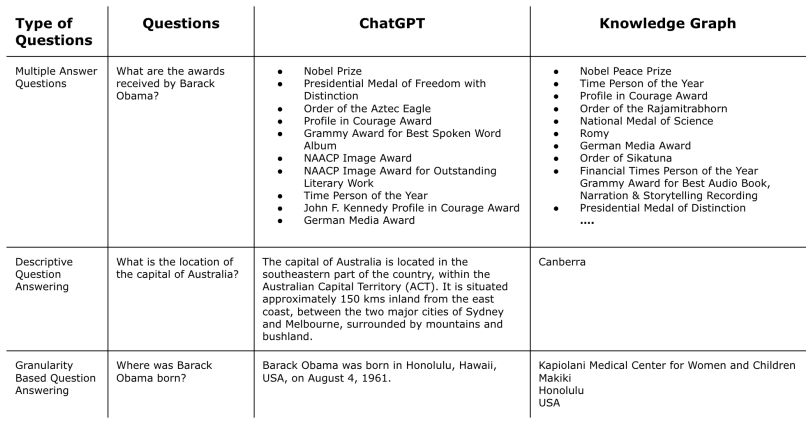
The paper's central claim is that factual correctness and informativeness are separable axes of answer quality, and that aligning a model to prefer the most informative correct answer also makes it more factual. The authors define an informativeness-evaluation dataset in which each question is paired with a hierarchy of correct answers, from most specific (Level 1) to most general, and use that hierarchy in a two-stage training framework. Structure tuning first teaches the model to move up one level when its answer is correct but coarse, and to say 'I don't know' when its answer is wrong. Informativeness alignment then rewards the model with $1/\sqrt{j}$ for an answer in level $j$, $0$ for abstention, and $-1$ for a wrong answer, optimized with PPO or DPO. Across Llama, Mistral, and Qwen models, the trained models show the highest overall F1 on TriviaQA, PopQA, TruthfulQA, Natural Questions, and PIQA, with precision gains from more effective abstention and no major recall drop; the same models also score higher on informativeness metrics for GRANOLA QA, QAMPARI, and RoMEQA.
Load-bearing premise
The pipeline assumes the GPT-4-based abstention detector correctly recognizes when a model has refused to answer; it sets training rewards and also defines the precision metric, and the paper reports no validation of the detector, so any systematic confusion between wrong answers and abstentions would inflate the factuality gains.
Editorial extensions
If this is right
- On all five factuality benchmarks tested, the informativeness-aligned models achieve the highest F1 of any method, including confidence-threshold, prompting, in-context, P(True), and semantic-entropy baselines.
- Factual precision rises because the model abstains on questions it would previously have answered wrongly, while recall stays close to the base model's level, indicating that the training does not erase stored knowledge.
- Improvements hold across model families and sizes (Llama-3.2-1B/3B, Llama-3.1-8B, Mistral-7B, Qwen2.5-7B), so the effect is not tied to one architecture.
- Both training stages matter: removing structure tuning degrades precision because the base models do not abstain effectively without it.
- The reward design makes PPO and DPO roughly interchangeable, with no statistically significant gap between them on the 1B model.
Reading between the lines
- If the effect is causal, informativeness-aligned training could serve as a behavioral alternative to confidence thresholds and semantic-entropy methods, teaching abstention rather than estimating it at inference time, which may be cheaper to deploy.
- The error analysis notes that 13% of the model's mistakes are conspicuously long answers, suggesting the model latches onto length as a proxy for informativeness; a controlled experiment that decouples answer length from granularity would test whether the reward is being gamed.
- Because the reward places abstention (0) above a wrong answer (-1) but below any correct answer, the method implicitly assumes users prefer a refusal over a guess; in settings where partial answers are useful, the hierarchy and reward would need reweighting.
- The approach depends on answer hierarchies, so extending it to domains without such structure would require constructing hierarchies from knowledge graphs or annotations; the paper's transformation of flat multi-answer datasets into pair and triplet levels is one such recipe.
Editorial analysis
A structured set of objections, weighed in public.
Referee Report
Summary. The paper introduces InFact, a two-stage alignment method aimed at improving the factual informativeness of LLM answers. A hierarchy of increasingly informative correct answers is constructed for questions from GRANOLA QA, QAMPARI, and RoMEQA; the model is first tuned to move from less informative to more informative answers and to abstain when its answer is wrong, then trained with a reward or preference objective that assigns larger rewards to more informative correct answers, zero reward to abstentions, and negative reward to wrong answers. Factuality is measured on TriviaQA, PopQA, TruthfulQA, Natural Questions, and PIQA by computing precision, recall, and F1 over outputs that a GPT-4-based abstention detector classifies as non-abstaining. The paper reports substantial gains in informativeness on the training-source benchmarks and, in most cases, higher F1 on the factuality benchmarks driven by precision, alongside ablations and an error analysis.
Significance. If the reported factuality gains are genuine, the paper would make a useful contribution: a lightweight alignment objective that jointly improves answer informativeness and reduces wrong answers would be valuable for LLM deployment. The breadth of the experiments—five base models, multiple training variants, and five factuality benchmarks—is a strength, as is the public release of code and data. However, two load-bearing issues currently limit the significance of the results. First, the factuality evaluation depends on an unvalidated GPT-4 abstention detector that is also used to assign training rewards, creating a potential reward-hacking loop. Second, the informativeness evaluation largely measures performance on the same hierarchy construction used to define the training reward, so the informativeness improvements are partly by construction. The paper should be credited for making the method and data available and for including ablations, but the central empirical claims need additional validation before the contribution can be accepted as stated.
major comments (5)
- [§3.2, §4 (Evaluation), Eq. (2)] The GPT-4 abstention detector is load-bearing but never validated. It is used in two places: in Eq. (2) it assigns reward 0 to abstentions versus -1 to wrong answers, and in the Section 4 precision metric it removes detected abstentions from the denominator. If the detector misclassifies wrong answers as abstentions, the same bias both rewards the model for producing detector-idiosyncratic abstentions and inflates the reported precision. The error analysis in Section 5.5 checks only undetected abstentions (the 3% case) and never reports false abstention errors, which are exactly the errors that would inflate the headline result. Please provide human-validated accuracy/precision/recall for the detector on held-out outputs from each model, and re-report factuality with abstentions treated as incorrect rather than excluded.
- [§4 (Evaluation Data)] The data split used for informativeness evaluation is not precisely specified. The text says the model is evaluated on the "test split" of GRANOLA QA, QAMPARI, and RoMEQA, but it does not state whether questions in the training subset were excluded from the test set, how the hierarchy for each test question was constructed, or whether any of the test examples were seen during in-context-learning baselines. Ambiguity here matters because the same hierarchy construction is used in training and evaluation. Please specify the exact split procedure and ensure no overlap between training and evaluation examples.
- [§4, §5.1, Table 2] The informativeness evaluation is partly circular. For QAMPARI and RoMEQA, the hierarchy of all pairs, triplets, and larger subsets is used both to construct the training reward in Eq. (2) and to score the test predictions through the original benchmark metrics. For GRANOLA QA, the same granularity hierarchy is used as the training label and as the evaluation metric. Improvements on these benchmarks can therefore reflect the model learning the specific hierarchy format rather than a general notion of informativeness. The paper should add an external or human evaluation of informativeness, or evaluate on hierarchies that were not used to define the reward.
- [§5.2, Tables 3–7] The claim that "across all model sizes and all benchmarks, the overall F1 performance of our models is the highest" is not supported by the tables. In Table 7, Qwen2.5-7B on PIQA has base model F1 78.6 and FT baseline F1 77.8, both higher than the informativeness-alignment F1 of 76.4. The claim should be qualified to the benchmarks where it is actually observed, or the contradicted cases should be discussed.
- [§5.3, Tables 2–3] The paper states that the PPO/DPO gap is "not compelling enough to be statistically significant," but no statistical significance tests or error bars are reported anywhere in the empirical sections. Given that Section 1 also claims "significant improvement in factual precision," the absence of variance estimates or significance testing makes the strength of the claims difficult to assess. Please report results across multiple seeds or provide confidence intervals and appropriate significance tests for the main comparisons.
minor comments (4)
- [§4 (Baselines)] The prompting baseline contains a typo: "refrain form answering" should be "refrain from answering."
- [§5.2, Tables 6 and 7] The table formatting is inconsistent: the Mistral row in Table 6 is typeset as one continuous line with missing separators, and several rows in Table 7 have uneven spacing. The tables should be reformatted for readability.
- [§2.2, §4 (Training Data)] For QAMPARI and RoMEQA, the phrase "all possible pairs, triplets, and so on" is potentially combinatorial; please clarify how the hierarchies were generated in practice, including any truncation or filtering, since the average of 8.9 levels per example suggests some selection rule.
- [§5.4] The ablation description says the results appear in Tables 2, 3, 4, and 5, but comparable ablation rows are not shown for Mistral and Qwen in Tables 6 and 7; please add those rows or adjust the cross-reference.
Circularity Check
Factuality gains are partly circular: the GPT-4 abstention detector that assigns rewards in Eq. (2) is also the filter defining the precision denominator, so the reported precision-driven improvement measures optimization of the reward's abstention component rather than an independent factuality gain.
-
self definitional
[Section 3.2; Section 3.4 Eq. (2); Section 4 Evaluation (precision); Section 5.2]
"R(M, ˆy) = 1√j if ∃j : ˆy ∈ Aj, 0 if ˆy ∈ ABSTAIN, −1 otherwise. ... Precision: the portion of factually correct answers out of all the questions that have a non-abstaining answer determined by our abstention detection model (see Section 3.2) ... across all model sizes and all benchmarks, the overall F1 performance of our models is the highest. These gains are mostly a result of the increase in precision."
The ABSTAIN predicate in Eq. (2) is the same GPT-4 detector from Section 3.2 that defines the precision denominator in Section 4. The reward assigns 0 to ABSTAIN and −1 to wrong answers, so the policy is directly trained to produce outputs the detector labels as abstentions. The precision metric then excludes exactly those outputs from its denominator; moving a wrong answer into detector-recognized abstention raises both the reward and reported precision. The headline improvement ('gains are mostly a result of the increase in precision') therefore measures alignment with the same unvalidated classifier used to assign training rewards, not an independent factual correctness gain.
full rationale
The paper's factuality correctness labels come from external benchmarks (TriviaQA, PopQA, TruthfulQA, Natural Questions, PIQA), so the factual-accuracy evaluation is not entirely circular. The informativeness results use the same answer hierarchies as the reward function, but on held-out test splits, so those gains are expected rather than a hidden equivalence. The load-bearing circularity is the abstention detector: Section 3.2 defines ABSTAIN via an unvalidated GPT-4 classifier; Eq. (2) gives 0 reward for ABSTAIN and −1 for wrong; Section 4 defines precision as correct answers among non-ABSTAIN outputs. Consequently, the precision-driven F1 gains reported as the main factuality result are partially a measure of how well the model learned to satisfy the same detector that assigns its training reward. This is a structural double-use, not a speculation about intent. The paper would need an independent validation of the detector (e.g., human-annotated abstention labels) or a precision metric whose denominator is fixed by an external judge to separate genuine factuality improvement from reward hacking. No self-citation chain or imported uniqueness theorem is load-bearing, so the score is 6 rather than higher.
Assumptions & free parameters
free parameters (2)
- Reward decay exponent =
1/sqrt(j) in Eq. (2)
- Confidence threshold for baseline =
tuned on dev set, value not reported
assumptions (4)
- domain assumption LLMs store factual knowledge in parameters and can access it via prompting.
- ad hoc to paper The constructed answer hierarchies (all pairs, triplets, etc.) reflect a meaningful informativeness ordering.
- domain assumption The GPT-4-based abstention detector correctly classifies abstaining outputs.
- domain assumption The 1k sampled training examples per dataset do not overlap with the test splits.
Cite this review
Pith. "Pith review of InFact: Informativeness Alignment for Improved LLM Factuality." pith.science (2026). https://pith.science/paper/OXN2FJ26
@misc{pith2026250520487,
  author       = {Pith},
  title        = {Pith review of: InFact: Informativeness Alignment for Improved LLM Factuality},
  year         = {2026},
  howpublished = {\url{https://pith.science/paper/OXN2FJ26}},
  note         = {Machine review of arXiv:2505.20487}
}
read the original abstract
Factual completeness is a general term that captures how detailed and informative a factually correct text is. For instance, the factual sentence ``Barack Obama was born in the United States'' is factually correct, though less informative than the factual sentence ``Barack Obama was born in Honolulu, Hawaii, United States''. Despite the known fact that LLMs tend to hallucinate and generate factually incorrect text, they might also tend to choose to generate factual text that is indeed factually correct and yet less informative than other, more informative choices. In this work, we tackle this problem by proposing an informativeness alignment mechanism. This mechanism takes advantage of recent factual benchmarks to propose an informativeness alignment objective. This objective prioritizes answers that are both correct and informative. A key finding of our work is that when training a model to maximize this objective or optimize its preference, we can improve not just informativeness but also factuality.
Figures

Reference graph
Works this paper leans on
-
[1]
Lukas Aichberger, Kajetan Schweighofer, Mykyta Ielanskyi, and Sepp Hochreiter. 2024. Semantically diverse language generation for uncertainty estimation in language models. arXiv preprint arXiv:2406.04306
arXiv 2024
-
[2]
Dimitrios Alivanistos, Selene B \'a ez Santamar \' a, Michael Cochez, Jan-Christoph Kalo, Emile van Krieken, and Thiviyan Thanapalasingam. 2022. Prompting as probing: Using language models for knowledge base construction. arXiv preprint arXiv:2208.11057
arXiv 2022
-
[3]
Samuel Amouyal, Tomer Wolfson, Ohad Rubin, Ori Yoran, Jonathan Herzig, and Jonathan Berant. 2023. https://aclanthology.org/2023.gem-1.9 QAMPARI : A benchmark for open-domain questions with many answers . In Proceedings of the Third Workshop on Natural Language Generation, Evaluation, and Metrics (GEM), pages 97--110, Singapore. Association for Computation...
work page 2023
-
[4]
Isabelle Augenstein, Timothy Baldwin, Meeyoung Cha, Tanmoy Chakraborty, Giovanni Luca Ciampaglia, David Corney, Renee DiResta, Emilio Ferrara, Scott Hale, Alon Halevy, et al. 2023. Factuality challenges in the era of large language models. arXiv preprint arXiv:2310.05189
arXiv 2023
-
[5]
Amos Azaria and Tom Mitchell. 2023. https://doi.org/10.18653/v1/2023.findings-emnlp.68 The internal state of an LLM knows when it ' s lying . In Findings of the Association for Computational Linguistics: EMNLP 2023, pages 967--976, Singapore. Association for Computational Linguistics
-
[6]
Jinze Bai, Shuai Bai, Yunfei Chu, Zeyu Cui, Kai Dang, Xiaodong Deng, Yang Fan, Wenhang Ge, Yu Han, Fei Huang, Binyuan Hui, Luo Ji, Mei Li, Junyang Lin, Runji Lin, Dayiheng Liu, Gao Liu, Chengqiang Lu, K. Lu, Jianxin Ma, Rui Men, Xingzhang Ren, Xuancheng Ren, Chuanqi Tan, Sinan Tan, Jianhong Tu, Peng Wang, Shijie Wang, Wei Wang, Shengguang Wu, Benfeng Xu, ...
arXiv 2023
-
[7]
Yonatan Bisk, Rowan Zellers, Ronan Le Bras, Jianfeng Gao, and Yejin Choi. 2019. https://api.semanticscholar.org/CorpusID:208290939 Piqa: Reasoning about physical commonsense in natural language . In AAAI Conference on Artificial Intelligence
2019
-
[8]
Tom Brown, Benjamin Mann, Nick Ryder, Melanie Subbiah, Jared D Kaplan, Prafulla Dhariwal, Arvind Neelakantan, Pranav Shyam, Girish Sastry, Amanda Askell, et al. 2020. Language models are few-shot learners. Advances in neural information processing systems, 33:1877--1901
2020
Show all 52 references
-
[9]
Roi Cohen, Konstantin Dobler, Eden Biran, and Gerard de Melo. 2025. I don't know: Explicit modeling of uncertainty with an [idk] token. Advances in Neural Information Processing Systems, 37:10935--10958
2025
-
[10]
Roi Cohen, Mor Geva, Jonathan Berant, and Amir Globerson. 2023 a . https://doi.org/10.18653/v1/2023.findings-eacl.139 Crawling the internal knowledge-base of language models . In Findings of the Association for Computational Linguistics: EACL 2023, pages 1856--1869, Dubrovnik,...
2023 doi
-
[11]
Roi Cohen, May Hamri, Mor Geva, and Amir Globerson. 2023 b . https://doi.org/10.18653/v1/2023.emnlp-main.778 LM vs LM : Detecting factual errors via cross examination . In Proceedings of the 2023 Conference on Empirical Methods in Natural Language Processing, pages 12621--1264...
2023 doi
-
[12]
Shrey Desai and Greg Durrett. 2020. https://doi.org/10.18653/v1/2020.emnlp-main.21 Calibration of pre-trained transformers . In Proceedings of the 2020 Conference on Empirical Methods in Natural Language Processing (EMNLP), pages 295--302, Online. Association for Computational...
2020 doi
-
[13]
Ashwin Devaraj, William Sheffield, Byron Wallace, and Junyi Jessy Li. 2022. https://doi.org/10.18653/v1/2022.acl-long.506 Evaluating factuality in text simplification . In Proceedings of the 60th Annual Meeting of the Association for Computational Linguistics (Volume 1: Long P...
2022 doi
-
[14]
Shehzaad Dhuliawala, Mojtaba Komeili, Jing Xu, Roberta Raileanu, Xian Li, Asli Celikyilmaz, and Jason Weston. 2023. Chain-of-verification reduces hallucination in large language models. arXiv preprint arXiv:2309.11495
2023 arXiv
-
[15]
Abhimanyu Dubey, Abhinav Jauhri, Abhinav Pandey, Abhishek Kadian, Ahmad Al-Dahle, Aiesha Letman, Akhil Mathur, Alan Schelten, Amy Yang, Angela Fan, et al. 2024. The llama 3 herd of models. arXiv preprint arXiv:2407.21783
2024 arXiv
-
[16]
Shangbin Feng, Weijia Shi, Yike Wang, Wenxuan Ding, Vidhisha Balachandran, and Yulia Tsvetkov. 2024. https://api.semanticscholar.org/CorpusID:267365203 Don't hallucinate, abstain: Identifying llm knowledge gaps via multi-llm collaboration . ArXiv, abs/2402.00367
2024 arXiv
-
[17]
So, Jamie Hall, Noah Fiedel, Romal Thoppilan, Zi Yang, Apoorv Kulshreshtha, Gaurav Nemade, Yifeng Lu, and Quoc V
Daniel De Freitas, Minh-Thang Luong, David R. So, Jamie Hall, Noah Fiedel, Romal Thoppilan, Zi Yang, Apoorv Kulshreshtha, Gaurav Nemade, Yifeng Lu, and Quoc V. Le. 2020. https://api.semanticscholar.org/CorpusID:210920238 Towards a human-like open-domain chatbot . ArXiv, abs/2001.09977
2020 arXiv
-
[18]
Weinberger
Chuan Guo, Geoff Pleiss, Yu Sun, and Kilian Q. Weinberger. 2017. https://proceedings.mlr.press/v70/guo17a.html On calibration of modern neural networks . In Proceedings of the 34th International Conference on Machine Learning, volume 70 of Proceedings of Machine Learning Resea...
2017
-
[19]
Jie Huang, Kevin Chen-Chuan Chang, Jinjun Xiong, and Wen mei W. Hwu. 2022. https://api.semanticscholar.org/CorpusID:252587308 Can language models be specific? how? In Annual Meeting of the Association for Computational Linguistics
2022
-
[20]
Lei Huang, Weijiang Yu, Weitao Ma, Weihong Zhong, Zhangyin Feng, Haotian Wang, Qianglong Chen, Weihua Peng, Xiaocheng Feng, Bing Qin, et al. 2024. A survey on hallucination in large language models: Principles, taxonomy, challenges, and open questions. ACM Transactions on Info...
2024
-
[21]
Albert Qiaochu Jiang, Alexandre Sablayrolles, Arthur Mensch, Chris Bamford, Devendra Singh Chaplot, Diego de Las Casas, Florian Bressand, Gianna Lengyel, Guillaume Lample, Lucile Saulnier, L'elio Renard Lavaud, Marie-Anne Lachaux, Pierre Stock, Teven Le Scao, Thibaut Lavril, T...
2023 arXiv
-
[22]
Zhengbao Jiang, Jun Araki, Haibo Ding, and Graham Neubig. 2021. https://doi.org/10.1162/tacl_a_00407 How can we know when language models know? on the calibration of language models for question answering . Transactions of the Association for Computational Linguistics, 9:962--977
2021 doi
-
[23]
Mandar Joshi, Eunsol Choi, Daniel S Weld, and Luke Zettlemoyer. 2017. TriviaQA : A large scale distantly supervised challenge dataset for reading comprehension. arXiv preprint arXiv:1705.03551
2017 arXiv
-
[24]
Brown, Jack Clark, Nicholas Joseph, Benjamin Mann, Sam McCandlish, Christopher Olah, and Jared Kaplan
Saurav Kadavath, Tom Conerly, Amanda Askell, Tom Henighan, Dawn Drain, Ethan Perez, Nicholas Schiefer, Zachary Dodds, Nova Dassarma, Eli Tran-Johnson, Scott Johnston, Sheer El-Showk, Andy Jones, Nelson Elhage, Tristan Hume, Anna Chen, Yuntao Bai, Sam Bowman, Stanislav Fort, De...
2022 arXiv
-
[25]
Jean Kaddour, Joshua Harris, Maximilian Mozes, Herbie Bradley, Roberta Raileanu, and Robert McHardy. 2023. Challenges and applications of large language models. arXiv preprint arXiv:2307.10169
2023 arXiv
-
[26]
Amita Kamath, Robin Jia, and Percy Liang. 2020. Selective question answering under domain shift. arXiv preprint arXiv:2006.09462
2020 arXiv
-
[27]
Lorenz Kuhn, Yarin Gal, and Sebastian Farquhar. 2023. Semantic uncertainty: Linguistic invariances for uncertainty estimation in natural language generation. arXiv preprint arXiv:2302.09664
2023 arXiv
-
[28]
Parikh, Chris Alberti, Danielle Epstein, Illia Polosukhin, Jacob Devlin, Kenton Lee, Kristina Toutanova, Llion Jones, Matthew Kelcey, Ming-Wei Chang, Andrew M
Tom Kwiatkowski, Jennimaria Palomaki, Olivia Redfield, Michael Collins, Ankur P. Parikh, Chris Alberti, Danielle Epstein, Illia Polosukhin, Jacob Devlin, Kenton Lee, Kristina Toutanova, Llion Jones, Matthew Kelcey, Ming-Wei Chang, Andrew M. Dai, Jakob Uszkoreit, Quoc V. Le, an...
2019
-
[29]
Stephanie Lin, Jacob Hilton, and Owain Evans. 2022. Teaching models to express their uncertainty in words. arXiv preprint arXiv:2205.14334
2022 arXiv
-
[30]
Lin, Jacob Hilton, and Owain Evans
Stephanie C. Lin, Jacob Hilton, and Owain Evans. 2021. https://api.semanticscholar.org/CorpusID:237532606 TruthfulQA : Measuring how models mimic human falsehoods . In Annual Meeting of the Association for Computational Linguistics
2021
-
[31]
Hongyuan Lu, Wai Lam, Hong Cheng, and Helen Meng. 2022. https://doi.org/10.18653/v1/2022.findings-acl.204 On controlling fallback responses for grounded dialogue generation . In Findings of the Association for Computational Linguistics: ACL 2022, pages 2591--2601, Dublin, Irel...
2022 doi
-
[32]
Hua Lu, Siqi Bao, Huang He, Fan Wang, Hua Wu, and Haifeng Wang. 2023. https://doi.org/10.18653/v1/2023.acl-long.224 Towards boosting the open-domain chatbot with human feedback . In Proceedings of the 61st Annual Meeting of the Association for Computational Linguistics (Volume...
2023 doi
-
[33]
Alex Mallen, Akari Asai, Victor Zhong, Rajarshi Das, Hannaneh Hajishirzi, and Daniel Khashabi. 2022. When not to trust language models: Investigating effectiveness and limitations of parametric and non-parametric memories. arXiv preprint arXiv:2212.10511
2022 arXiv
-
[34]
Joshua Maynez, Shashi Narayan, Bernd Bohnet, and Ryan McDonald. 2020. https://doi.org/10.18653/v1/2020.acl-main.173 On faithfulness and factuality in abstractive summarization . In Proceedings of the 58th Annual Meeting of the Association for Computational Linguistics, pages 1...
2020 doi
-
[35]
Jeff Z. Pan, Simon Razniewski, Jan-Christoph Kalo, Sneha Singhania, Jiaoyan Chen, Stefan Dietze, Hajira Jabeen, Janna Omeliyanenko, Wen Zhang, Matteo Lissandrini, Russa Biswas, Gerard de Melo, Angela Bonifati, Edlira Vakaj, Mauro Dragoni, and Damien Graux. 2023. https://doi.or...
2023 doi
-
[36]
Fabio Petroni, Tim Rockt \"a schel, Sebastian Riedel, Patrick Lewis, Anton Bakhtin, Yuxiang Wu, and Alexander Miller. 2019. https://doi.org/10.18653/v1/D19-1250 Language models as knowledge bases? In Proceedings of the 2019 Conference on Empirical Methods in Natural Language P...
2019 doi
-
[37]
Daking Rai, Yilun Zhou, Shi Feng, Abulhair Saparov, and Ziyu Yao. 2024. https://api.semanticscholar.org/CorpusID:270924412 A practical review of mechanistic interpretability for transformer-based language models . ArXiv, abs/2407.02646
2024
-
[38]
Adam Roberts, Colin Raffel, and Noam Shazeer. 2020. How much knowledge can you pack into the parameters of a language model? arXiv preprint arXiv:2002.08910
2020 arXiv
-
[39]
Timo Schick, Jane Dwivedi-Yu, Roberto Dess \` , Roberta Raileanu, Maria Lomeli, Luke Zettlemoyer, Nicola Cancedda, and Thomas Scialom. 2023. Toolformer: Language models can teach themselves to use tools. arXiv preprint arXiv:2302.04761
2023 arXiv
-
[40]
Derek Tam, Anisha Mascarenhas, Shiyue Zhang, Sarah Kwan, Mohit Bansal, and Colin Raffel. 2023. https://doi.org/10.18653/v1/2023.findings-acl.322 Evaluating the factual consistency of large language models through news summarization . In Findings of the Association for Computat...
2023 doi
-
[41]
Romal Thoppilan, Daniel De Freitas, Jamie Hall, Noam Shazeer, Apoorv Kulshreshtha, Heng-Tze Cheng, Alicia Jin, Taylor Bos, Leslie Baker, Yu Du, et al. 2022. Lamda: Language models for dialog applications. arXiv preprint arXiv:2201.08239
2022 arXiv
-
[42]
Hugo Touvron, Thibaut Lavril, Gautier Izacard, Xavier Martinet, Marie-Anne Lachaux, Timoth \'e e Lacroix, Baptiste Rozi \`e re, Naman Goyal, Eric Hambro, Faisal Azhar, et al. 2023. Llama: Open and efficient foundation language models. arXiv preprint arXiv:2302.13971
2023 arXiv
-
[43]
Neeraj Varshney, Swaroop Mishra, and Chitta Baral. 2022. https://doi.org/10.18653/v1/2022.findings-acl.158 Investigating selective prediction approaches across several tasks in IID , OOD , and adversarial settings . In Findings of the Association for Computational Linguistics:...
2022 doi
-
[44]
Blerta Veseli, Sneha Singhania, Simon Razniewski, and Gerhard Weikum. 2023. https://api.semanticscholar.org/CorpusID:257632108 Evaluating language models for knowledge base completion . ArXiv, abs/2303.11082
2023 arXiv
-
[45]
An Yang, Baosong Yang, Beichen Zhang, Binyuan Hui, Bo Zheng, Bowen Yu, Chengyuan Li, Dayiheng Liu, Fei Huang, Haoran Wei, et al. 2024. Qwen2. 5 technical report. arXiv preprint arXiv:2412.15115
2024 arXiv
-
[46]
Gal Yona, Roee Aharoni, and Mor Geva. 2024. https://doi.org/10.18653/v1/2024.acl-long.365 Narrowing the knowledge evaluation gap: Open-domain question answering with multi-granularity answers . In Proceedings of the 62nd Annual Meeting of the Association for Computational Ling...
2024 doi
-
[47]
Ori Yoran, Tomer Wolfson, Ben Bogin, Uri Katz, Daniel Deutch, and Jonathan Berant. 2023. https://doi.org/10.18653/v1/2023.emnlp-main.364 Answering questions by meta-reasoning over multiple chains of thought . In Proceedings of the 2023 Conference on Empirical Methods in Natura...
2023 doi
-
[48]
Hiyori Yoshikawa and Naoaki Okazaki. 2023. https://doi.org/10.18653/v1/2023.findings-eacl.150 Selective- LAMA : Selective prediction for confidence-aware evaluation of language models . In Findings of the Association for Computational Linguistics: EACL 2023, pages 2017--2028, ...
2023 doi
-
[49]
Hanning Zhang, Shizhe Diao, Yong Lin, Yi Fung, Qing Lian, Xingyao Wang, Yangyi Chen, Heng Ji, and Tong Zhang. 2024. https://doi.org/10.18653/v1/2024.naacl-long.394 R -tuning: Instructing large language models to say ` I don ' t know ' . In Proceedings of the 2024 Conference of...
2024 doi
-
[50]
Victor Zhong, Weijia Shi, Wen tau Yih, and Luke Zettlemoyer. 2022. https://api.semanticscholar.org/CorpusID:253116788 RoMQA : A benchmark for robust, multi-evidence, multi-answer question answering . In Conference on Empirical Methods in Natural Language Processing
2022
-
[51]
URL: " 'urlintro :=
ENTRY address author booktitle chapter edition editor howpublished institution journal key month note number organization pages publisher school series title type volume year eprint doi pubmed url lastchecked label extra.label sort.label short.list INTEGERS output.state before...
-
[52]
write newline
" write newline "" before.all 'output.state := FUNCTION n.dashify 't := "" t empty not t #1 #1 substring "-" = t #1 #2 substring "--" = not "--" * t #2 global.max substring 't := t #1 #1 substring "-" = "-" * t #2 global.max substring 't := while if t #1 #1 substring * t #2 gl...
Reviewed August 7, 2026 · model on record in the stance chip above.
Discussion (0). Sign in to comment.