REVIEW 4 major objections 5 minor 50 references
The paper claims that an electron can be transferred from a static quantum dot into a surface-acoustic-wave-driven moving dot with probability 0.9997 using only the geometry of the passing potential, and that the leading spin-orbit correcti
Reviewed by Pith at T0; open to challenge. T0 means a machine referee read the full paper against a public rubric. the ladder, T0–T4 →
A theoretical model shows near-perfect electron transfer from a static quantum dot into a surface-acoustic-wave moving dot is possible, with first-order protection against Rashba-Dresselhaus spin-orbit errors at the optimal operating point.
T0 review reviewed 2026-08-05 challenge →
load-bearing objection Useful effective-model analysis of SAW static-to-moving dot transfer, but the reported Gaussian parameters are internally inconsistent and the central numbers are not reproducible as written. the 4 major comments →
Electron transfer between surface-acoustic-wave-induced moving and static quantum dots
The pith
A machine-rendered reading of the paper's core claim, the machinery that carries it, and where it could break.
The reading
Core claim
The central claim is that close-to-complete transfer from a static quantum dot's ground state into a surface-acoustic-wave-induced moving dot's lowest eigenstate can be achieved simply by having the moving potential pass by the static dot at a suitable distance, without any additional time-dependent driving. Numerically the paper finds P0 = 0.9997 at impact parameter gp0 = 160.5 nm for Gaussian dots with a 3 meV level spacing and SAW speed 3 nm/ps. The transfer obeys a two-level effective Hamiltonian, and complete transfer occurs when the accumulated phases satisfy Γ = π/2 + nπ and γ = π/4 + nπ/2. With Rashba-Dresselhaus spin-orbit interaction included, the first-order correction to the tran
What carries the argument
The argument rests on reducing the full two-dimensional single-particle dynamics to the near-degenerate subspace spanned by the two lowest instantaneous eigenstates, one localized in the static dot and one in the moving dot. In this basis the effective Hamiltonian is H̃0(t) = f0(t)σ0 + fy(t)σy + fz(t)σz, where fy is the non-adiabatic coupling and fz is the instantaneous energy splitting. Reflection symmetry makes fy odd under time reversal and fz even, so the evolution factorizes into three partial unitaries, and complete transfer requires the two phase conditions on Γ and γ. The spin-orbit extension inserts Rashba-Dresselhaus corrections into the same effective fields; a first-order Dyson-s
Load-bearing premise
The load-bearing premise is that a real SAW pulse behaves as a rigid, reflection-symmetric moving potential with a single minimum that can be tuned into resonance with a static dot and passed within about a nanometre of the optimal offset while the electron stays coherent, and that the numerical integrations are converged, though no grid or timestep data are shown.
What would settle it
Measure the electron-transfer probability while scanning the lateral offset between a static dot and a SAW-driven moving dot in a GaAs device. The model predicts a sharp near-unity peak at a specific offset, with oscillations on a few-nanometre scale; the absence of that structure, or a peak that shifts by more than the predicted few nanometres when the SAW speed is changed, would refute the two-level mechanism.
If this is right
- SAW-only loading can reach transfer probabilities around 0.9997, comparable to pulsed-gate injection, without any time-dependent gate control.
- Loading and unloading are reversible: the same probabilities apply for moving-to-static transfer by switching to the SAW rest frame.
- The optimum is a geometric sweet spot: the impact parameter must sit within roughly a nanometre of gp0, and the position of this window is most sensitive to trap depth and frequency, not SAW speed.
- At the optimal transfer point the first-order spin-orbit correction vanishes for both spin directions, protecting the spin state during loading.
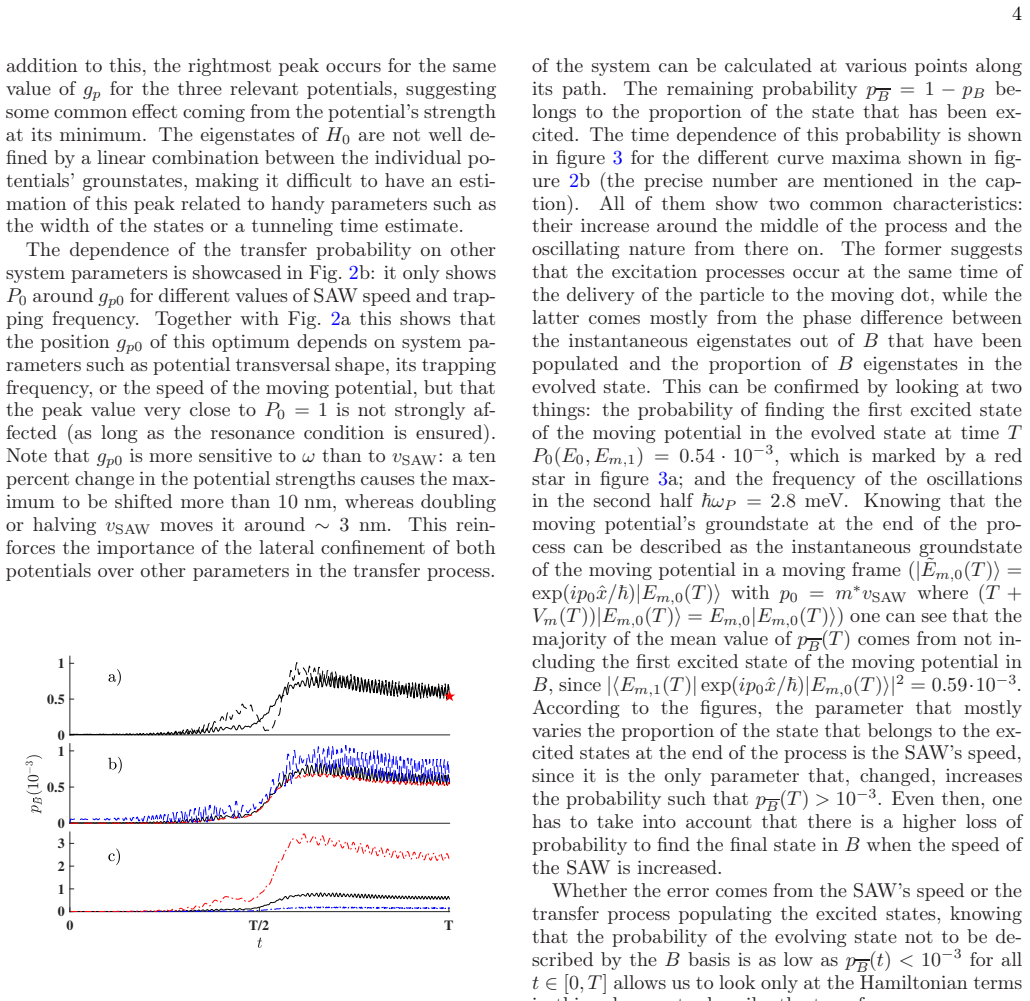
- Leakage outside the two-level subspace stays below 10^-3, with the residual error dominated by the first excited state of the moving dot.
Where Pith is reading between the lines
- The Γ/γ phase conditions derive only from reflection symmetry and two-level phase integrals, so the same pass-by mechanism should transfer to other reflection-symmetric moving-potential platforms; the paper mentions other setups but does not develop the parameter search.
- The predicted oscillation of P0 with impact parameter on a few-nanometre scale is a directly testable fingerprint: scanning the lateral offset should reveal this structure, giving an experimental signature of the coherent two-level dynamics.
- Because the residual leakage is dominated by the moving dot's first excited state, a deliberately shaped or slightly asymmetric pulse could populate that state to widen the narrow high-fidelity window; this shortcut-to-adiabaticity direction is named but not developed in the paper.
- The vanishing of the first-order spin-orbit correction exactly at the transfer optimum suggests the same pass distance should maximize spin-state purity, not just orbital transfer probability; measuring spin errors versus gp would test this directly.
Editorial analysis
A structured set of objections, weighed in public.
Referee Report
Summary. The paper studies a single electron loaded from a static quantum dot into a moving quantum dot created by a surface acoustic wave (SAW), modeled by a 2D single-particle Hamiltonian with static and moving Gaussian-like potentials. The authors numerically compute the transfer probability as a function of the transverse impact parameter and report a peak of P0 = 0.9997 at gp0 = 160.5 nm. They reduce the dynamics to the two lowest instantaneous eigenstates, supported by a check that leakage is below 10^-3, and derive a three-interval factorization of the time-evolution operator. This leads to conditions for complete transfer, Gamma = pi/2 + n pi and gamma = pi/4 + n pi/2, with gamma numerically found to be close to -pi/4. The spin-orbit interaction is then included perturbatively; a first-order Dyson-series calculation gives a correction to the transfer probability proportional to cos(Gamma), implying first-order protection at the optimal operating point. The paper concludes that SAW-only loading can achieve near-perfect transfer under experimentally available parameters.
Significance. If the results are correct, the paper provides a concrete and conceptually simple mechanism for high-fidelity loading of an electron from a static dot into a SAW-driven moving dot without additional time-dependent driving, with a clear physical picture based on non-adiabatic transitions in a nearly degenerate two-level subspace. The spin-orbit analysis, especially the vanishing of the first-order correction when cos Gamma = 0, is an elegant and practically relevant result. The two-level truncation is checked numerically, and the factorization into partial unitaries is a useful explanatory framework. However, the quantitative claims rest on numerical simulations whose parameter definition is internally inconsistent, and on convergence tests that are not reported. The analytic transfer conditions are partly post hoc because gamma is extracted from the numerics rather than predicted. These issues currently limit the reliability of the stated fidelity and the claimed experimental relevance.
major comments (4)
- [§III, parameter definitions after Eq. (3)] There is an internal inconsistency in the Gaussian potential parameters. For V = -V0 exp(-k r^2), the harmonic expansion gives V0 k r^2, so m* omega^2 = 2 V0 k. With V_{s,0} = 45 meV and k_s = 3.96 nm^-2, this yields hbar omega_0 = sqrt(2 V0 k / m*) ~ 0.64 eV, not the stated 3 meV. To obtain hbar omega_0 = 3 meV with V0 = 45 meV requires k_s ~ 1.8 x 10^-4 nm^-2, four orders of magnitude smaller. Thus at least one reported parameter is wrong, and the numerical run behind P0 = 0.9997 and gp0 = 160.5 nm is not reproducible from the text. The central claim of 'experimentally available parameters' depends on resolving this discrepancy.
- [§III, numerical integration] The paper reports the use of a Trotter-Suzuki decomposition but gives no grid spacing, number of grid points, time step, or convergence checks. For a quantitative claim P0 = 0.9997 and a leakage bound p_B < 10^-3, the numerical error should be quantified. Without this, the reported fidelity and the small differences between potential shapes in Fig. 2a are not firmly established.
- [§V, Eqs. (22)-(27) and (33)] The Dyson-series prefactors appear dimensionally inconsistent. Equation (22) as written has -i hbar integral H_SO, whereas the standard first-order Dyson correction is -(i/hbar) integral H_SO. Consequently Eqs. (24)-(27) and Eq. (33) inherit this issue; Eq. (33) has dimensions of hbar times an energy-time integral, not a dimensionless probability correction. The qualitative conclusion that the correction vanishes when cos Gamma = 0 is independent of the prefactor, but the quantitative spin-orbit result and the definition of K need to be corrected, or the section should state explicitly that hbar is set to 1.
- [§IV, effective model and transfer conditions] The transfer conditions in Eqs. (16)-(17) are presented as derived conditions, but the key value gamma ~ -pi/4 is an observed numerical result obtained from the same eigenstates used in the simulation. The analytic model therefore rationalizes the numerical peak rather than predicting gp0 or the value of gamma from the potential parameters. The paper should explicitly distinguish the derived structural conditions from the numerically determined value of gamma; otherwise the statement 'this sets a series of conditions for a complete transfer' overstates the predictive content.
minor comments (5)
- [Abstract] Typo: 'surface-acoustic-wave-induce d' should be 'surface-acoustic-wave-induced'.
- [§II, Eq. (8)] The diagonal term should be written as ((epsilon_0 + epsilon_1)/2) sigma_0; the current text 'epsilon_0 + epsilon_1/2 sigma_0' is ambiguous.
- [§III, caption of Fig. 2] The inset description is garbled ('showing the log a-rithm'); please clarify that it plots log10(1 - P0).
- [§V, around Eq. (31)] Typo: 'the last to subscripts' should be 'the last two subscripts'.
- [§II, Eq. (3)] The notation P0(Psi_i, Psi_t) is slightly confusing because the subscript 0 is also used for the unperturbed Hamiltonian; consider renaming or clarifying.
Circularity Check
No significant circularity: the numerical transfer results and the analytic two-level/spin-orbit conditions are each derived from the model Hamiltonian rather than being fitted into it; the noted parameter inconsistency is a correctness issue, not a circularity.
full rationale
The paper's derivation chain is linear: H0(t) in Eq. (1) is the input; U0(T,0) and P0 in Eqs. (2)-(3) are computed from it; the two-level description in Sec. IV uses the instantaneous eigenstates of H0 and derives the transfer conditions Γ=π/2+nπ and γ=π/4+nπ/2 (Eqs. 16-17). The later statement that γ≈−π/4 is a numerical evaluation of that derived quantity, not a parameter fitted to the transfer probability: the high-fidelity peaks in Fig. 2 are found by direct solution of the Schrödinger equation, not by imposing the two-level conditions. Similarly, the spin-orbit correction ΔP=√2ℏ cosΓ·K1+ in Eq. (33) is obtained by a first-order Dyson expansion; the vanishing at cosΓ=0 is a corollary of the previously derived optimality condition, not an input. The only close call is that the analytic conditions are verified with eigenstates computed in the same simulation, but this is an internal consistency check of the effective model rather than a circular reduction of the headline result; the headline P0=0.9997 stands on the full numerics. Self-citations (refs. 30, 32, 44) are background proposals and are not load-bearing. In contrast, the reported parameter set Vs0=45 meV, k=3.96 nm^-2, and ℏω0=3 meV is internally inconsistent (the stated k implies ℏω0≈0.64 eV for m*=0.067m_e), and the paper gives no grid/timestep convergence details; these are reproducibility/correctness flaws, not circularity.
Axiom & Free-Parameter Ledger
free parameters (3)
- Resonance depth difference Vs,0 - Vm,0 = m*v_SAW^2/2 =
not quoted; set by the resonance condition (for GaAs m* = 0.067 me, v = 3 nm/ps, this is ~2 µeV)
- Optimal impact parameter gp0 =
160.5 nm (Gaussian potential, ℏω0 = 3 meV claimed, v_SAW = 3 nm/ps)
- Curvature matching km = ks·Vs,0/Vm,0 =
implicit (set by the resonance condition)
axioms (5)
- domain assumption The SAW-induced potential is a rigid, reflection-symmetric potential with a single global minimum, moving at constant velocity v_SAW; the perpendicular confinement is traced out, leaving a 2D single-particle problem (Eq. 1).
- domain assumption The dynamics is confined to the two near-degenerate instantaneous ground states; transitions to all other eigenstates are negligible (pB(t) < 10⁻³ for all t).
- ad hoc to paper In the three-interval factorization U ≈ U_{2,y} U_{1,z} U_{0,y} (Eq. 12), the sub-dominant term in each interval can be neglected.
- domain assumption The spin-orbit coupling is a weak perturbation whose projection onto the four-level (2 orbital x 2 spin) subspace, with block structure H+ ⊕ H- (Eqs. 20-21), captures its effect; population outside these four levels is negligible.
- standard math The Trotter-Suzuki time-slicing with FFT implementation converges for the reported quantitative results.
Cite this review
Pith. "Pith review of Electron transfer between surface-acoustic-wave-induced moving and static quantum dots." pith.science (2026). https://pith.science/paper/OXPGOMVK
@misc{pith2026250901525,
  author       = {Pith},
  title        = {Pith review of: Electron transfer between surface-acoustic-wave-induced moving and static quantum dots},
  year         = {2026},
  howpublished = {\url{https://pith.science/paper/OXPGOMVK}},
  note         = {Machine review of arXiv:2509.01525}
}
read the original abstract
Fast long-range interactions between distant quantum dots in arrays remains an unsolved issue, which can be key to solve scalability issues in quantum simulation and computation processes, particularly related to the overhead associated with quantum error correction schemes. Furthermore, transport between static and moving quantum dots, relevant in surface acoustic wave induced experiments, has not been studied in detail. This article presents a paradigmatic model for picturing this process, where non-adiabatic terms driving a two-state transfer process are derived and discussed. Moreover, the main effects in the spin state of the electron and its effect on the transfer probability of the loading are analyzed including the most relevant interaction in semiconductor heterostructure induced 2 dimensional electron gases i.e. the Rashba-Dresselhaus terms.
Figures




Reference graph
Works this paper leans on
-
[1]
does not take into account the spin degree of freedom. However, in GaAs the presence of structural inversion asymmetry and bulk inversion asymmetry give rise to both Rashba [ 40] and Dresselhaus [ 41] spin orbit coupling. Denoting by x and y the main crystallographic directions in the (001) plane of GaAs, the Hamiltonian takes the form HSO = αR(ˆpxσy − ˆp...
-
[2]
The vertical dashed-lines define t0, t1, t2 = T − (t0 + t1) and t3 = T − t0, respectively
5 nm and ω 0 = 3 meV: fz (solid) and fy (dashed). The vertical dashed-lines define t0, t1, t2 = T − (t0 + t1) and t3 = T − t0, respectively. which we do for our calculations. This leaves us with an effective Hamiltonian ˜H0 that includes real values in the diagonal (the energies of the system) and a purely imaginary coupling between the two states. In terms...
-
[3]
G. Burkard, T. D. Ladd, J. M. Nichol, A. Pan, and J. R. Petta, Semiconductor spin qubits, Rev. Mod. Phys. 95, 025003 (2023) , arxiv:2112.08863
Pith/arXiv arXiv 2023
-
[4]
Ultra-long distance interaction between spin qubits
G. Burkard and A. Imamoğlu, Ultra-long-distance inter- action between spin qubits, Phys. Rev. B 74, 041307 (2006), cond-mat/0603119
work page internal anchor Pith review Pith/arXiv arXiv 2006
-
[5]
Long-distance spin-spin coupling via floating gates
L. Trifunovic, O. Dial, M. Trif, J. R. Wootton, R. Abebe, A. Yacoby, and D. Loss, Long-distance spin-spin cou- pling via floating gates, Phys. Rev. X 2, 011006 (2012) , 1110.1342
work page internal anchor Pith review Pith/arXiv arXiv 2012
-
[6]
When condition ( 16) is met, cos Γ = 0 , which, in turn, means that there is first-order protection to the spin-orbit interaction perturbation for the prob- ability transfer of the particle for both spin directions when the transfer process is optimal. VI. CONCLUSIONS AND OUTLOOK In conclusion, we have shown that under experimen- tally available parameters...
2023
-
[7]
Loss and D
D. Loss and D. P. DiVincenzo, Quantum computation with quantum dots, Physical Review A 57, 120 (1998)
1998
-
[8]
G. Burkard, D. Loss, and D. P. DiVincenzo, Coupled quantum dots as quantum gates, Physical Review B 59, 2070 (1999)
work page 2070
-
[9]
J. D. Sterk, H. Coakley, J. Goldberg, V. Hietala, J. Lechtenberg, H. McGuinness, D. McMurtrey, L. P. Parazzoli, J. Van Der Wall, and D. Stick, Closed- loop optimization of fast trapped-ion shuttling with sub-quanta excitation, npj Quantum Information 8, 10.1038/s41534-022-00579-3 (2022)
-
[10]
D. Bluvstein, H. Levine, G. Semeghini, T. T. Wang, S. Ebadi, M. Kalinowski, A. Keesling, N. Maskara, H. Pichler, M. Greiner, V. Vuletić, and M. D. Lukin, A quantum processor based on coherent transport of en- tangled atom arrays, Nature 604, 451–456 (2022)
work page 2022
-
[11]
D. Bluvstein, S. J. Evered, A. A. Geim, S. H. Li, H. Zhou, T. Manovitz, S. Ebadi, M. Cain, M. Kali- nowski, D. Hangleiter, J. P. Bonilla Ataides, N. Maskara, I. Cong, X. Gao, P. Sales Rodriguez, T. Karolyshyn, G. Semeghini, M. J. Gullans, M. Greiner, V. Vuletić, and M. D. Lukin, Logical quantum processor based on reconfigurable atom arrays, Nature 626, 58–...
work page 2023
-
[12]
J. M. Taylor, H.-A. Engel, W. Dür, A. Yacoby, C. M. Marcus, P. Zoller, and M. D. Lukin, Fault-tolerant archi- tecture for quantum computation using electrically con- trolled semiconductor spins, Nature Phys. 1, 177 (2005)
work page 2005
-
[13]
C. H. W. Barnes, J. M. Shilton, and A. M. Robinson, Quantum computation using electrons trapped by surface acoustic waves, Physical Review B 62, 8410 (2000)
work page 2000
-
[14]
J. M. Pino, J. M. Dreiling, C. Figgatt, J. P. Gaebler, S. A. Moses, M. S. Allman, C. H. Baldwin, M. Foss-Feig, D. Hayes, K. Mayer, C. Ryan-Anderson, and B. Neyen- huis, Demonstration of the trapped-ion quantum ccd computer architecture, Nature 592, 209–213 (2021)
2021
-
[15]
to U (t3, t0) = eiΓ σ x , which gives a probability of PT, 0(T ) = sin 2 Γ to find the particle in the other potential at the end of the process. Also, since the transfer process can be simplified to this two-level system as a good approximation, the insertion of the electron from the initial moving state to a final static state would be as optimal and requi...
-
[16]
C. J. B. Ford, Transporting and manipulating single elec- trons in surface-acoustic-wave minima, physica status so- lidi (b) 254, 1600658 (2017)
work page 2017
-
[17]
L. M. K. Vandersypen and M. A. Eriksson, Quantum computing with semiconductor spins, Physics Today 72, 38–45 (2019)
work page 2019
-
[18]
gives a interaction size range of ∼ m∗v2 SA W/10 ≪ ℏω0, which is five times smaller than an already small quantity in the energy range of H0, the kinetic energy of the moving par- ticle, which in turn is much smaller than the energy gap between the groundstates and the excited states. Follow- ing [ 34], we can define new in-plane axes x′, y′r rotated by π/4...
-
[19]
A. R. Mills, D. M. Zajac, M. J. Gullans, F. J. Schupp, T. M. Hazard, and J. R. Petta, Shuttling a single charge across a one-dimensional array of silicon quantum dots, Nature Communications 10, 10.1038/s41467-019-08970-z (2019)
-
[20]
A. M. J. Zwerver, S. V. Amitonov, S. L. de Snoo, M. T. Mądzik, M. Rimbach-Russ, A. Sammak, G. Scappucci, and L. M. K. Vandersypen, Shuttling an electron spin through a silicon quantum dot array, PRX Quantum 4, 10.1103/prxquantum.4.030303 (2023)
-
[21]
Y. Matsumoto, M. De Smet, L. Tryputen, S. L. de Snoo, S. V. Amitonov, A. Sammak, M. Rimbach-Russ, G. Scap- pucci, and L. M. K. Vandersypen, Two-qubit logic and teleportation with mobile spin qubits in silicon (2025)
work page 2025
-
[22]
R. P. G. McNeil, M. Kataoka, C. J. B. Ford, C. H. W. Barnes, D. Anderson, G. A. C. Jones, I. Farrer, and D. A. Ritchie, On-demand single-electron transfer between dis- tant quantum dots, Nature 477, 439–442 (2011)
work page 2011
-
[23]
S. Machnes, U. Sander, S. J. Glaser, P. de Fouquières, A. Gruslys, S. Schirmer, and T. Schulte-Herbrüggen, Comparing, optimizing, and benchmarking quantum- control algorithms in a unifying programming frame- work, Physical Review A 84, 10.1103/physreva.84.022305 (2011). 10
-
[24]
A. M. J. Zwerver, T. Krähenmann, T. F. Watson, L. Lampert, H. C. George, R. Pillarisetty, S. A. Bojarski, P. Amin, S. V. Amitonov, J. M. Boter, R. Caudillo, D. Correas-Serrano, J. P. Dehollain, G. Droulers, E. M. Henry, R. Kotlyar, M. Lodari, F. Lüthi, D. J. Michalak, B. K. Mueller, S. Neyens, J. Roberts, N. Samkharadze, G. Zheng, O. K. Zietz, G. Scappucc...
work page 2022
-
[25]
J. Wang, H. Edlbauer, B. Jadot, T. Meunier, S. Takada, C. Bäuerle, and H. Sellier, Electron qubits surfing on acoustic waves: review of recent progress, Journal of Physics D: Applied Physics 58, 023002 (2024)
work page 2024
-
[26]
W. G. van der Wiel, S. De Franceschi, J. M. Elzerman, T. Fujisawa, S. Tarucha, and L. P. Kouwenhoven, Elec- tron transport through double quantum dots, Reviews of Modern Physics 75, 1–22 (2002)
work page 2002
-
[27]
V. Langrock, J. A. Krzywda, N. Focke, I. Seidler, L. R. Schreiber, and Ł. Cywiński, Blueprint of a scalable spin qubit shuttle device for coherent mid-range qubit transfer in disordered Si/SiGe/SiO2, PRX quantum 4 (2023)
work page 2023
-
[28]
B. Buonacorsi, B. Shaw, and J. Baugh, Simulated coher- ent electron shuttling in silicon quantum dots, Physical Review B 102, 10.1103/physrevb.102.125406 (2020)
-
[29]
H. V. Lepage, A. A. Lasek, D. R. M. Arvidsson- Shukur, and C. H. W. Barnes, Entanglement generation via power-of-swap operations between dynamic electron- spin qubits, Physical Review A 101, 10.1103/phys- reva.101.022329 (2020)
doi:10.1103/phys- 2020
-
[30]
H. L. Mortensen, J. J. W. H. Sørensen, K. Mølmer, and J. F. Sherson, Fast state transfer in a Λ -system: a shortcut-to-adiabaticity approach to robust and resource optimized control, New J. Phys. 20, 025009 (2018)
work page 2018
-
[31]
D. Guéry-Odelin, A. Ruschhaupt, A. Kiely, E. Tor- rontegui, S. Martínez-Garaot, and J. Muga, Short- cuts to adiabaticity: Concepts, methods, and applica- tions, Reviews of Modern Physics 91, 10.1103/revmod- phys.91.045001 (2019)
doi:10.1103/revmod- 2019
-
[32]
J. Wang, S. Ota, H. Edlbauer, B. Jadot, P.-A. Morte- mousque, A. Richard, Y. Okazaki, S. Nakamura, A. Lud- wig, A. D. Wieck, M. Urdampilleta, T. Meunier, T. Kodera, N.-H. Kaneko, S. Takada, and C. Bäuerle, Generation of a single-cycle acoustic pulse: A scalable solution for transport in single-electron circuits, Physi cal Review X 12, 10.1103/physrevx.12....
- [33]
-
[34]
C. Bäuerle, D. C. Glattli, T. Meunier, F. Portier, P. Roche, P. Roulleau, S. Takada, and X. Waintal, Co- herent control of single electrons: a review of current progress, Reports on Progress in Physics 81, 056503 (2018)
work page 2018
-
[35]
B. Bertrand, S. Hermelin, S. Takada, M. Yamamoto, S. Tarucha, A. Ludwig, A. D. Wieck, C. Bäuerle, and T. Meunier, Fast spin information transfer between dis- tant quantum dots using individual electrons, Nature Nanotechnology 11, 672 (2016)
work page 2016
- [36]
-
[37]
B. Jadot, P.-A. Mortemousque, E. Chanrion, V. Thiney, A. Ludwig, A. D. Wieck, M. Urdampilleta, C. Bäuerle, and T. Meunier, Distant spin entanglement via fast and coherent electron shuttling, Nature Nanotechnology 16, 570 (2021)
work page 2021
- [38]
-
[39]
S. Takada, H. Edlbauer, H. V. Lepage, J. Wang, P.-A. Mortemousque, G. Georgiou, C. H. W. Barnes, C. J. B. Ford, M. Yuan, P. V. Santos, X. Waintal, A. Lud- wig, A. D. Wieck, M. Urdampilleta, T. Meunier, and C. Bäuerle, Sound-driven single-electron transfer in a cir - cuit of coupled quantum rails, Nature Communications 10, 10.1038/s41467-019-12514-w (2019)
-
[40]
Huang and X
P. Huang and X. Hu, Spin qubit relaxation in a moving quantum dot, Phys. Rev. B 88, 075301 (2013)
2013
-
[41]
Dresselhaus, Spin-orbit coupling effects in zinc blende structures, Phys
G. Dresselhaus, Spin-orbit coupling effects in zinc blende structures, Phys. Rev. 100, 580 (1955)
work page 1955
-
[42]
S. Tarucha, D. G. Austing, T. Honda, R. J. van der Hage, and L. P. Kouwenhoven, Shell filling and spin effects in a few electron quantum dot, Physical Review Letters 77, 3613–3616 (1996)
work page 1996
-
[43]
J. A. H. Stotz, R. Hey, P. V. Santos, and K. H. Ploog, Coherent spin transport through dynamic quantum dots, Nature Materials 4, 585–588 (2005)
work page 2005
-
[44]
M. Suzuki, Generalized trotter 's formula and systematic approximants of exponential operators and inner deriva- tions with applications to many-body problems, Commu- nications in Mathematical Physics 51, 183 (1976)
work page 1976
-
[45]
N. Hatano and M. Suzuki, Finding exponential prod- uct formulas of higher orders, in Quantum Annealing and Other Optimization Methods (Springer Berlin Hei- delberg, 2005) pp. 37–68
work page 2005
-
[46]
Y. A. Bychkov and É. I. Rashba, Properties of a 2D elec- tron gas with lifted spectral degeneracy, Soviet Journal of Experimental and Theoretical Physics Letters 39, 78 (1984)
work page 1984
-
[48]
M. Studer, G. Salis, K. Ensslin, D. C. Driscoll, and A. C. Gossard, Gate-controlled spin-orbit interaction in a parabolic gaas/algaas quantum well, Physical Review Letters 103, 10.1103/physrevlett.103.027201 (2009)
-
[49]
F. Dettwiler, J. Fu, S. Mack, P. J. Weigele, J. C. Egues, D. D. Awschalom, and D. M. Zumbühl, Stretchable per- sistent spin helices in gaas quantum wells, Phys. Rev. X 7, 031010 (2017)
work page 2017
-
[50]
J. Knörzer, M. J. A. Schuetz, G. Giedke, H. Huebl, M. Weiler, M. D. Lukin, and J. I. Cirac, Solid-state magnetic traps and lattices, Physical Review B 97, 10.1103/physrevb.97.235451 (2018)
-
[160]
5 nm (continuous black) is shown as a reference in all figures. The red star shows the probability of finding the first excited state of the moving dot in the evolved state at t = T . The rest of the curves are p B(t) for: a) gp1 = 155 . 375 nm (dashed black), the leftmost peak in the Gaussian transfer probability curve in 2; b) gp0 = 176 . 375 nm and ω = 0 ...
This paper was first reviewed by deepseek-v4-flash on August 5, 2026.
discussion (0)
Sign in with ORCID, Apple, or X to comment. Anyone can read and Pith papers without signing in.