REVIEW 4 major objections 5 minor 138 references
Articulate3D claims that a training-free, two-step pipeline can repose a rigged 3D mesh from a text prompt while preserving its identity, by rewiring a multi-view diffusion model's self-attention to generate posed target images and then ali
Reviewed by Pith at T0; open to challenge. T0 means a machine referee read the full paper against a public rubric. the ladder, T0–T4 →
A zero-shot pipeline that reposes 3D meshes by generating text-conditioned target images with rewired multi-view attention and aligning mesh keypoints to them.
T0 review reviewed 2026-08-05 challenge →
load-bearing objection Useful training-free text-to-pose pipeline for already-rigged meshes, with a genuinely new attention-rewiring trick; the unstated rig requirement and thin identity evaluation make it conditional rather than a slam dunk. the 4 major comments →
Articulate3D: Zero-Shot Text-Driven 3D Object Posing
The pith
A machine-rendered reading of the paper's core claim, the machinery that carries it, and where it could break.
The reading
Core claim
The central claim is that zero-shot text-driven 3D posing works when the pose signal is generated explicitly instead of distilled. RSActrl replaces the self-attention layers of a multi-view diffusion model so that each target view attends to its corresponding source view and the other target views, which keeps structure and viewpoint fixed while letting pose follow the prompt; DDIM inversion with an automatic depth-selection criterion provides the starting latent. The mesh is then articulated by minimizing mean squared error between keypoints rendered from the mesh and keypoints in the generated target images, with per-view root-bone rotation attenuated for stability. The authors report that
What carries the argument
The load-bearing object is RSActrl (Rewired Self-Attention control): instead of a standard self-attention computation where each query attends to keys and values from its own frame, the articulation frame's view k builds its key/value set from the corresponding source-frame view plus the other articulation views, so structure is inherited from the source while pose flexibility comes from prompt-conditioned generation. Around it sits a pipeline of DDIM inversion with time-shifted denoising and an automatic inversion-depth selector based on noise-difference norms; the optimization side uses keypoint alignment — SuperAnimal keypoints for quadrupeds, self-supervised correspondences for birds and
Load-bearing premise
The pipeline assumes the input mesh already has a skeleton rig with bones and skinning weights; if a mesh has no rig, there are no bone parameters to optimize and the keypoint-alignment objective cannot move the geometry.
What would settle it
Run Articulate3D on an unrigged mesh with a simple prompt such as 'front legs up'; if the pose still changes, the rig requirement in Sec. 3.3 is not load-bearing; if nothing moves, the method's scope is exactly already-articulated meshes, regardless of the paper's broad phrasing.
If this is right
- Existing libraries of rigged 3D assets could be reanimated from text prompts, turning static meshes into posed keyframes without manual rigging or per-asset fine-tuning.
- Because the method is training-free, it inherits the diversity of the base multi-view generator: any improvement in that generator should directly raise the quality of the posed target images and hence of the final articulation.
- The keypoint-alignment objective is smoother than SDS gradients, so the optimizer avoids local minima and runs faster, making the pipeline practical for batch reposing.
- The two-step design cleanly separates 2D generation from 3D optimization: the 2D step (RSActrl) is independently useful for language-controlled pose editing in images with viewpoint preservation.
- The method's ceiling is set by the target image generator: prompts far from the generator's training distribution will fail to articulate well, as the paper acknowledges in Sec. 4.5.
Where Pith is reading between the lines
- We read the dependence on an existing skeleton rig as the real boundary of the method: the optimization only works on meshes that already have bones and skinning weights, and the paper never tests an unrigged mesh, so the 'diverse range of 3D objects' is a range of pre-rigged ones.
- A likely failure mode not isolated in the evaluation: a keypoint detector that cannot see the semantic part being moved (say, a tail or a beak) will give the optimizer no correspondence to pull on, so the pose change will be incomplete even when the target image is correct.
- An immediate testable extension would feed the posed mesh back through RSActrl to chain poses into a short animation sequence, effectively turning text prompts into keyframe generation without any learned motion model.
- If the attention-rewiring scheme is the right disentangler, it should transfer to other multi-view generators and to video diffusion, where structure-pose disentanglement would aid controllable generation.
Editorial analysis
A structured set of objections, weighed in public.
Referee Report
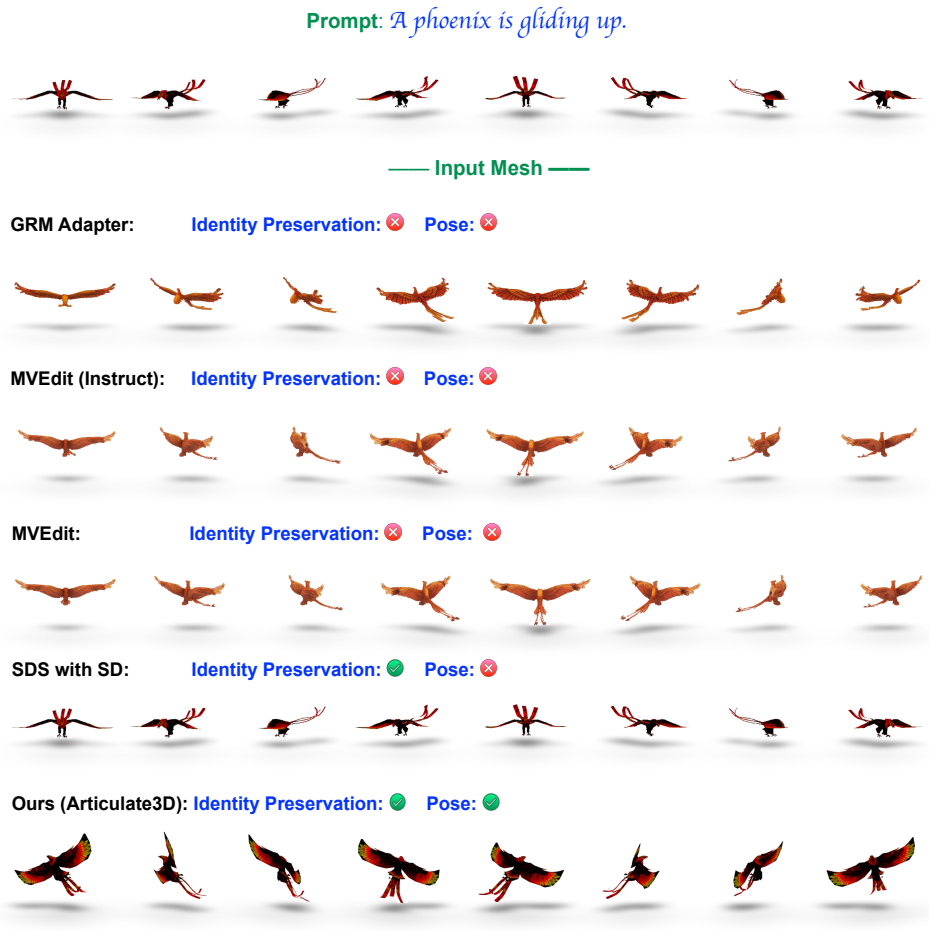
Summary. The paper proposes Articulate3D, a training-free pipeline that reposes an input 3D mesh according to a text prompt. The method first uses RSActrl, a self-attention rewiring mechanism applied to the MVDream multi-view diffusion model, to generate target images from rendered views of the mesh and the text instruction. It then detects keypoints in both the rendered views and the generated target images, using SuperAnimal for quadrupeds and self-supervised correspondences for other categories, and optimizes bone rotations to minimize keypoint MSE between the two sets. Experiments compare against SDS with Stable Diffusion, MVEdit, MVEdit (Instruct), and GRM Adapter on a set of animal meshes and free-form prompts, reporting CLIP score, CLIP directional similarity, and user preference. The central claim is zero-shot, identity-preserving pose manipulation of 3D meshes.
Significance. If the method works as claimed, it offers a practical training-free alternative to SDS-based or reconstruction-based 3D editing for assets that already have an articulated rig. The paper has several strengths: it avoids per-mesh fine-tuning, uses a multi-view generator to promote viewpoint consistency, and replaces noisy pixel-level SDS gradients with keypoint supervision, which is a sensible choice for articulation optimization. The pipeline is not circular: the target pose is inherited from the text-conditioned generator and the mesh is aligned to generated keypoints using an external detector. However, the actual scope is narrower than the stated headline because the optimization step presupposes a pre-existing skeleton rig, and the evaluation does not directly measure identity preservation despite this being a central claimed benefit. These issues need to be addressed before the contribution can be assessed at face value.
major comments (4)
- [Sec. 3.3 (Step 2.2) and Sec. 1] The input is defined in Sec. 1 as 'a 3D mesh and a language prompt,' but Step 2.2 optimizes 'the rotation of each bone' against keypoint MSE. This presupposes that the input mesh already has a skeleton rig with a bone hierarchy and skinning weights. For an unrigged mesh there are no bone parameters to optimize, and the keypoint-alignment objective cannot move the geometry. The paper never states this input requirement or describes how the tiger, phoenix, bird, and frog assets in Fig. 4 were rigged. If rig construction is a separate manual or learned step, the method is not zero-shot for arbitrary meshes. Please state the precondition explicitly, provide rigging details for the evaluation assets, or evaluate on unrigged meshes using an automatic rigging stage.
- [Sec. 4.3, Tables 1-2] The abstract and conclusion claim that the method 'preserves the mesh's identity,' and Fig. 4 labels 'Identity Preservation,' but no quantitative identity metric is reported. CLIP score measures text alignment, and CDS measures directional change in CLIP space; neither measures whether the output mesh's shape, texture, or semantic identity matches the input. The user study preference may conflate pose correctness with identity preservation. Please add a direct identity metric (e.g., LPIPS or cosine similarity between rendered input and output views) or a separate user-study dimension that explicitly asks about identity preservation.
- [Sec. 3.3 Step 2.2] The keypoint-alignment optimization is not specified in enough detail to be reproducible. The text says 'minimising the mean squared error between the rendered and target keypoints' and 'the rotation of each bone serves as a parameter,' but no loss equation, camera projection model, per-view weighting, or optimization hyperparameters (learning rate, number of iterations, root-rotation attenuation factor) are given. In addition, the root bone is optimized separately for each view, which is a potential source of global inconsistency because different views can select different root orientations. Please formalize the objective, describe how 2D keypoints from each view are related to the 3D bone parameters, and explain how multi-view consistency is enforced for the root bone.
- [Sec. 3.2.1, Eq. (4), and Fig. 6] The automatic DDIM inversion depth selection relies on the empirical claim that 'inversion depths corresponding to regions of high noise difference norm correlate with superior reconstruction and articulation quality.' Only one example (the penguin, where depth=25 is selected) is shown, with no quantitative validation of the correlation over the prompt/mesh set. Since this heuristic determines the starting latent for all target images, its failure modes are not characterized. Please validate the selection procedure across the full evaluation set and report how frequently the automatically selected depth agrees with the best manual depth.
minor comments (5)
- [Abstract, Sec. 1, Sec. 4.3, Tables 1-2] The preference numbers are inconsistent: the abstract and introduction say 'over 85% of the time,' while Sec. 4.3 reports 90% for Articulate3D and Table 2 reports 86% for RSActrl. Please reconcile these numbers and state the exact protocol and sample size.
- [Tables 3 and 5] The absolute CLIP score advantages over the best baseline are often small (e.g., less than 1 point in many rows), and no significance tests or confidence intervals are reported. A win rate over 20 cases is coarse; please report per-prompt variance or a paired test.
- [Eq. (4)] The definition of d is unclear: the expression appears to contain stray characters and does not show a norm or averaging operation. Please define the notation cleanly, e.g., d = (1/T) Σ_t ||εθ(x_t, e_p) − εθ(x_t, e_∅)||².
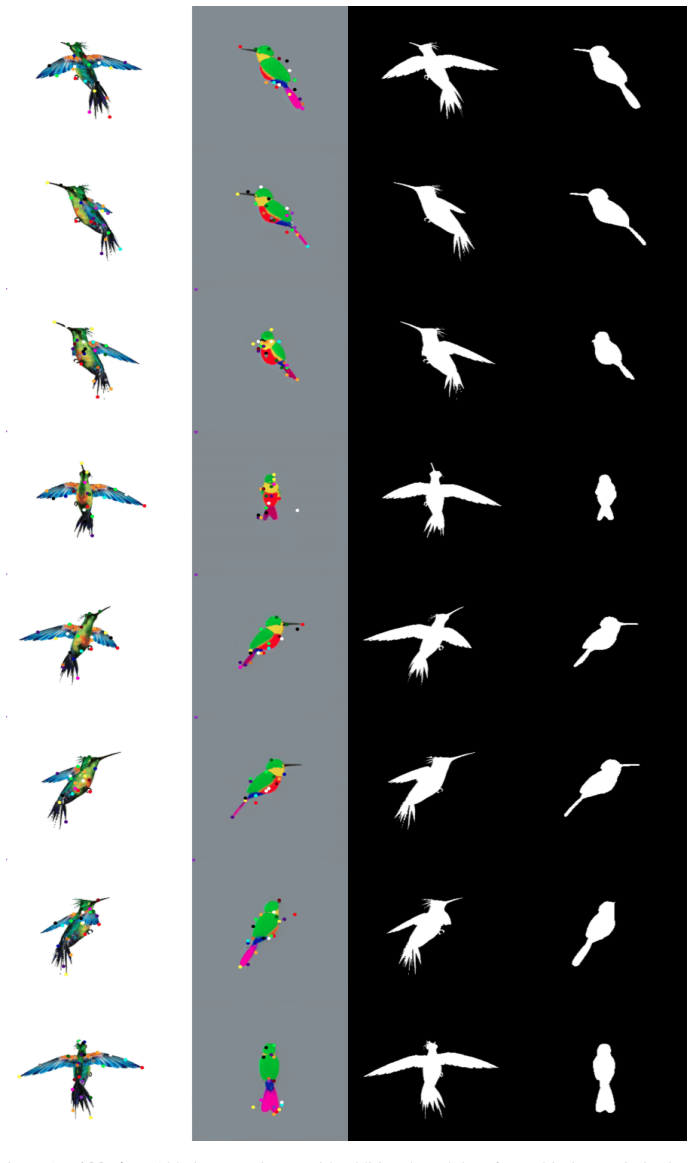
- [Sec. 3.3 Step 2.1] For non-quadruped categories, the paper says self-supervised correspondences [37] are used, but it does not specify how keypoints are extracted from those correspondences, how many are used, or how they are matched across views. Please provide these details for reproducibility.
- [Sec. 4.5] The limitation section mentions 'training distribution (ObjaVerse)' - likely a typo for 'Objaverse.' Please correct.
Circularity Check
No significant circularity: Articulate3D is a self-contained, training-free alignment pipeline; the unstated articulated-rig prerequisite is a scope limitation, not a circular step.
full rationale
The core derivation chain is self-contained. The method generates target images with RSActrl by conditioning a pre-trained multi-view diffusion model on the input renders and the text prompt; it then detects keypoints in both the rendered mesh views and the generated target images using external estimators (SuperAnimal or self-supervised correspondences), and optimizes bone rotations to minimize keypoint MSE. The target images are not defined in terms of the final posed mesh, and the bone rotations are not fitted parameters later renamed as predictions; they are per-input optimization variables aligned to externally detected keypoints. The paper's self-citations (refs [9],[10]) appear only in related-work background on pose estimation and are not load-bearing. No uniqueness theorem is imported from the authors' prior work, and no ansatz is smuggled in via citation. The reviewer-noted gap—that Step 2.2 presupposes a skeleton rig with bone hierarchy and skinning weights, while the abstract says only 'a 3D mesh and a language prompt'—is a real scope/precondition omission, but it is not circularity: for an unrigged mesh the optimization would be inapplicable rather than tautologically satisfied. Evaluation via CLIP and user studies may inherit quality from the target-image generator, but that is a benchmarking limitation, not a derivation-level circular step.
Axiom & Free-Parameter Ledger
free parameters (5)
- CFG guidance scale =
7.5
- Denoising steps =
T=50
- DDIM inversion depth =
auto-selected, e.g., 25 or 30
- Root bone rotation attenuation =
not specified
- Number of rendered views =
N=8
axioms (5)
- domain assumption Input meshes are pre-rigged with a skeleton and skinning weights
- domain assumption SuperAnimal (quadrupeds) and DIFT (other animals) provide reliable keypoint/correspondence matches for all test objects
- ad hoc to paper The noise difference norm correlates with perceived identity/detail preservation
- ad hoc to paper Rewiring self-attention per Eq. 3 preserves source structure while allowing pose changes
- ad hoc to paper Keypoint MSE is smoother than SDS or image-gradient losses for articulation
Cite this review
Pith. "Pith review of Articulate3D: Zero-Shot Text-Driven 3D Object Posing." pith.science (2026). https://pith.science/paper/OXUMZ7CE
@misc{pith2026250819244,
  author       = {Pith},
  title        = {Pith review of: Articulate3D: Zero-Shot Text-Driven 3D Object Posing},
  year         = {2026},
  howpublished = {\url{https://pith.science/paper/OXUMZ7CE}},
  note         = {Machine review of arXiv:2508.19244}
}
read the original abstract
We propose a training-free method, Articulate3D, to pose a 3D asset through language control. Despite advances in vision and language models, this task remains surprisingly challenging. To achieve this goal, we decompose the problem into two steps. We modify a powerful image-generator to create target images conditioned on the input image and a text instruction. We then align the mesh to the target images through a multi-view pose optimisation step. In detail, we introduce a self-attention rewiring mechanism (RSActrl) that decouples the source structure from pose within an image generative model, allowing it to maintain a consistent structure across varying poses. We observed that differentiable rendering is an unreliable signal for articulation optimisation; instead, we use keypoints to establish correspondences between input and target images. The effectiveness of Articulate3D is demonstrated across a diverse range of 3D objects and free-form text prompts, successfully manipulating poses while maintaining the original identity of the mesh. Quantitative evaluations and a comparative user study, in which our method was preferred over 85\% of the time, confirm its superiority over existing approaches. Project page:https://odeb1.github.io/articulate3d_page_deb/
Figures






Reference graph
Works this paper leans on
-
[1]
In- structpix2pix: Learning to follow image editing instructions
Tim Brooks, Aleksander Holynski, and Alexei A Efros. In- structpix2pix: Learning to follow image editing instructions. In Proceedings of the IEEE/CVF Conference on Computer Vision and Pattern Recognition, pages 18392–18402, 2023. 2
2023
-
[2]
Masactrl: Tuning-free mu- tual self-attention control for consistent image synthesis and editing
Mingdeng Cao, Xintao Wang, Zhongang Qi, Ying Shan, Xi- aohu Qie, and Yinqiang Zheng. Masactrl: Tuning-free mu- tual self-attention control for consistent image synthesis and editing. In Proceedings of the IEEE/CVF International Con- ference on Computer Vision (ICCV) , pages 22560–22570,
-
[3]
Emerg- ing properties in self-supervised vision transformers
Mathilde Caron, Hugo Touvron, Ishan Misra, Herv ´e J´egou, Julien Mairal, Piotr Bojanowski, and Armand Joulin. Emerg- ing properties in self-supervised vision transformers. In Pro- ceedings of the International Conference on Computer Vi- sion (ICCV), 2021. 1
2021
-
[4]
Generic 3d diffusion adapter using controlled multi-view editing
Hansheng Chen, Ruoxi Shi, Yulin Liu, Bokui Shen, Ji- ayuan Gu, Gordon Wetzstein, Hao Su, and Leonidas Guibas. Generic 3d diffusion adapter using controlled multi-view editing. arXiv preprint arXiv:2403.12032 , 2024. 3, 7, 8, 10, 11
Pith/arXiv arXiv 2024
-
[5]
Dge: Direct gaussian 3d editing by consistent multi-view editing
Minghao Chen, Iro Laina, and Andrea Vedaldi. Dge: Direct gaussian 3d editing by consistent multi-view editing. arXiv preprint arXiv:2404.18929, 2024. 3
Pith/arXiv arXiv 2024
-
[6]
Shap-editor: Instruction-guided latent 3d editing in seconds
Minghao Chen, Junyu Xie, Iro Laina, and Andrea Vedaldi. Shap-editor: Instruction-guided latent 3d editing in seconds. In Proceedings of the IEEE/CVF Conference on Computer Vision and Pattern Recognition, pages 26456–26466, 2024. 3
2024
-
[7]
Fan- tasia3d: Disentangling geometry and appearance for high- quality text-to-3d content creation, 2023
Rui Chen, Yongwei Chen, Ningxin Jiao, and Kui Jia. Fan- tasia3d: Disentangling geometry and appearance for high- quality text-to-3d content creation, 2023. 1, 3
2023
-
[8]
Diffedit: Diffusion-based semantic image editing with mask guidance
Guillaume Couairon, Jakob Verbeek, Holger Schwenk, and Matthieu Cord. Diffedit: Diffusion-based semantic image editing with mask guidance. In The Eleventh International Conference on Learning Representations, 2023. 2
2023
-
[9]
Towards multi-modal animal pose estimation: An in-depth analysis,
Qianyi Deng, Oishi Deb, Amir Patel, Christian Rupprecht, Philip Torr, Niki Trigoni, and Andrew Markham. Towards multi-modal animal pose estimation: An in-depth analysis,
-
[10]
Towards multi-modal animal pose estimation: A survey and in-depth analysis, 2025
Qianyi Deng, Oishi Deb, Amir Patel, Christian Rupprecht, Philip Torr, Niki Trigoni, and Andrew Markham. Towards multi-modal animal pose estimation: A survey and in-depth analysis, 2025. 2
2025
-
[11]
An image is worth one word: Personalizing text-to- image generation using textual inversion
Rinon Gal, Yuval Alaluf, Yuval Atzmon, Or Patash- nik, Amit H Bermano, Gal Chechik, and Daniel Cohen- Or. An image is worth one word: Personalizing text-to- image generation using textual inversion. arXiv preprint arXiv:2208.01618, 2022. 2
Pith/arXiv arXiv 2022
-
[12]
Prompt-to-prompt image editing with cross-attention control
Amir Hertz, Ron Mokady, Jay Tenenbaum, Kfir Aberman, Yael Pritch, and Daniel Cohen-or. Prompt-to-prompt image editing with cross-attention control. In The Eleventh Inter- national Conference on Learning Representations, 2023. 2, 6, 8, 12, 13
2023
-
[13]
Denoising dif- fusion probabilistic models
Jonathan Ho, Ajay Jain, and Pieter Abbeel. Denoising dif- fusion probabilistic models. Advances in neural information processing systems, 33:6840–6851, 2020. 1
2020
-
[14]
Lora: Low-rank adaptation of large language models
Edward J Hu, Yelong Shen, Phillip Wallis, Zeyuan Allen- Zhu, Yuanzhi Li, Shean Wang, Lu Wang, and Weizhu Chen. Lora: Low-rank adaptation of large language models. arXiv preprint arXiv:2106.09685, 2021. 2
Pith/arXiv arXiv 2021
-
[15]
Fresca: Unveiling the scaling space in diffusion models
Chao Huang, Susan Liang, Yunlong Tang, Li Ma, Yapeng Tian, and Chenliang Xu. Fresca: Unveiling the scaling space in diffusion models. arXiv preprint arXiv:2504.02154, 2025. 5
Pith/arXiv arXiv 2025
-
[16]
Imagic: Text-based real image editing with diffusion models
Bahjat Kawar, Shiran Zada, Oran Lang, Omer Tov, Huiwen Chang, Tali Dekel, Inbar Mosseri, and Michal Irani. Imagic: Text-based real image editing with diffusion models. InPro- ceedings of the IEEE/CVF Conference on Computer Vision and Pattern Recognition, pages 6007–6017, 2023. 2
2023
-
[17]
Synthetic Data for Machine Learning: Revolutionize Your Approach to Machine Learning with this Comprehensive Conceptual Guide
Abdulrahman Kerim. Synthetic Data for Machine Learning: Revolutionize Your Approach to Machine Learning with this Comprehensive Conceptual Guide. Packt Publishing, Birm- ingham, UK, 2023. 1
2023
-
[18]
Alleviating exposure bias in diffusion models through sampling with shifted time steps
Mingxiao Li, Tingyu Qu, Ruicong Yao, Wei Sun, and Marie- Francine Moens. Alleviating exposure bias in diffusion models through sampling with shifted time steps. In The Twelfth International Conference on Learning Representa- tions, 2024. 5
2024
-
[19]
Magic3d: High-resolution text-to-3d content creation, 2023
Chen-Hsuan Lin, Jun Gao, Luming Tang, Towaki Takikawa, Xiaohui Zeng, Xun Huang, Karsten Kreis, Sanja Fidler, Ming-Yu Liu, and Tsung-Yi Lin. Magic3d: High-resolution text-to-3d content creation, 2023. 1, 3
2023
-
[20]
Towards understanding cross and self-attention in stable diffusion for text-guided image editing
Bingyan Liu, Chengyu Wang, Tingfeng Cao, Kui Jia, and Jun Huang. Towards understanding cross and self-attention in stable diffusion for text-guided image editing. InProceed- ings of the IEEE/CVF conference on computer vision and pattern recognition, pages 7817–7826, 2024. 2, 6, 8, 12, 13
2024
-
[21]
Zero-1-to-3: Zero-shot one image to 3d object, 2023
Ruoshi Liu, Rundi Wu, Basile Van Hoorick, Pavel Tok- makov, Sergey Zakharov, and Carl V ondrick. Zero-1-to-3: Zero-shot one image to 3d object, 2023. 3
2023
-
[22]
SDEdit: Guided image synthesis and editing with stochastic differential equa- tions
Chenlin Meng, Yutong He, Yang Song, Jiaming Song, Jia- jun Wu, Jun-Yan Zhu, and Stefano Ermon. SDEdit: Guided image synthesis and editing with stochastic differential equa- tions. In International Conference on Learning Representa- tions, 2022. 2, 6, 8, 12, 13
2022
-
[23]
Null-text inversion for editing real im- ages using guided diffusion models
Ron Mokady, Amir Hertz, Kfir Aberman, Yael Pritch, and Daniel Cohen-Or. Null-text inversion for editing real im- ages using guided diffusion models. In Proceedings of the IEEE/CVF Conference on Computer Vision and Pattern Recognition, pages 6038–6047, 2023. 2
2023
-
[24]
Chong Mou, Xintao Wang, Liangbin Xie, Yanze Wu, Jian Zhang, Zhongang Qi, Ying Shan, and Xiaohu Qie. T2i- adapter: Learning adapters to dig out more controllable ability for text-to-image diffusion models. arXiv preprint arXiv:2302.08453, 2023. 2
Pith/arXiv arXiv 2023
-
[25]
Barron, and Ben Milden- hall
Ben Poole, Ajay Jain, Jonathan T. Barron, and Ben Milden- hall. Dreamfusion: Text-to-3d using 2d diffusion, 2022. 1, 3
2022
-
[26]
Learning 9 transferable visual models from natural language supervi- sion
Alec Radford, Jong Wook Kim, Chris Hallacy, Aditya Ramesh, Gabriel Goh, Sandhini Agarwal, Girish Sastry, Amanda Askell, Pamela Mishkin, Jack Clark, et al. Learning 9 transferable visual models from natural language supervi- sion. In International conference on machine learning, pages 8748–8763. PMLR, 2021. 1
2021
-
[27]
Dreambooth: Fine tuning text-to-image diffusion models for subject-driven generation
Nataniel Ruiz, Yuanzhen Li, Varun Jampani, Yael Pritch, Michael Rubinstein, and Kfir Aberman. Dreambooth: Fine tuning text-to-image diffusion models for subject-driven generation. In Proceedings of the IEEE/CVF Conference on Computer Vision and Pattern Recognition, pages 22500– 22510, 2023. 2
2023
-
[28]
Mvdream: Multi-view diffusion for 3d gen- eration
Yichun Shi, Peng Wang, Jianglong Ye, Long Mai, Kejie Li, and Xiao Yang. Mvdream: Multi-view diffusion for 3d gen- eration. arXiv:2308.16512, 2023. 3, 4, 6
Pith/arXiv arXiv 2023
-
[29]
Denois- ing diffusion implicit models
Jiaming Song, Chenlin Meng, and Stefano Ermon. Denois- ing diffusion implicit models. In International Conference on Learning Representations, 2021. 5, 6
2021
-
[30]
Plug-and-play diffusion features for text-driven image-to-image translation
Narek Tumanyan, Michal Geyer, Shai Bagon, and Tali Dekel. Plug-and-play diffusion features for text-driven image-to-image translation. InProceedings of the IEEE/CVF Conference on Computer Vision and Pattern Recognition , pages 1921–1930, 2023. 2, 6, 8, 12, 13
1921
-
[31]
Attention is all you need
Ashish Vaswani, Noam Shazeer, Niki Parmar, Jakob Uszko- reit, Llion Jones, Aidan N Gomez, Ł ukasz Kaiser, and Illia Polosukhin. Attention is all you need. In Advances in Neu- ral Information Processing Systems. Curran Associates, Inc.,
-
[32]
De- tecting, explaining, and mitigating memorization in diffusion models
Yuxin Wen, Yuchen Liu, Chen Chen, and Lingjuan Lyu. De- tecting, explaining, and mitigating memorization in diffusion models. ICLR, 2023. 5
2023
-
[33]
Structured 3d latents for scalable and versatile 3d gen- eration
Jianfeng Xiang, Zelong Lv, Sicheng Xu, Yu Deng, Ruicheng Wang, Bowen Zhang, Dong Chen, Xin Tong, and Jiaolong Yang. Structured 3d latents for scalable and versatile 3d gen- eration. arXiv preprint arXiv:2412.01506, 2024. 1, 3
Pith/arXiv arXiv 2024
-
[34]
Grm: Large gaus- sian reconstruction model for efficient 3d reconstruction and generation
Yinghao Xu, Zifan Shi, Wang Yifan, Sida Peng, Ceyuan Yang, Yujun Shen, and Wetzstein Gordon. Grm: Large gaus- sian reconstruction model for efficient 3d reconstruction and generation. arxiv: 2403.14621, 2024. 3, 6, 8, 10, 11
Pith/arXiv arXiv 2024
-
[35]
Superanimal pretrained pose estimation models for behavioral analysis
Shaokai Ye, Anastasiia Filippova, Jessy Lauer, Steffen Schneider, Maxime Vidal, Tian Qiu, Alexander Mathis, and Mackenzie Weygandt Mathis. Superanimal pretrained pose estimation models for behavioral analysis. Nature Commu- nications, 15:5165, 2024. 3, 6
2024
-
[36]
Multimodal image synthesis and editing: A survey and taxonomy
Fangneng Zhan, Yingchen Yu, Rongliang Wu, Jiahui Zhang, Shijian Lu, Lingjie Liu, Adam Kortylewski, Christian Theobalt, and Eric Xing. Multimodal image synthesis and editing: A survey and taxonomy. IEEE Transactions on Pat- tern Analysis and Machine Intelligence, 2023. 2
2023
-
[37]
A tale of two features: Stable diffusion complements DINO for zero-shot semantic correspondence
Junyi Zhang, Charles Herrmann, Junhwa Hur, Luisa Pola- nia Cabrera, Varun Jampani, Deqing Sun, and Ming-Hsuan Yang. A tale of two features: Stable diffusion complements DINO for zero-shot semantic correspondence. In Thirty- seventh Conference on Neural Information Processing Sys- tems, 2023. 2, 3, 6
2023
-
[38]
Adding conditional control to text-to-image diffusion models
Lvmin Zhang, Anyi Rao, and Maneesh Agrawala. Adding conditional control to text-to-image diffusion models. In Proceedings of the IEEE/CVF International Conference on Computer Vision, pages 3836–3847, 2023. 2
2023
-
[39]
Hunyuan3d 2.0: Scaling diffu- sion models for high resolution textured 3d assets generation
Zibo Zhao, Zeqiang Lai, Qingxiang Lin, Yunfei Zhao, Haolin Liu, Shuhui Yang, Yifei Feng, Mingxin Yang, Sheng Zhang, Xianghui Yang, et al. Hunyuan3d 2.0: Scaling diffu- sion models for high resolution textured 3d assets generation. arXiv preprint arXiv:2501.12202, 2025. 1 10 Articulate3D: Zero-Shot Text-Driven 3D Object Posing Supplementary Material The su...
Pith/arXiv arXiv 2025
-
[40]
io/articulate3d_page_deb/
Interactive 3D and Animation results: The outputs in 3D and the animation results can be viewed at our project page here: https://odeb1.github. io/articulate3d_page_deb/
-
[41]
Articulate3D more and detailed results:
-
[42]
9 to Fig
Visual results of Articulate3D in more views i.e 8 views for various text prompts are shown here Fig. 9 to Fig. 14
-
[43]
3 and Clip Direc- tional Score (CDS) evaluation results in Tab
Clip score evaluation results in Tab. 3 and Clip Direc- tional Score (CDS) evaluation results in Tab. 4 for Artic- ulate3D and other prior methods
-
[44]
RSActrl more and detailed results:
-
[45]
15 and Fig
Visual results of RSActrl in more views are shown in Fig. 15 and Fig. 16
-
[46]
5 and Clip Direc- tional Score (CDS) in Tab
Clip score evaluation result in Tab. 5 and Clip Direc- tional Score (CDS) in Tab. 6 for RSActrl and other prior methods
-
[47]
Implementation in pixel space results in over-saturation, likely due to high classifier guidance, whereas implementation in latent space generates red, blob- like artefacts
Baseline: SDS with Stable Diffusion (SD) Here, in Figure 7, we visually illustrate why a naive appli- cation of SDS on Multi-View Diffusion Models produces undesirable results. Implementation in pixel space results in over-saturation, likely due to high classifier guidance, whereas implementation in latent space generates red, blob- like artefacts. Both o...
-
[48]
Fig- ure 8 presents the results of our articulation optimisation process
More Ablation Experiments Varying number of Keypoints for Articulation. Fig- ure 8 presents the results of our articulation optimisation process. This figure highlights the accurate alignment achieved between the rendered image of the 3D mesh and the generated target image, showcasing the benefits of using keypoint alignment. Mask Loss for Articulation. W...
-
[49]
A hummingbird is folding its wings
Articulation Hummingbird wings folded MVEdit: Identity Preservation: Pose: SDS with SD: Identity Preservation: Pose: Ours (Articulate3D): Identity Preservation: Pose: MVEdit (Instruct): Identity Preservation: Pose: GRM Adapter: Identity Preservation: Pose: ——— Input Mesh ——— Prompt: A hummingbird is folding its wings. Figure 9. Articulate3D Results. Eight...
-
[50]
A phoenix is gliding up
Articulation Tiger jump, stand back 2 legs —— Input Mesh —— MVEdit: Identity Preservation: Pose: SDS with SD: Identity Preservation: Pose: Ours (Articulate3D): Identity Preservation: Pose: MVEdit (Instruct): Identity Preservation: Pose: GRM Adapter: Identity Preservation: Pose: Prompt: A phoenix is gliding up. Figure 10. Articulate3D Results. Eight views ...
-
[51]
A hummingbird is bending its head
Articulation Hummingbird wings folded MVEdit: Identity Preservation: Pose: SDS with SD: Identity Preservation: Pose: Ours (Articulate3D): Identity Preservation: Pose: MVEdit (Instruct): Identity Preservation: Pose: GRM Adapter: Identity Preservation: Pose: ——— Input Mesh ——— Prompt: A hummingbird is bending its head. Figure 11. Articulate3D Results. Eight...
-
[52]
A tiger is lifting its front legs
Articulation Tiger jump, stand back 2 legs ——— Input Mesh ——— MVEdit: Identity Preservation: Pose: SDS with SD: Identity Preservation: Pose: Ours (Articulate3D): Identity Preservation: Pose: MVEdit (Instruct): Identity Preservation: Pose: GRM Adapter: Identity Preservation: Pose: Prompt: A tiger is lifting its front legs up. Figure 12. Articulate3D Result...
-
[53]
A frog is jumping
Articulation Tiger jump, stand back 2 legs —— Input Mesh —— MVEdit: Identity Preservation: Pose: SDS with SD: Identity Preservation: Pose: Ours (Articulate3D): Identity Preservation: Pose: MVEdit (Instruct): Identity Preservation: Pose: GRM Adapter: Identity Preservation: Pose: Prompt: A frog is jumping. Figure 13. Articulate3D Results. Eight views result...
-
[54]
A seagull is stretching its wings up
Articulation Tiger jump, stand back 2 legs —— Input Mesh —— MVEdit: Identity Preservation: Pose: SDS with SD: Identity Preservation: Pose: Ours (Articulate3D): Identity Preservation: Pose: MVEdit (Instruct): Identity Preservation: Pose: GRM Adapter: Identity Preservation: Pose: Prompt: A seagull is stretching its wings up. Figure 14. Articulate3D Results....
-
[55]
[4] [4] [Baseline] (ours) CS CS CS CS CS
-
[56]
29.164 30.012 29.264 28.049 30.121
A hummingbird is folding its wings down. 29.164 30.012 29.264 28.049 30.121
-
[57]
28.954 28.014 28.972 29.142 30.391
A tiger is lifting its front legs up. 28.954 28.014 28.972 29.142 30.391
-
[58]
29.823 30.683 29.815 30.814 30.652
A seagull is stretching its wings up. 29.823 30.683 29.815 30.814 30.652
-
[59]
28.399 28.012 28.961 28.696 30.307
A tiger is stretching its front leg forward. 28.399 28.012 28.961 28.696 30.307
-
[60]
28.163 31.308 28.069 31.059 30.943
A hummingbird is looking up. 28.163 31.308 28.069 31.059 30.943
-
[61]
28.836 30.001 29.759 29.981 30.012
A frog is jumping. 28.836 30.001 29.759 29.981 30.012
-
[62]
28.971 30.112 29.841 30.161 30.949
An eagle is lifting its wings up. 28.971 30.112 29.841 30.161 30.949
-
[63]
28.980 29.973 29.852 29.416 29.938
A sheep is running. 28.980 29.973 29.852 29.416 29.938
-
[64]
28.907 29.013 29.784 27.844 30.185
A tiger is sitting. 28.907 29.013 29.784 27.844 30.185
-
[65]
28.094 28.885 29.841 29.474 30.719
A tiger is walking. 28.094 28.885 29.841 29.474 30.719
-
[66]
28.098 28.331 29.815 30.110 29.163
A brown bird is raising its wings. 28.098 28.331 29.815 30.110 29.163
-
[67]
28.982 28.293 29.762 28.110 31.910
A penguin is bringing its flippers down. 28.982 28.293 29.762 28.110 31.910
-
[68]
28.095 30.029 29.853 28.110 29.200
A phoenix is gliding up. 28.095 30.029 29.853 28.110 29.200
-
[69]
28.951 28.331 29.082 28.195 30.110
A giraffe is bending its front leg. 28.951 28.331 29.082 28.195 30.110
-
[70]
28.906 28.981 29.851 29.010 31.782
An elephant is lowering its trunk down. 28.906 28.981 29.851 29.010 31.782
-
[71]
29.071 28.701 29.812 29.111 30.120
A hummingbird is bending its head down. 29.071 28.701 29.812 29.111 30.120
- [72]
-
[73]
28.094 29.023 29.813 29.718 31.078
A golden bird is gliding up. 28.094 29.023 29.813 29.718 31.078
-
[74]
29.061 29.378 29.075 29.281 31.837
A phoenix is lowering its wings. 29.061 29.378 29.075 29.281 31.837
-
[75]
28.096 28.532 28.163 29.916 30.941 Table 3
A golden bird is folding its wings. 28.096 28.532 28.163 29.916 30.941 Table 3. Result for our Articulate3D method with nine text prompts evaluated using Clip Score is shown here. 10 Sl no. Text Prompts GRM MVEdit MVEdit SDS Articulate3D Adapter (Instruct) with SD
-
[76]
[4] [4] [Baseline] (ours) CDS CDS CDS CDS CDS
-
[77]
0.28932 0.29981 0.29731 0.29991 0.30010
A hummingbird is folding its wings down. 0.28932 0.29981 0.29731 0.29991 0.30010
-
[78]
0.28101 0.30017 0.29041 0.30029 0.30031
A tiger is lifting its front legs up. 0.28101 0.30017 0.29041 0.30029 0.30031
-
[79]
0.28161 0.29872 0.29631 0.31012 0.30765
A seagull is stretching its wings up. 0.28161 0.29872 0.29631 0.31012 0.30765
-
[80]
0.28135 0.28012 0.29528 0.28686 0.30298
A tiger is stretching its front leg forward. 0.28135 0.28012 0.29528 0.28686 0.30298
This paper was first reviewed by deepseek-v4-flash on August 5, 2026.
discussion (0)
Sign in with ORCID, Apple, or X to comment. Anyone can read and Pith papers without signing in.