REVIEW 4 major objections 4 minor 30 references
False-vacuum bubbles in sphaleron scattering
T0 review · 4 major / 4 minor · reviewed 2026-08-15 · deepseek-v4-flash
Pith's one-line read Head-on collisions of two sphalerons can create a long-lived false-vacuum bubble that bounces before decaying.
desk verdict Novel bubble outcome in sphaleron scattering, but the lack of convergence checks leaves the main claim resting on a single numerical setup. read the letter →
The pith
A machine-rendered reading of the paper's core claim, the machinery that carries it, and where it could break.
The reading
What carries the argument
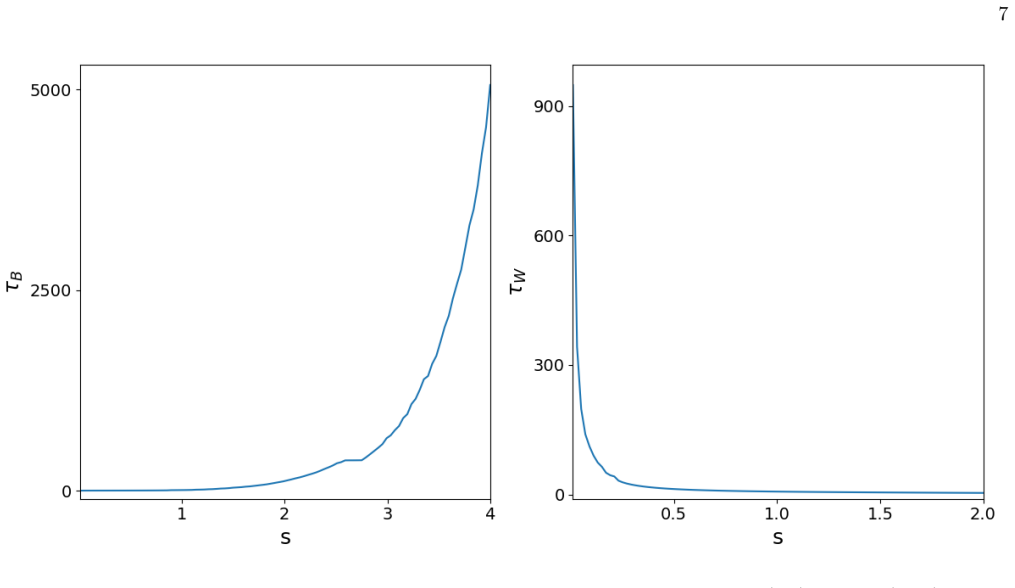
The central objects are the bright sphalerons of two exactly solvable deformed $\phi^6$ potentials, the barrier model and the well model. A bright sphaleron is a localized, non-monotonic stationary solution sitting in a false vacuum; in these models its profile looks like a kink-antikink pair for some parameter values and a single lump for others. The kink and the antikink are the standard names for smooth field steps connecting one vacuum value to a neighboring vacuum, with the antikink being the mirror-image step. Each sphaleron carries one negative eigenmode in its linear stability spectrum, and the well model additionally supports several bound states; the paper uses this spectrum to explain why barrier-model sphalerons become longer-lived as $s$ grows while well-model sphalerons decay faster. The bubble is identified as a false-vacuum domain bounded by a kink-antikink pair, and the paper argues that its repeated collapse and re-expansion is governed by the dynamics of these walls and their successive collisions, not by local field dynamics inside the bubble.
What would settle it
Repeat the bright-sphaleron collision at the same parameter values with spatial resolution $h=1/60$, half the time step, and an independent integrator, and compare the field at the origin $\phi(0,t)$ in the bubble regime. If the number of bounces, the bubble lifetime, or the existence of the false-vacuum domain changes qualitatively with resolution, the central claim is not supported; a clean positive check would show the bounce count and period converging as the grid is refined.
Extended reading notes
Core claim
The paper's discovery is that sphaleron collisions in deformed $\phi^6$ theories with false vacua have a qualitatively new final state: a finite domain in which the field stays near the false-vacuum value, separated from the surrounding vacuum by a kink and an antikink. The walls of this domain repeatedly move together, collide, and re-emerge, so the bubble collapses and re-expands several times; eventually it relaxes into a long-lived oscillon. This bubble appears in both the barrier model (one false vacuum) and the well model (two false vacua), and it also appears when initially static sphalerons are perturbed along their unstable eigenmode before colliding. In collisions of a perturbed bright sphaleron with a perturbed dark sphaleron in the barrier model, a false-vacuum bubble forms and persists for the entire simulation because the two inner kinks repel each other. The authors state that, to their knowledge, such bubble formation has not been reported before in sphaleron scattering in real scalar field theories.
Load-bearing premise
The load-bearing premise is that the numerical simulations faithfully reproduce the continuum field theory: the grid spacing, time step, and fourth-order integrator are not checked against finer resolutions or a different integrator, so the repeated bubble bounces and the long lifetime could in principle be numerical artifacts.
Editorial extensions
If this is right
- In the barrier model, small changes in deformation parameter $s$ and collision velocity $v$ switch the outcome among kink-antikink pairs, one to three oscillons, radiative decay, and the bouncing false-vacuum bubble, so the final state is highly sensitive to both parameters.
- In regions where the true and false vacua are nearly degenerate in energy, oscillon production becomes the dominant channel, since the sphalerons are long-lived enough to collide repeatedly and deposit energy into localized oscillations.
- The bubble state is distinct from an oscillon: its time evolution is controlled by repeated kink-antikink wall collisions, so any effective description of the bubble must model the walls rather than the interior field alone.
- Perturbing the sphalerons along their unstable mode before the collision does not destroy the bubble; a transient false-vacuum bubble still forms for a wide range of initial separations and perturbation amplitudes, and in the bright-dark collision the bubble remains stable throughout the simulation.
Reading between the lines
- Beyond the paper: if the bubble is genuine, a similar wall-bounded false-vacuum domain should be producible in higher-dimensional scalar models by colliding sphaleron-like lumps, where the analogue would be a domain-wall bubble whose lifetime could matter cosmologically.
- The repeated bounces suggest a resonance condition: bubble lifetime and bounce count may peak at discrete collision velocities, analogous to resonance windows in kink-antikink scattering; this can be tested by scanning velocity more finely around the bubble region of the phase diagrams.
- A collective-coordinate model of the two walls interacting across the false-vacuum interior would predict a bounce period set by wall separation and wall tension; comparing that prediction with the measured oscillation period of $\phi(0,t)$ is a quantitative test of the wall-driven mechanism.
- The bright-dark collision's stable bubble, if it persists beyond the simulation time, would be a dynamical way to create a long-lived region of metastable vacuum without tunneling, which is a stronger statement than the paper explicitly makes.
Signed reviews
Editorial analysis
A structured set of objections, weighed in public.
Referee Report
Summary. This manuscript studies head-on collisions of two bright sphalerons in two one-parameter families of deformed φ^6 scalar theories, called the barrier and well models. After reviewing the static sphaleron profiles and their linear stability spectra, the authors numerically integrate the field equation for many values of the deformation parameter s and initial velocity v. They report a variety of final states: kink–antikink pairs, one or several oscillons in true or false vacuum, and radiative decay. The claimed central novelty is a long-lived false-vacuum bubble bounded by a kink–antikink pair that repeatedly collapses and re-expands before eventually decaying into an oscillon; this is reported in both models and in perturbed sphaleron collisions. The paper also gives phase diagrams and isolated-sphaleron lifetime fits.
Significance. If the bubble observation is a genuine continuum result, it is a new final state in real scalar field theory and substantially extends earlier studies of metastable-lump and oscillon collisions. The reasoning is not circular: the bubble is obtained by direct numerical evolution of the stated PDE from explicitly given initial data, with no part of the target outcome used as input. The qualitative appearance of the same phenomenon in the barrier and well models and in perturbed bright–bright and bright–dark runs is supporting evidence. However, the central claim is currently supported only by a single numerical setup: no convergence checks, resolution study, energy diagnostics, or code/data release are provided, and the phrase 'long-lived' is never quantified. The significance is therefore conditional on the numerical validation requested below.
major comments (4)
- [§IV, numerical setup; Figs. 8(a), 11(a)] The central bubble observation is obtained with a single discretization (spatial step h=1/30, time step τ=0.0025, fourth-order spatial differencing and fourth-order Størmer–Verlet time stepping), and no convergence study or independent integrator is reported. This is not a peripheral omission: the authors note in Section I that numerical error acts to trigger the sphaleron's unstable mode, and the bubble evolution in Figs. 8(a) and 11(a) consists of repeated near-threshold kink–antikink collisions. The runs should be repeated at finer resolution (e.g., h=1/60 and h=1/120 with correspondingly reduced τ), and the evolution of ϕ(0,t) in the bottom panels of Figs. 8 and 11 should be compared quantitatively across resolutions, together with an energy-drift diagnostic. Without this, the repeated bounces and long lifetime cannot be attributed to the continuum field theory.
- [§IV(A),(B), Figs. 8 and 11, abstract] The term 'long-lived' is used in the abstract and in Section IV but is never defined quantitatively. The paper gives no bubble lifetime, no number of kink–antikink wall collisions, and no comparison with the radiation or oscillon decay timescales in the same models. The bottom panels of Figs. 8 and 11 show only a finite time window, so the long-lived claim is not testable. Please report, for each bubble case, the interval during which the false-vacuum domain persists, the number of successful wall bounces, and the time at which the bubble decays into an oscillon.
- [§V, perturbed sphalerons] The robustness statement in Section V ('We have verified ... for a wide range of initial separations and perturbation amplitudes') is not accompanied by data or parameter scans. In addition, the perturbation is introduced in Eq. (16) as the unstable eigenfunction η_{-1}(x), but Section V says the runs use 'a normalized gaussian function'; these are different initial data, so it is unclear which perturbation generates Figs. 13 and 14. The robustness argument should be supported by explicit scans or narrowed to the displayed cases, and the perturbation definition should be reconciled with Eq. (16).
- [Eqs. (18)–(19), §IV] The initial fields in Eq. (18) are called boosted, but the expression ϕ_{B(W)}(x − x1 − v1 t) is a Galilean translation rather than a Lorentz boost of the scalar field. A correctly boosted sphaleron would be ϕ_{B(W)}(γ(x − v t)) with γ=(1−v^2)^{−1/2}, and the initial momentum in Eq. (19) would contain the same γ factors. Since the scattering outcomes are sensitive to the initial energy and velocity, the authors should either implement the proper Lorentz-boosted data or justify why the nonrelativistic approximation is adequate for the bubble cases in Figs. 8 and 11.
minor comments (4)
- [§III, barrier model spectrum] The sentence 'the magnitude of the unstable mode increases with increasing s, indicating that the sphalerons become more stable' is internally inconsistent: a larger magnitude of a negative eigenvalue means faster instability. Please correct the wording or, if the plotted quantity is |ω^2|, state explicitly that the sign is taken into account.
- [§II, Eq. (7)] The phrase 'static solutions that minimize the energy' is imprecise for the sphaleron solutions, which are saddle points rather than minima of the energy. Eq. (7) should be described as the first-order equations for static extrema (kinks and sphalerons).
- [Figs. 9 and 12] The phase diagrams classify final states by the value of the field at a single point x=0 at a single time t_end. Please define the color scale, state the classification rule precisely, and comment on how sensitive the region boundaries are to the chosen t_end.
- [Fig. 5; captions] The lifetime fits in Fig. 5 (τ_B∼e^{2s}, τ_W∼s^{−1}) are reported without fit details or error estimates; please show the data points and fit curves. There are also small typographical issues, including 'time evaluation' in the Fig. 11 caption and 'of of' in the Fig. 10 caption.
Circularity Check
No circularity: the central bubble claim is obtained by direct numerical evolution of the stated PDE from stated initial data, with no target result used as input.
full rationale
The paper's central claim—the formation and repeated collapse/re-expansion of a false-vacuum bubble bounded by a kink-antikink pair—is derived by numerically integrating the stated field equations (Eqs. (4)–(6)) with explicit initial data (Eqs. (18)–(19)) for each parameter choice. The bubble outcome is read off from the resulting space-time profiles (Figs. 8 and 11) and is not used as an input anywhere in the construction of the model, the initial conditions, or the numerical scheme. The lifetime scalings (tau_B ~ e^{2s}, tau_W ~ s^{-1}) reported in Sec. III are ancillary empirical fits and are not fed back into the scattering simulations, so they do not make the bubble claim circular. The authors do rely on the prior work of Ref. [25] for the potentials and static sphaleron solutions, but that prior work is cited as background input, not as a substitute for the new scattering results, and the present paper's target result—collision dynamics and bubble formation—is not asserted to follow from that citation. Some authors of the present paper also appear in cited works (e.g., Refs. [18, 26]), but those citations are not load-bearing for the central claim; they concern background phenomenology and long-time sphaleron decay, and the bubble observation is independently supported by the simulations reported here. The robustness statement in Sec. V is qualitative and would need numerical-convergence support to fully establish the continuum claim, but that is a numerical-correctness risk, not a circularity. No fitted input is relabeled as a prediction; no derived quantity is defined in terms of the claimed result; no uniqueness theorem from the authors' prior work is invoked to force the outcome. The derivation chain is therefore self-contained with respect to the stated target result.
Assumptions & free parameters
assumptions (4)
- domain assumption The (1+1)-dimensional Lagrangian and equation of motion (Eqs. 1 and 4) are the correct continuum description of the model.
- ad hoc to paper Initial data can be constructed as a superposition of two boosted sphalerons (Eq. 18), providing a good approximation until the collision time t*.
- domain assumption The fourth-order finite-difference and Størmer-Verlet schemes with absorbing boundaries accurately evolve the PDE for the durations considered.
- standard math Linear stability analysis via the Sturm-Liouville problem (Eq. 12) correctly identifies the unstable modes that seed decay.
Cite this review
Pith. "Pith review of False-vacuum bubbles in sphaleron scattering." pith.science (2026). https://pith.science/paper/OYC6GQHS
@misc{pith2026260811370,
  author       = {Pith},
  title        = {Pith review of: False-vacuum bubbles in sphaleron scattering},
  year         = {2026},
  howpublished = {\url{https://pith.science/paper/OYC6GQHS}},
  note         = {Machine review of arXiv:2608.11370}
}
abstract
We investigate the collision dynamics of two bright sphalerons in a (1+1)-dimensional deformed $\phi^6$ scalar field theory with a symmetric potential possessing false vacua. Two one-parameter realizations of the model, referred to as the barrier and well models, are considered and their static and linear instability properties are first reviewed. We then study head-on collisions of boosted sphalerons over a broad range of initial velocities and deformation parameters. The scattering dynamics exhibit a rich variety of final states, including the production of kink-antikink pairs, long-lived oscillons in true and false vacuum, multiple oscillons propagating in false-vacuum regions, and radiative decay. A particularly remarkable outcome is the emergence of a long-lived bubble of the false broken vacuum bounded by a kink-antikink pair, which repeatedly collapses and re-expands before eventually decaying into an oscillon. These results demonstrate that deformed $\phi^6$ theories with false vacua exhibit considerably richer sphaleron dynamics than previously known and provide new insight into the role of unstable localized configurations in nonlinear field theories.
Figures


Figures from the paper (11 more)



Reference graph
Works this paper leans on
-
[29]
D. Canillas Mart´ ınez, P. Dorey, T. Roma´ nczukiewicz, P. M. Saffin, K. S lawi´ nska, and A. Wereszczy´ nski. Oscillons and bubbles inq-ball dynamics, 2025. arXiv:2509.03192
arXiv 2025
-
[1]
N. S. Manton and T. M. Samols. Sphaleron on a circle.Phys. Lett. B, 207:179–184, 1988
work page 1988
-
[2]
Sphalerons and instantons in two-dimensional field theory.Annals Phys., 216:122–151, 1992
Juan Mateos Guilarte. Sphalerons and instantons in two-dimensional field theory.Annals Phys., 216:122–151, 1992
work page 1992
-
[3]
Ya. Shnir and D. H. Tchrakian. Skyrmion-Anti-Skyrmion Chains.J. Phys. A, 43:025401, 2010
work page 2010
-
[4]
N. S. Manton. The Inevitability of Sphalerons in Field Theory.Phil. Trans. Roy. Soc. Lond. A, 377(2161):20180327, 2019
work page 2019
-
[5]
N. S. Manton and T. Roma´ nczukiewicz. Simplest oscillon and its sphaleron.Phys. Rev. D, 107(8):085012, 2023
work page 2023
-
[6]
Frans R. Klinkhamer. A New Sphaleron in the Weinberg-Salam Theory.Phys. Lett. B, 246:131–134, 1990
work page 1990
-
[7]
J. Kunz and Y. Brihaye. New Sphalerons in the Weinberg-Salam Theory.Phys. Lett. B, 216:353–359, 1989
work page 1989
Show all 30 references
-
[8]
The Existence of a Nonminimal Solution to the SU(2) Yang-Mills Higgs Equations on R**3
Clifford Henry Taubes. The Existence of a Nonminimal Solution to the SU(2) Yang-Mills Higgs Equations on R**3. part i.Commun. Math. Phys., 86:257, 1982. 15
1982
-
[9]
The Existence of a Nonminimal Solution to the SU(2) Yang-Mills Higgs Equations on R**3
Clifford Henry Taubes. The Existence of a Nonminimal Solution to the SU(2) Yang-Mills Higgs Equations on R**3. part ii.Commun. Math. Phys., 86:299–320, 1982
1982
-
[10]
Monopole–antimonopole: interaction, scattering and creation.Phil
Ayush Saurabh and Tanmay Vachaspati. Monopole–antimonopole: interaction, scattering and creation.Phil. Trans. Roy. Soc. Lond. A, 377(2161):20190143, 2019
2019
-
[11]
Sphalerons in the Skyrme model.J
Steffen Krusch and Paul Sutcliffe. Sphalerons in the Skyrme model.J. Phys. A, 37:9037, 2004
2004
-
[12]
Isler, J
K. Isler, J. Letourneux, and Manu B. Paranjape. Sphaleron in the skyrme model.Phys. Rev. D, 40:2490–2492, 1989
1989
-
[13]
Ya Shnir and D. H. Tchrakian. Axially-symmetric sphaleron solutions of the Skyrme model.J. Phys. Conf. Ser., 284:012053, 2011
2011
-
[14]
Shnir and G
Ya. Shnir and G. Zhilin. Sphaleron solutions of the Skyrme model from Yang-Mills holonomy.Phys. Lett. B, 723:236–240, 2013
2013
-
[15]
Klinkhamer and N
Frans R. Klinkhamer and N. S. Manton. A Saddle Point Solution in the Weinberg-Salam Theory.Phys. Rev. D, 30:2212, 1984
1984
-
[16]
Obtaining the sphaleron field configurations with gradient flow.Phys
Yu Hamada and Kengo Kikuchi. Obtaining the sphaleron field configurations with gradient flow.Phys. Rev. D, 101(9):096014, 2020
2020
-
[17]
Sphalerons in two Higgs doublet theories.Phys
Jackie Grant and Mark Hindmarsh. Sphalerons in two Higgs doublet theories.Phys. Rev. D, 64:016002, 2001
2001
-
[18]
C. Adam, D. Ciurla, K. Oles, T. Romanczukiewicz, and A. Wereszczynski. Sphalerons and resonance phenomenon in kink-antikink collisions.Phys. Rev. D, 104(10):105022, 2021
2021
-
[19]
K. Oles, J. Queiruga, T. Romanczukiewicz, and A. Wereszczynski. Sphaleron without shape mode and its oscillon.Phys. Lett. B, 847:138300, 2023
2023
-
[20]
Alonso-Izquierdo, S
A. Alonso-Izquierdo, S. Navarro-Obreg´ on, K. Oles, J. Queiruga, T. Romanczukiewicz, and A. Wereszczynski. Semi- Bogomol’nyi-Prasad-Sommerfield sphaleron and its dynamics.Phys. Rev. E, 108(6):064208, 2023
2023
-
[21]
N. S. Manton. Integration theory for kinks and sphalerons in one dimension.J. Phys. A, 57(2):025202, 2024
2024
-
[22]
Stephen C. Anco. Instability of sphalerons inϕ 4 models with a false vacuum, 8 2025. arXiv:2508.12150
2025
-
[23]
Pseudostable bubbles.Phys
Marcelo Gleiser. Pseudostable bubbles.Phys. Rev. D, 49:2978–2981, 1994
1994
-
[24]
A General Theory of Oscillon Dynamics.Phys
Marcelo Gleiser and David Sicilia. A General Theory of Oscillon Dynamics.Phys. Rev. D, 80:125037, 2009
2009
-
[25]
Navarro-Obreg´ on and J
S. Navarro-Obreg´ on and J. Queiruga. Impact of the internal modes on the sphaleron decay.Eur. Phys. J. C, 84(8):821, 2024
2024
-
[26]
Anco and Danial Saadatmand
Stephen C. Anco and Danial Saadatmand. Long-time behaviour of sphalerons inϕ 4 models with a false vacuum, 2026. arXiv:2510.04283
2026 arXiv
-
[27]
Lima, Fabiano C
Fred C. Lima, Fabiano C. Simas, K. Z. Nobrega, and Adalto R. Gomes. Scattering of metastable lumps in a model with a false vacuum.Phys. Lett. B, 822:136707, 2021
2021
-
[28]
J. G. F. Campos, N. S. Manton, and Azadeh Mohammadi. Collision dynamics of false-vacuum oscillons, 2026. arXiv:2605.12633
2026 arXiv
-
[30]
Kink-antikink collisions in theϕ 6 model.Phys
Patrick Dorey, Kieran Mersh, Tomasz Romanczukiewicz, and Yasha Shnir. Kink-antikink collisions in theϕ 6 model.Phys. Rev. Lett., 107:091602, 2011
2011
Reviewed August 15, 2026 · model on record in the stance chip above.
Discussion (0). Continue with ORCID to comment.