Impact of a Soft Wearable Back-Support Device on Postural Stability during Trip-Like Perturbations
Reviewed by Pith2026-06-28 13:56 UTCgrok-4.3pith:OYGY7FX6open to challenge →
The pith
Soft wearable back-support device raises minimum margin of stability during trip-like perturbations
A machine-rendered reading of the paper's core claim, the machinery that carries it, and where it could break.
Core claim
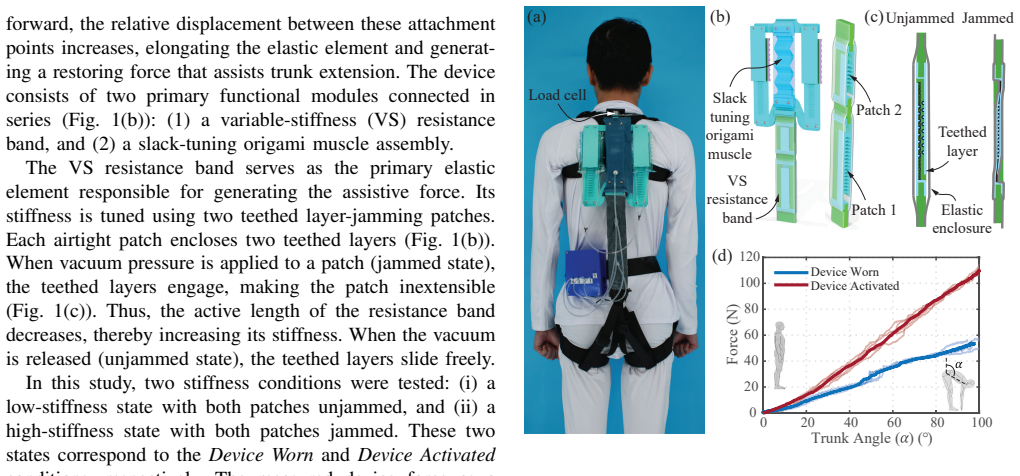
The soft wearable back-support device increases the minimum margin of stability under trip-like perturbations in both standing and walking, with higher stiffness yielding significantly greater improvements in standing while both stiffness levels outperform no device in walking.
What carries the argument
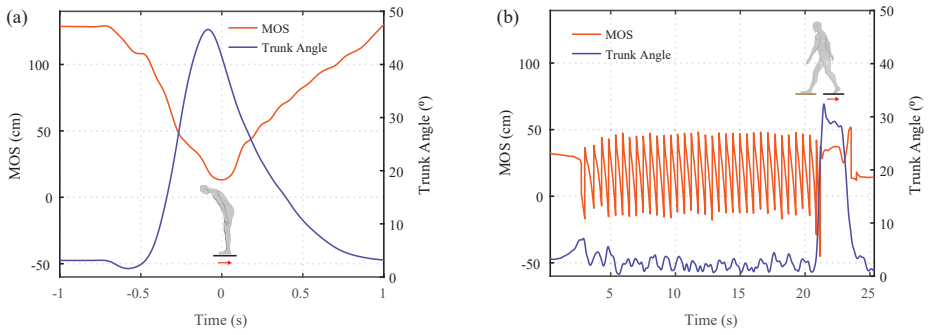
Minimum margin of stability (MOS) measured at the point of maximal instability, used as the primary metric to quantify whole-body postural stability across device conditions.
If this is right
- Higher device stiffness produces larger stability gains in standing than in walking.
- Both low and high stiffness settings improve stability over no device during walking perturbations.
- Adjustable stiffness allows the device to support reactive balance control against external disturbances.
- The findings support further development of such devices for fall prevention applications.
Where Pith is reading between the lines
- The device may offer larger benefits when tested in older adults or individuals with elevated fall risk.
- Real-time stiffness adjustment based on detected perturbations could enhance performance beyond fixed settings.
- Similar wearable supports might be developed for other joints or perturbation types to address different balance challenges.
Load-bearing premise
The minimum margin of stability at peak instability fully and accurately captures postural stability, and any differences between the three device conditions arise solely from the back-support device.
What would settle it
Repeating the standing and walking perturbation trials and finding no increase or a decrease in minimum margin of stability when the device is worn compared to no device.
Figures



read the original abstract
The effectiveness of a soft wearable back-support device in enhancing postural stability was investigated under trip-like perturbations using two experimental paradigms: perturbed standing and perturbed walking. Healthy subjects completed trials under three different back-support conditions: no device, device worn with low stiffness, and device activated with high stiffness. Whole-body stability was quantified using the minimum Margin of Stability (MOS) at the point of maximal instability. Results demonstrated increased MOS during device use, indicating enhanced postural stability. In standing, MOS increased significantly with device stiffness, whereas in walking, both device conditions improved MOS relative to no device but did not differ significantly from each other. These findings highlight the potential of soft wearable back-support devices with adjustable stiffness to improve reactive balance control against external perturbations, with important implications for fall prevention. Future research should explore personalized stiffness optimization and evaluate efficacy in populations at elevated risk of falls.
Editorial analysis
A structured set of objections, weighed in public.
Referee Report
Summary. The manuscript reports results from an experimental study examining the effects of a soft wearable back-support device (with low and high stiffness settings) on postural stability during trip-like perturbations. Two tasks are tested: perturbed standing and perturbed walking. Whole-body stability is quantified exclusively via the minimum Margin of Stability (MOS) at the point of maximal instability. The central claim is that device use increases minimum MOS relative to the no-device condition, with a stiffness-dependent effect in standing but only a presence effect in walking.
Significance. If the reported MOS increases prove robust after full methodological disclosure and statistical verification, the work would provide preliminary evidence that adjustable-stiffness soft exosuits can augment reactive balance under external perturbations, with potential relevance to fall-prevention applications. The distinction between standing and walking responses is a useful empirical observation, though the paper supplies no machine-checked proofs, open code, or parameter-free derivations.
major comments (2)
- [Abstract] Abstract: the statements that MOS 'increased significantly with device stiffness' (standing) and 'improved MOS relative to no device' (walking) are presented without sample size, statistical test, p-value, effect size, or error-bar information. This omission renders the central empirical claim unverifiable from the supplied text and is load-bearing for any assessment of the result.
- [Methods] Methods (implied by abstract): no description is given of perturbation delivery mechanics, device donning/fit protocol, participant exclusion criteria, how the 'point of maximal instability' was identified for MOS extraction, or whether complementary metrics (e.g., COM velocity, step length) were examined. These details are required to evaluate whether observed MOS differences can be attributed to the device without unaccounted biomechanical confounds.
minor comments (1)
- [Abstract] Abstract: the final sentence on 'personalized stiffness optimization' would benefit from a brief citation to existing literature on stiffness tuning in wearable robots.
Simulated Author's Rebuttal
We thank the referee for the detailed and constructive feedback. We address each major comment below and have prepared revisions to improve clarity and completeness of the manuscript.
read point-by-point responses
-
Referee: [Abstract] Abstract: the statements that MOS 'increased significantly with device stiffness' (standing) and 'improved MOS relative to no device' (walking) are presented without sample size, statistical test, p-value, effect size, or error-bar information. This omission renders the central empirical claim unverifiable from the supplied text and is load-bearing for any assessment of the result.
Authors: We agree that the abstract should include key statistical details to make the central claims verifiable. The full manuscript reports a sample size of n=15, two-way repeated-measures ANOVA with post-hoc tests, p<0.05 for the stiffness effect in standing, Cohen's d=0.75, and standard-error bars. We will revise the abstract to incorporate these values while preserving brevity. revision: yes
-
Referee: [Methods] Methods (implied by abstract): no description is given of perturbation delivery mechanics, device donning/fit protocol, participant exclusion criteria, how the 'point of maximal instability' was identified for MOS extraction, or whether complementary metrics (e.g., COM velocity, step length) were examined. These details are required to evaluate whether observed MOS differences can be attributed to the device without unaccounted biomechanical confounds.
Authors: The full manuscript contains dedicated Methods subsections on these topics (perturbation via sudden treadmill-belt accelerations, standardized donning protocol with fit verification, exclusion of participants with balance disorders, MOS extraction at peak COM anterior displacement, and analysis of complementary COM velocity and step-length metrics). We will expand the Methods section with additional explicit wording and cross-references to ensure these elements are immediately apparent. revision: partial
Circularity Check
No circularity: purely empirical experimental comparison
full rationale
The paper reports direct experimental measurements of minimum Margin of Stability (MOS) under three device conditions in perturbed standing and walking tasks. No equations, derivations, fitted parameters, or self-citations appear in the provided text or abstract. The central claims are observational outcomes of the protocol rather than reductions of any model to its inputs. This is the most common honest finding for empirical device studies.
Axiom & Free-Parameter Ledger
axioms (1)
- domain assumption Minimum Margin of Stability (MOS) at maximal instability is a valid and sufficient measure of whole-body postural stability
Reference graph
Works this paper leans on
-
[1]
Assessing balance loss and stability control in older adults exposed to gait perturbations under different environmental conditions: A feasibility study,
G. Varas-Diaz, U. Jayakumar, B. Taras, S. Wang, and T. Bhatt, “Assessing balance loss and stability control in older adults exposed to gait perturbations under different environmental conditions: A feasibility study,”Biomechanics, vol. 2, no. 3, pp. 392–405, 2022
2022
-
[2]
Perturbation training can reduce community-dwelling older adults’ annual fall risk: A randomized controlled trial,
Y .-C. Pai, T. Bhatt, F. Yang, and E. Wang, “Perturbation training can reduce community-dwelling older adults’ annual fall risk: A randomized controlled trial,”J. Gerontol. A Biol. Sci. Med. Sci., vol. 69, no. 12, pp. 1586–1594, 2014
2014
-
[3]
Mobility device use among older adults and incidence of falls and worry about falling: Findings from the 2011–2012 National Health and Aging Trends Study,
N. M. Gell, R. B. Wallace, A. Z. LaCroix, T. M. Mroz, and K. V . Patel, “Mobility device use among older adults and incidence of falls and worry about falling: Findings from the 2011–2012 National Health and Aging Trends Study,”J. Am. Geriatr . Soc., vol. 63, no. 5, pp. 853–859, 2015
2011
-
[4]
M. Tagliaferri and I. Kang, “Systematic evaluation of hip exoskeleton assistance parameters for enhancing gait stability during ground slip perturbations,” arXiv:2601.15056, 2026
-
[5]
Dynamic duo: Design and validation of an autonomous frontal and sagittal actuating hip exoskeleton for balance modulation during perturbed locomotion,
J. Leestma, S. Mathur, M. Anderton, G. Sawicki, and A. Young, “Dynamic duo: Design and validation of an autonomous frontal and sagittal actuating hip exoskeleton for balance modulation during perturbed locomotion,”IEEE Robot. Autom. Lett., vol. 9, pp. 3995– 4002, 2024
2024
-
[6]
Multi-tasking deteriorates trunk movement control during and after obstacle avoidance,
M. Nevisipour, T. Sugar, and H. Lee, “Multi-tasking deteriorates trunk movement control during and after obstacle avoidance,”Hum. Mov. Sci., vol. 87, Art. no. 103053, 2023
2023
-
[7]
Reduced trunk movement control during motor dual-tasking in older adults,
A. O. Vanderlinden, M. Nevisipour, T. Sugar, and H. Lee, “Reduced trunk movement control during motor dual-tasking in older adults,” Hum. Mov. Sci., vol. 95, Art. no. 103223, 2024
2024
-
[8]
Effects of two passive back-support exoskeletons on postural balance during quiet stance and functional limits of stability,
J.-H. Park, S. Kim, M. A. Nussbaum, and D. Srinivasan, “Effects of two passive back-support exoskeletons on postural balance during quiet stance and functional limits of stability,”Journal of Electromyo- graphy and Kinesiology, vol. 57, Art. no. 102516, 2021
2021
-
[9]
Effects of back-support exoskeleton use on gait performance and stability during level walking,
J.-H. Park, S. Kim, M. A. Nussbaum, and D. Srinivasan, “Effects of back-support exoskeleton use on gait performance and stability during level walking,”Gait & Posture, vol. 92, pp. 181–190, 2022
2022
-
[10]
Wearing a back-support exoskeleton alters lower-limb joint kinetics during single-step recovery following a forward loss of balance,
J.-H. Park, M. L. Madigan, S. Kim, M. A. Nussbaum, and D. Srinivasan, “Wearing a back-support exoskeleton alters lower-limb joint kinetics during single-step recovery following a forward loss of balance,”Journal of Biomechanics, vol. 166, Art. no. 112069, 2024
2024
-
[11]
Occu- pational arm-support and back-support exoskeletons elicit changes in reactive balance after slip-like and trip-like perturbations on a treadmill,
S. Dooley, S. Kim, M. A. Nussbaum, and M. L. Madigan, “Occu- pational arm-support and back-support exoskeletons elicit changes in reactive balance after slip-like and trip-like perturbations on a treadmill,”Applied Ergonomics, vol. 115, Art. no. 104178, 2024
2024
-
[12]
Effects of non- extensible lumbar belts on static and dynamic postural stability,
J. Bai, A. Hua, D. Weng, N. Wang, and J. Wang, “Effects of non- extensible lumbar belts on static and dynamic postural stability,”BMC Musculoskelet. Disord., vol. 24, Art. no. 362, 2023
2023
-
[13]
Immediate effects of lumbosacral orthosis on postural stability in patients with low back pain: A preliminary study,
F. Azadinia, I. Ebrahimi-Takamjani, M. Kamyab, M. Asgari, and M. Parnianpour, “Immediate effects of lumbosacral orthosis on postural stability in patients with low back pain: A preliminary study,”Arch. Bone Joint Surg., vol. 7, no. 4, pp. 360–366, 2019
2019
-
[14]
A hybrid variable-stiffness soft back support device,
R. Khatavkar, T. B. Nguyen, Y . Chen, H. Lee, and J. Sun, “A hybrid variable-stiffness soft back support device,”IEEE Robot. Autom. Lett., vol. 10, no. 4, pp. 3238–3245, 2025
2025
-
[15]
Accessed: 2023
Vicon,Vicon Nexus Plug-In Gait Reference Guide (Revision 2). Accessed: 2023. [Online]
2023
-
[16]
Relationship between gait stability indices and gait parameters com- prising joint angles based on walking data from 288 people,
T. Inagaki, Y . Akiyama, S. Okamoto, T. Mayumi, and Y . Yamada, “Relationship between gait stability indices and gait parameters com- prising joint angles based on walking data from 288 people,”Nagoya J. Med. Sci., vol. 85, no. 2, pp. 211–222, 2023
2023
-
[17]
Assessing the stability of human locomotion: A review of current measures,
S. M. Bruijn, O. G. Meijer, P. J. Beek, and J. H. van Die ¨en, “Assessing the stability of human locomotion: A review of current measures,”J. R. Soc. Interface, vol. 10, no. 83, Art. no. 20120999, 2013
2013
-
[18]
The condition for dynamic stability,
A. L. Hof, M. G. J. Gazendam, and W. E. Sinke, “The condition for dynamic stability,”J. Biomech., vol. 38, no. 1, pp. 1–8, 2005
2005
-
[19]
Time series smoothing improving forecasting,
V . Romanuke, “Time series smoothing improving forecasting,”Appl. Comput. Syst., vol. 26, no. 1, pp. 60–70, 2021
2021
-
[20]
Linear mixed-effects model,
A. Galecki and T. Burzykowski, “Linear mixed-effects model,” in Linear Mixed-Effects Models Using R: A Step-by-Step Approach, Springer Texts in Statistics, Springer, 2013, pp. 245–273
2013
-
[21]
Linking whole-body angular momentum and step placement during perturbed human walking,
J. Leestma, P. Golyski, C. Smith, G. Sawicki, and A. Young, “Linking whole-body angular momentum and step placement during perturbed human walking,”J. Exp. Biol., vol. 226, Art. no. jeb244760, 2023
2023
-
[22]
Angular momentum regulation may dictate the slip severity in young adults,
M. Nazifi, K. Beschorner, and P. Hur, “Angular momentum regulation may dictate the slip severity in young adults,”PLoS One, vol. 15, Art. no. e0230019, 2020
2020
-
[23]
Non-ideal behavior of a treadmill depends on gait phase, speed, and weight,
A. Tielke, J. Ahn, and H. Lee, “Non-ideal behavior of a treadmill depends on gait phase, speed, and weight,”Sci. Rep., vol. 9, Art. no. 12755, 2019
2019
-
[24]
A kinematic comparison of overground and treadmill walking,
F. Alton, L. Baldey, S. Caplan, and M. C. Morrissey, “A kinematic comparison of overground and treadmill walking,”Clin. Biomech., vol. 13, no. 6, pp. 434–440, 1998
1998
-
[25]
R. Khatavkar, T. Nguyen, I. Kang, H. Lee, and J. Sun, “Soft semi- active back support device with adaptive force profiles using variable- elastic actuation and weight feedback,” arXiv:2603.03724, 2026
discussion (0)
Sign in with ORCID, Apple, or X to comment. Anyone can read and Pith papers without signing in.