Effective synchronization amid noise-induced chaos
Pith reviewed 2026-05-22 15:05 UTC · model grok-4.3
The pith
Clocks driven by strong common noise achieve effective synchronization by losing memory of initial phases and allowing phase estimation.
A machine-rendered reading of the paper's core claim, the machinery that carries it, and where it could break.
Core claim
Under strong disruptive noise the relative phases of the two clocks vary erratically yet become statistically independent of initial conditions after a well-defined timescale, so that one agent can estimate an effective phase that closely agrees with the phase of the other agent.
What carries the argument
Statistical independence of relative phases from initial conditions under shared stochastic forcing, which enables phase estimation.
If this is right
- Synchronization remains attainable for stronger environmental forcing than the conventional noise-induced regime allows.
- Distant agents can coordinate actions by estimating each other's phase without exchanging signals.
- The time to reach statistical independence sets a practical limit on how quickly the clocks become usable for joint tasks.
- The same mechanism could operate in living systems that share fluctuating external conditions.
Where Pith is reading between the lines
- Similar effective synchronization might appear in other driven chaotic oscillators when they share a common random drive.
- Testing the result with measured biological noise spectra would check whether the simple noise model captures real environments.
- The estimated phase could serve as a shared reference for timing decisions in distributed systems.
Load-bearing premise
The demonstration uses one particular simple model of strong disruptive noise.
What would settle it
A measurement showing that relative phases under different initial conditions remain correlated for arbitrarily long times under the same noise would falsify the independence claim.
Figures




read the original abstract
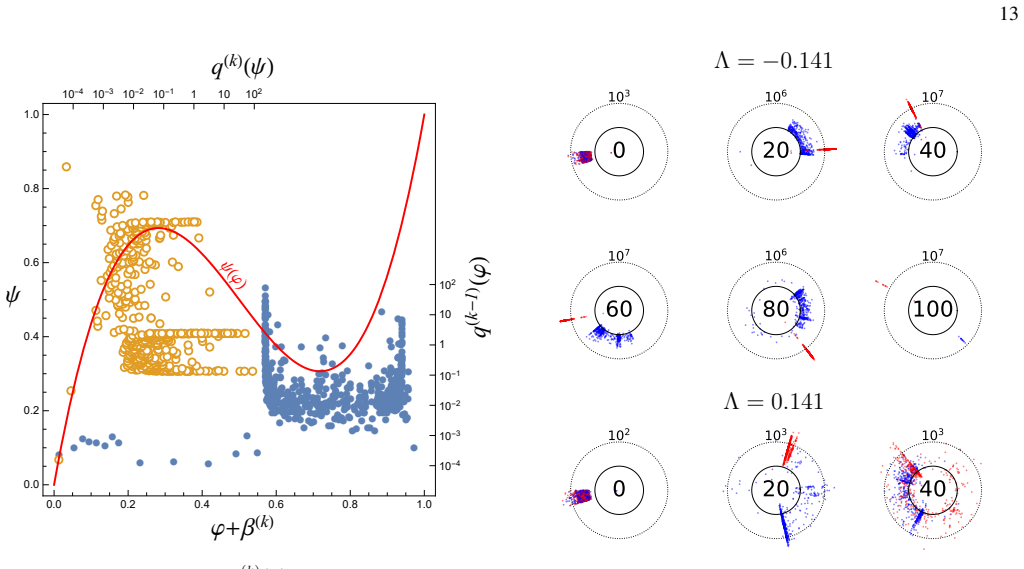
Two remote agents with synchronized clocks may use them to act in concert and communicate. This necessitates some means of creating and maintaining synchrony. One method, not requiring any direct interaction between the agents, is to expose them to a common, environmental, stochastic forcing. This "noise-induced synchronization" only occurs under sufficiently mild forcing; stronger forcing disrupts synchronization. We investigate the regime of strong noise, where the clocks' relative phases evolve chaotically. Using a simple realization of disruptive noise, we demonstrate effective synchronization. First, although the relative phases of the two clocks varied erratically, we confirm that they became statistically independent of initial conditions and hence equivalent after a well-defined timescale. Second, we show that an agent can estimate an effective phase that closely agrees with the other's phase. Thus, synchronization is practically attainable beyond the regime of conventional noise-induced synchronization. We finally discuss how it might be used in living systems.
Editorial analysis
A structured set of objections, weighed in public.
Referee Report
Summary. The manuscript investigates synchronization of remote clocks under common environmental stochastic forcing. In the strong-noise regime where relative phases evolve chaotically, it claims that the phases nevertheless become statistically independent of initial conditions after a finite timescale and that one agent can estimate an effective phase that agrees with the other agent's phase. The demonstration uses a simple realization of disruptive noise and discusses possible relevance to living systems.
Significance. If the statistical forgetting and phase estimability are shown to be robust properties of strong common forcing rather than artifacts of one noise process, the result would meaningfully extend noise-induced synchronization beyond the conventional mild-forcing regime. The concrete numerical demonstration for the chosen model is a strength, but the absence of generality checks limits the immediate impact.
major comments (1)
- [Numerical demonstration of chaotic relative-phase evolution] The central demonstration (described in the abstract and the main numerical section) relies exclusively on one specific realization of disruptive noise. No analytic derivation is given showing that statistical independence of initial conditions follows from general properties of strong forcing, and no additional simulations with qualitatively different noise (different correlation structure, amplitude distribution, or non-Gaussian statistics) are reported. Because the claim is framed for the regime of strong noise in general, this specificity is load-bearing and must be addressed to support the conclusion that effective synchronization is attainable beyond conventional noise-induced synchronization.
minor comments (2)
- [Abstract] The abstract states that phases 'became statistically independent of initial conditions and hence equivalent after a well-defined timescale' but provides no quantitative measure of that timescale or error bars on the independence test; adding these details would improve clarity.
- [Agent phase estimation] Notation for the effective phase estimated by the agent should be introduced explicitly when first used, and the agreement metric (e.g., mean phase difference or correlation) should be defined in the text rather than left implicit.
Simulated Author's Rebuttal
We thank the referee for their constructive feedback. We address the major comment on the specificity of the noise realization below and describe planned revisions.
read point-by-point responses
-
Referee: The central demonstration (described in the abstract and the main numerical section) relies exclusively on one specific realization of disruptive noise. No analytic derivation is given showing that statistical independence of initial conditions follows from general properties of strong forcing, and no additional simulations with qualitatively different noise (different correlation structure, amplitude distribution, or non-Gaussian statistics) are reported. Because the claim is framed for the regime of strong noise in general, this specificity is load-bearing and must be addressed to support the conclusion that effective synchronization is attainable beyond conventional noise-induced synchronization.
Authors: We acknowledge that the central demonstration relies on one specific realization of disruptive noise, as described in the methods. We do not provide an analytic derivation showing statistical independence from general properties of strong forcing, as this would require a broader theoretical framework outside the scope of the present numerical study. To address the concern about robustness, we will add in the revised manuscript additional simulations using qualitatively different noise processes, including altered correlation structures, different amplitude distributions, and non-Gaussian statistics. These results will test whether the observed statistical independence of initial conditions after a finite timescale and the estimability of an effective phase remain valid beyond the original noise model. revision: yes
- Analytic derivation showing that statistical independence of initial conditions follows from general properties of strong forcing
Circularity Check
No circularity: claims rest on direct numerical demonstration for a specific noise model
full rationale
The paper presents a demonstration of statistical independence of relative phases from initial conditions and effective phase estimation under one chosen disruptive noise process. No load-bearing step reduces by construction to a fitted parameter renamed as prediction, no self-citation chain justifies the central result, and no ansatz or uniqueness theorem is imported from prior author work to force the outcome. The derivation chain consists of explicit simulation and statistical checks on the chosen model rather than tautological re-expression of inputs. This is the expected honest outcome for a demonstration paper whose scope is limited to one realization.
Axiom & Free-Parameter Ledger
axioms (1)
- domain assumption Clocks are modeled as phase oscillators subject to common environmental stochastic forcing.
Reference graph
Works this paper leans on
-
[1]
We takeD(A∥B)→0to mean that the two distributions have converged and become equivalent. Pursuing this evidence that all agents become statistically equivalent, we show in Sec. IV that each agent may define an effective phase that agrees closely with that of the other agent. This is possible in spite of the agents’ current phases differ- ing widely. This a...
work page 2000
-
[2]
These misidentifications were an important factor in our choice of smoothing widthσ=e S
We anticipate that any remaining largeφ f’s could be made insignificant. These misidentifications were an important factor in our choice of smoothing widthσ=e S. Indeed, when we used σ=e S/N(rather thanσ=e S of Sec. IV A) as a band- width, there were791misidentified points (8%), which have occurred with distributions of entropies as a low asS=−14; see Fig...
-
[3]
J. C. Dunlap, Molecular bases for circadian clocks, Cell96, 271 (1999)
work page 1999
-
[4]
Y . Liao and M. J. Rust, The circadian clock ensures successful DNA replication in cyanobacteria, Proc. Natl. Acad. Sci. U.S.A. 118, e2022516118 (2021)
work page 2021
-
[5]
G. Banfalvi,Cell Cycle Synchronization, 2nd ed., Methods in Molecular Biology (Springer, New York, 2017)
work page 2017
- [6]
-
[7]
Z. F. Mainen and T. J. Sejnowski, Reliability of spike timing in neocortical neurons, Science268, 1503 (1995)
work page 1995
-
[8]
R. R. de Ruyter van Steveninck, G. D. Lewen, S. P. Strong, R. Koberle, and W. Bialek, Reproducibility and variability in neural spike trains, Science275, 1805 (1997)
work page 1997
-
[9]
Y . Penn, M. Segal, and E. Moses, Network synchronization in hippocampal neurons, Proc. Natl. Acad. Sci. USA113, 3341 (2016)
work page 2016
-
[10]
K. H. Srivastava, C. M. Holmes, M. Vellema, A. R. Pack, C. P. H. Elemans, I. Nemenman, and S. J. Sober, Motor con- trol by precisely timed spike patterns, Proc. Natl. Acad. Sci. 114, 1171 (2017)
work page 2017
-
[11]
S. J. Sober, S. Sponberg, I. Nemenman, and L. H. Ting, Mil- lisecond spike timing codes for motor control, Trends Neurosci. 41, 644 (2018), special Issue: Time in the Brain
work page 2018
-
[12]
S. Trolier-McKinstry, S. Zhang, A. J. Bell, and X. Tan, High- performance piezoelectric crystals, ceramics, and films, Annu. Rev. Mater. Res.48, 191 (2018)
work page 2018
-
[13]
Strogatz,Sync: The emerging science of spontaneous order (Penguin UK, 2004)
S. Strogatz,Sync: The emerging science of spontaneous order (Penguin UK, 2004)
work page 2004
-
[14]
A. Pikovsky, M. Rosenblum, and J. Kurths,Synchronization: a universal concept in nonlinear sciences, V ol. 12 (Cambridge University Press, 2003)
work page 2003
-
[15]
D. J. T. Sumpter, The principles of collective animal behaviour, Philos. Trans. R. Soc. B361, 5 (2006)
work page 2006
- [16]
-
[17]
A. Pikovsky, Synchronization and stochastization of array of self-excited oscillators by external noise, Radiophys. Quantum 17 Electron27, 390 (1984)
work page 1984
-
[18]
A. S. Pikovsky and J. Kurths, Coherence resonance in a noise- driven excitable system, Phys. Rev. Lett.78, 775 (1997)
work page 1997
-
[19]
R. V . Jensen, Synchronization of randomly driven nonlinear os- cillators, Phys. Rev. E58, R6907 (1998)
work page 1998
-
[20]
J. Teramae and D. Tanaka, Robustness of the noise-induced phase synchronization in a general class of limit cycle oscil- lators, Phys. Rev. Lett.93, 204103 (2004)
work page 2004
-
[21]
D. S. Goldobin and A. Pikovsky, Synchronization and desyn- chronization of self-sustained oscillators by common noise, Phys. Rev. E71, 045201 (2005)
work page 2005
- [22]
-
[23]
K. Nagai and H. Nakao, Experimental synchronization of cir- cuit oscillations induced by common telegraph noise, Phys. Rev. E79, 036205 (2009)
work page 2009
- [24]
-
[25]
J. A. Eaton, B. Moths, and T. A. Witten, Criterion for noise- induced synchronization: Application to colloidal alignment, Phys. Rev. E94, 032207 (2016)
work page 2016
-
[26]
Y . Song and T. A. Witten, Stochastic synchronization induced by noise, Phys. Rev. E106, 044207 (2022)
work page 2022
-
[27]
T. Yamamoto, I. Oowada, H. Yip, A. Uchida, S. Yoshi- mori, K. Yoshimura, J. Muramatsu, S. Goto, and P. Davis, Common-chaotic-signal induced synchronization in semicon- ductor lasers, Opt. Express15, 3974 (2007)
work page 2007
-
[28]
F. Schmolke and E. Lutz, Noise-induced quantum synchroniza- tion, Phys. Rev. Lett.129, 250601 (2022)
work page 2022
-
[29]
Z. Tao, F. Schmolke, C.-K. Hu, W. Huang, Y . Zhou, J. Zhang, J. Chu, L. Zhang, X. Sun, Z. Guo, J. Niu, W. Weng, S. Liu, Y . Zhong, D. Tan, D. Yu, and E. Lutz, Noise-induced quantum synchronization with entangled oscillations, Nat. Commun.16, 8457 (2025)
work page 2025
-
[30]
T. Zhou, L. Chen, and K. Aihara, Molecular communication through stochastic synchronization induced by extracellular fluctuations, Phys. Rev. Lett.95, 178103 (2005)
work page 2005
-
[31]
Buzzi, Exponential decay of correlations for random Lasota– Yorke maps, Commun
J. Buzzi, Exponential decay of correlations for random Lasota– Yorke maps, Commun. Math. Phys.208, 25 (1999)
work page 1999
- [32]
-
[33]
G. Froyland, C. Gonz ´alez-Tokman, and A. Quas, Stability and approximation of random invariant densities for Lasota–Yorke map cocycles, Nonlinearity27, 647 (2014)
work page 2014
-
[34]
G. Froyland, C. Gonza ´lez-Tokman, and R. Murray, Quenched stochastic stability for eventually expanding-on-average ran- dom interval map cocycles, Ergod. Theory Dyn. Syst.39, 2769–2792 (2019)
work page 2019
-
[35]
V . I. Arnold,Mathematical Methods of Classical Mechanics, Graduate Texts in Mathematics (Springer, New York, 1978)
work page 1978
-
[36]
S. B. S. Khalsa, M. E. Jewett, C. Cajochen, and C. A. Czeisler, A phase response curve to single bright light pulses in human subjects, J. Physiol.549, 945 (2003)
work page 2003
-
[37]
N. W. Schultheiss, A. A. Prinz, and R. J. Butera, eds.,Phase Response Curves in Neuroscience, Springer Series in Compu- tational Neuroscience (Springer, New York, 2012)
work page 2012
-
[38]
S. Hata, T. Shimokawa, K. Arai, and H. Nakao, Synchroniza- tion of uncoupled oscillators by common gamma impulses: From phase locking to noise-induced synchronization, Phys. Rev. E82, 036206 (2010)
work page 2010
-
[39]
T. M. Cover and J. A. Thomas,Elements of information theory, 2nd ed. (Wiley-Interscience, 2006)
work page 2006
-
[40]
Q. Wang, S. R. Kulkarni, and S. Verdu, Divergence estima- tion for multidimensional densities viak-nearest-neighbor dis- tances, IEEE Trans. Inf. Theory55, 2392 (2009)
work page 2009
-
[41]
J. D. Victor, Binless strategies for estimation of information from neural data, Phys. Rev. E66, 051903 (2002)
work page 2002
-
[42]
Arnold,Random Dynamical Systems, 2nd ed
L. Arnold,Random Dynamical Systems, 2nd ed. (Springer, 2003)
work page 2003
-
[43]
D. A. Levin, Y . Peres, and E. Wilmer,Markov Chains and Mix- ing Times, 2nd ed. (American Mathematical Society, 2017)
work page 2017
-
[44]
B. W. Silverman,Density Estimation for Statistics and Data Analysis(Chapman & Hall, 1986)
work page 1986
-
[45]
B. U. Park and J. S. Marron, Comparison of data-driven band- width selectors, J. Am. Statist. Ass.85, 66 (1990)
work page 1990
-
[46]
S. J. Sheather and M. C. Jones, A reliable data-based bandwidth selection method for kernel density estimation, J. R. Statist. Soc. B53, 683 (1991)
work page 1991
-
[47]
B. W. Silverman, Using kernel density estimates to investigate multimodality, J. R. Statist. Soc. B43, 97 (1981)
work page 1981
- [48]
-
[49]
P. Vincent and Y . Bengio, Manifold parzen windows, inAd- vances in Neural Information Processing Systems, V ol. 15, edited by S. Becker, S. Thrun, and K. Obermayer (MIT Press,
-
[50]
A. M ´esz´aros, J. F. Schumann, J. Alonso-Mora, A. Zgonnikov, and J. Kober, Rome: Robust multi-modal density estimator, in Proc. 33rd Int. Jt. Conf. on Artif. Intell, edited by K. Larson (International Joint Conferences on Artificial Intelligence Or- ganization, 2024) pp. 4751–4759
work page 2024
-
[51]
A. Marsiglietti and V . Kostina, A lower bound on the differen- tial entropy of log-concave random vectors with applications, Entropy20, 185 (2018)
work page 2018
-
[52]
C. Zhou, J. Kurths, I. Z. Kiss, and J. L. Hudson, Noise-enhanced phase synchronization of chaotic oscillators, Phys. Rev. Lett. 89, 014101 (2002)
work page 2002
-
[53]
Z. G. Nicolaou, M. Sebek, I. Z. Kiss, and A. E. Motter, Coher- ent dynamics enhanced by uncorrelated noise, Phys. Rev. Lett. 125, 094101 (2020)
work page 2020
-
[54]
J. C. Pang, L. L. Gollo, and J. A. Roberts, Stochastic synchro- nization of dynamics on the human connectome, NeuroImage 229, 117738 (2021)
work page 2021
-
[55]
E. R. Bittner and B. Tyagi, Noise-induced synchronization in coupled quantum oscillators, J. Chem. Phys.162, 104116 (2025)
work page 2025
-
[56]
E. Marder and D. Bucher, Central pattern generators and the control of rhythmic movements, Curr. Biol.11, R986 (2001)
work page 2001
- [57]
-
[58]
Gilpin, Cryptographic hashing using chaotic hydrodynam- ics, Proc
W. Gilpin, Cryptographic hashing using chaotic hydrodynam- ics, Proc. Natl. Acad. Sci. U.S.A.115, 4869 (2018)
work page 2018
-
[59]
A. Argyris, D. Syvridis, L. Larger, V . Annovazzi-Lodi, P. Co- let, I. Fischer, J. Garc ´ıa-Ojalvo, C. R. Mirasso, L. Pesquera, and K. A. Shore, Chaos-based communications at high bit rates using commercial fibre-optic links, Nature438, 343 (2005)
work page 2005
-
[60]
H.-H. Choi and J.-R. Lee, Principles, applications, and chal- lenges of synchronization in nature for future mobile commu- nication systems, Mob. Inf. Syst.2017, 8932631 (2017)
work page 2017
-
[61]
A. Pljonkin, K. Rumyantsev, and P. K. Singh, Synchroniza- tion in quantum key distribution systems, Cryptography1, 18 (2017)
work page 2017
-
[62]
J. T. Stuart, On the non-linear mechanics of wave disturbances in stable and unstable parallel flows part 1. the basic behaviour 18 in plane poiseuille flow, J. Fluid Mech.9, 353 (1960)
work page 1960
-
[63]
J. Watson, On the non-linear mechanics of wave disturbances in stable and unstable parallel flows part 2. the development of a solution for plane poiseuille flow and for plane couette flow, J. Fluid Mech.9, 371 (1960)
work page 1960
-
[64]
K. Fukunaga and L. Hostetler, The estimation of the gradient of a density function, with applications in pattern recognition, IEEE Trans. Inf. Theory21, 32 (1975)
work page 1975
-
[65]
Cheng, Mean shift, mode seeking, and clustering, IEEE Trans
Y . Cheng, Mean shift, mode seeking, and clustering, IEEE Trans. Pattern Anal. Mach. Intell.17, 790 (1995)
work page 1995
-
[66]
D. Comaniciu and P. Meer, Mean shift: a robust approach to- ward feature space analysis, IEEE Trans. Pattern Anal. Mach. Intell.24, 603 (2002)
work page 2002
discussion (0)
Sign in with ORCID, Apple, or X to comment. Anyone can read and Pith papers without signing in.