REVIEW 4 major objections 4 minor 123 references
Text-driven 3D human garment editing gets a fidelity boost from SMPL-X body priors, which anchor Gaussians to the body surface, tie cross-view attention to shared mesh vertices, and prune overflow with a signed-distance field.
Reviewed by Pith at T0; open to challenge. T0 means a machine referee read the full paper against a public rubric. the ladder, T0–T4 →
T0 review · deepseek-v4-flash
2026-08-02 04:32 UTC pith:OYRP33IA
load-bearing objection A genuinely useful three-stage recipe for 3D garment editing, with qualitative results that look right; the quantitative evidence is thinner than the claims, and the paper never validates the SMPL-X fit that the whole mechanism rests on. the 4 major comments →
T3HG-Editor: Text-driven 3D Human Garment Editing with Body Priors Embedded in SMPL-X
The pith
A machine-rendered reading of the paper's core claim, the machinery that carries it, and where it could break.
Core claim
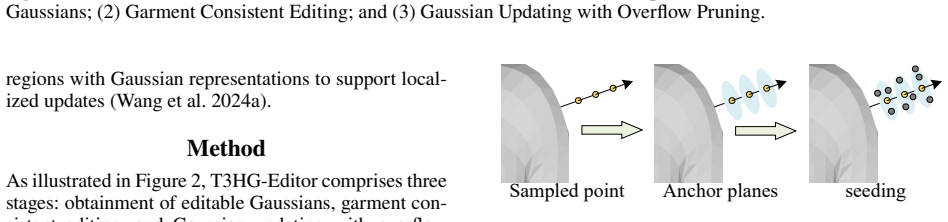
The central claim is that the SMPL-X model, which already encodes human body geometry and pose joints, can serve as a structural anchor for 3D Gaussian garment editing, and that doing so resolves two failure modes that plague existing 2D-edit-then-3D-update pipelines: shape distortions in the garment region and cross-view garment inconsistencies. Concretely, the paper seeds Gaussians along SMPL-X surface normals to densely cover near-body regions that may be missing after an edit, uses a union of pre- and post-edit garment masks to localize the edit region, forces cross-view consistency by concatenating the self-attention tokens of pixels that map to the same SMPL-X vertex across key views,
What carries the argument
The load-bearing object is the SMPL-X mesh used as a unified geometric reference. Three mechanisms hang off it: (1) SMPL-X-based Gaussian seeding — points are sampled along each vertex normal within a distance D_max and turned into new Gaussians whose attributes are aggregated from nearest neighbours, giving the scene sufficient near-surface coverage for garments that grow or change shape; (2) SMPL-X-vertex guided attention and feature propagation — pixel patches are annotated with the index of the SMPL-X vertex they project to, tokens sharing the same vertex across key views are concatenated and processed together in the U-Net self-attention, and the resulting features are propagated to non
Load-bearing premise
The whole pipeline assumes that the fitted SMPL-X mesh tracks the actual garment surface closely enough that normal-seeded Gaussians land on the garment and vertex-to-pixel correspondences are meaningful; when the fit is poor—loose dresses, puffy jackets, extreme poses—the seeds, attention, and pruning all degrade.
What would settle it
Take a clothed human with a loose or heavily folded garment (e.g., a puffer jacket or a flowing skirt), run T3HG-Editor, and compare the edited render with the same prompt applied by a strong 2D editor; if the CLIP similarity or human-rated fidelity does not exceed a simple per-view 2D edit with 3D back-projection, the claimed benefit of SMPL-X anchoring would be falsified.
If this is right
- If the claim holds, text-driven garment editing can be confined to the desired region without contaminating the background or untouched body parts, which matters for asset reuse and e-commerce display.
- The vertex-tied cross-view attention provides a training-free way to enforce multi-view consistency for human-centred edits, avoiding the cost of per-scene fine-tuning.
- The SDF-plus-mask pruning suggests a general recipe for preventing Gaussian drift in any 3DGS editing task where a strong geometric prior is available, not only for garments.
- The reported ~8-minute runtime with competitive editing quality indicates the approach is practical on a single 32GB GPU, opening the door to interactive workflows.
Where Pith is reading between the lines
- A natural extension the paper leaves implicit is to replace InstructPix2Pix with a stronger instruction-following editor or a garment-specific diffusion model, which could improve prompt faithfulness and reduce reliance on selecting the best of several edited views.
- The vertex-anchored correspondence could be upgraded to a continuous UV or barycentric coordinate mapping instead of nearest-vertex indices, potentially improving consistency for loose garments that slide relative to the body surface.
- One testable extension is whether the same SMPL-X-anchored pipeline generalizes to accessories (hats, scarves, shoes) or to body shape changes, where the fitted SMPL-X surface is less reliable.
- Because the method depends on a fitted SMPL-X mesh, a quantitative study of how registration error affects edit quality would make the approach's practical boundary explicit.
Editorial analysis
A structured set of objections, weighed in public.
Referee Report
Summary. The paper proposes T3HG-Editor, a text-driven 3D human garment editing system built on 3D Gaussian Splatting and SMPL-X body priors. The pipeline consists of three stages: (1) obtaining editable Gaussians by seeding them along SMPL-X vertex normals and filtering with a union of pre- and post-edit 2D masks from SAM; (2) enforcing cross-view garment consistency by restricting self-attention to tokens from the same SMPL-X vertex across key views and propagating the resulting features to other views; (3) updating Gaussians with a dual 2D/3D pruning mechanism that uses an SMPL-X SDF and a semantic mask to remove overflowing Gaussians. Experiments on 10 text prompts compare with GaussianEditor, DGE, and EditSplat, reporting higher CLIP similarity and CLIP directional similarity (Table 1) and better SSIM/LPIPS in target and non-target garment regions (Table 2), with qualitative results in Fig. 6 and a qualitative ablation in Fig. 7. The paper concludes that T3HG-Editor outperforms state-of-the-art methods in editing quality and garment consistency.
Significance. If the claimed results are reliable, T3HG-Editor would be a practical recipe for editing 3D human garments with Gaussian splatting: SMPL-X-normal-based seeding, mask-union localization, vertex-tied cross-view attention, and SDF/mask pruning together form a coherent system. The use of SMPL-X as a unified geometric reference for correspondence is a sensible way to attack the multi-view inconsistency problem, and the introduced pruning mechanism targets a real failure mode of existing editing methods. However, the evidence provided is not yet sufficient to establish the central claim of 'outperforming state-of-the-art': several load-bearing parameters and the SMPL-X fitting procedure are undisclosed, the quantitative evaluation is partly circular and lacks statistical grounding, and the comparison protocol may be biased by the ImageReward selection step. The technical idea is promising, but the validation gaps currently prevent the paper from being accepted in its present form.
major comments (4)
- [Experimental Setup — Implementation Details; §Obtainment of Editable Gaussians; §3D Pruning] The representable geometry of the edited garment is bounded by the hand-set parameters D_max (seeding distance) and β (SDF pruning threshold), both described as 'typically set within the range of 0 to 0.1 m'. The paper's own qualitative examples include a puffer jacket and a formal dress (Fig. 6), garments whose surfaces are often more than 0.1 m from the SMPL-X body mesh at hems and sleeves. If the per-prompt thresholds were not raised substantially for those examples, the described mechanism is geometrically incapable of producing the shown outputs. The paper never reports per-prompt values of D_max and β, nor does it describe the SMPL-X fitting procedure that is the foundation of normal seeding, vertex–pixel correspondences, and SDF pruning. This makes the central claim unfalsifiable from the text and needs to be resolved by reporting the fitting method, its accuracy on loose garments
- [§Quantitative Comparisons, Table 2; Eq. (3)] The target-region PSNR, SSIM, and LPIPS in Table 2 compare rendered test views against edited images that are themselves used as supervision in the editing loss (Eq. (3)) and as the source of the pruning mask M_final. This is not an independent assessment of editing quality; it largely measures reconstruction fidelity to the method's own supervisory signal. The non-target-region metrics are more meaningful, but the target-region numbers are circular. The authors should either compare against an independent reference (e.g., manually edited or template-based ground truth), or clearly separate the reconstruction-based quality from the semantic editing quality, or add a human evaluation.
- [§Mask-based filtering] The pipeline selects the top-N IP2P outputs using ImageReward and uses only those images as supervision (Eq. (3)). It is not stated whether the three baseline methods (GaussianEditor, DGE, EditSplat) are also permitted this selection. If they are not, the comparison is confounded: T3HG-Editor optimizes against only the high-quality edited views, while baselines may be forced to incorporate poorly edited views. The comparison should apply the same selection procedure to all methods, or report a control without ImageReward selection to isolate the contribution of the proposed editing mechanism.
- [Tables 1 and 2] No standard deviations, confidence intervals, or significance tests are reported for any metric. The margins over the best baseline are small (e.g., SSIM 0.5796 vs. 0.5783 in the target region; CLIP similarity 0.2660 vs. 0.2573). Without knowledge of run-to-run variability across seeds or prompt subsets, the claim of 'outperforms state-of-the-art' is not statistically supported. Please report per-prompt results and error bars, or at least multiple runs with means and standard deviations.
minor comments (4)
- [Eq. (3) and Eq. (7)] The notation 'min_{N}' is ambiguous: the subscript n appears both as a view index and as the index over the N selected views. It should be clarified whether the minimization is over the selected views or over all rendered views.
- [§SMPL-X-vertex Guided Feature Propagation, Eq. (6)] The definition of the weights w_m is unclear: 'normalizing the number of vertices. It shares with the n-th normal view' is grammatically broken and mathematically imprecise. Please define w_m formally, e.g., w_m ∝ |V_n ∩ V_m| where V_n is the set of vertices visible in view n.
- [Figures 5 and 6 captions] The captions contain empty parentheses, e.g., 'Original view ( )' and 'Edited view ( )', which appear to be placeholders for images. Please fill these in.
- [Experiments] The ten text prompts are not listed explicitly. A list of all prompts and per-prompt metric values would greatly improve reproducibility and enable readers to assess prompt difficulty.
Circularity Check
Table 2 target/non-target metrics use the method's own supervision images and self-derived mask; central CLIP/qualitative comparisons remain independent.
specific steps
-
fitted input called prediction
[Method (Eq. 3; Mask-based filtering) vs. Experiments (Table 2)]
"the top N images are selected as supervision for subsequent Gaussian updates ... the resulting 2D mask M_final is used both as the loss region and as the supervision region for subsequent pruning ... The rendered test views are compared with the edited images in the target garment regions and with the original images in the non-target regions."
Table 2's target-region reference (the IP2P-edited images) and mask region (M_final) are the same objects that Eq. (3) minimizes against: L_edit = min Σ ||I_post(M_final) − I′(M_final)||. M_final is computed from SAM on the IP2P-edited outputs and is explicitly 'used both as the loss region and as the supervision region for subsequent pruning.' Thus the reported target-region PSNR/SSIM/LPIPS largely measure how closely the 3DGS reproduces its own supervision and its self-defined mask. The four held-out views soften the overlap, but the reference images and mask pipeline are shared with training, so this part of the evaluation is not an independent editing-quality ground truth.
full rationale
The paper's derivation chain is otherwise self-contained. SMPL-X-based seeding, vertex-guided cross-view attention, and SDF+mask pruning are new mechanisms built on external components (SMPL-X, GaussianEditor-style mask back-projection, IP2P, SAM, ImageReward) rather than on the paper's own conclusions. There is no load-bearing self-citation chain, no imported uniqueness theorem, and no ansatz smuggled in via self-citation. The CLIP similarity and CLIP directional similarity in Table 1 are computed against text on rendered views of the final 3DGS and are not direct training objectives, so they remain external evidence; the qualitative comparisons are also independent. The main circularity concern is localized to Table 2, where the target-region and non-target-region references coincide with the supervision and loss terms of Eq. (3)/(7), making those fidelity/consistency numbers partly self-referential. The β/D_max shell-boundedness issue raised in the skeptic note is a correctness and geometric-expressiveness concern about loose garments, not a circularity, because it does not reduce the output to an input by construction. Overall, the central claims retain substantial independent content, so the score is low-to-moderate rather than high.
Axiom & Free-Parameter Ledger
free parameters (6)
- D_max (SMPL-X normal seeding distance) =
0-0.1 m (per garment)
- r (seeding in-plane radius) =
not specified
- J (sampled points per vertex normal) =
not specified
- beta (SDF pruning distance threshold) =
0-0.1 m (per garment)
- Key view sampling density (1 per 5 views) =
M about 4 for 20 views
- N and iteration count =
N=20 views, 1200 iterations
axioms (6)
- domain assumption The input scene has an accurately fitted SMPL-X mesh aligned with the clothed human body
- domain assumption InstructPix2Pix produces garment edits faithful enough to the text for mask and supervision
- domain assumption SAM's masks (M_pre, M_post, M_hum) correctly isolate the target garment and the human
- domain assumption Rendering SMPL-X vertices into each view produces a reliable bidirectional token-vertex index despite occlusion
- domain assumption GaussianEditor's back-projection correctly assigns semantic labels from the 2D mask to Gaussians
- domain assumption The SMPL-X SDF distance approximates 'out-of-body drift' well enough to prune contaminated Gaussians
read the original abstract
While 3D Gaussian Editing (3DGE) has seen substantial progress, text-driven 3D human garment editing remains largely underexplored. Existing 3DGE works typically follow a paradigm that applies 2D editing techniques to multi-view rendered images and updates 3D Gaussians based on the modified images. Extending such methods to 3D human garment editing suffers from low-fidelity outcomes, caused by introduced distortions and garment inconsistencies. A promising breakthrough opportunity arises from the SMPL eXpressive (SMPL-X) model that embodies rich prior information for virtual humans. Motivated by this insight, we propose a text-driven 3D human garment editor termed T3HG-Editor, which delivers high-fidelity and garment consistent results by leveraging geometry and joint priors embedded in SMPL-X. Specifically, T3HG-Editor contains three stages, namely obtainment of editable Gaussians, garment consistent editing, and Gaussian updating with overflow pruning. The obtainment of editable Gaussians begins with seeding Gaussians along SMPL-X normals to generate sufficient near surface Gaussians, followed by a 2D mask constraint that precisely localizes the target Gaussians to be edited. The garment consistent editing aggregates tokens corresponding to the same SMPL-X vertex across multiple views and propagates them to their original views, enforcing garment consistency without requiring additional training. Gaussian updating with overflow pruning employs a Signed Distance Function (SDF) defined on SMPL-X to construct a human distance field, which is then integrated with a 2D semantic mask to prune overflowing Gaussians, thus preventing contamination of non-target regions. Experiments on multiple subjects and diverse garment types demonstrate that T3HG-Editor outperforms state-of-the-art methods in both editing quality and garment consistency.
Figures




Reference graph
Works this paper leans on
-
[1]
Bao, Z.; Liao, G.; Zhou, K.; Liu, K.; Li, Q.; and Qiu, G. 2025. LoopSparseGS : Loop-Based Sparse-View Friendly Gaussian Splatting. IEEE Trans. Image Process., 34: 3889--3902
2025
-
[2]
Brooks, T.; Holynski, A.; and Efros, A. A. 2023. InstructPix2Pix : Learning to follow image editing instructions. In Proc. IEEE/CVF Conf. Comput. Vis. Pattern Recognit. , 18392--18402
2023
-
[3]
Chan, C.-Y.; Siu, W.-C.; Chan, Y.-H.; and Anthony Chan, H. 2024. AnlightenDiff : Anchoring Diffusion Probabilistic Model on Low Light Image Enhancement. IEEE Trans. Image Process., 33: 6324--6339
2024
-
[4]
Chen, H.; Huang, Y.; Huang, H.; Ge, X.; and Shao, D. 2024 a . GaussianVTON : 3D human virtual try-on via multi-stage gaussian splatting editing with image prompting. arXiv preprint arXiv:2405.07472
Pith/arXiv arXiv 2024
-
[5]
R.; M \"u ller, N.; Porzi, L.; Kontschieder, P.; and Wang, Y.-X
Chen, J.-K.; Bulo, S. R.; M \"u ller, N.; Porzi, L.; Kontschieder, P.; and Wang, Y.-X. 2024 b . ConsistDreamer : 3D -consistent 2D diffusion for high-fidelity scene editing. In Proc. IEEE/CVF Conf. Comput. Vis. Pattern Recognit. , 21071--21080
2024
-
[6]
Chen, J.-K.; and Wang, Y.-X. 2024. Proedit: Simple Progression is All You Need for High-Quality 3D Scene Editing. Adv. Neural Inf. Process. Syst., 37: 4934--4955
2024
-
[7]
Chen, M.; Laina, I.; and Vedaldi, A. 2024. DGE : Direct gaussian 3D editing by consistent multi-view editing. In Eur. Conf. Comput. Vis., 74--92. Springer
2024
-
[8]
Chen, Y.; Chen, Z.; Zhang, C.; Wang, F.; Yang, X.; Wang, Y.; Cai, Z.; Yang, L.; Liu, H.; and Lin, G. 2024 c . GaussianEditor : Swift and controllable 3D editing with gaussian splatting. In Proc. IEEE/CVF Conf. Comput. Vis. Pattern Recognit. , 21476--21485
2024
-
[9]
Couairon, G.; Verbeek, J.; Schwenk, H.; and Cord, M. 2022. DiffEdit : Diffusion-based semantic image editing with mask guidance. arXiv preprint arXiv:2210.11427
Pith/arXiv arXiv 2022
-
[10]
Cover, T.; and Hart, P. 1967. Nearest neighbor pattern classification. IEEE Trans. Inf. Theory, 13(1): 21--27
1967
-
[11]
A.; Holynski, A.; and Kanazawa, A
Haque, A.; Tancik, M.; Efros, A. A.; Holynski, A.; and Kanazawa, A. 2023. Instruct-NeRF2NeRF : Editing 3D scenes with instructions. In Proc. IEEE/CVF Int. Conf. Comput. Vis. , 19740--19750
2023
-
[12]
He, R.; Huang, S.; Nie, X.; Hui, T.; Liu, L.; Dai, J.; Han, J.; Li, G.; and Liu, S. 2024. Customize your NeRF : Adaptive source driven 3D scene editing via local-global iterative training. In Proc. IEEE/CVF Conf. Comput. Vis. Pattern Recognit. , 6966--6975
2024
-
[13]
Ho, J.; Jain, A.; and Abbeel, P. 2020. Denoising diffusion probabilistic models. Adv. Neural Inf. Process. Syst., 33: 6840--6851
2020
-
[14]
Hu, L.; Zhang, H.; Zhang, Y.; Zhou, B.; Liu, B.; Zhang, S.; and Nie, L. 2024. GaussianAvatar : Towards realistic human avatar modeling from a single video via animatable 3D gaussians. In Proc. IEEE/CVF Conf. Comput. Vis. Pattern Recognit. , 634--644
2024
-
[15]
Hu, S.; Hu, T.; and Liu, Z. 2024. GauHuman : Articulated gaussian splatting from monocular human videos. In Proc. IEEE/CVF Conf. Comput. Vis. Pattern Recognit. , 20418--20431
2024
-
[16]
Huang, Y.; Wang, J.; Zeng, A.; Zha, Z.-J.; Zhang, L.; and Liu, X. 2025. DreamWaltz-G : Expressive 3D gaussian avatars from skeleton-guided 2D diffusion. IEEE Trans. Pattern Anal. Mach. Intell
2025
-
[17]
Karim, N.; Iqbal, H.; Khalid, U.; Chen, C.; and Hua, J. 2024. Free-Editor : Zero-shot text-driven 3D scene editing. In Eur. Conf. Comput. Vis., 436--453. Springer
2024
-
[18]
Kerbl, B.; Kopanas, G.; Leimk \"u hler, T.; and Drettakis, G. 2023. 3D Gaussian splatting for real-time radiance field rendering. ACM Trans. Graph., 42(4): 139--1
2023
-
[19]
C.; Lo, W.-Y.; et al
Kirillov, A.; Mintun, E.; Ravi, N.; Mao, H.; Rolland, C.; Gustafson, L.; Xiao, T.; Whitehead, S.; Berg, A. C.; Lo, W.-Y.; et al. 2023. Segment anything. In Proc. IEEE/CVF Int. Conf. Comput. Vis., 4015--4026
2023
-
[20]
R.; Gabriel, J.; Tuzel, O.; and Ranjan, A
Kocabas, M.; Chang, J.-H. R.; Gabriel, J.; Tuzel, O.; and Ranjan, A. 2024. HUGS : Human Gaussian splats. In Proc. IEEE/CVF Conf. Comput. Vis. Pattern Recognit. , 505--515
2024
-
[21]
I.; Park, H.; Seo, J.; Park, E.; Park, H.; Baek, H
Lee, D. I.; Park, H.; Seo, J.; Park, E.; Park, H.; Baek, H. D.; Shin, S.; Kim, S.; and Kim, S. 2025. EditSplat : Multi-view fusion and attention-guided optimization for view-consistent 3D scene editing with 3D gaussian splatting. In Proc. IEEE/CVF Conf. Comput. Vis. Pattern Recognit. , 11135--11145
2025
-
[22]
Li, L.; Hou, J.; Liu, W.; Fang, Y.; and Yan, J. 2025. Diffusion-Based Facial Aesthetics Enhancement With 3D Structure Guidance. IEEE Trans. Image Process., 34: 1879--1894
2025
-
[23]
Li, M.; Yao, S.; Xie, Z.; and Chen, K. 2024 a . GaussianBody : Clothed human reconstruction via 3D Gaussian splatting. arXiv preprint arXiv:2401.09720
Pith/arXiv arXiv 2024
-
[24]
Li, W.; Cai, F.; Mi, Y.; Yang, Z.; Zuo, W.; Wang, X.; and Fan, X. 2024 b . Scenedreamer360 : Text-driven 3D -consistent scene generation with panoramic Gaussian splatting. arXiv preprint arXiv:2408.13711
Pith/arXiv arXiv 2024
-
[25]
Lin, Z.; Wang, R.; Ling, J.; and Song, L. 2025. Siavatar: Animatable 3D Gaussian Avatar from a Single Image. In Proc. IEEE Int. Conf. Image Process., 1067--1072
2025
-
[26]
Liu, X.; Zhan, X.; Tang, J.; Shan, Y.; Zeng, G.; Lin, D.; Liu, X.; and Liu, Z. 2024. HumanGaussian : Text-driven 3D human generation with gaussian splatting. In Proc. IEEE/CVF Conf. Comput. Vis. Pattern Recognit. , 6646--6657
2024
-
[27]
Loper, M.; Mahmood, N.; Romero, J.; Pons-Moll, G.; and Black, M. J. 2015. SMPL : A Skinned Multi-Person Linear Model. ACM Trans. Graph., 34(6): 1--16
2015
-
[28]
Narasimhaswamy, S.; Bhattacharya, U.; Chen, X.; Dasgupta, I.; Mitra, S.; and Hoai, M. 2024. HanDiffuser : Text-to-image generation with realistic hand appearances. In Proc. IEEE/CVF Conf. Comput. Vis. Pattern Recognit. , 2468--2479
2024
-
[29]
Pan, P.; Su, Z.; Lin, C.; Fan, Z.; Zhang, Y.; Li, Z.; Shen, T.; Mu, Y.; and Liu, Y. 2024. HumanSplat : Generalizable single-image human gaussian splatting with structure priors. Adv. Neural Inf. Process. Syst., 37: 74383--74410
2024
-
[30]
A.; Tzionas, D.; and Black, M
Pavlakos, G.; Choutas, V.; Ghorbani, N.; Bolkart, T.; Osman, A. A.; Tzionas, D.; and Black, M. J. 2019. Expressive body capture: 3D hands, face, and body from a single image. In Proc. IEEE/CVF Conf. Comput. Vis. Pattern Recognit. , 10975--10985
2019
-
[31]
F.; and Rupprecht, C
Prospero, L.; Hamdi, A.; Henriques, J. F.; and Rupprecht, C. 2025. GST : Precise 3D Human Body from a Single Image with Gaussian Splatting Transformers. In Proc. IEEE/CVF Conf. Comput. Vis. Pattern Recognit. , 6007--6017
2025
-
[32]
W.; Hallacy, C.; Ramesh, A.; Goh, G.; Agarwal, S.; Sastry, G.; Askell, A.; Mishkin, P.; Clark, J.; et al
Radford, A.; Kim, J. W.; Hallacy, C.; Ramesh, A.; Goh, G.; Agarwal, S.; Sastry, G.; Askell, A.; Mishkin, P.; Clark, J.; et al. 2021. Learning transferable visual models from natural language supervision. In Int. Conf. Mach. Learn., 8748--8763. PMLR
2021
-
[33]
Shao, Z.; Wang, D.; Tian, Q.-Y.; Yang, Y.-D.; Meng, H.; Cai, Z.; Dong, B.; Zhang, Y.; Zhang, K.; and Wang, Z. 2025. DEGAS : Detailed expressions on full-body gaussian avatars. In Int. Conf. 3D Vis., 1529--1540
2025
-
[34]
Sun, Y.; Hao, Z.; Wang, Z.; Jin, J.; Ye, Q.; and Lyu, Y. 2025. Deep learning for 3D garment generation: A review. Textile Research Journal
2025
-
[35]
Svitov, D.; Morerio, P.; Agapito, L.; and Del Bue, A. 2024. HAHA : Highly articulated gaussian human avatars with textured mesh prior. In Proc. Asian Conf. Comput. Vis., 4051--4068
2024
-
[36]
Vachha, C.; and Haque, A. 2024. Instruct-GS2GS : Editing 3D gaussian splats with instructions. URL https://instruct-gs2gs. github. io
2024
-
[37]
Wang, J.; Fang, J.; Zhang, X.; Xie, L.; and Tian, Q. 2024 a . GaussianEditor : Editing 3D gaussians delicately with text instructions. In Proc. IEEE/CVF Conf. Comput. Vis. Pattern Recognit. , 20902--20911
2024
-
[38]
Wang, Y.; Wei, X.; Lu, M.; and Kang, G. 2025. PLGS : Robust Panoptic Lifting With 3D Gaussian Splatting. IEEE Trans. Image Process., 34: 3377--3388
2025
-
[39]
Wang, Y.; Yi, X.; Wu, Z.; Zhao, N.; Chen, L.; and Zhang, H. 2024 b . View-consistent 3D editing with gaussian splatting. In Eur. Conf. Comput. Vis., 404--420. Springer
2024
-
[40]
Wu, J.; Bian, J.-W.; Li, X.; Wang, G.; Reid, I.; Torr, P.; and Prisacariu, V. A. 2024. GaussCtrl : Multi-view consistent text-driven 3D gaussian splatting editing. In Eur. Conf. Comput. Vis., 55--71. Springer
2024
-
[41]
Xu, J.; Liu, X.; Wu, Y.; Tong, Y.; Li, Q.; Ding, M.; Tang, J.; and Dong, Y. 2023. ImageReward : Learning and evaluating human preferences for text-to-image generation. Adv. Neural Inf. Process. Syst., 36: 15903--15935
2023
-
[42]
Zhan, Y.; Zhu, Q.; Niu, M.; Ma, M.; Zhao, J.; Zhong, Z.; Sun, X.; Qiao, Y.; and Zheng, Y. 2024. ToMiE : Towards Modular Growth in Enhanced SMPL Skeleton for 3D Human with Animatable Garments. arXiv preprint arXiv:2410.08082
Pith/arXiv arXiv 2024
-
[43]
Zhang, Y.; Jiang, F.; Rho, S.; Liu, S.; Zhao, D.; and Ji, R. 2016. 3D object retrieval with multi-feature collaboration and bipartite graph matching. Neurocomputing, 195: 40--49
2016
-
[44]
Zhou, Peng and Cai, Dunbo and Du, Yujian and Zhang, Runqing and Ni, Bingbing and Qin, Jie and Qian, Ling , booktitle =. Edit
-
[45]
Proedit: Simple Progression is All You Need for High-Quality
Chen, Jun-Kun and Wang, Yu-Xiong , journal=. Proedit: Simple Progression is All You Need for High-Quality
-
[46]
Towards a Training Free Approach for
Madhavaram, Vivek and Rawat, Shivangana and Devaguptapu, Chaitanya and Sharma, Charu and Kaul, Manohar , booktitle=. Towards a Training Free Approach for
-
[47]
Denoising diffusion probabilistic models , author=. Adv. Neural Inf. Process. Syst. , volume=
-
[48]
ACM Trans
Kerbl, Bernhard and Kopanas, Georgios and Leimk. ACM Trans. Graph. , volume=
-
[49]
Deep learning for
Sun, Yuexin and Hao, Zhenhua and Wang, Zhaohui and Jin, Jiping and Ye, Qinwen and Lyu, Yingrui , journal=. Deep learning for. 2025 , publisher=
2025
-
[50]
NeRF: Representing scenes as neural radiance fields for view synthesis , author=. Commun. ACM , volume=. 2021 , publisher=
2021
-
[51]
2024 , organization=
Khalid, Umar and Iqbal, Hasan and Karim, Nazmul and Tayyab, Muhammad and Hua, Jing and Chen, Chen , booktitle=. 2024 , organization=
2024
-
[52]
2024 , organization=
Karim, Nazmul and Iqbal, Hasan and Khalid, Umar and Chen, Chen and Hua, Jing , booktitle=. 2024 , organization=
2024
-
[53]
Vachha, Cyrus and Haque, Ayaan , journal=
-
[54]
Brooks, Tim and Holynski, Aleksander and Efros, Alexei A , booktitle =
-
[55]
Haque, Ayaan and Tancik, Matthew and Efros, Alexei A and Holynski, Aleksander and Kanazawa, Angjoo , booktitle=
-
[56]
Chen, Yiwen and Chen, Zilong and Zhang, Chi and Wang, Feng and Yang, Xiaofeng and Wang, Yikai and Cai, Zhongang and Yang, Lei and Liu, Huaping and Lin, Guosheng , booktitle =
-
[57]
, journal =
Loper, Matthew and Mahmood, Naureen and Romero, Javier and Pons-Moll, Gerard and Black, Michael J. , journal =. 2015 , pages =
2015
-
[58]
Expressive body capture:
Pavlakos, Georgios and Choutas, Vasileios and Ghorbani, Nima and Bolkart, Timo and Osman, Ahmed AA and Tzionas, Dimitrios and Black, Michael J , booktitle=. Expressive body capture:
-
[59]
2024 , organization=
Chen, Minghao and Laina, Iro and Vedaldi, Andrea , booktitle=. 2024 , organization=
2024
-
[60]
Karnewar, Animesh and Vedaldi, Andrea and Novotny, David and Mitra, Niloy J , booktitle =
-
[61]
Autodecoding latent
Ntavelis, Evangelos and Siarohin, Aliaksandr and Olszewski, Kyle and Wang, Chaoyang and Gool, Luc V and Tulyakov, Sergey , journal=. Autodecoding latent
-
[62]
Yi, Taoran and Fang, Jiemin and Wang, Junjie and Wu, Guanjun and Xie, Lingxi and Zhang, Xiaopeng and Liu, Wenyu and Tian, Qi and Wang, Xinggang , booktitle =
-
[63]
Photorealistic text-to-image diffusion models with deep language understanding , author=. Adv. Neural Inf. Process. Syst. , volume=
-
[64]
High-resolution image synthesis with latent diffusion models , author=. Proc
-
[65]
Sketch-guided text-to-image diffusion models , author=
-
[66]
Couairon, Guillaume and Verbeek, Jakob and Schwenk, Holger and Cord, Matthieu , journal=
-
[67]
Sajnani, Rahul and Vanbaar, Jeroen and Min, Jie and Katyal, Kapil and Sridhar, Srinath , booktitle=
-
[68]
Nichol, Alex and Dhariwal, Prafulla and Ramesh, Aditya and Shyam, Pranav and Mishkin, Pamela and McGrew, Bob and Sutskever, Ilya and Chen, Mark , journal=
-
[69]
Ruiz, Nataniel and Li, Yuanzhen and Jampani, Varun and Pritch, Yael and Rubinstein, Michael and Aberman, Kfir , booktitle=
-
[70]
Delta denoising score , author=. Proc
-
[71]
Shi, Yujun and Xue, Chuhui and Liew, Jun Hao and Pan, Jiachun and Yan, Hanshu and Zhang, Wenqing and Tan, Vincent YF and Bai, Song , booktitle=
-
[72]
arXiv preprint arXiv:2208.01626 , year=
Prompt-to-prompt image editing with cross attention control , author=. arXiv preprint arXiv:2208.01626 , year=
-
[73]
2015 , organization=
Ronneberger, Olaf and Fischer, Philipp and Brox, Thomas , booktitle=. 2015 , organization=
2015
-
[74]
Learning transferable visual models from natural language supervision , author=. Int. Conf. Mach. Learn. , pages=. 2021 , organization=
2021
-
[75]
Dong, Jiahua and Wang, Yu-Xiong , journal=
-
[76]
2024 , organization=
Rojas, Sara and Philip, Julien and Zhang, Kai and Bi, Sai and Luan, Fujun and Ghanem, Bernard and Sunkavalli, Kalyan , booktitle=. 2024 , organization=
2024
-
[77]
Chen, Jun-Kun and Bulo, Samuel Rota and M. Proc
-
[78]
View-consistent
Wang, Yuxuan and Yi, Xuanyu and Wu, Zike and Zhao, Na and Chen, Long and Zhang, Hanwang , booktitle=. View-consistent. 2024 , organization=
2024
-
[79]
Lee, Dong In and Park, Hyeongcheol and Seo, Jiyoung and Park, Eunbyung and Park, Hyunje and Baek, Ha Dam and Shin, Sangheon and Kim, Sangmin and Kim, Sangpil , booktitle=
-
[80]
2024 , organization=
Wu, Jing and Bian, Jia-Wang and Li, Xinghui and Wang, Guangrun and Reid, Ian and Torr, Philip and Prisacariu, Victor Adrian , booktitle=. 2024 , organization=
2024
discussion (0)
Sign in with ORCID, Apple, or X to comment. Anyone can read and Pith papers without signing in.