REVIEW 3 major objections 4 minor 1 cited by
Gluon emission by a $q\bar{q}$ antenna with realistic parton-medium interactions
T0 review · 3 major / 4 minor · reviewed 2026-08-05 · deepseek-v4-flash
Pith's one-line read A numerical solution of propagator equations gives the full coherent gluon spectrum from a quark-antiquark pair in a realistic medium.
desk verdict A useful technique applied to the antenna, but Eq. (6) drops the vacuum term and the plot shows only half the spectrum—so the claim as stated outstrips the calculation. read the letter →
The pith
A machine-rendered reading of the paper's core claim, the machinery that carries it, and where it could break.
The reading
What carries the argument
The machinery is the set of propagator equations (3)-(4) for the transverse-momentum broadening P and emission kernel K, combined with the identity (5) that reorganizes the antenna spectrum (after vacuum subtraction) into terms A, B, C. The B contribution is evaluated through the azimuthally averaged auxiliary function ψB, which satisfies the initial-value problem (8)-(9): it is initialized at τ = s and evolved to τ = L under the collision kernel M0(κ, q; μ), the azimuthally averaged momentum transfer rate. A and C are handled similarly with different initial data. This replaces analytic approximations by a numerical evolution that works for any scattering rate V(q²).
What would settle it
Directly integrate the full azimuthally averaged Rsing in (1) via Eq. (2) without the decomposition, e.g. by Monte Carlo over the transverse momenta, for a handful of (ω,θ) values at χ = 5, and compare with the sum of the quark and anti-quark assigned contributions from Eq. (6); a mismatch would show the split is approximate and the plotted spectrum is incomplete.
Extended reading notes
Core claim
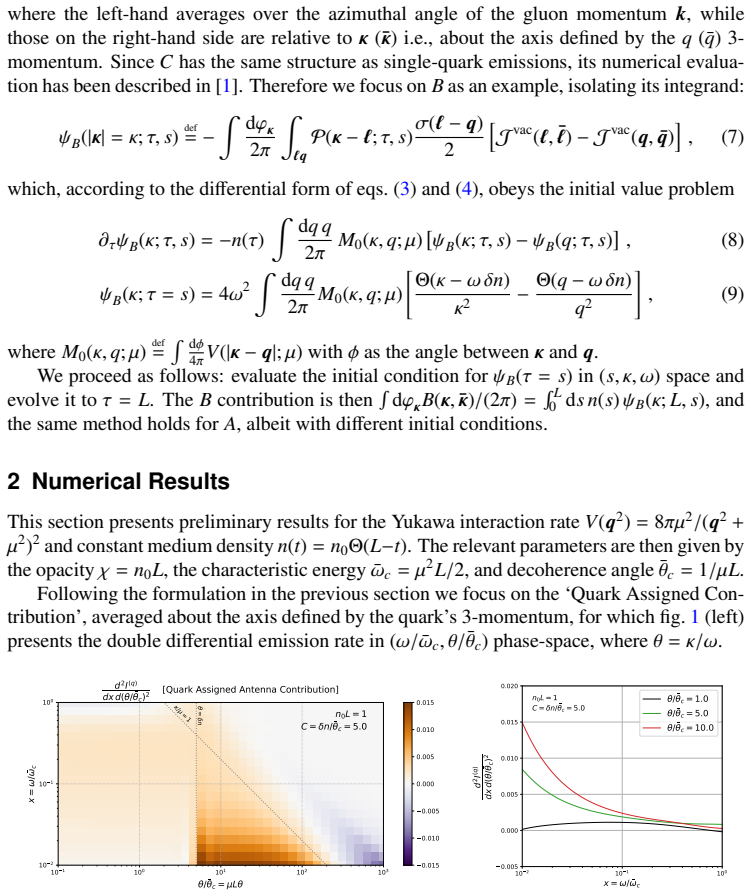
On the paper's own terms, the discovery is that the antenna spectrum can be reorganized, after subtracting the vacuum result, into three terms A, B, C whose azimuthal averages obey ordinary differential initial-value problems derived from the propagator equations. The numerical solution of these equations for a Yukawa rate and constant density yields the first full (ω,θ) medium-induced emission spectrum for a qqbar antenna beyond the harmonic-oscillator and opacity-expansion regimes. For an antenna opening δn = 5θ̄c and opacity n0L = 5, the spectrum is constant for θ < δn, where the C term dominates, and is strongly enhanced for θ > δn up to transverse momentum κ ≲ μ, the anti-angular ordere
Load-bearing premise
The numerical results plot only the quark-assigned contribution; the split in Eq. (6) is justified by the statement that symmetries of A and B 'suggest' the separation, with no proof that the remaining cross terms vanish, so the plotted spectrum may not represent the full emission.
Editorial extensions
If this is right
- Numerical solutions for realistic rates (starting with Yukawa, then Hard Thermal Loop) can now serve as reference for testing the harmonic-oscillator, GLV, and Improved Opacity Expansion approximations.
- Adding the anti-quark assigned contribution from Eq. (6) gives the full antenna spectrum, which the authors state paves the way for precision calculations of jet substructure in heavy-ion collisions.
- The predicted anti-angular ordered enhancement, stronger at low ω/ω̄c and larger θ/θ̄c, quantitatively characterises the breakdown of colour coherence across the full accessible phase-space.
Reading between the lines
- The same numerical treatment could be applied to a quark-gluon or gluon-gluon antenna; the colour factors would change, but the propagator machinery should carry over, giving a colour-coherence benchmark for multi-parton cascades.
- The validity of Eq. (6) can be checked numerically by also computing the anti-quark assigned contribution and summing; a nonzero mismatch would reveal the size of the neglected cross terms and quantify the error in figure 1.
- Because the spectrum depends on the shape of V(q), repeating the calculation with the Hard Thermal Loop rate may shift the anti-angular ordered enhancement in angle and energy, providing a handle on medium properties from the measured out-of-cone radiation pattern.
Editorial analysis
A structured set of objections, weighed in public.
Referee Report
Summary. The paper extends the numerical framework of [1], originally developed for single-quark medium-induced radiation, to the coherent emission of a soft gluon from a q-qbar antenna. The starting point is the standard antenna spectrum Eq. (1), expressed through the interference term J in Eq. (2). After subtracting the vacuum term Jvac and using the propagator equations (3)-(4), the authors reorganize J-Jvac into the pieces A, B, C of Eq. (5). They then assert an azimuthal separation into quark-assigned and anti-quark-assigned contributions, Eq. (6), and reduce B (and similarly A and C) to numerically solvable initial-value problems, Eqs. (7)-(9). The numerical section computes the quark-assigned contribution for a Yukawa interaction and constant density, presenting a double-differential spectrum in Fig. 1 and interpreting it as the medium-induced quark-antenna radiation, with anti-angular ordering for angles larger than the antenna opening.
Significance. If the formalism is correct, this is a useful step beyond the harmonic-oscillator and opacity-expansion approximations, since the propagator equations can in principle be solved for arbitrary V(q^2) and n(t). The manuscript gives explicit differential equations and initial conditions, uses no fitted parameters, and reproduces the qualitative anti-angular ordering expected from [12]. These are genuine strengths. However, the central quantitative claim is compromised by an algebraic error in Eq. (6): the displayed equality does not hold for the full Rsing defined in Eq. (1), and the plotted 'Quark Assigned Antenna Contribution' is only one of two pieces of the medium-induced spectrum. Unless this is corrected and the anti-quark piece is supplied or shown to be identical, the paper does not yet present the full medium-induced antenna spectrum promised in the abstract and summary.
major comments (3)
- [Eq. (6)] The equality in Eq. (6) as written is not an identity for Rsing defined in Eq. (1). Substituting Eq. (5) into Rsing = R(kappa)+R(barkappa)-2J(kappa,barkappa), and using A(kappa,kappa)+B(kappa,kappa)=0, gives the right-hand side of Eq. (6) equal to the vacuum-subtracted combination Rsing - Rsing_vac, where Rsing_vac = Jvac(kappa,kappa)+Jvac(barkappa,barkappa)-2Jvac(kappa,barkappa). In the no-medium limit n=0 all A, B, C vanish, so Eq. (6) would assert that the azimuthal average of the vacuum antenna pattern is zero, but it is not: after averaging, Rsing_vac = 4 omega^4 delta_n^2/(kappa^2 barkappa^2) > 0. Thus the LHS of Eq. (6) should be the azimuthal average of Rsing - Rsing_vac, not of Rsing. This is a load-bearing bookkeeping error: it conflates the full antenna spectrum with its medium-induced part and should be corrected before the numerical results can be interpreted.
- [Sec. 2, Fig. 1] The numerical section explicitly states that only the 'Quark Assigned Contribution' is computed and plotted, and the figure title says 'Quark Assigned Antenna Contribution'. Yet the abstract and the summary describe the result as 'the (omega, theta) medium-induced gluon spectrum'. The full medium-induced spectrum is the sum of the quark and anti-quark assigned contributions in Eq. (6). Unless the anti-quark piece is shown to be equal by symmetry, which is not stated, the plotted spectrum is only half of the physical result. Even if the two pieces coincide under kappa <-> barkappa, the paper should say so explicitly. As it stands, the central claim about the breakdown of colour coherence across 'the entire accessible phase-space' is based on an incomplete quantity. Please either include the anti-quark term or restrict the claims to the quark-assigned contribution and justify its use for t
- [Eqs. (2)-(5)] The reorganization of Eq. (2) into Eq. (5) is asserted without derivation: the text says only 'using eqs. (3) and (4) to reorganise', followed by the three lengthy expressions. This is the technical core of the paper, and the Eq. (6) inconsistency shows that the bookkeeping between full, vacuum, and medium-induced pieces is delicate. The reader cannot verify the cancellation of terms or the precise definitions of A, B, and C. A derivation, or at least a detailed appendix, is needed. This is not a mere presentation issue; it is load-bearing for every subsequent numerical result.
minor comments (4)
- [Fig. 1] The color scale extends to negative values. The text does not explain whether negative values are physical (e.g., due to vacuum subtraction or interpolation) or a numerical artifact. Please clarify.
- [Sec. 2] The paper gives no numerical error bars or convergence checks for the solutions of the initial-value problems. As these are 'preliminary results', a statement of numerical precision and grid-independence would be valuable.
- [Fig. 1 labels] The labels 'C = n/ c = 5.0' and 'C = n/ c = 1.0' appear garbled; presumably they denote chi = n0 L. Please correct the notation.
- [Sec. 1, text after Eq. (4)] 'The former considers momentum exchanges below a thermal scale q2 ≲ µ2' is a condensed statement; specifying the regime of the harmonic oscillator approximation more precisely would help the reader.
Circularity Check
No circularity: the spectrum is computed from stated input potentials and propagator equations; self-citation to [1] is independent support, and the Eq. (6) caveat is a mathematical/completeness issue, not a circular reduction.
full rationale
The derivation is self-contained: the inputs are the Yukawa interaction V(q^2), the medium density n(t), and the propagator equations (3)-(4). The numerical quantity ψB is defined as the integrand of the B contribution and is obtained by solving the initial-value problem (8)-(9), with no fitted parameter or post-hoc selection entering the calculation. The only self-citation, to the authors' earlier paper [1], is used for the single-quark numerical method (C term) and for the general propagator formalism; [1] is an independent, parameter-free published derivation that does not contain the q-qbar antenna result, so it is legitimate support rather than a circular premise. The skeptical concern about Eq. (6) is not circularity: substituting Eq. (5) into Eq. (1) shows that the RHS of Eq. (6) matches the medium-induced (vacuum-subtracted) combination rather than the full Rsing as written, and the paper plots only the quark-assigned contribution while calling it the medium-induced spectrum. These are mathematical/completeness caveats that would affect correctness or interpretation, but they do not make the central claim equivalent to its inputs by construction. No fitted-input-called-prediction, no self-definitional reduction, and no ansatz-smuggling are present.
Assumptions & free parameters
free parameters (3)
- Yukawa screening scale mu =
input scale, not fitted
- Medium opacity chi = n0 L =
5 for fig. 1
- Scaled antenna opening delta_n / theta_bar_c =
5 for fig. 1
assumptions (4)
- domain assumption The eikonal and soft-gluon approximations, including the vacuum subtraction J_vac = 4 omega^2 kappa dot kappa_bar / (kappa^2 kappa_bar^2), are valid in the kinematic range shown.
- domain assumption The propagator equations (3)-(4), with medium density n(t) and dipole cross-section sigma(q), exactly resum multiple scatterings for the Yukawa rate.
- ad hoc to paper The reorganization of Eq. (2) into A, B, C in Eq. (5) and the azimuthal separation in Eq. (6) are algebraically exact.
- domain assumption A constant density slab n(t) = n0 Theta(L - t) and the Yukawa rate V(q^2) = 8 pi mu^2 / (q^2 + mu^2)^2 represent the medium for the numerical results.
Cite this review
Pith. "Pith review of Gluon emission by a $q\bar{q}$ antenna with realistic parton-medium interactions." pith.science (2026). https://pith.science/paper/OZG4MGOP
@misc{pith2026250821719,
  author       = {Pith},
  title        = {Pith review of: Gluon emission by a $q\barq$ antenna with realistic parton-medium interactions},
  year         = {2026},
  howpublished = {\url{https://pith.science/paper/OZG4MGOP}},
  note         = {Machine review of arXiv:2508.21719}
}
read the original abstract
The spectrum of coherent gluon radiation from a quark-anti-quark pair experiencing multiple scatterings within a coloured medium is central for understanding in-medium parton cascades. Despite its foundational importance, current results are limited by reliance on simplified scattering rates, such as the harmonic oscillator approximation, valid only in restricted phase-space regions. Using the formalism introduced in a previous article, we express the gluon emission spectrum as a set of differential equations that can be solved numerically, circumventing conventional approximations. We present the transverse momentum and energy distributions of emitted gluons for realistic interaction models, illustrating the breakdown of colour coherence across the entire accessible phase-space, and consequently enabling a higher-precision description of jet observables.
Figures
Forward citations
Cited by 1 Pith paper
-
Quantum simulating multi-particle processes in high energy nuclear physics: dijet production and color (de)coherence
A quantum-circuit framework maps partonic cross-sections for multi-particle QCD processes in media, benchmarked on dipole formation and antenna radiation at leading order.
Reference graph
Works this paper leans on
- [1]
-
[10]
M.V . Kuzmin, J.M. Silva, QCD antenna radiative spectrum in dense media: accounting for full jet-medium interactions (2025), 2507.00143
arXiv 2025
-
[12]
Y . Mehtar-Tani, C.A. Salgado, K. Tywoniuk, Anti-angular ordering of gluon radia- tion in QCD media, Phys. Rev. Lett. 106, 122002 (2011), 1009.2965. 10.1103/Phys- RevLett.106.122002
arXiv 2011
-
[2]
L. Apolinário, Y .T. Chien, L. Cunqueiro Mendez, Jet substructure, Int. J. Mod. Phys. E 33, 2430003 (2024). 10.1142/9789811294679_0002
- [3]
-
[4]
Time reclustering for jet quenching studies
L. Apolinário, A. Cordeiro, K. Zapp, Time reclustering for jet quenching studies, Eur. Phys. J. C 81, 561 (2021), 2012.02199. 10.1140/epjc/s10052-021-09346-8
work page Pith review arXiv 2021
-
[5]
Exploring the time axis within medium-modified jets
L. Apolinário, P. Guerrero-Rodríguez, K. Zapp, Exploring the time axis within medium- modified jets, Eur. Phys. J. C 84, 672 (2024), 2401.14229. 10.1140/epjc/s10052-024- 13048-2
work page Pith review arXiv 2024
-
[6]
Y . Mehtar-Tani, C.A. Salgado, K. Tywoniuk, The radiation pattern of a QCD antenna in a dilute medium, JHEP 04, 064 (2012), 1112.5031. 10.1007/JHEP04(2012)064
arXiv 2012
Show all 12 references
-
[7]
Casalderrey-Solana, E
J. Casalderrey-Solana, E. Iancu, Interference e ffects in medium-induced gluon radia- tion, JHEP 08, 015 (2011), 1105.1760. 10.1007/JHEP08(2011)015
2011 arXiv
-
[8]
Barata, Y
J. Barata, Y . Mehtar-Tani, Improved opacity expansion at NNLO for medium induced gluon radiation, JHEP 10, 176 (2020), 2004.02323. 10.1007/JHEP10(2020)176
2020 arXiv
-
[9]
Gyulassy, P
M. Gyulassy, P. Levai, I. Vitev, Reaction operator approach to Non-Abelian energy loss, Nucl. Phys. B 594, 371 (2001), nucl-th/0006010. 10.1016/S0550-3213(00)00652-0
2001 arXiv
-
[11]
Caron-Huot, C
S. Caron-Huot, C. Gale, Finite-size effects on the radiative energy loss of a fast parton in hot and dense strongly interacting matter, Phys. Rev. C82, 064902 (2010), 1006.2379. 10.1103/PhysRevC.82.064902
2010 arXiv
Reviewed August 5, 2026 · model on record in the stance chip above.
Discussion (0). Sign in to comment.