REVIEW 4 major objections 6 minor 1 cited by
A Few Moments Please: Scalable Graphon Learning via Moment Matching
T0 review · 4 major / 6 minor · reviewed 2026-08-07 · deepseek-v4-flash
Pith's one-line read Subgraph moments provably recover graphons in polynomial time
desk verdict A promising moment-matching estimator whose main theorem is currently not proved because the loss uses induced motif densities while the inverse-counting lemma is stated for homomorphism densities. read the letter →
The pith
A machine-rendered reading of the paper's core claim, the machinery that carries it, and where it could break.
The reading
What carries the argument
The machinery is moment matching: the graphon is represented by an INR $f_\theta$ mapping pairs of latent coordinates to edge probabilities, and its induced motif densities are estimated by Monte Carlo integration with $L$ uniform samples of $k$ latent coordinates. The training loss is the weighted mean squared error $\sum_i w_i(m_i - \hat{m}_i(\theta))^2$ with weights $w_i = 1/m_i$, balancing frequent and rare motifs. The theory then switches from induced densities to homomorphism densities $t(F,W)$, so that Lemma 2 can turn uniform closeness over all $k$-vertex motifs into a cut-distance bound. The INR supplies a continuous, resolution-free representation, and motif counting is a one-time preprocessing step that keeps the overall procedure polynomial-time.
What would settle it
For a 4-node motif such as the path, compute both the induced density from graphlet counts and the homomorphism density $t(F,W)$ on a simple graphon like $W(x,y)=xy$; if the values differ and no identity in the paper connects them, the step from empirical moments to Lemma 2's bound is unsupported.
Extended reading notes
Core claim
The central claim is Theorem 1: under a neural-network approximation assumption and the sample-size condition in inequality (6), an INR whose moment estimates are within $\delta_M/2$ of the empirical motif densities yields an estimate $\hat{W}_\theta$ with $d_{\mathrm{cut}}(\hat{W}_\theta, W^*) < \eta$. The proof chains three ingredients: a concentration bound showing that empirical motif densities from independent graph samples cluster around the true graphon's densities; an approximation assumption asserting that a sufficiently expressive network can match those empirical densities; and an inverse counting lemma (Lemma 2) stating that closeness in all $k$-vertex motif densities implies closeness in cut distance. The method deliberately avoids latent variables and Gromov–Wasserstein optimization: the graphon is trained against a vector of observed subgraph densities, and the Monte Carlo estimator used in training is shown to be unbiased. The paper also claims that MomentMixup, which interpolates moment vectors between classes and samples new graphs from the resulting graphon, improves classification accuracy on the majority of its benchmarks.
Load-bearing premise
The proof assumes that the induced subgraph densities measured by the graphlet counter and the homomorphism densities used in Lemma 2 can be treated interchangeably; no explicit inclusion–exclusion bridge is given, and if the two notions diverge Theorem 1's chain has a missing link.
Editorial extensions
If this is right
- Graphon estimation becomes a polynomial-time procedure that needs no latent-variable inference and no Gromov–Wasserstein optimization.
- With sufficiently large or numerous graph samples, the estimated graphon carries a provable cut-distance guarantee rather than only an empirical fit.
- The same trained INR can generate or analyze graphs at any target resolution, because it represents a continuous function.
- Moment-space interpolation between class moment vectors yields augmented graphs that improve GNN classification accuracy on most tested datasets.
Reading between the lines
- If moment matching is as robust as reported, the same training objective could be adapted to sparse or dynamic networks by weighting moments by graph size, a direction the paper leaves open.
- The proof's reliance on homomorphism densities while the estimator targets induced densities suggests a concrete check: an explicit inclusion–exclusion formula connecting the two would close the gap, while a counterexample would localize the failure.
- Because only nine motifs were used, the performance gap on very large graphs, such as Reddit-Binary, hints that adaptive or larger motif sets may be the next lever for MomentMixup.
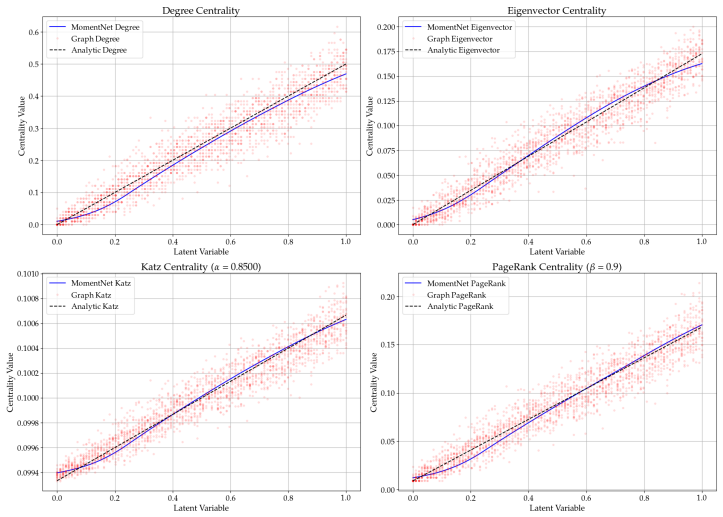
- A resolution-free estimator trained on moments could be combined with graphon-based centrality or topology-inference pipelines, extending the method beyond classification.
Editorial analysis
A structured set of objections, weighed in public.
Referee Report
Summary. MomentNet estimates a graphon by training an implicit neural representation (INR) to minimize a weighted mean squared error between empirical motif densities computed with ORCA from observed graphs and Monte Carlo estimates of the motif densities of the INR graphon. The paper states Theorem 1, which claims a bound on the cut distance between the estimated and true graphons under an approximation assumption on the trained network and a sample-size condition, and it introduces MomentMixup, a data augmentation method that interpolates moment vectors and then samples new graphs from the graphon fitted to the interpolated moments. Experiments compare MomentNet with USVT, SAS, IGNR, GWB, and SIGL on thirteen synthetic graphons and evaluate MomentMixup on four graph classification datasets.
Significance. The proposal is appealing: replacing latent-variable estimation and Gromov-Wasserstein alignment with moment matching is a natural way to obtain a scalable, resolution-free graphon estimator, and the experimental comparison is reasonably broad. If Theorem 1 were valid, the paper would offer a polynomial-time estimator with a global metric guarantee, which would be a notable contribution. However, the central theorem does not follow from the proof as written: the loss and estimator use induced motif densities while the inverse counting lemma is stated for homomorphism densities; the theorem requires all graphs in F_k while the experiments use only nine graphlets; and Assumption 1 postulates the central training success without proof. In addition, the theorem's quantitative conditions are astronomically large for the reported experimental settings. The empirical results are useful evidence for the method, but they do not compensate for the broken theoretical claim at the paper's core.
major comments (4)
- [§3.2, Appendix B] The proof of Theorem 1 conflates induced and homomorphism motif densities. The loss in Eq. (5) and the Monte Carlo estimator in Eq. (4) are defined for induced densities t'(F, \hat W_θ), with factors (1-W) on non-edges, and the empirical targets are induced ORCA graphlet counts. Lemma 2, however, is stated for homomorphism densities t(F,W), and the proof's Eq. (19) bounds |\hat t_θ(F,\hat W_θ)-t(F,W*)| as if \hat t_θ were a homomorphism density. Induced densities are alternating sums of homomorphism densities of supergraphs, so a small induced-density error does not in general imply a small homomorphism-density error; no inclusion-exclusion or citation bridges this gap. Consequently Lemma 2 cannot be applied, and Theorem 1 does not follow from the proof as written.
- [§3.2, Fig. 5] Lemma 2 requires |t(F,W1)-t(F,W2)| < δ_M for every simple graph F in F_k, where F_k is the set of all non-isomorphic simple graphs on k vertices. The method and experiments use only the nine connected graphlets with up to four nodes shown in Fig. 5, not all graphs in F_4 or F_k. The manuscript gives no argument that the empirical moments for these nine motifs control the homomorphism densities of every graph in F_k, so even a repaired induced/homomorphism step would not transfer the guarantee to the implemented motif set.
- [Appendix B, Assumption 1] Assumption 1 essentially postulates that training succeeds: it asserts the trained INR's Monte Carlo motif estimates are within ε_a = δ_M/2 of the empirical densities for all F in F_k. This is not derived from optimization or sample-complexity results; the cited universal approximation theorems concern expressivity of neural networks, not convergence of nonconvex training or the variance of the finite-L Monte Carlo estimator in Eq. (4). Theorem 1 is therefore a conditional statement whose main hypothesis is the conclusion of the learning procedure, which is weaker than the 'provable upper bound' claimed in the abstract.
- [Theorem 1, Eq. (6)] The theorem's quantitative conditions are not met in the experiments. With Lemma 2's δ_M = 3^{-k^2}, the condition n > k(k-1)/δ_M is roughly 10^9 for k=4, and the exponent in Eq. (6) requires P n on the order of 3^{2k^2} (about 10^{19} for k=4) to make the failure probability small. The experiments use n ≤ 300 and P = 10, so the experimental regime is orders of magnitude outside the theorem's range. The theory therefore does not provide a guarantee for the settings in which the method is demonstrated.
minor comments (6)
- [Abstract, §5] The abstract claims improvement in 75% of benchmark settings, but Fig. 2a reports outperformance on 9 of 13 graphons and Table 1 shows improvement on three of four datasets; the calculation of the 75% figure should be clarified.
- [§3.1, Step 1] The manuscript states that ORCA graphlet counts are converted into motif counts, but the conversion is not specified; because the theoretical statements depend on which density notion is used, the exact formulas should be provided.
- [Fig. 2] The panels of Fig. 2 lack clearly labeled axes in the main text and the description does not state whether the reported GW-loss values include error bars or standard deviations; these should be added.
- [Algorithm 1] Line 8 computes y_target as a convex combination of integer class labels; the manuscript should explain how these soft labels are used by the GIN classifier during training.
- [Theorem 1] Theorem 1 assumes all P graphs have exactly n vertices, while the experiments average moments over graphs of varying sizes; the authors should either relax the assumption or explain how the theorem extends to variable graph sizes.
- [Appendix B] In Eq. (25) the estimated graphon is written as W_θ while Theorem 1 and the abstract use \hat W_θ; the notation should be unified.
Circularity Check
No circularity: the cut-distance conclusion follows conditionally from an external inverse-counting lemma and a realizability assumption, not from fitting the target.
full rationale
The central theoretical claim of the paper is not circular. The INR is trained to match empirical induced motif densities via Eqs. (4) and (5), and the cut-distance bound in Theorem 1 is obtained by combining a concentration argument (Lemma 1) with Borgs et al.'s inverse counting lemma (Lemma 2), which is an external result connecting motif-distance proximity to cut-distance proximity. Assumption 1 is a realizability condition on the neural network: it postulates that training can bring the estimated moments within epsilon_a of the empirical moments. This is a conditional hypothesis, not a restatement of the theorem's conclusion, and it is not the object being predicted. The paper does contain a serious derivation gap: the estimator and loss use induced densities t'(F,W) (Eqs. (4)-(5)), while Lemma 2 and the proof of Theorem 1 apply to homomorphism densities t(F,W), with no inclusion-exclusion step bridging the two notions; moreover, the experiments use only nine motifs while Lemma 2 requires all graphs in F_k. These are correctness gaps, not circular reductions, and they do not make the claimed result equivalent to its inputs by construction. The self-citations in the paper (e.g., SIGL, centrality measures) are contextual and are not load-bearing for the main theorem, which relies on Borgs et al. and standard universal approximation references. The limitation noted in Section 6 about reliance on a pre-selected set of moments is a caveat about scope, not evidence of circularity. Therefore, no circular step is exhibited, and the circularity score is 0.
Assumptions & free parameters
free parameters (4)
- Motif set F =
nine graphlets up to four nodes, not all N_k graphs
- Loss weights w_i =
w_i = 1/m_i, inverse empirical motif density
- Monte Carlo sample count L =
20,000
- MomentMixup hyperparameters =
tuned per dataset, values not reported
assumptions (6)
- standard math Inverse counting lemma from Borgs et al.: if |t(F,W1)-t(F,W2)| < delta_M for all F in F_k, then d_cut(W1,W2) <= eta.
- standard math Concentration and bias bounds for t(F,G_n(W)) from Borgs et al., including a sub-Gaussian tail and bias B_n <= k(k-1)/(2n).
- standard math Universal Approximation Theorem for one-hidden-layer MLPs.
- ad hoc to paper Assumption 1: the trained INR's Monte Carlo motif estimates match the empirical motif densities within epsilon_a for all F in F_k.
- domain assumption Observed graphs are conditionally independent samples from a single true graphon W* in the dense Gn(W*) model.
- domain assumption ORCA graphlet counts can be converted to the motif densities required by Lemma 2.
Cite this review
Pith. "Pith review of A Few Moments Please: Scalable Graphon Learning via Moment Matching." pith.science (2026). https://pith.science/paper/P24AX55Y
@misc{pith2026250604206,
  author       = {Pith},
  title        = {Pith review of: A Few Moments Please: Scalable Graphon Learning via Moment Matching},
  year         = {2026},
  howpublished = {\url{https://pith.science/paper/P24AX55Y}},
  note         = {Machine review of arXiv:2506.04206}
}
read the original abstract
Graphons, as limit objects of dense graph sequences, play a central role in the statistical analysis of network data. However, existing graphon estimation methods often struggle with scalability to large networks and resolution-independent approximation, due to their reliance on estimating latent variables or costly metrics such as the Gromov-Wasserstein distance. In this work, we propose a novel, scalable graphon estimator that directly recovers the graphon via moment matching, leveraging implicit neural representations (INRs). Our approach avoids latent variable modeling by training an INR--mapping coordinates to graphon values--to match empirical subgraph counts (i.e., moments) from observed graphs. This direct estimation mechanism yields a polynomial-time solution and crucially sidesteps the combinatorial complexity of Gromov-Wasserstein optimization. Building on foundational results, we establish a theoretical guarantee: when the observed subgraph motifs sufficiently represent those of the true graphon (a condition met with sufficiently large or numerous graph samples), the estimated graphon achieves a provable upper bound in cut distance from the ground truth. Additionally, we introduce MomentMixup, a data augmentation technique that performs mixup in the moment space to enhance graphon-based learning. Our graphon estimation method achieves strong empirical performance--demonstrating high accuracy on small graphs and superior computational efficiency on large graphs--outperforming state-of-the-art scalable estimators in 75\% of benchmark settings and matching them in the remaining cases. Furthermore, MomentMixup demonstrated improved graph classification accuracy on the majority of our benchmarks.
Figures


Figures from the paper (5 more)




Forward citations
Cited by 1 Pith paper
-
From Moments to Models: Graphon-Mixture Learning for Mixup and Contrastive Learning
A moment-based clustering of graphs into latent graphon mixtures improves graph mixup and contrastive learning, with a claimed tighter motif-density concentration bound.
Reference graph
Works this paper leans on
-
[1]
Airoldi, E. M., Blei, D. M., Fienberg, S. E., and Xing, E. P. (2008). Mixed membership stochastic blockmodels. InJournal of Machine Learning Research, volume 9, pages 1981–2014
work page 2008
-
[2]
Avella-Medina, M., Parise, F., Schaub, M. T., and Segarra, S. (2020). Centrality measures for graphons: Accounting for uncertainty in networks.IEEE Transactions on Network Science and Engineering, 7(1):520–537
work page 2020
-
[3]
Azizpour, A., Zilberstein, N., and Segarra, S. (2025). Scalable implicit graphon learning. InThe 28th International Conference on Artificial Intelligence and Statistics
work page 2025
-
[4]
Borgs, C., Chayes, J., and Lovász, L. (2010). Moments of two-variable functions and the uniqueness of graph limits.Geometric and Functional Analysis, 19(6):1597–1619
work page 2010
-
[5]
Borgs, C., Chayes, J., Lovász, L., Sós, V ., and Vesztergombi, K. (2008). Convergent sequences of dense graphs i: Subgraph frequencies, metric properties and testing.Advances in Mathematics, 219(6):1801–1851
work page 2008
-
[6]
Chan, S. and Airoldi, E. (2014). A consistent histogram estimator for exchangeable graph models. In Xing, E. P. and Jebara, T., editors,Proceedings of the 31st International Conference on Machine Learning, volume 32 ofProceedings of Machine Learning Research, pages 208–216, Bejing, China. PMLR
work page 2014
-
[7]
Chatterjee, S. (2015). Matrix estimation by universal singular value thresholding.The Annals of Statistics, 43(1)
work page 2015
-
[8]
Cybenko, G. (1989). Approximation by superpositions of a sigmoidal function.Mathematics of control, signals, and systems, 2(4):303–314
work page 1989
Show all 37 references
-
[9]
Ding, K., Xu, Z., Tong, H., and Liu, H. (2022). Data augmentation for deep graph learning: A survey
2022
-
[10]
Dong, X., Thanou, D., Toni, L., Bronstein, M., and Frossard, P. (2020). Graph signal processing for machine learning: A review and new perspectives.IEEE Signal Processing Magazine, 37(6):117–127
2020
-
[11]
Gao, C., Lu, Y ., and Zhou, H. H. (2015). Rate-optimal graphon estimation.The Annals of Statistics, 43(6):2624–2652
2015
-
[12]
and Caines, P
Gao, S. and Caines, P. E. (2020). Graphon control of large-scale networks of linear systems. IEEE Transactions on Automatic Control, 65(10):4090–4105
2020
-
[13]
Han, X., Jiang, Z., Liu, N., and Hu, X. (2022). G-Mixup: Graph Data Augmentation for Graph Classification. InProceedings of the 39th International Conference on Machine Learning (ICML), volume 162 ofProceedings of Machine Learning Research, pages 8450–8465. PMLR
2022
-
[14]
Hornik, K., Stinchcombe, M., and White, H. (1989). Multilayer feedforward networks are universal approximators.Neural networks, 2(5):359–366
1989
-
[15]
and Demšar, J
Hoˇcevar, T. and Demšar, J. (2014). A combinatorial approach to graphlet counting.Bioinfor- matics, 30(4):559–565. 10
2014
-
[16]
Y ., Pinkus, A., and Schocken, S
Leshno, M., Lin, V . Y ., Pinkus, A., and Schocken, S. (1993). Multilayer feedforward networks with a nonpolynomial activation function can approximate any function.Neural networks, 6(6):861– 867
1993
-
[17]
(2012).Large networks and graph limits, volume 60
Lovász, L. (2012).Large networks and graph limits, volume 60. American Mathematical Soc
2012
-
[18]
and Szegedy, B
Lovász, L. and Szegedy, B. (2006). Limits of dense graph sequences.Journal of Combinatorial Theory, Series B, 96(6):933–957
2006
-
[19]
and Segarra, S
Navarro, M. and Segarra, S. (2022). Joint network topology inference via a shared graphon model.IEEE Transactions on Signal Processing, 70:5549–5563
2022
-
[20]
and Segarra, S
Navarro, M. and Segarra, S. (2023). Graphmad: Graph mixup for data augmentation using data- driven convex clustering. InICASSP 2023 - 2023 IEEE International Conference on Acoustics, Speech and Signal Processing (ICASSP), pages 1–5
2023
-
[21]
and Ozdaglar, A
Parise, F. and Ozdaglar, A. (2023). Graphon games: A statistical framework for network games and interventions.Econometrica, 91(1):191–225
2023
-
[22]
Peyré, G., Cuturi, M., and Solomon, J. (2016). Gromov-wasserstein averaging of kernel and distance matrices. InInternational conference on machine learning, pages 2664–2672. PMLR
2016
-
[23]
M., Segarra, S., and Marques, A
Rey, S., Navarro, M., Tenorio, V . M., Segarra, S., and Marques, A. G. (2025). Redesigning graph filter-based gnns to relax the homophily assumption. In2025 IEEE International Conference on Acoustics, Speech and Signal Processing (ICASSP), pages 1–5
2025
-
[24]
M., and Marqués, A
Rey, S., Tenorio, V . M., and Marqués, A. G. (2023). Robust graph filter identification and graph denoising from signal observations.IEEE Transactions on Signal Processing, 71:3651–3666
2023
-
[25]
and Bunke, H
Riesen, K. and Bunke, H. (2008). Iam graph database repository for graph based pattern recognition and machine learning. In da Vitoria Lobo, N., Kasparis, T., Roli, F., Kwok, J. T., Georgiopoulos, M., Anagnostopoulos, G. C., and Loog, M., editors,Structural, Syntactic, and Sta...
2008
-
[26]
M., Navarro, M., and Segarra, S
Roddenberry, T. M., Navarro, M., and Segarra, S. (2021). Network topology inference with graphon spectral penalties. In2021 IEEE International Conference on Acoustics, Speech and Signal Processing (ICASSP), pages 5390–5394
2021
-
[27]
Z., and Yu, P
Su, X., Xue, S., Liu, F., Wu, J., Yang, J., Zhou, C., Hu, W., Paris, C., Nepal, S., Jin, D., Sheng, Q. Z., and Yu, P. S. (2024). A comprehensive survey on community detection with deep learning. IEEE Transactions on Neural Networks and Learning Systems, 35(4):4682–4702
2024
-
[28]
M., Isufi, E., Leus, G., and Marques, A
Tenorio, V . M., Isufi, E., Leus, G., and Marques, A. G. (2025). Tracking network dynamics using probabilistic state-space models. In2025 IEEE International Conference on Acoustics, Speech and Signal Processing (ICASSP), pages 1–5
2025
-
[29]
Van Handel, R. (2014). Probability in high dimension.Lecture Notes (Princeton University), 2(3):2–3
2014
-
[30]
Wang, Y ., Wang, W., Liang, Y ., Cai, Y ., and Hooi, B. (2021). Mixup for node and graph classification. InProceedings of the Web Conference 2021, WWW ’21, page 3663–3674, New York, NY , USA. Association for Computing Machinery
2021
-
[31]
Xia, X., Mishne, G., and Wang, Y . (2023). Implicit graphon neural representation. InProceed- ings of The 26th International Conference on Artificial Intelligence and Statistics, volume 206 of Proceedings of Machine Learning Research, pages 10619–10634. PMLR
2023
-
[32]
Xu, H., Luo, D., Carin, L., and Zha, H. (2021a). Learning graphons via structured gromov-wasserstein barycenters.Proceedings of the AAAI Conference on Artificial Intelligence, 35(12):10505–10513
2021
-
[33]
Xu, H., Luo, D., Carin, L., and Zha, H. (2021b). Learning graphons via structured gromov- wasserstein barycenters. InProceedings of the AAAI Conference on Artificial Intelligence, pages 10505–10513. 11
2021
-
[34]
Xu, H., Luo, D., Zha, H., and Duke, L. C. (2019a). Gromov-Wasserstein learning for graph matching and node embedding. In Chaudhuri, K. and Salakhutdinov, R., editors,Proceedings of the 36th International Conference on Machine Learning, volume 97 ofProceedings of Machine Learni...
2019
-
[35]
Xu, K., Hu, W., Leskovec, J., and Jegelka, S. (2019b). How powerful are graph neural networks?
2019
-
[36]
and Vishwanathan, S
Yanardag, P. and Vishwanathan, S. (2015). Deep graph kernels. InProceedings of the 21th ACM SIGKDD International Conference on Knowledge Discovery and Data Mining, KDD ’15, page 1365–1374, New York, NY , USA. Association for Computing Machinery
2015
-
[37]
mixed terms
Zhang, H., Cisse, M., Dauphin, Y . N., and Lopez-Paz, D. (2018). mixup: Beyond empirical risk minimization. InInternational Conference on Learning Representations (ICLR). A Detailed Related Work Graphon EstimationGraphon estimation aims to recover the underlying generative str...
2018
Reviewed August 7, 2026 · model on record in the stance chip above.
Discussion (0). Sign in to comment.