REVIEW 4 major objections 5 minor 29 references
Empowering Morphing Attack Detection using Interpretable Image-Text Foundation Model
T0 review · 4 major / 5 minor · reviewed 2026-08-05 · deepseek-v4-flash
Pith's one-line read A pretrained CLIP model, never fine-tuned on morphs, classifies face images as bona fide or morphed by scoring short text prompts, and the top prompt doubles as a plain-text explanation.
desk verdict Useful CLIP-for-MAD empirical study; the generalization claim outruns the evidence and needs major revision, but it deserves referee time. read the letter →
The pith
A machine-rendered reading of the paper's core claim, the machinery that carries it, and where it could break.
The reading
What carries the argument
The shared image-text embedding space of CLIP: an image encoder (ViT) and a text encoder (transformer) project both modalities into a common space, and the system classifies by cosine similarity between the image and each candidate text prompt, normalized by softmax. Prompt engineering is the control variable: short synonym-style prompts align better with CLIP's training distribution and yield the best detection.
What would settle it
Evaluate the same ten prompts on a morphing dataset built from a different face database than FRGC V2 under the same BPCER@MACER=10% metric; if no short prompt matches the digital-medium error rate reported here, or if the prompt ranking collapses, the claim of zero-shot generalization across morphing attacks is refuted. The paper's own low-quality print-scan result (90.87% BPCER at 10% MACER) already marks that regime as a partial failure.
Extended reading notes
Core claim
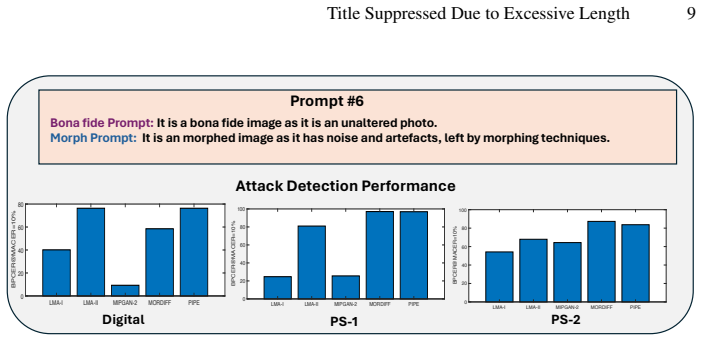
The central claim is that zero-shot evaluation of CLIP yields both generalizable morphing attack detection and the most relevant text snippet for a decision. Given a face image, the ViT image encoder of CLIP extracts an embedding; ten crafted textual prompts describing bona fide and morphed images are encoded by the text encoder; a softmax over cosine similarities assigns the image to the prompt with the highest score. The highest-scoring prompt—e.g., "It is a morphed image"—is the textual explanation. In experiments on a morphing dataset built from FRGC V2 with five morphing generators and three media, the best prompt (#5) achieved BPCER@MACER=10% of 29.87% (digital) and 43.15% (high-qualit
Load-bearing premise
The method assumes CLIP's embeddings, learned from general web image-text pairs, rank "morphed image" text closer to morphed faces than to bona fide faces without ever being trained on morphing attacks—an assumption that the paper's own low-quality print-scan results cast doubt on.
Editorial extensions
If this is right
- A working system needs no morphing data or training: any deployment can use the frozen CLIP weights and a prompt pair, so new morphing algorithms can be handled without retraining.
- The winning text snippet gives non-technical operators a human-readable explanation, replacing noisy heatmap-based interpretability.
- Short prompts crafted to resemble CLIP's web-training text should be preferred; longer explanatory sentences hurt detection accuracy.
- Digital and high-quality print-scan images are detectable, but low-quality print-scan is a failure regime that any real rollout must handle separately.
- Zero-shot CLIP establishes a new baseline for language-guided morphing detection, outperforming zero-shot ResNet50, VGG-19, and ViT on digital and high-quality print-scan images.
Reading between the lines
- If the digital-medium results transfer to other datasets, CLIP's general language-image alignment has implicitly learned facial blending artifacts, suggesting frozen CLIP features could serve as a fixed front-end for unsupervised detection of unseen morphing algorithms.
- The steep low-quality print-scan failure implies the zero-shot signal rides on high-frequency texture cues; sharpening or preprocessing the image before CLIP could be a cheap, testable fix.
- Because the text side is frozen and prompt-dependent, the mechanism can be ported across languages by translating the prompts alone, giving localized textual explanations without touching the vision model.
- The same prompt-ranking logic extends to other description-friendly face attacks (presentation attacks, deepfakes), unifying zero-shot textual explainability across biometric attack types.
Signed reviews
Editorial analysis
A structured set of objections, weighed in public.
Referee Report
Summary. The paper proposes a zero-shot single-image morphing attack detection (S-MAD) framework based on CLIP, in which a facial image is compared against handcrafted textual prompts for 'bona fide' and 'morphed' classes. The authors claim that, without any training on morphing data, CLIP can both detect morphing attacks and output the selected text snippet as a human-understandable explanation. They evaluate ten prompts on a self-built morphing dataset (MD) sampled from FRGC V2, with five morphing generation algorithms and three capture mediums (digital, high-quality print-scan PS-1, and low-quality print-scan PS-2), and compare against pretrained ResNet50, VGG-19, and ViT in zero-shot settings. The best-performing prompt (#5) is highlighted in the summary table.
Significance. If validated, the paper would introduce a novel application of CLIP zero-shot classification to explainable morphing attack detection, with the practical appeal of requiring no task-specific training and providing a textual output for non-technical users. The paper's strengths are its systematic prompt analysis and the inclusion of multiple morphing generation algorithms and print-scan conditions. However, the central generalization claim is supported only by a single in-house dataset with post-hoc prompt selection, and the 'textual explanation' is essentially the class label chosen by the model. These issues currently limit the strength of the contribution.
major comments (4)
- [Section 3.2 / Table 1 / Fig. 18] The headline results in Table 1 are reported for prompt #5, which is selected post hoc as the best-performing prompt on the same evaluation set (Fig. 18). Selecting the prompt on the test data and then reporting its performance on that same data inflates the reported BPCER values and makes the 'generalizable' claim in the abstract and conclusion unsubstantiated. The paper should report all ten prompts on the same plot/table, or better, select the prompt on a held-out validation set and report performance on an independent test set.
- [Section 3.1] There is an arithmetic inconsistency in the dataset description: '2526 × 5 × 2 = 12630' is incorrect (the correct product is 25260), and the sentence describing bona fide samples, '1276 × 2 = 2552', is also ambiguous because it says 'separately for digital and morphing'. This makes the exact evaluation set unclear and harms reproducibility. Please clarify the number of bona fide and morphing images per medium and per morphing algorithm, and correct the arithmetic.
- [Abstract / Section 4] The claim that zero-shot CLIP yields 'generalizable morphing attack detection' is load-bearing, yet all experiments are conducted on the self-built MD dataset sampled from FRGC V2. No cross-dataset evaluation, no subject-disjoint evaluation, and no unseen morphing algorithm are presented. Because the novelty of the paper is precisely the zero-shot transfer of CLIP, the absence of any external validation means the generalization claim is currently unsupported. The authors should either add a cross-dataset experiment (e.g., on a publicly available MAD benchmark) or significantly soften the generalization claim in the abstract and conclusion.
- [Title / Section 1 / Section 2.2] The paper describes the method as providing a 'textual explanation' and 'predict[ing] the most relevant text snippet', but in the proposed zero-shot setup the selected text snippet is simply the argmax of the softmax over the two class prompts. This is a class label, not an explanation of the decision. No evidence is given that the returned text conveys image content beyond the category. The LIME analysis in Section 3.2 (Fig. 19) concerns the vision encoder and, as the authors state, it is challenging to determine which features contributed to the decision. To support the interpretability claim, the paper should demonstrate that the text output provides additional, non-trivial information, for example via a human study or semantic analysis.
minor comments (5)
- [Section 3] Typographical errors: 'zero-short evaluation' should be 'zero-shot evaluation' in the introductory paragraph of Section 3.
- [Table 1] The table is labeled 'Qualitative evaluation' but reports quantitative BPCER values. It should be labeled 'Quantitative evaluation'.
- [Figure 19] The caption refers to 'CLIP video encoder', but CLIP has an image encoder, not a video encoder. Please correct the terminology.
- [References] The CLIP reference appears twice as [11] and [12] with the same citation information. Merge duplicate references.
- [Section 2.1] The phrase 'The image encoder consists of transformer blocks' is imprecise for the ViT variant; clarify which CLIP variant is used in the experiments and report the specific backbone (e.g., ViT-B/32).
Circularity Check
No significant circularity: the CLIP zero-shot pipeline is self-contained; post-hoc prompt selection is a validity concern, not a circular derivation.
full rationale
The paper's derivation chain is straightforward: CLIP's pretrained image and text encoders map face images and two fixed text prompts into a shared space, and a softmax over cosine similarities yields the detection decision and the selected text snippet (Section 2.2). This is a standard zero-shot classification procedure with no fitted parameters and no quantity that reduces by definition to its input. The claimed 'prediction of the text snippet' is simply the argmax over the two class prompts, which is the operational output of the method rather than a circularly defined result. The dataset is self-built from FRGC V2 and the paper compares CLIP against ImageNet-pretrained baselines, but this affects external validity, not circularity. The selection of prompt #5 as the best-performing prompt in Figure 18 and its use in Table 1 is disclosed and post-hoc; it is a model-selection-on-test-set concern that can inflate reported BPCER, but it is not a fitted parameter renamed as a prediction because the paper explicitly presents it as the best-performing prompt rather than as an independent forecast. Self-citations such as [29] and [30] are used for dataset protocol and ViT motivation, but they are not load-bearing for the central zero-shot mechanism, and no uniqueness theorem is invoked. There is no step in which an equation equals its own input or a fitted value is relabeled as a prediction.
Assumptions & free parameters
free parameters (1)
- Best-performing text prompt template (Prompt #5) =
Bona fide: 'It is not a morphed image.'; Morph: 'It is a morphed image.'
assumptions (3)
- domain assumption CLIP's pretrained image-text embedding space ranks 'morphed image' text above 'bona fide image' text for morphed faces and the reverse for bona fide faces.
- domain assumption The MD dataset, built from 143 FRGC V2 subjects and five morphing algorithms, is representative of realistic morphing attacks across digital and print-scan mediums.
- domain assumption The printed and scanned images at 300 dpi preserve the morphing artifacts needed for detection.
Cite this review
Pith. "Pith review of Empowering Morphing Attack Detection using Interpretable Image-Text Foundation Model." pith.science (2026). https://pith.science/paper/P2HPGLSB
@misc{pith2026250810110,
  author       = {Pith},
  title        = {Pith review of: Empowering Morphing Attack Detection using Interpretable Image-Text Foundation Model},
  year         = {2026},
  howpublished = {\url{https://pith.science/paper/P2HPGLSB}},
  note         = {Machine review of arXiv:2508.10110}
}
read the original abstract
Morphing attack detection has become an essential component of face recognition systems for ensuring a reliable verification scenario. In this paper, we present a multimodal learning approach that can provide a textual description of morphing attack detection. We first show that zero-shot evaluation of the proposed framework using Contrastive Language-Image Pretraining (CLIP) can yield not only generalizable morphing attack detection, but also predict the most relevant text snippet. We present an extensive analysis of ten different textual prompts that include both short and long textual prompts. These prompts are engineered by considering the human understandable textual snippet. Extensive experiments were performed on a face morphing dataset that was developed using a publicly available face biometric dataset. We present an evaluation of SOTA pre-trained neural networks together with the proposed framework in the zero-shot evaluation of five different morphing generation techniques that are captured in three different mediums.
Figures


Figures from the paper (16 more)




Reference graph
Works this paper leans on
-
[1]
http://dnpphoto.com/en-us/Products/Printers/DS820A (2020), accessed: October 2020 5
DNP printer. http://dnpphoto.com/en-us/Products/Printers/DS820A (2020), accessed: October 2020 5
work page 2020
-
[3]
ArXiv abs/2010.11929 (2020), https://api.semanticscholar.org/CorpusID:225039882 3
Dosovitskiy, A., Beyer, L., Kolesnikov, A., Weissenborn, D., Zhai, X., Unterthiner, T., De- hghani, M., Minderer, M., Heigold, G., Gelly, S., Uszkoreit, J., Houlsby, N.: An image is worth 16x16 words: Transformers for image recognition at scale. ArXiv abs/2010.11929 (2020), https://api.semanticscholar.org/CorpusID:225039882 3
arXiv 2010
- [4]
-
[5]
https://doi.org/10.1109/ TTS.2022.3231450 1
Godage, S.R., Løv ˚asdal, F., Venkatesh, S., Raja, K., Ramachandra, R., Busch, C.: Analyzing human observer ability in morphing attack detection—where do we stand? IEEE Transac- tions on Technology and Society 4(2), 125–145 (2023). https://doi.org/10.1109/ TTS.2022.3231450 1
-
[6]
In: Pro- ceedings of the IEEE conference on computer vision and pattern recognition
He, K., Zhang, X., Ren, S., Sun, J.: Deep residual learning for image recognition. In: Pro- ceedings of the IEEE conference on computer vision and pattern recognition. pp. 770–778 (2016) 3
work page 2016
-
[7]
https://www.learnopencv.com/ face-morph-using-opencv-cpp-python/ 5, 6
landmark based face morphing, F.: Open CV. https://www.learnopencv.com/ face-morph-using-opencv-cpp-python/ 5, 6
-
[8]
https://pages.nist.gov/frvt/html/frvt_ morph.html 2
NIST: FRVT morph web site. https://pages.nist.gov/frvt/html/frvt_ morph.html 2
-
[9]
Organization, I.C.A.: Machine readable passports – part 1 – introduction. http://www. icao.int/publications/Documents/9303_p1_cons_en.pdf (2015) 5
work page 2015
Show all 29 references
-
[10]
In: 2005 IEEE Computer Society Conference on Computer Vision and Pattern Recognition (CVPR’05)
Phillips, P.J., Flynn, P.J., Scruggs, T., Bowyer, K.W., Jin Chang, Hoffman, K., Marques, J., Jaesik Min, Worek, W.: Overview of the face recognition grand challenge. In: 2005 IEEE Computer Society Conference on Computer Vision and Pattern Recognition (CVPR’05). pp. 947–954 vol...
2005 doi
-
[11]
In: Meila, M., Zhang, T
Radford, A., Kim, J.W., Hallacy, C., Ramesh, A., Goh, G., Agarwal, S., Sastry, G., Askell, A., Mishkin, P., Clark, J., Krueger, G., Sutskever, I.: Learning transferable visual mod- els from natural language supervision. In: Meila, M., Zhang, T. (eds.) Proceedings of the 38th I...
2021
-
[12]
In: International conference on machine learning
Radford, A., Kim, J.W., Hallacy, C., Ramesh, A., Goh, G., Agarwal, S., Sastry, G., Askell, A., Mishkin, P., Clark, J., et al.: Learning transferable visual models from natural language supervision. In: International conference on machine learning. pp. 8748–8763. PMLR (2021) 2, 3
2021
-
[13]
In: 2016 IEEE 8th Intl
Raghavendra, R., Raja, K., Busch, C.: Detecting morphed face images. In: 2016 IEEE 8th Intl. Conf. on Biometrics: Theory, Applications and Systems (BTAS). 8th IEEE Intl. Conf. on Biometrics: Theory, Applications and Systems (BTAS-2016), IEEE (September 2016) 2
2016
-
[14]
In: IEEE Conf
Raghavendra, R., Raja, K., Venkatesh, S., Busch, C.: Transferable deep-CNN features for de- tecting digital and print-scanned morphed face images. In: IEEE Conf. on Computer Vision and Pattern Recognition Workshops (CVPRW). pp. 1822–1830 (2017) 2, 13
2017
-
[15]
In: Intl
Raghavendra, R., Venkatesh, S., Raja, K., Busch, C.: Detecting face morphing attacks with collaborative representation of steerable features. In: Intl. Conf. on Computer Vision and Image Processing (CVIP) (September 2018) 2
2018
-
[16]
Image and Vision Computing 126, 104535 (2022)
Raja, K., Gupta, G., Venkatesh, S., Ramachandra, R., Busch, C.: Towards generalized morphing attack detection by learning residuals. Image and Vision Computing 126, 104535 (2022). https://doi.org/https://doi.org/10.1016/j.imavis. 2022.104535, https://www.sciencedirect.com/scie...
2022
-
[17]
In: Proceedings of the IEEE/CVF Winter Conference on Applications of Computer Vision
Ramachandra, R., Venkatesh, S., Damer, N., Vetrekar, N.: Multispectral imaging for differ- ential face morphing attack detection: A preliminary study. In: Proceedings of the IEEE/CVF Winter Conference on Applications of Computer Vision. pp. 6185–6193 (2024) 1 16 Sushrut, Ragha...
2024
-
[19]
In: 2023 5th International Conference on Bio- engineering for Smart Technologies (BioSMART)
Ramachandra, R., Venkatesh, S., Li, G., Raja, K.: Differential newborn face morphing at- tack detection using wavelet scatter network. In: 2023 5th International Conference on Bio- engineering for Smart Technologies (BioSMART). pp. 1–4 (2023). https://doi.org/ 10.1109/BioSMART...
2023
-
[20]
Computers 10(9) (2021)
Seibold, C., Hilsmann, A., Eisert, P.: Feature focus: Towards explainable and trans- parent deep face morphing attack detectors. Computers 10(9) (2021). https://doi. org/10.3390/computers10090117, https://www.mdpi.com/2073-431X/ 10/9/117 2
2021 doi
-
[21]
In: Proceedings of the IEEE international conference on computer vision
Selvaraju, R.R., Cogswell, M., Das, A., Vedantam, R., Parikh, D., Batra, D.: Grad-cam: Vi- sual explanations from deep networks via gradient-based localization. In: Proceedings of the IEEE international conference on computer vision. pp. 618–626 (2017) 2
2017
-
[22]
IEEE Transactions on Biometrics, Behavior, and Identity Science (2023) 1
Singh, J.M., Ramachandra, R.: 3d face morphing attacks: Generation, vulnerability and de- tection. IEEE Transactions on Biometrics, Behavior, and Identity Science (2023) 1
2023
-
[23]
In: 2023 26th International Conference on Information Fusion (FUSION)
Singh, J.M., Venkatesh, S., Ramachandra, R.: Robust face morphing attack detection us- ing fusion of multiple features and classification techniques. In: 2023 26th International Conference on Information Fusion (FUSION). pp. 1–8 (2023). https://doi.org/10. 23919/FUSION52260.20...
2023
-
[24]
In: Proceedings of the IEEE/CVF International Conference on Computer Vision
Srivatsan, K., Naseer, M., Nandakumar, K.: Flip: Cross-domain face anti-spoofing with lan- guage guidance. In: Proceedings of the IEEE/CVF International Conference on Computer Vision. pp. 19685–19696 (2023) 3
2023
-
[25]
In: 2023 11th International Workshop on Biometrics and Forensics (IWBF)
Tapia, J.E., Busch, C.: Face feature visualisation of single morphing attack detection. In: 2023 11th International Workshop on Biometrics and Forensics (IWBF). pp. 1–6 (2023). https://doi.org/10.1109/IWBF57495.2023.10157534 2
2023
-
[26]
In: Proceedings of the 31st International Conference on Neural Information Processing Systems
Vaswani, A., Shazeer, N., Parmar, N., Uszkoreit, J., Jones, L., Gomez, A.N., Kaiser, L., Polosukhin, I.: Attention is all you need. In: Proceedings of the 31st International Conference on Neural Information Processing Systems. p. 6000–6010. NIPS’17, Curran Associates Inc., Red...
2017
-
[27]
IEEE Transactions on Technology and Society 2(3), 128–145 (March 2021)
Venkatesh, S., Raghavendra, R., Raja, K., Busch, C.: Face morphing attack generation and detection: A comprehensive survey. IEEE Transactions on Technology and Society 2(3), 128–145 (March 2021). https://doi.org/10.1109/TTS.2021.3066254 1, 2
2021
-
[28]
In: 9th Intl
Venkatesh, S., Raghavendra, R., Raja, K., Spreeuwers, L., Veldhuis, R., Busch, C.: Morphed face detection based on deep color residual noise. In: 9th Intl. Conf. on Image Processing Theory, Tools and Applications (IPTA). IEEE (November 2019) 13
2019
-
[29]
IEEE Transactions on Biometrics, Behavior, and Identity Science 3(3), 365–383 (2021)
Zhang, H., Venkatesh, S., Raghavendra, R., Raja, K., Damer, N., Busch, C.: MIP- GAN—Generating strong and high quality morphing attacks using identity prior driven GAN. IEEE Transactions on Biometrics, Behavior, and Identity Science 3(3), 365–383 (2021). https://doi.org/10.110...
2021
-
[30]
In: Proceedings of the IEEE/CVF Conference on Computer Vision and Pattern Recognition
Zhang, H., Ramachandra, R., Raja, K., Busch, C.: Generalized single-image-based morphing attack detection using deep representations from vision transformer. In: Proceedings of the IEEE/CVF Conference on Computer Vision and Pattern Recognition. pp. 1510–1518 (2024) 4, 13
2024
-
[31]
In: Norsk IKT-konferanse for forskn- ing og utdanning (NISK)
Zhang, Haoyu; Ramachandra, R.R.K.B.C.: Morph-pipe: Plugging in identity prior to en- hance face morphing attack based on diffusion model. In: Norsk IKT-konferanse for forskn- ing og utdanning (NISK). vol. 3, pp. 1–6 (2023) 5, 6
2023
Reviewed August 5, 2026 · model on record in the stance chip above.
Discussion (0). Continue with ORCID to comment.