REVIEW 3 major objections 5 minor 149 references
Beehive monitoring can be run with low-power, on-device machine learning rather than cloud processing.
Reviewed by Pith at T0; open to challenge. T0 means a machine referee read the full paper against a public rubric. the ladder, T0–T4 →
T0 review · deepseek-v4-flash
2026-08-04 20:03 UTC pith:P2J4D7FU
load-bearing objection A useful survey whose ultra-low-power framing overreaches its SBC/GPU evidence base; the taxonomy and gap analysis hold up. the 3 major comments →
A Survey of TinyML Applications in Beekeeping for Hive Monitoring and Management
The pith
A machine-rendered reading of the paper's core claim, the machinery that carries it, and where it could break.
Core claim
The paper's central claim is that TinyML is a viable, scalable, and non-invasive alternative to both manual hive inspections and cloud-based monitoring. It synthesizes published work showing that lightweight models can classify bee behaviors, detect Varroa mites and other pests, flag disease via volatile organic compounds, and predict swarming events days or minutes ahead from acoustic, vibration, visual, temperature, humidity, weight, and gas signals. The authors conclude that the technology is mature enough for field deployments, and that remaining obstacles are data scarcity, inconsistent benchmarking, hardware trade-offs, and off-grid energy constraints rather than fundamental algorithmi
What carries the argument
The carrying mechanism is an end-to-end edge-computing pipeline: sensors embedded in or near the hive capture audio, images, vibration, temperature, humidity, weight, or volatile organic compounds; lightweight models are trained on those signals and then quantized, pruned, or distilled so they fit on microcontrollers or small edge accelerators; inference happens locally in real time, with only compact alerts or summaries transmitted over low-power links. The paper uses this pipeline to unify four functional areas—hive conditions, bee behavior, pest and disease detection, and swarm prediction—and treats it as the shared backbone of every successful demonstration it reviews.
Load-bearing premise
The review's central claim relies on the assumption that the cited studies are genuinely TinyML deployments—low-power, on-device inference on resource-constrained hardware—but several demonstrated systems use single-board computers or GPUs that draw far more power than microcontrollers.
What would settle it
Measure the average power draw during inference for every deployment the survey counts as TinyML. If a substantial share of the cited successes consume watts (single-board computers or desktop GPUs) rather than milliwatts (microcontrollers), then the 'ultra-low-power, edge-only' feasibility claim is not yet established for the devices TinyML promises.
If this is right
- A beekeeper with a solar-powered microcontroller and a microphone could receive real-time swarm or queen-loss alerts without relying on internet connectivity.
- Pest and disease detection can shift from destructive lab tests and manual comb inspection to passive sensing of visual, acoustic, or chemical cues.
- The same TinyML pipeline will transfer across hives and regions only after datasets are standardized; otherwise models trained in one apiary will not generalize to another.
- Standardized TinyML-specific benchmarks would let practitioners compare accuracy, latency, memory, and energy per inference across different sensing modalities and hardware.
- Off-grid apiaries become addressable because local inference avoids constant cloud communication, with only small telemetry or event flags transmitted over low-power networks.
Where Pith is reading between the lines
- If data scarcity is truly the bottleneck, then a coordinated effort to label a few large, multimodal hive datasets would likely accelerate progress more than further model architecture design.
- A testable extension: acoustic models trained on one apiary will show a sharp accuracy drop when tested on another apiary unless the training set includes broad environmental and seasonal variation; confirming this would validate the paper's generalization concern.
- The same edge-monitoring pipeline could transfer to other managed pollinators or invasive-species surveillance, since the sensing modalities—audio, vibration, imaging, and volatile organic compounds—are not bee-specific.
- Because some of the reviewed successes run on single-board computers or desktop-class GPUs, the 'ultra-low-power' framing may overstate true microcontroller readiness; a systematic power-budget audit of the cited systems would clarify which demonstrations genuinely belong to TinyML.
Editorial analysis
A structured set of objections, weighed in public.
Referee Report
Summary. This survey reviews TinyML applications in beekeeping, organizing the literature around four functional areas: hive conditions, bee behavior, pest/disease detection, and swarm forecasting. It catalogs sensing modalities, ML models, public datasets, benchmark practices, hardware platforms, and deployment challenges, concluding that edge-deployable ML is a viable path for non-invasive hive monitoring and that the principal bottlenecks are dataset standardization and benchmarking rather than algorithmic feasibility.
Significance. The survey is timely and useful for an emerging applied field. Its strengths include honest limitation sections (e.g., §4.3), a useful dataset inventory (Table 2), an explicit disclaimer about the radar-style hardware comparison (Figure 6), and a clear articulation of the missing benchmark infrastructure. However, the central feasibility claim—that TinyML enables ultra-low-power real-time monitoring on edge devices—is not supported by the evidence as categorized, because the survey treats SBCs, GPUs, and desktop pipelines as TinyML deployments. If the scope definition is tightened and the claims are correspondingly tempered, this would be a valuable reference; in its current form it overreaches.
major comments (3)
- [Sections 1, 2.2, 5.1; Tables 3 and 4] The central claim—that TinyML delivers 'ultra-low power consumption' and 'ultra-efficient inference pipelines'—is not supported by the evidence as presented. Table 4 defines TinyML hardware to include SBCs (Raspberry Pi, Jetson), and Table 3 benchmarks YOLO variants on a GTX-980 GPU with Raspberry Pi as a secondary target (Kulyukin et al. [60]). Section 3.1 cites Ngo et al. [77] as a TinyML-style success although it runs YOLOv3-tiny on a Jetson TX2. Section 5.1 itself concedes that SBC power draw 'limits their use in battery-only apiaries,' and Section 4.3 concedes that most evaluations are desktop-class. The authors should impose an operational TinyML inclusion criterion (e.g., MCU/ULP-class power budget, on-device inference) and either reclassify SBC/GPU work as adjacent edge-ML or temper the abstract and conclusions to claim edge ML broadly.
- [Section 6.1, reference [14]] The BeeStar platform is presented as a practical example that 'demonstrates the feasibility of deploying TinyML for real-time hive monitoring at scale,' but the only citation is a company website, and the example is authored by a BeeSTAR-affiliated co-author. No accuracy, power, throughput, independent validation, or dataset is reported. In a survey, this is unsupported evidence. The passage should be removed, replaced with peer-reviewed examples, or accompanied by concrete data and a transparent conflict-of-interest statement.
- [Section 4; Tables 2 and 3] The survey does not report a systematic literature search or explicit inclusion/exclusion criteria, so the claims of 'comprehensive' and 'structured synthesis' cannot be checked for selection bias. This is especially consequential given the definitional ambiguity of the TinyML label: Table 2 mixes datasets with very different modalities, sizes, and availability, while Table 3 mixes GPU/desktop and edge hardware without a screening criterion for what counts as a TinyML evaluation. State the search method, time window, and inclusion rules, and use them to justify the tables.
minor comments (5)
- [Section 2.3] The subsection on nano-enabled IoT sensors is forward-looking and contains no demonstrated TinyML deployment. It would fit better as a future-direction subsection, or it should be explicitly connected to the survey's TinyML scope.
- [Figure 6] The radar chart presents numerical scores (1–5) with no uncertainty or underlying data. Although the text disclaims that the scores are synthesized, the visual format suggests quantitative measurement. Consider qualitative labels or a tabular summary instead.
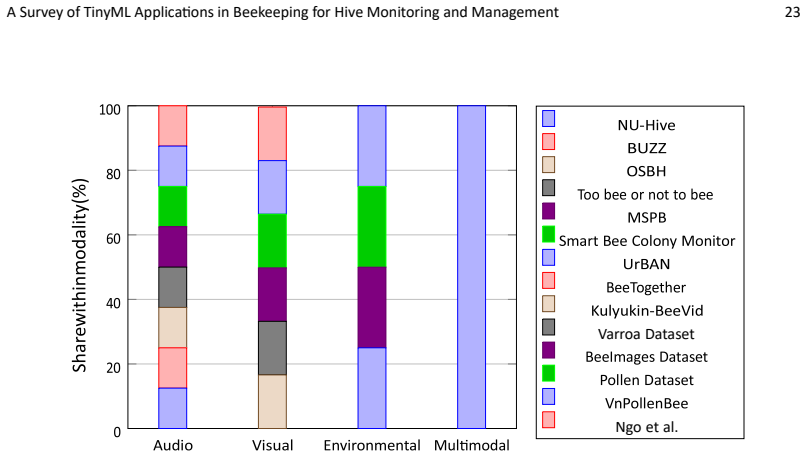
- [Table 2] NU-Hive's availability row is ambiguous: 'Public / Not available / Not available' for audio, temperature, and humidity. Please clarify whether the full multimodal dataset is public or only the audio subset, and if so, which subset.
- [Table 5] In the 'Chemical VOC-based' row, Rigakis [102] is cited for VOC monitoring, but reference [102] describes a multisensory device and time-series prediction, not a VOC study. Also, the 'Integrated Multi-modal' row lists generic model classes without a specific example study; either add citations or remove the row.
- [References / throughout] Several references are malformed or contain typos, e.g., reference [7] has a garbled author list, reference [36] reads 'Colonie' instead of 'Colony,' and reference [48] is a Kaggle dataset without an access date or version. A careful proofreading pass is needed.
Circularity Check
No significant circularity; the survey is a self-contained synthesis of external benchmarks, with only a minor non-load-bearing self-promotional example.
full rationale
This is a survey paper, not a derivation. It does not fit parameters, make predictions, or invoke uniqueness theorems. The central claim—that TinyML enables low-power, on-device hive monitoring—is supported by citations to external studies with reported accuracies (e.g., Kim et al. 91.93%, Kulyukin et al. 99.93%, Iqbal et al. 99%, Ngo et al. F1=0.94). These benchmarks anchor the synthesis independently of the authors' own work. The only self-referential item is the BeeStar example in Section 6.1, citing the company website [14] of an affiliated author; it is presented as 'a practical example' and is not load-bearing for any conclusion. Section 5.1 itself acknowledges that SBCs such as Raspberry Pi/Jetson have 'high power draw, which limits their use in battery-only apiaries,' and Section 4.3 concedes that most benchmarking is 'desktop-class' rather than TinyML-specific. These are honest limitations; they weaken the abstract's broad low-power framing but are not circular reasoning. The tension between the paper's ultra-low-power definition of TinyML and its inclusion of SBC/GPU platforms is an inclusion-criteria inconsistency, not a self-definitional derivation. No quoted equation or construction reduces a claimed result to its input, so no circular step is identified.
Axiom & Free-Parameter Ledger
axioms (3)
- domain assumption The surveyed primary studies are accurately characterized and their reported accuracies are trustworthy.
- ad hoc to paper TinyML can be defined broadly enough to include single-board computers and edge accelerators, not only MCU-class devices.
- domain assumption The BeeStar platform is a valid demonstrative example of TinyML in beekeeping.
Cite this review
Pith. "Pith review of A Survey of TinyML Applications in Beekeeping for Hive Monitoring and Management." pith.science (2026). https://pith.science/paper/P2J4D7FU
@misc{pith2026250908822,
  author       = {Pith},
  title        = {Pith review of: A Survey of TinyML Applications in Beekeeping for Hive Monitoring and Management},
  year         = {2026},
  howpublished = {\url{https://pith.science/paper/P2J4D7FU}},
  note         = {Machine review of arXiv:2509.08822}
}
read the original abstract
Honey bee colonies are essential for global food security and ecosystem stability, yet they face escalating threats from pests, diseases, and environmental stressors. Traditional hive inspections are labor-intensive and disruptive, while cloud-based monitoring solutions remain impractical for remote or resource-limited apiaries. Recent advances in Internet of Things (IoT) and Tiny Machine Learning (TinyML) enable low-power, real-time monitoring directly on edge devices, offering scalable and non-invasive alternatives. This survey synthesizes current innovations at the intersection of TinyML and apiculture, organized around four key functional areas: monitoring hive conditions, recognizing bee behaviors, detecting pests and diseases, and forecasting swarming events. We further examine supporting resources, including publicly available datasets, lightweight model architectures optimized for embedded deployment, and benchmarking strategies tailored to field constraints. Critical limitations such as data scarcity, generalization challenges, and deployment barriers in off-grid environments are highlighted, alongside emerging opportunities in ultra-efficient inference pipelines, adaptive edge learning, and dataset standardization. By consolidating research and engineering practices, this work provides a foundation for scalable, AI-driven, and ecologically informed monitoring systems to support sustainable pollinator management.
Figures



Reference graph
Works this paper leans on
-
[1]
Biosecurity Code of Practice VERSION 1 Nationally endorsed by industry Biosecurity Code of Practice
2016. Biosecurity Code of Practice VERSION 1 Nationally endorsed by industry Biosecurity Code of Practice . Technical Report
2016
-
[2]
Youssef Abadade, Anas Temouden, Hatim Bamoumen, Nabil Benamar, Yousra Chtouki, and Abdelhakim Senhaji Hafid
-
[3]
Haron M Abdel -Raziq, Daniel M Palmer, Phoebe A Koenig, Alyosha C Molnar, and Kirstin H Petersen. 2021. System design for inferring colony -level pollination activity through miniature bee -mounted sensors. Scientific Reports 11 (2021), 4239. doi:10.1038/s41598-021-82537-1
-
[4]
Mahsa Abdollahi, Pierre Giovenazzo, and Tiago H. Falk. 2022. Automated Beehive Acoustics Monitoring: A Comprehensive Review of the Literature and Recommendations for Future Work. Applied Sciences (Switzerland) 12, 8 (4 2022). doi:10.3390/app12083920
-
[5]
Guimarães, Nico Coallier, Ségolène Maucourt, Pierre Giovenazzo, and Tiago H
Mahsa Abdollahi, Yi Zhu, Heitor R. Guimarães, Nico Coallier, Ségolène Maucourt, Pierre Giovenazzo, and Tiago H. Falk. 2024. UrBAN: Urban Beehive Acoustics and PheNotyping Dataset. Scientific Data (6 2024). doi:10.1038/s41597025-04869-1 26 , Vol. 1, No. 1, Article . Publication date: September 2025
-
[6]
H. F. Abou-Shaara, A. A. Owayss, Y . Y . Ibrahim, and N. K. Basuny. 2017. A review of impacts of temperature and relative humidity on various activities of honey bees. Insectes Sociaux 64, 4 (11 2017), 455 –463. doi:10.1007/s00040-017- 0573-8
-
[7]
N P ; F ; Addeo, F ; Lazzari, F ; Manganello, F Bovera, Pier Paolo Danieli, Nicola Francesco Addeo, Filippo Lazzari, Federico Manganello, and Fulvia Bovera. 2024. Precision Beekeeping Systems: State of the Art, Pros and Cons, and Their Application as Tools for Advancing the Beekeeping Sector. Animals 14 (2024), 70. doi:10.3390/ani14010070 [8] AgriFutures ...
-
[9]
M. A.A.Che Ali, B. Ilias, N. Abdul Rahim, S. A.Abdul Shukor, A. H. Adom, and M. A.H. Saad. 2021. A Review on the Stingless Beehive Conditions and Parameters Monitoring using IoT and Machine Learning. In Journal of Physics: Conference Series, Vol. 2107. IOP Publishing Ltd. doi:10.1088/1742-6596/2107/1/012040
-
[10]
Doreid Ammar, Jean Savinien, and Lionel Radisson. 2019. The Makers’ Beehives: Smart Beehives for Monitoring Honey-Bees’ Activities. Association for Computing Machinery (2019). doi:10.1145/3365871.3365887
arXiv 2019
-
[11]
Omar Anwar, Adrian Keating, Rachel Cardell -Oliver, Amitava Datta, and Gino Putrino. 2023. Apis -Prime: A deep learning model to optimize beehive monitoring system for the task of daily weight estimation. Applied Soft Computing 144 (2023), 110546. doi:10.1016/j.asoc.2023.110546
arXiv 2023
-
[12]
Colby Banbury, Emil Njor, Andrea Mattia Garavagno, Matthew Stewart, Pete Warden, Manjunath Kudlur, Nat Jeffries, Xenofon Fafoutis, and Vijay Janapa Reddi. 2024. Wake Vision: A Tailored Dataset and Benchmark Suite for TinyML Computer Vision Applications. arXiv preprint arXiv:2405.00892 (5 2024). http://arxiv.org/abs/2405.00892
Pith/arXiv arXiv 2024
-
[13]
Colby R. Banbury, Vijay Janapa Reddi, Max Lam, William Fu, Amin Fazel, Jeremy Holleman, Xinyuan Huang, Robert Hurtado, David Kanter, Anton Lokhmotov, David Patterson, Danilo Pau, Jae-sun Seo, Jeff Sieracki, Urmish Thakker, Marian Verhelst, and Poonam Yadav. 2021. Benchmarking TinyML Systems: Challenges and Direction. arXiv preprint arXiv:2003.04821 (3 202...
Pith/arXiv arXiv 2021
-
[14]
BeeStar Australia. 2024. BeeStar Smart Beehive Monitoring. https://www.beestar.com.au/
2024
-
[15]
Bojana Bekić Šarić, Etleva Dashi Muça, Jonel Subić, Irena Džimrevska, and Slađan Rašić. 2023. Environmental threats to beekeeping in the Western Balkan countries-beekeepers’ perceptions. Environmental Research Communications 5 (2023). doi:10.1088/2515-7620/acd913
-
[16]
Martin Bencsik, Joseph Bencsik, Michael Baxter, and Andrei Lucian. 2011. Identification of the honey bee swarming process by analysing the time course of hive vibrations. Computers and Electronics in Agriculture 76 (2011), 44–50. doi:10.1016/j.compag.2011.01.004
-
[17]
Bikaun, Tiffane Bates, Maike Bollen, Gavin R
Jessica M. Bikaun, Tiffane Bates, Maike Bollen, Gavin R. Flematti, Joanna Melonek, Praveen Praveen, and Julia Grassl
-
[18]
Simon Bilik, Ilona Janakova, Adam Ligocki, and Dominik Ficek Karel Horak. 2024. Computer Vision Approaches for Automated Bee Counting Application. In IFAC-PapersOnLine, Vol. 58. Elsevier B.V., 43–48. doi:10.1016/j.ifacol.2024.07. 369
-
[19]
Diogo Braga, Ana Madureira, Fabio Scotti, Vincenzo Piuri, and Ajith Abraham. 2021. An Intelligent Monitoring System for Assessing Bee Hive Health. IEEE Access 9 (2021), 89009–89019. doi:10.1109/ACCESS.2021.3089538
arXiv 2021
-
[20]
Augustin Bricout, Philippe Leleux, Pascal Acco, Christophe Escriba, Jean -Yves Fourniols, Georges Soto-Romero, and Rémi Floquet. 2024. Bee Together: Joining Bee Audio Datasets for Hive Extrapolation in AI-Based Monitoring. Sensors (2024). doi:10.3390/s24186067
-
[21]
Jerry J Bromenshenk, Garon C Smith, Bruce E King, Robert A Seccomb, Ghassan Alnasser, Colin B Henderson, ; Christopher, L Wrobel, Matthew R Loeser, and J Ili. 1996. New and Improved Methods for Monitoring Air Quality and the Terrestrial Environment PRINCIPAL INVESTIGATOR. Technical Report
1996
-
[22]
Daniel S Bush, Bernarda Calla, May R Berenbaum, and S Bush. 2024. An Aspergillus flavus strain from bee bread of the Western honey bee (Apis mellifera) displays adaptations to distinctive features of the hive environment. Ecology and Evolution 14 (2024). doi:10.1002/ece3.10918
-
[23]
Stefania Cecchi, Susanna Spinsante, Alessandro Terenzi, and Simone Orcioni. 2020. A smart sensor -based measurement system for advanced bee hive monitoring. Sensors (Switzerland) 20, 9 (5 2020). doi:10.3390/s20092726
-
[24]
Stefania Cecchi, Alessandro Terenzi, Simone Orcioni, Paola Riolo, Sara Ruschioni, and Nunzio Isidoro. 2018. A Preliminary Study of Sounds Emitted by Honey Bees in a Beehive. In 144th Audio Engineering Society (AES) Convention. Audio Engineering Society (AES). A Survey of TinyML Applications in Beekeeping for Hive Monitoring and Management 27 , Vol. 1, No....
2018
-
[25]
Urmila Chakraborty, Ajeet Kaushik, Ganga Ram Chaudhary, and Yogendra Kumar Mishra. 2024. Emerging nanoenabled gas sensor for environmental monitoring – Perspectives and open challenges. Current Opinion in Environmental Science & Health 37 (2 2024), 100532. doi:10.1016/J.COESH.2024.100532
arXiv 2024
-
[26]
Nadine Chapman. 2020. Plan Bee - Australian honey bee genetic improvement program - Professional Beekeepers. https://extensionaus.com.au/professionalbeekeepers/plan-bee-australian-honey-bee-genetic- improvementprogram/
2020
-
[27]
Vasileia Chatzaki, Marta Montoro, Rámi El-Rashid, Annette Bruun Jensen, and Antoine Lecocq. 2023. A New Approach for Detecting Sublethal Effects of Neonicotinoids on Bumblebees Using Optical Sensor A New Approach for Detecting Sublethal Effects of Neonicoti noids on Bumblebees Using Optical Sensor Technology. Insects (2023). doi:10.3390/insects14080713
-
[28]
Dario De Nart, Cecilia Costa, Gennaro Di Prisco, and Emanuele Carpana. 2022. Image recognition using convolutional neural networks for classification of honey bee subspecies. Apidologie 1 (2022), 3. doi:10.1007/s13592-022-00918-5
-
[29]
Andrea De Simone, Luca Barbisan, Student Member, Giovanna Turvani, and Fabrizio Riente. 2024. Advancing Beekeeping: IoT and TinyML for Queen Bee Monitoring Using Audio Signals. IEEE TRANSACTIONS ON INSTRUMENTATION AND MEASUREMENT 73 (2024), 2024. doi:10.1109/TIM.2024.3449981
arXiv 2024
-
[30]
Water Department of Agriculture and the Environment. 2020. Department of Agriculture, Water and the Environment Delivering Ag2030. Technical Report. Department of Agriculture, Water and the Environment
2020
-
[31]
S. K. Devitt, P . W. J. Baxter, and G. Hamilton. 2021. The Ethics of Biosurveillance. Journal of Agricultural and Environmental Ethics 32, 5-6 (11 2021), 709–740. doi:10.1007/s10806-019-09775-2
-
[32]
M. Doinea, I. Trandafir, C. Toma, M. Popa, and A. Zamfiroiu. 2024. IoT Embedded Smart Monitoring System with Edge Machine Learning for Beehive Management. International Journal of Computers, Communications and Control 19, 4 (2024). doi:10.15837/IJCCC.2024.4.6632
-
[33]
Zina Sabrina Duma, Tomas Zemcik, Simon Bilik, Tuomas Sihvonen, Peter Honec, Satu Pia Reinikainen, and Karel Horak
-
[34]
Abdelrahman Elgendy. 2025. Beekeeping with computer vision: Smarter hive monitoring. https://www.ultralytics. com/blog/beekeeping-with-computer-vision-smarter-hive-monitoring
2025
-
[35]
Etxegarai-Legarreta, Olatz and Sanchez-Famoso, and Valeriano. 2022. The Role of Beekeeping in the Generation of Goods and Services: The Interrelation between Environmental, Socioeconomic, and Sociocultural Utilities. Agriculture 12 (4 2022). doi:10.3390/agriculture12040551
-
[36]
Richard M Florio. 2011. Bees Biology Threats and Colonie. Nova Science
2011
-
[37]
Amira Ghezal, Christian Jair Luis Peña, and Andreas König. 2024. Varroa Mite Counting Based on Hyperspectral Imaging. Sensors 24, 14 (7 2024). doi:10.3390/s24144437
-
[38]
Aleš Gregorc and Blair Sampson. 2019. diversity Diagnosis of Varroa Mite (Varroa destructor) and Sustainable Control in Honey Bee (Apis mellifera) Colonies-A Review. Diversity 11 (2019). doi:10.3390/d11120243
-
[39]
Hugo Hadjur, Doreid Ammar, and Laurent Lefèvre. 2022. Toward an intelligent and efficient beehive: A survey of precision beekeeping systems and services. Computers and Electronics in Agriculture 192 (2022), 106604. doi:10.1016/j. compag.2021.106604
arXiv 2022
-
[40]
Hamza, Rahman Tashakkori, Bejamen Underwood, William O’Brien, and Chris Campell
Abdelbaset S. Hamza, Rahman Tashakkori, Bejamen Underwood, William O’Brien, and Chris Campell. 2023. BeeLive: The IoT platform of Beemon monitoring and alerting system for beehives. Smart Agricultural Technology 6 (12 2023), 100331. doi:10.1016/J.ATECH.2023.100331
arXiv 2023
-
[41]
Gyan P Harwood and Adam G Dolezal. 2020. Pesticide-Virus Interactions in Honey Bees: Challenges and Opportunities for Understanding Drivers of Bee Declines. Viruses (2020). doi:10.3390/v12050566
-
[42]
Huu-Tuong Ho, Minh-Tien Pham, Quang-Duong Tran, Quang-Huy Pham, Thi-Thu-Hong Phan, and Ho Chi Minh. 2023. Evaluating Audio Feature Extrac -tion Methods for Identifying Bee Queen Presence. (2023). doi:10.1145/3628797. 3628852
-
[43]
Kainat Iqbal, Bayan Alabdullah, Naif Al Mudawi, Asaad Algarni, Ahmad Jalal, and Jeongmin Park. 2024. Empirical Analysis of Honeybees Acoustics as Biosensors Signals for Swarm Prediction in Beehives. IEEE Access 12 (1 2024), 148405–148421. doi:10.1109/ACCESS.2024.3471895
arXiv 2024
-
[44]
Vikram Jain, Sebastian Giraldo, Jaro De Roose, Linyan Mei, Bert Boons, and Marian Verhelst. 2023. TinyVers: A Tiny Versatile System-on-Chip With State -Retentive eMRAM for ML Inference at the Extreme Edge. IEEE JOURNAL OF SOLID-STATE CIRCUITS 58, 8 (2023). doi:10.1109/JSSC.2023.3236566 28 , Vol. 1, No. 1, Article . Publication date: September 2025
arXiv 2023
-
[45]
Kyungchang Jeong, Hongseok Oh, Yeongyu Lee, Hanbit Seo, Gyuchan Cho, Jaemin Jeong, Gyutae Park, Jungseok Choi, Young-Duk Seo, Ji -Hoon Jeong, and Euijong Lee. 2024. IoT and AI Systems for Enhancing Bee Colony Strength in Precision Beekeeping: A Survey and F uture Research Directions. IEEE Internet of Things Journal (2024). doi:10.1109/JIOT.2024.3461775
arXiv 2024
-
[46]
Joe Air Jiang, Jen Cheng Wang, Chien Peng Huang, Mu Hwa Lee, An Chi Liu, Hung Jen Lin, Chien Hao Wang, Cheng Ying Chou, and En Cheng Yang. 2024. Foraging flight-based health indicators for honey bee colonies using automatic monitoring systems. Computers and Electronics in Agriculture 216 (1 2024). doi:10.1016/j.compag.2023.108476
arXiv 2024
-
[47]
Divason Jose. 2024. Analysis of Varroa Mite Colony Infestation Level Using NewOpen Software Based on Deep Learning Techniques. (2024). doi:10.3390/s24123828
-
[48]
Anna Jyang. 2023. Smart Bee Colony Monitor: Clips of Beehive Sounds. https://www.kaggle.com/datasets/annajyang/ beehive-sounds
2023
-
[49]
Charbel Kady, Anna Maria Chedid, Ingred Kortbawi, Charles Yaacoub, Adib Akl, Nicolas Daclin, François Trousset, François Pfister, Gregory Zacharewicz, and A A Lb. 2021. IoT-Driven Workflows for Risk Management and Control of Beehives. (2021). doi:10.3390/d13070296
-
[50]
Selcan Kaplan Berkaya, Efnan Sora Gunal, and Serkan Gunal. 2021. Deep learning -based classification models for beehive monitoring. Ecological Informatics 64 (9 2021). doi:10.1016/j.ecoinf.2021.101353
arXiv 2021
-
[51]
Shaden A.M. Khalifa, Esraa H. Elshafiey, Aya A. Shetaia, Aida A.Abd El-Wahed, Ahmed F. Algethami, Syed G. Musharraf, Mohamed F. Alajmi, Chao Zhao, Saad H.D. Masry, Mohamed M. Abdel-Daim, Mohammed F. Halabi, Guoyin Kai, Yahya Al Naggar, Mokhtar Bishr, Mohamed A.M. Diab, and Hesham R. El -Seedi. 2021. Overview of bee pollination and its economic value for c...
-
[53]
Dimitrios I Kiromitis, Christos V Bellos, Konstantinos A Stefanou, Georgios S Stergios, Thomas Katsantas, and Sotirios Kontogiannis. 2022. Bee Sound Detector: An Easy -to-Install, Low-Power, Low-Cost Beehive Conditions Monitoring System. (2022). doi:10.3390/electronics11193152
-
[54]
Simon Klein, Amélie Cabirol, Jean Marc Devaud, Andrew B. Barron, and Mathieu Lihoreau. 2017. Why Bees Are So Vulnerable to Environmental Stressors. Trends in Ecology and Evolution 32, 4 (4 2017), 268–278. doi:10.1016/j.tree. 2016.12.009
doi:10.1016/j.tree 2017
-
[55]
Olivia Kline and Neelendra K Joshi. 2020. Mitigating the Effects of Habitat Loss on Solitary Bees in Agricultural Ecosystems. Agriculture (2020). doi:10.3390/agriculture10040115
-
[56]
Von Knoblauch, T ; Jensen, A B ; Mülling, Tammo Von Knoblauch, Annette B Jensen, Christoph K W Mülling, Heike Aupperle-Lellbach, and Elke Genersch. 2024. Chalkbrood Disease Caused by Ascosphaera apis in Honey Bees (Apis mellifera)-Morphological and Histological Changes in Infected Larvae. Vet. Sci 2024 (2024), 415. doi:10.3390/vetsci
-
[57]
Sotirios Kontogiannis. 2024. Beehive Smart Detector Device for the Detection of Critical Conditions That Utilize Edge Device Computations and Deep Learning Inferences. Sensors (2024). doi:10.3390/s24165444
-
[58]
Grzegorz Krzywoszyja, Ryszard Rybski, and Grzegorz Andrzejewski. 2019. Bee Swarm Detection Based on Comparison of Estimated Distributions Samples of Sound. IEEE TRANSACTIONS ON INSTRUMENTATION AND MEASUREMENT 68, 10 (2019). doi:10.1109/TIM.2018.2878594
arXiv 2019
-
[59]
Vladimir Kulyukin, Sarbajit Mukherjee, and Prakhar Amlathe. 2018. Toward Audio Beehive Monitoring: Deep Learning vs. Standard Machine Learning in Classifying Beehive Audio Samples. Appl. Sci 8 (2018). doi:10.3390/app8091573
-
[60]
Vladimir A. Kulyukin and Aleksey V. Kulyukin. 2023. Accuracy vs. Energy: An Assessment of Bee Object Inference in Videos from On -Hive Video Loggers with YOLOv3, YOLOv4 -Tiny, and YOLOv7 -Tiny. Sensors 23, 15 (8 2023). doi:10.3390/s23156791
-
[61]
Urszula Libal and Pawel Biernacki. 2024. MFCC Selection by LASSO for Honey Bee Classification. Applied Sciences (2024). doi:10.3390/app14020913
-
[62]
Ji Lin, Ligeng Zhu, Wei Ming Chen, Wei Chen Wang, and Song Han. 2023. Tiny Machine Learning: Progress and Futures. IEEE Circuits and Systems Magazine 23, 3 (2023), 8–34. doi:10.1109/MCAS.2023.3302182
arXiv 2023
-
[63]
Bruno Loureiro Coelho, Pablo Rafael Bodmann, Niccolò Cavagnero, Christopher Frost, and Paolo Rech. 2025. Vision Transformer Reliability Evaluation on the Coral Edge TPU. IEEE Transactions on Nuclear Science 72, 4 (2025), 1443–
2025
-
[64]
Rüdiger Machhamer, Jannik Altenhofer, Kristof Ueding, Levin Czenkusch, Florian Stolz, Maximilian Harth, Michael Mattern, Azhar Latif, Swen Haab, Jürgen Herrmann, Anke Schmeink, Klaus-Uwe Gollmer, and Guido Dartmann. 2020. Visual Programmed IoT Beehive Moni toring for Decision Aid by Machine Learning based Anomaly Detection. In A Survey of TinyML Applicati...
2020
-
[65]
Katherine McNamara Manning, Reid R. Coffman, and Christie A. Bahlai. 2024. Insect pollinator and natural enemy communities in green roof and ground-level urban habitats. Urban Ecosystems (1 2024). doi:10.1007/s11252-023- 01499-6
-
[66]
Francesco Marinello, Xiongzhe Han, Tianyi Wang, Shreyas M Guruprasad, and Benjamin Leiding. 2024. BeeOpen-An Open Data Sharing Ecosystem for Apiculture. Agriculture (2024). doi:10.3390/agriculture14030470
-
[67]
Francesco Marinello, Efthymios Rodias, and Vasileios Kilimpas. 2024. AgriEngineering Remote Monitoring of Bee Apiaries as a Tool for Crisis Management. AgriEngineering (2024). doi:10.3390/agriengineering6030133
-
[68]
Peter Mattson Google, Brain Vijay, Janapa Reddi, Christine Cheng, Cody Coleman, Greg Diamos, David Kanter, David Patterson, Guenther Schmuelling, Hanlin Tang, Gu -Yeon Wei, and Carole -Jean Wu. 2020. MLPerf: An Industry Standard Benchmark Suite for Machine L earning Performance. IEEE Micro 40 (3 2020), 8 –16. doi:10.1109/MM.2020.2974843
arXiv 2020
-
[69]
M Michalczyk, R Sokół, A Bancerz -Kisiel, and R Sok. 2024. Presence of Lotmaria passim, Crithidia mellificae and Nosema spp. in differently aged Apis mellifera brood. Journal of Apicultural Reseach (2024). doi:10.1080/00218839. 2022.2055265
arXiv 2024
-
[70]
Avshalom Mizrahi and Yaacov Lensky. 1997. Bee Products: Properties, Applications and Apitherapy. Springer Science and Business Media. doi:10.1007/978-1-4757-9371-0
-
[71]
Abdul M Mouazen, Viacheslav Adamchuk, Massimiliano Micheli, Giulia Papa, Ilaria Negri, Matteo Lancini, Cristina Nuzzi, and Simone Pasinetti. 2024. Sensorizing a Beehive: A Study on Potential Embedded Solutions for Internal Contactless Monitoring of Bees Activity. Sensors (2024). doi:10.3390/s24165270
-
[72]
Dariusz Mrozek, Rafał G ˙ Orny, Anna Wachowicz, Bo˙ Zena Małysiak -Mrozek, Agostino Forestiero, and Anna Wachowicz@polsl Pl. 2021. Edge -Based Detection of Varroosis in Beehives with IoT Devices with Embedded and TPU-Accelerated Machine Learning. (2021). doi:10.3390/app112211078
-
[73]
Muhammad Mulhim Md Jani, Muhammad Asraf Hairuddin, Hajar Ja, Ilham Rustam, Ali Abd Almisreb, and Nur Dalila Khirul Ashar. [n. d.]. Real-Time IoT-Blynk Application for Log Hive Weight Monitoring in Stingless Bees. International Information and Engineering Technology Asso ([n. d.]). doi:10.18280/i2m.230202
-
[74]
Christian I. Narcia -Macias, Joselito Guardado, Jocell Rodriguez, Joanne Rampersad -Ammons, Erik Enriquez, and Dong-Chul Kim. 2023. IntelliBeeHive: An Automated Honey Bee, Pollen, and Varroa Destructor Monitoring System. arXiv preprint (9 2023). http://arxiv.org/abs/2309.08955
Pith/arXiv arXiv 2023
-
[75]
Abdul Nasir, Muhammad Obaid Ullah, and Muhammad Haroon Yousaf. 2023. AI in apiculture: A novel framework for recognition of invasive insects under unconstrained flying conditions for smart beehives. Engineering Applications of Artificial Intelligence 119 (3 2023). doi:10.1016/j.engappai.2022.105784
arXiv 2023
-
[76]
Shahin Nekoei, Mahsa Rezvan, Faham Khamesipour, Christopher Mayack, Marcelo Beltrão Molento, and Pablo Damián Revainera. 2023. A systematic review of honey bee (Apis mellifera, Linnaeus, 1758) infections and available treatment options. Veterinary Medicine and Science 9, 4 (7 2023), 1848–1860. doi:10.1002/VMS3.1194
-
[77]
Thi Nha Ngo, Dan Jeric, Arcega Rustia, En-Cheng Yang, and Ta-Te Lin. 2021. Automated monitoring and analyses of honey bee pollen foraging behavior using a deep learning -based imaging system. Computers and Electronics in Agriculture 187 (2021), 106239. doi:10.1016/j.compag.2021.106239
arXiv 2021
-
[78]
Dinh Tu Nguyen, Thi Nhung Le, Thi Huong Phung, Duc Manh Nguyen, Hong Quan Nguyen, Hong Thai Pham, Thi Thu Hong Phan, Hai Vu, and Thi Lan Le. 2024. Improving pollen -bearing honey bee detection from videos captured at hive entrance by combining deep learning and handling imbalance techniques. Ecological Informatics 82 (9 2024), 102744. doi:10.1016/J.ECOINF...
arXiv 2024
-
[79]
Duy-Tung Nguyen, Duc-Manh Nguyen, Dinh-Tan Pham, Khoat Than, Hong-Thai Pham, Hai Vu, and Ho Chi Minh. 2023. Bayesian method for bee counting with noise-labeled data. (2023). doi:10.1145/3628797.3628969
arXiv 2023
-
[80]
Hai Cong Nguyen, Dinh -Tu Nguyen, Thi-Huong Phung, Thi-Lan-Anh Nguyen, Toi Van Nguyen, Pham Thai, ThuHong Phan, Thi-Lan Le, Xuan Dung Nguyen, Ngoc Lan, Tran Thi, and Vu Hai. 2022. A method for automatic honey bees detection and counting from images with high density of bees. (2022). doi:10.1109/ICCE55644.2022.9852024
arXiv 2022
-
[81]
Hien Nguyen Thi, Thi-Thu-Hong Phan, and Cao Truong Tran. 2023. Ge-netic Programming for Bee Audio Classification. (2023). doi:10.1145/3591569.3591612
arXiv 2023
-
[82]
Malika Nisal, Ratnayake Id, Adrian G Dyer Id, and Alan Dorin Id. 2021. Tracking individual honeybees among wildflower clusters with computer vision -facilitated pollinator monitoring. Plos One (2021). doi:10.1371/journal.pone. 0239504 30 , Vol. 1, No. 1, Article . Publication date: September 2025
discussion (0)
Sign in with ORCID, Apple, or X to comment. Anyone can read and Pith papers without signing in.