REVIEW 3 major objections 4 minor 1 cited by
Classical transport theory for the planar Hall effect with threefold symmetry
T0 review · 3 major / 4 minor · reviewed 2026-08-03 · deepseek-v4-flash
Pith's one-line read The paper argues that the threefold component of the planar Hall effect arises classically from a third-order expansion of the Boltzmann equation, governed by mirror symmetry rather than Berry curvature.
desk verdict Third-order Boltzmann expansion is a genuinely new result, but the paper's 'two mirror planes broken' selection rule is wrong: Table I shows the C3 term actually requires breaking the mirror plane that contains the current and voltage. read the letter →
The pith
A machine-rendered reading of the paper's core claim, the machinery that carries it, and where it could break.
The reading
What carries the argument
The load-bearing object is the Jones–Zener solution of the linearized Boltzmann equation, expanded to third order in the magnetic field. Equation (5) packages the result as σ(3)_yx = −(e^5 τ^4/16π^3) [⟨Λxx+Λyx⟩ cos3φ + ⟨Λyy+Λxy⟩ sin3φ], where the Λ's are built from αij = ℏ^-2∂^2ε/∂k_i∂k_j and Kij = αiiαjj − αij^2. The parity of these Λ terms in kx, ky, kz (Table I) is the entire selection rule: for an even dispersion each Λ is odd along at least two directions, so the angular integral vanishes; a mixed-parity dispersion leaves an even component and produces a finite threefold term. The three-ellipsoid model supplies an explicit non-perturbative formula—ρ3 ∝ (μ1−μ2)^3 cos^5θ sinθ / (C1B^4 + C
What would settle it
Measure the planar Hall resistivity in a cubic crystal with the current along one C4 axis and the transverse voltage along another C4 axis, with negligible sample misalignment. The theory predicts the threefold sin3φ component is exactly zero in this geometry; observing a finite threefold term above noise would falsify the central selection rule. Alternatively, check the predicted parametric dependence of the threefold amplitude from the effective-mass model: ρ3 ∝ (μ1−μ2)^3 cos^5θ sinθ / (C1B^4+C2B^2+C3); a clean experimental measurement that disagrees with this functional form would also cast
Extended reading notes
Core claim
The paper's central claim is that the threefold PHE is a classical transport effect whose selection rule is fixed by the parity of the band dispersion with respect to the symmetry planes of the measurement setup. In the third-order Jones–Zener expansion, the conductivity correction σ(3)_yx is an integral over products of second-derivative terms αij and Gaussian-curvature factors Kij. Each product is odd under inversion in at least two of the k-space directions aligned with the current, voltage, and J×E axes when the dispersion is even, so the integral vanishes. When the dispersion has mixed parity—which happens when only a single mirror plane is retained, as when a C3 axis is aligned with J×
Load-bearing premise
The load-bearing premise is that the band dispersion can be treated as quadratic (higher-order derivatives negligible) and that a single, wavevector-independent relaxation time τ describes the scattering; the parity bookkeeping in Table I, and hence the exact selection rule, rests on those assumptions.
Editorial extensions
If this is right
- In a cubic crystal, the threefold PHE component is identically zero when the C4 axes are aligned with the current, voltage, and their normal; rotating the measurement so a C3 axis (body diagonal) points along the normal makes the same crystal show a finite sin3φ component.
- Every trigonal, triclinic, and monoclinic crystal is predicted to show a threefold PHE component that cannot be eliminated by changing the measurement geometry, because at most one mirror plane can be preserved.
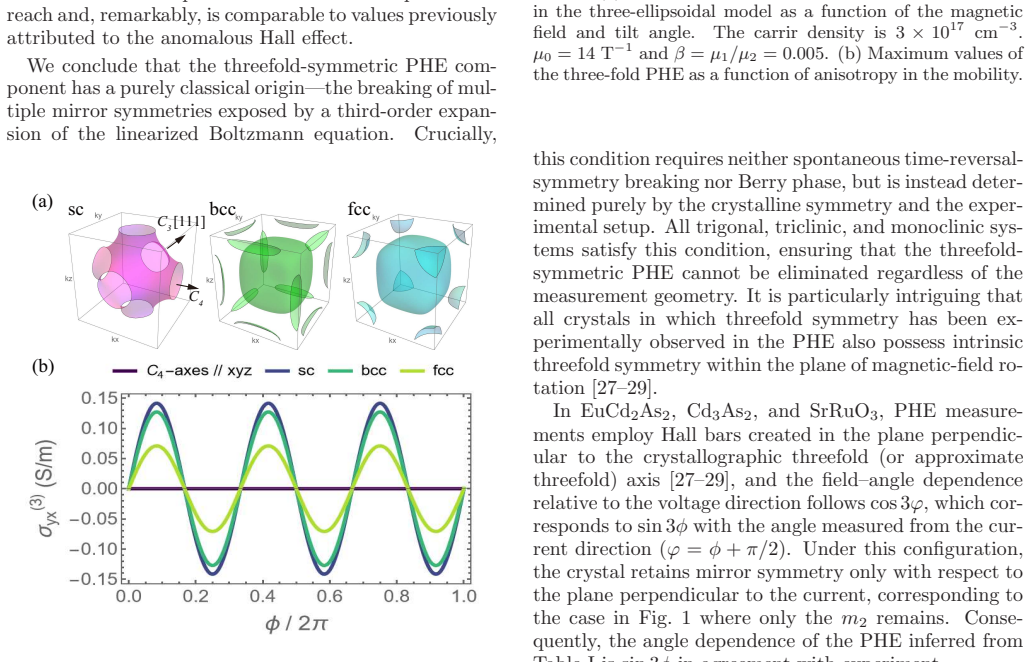
- The amplitude of the classical threefold component reaches roughly 25% of the maximum PHE signal in the three-ellipsoid model, and in compensated semimetals it can exceed several hundred mΩ·cm—comparable to values previously reported as anomalous Hall or Berry-curvature signatures.
- The phase of the threefold signal (sin3φ vs cos3φ) is set by how the crystal's mirror planes sit relative to the current and voltage directions, so rotating the sample or the Fermi surfaces shifts the phase continuously.
Reading between the lines
- If the parity selection rule holds beyond the quadratic-dispersion approximation, a practical consequence is that the threefold PHE could serve as a crystallographic orientation tool: measuring the angular phase in a known crystal would locate the mirror planes.
- The same third-order machinery might apply to other odd harmonics (e.g., fivefold or higher) by expanding to fifth order, though the paper does not consider this; the mirror-plane bookkeeping would presumably generalize.
- The single-relaxation-time assumption is the most likely place the selection rule could soften: in real materials with strongly energy-dependent scattering, even a fully symmetric setup might show a residual threefold term, which would not refute the core claim but would add a correction term.
Editorial analysis
A structured set of objections, weighed in public.
Referee Report
Summary. Using the Jones–Zener expansion of the linearized Boltzmann equation to third order in the magnetic field, the authors derive a general expression for a threefold-symmetric planar Hall conductivity (Eq. (5)) and argue, from a parity analysis of the integrands (Table I), that this component is controlled by mirror symmetries of the band dispersion relative to the current, voltage, and their normal. They illustrate the effect in a three-ellipsoid effective-mass model (Supplemental Eq. (1)) and in tight-binding cubic lattices, and estimate amplitudes that can reach the mΩ cm scale, comparable to signals previously attributed to the anomalous Hall effect. They conclude that many recent threefold PHE observations in trigonal materials can be explained classically, without invoking Berry curvature or spontaneous time-reversal breaking.
Significance. If the central selection rule is correct, the paper makes a valuable contribution: it provides a transparent, parameter-free symmetry argument separating classical Lorentz-force contributions from Berry-curvature/AHE interpretations in recent threefold PHE experiments. The parity bookkeeping is explicit, the model calculations are concrete, and the three-ellipsoid formula is analytic. The paper also clearly shows that a threefold arrangement of Fermi surfaces alone is insufficient; tilt/mirror breaking is required, which is a falsifiable prediction. These strengths make the central claim worth pursuing, provided the symmetry criterion and the supporting derivation are corrected and substantiated.
major comments (3)
- [Eq. (5) and Table I] The stated mirror criterion is not correct as written. Table I has n=3 (odd) in the k_z column for every Λ tensor. If ε(k) is even under k_z→-k_z (the xy plane, spanned by j and E, is a mirror plane), every integrand in Eq. (5) is odd in k_z and the C3 integral vanishes. The text after Eq. (5) says the threefold component is observable when mirror symmetry is broken for two of the three planes; this would include the case (yz,zx broken, xy present), for which the C3 term is zero by Table I. The correct necessary condition is that the xy mirror must be broken; yz/zx only select the sin3φ/cos3φ phase. This also invalidates the concluding claim that the C3 PHE 'cannot be eliminated regardless of the measurement geometry' for all trigonal/triclinic/monoclinic systems: a geometry whose measurement plane is a mirror plane eliminates it.
- [Eq. (5)] Eq. (5) is the foundation of the paper but is asserted without derivation: the third-order Jones–Zener expansion leading to the Λ tensors is not shown. Since Table I and the entire selection rule rest on the parity of Λxx, Λyy, Λxy, Λyx, the derivation (or at least a sketch specifying how the powers of α, K, and v arise) must be included. Please also define the bracket ⟨...⟩ and the role of the Fermi function precisely.
- [After Eq. (5)] The claim that including higher-order derivatives of ε(k) 'does not alter the subsequent arguments' is unproved and load-bearing. At third order in B the expansion can generate third/fourth derivatives, whose parity under k_z→-k_z is not the same as the quadratic terms. Without a proof, the selection rule is only established for quadratic dispersions; the paper's generality claims (e.g., 'all trigonal, triclinic, and monoclinic systems') go beyond what is shown.
minor comments (4)
- [Figs. 2–4 and Supplemental Eq. (S1)] The amplitude estimates use representative parameters (β=0.005, μ0=14 T^-1, n=10^17 cm^-3) without sensitivity analysis. The quantitative claim that the threefold component can reach mΩ cm and is comparable to AHE-derived values would be strengthened by showing a range over β, μ0, and n.
- [Eq. (3)] The derivation assumes a single, k-independent relaxation time τ. The symmetry of τ under the relevant mirror planes is not discussed; an anisotropic or k-dependent τ could in principle modify the parity argument. This limitation should be stated explicitly.
- [Throughout] The statement near the beginning that 'no expansion beyond this order had previously been attempted' is a strong historical claim; a softer wording would be safer. The PDF typos such as 'effect' and the formatting of Figure 2 captions should be corrected.
- [Eq. (7)] The sign convention for electron and hole carriers would benefit from an explicit statement that e>0, to avoid ambiguity in the ± signs.
Circularity Check
No significant circularity: the third-order Boltzmann derivation is self-contained; only minor contextual self-citations.
full rationale
The central claim follows from Eq. (5), obtained by applying the Jones-Zener expansion to the linearized Boltzmann equation (Eqs. (3)-(4)) and expanding to third order in B. The threefold component is not assumed as an output; it appears algebraically through triple-angle identities from the third-order terms. The symmetry selection rule in Table I is parity bookkeeping on Eq. (5), not an input fitted to threefold PHE data. Numerical amplitudes are generated with stated representative parameters (e.g., mu0 = 14 T^-1, beta = 0.005, n = 1e17 cm^-3, tau = 1 ps, t = 30 meV) and are presented as predictions; no experimental threefold amplitude is used to extract a parameter. Citations [17,34,35] are by the same research group and provide context and a modeling technique, but the load-bearing derivation does not reduce to them; no uniqueness theorem or hidden ansatz is imported. The statement 'For simplicity, we assume that higher-order derivatives of the effective mass become negligibly small. However, including such terms does not alter the subsequent arguments' is an explicitly stated, unproved assumption and is a correctness/completeness risk, not a circular step, because the derivation's predictive content does not depend on that assertion. Any overstatement in the concluding symmetry rule would be an internal-consistency/correctness concern, not circularity. Hence the paper is essentially non-circular; the score only reflects minor self-citation in contextual references.
Assumptions & free parameters
free parameters (6)
- mobility anisotropy ratio β = μ1/μ2 =
0.005 (Figs. 2 and 4); varied in Fig. 4(b)
- out-of-plane tilt angle θ =
0°–20°; SM analytic amplitude ∝ sinθ cos^5θ
- carrier density n =
10^17 cm^-3 (Fig. 2) and 3×10^17 cm^-3 (Fig. 4)
- mobility scale μ0 =
14 T^-1 (main); 7 and 28 T^-1 in Fig. 4(b)
- tight-binding parameters =
t=30 meV, E_F/t=-0.5, k_BT/t=2.8×10^-2, τ=1 ps (Fig. 3)
- residual hole density in semimetal model =
1% of total carrier number (SM)
assumptions (5)
- domain assumption Jones–Zener solution of the linearized Boltzmann equation with constant relaxation time τ (Eq. 3)
- ad hoc to paper Truncation at third order in B and neglect of higher-order derivatives of ε(k)
- standard math Parity argument: integrals over the Brillouin zone of functions odd in any direction vanish; ε(k) can be decomposed into even and odd parts
- domain assumption Multi-ellipsoid mobility-tensor model (Eq. 7) represents the Fermi surfaces with non-perturbative field dependence
- standard math Triple-angle identities reduce the four cubic angular terms to sin3φ and cos3φ
Cite this review
Pith. "Pith review of Classical transport theory for the planar Hall effect with threefold symmetry." pith.science (2026). https://pith.science/paper/P2PHNJSS
@misc{pith2026260113613,
  author       = {Pith},
  title        = {Pith review of: Classical transport theory for the planar Hall effect with threefold symmetry},
  year         = {2026},
  howpublished = {\url{https://pith.science/paper/P2PHNJSS}},
  note         = {Machine review of arXiv:2601.13613}
}
read the original abstract
In recent years, the planar Hall effect (PHE) has become a key probe of Berry curvature and the anomalous Hall effect (AHE). Threefold-symmetric signals under in-plane fields are often attributed to such quantum mechanisms. Here, we establish a purely classical origin for a three-fold-symmetric PHE. The idea is simple yet decisive: a third-order expansion of the Boltzmann equation in the magnetic field reveals that the threefold component originates from the relative positions of the mirror planes in the crystals with respect to the measurement setups. Remarkably, the threefold contribution should be ubiquitous because this symmetry condition can be realized across a broad range of crystals. Numerical estimates based on concrete models further show that its amplitude is comparable to that expected from the AHE.
Figures


Figures from the paper (1 more)
Forward citations
Cited by 1 Pith paper
-
Chiral anomaly and planar Hall conductance in pseudospin-$1$ Fermions
Boltzmann transport calculation finds sign-reversing planar Hall conductance and anisotropic angular responses in tilted pseudospin-1 fermions arising from chiral anomaly effects.
Reference graph
Works this paper leans on
-
[1]
Goldberg and R
C. Goldberg and R. E. Davis, Phys. Rev. 94, 1121 (1954)
1954
-
[2]
Jones, C
H. Jones, C. Zener, and R. H. Fowler, Proc. Roy. Soc., A 145, 268 (1934)
1934
-
[3]
Seitz, Phys
F. Seitz, Phys. Rev. 79, 372 (1950)
1950
-
[4]
Shibuya, J
M. Shibuya, J. Phys. Soc. Jpn. 9, 134 (1954)
1954
-
[5]
Shogenji and S
K. Shogenji and S. Uchiyama, J. Phys. Soc. Jpn. 12, 1164 (1957)
1957
-
[6]
Lu, S.-B
H.-Z. Lu, S.-B. Zhang, and S.-Q. Shen, Phys. Rev. B 92, 045203 (2015)
2015
-
[7]
Nielsen and M
H. Nielsen and M. Ninomiya, Phys. Lett. B 130, 389 (1983)
1983
-
[8]
N. P. Ong and S. Liang, Nat. Rev. Phys. 3, 394 (2021)
2021
Show all 35 references
-
[9]
Nandy, G
S. Nandy, G. Sharma, A. Taraphder, and S. Tewari, Phys. Rev. Lett. 119, 1 (2017)
2017
-
[10]
A. A. Burkov, Phys. Rev. B 96, 1 (2017)
2017
-
[11]
Xiong, S
J. Xiong, S. K. Kushwaha, T. Liang, J. W. Krizan, M. Hirschberger, W. Wang, R. J. Cava, and N. P. Ong, Science 350, 413 (2015)
2015
-
[12]
Kumar, S
N. Kumar, S. N. Guin, C. Felser, and C. Shekhar, Phys. Rev. B 98, 041103 (2018)
2018
-
[13]
Liang, J
S. Liang, J. Lin, S. Kushwaha, J. Xing, N. Ni, R. J. Cava, and N. P. Ong, Phys. Rev. X 8, 1 (2018)
2018
-
[14]
P. Li, C. Zhang, Y. Wen, L. Cheng, G. Nichols, D. G. Cory, G. X. Miao, and X. X. Zhang, Phys. Rev. B 100, 1 (2019)
2019
-
[15]
S.-Y. Yang, K. Chang, and S. S. P. Parkin, Phys. Rev. Research 2, 12 (2020)
2020
-
[16]
Z. Li, T. Xiao, R. Zou, J. Li, Y. Zhang, Y. Zeng, M. Zhou, J. Zhang, and W. Wu, J. Appl. Phys. 127, 054306 (2020)
2020
-
[17]
Yamada and Y
A. Yamada and Y. Fuseya, Phys. Rev. B 103, 125148 (2021)
2021
-
[18]
Liu, H.-C
X. Liu, H.-C. Hsu, and C.-X. Liu, Phys. Rev. Lett. 111, 086802 (2013)
2013
-
[19]
Y. Ren, J. Zeng, X. Deng, F. Yang, H. Pan, and Z. Qiao, Phys. Rev. B 94, 085411 (2016)
2016
-
[20]
V. A. Zyuzin, Phys. Rev. B 102, 241105(R) (2020)
2020
-
[21]
Battilomo, N
R. Battilomo, N. Scopigno, and C. Ortix, Phys. Rev. Re- search 3, L012006 (2021)
2021
-
[22]
J. H. Cullen, P. Bhalla, E. Marcellina, A. R. Hamilton, and D. Culcer, Phys. Rev. Lett. 126, 256601 (2021)
2021
-
[23]
Z. Li, Y. Han, and Z. Qiao, Phys. Rev. Lett. 129, 036801 (2022)
2022
-
[24]
S. Sun, H. Weng, and X. Dai, Phys. Rev. B 106, L241105 (2022)
2022
-
[25]
J. Cao, W. Jiang, X.-P. Li, D. Tu, J. Zhou, J. Zhou, and Y. Yao, Phys. Rev. Lett. 130, 166702 (2023)
2023
-
[26]
Wang, Y.-X
H. Wang, Y.-X. Huang, H. Liu, X. Feng, J. Zhu, W. Wu, C. Xiao, and S. A. Yang, Phys. Rev. Lett. 132, 056301 (2024)
2024
-
[27]
Nakamura, S
A. Nakamura, S. Nishihaya, H. Ishizuka, M. Kriener, Y. Watanabe, and M. Uchida, Phys. Rev. Lett. 133, 236602 (2024)
2024
-
[28]
Nishihaya, H
S. Nishihaya, H. Ishizuka, Y. Deguchi, A. Nakamura, T. Yoneda, H. Lee, M. Kriener, and M. Uchida, Phys. Rev. Lett. 135, 106603 (2025)
2025
-
[29]
Nishihaya, Y
S. Nishihaya, Y. Matsuki, H. Kaminakamura, H. Sugeno, M.-C. Jiang, Y. Murakami, R. Arita, H. Ishizuka, and M. Uchida, Adv. Mater. 37, e02624 (2025)
2025
-
[30]
Liang, J
T. Liang, J. Lin, Q. Gibson, S. Kushwaha, M. Liu, W. Wang, H. Xiong, J. A. Sobota, M. Hashimoto, P. S. Kirchmann, Z.-X. Shen, R. J. Cava, and N. P. Ong, Nat. Phys. 14, 451 (2018)
2018
-
[31]
Y. Wang, T. B¨ omerich, A. A. Taskin, A. Rosch, and Y. Ando, Phys. Rev. B 111, L041201 (2025)
2025
-
[32]
H. J. Mackey and J. R. Sybert, Phys. Rev. 180, 678 (1969)
1969
-
[33]
J. E. Aubrey, J. Phys. F 1, 493 (1971)
1971
-
[34]
Z. Zhu, B. Fauqu´ e, K. Behnia, and Y. Fuseya, J. Phys.: Condens. Matter 30, 313001 (2018)
2018
-
[35]
Classical transport theory for the planar Hall effect wi th threefold symmetry
Y. Mitani and Y. Fuseya, J. Phys.: Condens. Matter 32, 345802 (2020). Supplemental Material for “Classical transport theory for the planar Hall effect wi th threefold symmetry” Akiyoshi Yamada and Yuki Fuseya Department of Physics, Kobe University, Kobe 657-8501, Jap an (Dated:...
2020
Reviewed August 3, 2026 · model on record in the stance chip above.
Discussion (0). Continue with ORCID to comment.