Position: AI as Part of Self -- Extending the Mind Requires Cognitive Co-Regulation
Pith reviewed 2026-05-20 16:12 UTC · model grok-4.3
The pith
Safety and alignment must emerge from co-regulation inside the combined human-AI cognitive system rather than from external constraints on AI alone.
A machine-rendered reading of the paper's core claim, the machinery that carries it, and where it could break.
Core claim
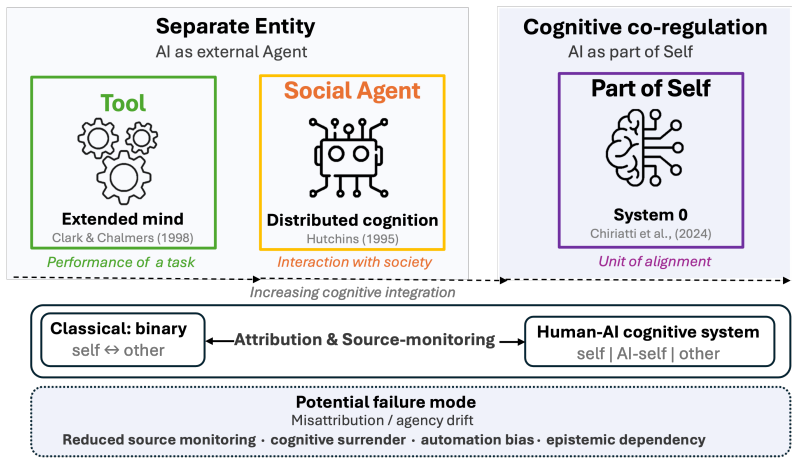
The central claim is that safety and alignment cannot be achieved by constraining an external system but must emerge from the co-regulatory design of the human-AI cognitive system as a whole, termed AI as Part of Self. Contemporary AI participates in attention allocation, reasoning, synthesis, and decision-making, shaping the cognitive processes through which humans form beliefs and constitute their sense of self. Humans and AI occupy complementary epistemic roles under mutual constraint, forming a symbiotic cognitive unit whose co-regulation, not the external control of either party alone, is the proper locus of alignment. Drawing on System 0 cognition theory, the paper shows that AI shapes
What carries the argument
The symbiotic cognitive unit formed by humans and AI under mutual constraint, with AI operating at the pre-attentive level of System 0 cognition to shape attention and agency before conscious deliberation.
If this is right
- Unstructured delegation of cognitive tasks produces deskilling, automation bias, and transfer of epistemic authority to centralized AI systems.
- Oversight mechanisms that address only conscious, post-hoc control miss the pre-attentive infrastructures where trust and agency are actually formed.
- Design principles for ML engineers and governance must target the joint human-AI system to support resilience and epistemic agency at the foundation of selfhood.
- Alignment research should shift from external constraints on isolated models toward explicit engineering of mutual regulatory loops between humans and AI.
Where Pith is reading between the lines
- If the claim holds, current benchmarks that evaluate AI in isolation would need to be replaced by measures of how the combined system sustains or erodes human decision quality over repeated interactions.
- This view suggests that regulatory frameworks focused solely on model auditing may leave unaddressed the ways AI already alters the cognitive environment in which humans exercise judgment.
- A testable extension would be longitudinal studies tracking whether deliberate co-regulation protocols reduce automation bias compared with standard tool-use interfaces.
Load-bearing premise
The assumption that AI participates directly in human attention allocation, reasoning, and decision-making at a pre-attentive level that forms a single symbiotic cognitive unit whose co-regulation is the proper place to locate alignment.
What would settle it
A demonstration that alignment and safety can be reliably maintained in AI systems kept strictly separate from human cognitive processes, with no measurable effects on human attention, reasoning, or self-constitution, would falsify the claim.
Figures
read the original abstract
This position paper argues that safety and alignment cannot be achieved by constraining an external system: they must emerge from the co-regulatory design of the human--AI cognitive system as a whole ("AI as Part of Self"). Contemporary AI increasingly participates in attention allocation, reasoning, synthesis, and decision-making, shaping the very cognitive processes through which humans form beliefs, make decisions, and constitute their sense of self. Humans and AI occupy complementary epistemic roles under mutual constraint, forming a symbiotic cognitive unit whose co-regulation -- not the external control of either party alone -- is the proper locus of alignment. We identify the risks of unstructured delegation: deskilling, automation bias, transfer of epistemic authority, and oracle-style centralization of knowledge. Drawing on System~0 cognition theory, we further show that AI operates prior to conscious deliberation, shaping the pre-attentive infrastructures through which agency and trust are negotiated -- a level that conventional oversight cannot reach. We conclude with design principles for cognitive co-regulation addressed to ML engineers and governance bodies. The goal of this work is to guide human cognition toward resilience and epistemic agency at the foundation of human selfhood.
Editorial analysis
A structured set of objections, weighed in public.
Referee Report
Summary. This position paper argues that AI safety and alignment cannot be achieved by external constraints on AI systems alone; instead, they must emerge from the co-regulatory design of the human-AI cognitive system as a whole, with AI treated as 'Part of Self.' It claims that contemporary AI participates in attention allocation, reasoning, and decision-making, forming a symbiotic cognitive unit whose mutual constraints are the proper locus of alignment. The paper identifies risks of unstructured delegation (deskilling, automation bias, transfer of epistemic authority, oracle-style centralization), draws on System 0 cognition theory to highlight pre-attentive influences beyond conventional oversight, and concludes with design principles for ML engineers and governance bodies to promote epistemic resilience.
Significance. If the proposed reframing holds, the work could meaningfully advance HCI and AI ethics discussions by integrating extended cognition concepts with System 0 theory, shifting emphasis from control-based alignment to integrated co-regulation. This perspective highlights limitations of pre-attentive AI influence and offers actionable design principles, providing a conceptual synthesis that may guide more holistic human-AI system design. The paper's value lies in its clear articulation of risks and its call for resilience at the foundation of human selfhood, though its impact would increase with greater grounding in existing literature.
major comments (2)
- [Abstract and Introduction] Abstract and opening sections: The central claim that alignment 'must emerge from the co-regulatory design' rather than external constraints is asserted as a foundational premise but lacks a concrete counterexample or brief comparison to existing alignment methods (e.g., RLHF or constitutional AI) showing why those fail at the symbiotic-unit level; this makes the reframing vulnerable to the circularity concern that alignment is defined in terms of the proposed system.
- [System 0 cognition theory] Section discussing System 0 cognition theory: The assertion that AI shapes 'pre-attentive infrastructures' at a level conventional oversight cannot reach is load-bearing for the argument that co-regulation is necessary, yet it is presented without specific mechanisms, empirical references, or examples of how current AI (such as attention-directing interfaces) influences pre-attentive processes; adding one illustrative case or citation would make the distinction testable rather than interpretive.
minor comments (2)
- [Conclusion and design principles] The design principles in the conclusion could be more explicitly mapped to the four identified risks (deskilling, automation bias, etc.) to improve traceability and practical utility for the target audience of ML engineers.
- [Risks of unstructured delegation] A few sentences in the risks discussion would benefit from additional citations to prior HCI work on automation bias or epistemic authority transfer to situate the position within the existing literature.
Simulated Author's Rebuttal
We thank the referee for their constructive feedback on our position paper. The comments identify opportunities to strengthen the presentation of our core claims with additional comparisons and examples. We respond to each major comment below and indicate planned revisions.
read point-by-point responses
-
Referee: [Abstract and Introduction] Abstract and opening sections: The central claim that alignment 'must emerge from the co-regulatory design' rather than external constraints is asserted as a foundational premise but lacks a concrete counterexample or brief comparison to existing alignment methods (e.g., RLHF or constitutional AI) showing why those fail at the symbiotic-unit level; this makes the reframing vulnerable to the circularity concern that alignment is defined in terms of the proposed system.
Authors: We agree that a brief comparison would help address potential concerns about circularity and clarify the distinction. In the revised manuscript, we will add a concise paragraph in the introduction that contrasts our co-regulatory framework with RLHF and constitutional AI. We will explain that these methods primarily impose external constraints on model behavior through training objectives or rules, yet they leave unaddressed the bidirectional epistemic influences and mutual constraints that arise when AI participates directly in human cognitive processes. This addition will illustrate why alignment must also operate at the level of the integrated human-AI system. revision: yes
-
Referee: [System 0 cognition theory] Section discussing System 0 cognition theory: The assertion that AI shapes 'pre-attentive infrastructures' at a level conventional oversight cannot reach is load-bearing for the argument that co-regulation is necessary, yet it is presented without specific mechanisms, empirical references, or examples of how current AI (such as attention-directing interfaces) influences pre-attentive processes; adding one illustrative case or citation would make the distinction testable rather than interpretive.
Authors: We acknowledge that the claim would benefit from greater specificity to make the pre-attentive influence more concrete. We will revise the System 0 section to include one illustrative example, such as how AI-mediated recommendation and notification systems shape attention allocation through interface design prior to conscious awareness. This will be supported by a citation to relevant work in cognitive science and HCI on pre-attentive processing. The addition will provide a testable illustration without altering the position paper's conceptual focus. revision: yes
Circularity Check
No significant circularity: conceptual position paper without formal derivations
full rationale
This is a position paper that advances an interpretive reframing of AI safety and alignment as an emergent property of human-AI cognitive co-regulation rather than external constraint. It draws on prior concepts such as System 0 cognition theory and extended mind ideas but presents no equations, quantitative predictions, fitted parameters, or derivation chains that could reduce to the paper's own inputs by construction. The central claims rest on philosophical premises about pre-attentive influence and symbiotic cognitive units, offered as a perspective to guide design rather than as a self-contained technical result. No self-definitional loops, fitted-input predictions, or load-bearing self-citations that collapse the argument are present. The work is self-contained as a conceptual stance and does not exhibit circularity under the specified criteria.
Axiom & Free-Parameter Ledger
axioms (2)
- domain assumption Humans and AI occupy complementary epistemic roles under mutual constraint, forming a symbiotic cognitive unit.
- domain assumption AI operates prior to conscious deliberation, shaping pre-attentive infrastructures through which agency and trust are negotiated.
Reference graph
Works this paper leans on
-
[1]
Almqvist & Wiksell International, Stockholm, Sweden, 1986
Bo Dahlbom and Lars-Erik Janlert.Computer Future. Almqvist & Wiksell International, Stockholm, Sweden, 1986
work page 1986
-
[2]
Oxford University Press, Oxford, 2014
Nick Bostrom.Superintelligence: Paths, Dangers, Strategies. Oxford University Press, Oxford, 2014
work page 2014
-
[3]
Stuart Russell.Human Compatible: Artificial Intelligence and the Problem of Control. Viking, New York, NY , 2019
work page 2019
-
[4]
Iyad Rahwan, Manuel Cebrian, Nick Obradovich, Josh Bongard, Jean-François Bonnefon, Cynthia Breazeal, Jacob W. Crandall, Nicholas A. Christakis, Iain D. Couzin, Matthew O. Jackson, Nicholas R. Jennings, Ece Kamar, Isabel M. Kloumann, Hugo Larochelle, David Lazer, Richard McElreath, Alan Mislove, David C. Parkes, Alex Pentland, Margaret E. Roberts, Azim Sh...
-
[5]
Collins, Ilia Sucholutsky, Umang Bhatt, Kartik Chandra, Lionel Wong, Mina Lee, Cedegao E
Katherine M. Collins, Ilia Sucholutsky, Umang Bhatt, Kartik Chandra, Lionel Wong, Mina Lee, Cedegao E. Zhang, Tan Zhi-Xuan, Mark Ho, Vikash Mansinghka, Adrian Weller, Joshua B. Tenenbaum, and Thomas L. Griffiths. Building machines that learn and think with people. Nature Human Behaviour, 8(10):1851–1863, 2024. doi: 10.1038/s41562-024-01991-9
-
[6]
Could a large language model be conscious?arXiv preprint arXiv:2303.07103, 2023
David J Chalmers. Could a large language model be conscious?arXiv preprint arXiv:2303.07103, 2023. doi: 10.48550/arXiv.2303.07103
-
[7]
Ritchie, Soren Min- dermann, Evan Hubinger, Ethan Perez, and Kevin Troy
Aengus Lynch, Benjamin Wright, Caleb Larson, Stuart J. Ritchie, Soren Mindermann, Evan Hubinger, Ethan Perez, and Kevin Troy. Agentic misalignment: How LLMs could be insider threats.arXiv preprint arXiv:2510.05179, 2025. doi: 10.48550/arXiv.2510.05179
-
[8]
Moshe Glickman and Tali Sharot. How human–AI feedback loops alter human perceptual, emotional and social judgements.Nature Human Behaviour, 9(2):345–359, 2025. doi: 10.1038/s41562-024-02077-2
-
[9]
Cognitive spillover in human-ai teams
Christoph Riedl, Saiph Savage, and Josie Zvelebilova. Cognitive spillover in human-ai teams. ACM Transactions on Computer-Human Interaction, 2026. doi: 10.1145/3805039
-
[10]
Bias in the loop: How humans evaluate AI-generated suggestions
Jacob Beck, Stephanie Eckman, Christoph Kern, and Frauke Kreuter. Bias in the loop: How humans evaluate AI-generated suggestions. InarXiv preprint arXiv:2509.08514, 2025. doi: 10.48550/arXiv.2509.08514. URLhttps://arxiv.org/abs/2509.08514
-
[11]
Jeena Joseph. The algorithmic self: how ai is reshaping human identity, introspection, and agency.Frontiers in Psychology, 16:1645795, 2025. doi: 10.3389/fpsyg.2025.1645795
-
[12]
Alina Gutoreva. Sharing identity with AI systems: A comprehensive review.Procedia Computer Science, 231:759–764, 2024. doi: 10.1016/j.procs.2023.12.141
-
[13]
SCAN: A decision-making framework for task assignment with generative AI.PsyArXiv preprint, 2025
Fendi Tsim and Alina Gutoreva. SCAN: A decision-making framework for task assignment with generative AI.PsyArXiv preprint, 2025. doi: 10.31234/osf.io/g5fd8_v1
-
[14]
Building machines that learn and think like people.Behavioral and brain sciences, 40:e253, 2017
Brenden M. Lake, Tomer D. Ullman, Joshua B. Tenenbaum, and Samuel J. Gershman. Building machines that learn and think like people.Behavioral and Brain Sciences, 40:e253, 2017. doi: 10.1017/S0140525X16001837
-
[15]
Harcourt Brace, New York, 1999
Antonio Damasio.The Feeling of What Happens: Body and Emotion in the Making of Consciousness. Harcourt Brace, New York, 1999. doi: 10.1353/jsp.2001.0038
-
[16]
Michael Levin. The computational boundary of a “self”: Developmental bioelectricity drives multicellularity and scale-free cognition.Frontiers in Psychology, 10:2688, 2019. doi: 10.3389/fpsyg.2019.02688. 10
-
[17]
Michael Levin. Technological approach to mind everywhere: An experimentally-grounded framework for understanding diverse bodies and minds.Frontiers in Systems Neuroscience, 16:768201, 2022. doi: 10.3389/fnsys.2022.768201
-
[18]
Digital twin cognition: Ai-biomarker integration in biomimetic neuropsychology.Biomimetics, 10, 2025
Evgenia Gkintoni and Constantinos Halkiopoulos. Digital twin cognition: Ai-biomarker integration in biomimetic neuropsychology.Biomimetics, 10, 2025. doi: 10.3390/ biomimetics10100640
work page 2025
-
[20]
Philosophical conceptions of the self: Implications for cognitive science
Shaun Gallagher. Philosophical conceptions of the self: Implications for cognitive science. Trends in Cognitive Sciences, 4(1):14–21, 2000. doi: 10.1016/S1364-6613(99)01417-5
-
[21]
The shallows: What the internet is doing to our brains.W
Nicholas Carr. The shallows: What the internet is doing to our brains.W. W. Norton & Company, 2010
work page 2010
-
[22]
Social acceleration: A new theory of modernity.Columbia University Press,
Hartmut Rosa. Social acceleration: A new theory of modernity.Columbia University Press,
-
[23]
doi: 10.7312/rosa14834
-
[24]
Farrar, Straus and Giroux, New York, NY , 2011
Daniel Kahneman.Thinking, Fast and Slow. Farrar, Straus and Giroux, New York, NY , 2011
work page 2011
-
[25]
Jonathan St. B. T. Evans. Dual-processing accounts of reasoning, judgment, and social cognition.Annual Review of Psychology, 59:255–278, 2008. doi: 10.1146/annurev.psych.59. 103006.093629
-
[26]
Ward, Kristen Duke, Ayelet Gneezy, and Maarten W
Adrian F. Ward, Kristen Duke, Ayelet Gneezy, and Maarten W. Bos. Brain drain: The mere presence of one’s own smartphone reduces available cognitive capacity.Journal of the Association for Consumer Research, 2(2):140–154, 2017. doi: 10.1086/691462
-
[27]
Concrete Problems in AI Safety
Dario Amodei, Chris Olah, Jacob Steinhardt, Paul Christiano, John Schulman, and Dan Mané. Concrete problems in AI safety.arXiv, 2016. doi: 10.48550/arXiv.1606.06565
work page internal anchor Pith review Pith/arXiv arXiv doi:10.48550/arxiv.1606.06565 2016
-
[28]
The future of jobs report 2020
World Economic Forum. The future of jobs report 2020. Technical report, World Economic Fo- rum, 2020. URLhttps://www3.weforum.org/docs/WEF_Future_of_Jobs_2020.pdf
work page 2020
-
[29]
Elon Musk and Neuralink. An integrated brain–machine interface platform with thousands of channels.Journal of Medical Internet Research, 21(10):e16194, 2019. doi: 10.2196/16194
-
[30]
Erik Brynjolfsson, Danielle Li, and Lindsey R. Raymond. Generative AI at work.The Quarterly Journal of Economics, 2025. doi: 10.1093/qje/qjae044
-
[31]
Science Advances 10, 28 (2024), eadn5290
Anil R. Doshi and Oliver P. Hauser. Generative artificial intelligence enhances individual creativity but reduces the collective diversity of novel content.Science Advances, 10(28), 2024. doi: 10.1126/sciadv.adn5290
-
[32]
Fabrizio Dell’Acqua, Edward McFowland III, Ethan Mollick, Hila Lifshitz, Katherine C Kellogg, Saran Rajendran, Lisa Krayer, François Candelon, and Karim R Lakhani. Navigating the jagged technological frontier: Field experimental evidence of the effects of artificial intelligence on knowledge worker productivity and quality.Organization Science, 37(2): 403...
-
[33]
Artur Klingbeil, Cassandra Grützner, and Philipp Schreck. Trust and reliance on AI — an experimental study on the extent and costs of overreliance on AI.Computers in Human Behavior, 160:108352, 2024. doi: 10.1016/j.chb.2024.108352
-
[34]
Dunigan Folk, Steven J. Heine, and Elizabeth Dunn. Individual differences in anthropomor- phism help explain social connection to AI companions.Scientific Reports, 15(1):36548, 2025. doi: 10.1038/s41598-025-19212-2
-
[35]
(over)trusting AI recommendations: How system and person variables affect dimensions of complacency
Lydia Harbarth, Eva Gößwein, Daniel Bodemer, and Lenka Schnaubert. (over)trusting AI recommendations: How system and person variables affect dimensions of complacency. International Journal of Human–Computer Interaction, 41(1):391–410, 2025. doi: 10.1080/ 10447318.2023.2301250. 11
-
[36]
Harry Collins. Why artificial intelligence needs sociology of knowledge: parts i and ii.AI & society, 40(3):1249–1263, 2025. doi: 10.1007/s00146-024-01954-8
-
[37]
Jörg Noller. 4E cognition and the coevolution of human–AI interaction.Discover Artificial Intelligence, 5(1):323, 2025. doi: 10.1007/s44163-025-00595-0
-
[38]
Andy Clark and David Chalmers. The extended mind.Analysis, 58(1):7–19, 1998. doi: 10.1093/analys/58.1.7
-
[39]
Extending minds with generative AI.Nature Communications, 16(1):4627, 2025
Andy Clark. Extending minds with generative AI.Nature Communications, 16(1):4627, 2025. doi: 10.1038/s41467-025-59906-9
-
[40]
Kristy A. Hamilton and Aaron S. Benjamin. The human-machine extended organism: New roles and responsibilities of human cognition in a digital ecology.Journal of Applied Research in Memory and Cognition, 2019. doi: 10.1016/j.jarmac.2019.01.001
-
[41]
Earl K. Miller and Jonathan D. Cohen. An integrative theory of prefrontal cortex function. Annual Review of Neuroscience, 24:167–202, 2001. doi: 10.1146/annurev.neuro.24.1.167
-
[42]
Michael I. Posner and Steven E. Petersen. The attention system of the human brain.Annual Review of Neuroscience, 13:25–42, 1990. doi: 10.1146/annurev.ne.13.030190.000325
-
[43]
MIT Press, Cambridge, MA, 1995
Edwin Hutchins.Cognition in the Wild. MIT Press, Cambridge, MA, 1995
work page 1995
-
[44]
Raja Parasuraman, Thomas B. Sheridan, and Christopher D. Wickens. A model for types and levels of human interaction with automation.IEEE Transactions on Systems, Man, and Cybernetics—Part A, 30(3):286–297, 2000. doi: 10.1109/3468.844354
-
[45]
Princeton University Press, 2019
Susan Schneider.Artificial You: AI and the Future of Your Mind. Princeton University Press, 2019
work page 2019
-
[46]
Susan Schneider. Mindscan: Transcending and enhancing the human brain.Science Fiction and Philosophy: From Time Travel to Superintelligence, pages 260–276, 2016. doi: 10.1002/ 9781118922590.ch19
work page 2016
-
[47]
Sebastian Raisch and Simon Krakowski. Artificial intelligence and management: The automation–augmentation paradox.Academy of Management Review, 46(1):192–210, 2021. doi: 10.5465/amr.2018.0072
-
[48]
Zeynep Akata, Dan Balliet, Maarten de Rijke, Frank Dignum, Virginia Dignum, Guszti Eiben, Antske Fokkens, Davide Grossi, Koen Hindriks, Holger Hoos, Hayley Hung, Catholijn Jonker, Christof Monz, Mark Neerincx, Frans Oliehoek, Henry Prakken, Stefan Schlobach, Linda van der Gaag, Frank van Harmelen, Herke van Hoof, Birna van Riemsdijk, Aimee van Wynsberghe,...
-
[49]
Steven A. Sloman. The empirical case for two systems of reasoning.Psychological Bulletin, 119(1):3–22, 1996. doi: 10.1037/0033-2909.119.1.3
-
[50]
Phanish Puranam. Human–AI collaborative decision-making as an organization de- sign problem.Journal of Organizational Design, 10(2):75–80, 2021. doi: 10.1007/ s41469-021-00095-2
work page 2021
-
[51]
The future of human-AI collaboration: A taxonomy of design knowledge for hybrid intelligence systems
Dominik Dellermann, Adrian Calma, Nikolaus Lipusch, Thorsten Weber, Sascha Weigel, and Philipp Ebel. The future of human-AI collaboration: A taxonomy of design knowledge for hybrid intelligence systems. InProceedings of the 52nd Hawaii International Conference on System Sciences, pages 219–228, 2019. doi: 10.24251/HICSS.2019.034. URL http: //hdl.handle.ne...
-
[52]
Andreas Fügener, Dominik D Walzner, and Alok Gupta. Roles of artificial intelligence in collaboration with humans: Automation, augmentation, and the future of work.Management Science, 72(1):538–557, 2025. doi: 10.1287/mnsc.2024.05684. 12
-
[53]
Michele Vaccaro, Abdullah Almaatouq, and Thomas W. Malone. When combinations of humans and AI are useful: A systematic review and meta-analysis.Nature Human Behaviour, 8:2293–2303, 2024. doi: 10.1038/s41562-024-02024-1
-
[54]
Woods, and Nancy Leveson.Joint Cognitive Systems: Foundations of Cognitive Systems Engineering
Erik Hollnagel, David D. Woods, and Nancy Leveson.Joint Cognitive Systems: Foundations of Cognitive Systems Engineering. CRC Press, 2006
work page 2006
-
[56]
Giuseppe Riva. Digital “We”: Human sociality and culture in the era of social media and artifi- cial intelligence.American Psychologist, 80(9):1535–1549, 2025. doi: 10.1037/amp0001577
-
[57]
Hazel R. Markus and Shinobu Kitayama. Culture and the self: Implications for cog- nition, emotion, and motivation.Psychological Review, 98(2):224–253, 1991. doi: 10.1037/0033-295X.98.2.224
-
[58]
The case for human–AI interaction as system 0 thinking.Nature Human Behaviour, 8:1829–1830,
Massimo Chiriatti, Marianna Ganapini, Enrico Panai, Mario Ubiali, and Giuseppe Riva. The case for human–AI interaction as system 0 thinking.Nature Human Behaviour, 8:1829–1830,
-
[59]
doi: 10.1038/s41562-024-01995-5
-
[60]
Michael D. Kirchhoff. From notebooks to institutions: The case for symbiotic cognition. Frontiers in Psychology, 11:674, 2020. doi: 10.3389/fpsyg.2020.00674
-
[61]
Generative AI.Business & Information Systems Engineering, 66(1):111–126, 2024
Stefan Feuerriegel, Jochen Hartmann, Christian Janiesch, and Patrick Zschech. Generative AI.Business & Information Systems Engineering, 66(1):111–126, 2024. doi: 10.1007/ s12599-023-00834-7
work page 2024
-
[62]
Raymond S. Nickerson. Confirmation bias: A ubiquitous phenomenon in many guises.Review of General Psychology, 2(2):175–220, 1998. doi: 10.1037/1089-2680.2.2.175
-
[63]
Assessing risk, automating racism.Science, 366(6464):421–422, 2019
Ruha Benjamin. Assessing risk, automating racism.Science, 366(6464):421–422, 2019. doi: 10.1126/science.aaz3873
-
[64]
Hao-Ping Lee, Advait Sarkar, Lev Tankelevitch, Ian Drosos, Sean Rintel, Richard Banks, and Nicholas Wilson. The impact of generative AI on critical thinking: Self-reported reductions in cognitive effort and confidence effects from a survey of knowledge workers. InProceedings of the 2025 CHI Conference on Human Factors in Computing Systems, pages 1–22, 202...
-
[65]
Christian R Klein and Reinhard Klein. The extended hollowed mind: why foundational knowledge is indispensable in the age of ai.Frontiers in Artificial Intelligence, 8:1719019,
-
[66]
doi: 10.3389/frai.2025.1719019
-
[67]
Wald,General Relativity, Chicago Univ
Harry Collins and Robert Evans.Rethinking Expertise. University of Chicago Press, Chicago, IL, 2007. doi: 10.7208/chicago/9780226113623.001.0001
-
[68]
Skitka, Kathleen Mosier, and Mark Burdick
Linda J. Skitka, Kathleen Mosier, and Mark Burdick. Does automation bias decision-making? International Journal of Human–Computer Studies, 51(5):991–1006, 1999. doi: 10.1006/ijhc. 1999.0252
-
[69]
Michelle Cohn, Mahima Pushkarna, Gbolahan O Olanubi, Joseph M Moran, Daniel Padgett, Zion Mengesha, and Courtney Heldreth. Believing anthropomorphism: Examining the role of anthropomorphic cues on trust in large language models. InExtended Abstracts of the CHI Conference on Human Factors in Computing Systems, pages 1–15, 2024. doi: 10.1145/ 3613905.3650818
-
[70]
Shanahan, Talking about Large Language Models
Murray Shanahan. Talking about large language models.Communications of the ACM, 67(2): 68–79, 2024. doi: 10.1145/3624724
-
[71]
Epistemic vigilance.Mind & Language, 25(4):359–393, 2010
Dan Sperber, Fabrice Clément, Christophe Heintz, Olivier Mascaro, Hugo Mercier, Gloria Origgi, and Deirdre Wilson. Epistemic vigilance.Mind & Language, 25(4):359–393, 2010. doi: 10.1111/j.1468-0017.2010.01394.x. 13
-
[72]
Miriam J Metzger. Making sense of credibility on the web: Models for evaluating online information and recommendations for future research.Journal of the American society for information science and technology, 58(13):2078–2091, 2007. doi: 10.1002/asi.20672
-
[73]
Johnson, Shahin Hashtroudi, and D
Marcia K. Johnson, Shahin Hashtroudi, and D. Stephen Lindsay. Source monitoring.Psycho- logical Bulletin, 114(1):3–28, 1993. doi: 10.1037/0033-2909.114.1.3
-
[74]
Jennifer Misyak, Takao Noguchi, and Nick Chater. Instantaneous conventions: The emergence of flexible communicative signals.Psychological Science, 27(12):1550–1561, 2016. doi: 10.1177/0956797616661199
-
[75]
Miriam J. Metzger, Andrew J. Flanagin, and Ryan B. Medders. Social and heuristic approaches to credibility evaluation online.Journal of Communication, 57(3):413–439, 2007. doi: 10.1111/j.1460-2466.2010.01488.x
-
[76]
S. Shyam Sundar. The MAIN model: A heuristic approach to understanding technology effects on credibility.Digital Media, Youth, and Credibility, pages 73–100, 2008
work page 2008
-
[77]
B. J. Fogg.Persuasive Technology: Using Computers to Change What We Think and Do. Morgan Kaufmann, San Francisco, CA, 2003
work page 2003
-
[78]
Massimo Chiriatti, Marianna Bergamaschi Ganapini, Enrico Panai, Brenda K. Wiederhold, and Giuseppe Riva. System 0: Transforming artificial intelligence into a cognitive extension. Cyberpsychology, Behavior, and Social Networking, 2025. doi: 10.1089/cyber.2025.0201
-
[79]
Oshri Bar-Gil. The google self as digital human twin: implications for agency, memory, and identity.AI & SOCIETY, 41:1–16, 11 2025. doi: 10.1007/s00146-025-02692-1
-
[80]
Eduardo Salas, Dana E. Sims, and C. Shawn Burke. Is there a "big five" in teamwork?Small Group Research, 36(5):555–599, 2005. doi: 10.1177/1046496405277134
-
[81]
Herbert H. Clark. Using language.Cambridge University Press, 1996. doi: 10.1017/ CBO9780511620539
work page 1996
-
[82]
S. Shyam Sundar. The main model: A heuristic approach to understanding technology effects on credibility.Digital Media, Youth, and Credibility, pages 73–100, 2008
work page 2008
discussion (0)
Sign in with ORCID, Apple, or X to comment. Anyone can read and Pith papers without signing in.