Hydration-controlled twist forms a moir\'e glass in charge-frustrated layered silicates
Pith reviewed 2026-06-26 23:15 UTC · model grok-4.3
The pith
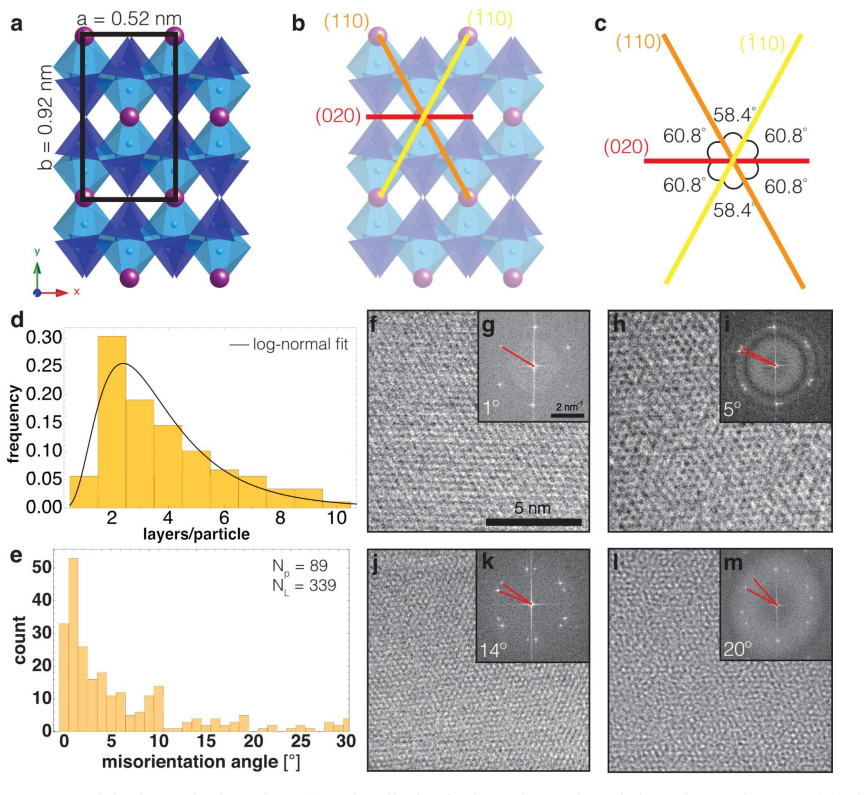
Montmorillonite clay naturally forms moiré superlattices with twist angles biased to 1-2°, 4°, and 10° by hydration states.
A machine-rendered reading of the paper's core claim, the machinery that carries it, and where it could break.
Core claim
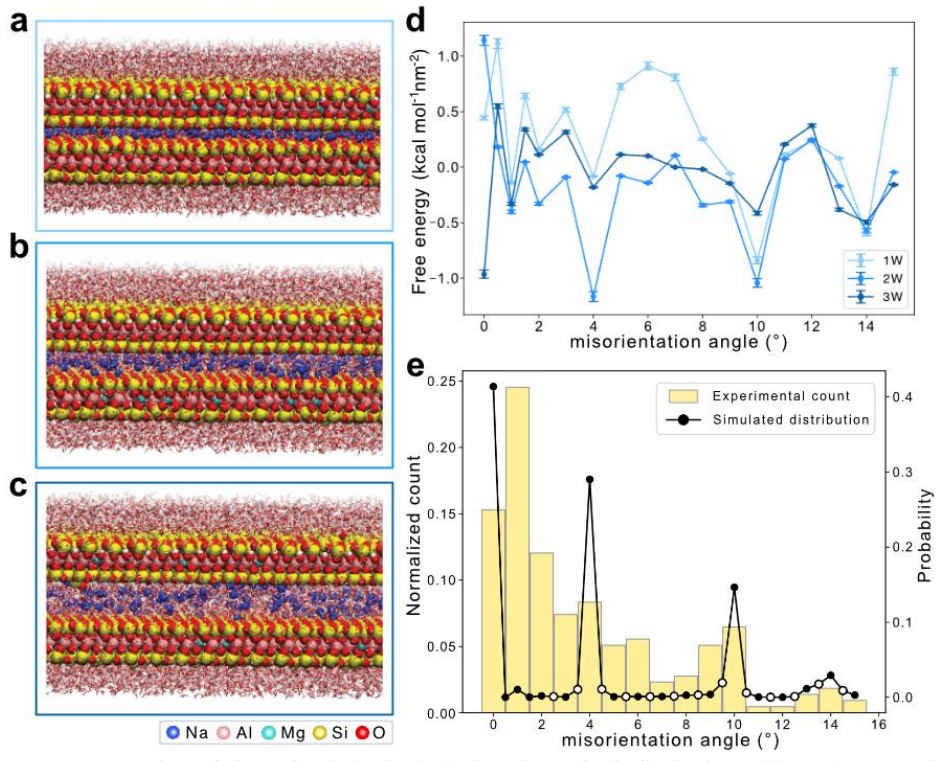
Multilayer stacks preferentially adopt twists near 1-2°, 4°, and 10°, producing long-wavelength moirés without long-range rotational order. This kinetically trapped state is defined as a moiré glass distinct from featureless turbostratic stacking. Simulations indicate that lattice-charge disorder stabilizes the angular preferences, whereas charge ordering promotes random stacking. Hydration screens interlayer interactions and lubricates twist, while dehydration arrests the resulting configurations in discrete steps.
What carries the argument
hydration-controlled twist, which biases misorientations toward discrete angles through charge-disorder stabilization during hydration-dehydration cycles
If this is right
- Hydration levels can be adjusted to select among discrete twist angles in layered silicates.
- Charge disorder in the lattice promotes specific angular preferences over random stacking.
- Dehydration can arrest twisted configurations at the favored angles.
- Natural stacking in abundant clays can generate long-wavelength moiré patterns.
Where Pith is reading between the lines
- The same hydration mechanism could apply to other swelling clays with comparable charge distributions.
- Bulk layered materials might be programmed for specific moiré wavelengths by humidity control rather than individual layer alignment.
- Kinetic trapping of twist angles may appear in other systems where interlayer forces are modulated by solvent or temperature.
Load-bearing premise
That lattice-charge disorder rather than defects or preparation history is what stabilizes the observed angular preferences in the simulations.
What would settle it
Finding random angular distributions instead of the reported 1-2, 4, and 10 degree preferences in montmorillonite samples prepared with minimized charge disorder or in simulations using charge-ordered models.
Figures
read the original abstract
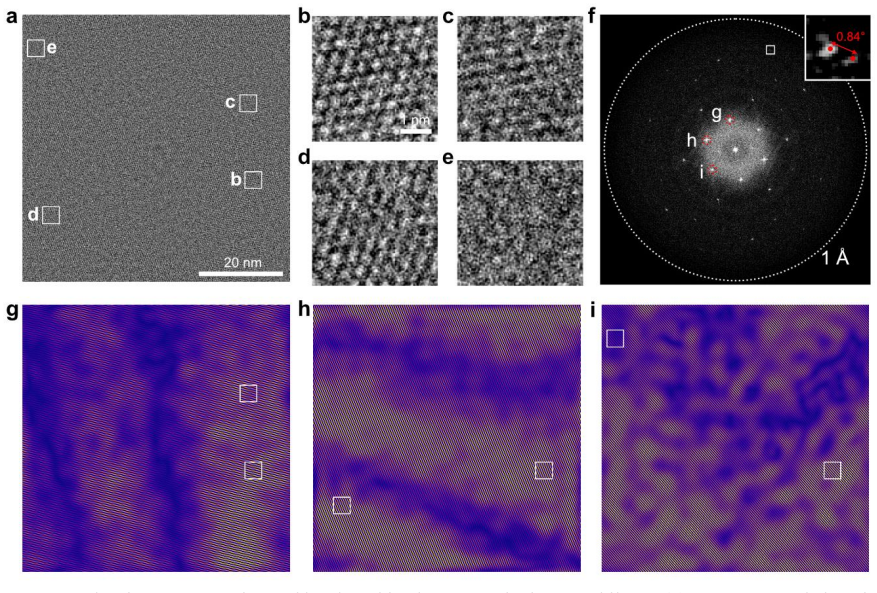
Twisting layered materials produces moir\'e superlattices, but prescribed twist angles are usually obtained by demanding assembly procedures. Here we show that montmorillonite, an abundant swelling clay, forms tunable moir\'e superlattices naturally. Focal-series high-resolution transmission electron microscopy, geometric phase analysis, and molecular dynamics simulation reveal that its apparent rotational disorder is biased toward low-angle misorientations inherited from discrete hydration states. Multilayer stacks preferentially adopt twists near 1-2{\deg}, 4{\deg}, and 10{\deg}, producing long-wavelength moir\'es without long-range rotational order. We define this kinetically trapped state as a moir\'e glass, distinct from featureless turbostratic stacking. Simulations indicate that lattice-charge disorder stabilizes the angular preferences, whereas charge ordering promotes random stacking. Hydration screens interlayer interactions and lubricates twist, while dehydration arrests the resulting configurations in discrete steps. These results establish dynamic hydration as a macroscopic handle for programming twist in layered matter.
Editorial analysis
A structured set of objections, weighed in public.
Referee Report
Summary. The paper claims that montmorillonite, a swelling clay, naturally forms tunable moiré superlattices through hydration-controlled twisting of layers. Focal-series HRTEM, geometric phase analysis, and molecular dynamics simulations show preferential twists near 1-2°, 4°, and 10° that produce long-wavelength moirés without long-range rotational order; this kinetically trapped state is defined as a 'moiré glass' distinct from turbostratic stacking. Simulations attribute the angular bias to lattice-charge disorder, with hydration screening interactions and dehydration arresting configurations.
Significance. If the central claims hold, the result is significant because it demonstrates a natural, hydration-tunable route to moiré formation in an abundant layered silicate without specialized assembly, and introduces the moiré glass concept as a distinct disordered state stabilized by charge frustration. The combination of direct imaging, GPA, and MD to link discrete hydration states to twist preferences offers a macroscopic control handle with potential implications for disordered layered materials.
major comments (2)
- [MD simulations] MD simulations section: the attribution of twist-angle preferences (~1-2°, 4°, 10°) to lattice-charge disorder rests on the specific charge assignment in the simulations, yet no independent validation (e.g., against DFT-derived charges or measured Al/Mg substitution patterns) is provided. If the interlayer Coulomb terms are misplaced or overweighted, the simulated stabilization of discrete angles versus random stacking would be an artifact, undermining the proposed mechanism.
- [HRTEM and GPA results] HRTEM/GPA results: the central claim of biased angular preferences (and thus the moiré glass) requires that the measured distributions are free of post-selection or preparation bias. The manuscript provides no raw data, error analysis, sample-preparation protocol details, or statistical tests on angle histograms, making it impossible to verify that the reported peaks reflect intrinsic behavior rather than experimental artifacts.
Simulated Author's Rebuttal
We thank the referee for their constructive comments on our manuscript. We address each major point below and will revise the manuscript accordingly to strengthen the presentation of the results.
read point-by-point responses
-
Referee: [MD simulations] MD simulations section: the attribution of twist-angle preferences (~1-2°, 4°, 10°) to lattice-charge disorder rests on the specific charge assignment in the simulations, yet no independent validation (e.g., against DFT-derived charges or measured Al/Mg substitution patterns) is provided. If the interlayer Coulomb terms are misplaced or overweighted, the simulated stabilization of discrete angles versus random stacking would be an artifact, undermining the proposed mechanism.
Authors: The partial charges in our MD simulations follow the ClayFF force field, which has been validated against experimental hydration and swelling data for montmorillonite. To address the concern directly, we will add a supplementary section that compares the employed charges to DFT-derived values reported in the literature for analogous Al/Mg substitutions in smectites. This will confirm that the observed stabilization of discrete twist angles arises from the charge disorder rather than an artifact of the Coulomb parameterization. revision: yes
-
Referee: [HRTEM and GPA results] HRTEM/GPA results: the central claim of biased angular preferences (and thus the moiré glass) requires that the measured distributions are free of post-selection or preparation bias. The manuscript provides no raw data, error analysis, sample-preparation protocol details, or statistical tests on angle histograms, making it impossible to verify that the reported peaks reflect intrinsic behavior rather than experimental artifacts.
Authors: We agree that additional methodological detail is required to substantiate the angular distributions. In the revised manuscript we will expand the experimental section with the full sample-preparation protocol, the total number of independent measurements (>200 angles from multiple specimens), error analysis on the histograms, and statistical tests (including comparison to a uniform distribution). Raw angle data will be deposited as supplementary material. These additions will demonstrate that the reported peaks are reproducible across preparations and not the result of post-selection bias. revision: yes
Circularity Check
No significant circularity; claims rest on independent imaging and simulation outputs
full rationale
The paper reports direct experimental observations of twist angles via HRTEM and GPA, then uses MD simulations to attribute preferences to charge disorder. No equations, fitted parameters, or self-citations are presented as load-bearing derivations that reduce to the target result by construction. The moiré glass definition is introduced as a descriptive label for the observed kinetically trapped state, not as a self-referential prediction. External benchmarks (imaging data, simulation outputs) remain independent of the final claim.
Axiom & Free-Parameter Ledger
invented entities (1)
-
moiré glass
no independent evidence
Reference graph
Works this paper leans on
-
[1]
N., Jayashree, R
Ramesh, T. N., Jayashree, R. S. & Kamath, P. V. Disorder in Layered Hydroxides: DIFFaX Simulation of the X-ray Powder Diffraction Patterns of Nickel Hydroxide. Clays Clay Miner. 51, 570–576 (2003). 23. K. Singh, M. et al. Atomic-scale observation of rotational misorientation in suspended few-layer graphene sheets. Nanoscale 2, 700–708 (2010). 24. Halberta...
2003
-
[2]
Gournis, D., Lappas, A., Karakassides, M. A., Többens, D. & Moukarika, A. A neutron diffraction study of alkali cation migration in montmorillonites. Phys. Chem. Miner. 35, 49–58 (2008). 44. Izadi, S. & Onufriev, A. V. Accuracy limit of rigid 3-point water models. J. Chem. Phys. 145, (2016). 45. Zarzycki, P. & Gilbert, B. Temperature-dependence of the die...
discussion (0)
Sign in with ORCID, Apple, or X to comment. Anyone can read and Pith papers without signing in.